
Teachers earn $67K on average. Is push for raises too late?
As schools across the country struggle to find teachers to hire, more governors are pushing for pay increases, bonuses, and other perks for the beleaguered profession — with some vowing to beat out other states competing for educators. Already in 2023, governors in Georgia and Arkansas have pushed through teacher pay increases. Ahead of Monday’s start of national Teacher Appreciation Week, others — both Republican and Democratic — have proposed doing the same to attract and retain educators. More than half of the states’ governors over the past year — 26 so far — have proposed boosting teacher compensation, according to groups that track it. The nonprofit Teacher Salary Project said it is the most it has seen in nearly two decades of tracking. “Today we have governors left and right from every political party and then some who are addressing this issue because they have to,” said founder and CEO Ninivé Caligari. “We’ve never seen what we are seeing right now. Never.” In Idaho, Gov. Brad Little is aiming to raise the state’s average starting salary into the nation’s top 10. In Delaware, Gov. John Carney said competition for teachers is more intense than ever, and a pay increase is necessary to “win the competition with surrounding states.” It’s not clear how far pay raises will go toward relieving the shortages, though, and some teachers say it is too little, too late to fix problems that are years in the making. Blame for teacher shortages has fallen on underfunding after the Great Recession, tight labor markets, lackluster enrollments in colleges and programs that train teachers, and teacher burnout inflamed by the travails of the COVID-19 pandemic. There has been no mass exodus, but data from some states that track teacher turnover has shown rising numbers of teachers leaving the profession over the past couple of years. Shortages are most extreme in certain areas, including the poorest or most rural districts, researchers say. Districts also report particular difficulties in hiring for in-demand subjects like special education, math, and science. Meanwhile, teacher salaries have fallen further and further behind those of their college-educated peers in other fields, as teachers report growing workloads, shrinking autonomy, and increasingly hostile school environments. Magan Daniel, who at 33 just left her central Alabama school district, was not persuaded to stay by pay raises as Alabama’s governor vows to make teacher salaries the highest in the Southeast. It would take big increases to match neighboring Georgia, where the average teacher salary is $62,200, according to the National Education Association. Fixing teachers’ deteriorating work culture and growing workloads would be a more powerful incentive than a pay raise, she said. She recalled, for instance, her principal asking her to make copies and lesson plans last fall while she was on unpaid maternity leave. Difficulty getting substitutes puts pressure on teachers who need time off for emergencies, she said, and spending nights and weekends on paperwork siphoned the joy out of teaching. “I would not go back just for a higher salary,” Daniel said. In Oklahoma, Joshua Morgan, 46, left his rural district a year ago because after 18 years he was still earning under $47,000. Oklahoma’s governor is talking about awarding performance bonuses, but Morgan said he would only go back to teaching for substantially more money — like $65,000 a year. The national average public school teacher salary in 2021-22 increased 2% from the previous year to $66,745, according to the NEA, the nation’s largest teachers union. Inflation peaked around 9% at the time. For new recruits, the math of paying for a college education is grim: The national average beginning teacher salary was $42,845 in 2021-22, according to the NEA. Teachers do often qualify for public service loan forgiveness, which forgives their student debt after they’ve made 10 years of monthly payments. Besides fewer teachers getting certified, the “teacher pay penalty” — the gap between teacher salaries and their college-educated peers in other professions — is growing. It reached a record 23.5% in 2021, with teachers earning an average 76.5 cents for every dollar earned by other college-educated professionals, according to the Economic Policy Institute, a nonpartisan think tank. It has been widening for decades, researchers say. For men, it is 35%, and for women, it is 17% — reflecting the gender pay gap seen across the U.S. economy. For Rachaele Otto and other Louisiana teachers, the prospect of a $3,000 salary increase proposed by the governor might be appreciated. But at roughly $200 a month after taxes, it’s not enough to keep a teacher who feels burned out or demoralized, Otto said. “I know there are teachers willing to take pay cuts to leave the profession,” said Otto, 38, a science teacher in a rural Louisiana district. “If you double the salary, maybe that would change their thinking.” Sylvia Allegretto, a senior economist who studies teacher compensation for the Center for Economic and Policy Research, called salary promises by governors one-time “Band-Aids” that barely keep up with inflation. “You’re kind of chipping away at the margins,” Allegretto said. “You’re not fixing the problem, generally.” For governors, raising teacher pay may be good politics, but raising it across the board may have little long-term impact. Getting better data on where the shortages are and then targeting raises — or bigger raises — to those areas will help more, researchers say. Research shows a pay raise will have at least some effect on retaining teachers, said Ed Fuller, a Penn State associate professor who studies teacher quality and turnover. What is difficult to research, Fuller said, is the effect a raise has on a college student’s decision to enter a teacher preparation program — and take on debt. Some districts haven’t waited for governors and legislatures to act. Kentucky’s biggest school district, Jefferson County in Louisville, gave a 4% raise last year, and the board approved another raise of 5% to start this coming July. It also started giving an annual $8,000 stipend to teachers who work with higher-need students. Superintendent Marty Pollio wants the district to
Amazon faces biggest union push in its history
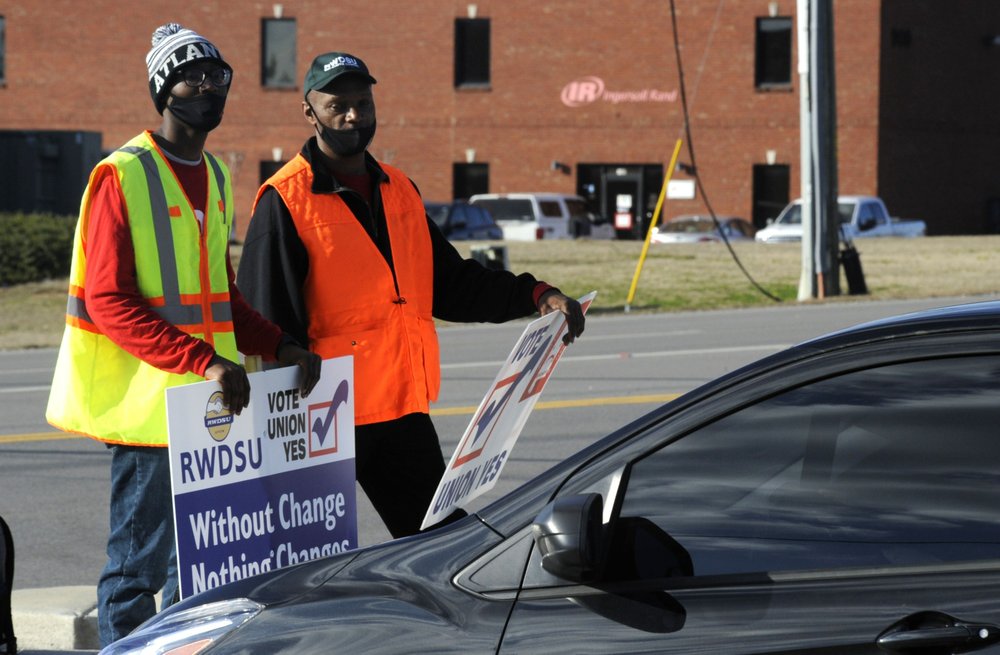
The second Jennifer Bates walks away from her post at the Amazon warehouse where she works, the clock starts ticking. She has precisely 30 minutes to get to the cafeteria and back for her lunch break. That means traversing a warehouse the size of 14 football fields, which eats up precious time. She avoids bringing food from home because warming it up in the microwave would cost her even more minutes. Instead, she opts for $4 cold sandwiches from the vending machine and hurries back to her post. If she makes it, she’s lucky. If she doesn’t, Amazon could cut her pay, or worse, fire her. It’s that kind of pressure that has led some Amazon workers to organize the biggest unionization push at the company since it was founded in 1995. And it’s happening in the unlikeliest of places: Bessemer, Alabama, a state with laws that don’t favor unions. The stakes are high. If organizers succeed in Bessemer, it could set off a chain reaction across Amazon’s operations nationwide, with thousands more workers rising up and demanding better working conditions. But they face an uphill battle against the second-largest employer in the country with a history of crushing unionizing efforts at its warehouses and its Whole Foods grocery stores. Attempts by Amazon to delay the vote in Bessemer have failed. So too have the company’s efforts to require in-person voting, which organizers argue would be unsafe during the pandemic. Mail-in voting started this week and will go on until the end of March. A majority of the 6,000 employees have to vote “yes” in order to unionize. Amazon, whose profits and revenues have skyrocketed during the pandemic, has campaigned hard to convince workers that a union will only suck money from their paycheck with little benefit. Spokeswoman Rachael Lighty says the company already offers them what unions want: benefits, career growth, and pay that starts at $15 an hour. She adds that the organizers don’t represent the majority of Amazon employees’ views. Bates makes $15.30 an hour unpacking boxes of deodorant, clothing, and countless other items that are eventually shipped to Amazon shoppers. The job, which the 48-year-old started in May, has her on her feet for most of her 10-hour shifts. Besides lunch, Bates says trips to the bathroom are also closely monitored, as is getting a drink of water or fetching a fresh pair of work gloves. Amazon denies that, saying it offers two 30-minute breaks during each shift and extra time to use the bathroom or get water. Fed up, Bates and a group of workers reached out to the Retail, Wholesale, and Department Store Union last summer. She hopes the union, which also represents poultry plant workers in Alabama, will mandate more breaks, prevent Amazon from firing workers for mundane reasons, and push for higher pay. “They will be a voice when we don’t have one,” Bates says. But according to Sylvia Allegretto, an economist and co-chair of the Center on Wage and Employment Dynamics at the University of California, Berkeley, “history tells us not to be optimistic.” The last time Amazon workers voted on whether they wanted to unionize was in 2014, and it was a much smaller group: 30 employees at a Amazon warehouse in Delaware who ultimately turned it down. Amazon currently employs nearly 1.3 million people worldwide. Also working against the unionizing effort is that it’s happening in Republican-controlled Alabama, which generally isn’t friendly to organized labor. Alabama is one of 27 “right-to-work states” where workers don’t have to pay dues to unions that represent them. In fact, the state is home to the only Mercedes-Benz plant in the world that isn’t unionized. That the union push at the Bessemer warehouse has even gotten this far is likely due to who the organizers are, says Michael Innis-Jiménez, an associate professor at the University of Alabama. Companies typically villainize union organizers as out-of-staters who don’t know what workers want. But the retail union has an office in nearby Birmingham and many of the organizers are Black, like the workers in the Bessemer warehouse. “I think that really helps a lot,” Innis-Jiménez said. “They’re not seen as outsiders.” More than 70% of the population of Bessemer is Black. The retail union estimates that as many as 85% of the workers are Black, much higher than the 22% for overall warehouse workers nationwide, according to an Associated Press analysis of census data. Stuart Appelbaum, the president of the Retail, Wholesale and Department Store Union, says the union’s success in Bessemer is partly due to the pandemic, with workers feeling betrayed by employers that didn’t do enough to protect them from the virus. And the Black Lives Matter movement, which has inspired people to demand to be treated with respect and dignity. Appelbaum says the union has heard from Amazon warehouse workers all over the country. “They want a voice in their workplace, too,” he says. Representatives of the Retail, Wholesale and Department Store Union spend most days outside the entrance of the Bessemer warehouse holding signs and wearing neon vests, although a lot of the unionization effort is being conducted online or by phone because of the pandemic. At the end of a recent workday, some Amazon employees leaving the plant rolled down their car windows and chatted with organizers; others hurried past without acknowledgement. Some workers from poultry plants have helped. Among them is Michael Foster, a union representative who works at a north Alabama poultry plant but has been in town for more than a month helping with the organizing push. He says an Amazon employee tried to shoo them away, saying they better make sure they’re not on Amazon property. “I let them know that this is not my first rodeo,” says Foster, who has helped get two other poultry plants to unionize. Inside the warehouse, Bates says Amazon has been holding daily classes on why workers should vote against the union. Lighty, the Amazon spokeswoman, says
