
Alabama exports surging in unexpected corners of the world
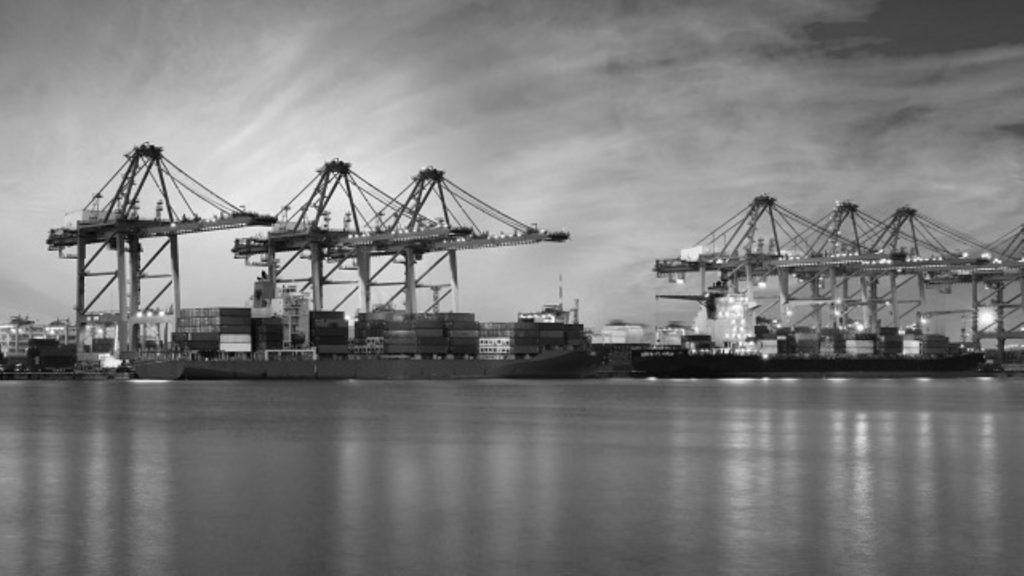
It’s clear that 2016 was a stellar year for Alabama exports, with rising shipments in a number of markets worldwide, signaling even more optimism for the future. The top five destinations for state goods and services – Canada, China, Germany, Mexico and the United Kingdom – remained relatively unchanged from 2015 and most showed year-over-year growth. Overall, Alabama-made goods were shipped to 189 countries. A number of them, while not among the top five, showed significant growth in 2016, including Kuwait, Russia, Taiwan and the United Arab Emirates. The Alabama Department of Commerce is always studying trade trends among state businesses and manufacturers, using the information to plan seminars and trips aimed at helping companies boost their export business, said Hilda Lockhart, director of Commerce’s Office of International Trade. Economic engine With Alabama’s 2016 exports reaching a record $20.55 billion, increasing 6.4 percent from the previous year, officials are looking to build on that momentum, Lockhart said. “We know rising exports for Alabama companies in overseas markets means greater potential for new jobs and investment back home,” Lockhart said. “International trade is truly a local economic engine, and Alabama workers and communities benefit from the growth.” U.S. Commerce Department figures show the state’s exports have risen 15 percent since 2011 and 48 percent since 2006. Vehicles are the state’s top export, by a large margin. Other key categories include chemicals, primary metals, paper products and non-electrical machinery, a category that includes combustion engines, agricultural machinery, metalworking machine tools and much more. Lockhart offered a closer look at some of the fastest-growing markets for Alabama exports, and what’s driving them: KUWAIT: Alabama’s exports to the Persian Gulf country increased to $104.9 million in 2016, a 285 percent spike from the previous year. The largest increases were in fabricated metal products, chemicals and paper. “This year Alabama was Kuwait’s No. 1 trading partner in the nation for fabricated metal products, perhaps due to the country’s recent expenditures on various hydrocarbon and petrochemical refineries, such as the $10 billion Olefins 3 plant,” Lockhart said. Currently in the pre-execution phase, the Olefins 3 plant will produce 1.4 million tons of ethylene a year when it is completed. The petrochemical is commonly used in the manufacturing process. RUSSIA: Shipments of state exports to Russia rebounded in 2016 to $102.1 million, after a poor showing the previous year, with major increases in the export of non-electrical machinery, chemicals and paper. Alabama was Russia’s No. 5 trading partner among U.S. states for non-electrical machinery products.Russia’s demand for machinery is “driven by the government’s strategy to modernize Russian industry across several sectors, including power generation, transportation, defense, automotive and aerospace,” according to the U.S. Foreign Commercial Service. Lockhart said the drop in exports in 2015 likely occurred because of the contraction in the price of oil that year, which caused a recession in Russia and other oil-producing countries. TAIWAN: Exports from Alabama to Taiwan nearly doubled in 2016, increasing to approximately $200 million. The largest gains were in chemicals, computer and electronic products, and paper. “Chemical exports alone accounted for more than half of the 2016 total, showing a two-year increase from $19.6 million in 2014 to $102.7 million in 2016,” Lockhart said. The state was Taiwan’s No. 6 trading partner in the nation for chemicals, predominantly in the category of basic chemicals, which include industrial gases used in the semiconductor production process. Lockhart said the semiconductor industry, including manufacturing, design and packaging, is a cornerstone of the Taiwanese IT economy, so it is likely that the increased exports are feeding into this sector. UAE: Alabama firms shipped $467.8 million in exports to the United Arab Emirates in 2016, an increase of more than 100 percent compared to exports just two years earlier. Much of the growth took place in the categories of transportation equipment, non-electrical machinery and chemicals. The state was the UAE’s No. 5 trading partner in the U.S. for transportation equipment, with this category alone accounting for $396.2 million of the export total for the year. “Aerospace products make up the bulk of these transportation equipment exports as the UAE develops its burgeoning satellite and Mars mission programs, expands its military and increases investment in the commercial airline industry,” Lockhart said. Meanwhile, other up and coming markets have shown significant growth over the past five years, and they could be potential targets of new, increased efforts to fuel trade, Lockhart said. The countries include Vietnam, Oman, the Bahamas, Denmark, Finland, Kenya, Liberia, Hungary and Bosnia-Herzegovina. This story originally appeared on the Alabama Department of Commerce’s Made in Alabama website. Republished with permission of Alabama NewsCenter.
World jittery about Donald Trump’s ‘America first’ inaugural speech

President Donald Trump‘s inaugural speech promised “America first” policy led by a forceful executive, in contrast to the coalition building and international conferences which have featured strongly in past administrations. The billionaire businessman and reality television star — the first president who had never held political office or high military rank — promised to stir a “new national pride” and protect America from the “ravages” of countries he says have stolen U.S. jobs. “This American carnage stops right here,” Trump declared. In a warning to the world, he said, “From this day forward, a new vision will govern our land. From this moment on, it’s going to be America first.” A look at some reactions from around the world: ___ AFGHANS DISAPPOINTED BUT HOPEFUL Like many in the Afghan capital of Kabul, restaurant owner Mohammad Nahim watched the presidential inauguration ceremonies but was disappointed to not hear any mention of Afghanistan. “Trump did not mention a word about Afghanistan in his speech and the salaries of the Afghan army and police are paid by the U.S.,” he said. He added that if the U.S. stops helping Afghanistan, “our country will again become a sanctuary to terrorists. I hope Trump will not forget Afghanistan.” Mohammed Kasim Zazi, a shopkeeper whose home is in eastern Afghanistan’s Khost province, where the feared Haqqani network is prominent, said he expected Trump to stay focused on Afghanistan. “Trump said he will finish the terrorists in the world and that has to mean that Afghanistan will remain in the sights of the U.S.” said Zazi. Chief Executive Abdullah Abdullah said he was encouraged by Trump’s speech to soldiers in Bagram. “There he announced his support to the troops and the continuation of support for their troops here and strengthening their troops, which is a good and elegant step and I am sure that our cooperation in other areas will continue as well.” ___ SPEECH RESONATES IN MEXICO Perhaps no country was watching the speech more closely than Mexico. Trump has made disparaging remarks about immigrants who come to the United States illegally and sought to pressure companies not to set up shop in Mexico by threatening a border tariff on goods manufactured there and exported to the United States. So Trump’s talk of “protect(ing) our borders,” ”America first” and “buy American and hire American” had particular resonance in America’s southern neighbor. Ricardo Anaya Cortes, president of the conservative opposition National Action Party, called for “the unity of all Mexicans, unity in the face of this protectionist, demagogic and protectionist speech we just heard. Unity against that useless wall, against deportations, against the blockade of investment.” “The challenge is enormous. … We demand the federal government leave aside tepidity, that it tackle with absolute firmness and dignity the new relationship with the United States,” Anaya said. The United States is by far Mexico’s largest commercial partner, buying some 80 percent of its $532 billion in exports in 2015. Mexico is the second-largest market for U.S. exports. “At least the word ‘Mexico’ was not heard in the speech. Nevertheless one can expect the United States to launch a hyper-protectionist project,” said Ilan Semo Groman, a researcher at Iberoamericana University. If Trump truly moves to block or drive away U.S. investment in Mexico, Semo said Mexico should focus its commercial efforts on other countries. “There are very clear possibilities,” Semo said. Mexican President Enrique Pena Nieto sent three tweets after Trump’s inaugural speech Friday: — “I congratulate @realDonaldTrump on his inauguration. We will work to strengthen our relationship with shared responsibility.” — “We will establish a respectful dialogue with the government of President @realDonaldTrump, to Mexico’s benefit.” — “Sovereignty, national interest and the protection of Mexicans will guide the relationship with the new government of the United States.” ___ PAKISTAN WORRIES ABOUT MUSLIM COMMENTS A group of retired government officials gathered after morning prayers for a walk in a sprawling park in the heart of the federal capital of Islamabad and the topic of their conversation was President Trump’s inaugural speech. They expressed concern that Trump would target the Islamic world, particularly Pakistan, because of his campaign rhetoric about Muslims as well as his inaugural speech in which he promised to eradicate Islamic terrorism worldwide. Pakistan has often been accused of harboring militant insurgents and declared terrorist groups that have targeted neighboring India, against whom Pakistan has fought three wars, as well as Afghanistan. Pakistan denies the charges. “Likely there is more trouble in store for the Islamic world and our country will take the most brunt of the harsh treatment from President Trump administration,” said Mohammad Afzal. His sentiments were echoed by Shafiq Khan, who said “the one main thing that the new president mentioned about the world outside America is to tackle Islamic radicalism and that should be the matter of concern for all of us.” Amanaullah, a school teacher in Islamabad, feared Trump’s reference to eliminating radical Islamic terrorism. “I think under this name he wants to malign and eliminate Islam,” he said. Umair Khan, an engineer, said of Trump: “Let him taste the burden of government and get settled, I am sure he will calm.” ___ CONCERN IN TOKYO Some Tokyo residents are worried that Trump’s “America first” policy will usher in an era of populism and protectionism at the expense of the rest of the world. Tadashi Gomibuchi, who works in the manufacturing industry, recorded Trump’s inauguration speech overnight as he was keen to hear what the new president had to say. “Trump is trying to make big changes to the way things are. Changes are good sometimes, but when America, the most powerful, loses stability … it’s a grave concern,” he said. “If you take his words literally, it may destabilize the world going forward and I’m really worried. I hope things will lead to a soft landing.” Retiree Kuninobu Inoue, who lived in the U.S. during the 1990s, is concerned about trade frictions between Japan and the U.S, citing Trump’s decision
China calls on US to bar Taiwan from Donald Trump’s inauguration
China on Wednesday called on the U.S. to bar a Taiwanese delegation from attending Donald Trump‘s inauguration on Friday, underscoring concerns that the incoming president could seek to redefine relations between Beijing, Taipei and Washington. Foreign Ministry spokeswoman Hua Chunying said the request had been passed to Trump’s transition team and to the current administration of Barack Obama. “We urge the U.S. side once again not to allow the Taiwan administration to send the so-called delegation to attend the inauguration and to avoid any forms of official exchange with Taiwan,” Hua said at a daily briefing. China firmly opposes “anyone from the Taiwan administration engaged in activities that interfere or undermine the China-U.S. relationship in the U.S. under any pretext,” she said. Delegation leader and former Premier Yu Shyi-kun departed for Washington on Monday together with politicians from both Taiwan’s ruling Democratic Progressive Party and the opposition Nationalists. Along with attending the inauguration, the delegates plan to hold talks with politicians, academics and overseas Chinese community representatives. Trump angered Beijing and upset decades of diplomatic precedent by talking by phone with Taiwanese President Tsai Ing-wen shortly after winning November’s presidential election. Last week, he said in a newspaper interview that Washington’s “one China policy” under which it recognized Beijing in 1979 was open to negotiation, and earlier questioned why the U.S. should be bound by such an approach without China offering incentives. The U.S. has no formal relations with Taipei in deference to China, which claims the island as its own. However, the two maintain robust informal ties, while Washington sells Taiwan arms and is legally bound to regard any threat to the island as a matter of grave concern. Tensions across the Taiwan Strait have risen since Tsai’s election last year, with Beijing cutting off contacts and working to deepen Taiwan’s diplomatic isolation. Republished with permission of The Associated Press.
Donald Trump picks Rex Tillerson to lead State Department

President-elect Donald Trump announced Tuesday he has picked ExxonMobil CEO Rex Tillerson to be secretary of state, calling him “among the most accomplished business leaders and international dealmakers in the world.” “Rex Tillerson’s career is the embodiment of the American dream. Through hard work, dedication and smart deal making, Rex rose through the ranks to become CEO of ExxonMobil, one of the world’s largest and most respected companies,” the billionaire real estate mogul said in a pre-dawn news release from Trump Tower in New York. Tillerson “knows how to manage a global enterprise, which is crucial to running a successful State Department,” Trump said. In a tweet, Trump added that Tillerson “has vast experience at dealing successfully with all types of foreign governments.” In an accompanying statement, Tillerson said he was “honored” by his selection and shares Trump’s “vision for restoring the credibility of the United States’ foreign relations and advancing our country’s national security.” But Tillerson has close ties to Russia and President Vladimir Putin, which is certain to draw scrutiny and fuel a potential Senate confirmation fight. Leading Republicans have already expressed anxieties as they contend with intelligence assessments saying Russia interfered with the U.S. presidential election to help Trump. Sen. Bob Corker, chairman of the Senate Foreign Relations Committee that will hold confirmation hearings in January, called Tillerson “a very impressive individual” with “an extraordinary working knowledge of the world.” Corker, who had been considered for the secretary of state job, said Trump called him Monday to inform him of the pick. Reince Priebus, Trump’s incoming chief of staff, said Tuesday that Tillerson was chosen because he is “a diplomat that happens to be able to drill oil.” Tillerson has “had to maintain relationships across the world in many places that aren’t the easiest places to have relationships,” Priebus said on MSNBC. “The good Lord didn’t put oil in all freedom-loving democracies across the world and yet Rex Tillerson was able to make this work. Donald Trump and Rex Tillerson, they hit it off, and they have a similar vision of how to get things done,” Priebus said. Trump has made it clear he sees Tillerson’s deep relations with Moscow as a selling point. As ExxonMobil’s head, Tillerson maintained close ties with Russia and was awarded by President Vladimir Putin with the Order of Friendship in 2013, an honor for a foreign citizen. For weeks, Trump has teased out the secretary of state decision process publicly, often exposing rifts in his organization. Besides Corker, he also considered former Massachusetts Gov. Mitt Romney, a one-time vocal Trump critic. Romney wrote on Facebook Monday that it “was an honor to have been considered” for the job. Trump’s unconventional Cabinet vetting procedures are in keeping with his presidential style thus far, unconcerned with tradition or business as usual. In recent weeks, he’s attacked CIA intelligence, spoken to the leader of Taiwan — irritating China — and has continued his late-night Twitter tirades. Beijing is looking forward to working with the new secretary of state “to push forward greater progress of the bilateral relationship on a new starting point,” China’s foreign ministry spokesman, Geng Shuang, said Tuesday. In Washington, a congressional investigation is in the works over a CIA assessment that Russia interfered in the November election on his behalf, a conclusion Trump has called “ridiculous.” The issue is raising red flags among lawmakers concerned about the sanctity of the U.S. voting system and potentially straining relations at the start of Trump’s administration. On Twitter Monday, Trump pushed back, saying: “Can you imagine if the election results were the opposite and WE tried to play the Russia/CIA card. It would be called conspiracy theory!” Putin, meanwhile, said he was ready to meet with Trump “at any moment.” In the transcript of his interview with journalists which was released Tuesday in Moscow, Putin said “it’s widely known that the elected president of the United States has publicly called for the normalization of the Russian-American relationship. We cannot but support this.” Putin added that he thought a meeting with Trump would be more likely after Trump’s January inauguration. “We understand it will not be a simple task considering the extent of degradation of the Russian-American relationship,” he said. “But we are prepared to do our bit.” If confirmed, Tillerson would face immediate challenges in Syria, where a civil war rages on, and in China, given Trump’s recent suggestions that he could take a more aggressive approach to dealing with Beijing. A native of Wichita Falls, Texas, Tillerson came to ExxonMobil Corp. as a production engineer straight out of the University of Texas at Austin in 1975 and never left. Groomed for an executive position, Tillerson came up in the rough-and-tumble world of oil production, holding posts in the company’s central United States, Yemen and Russian operations. Early in the company’s efforts to gain access to the Russian market, Tillerson cut a deal with state-owned Rosneft. The neglected post-Soviet company didn’t have a tremendous amount to offer, but Exxon partnered with it “to be on the same side of the table,” Tillerson said, according to “Private Empire,” an investigative history of Exxon by Steve Coll. Republished with permission of the Associated Press.
Donald Trump’s call inspires hope in Taiwan, concern in Beijing
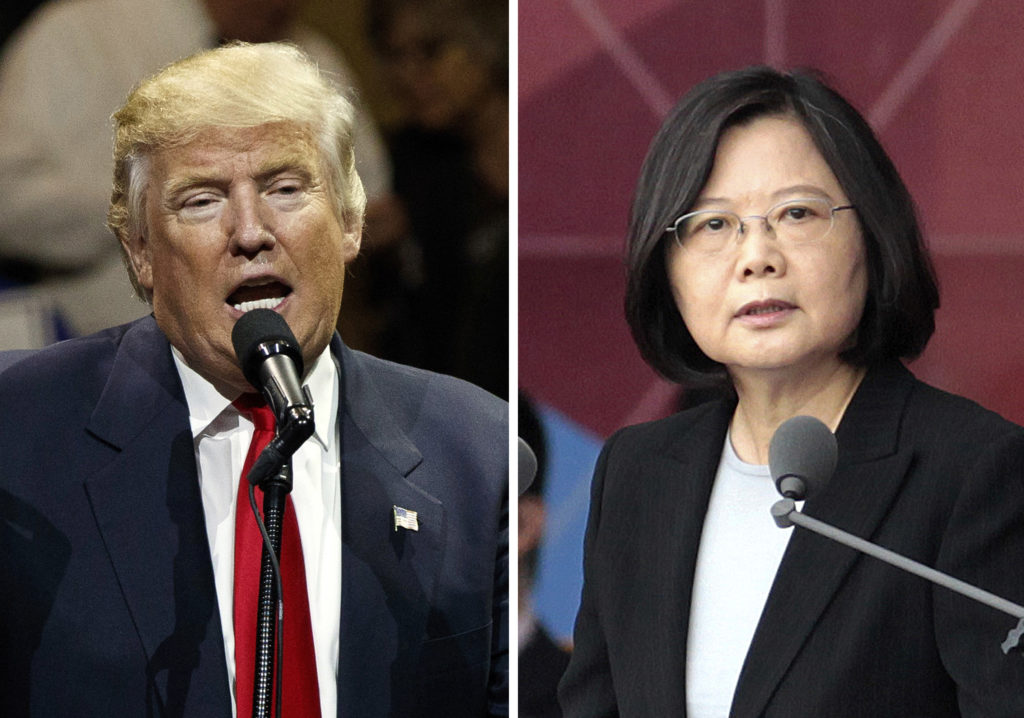
With a 10-minute phone call and two tweets, Donald Trump inspired banner headlines and renewed hopes across Taiwan for a stronger partnership with the United States, while also inflaming the complex relationships between the U.S., mainland China, and the self-governing island China regards as a renegade province. Whether the U.S. president-elect meant to jump into the generational fight between China and Taiwan remains an open question. But by speaking to Taiwanese President Tsai Ing-wen, Trump upended four decades of American foreign policy and engaged China directly on the issue of Taiwan, which Beijing has threatened to reclaim by force if necessary. No American president or president-elect has publicly spoken to Taiwan’s leader since the U.S. ended their formal diplomatic relationship in 1979. Four of his words drew particular attention in Taiwanese newspapers: Trump’s reference, in a follow-up tweet, to Tsai being “the President of Taiwan.” The phrase is far from benign for China, which regards any reference to a Taiwanese president as an unacceptable acknowledgement of Taiwan’s statehood. Official Chinese pronouncements typically refer to the Taiwanese president as “the Taiwan regional leader.” Chinese leaders have indicated they dislike Tsai, who was elected in January from a pro-Taiwan independence party and became the island’s first female president. An editorial from the state-run China Daily newspaper admonished Tsai and said the call would “bring nothing substantial but illusionary pride.” As for Trump, the newspaper said the incident “came as a striking move,” but was not as important as “it seems to be.” Taiwanese are generally considered to support independence or the status quo, in which China and Taiwan maintain robust social and economic exchanges while the island retains its democracy and de facto independence, over unification with China. Chinese President Xi Jinping, however, has warned that the issue of unification cannot be put off indefinitely. Yang Chih-kai, a 22-year-old university student at Taiwan’s Tamkang University, said Saturday that the call raised Taiwanese hopes for a stronger relationship with the United States. “People will think that the U.S. will keep on helping Taiwan protect itself against China’s threat,” Yang said. Chen Chun-hao, a 43-year-old designer, said Trump might “bring more help” to Taiwan now that both sides had opened a dialogue. “I believe that this could help Taiwan in its international status and its global situation,” Chen said. Kao-cheng Wang, dean of Tamkang University’s college of international studies, said he believes Trump might increase American military exports to Taiwan, over Beijing’s vociferous opposition, and try to strengthen economic ties between the two sides. “Trump will not be restricted by the established foreign policy,” Wang said. “The diplomatic policy may be flexible after he takes office.” China cut off diplomatic contact with Taiwan in June, one month after Tsai took office, accusing her of refusing to endorse the concept that Taiwan is a part of China. Last month, Xi met with Taiwan’s opposition leader, Nationalist Party Chairwoman Hung Hsiu-chu. Zhou Qinfen, a retiree from China’s eastern Jiangsu province visiting Beijing on Sunday, echoed several other Chinese interviewed who said they consider Taiwan to be an inextricable part of China. “If an American president who has only been recently elected starts opposing the unity of China, the people of China will never agree with that,” she said. The Taiwanese presidential office said Trump and Tsai discussed issues affecting Asia and the future of U.S. relations with Taiwan. Tsai also told Trump that she hoped the U.S. would support Taiwan in its participation in international affairs, the office said, in an apparent reference to China’s efforts to isolate Taiwan from global institutions such as the United Nations. Taiwan’s presidential office spokesman Alex Huang said separately that Taiwan’s relations with China and “healthy” Taiwan-U.S. relations can proceed in parallel. “There is no conflict (in that),” he told reporters in Taipei on Saturday. After Chinese Foreign Minister Wang Yi blamed Taiwanese leaders Saturday for playing a “small trick,” China said it would issue a diplomatic complaint with Washington. That is likely only the beginning of China’s response, said Douglas Paal, a former director of the American Institute in Taiwan, which unofficially represents U.S. interests in Taipei. Wang’s comment “is intended to give time for Trump to back away from or desist from moves to elevate treatment of Taiwan,” said Paal, now vice president for studies at the Carnegie Endowment for International Peace. “China will watch carefully to see what he does. But Taiwan will be seen as in need of some form of punishment.” One potential move for China is to apply new pressure to the 22 states that have formal diplomatic ties with Taipei, Paal said. Most of the world and the United Nations already recognize Beijing as the official government of China. What happens next will hinge on whether the call is seen as a “complicated accident” or an intentional signal of new policy, Paal said. “Beijing will watch closely to see which it is,” he said. “But until someone from Trump Tower explains further, it is unknowable.” Republished with permission of the Associated Press.
China hopes Donald Trump call with Taiwan leader won’t damage ties
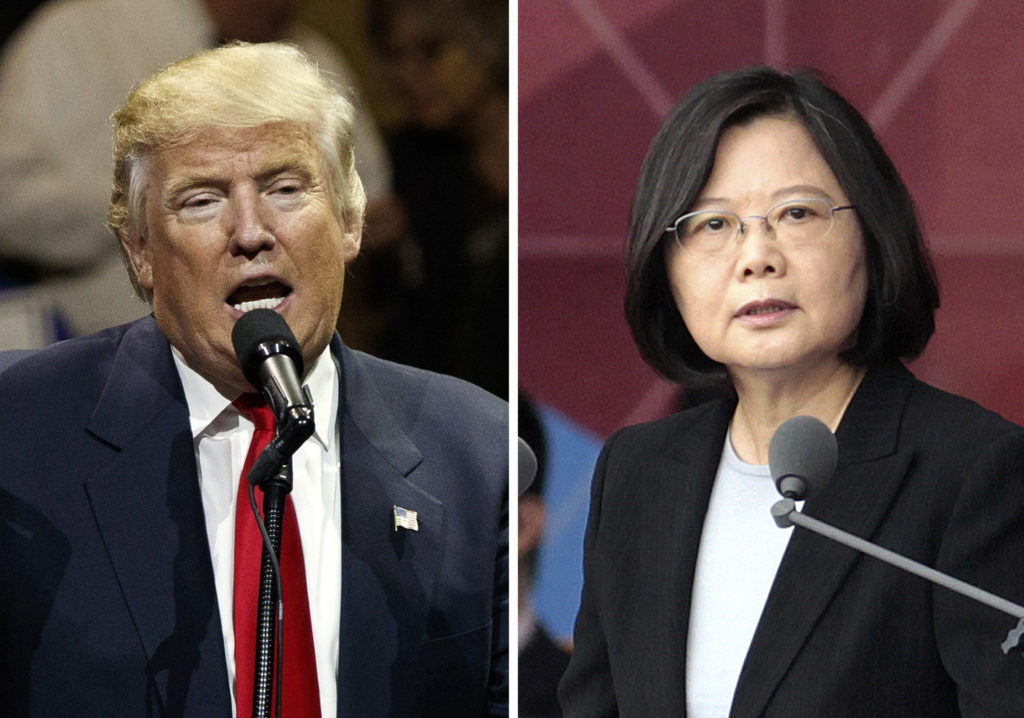
China’s foreign minister said Saturday he hopes Beijing’s relations with the U.S. would not be “interfered with or damaged” after President-elect Donald Trump broke with decadeslong diplomatic tradition and spoke directly with Taiwan’s leader. It is highly unusual, probably unprecedented, for a U.S. president or president-elect to speak directly with a leader of Taiwan, a self-governing island the U.S. broke diplomatic ties with in 1979. Chinese Foreign Minister Wang Yi said the call between Taiwan’s president and Trump was “just a small trick by Taiwan” that he believed would not change U.S. policy toward China, according to Hong Kong’s Phoenix TV. “The one-China policy is the cornerstone of the healthy development of China-U.S. relations and we hope this political foundation will not be interfered with or damaged,” Wang was quoted as saying. Washington has pursued a so-called “one China” policy since 1979, when it shifted diplomatic recognition of China from the government in Taiwan to the communist government on the mainland. Under that policy, the U.S. recognizes Beijing as representing China but retains unofficial ties with Taiwan. A statement from Trump’s transition team said he spoke with Taiwanese President Tsai Ing-wen, who offered her congratulations. “During the discussion, they noted the close economic, political, and security ties … between Taiwan and the United States. President-elect Trump also congratulated President Tsai on becoming President of Taiwan earlier this year,” the statement said. Trump tweeted later: “The President of Taiwan CALLED ME today to wish me congratulations on winning the Presidency. Thank you!” The Taiwanese presidential office issued a statement early Saturday saying Trump and Tsai discussed issues affecting Asia and the future of U.S. relations with Taiwan. “The (Taiwanese) president is looking forward to strengthening bilateral interactions and contacts as well as setting up closer cooperative relations,” the statement said. “The president also told U.S. President-elect Trump that she hopes the U.S. will continue to support Taiwan’s efforts in having more opportunities to participate in and contribute to international affairs in the future,” Tsai’s office said. It said the two also “shared ideas and concepts” on “promoting domestic economic development and strengthening national defense” to improve the lives of ordinary people. The White House learned of the conversation after it had taken place, said a senior Obama administration official, who requested anonymity because of the sensitive diplomatic relations involved. China’s embassy in Washington, its foreign ministry in Beijing and Taiwan Affairs Office did not respond to requests for comment. Friday’s call is the starkest example yet of how Trump has flouted diplomatic conventions since he won the Nov. 8 election. He has apparently undertaken calls with foreign leaders without guidance customarily lent by the State Department, which oversees U.S. diplomacy. Republished with permission of the Associated Press.
