
Montgomery’s Zestlan Simmons named 2018 Alabama Teacher of the Year
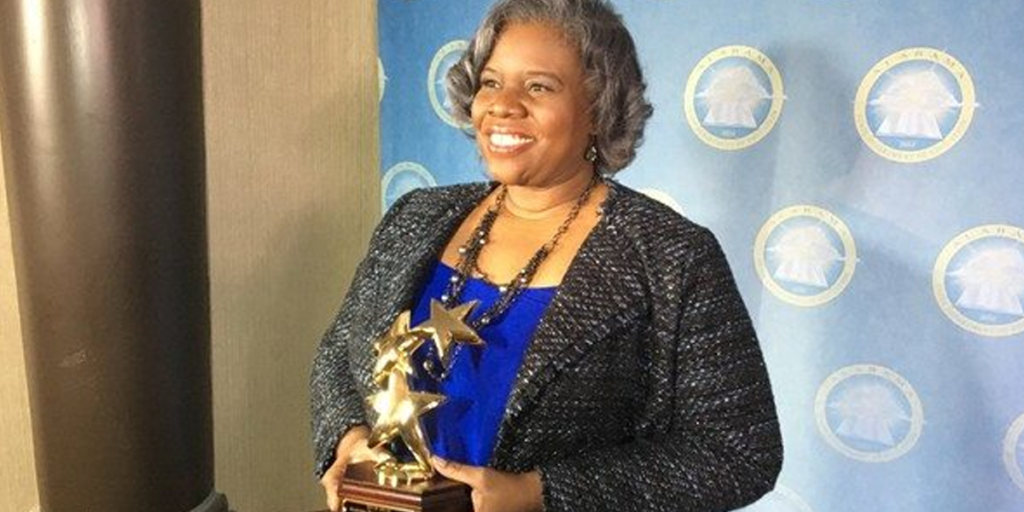
The Alabama State Department of Education (ALSDE) has named a Montgomery County school teacher who makes it her personal mission to engage and efficiently develop daily the academic skills of all students as its 2018 Teacher of the Year. Zestlan Simmons, who teaches English at Booker T. Washington Magnet High School will serve as the state’s ambassador for public education and the teaching profession. Simmons, who was recognized by the National Math and Science Initiative as the AP English Teacher of the Year, automatically becomes Alabama’s nominee for National Teacher of the Year. “This is truly a great honor and I am thankful for this wonderful opportunity to represent our Great State as the 2018-2019 Alabama Teacher of the Year,” said Simmons. “Students must have supportive learning environments and they must be encouraged to achieve at all levels – utilizing their local communities and digital learning opportunities to connect to the world.” Simmons was announced as Teacher of the Year during a celebration honoring the 12 semi-finalists and 4 finalists who were nominated for the coveted title at the RSA Plaza Terrace in Montgomery, Ala. Interim State Superintendent of Education Ed Richardson said it is an honor to join in the recognition of exemplary educators who transform classrooms and our society. “Teachers of the Year are world changers – they ensure the future prosperity of our great nation,” Richardson said. “These educators have shown our students a brilliant example of excellence.”
Final four announced for Alabama Teacher of the Year

The Alabama State Department of Education(ALSDE) has narrowed down its list of 16 educator-finalists from across the Yellowhammer State down to four for the Alabama’s 2018-2019 Teacher of the Year award. “Highly-skilled, dedicated, and caring teachers are essential to achieving excellence and in preparing our nation’s next generation of outstanding professionals,” is how the ALSDE describes these individuals. The four will proceed forward in the competition and will undergo an extensive interview process with the state judging committee. The winner will be announced during a ceremony at the RSA Plaza Terrace in Montgomery, Ala. on May 9. Alabama’s Teacher of the Year spends the majority of the school year serving as a full-time ambassador for education and the teaching profession as well as presenting workshops to various groups. Additionally, the winner will become Alabama’s candidate for the National Teacher of the Year award. The four finalists Meghan Allen | Minor Community School from the Jefferson County School System: My students with limited verbal skills can learn and develop ways to use their voice more effectively. For my students who are non-verbal, they need pictures, static devices, or dynamic displays to communicate. We must give our students a voice and teach them to use it. We value all students, and instruction must reflect their needs and value. Dr. Blake Busbin | Auburn High School from Auburn City School System: Teachers and community members stand to benefit from greater cooperation in discovering ways in which the community’s expertise can lend itself to enhancing learning. Guest speakers, such as individuals representing varied career fields, are one popular inclusion, but they can be so much greater. Experts in given fields can assist in student project development or evaluation during presentations heightening the relevancy and authenticity of project-based learning. Carol McLaughlin | Greystone Elementary School of the Hoover City School System: Our world is connected in ways we never imagined ten years ago. It is essential students use these connections to learn, solve problems, and be active global citizens. With technology, students can find answers to questions, by connecting them to experts around the world. Classrooms are no longer limited by the knowledge of the teachers or the books in the library. Zestian Simmons | Booker T. Washington Magnet High School in Montgomery from the Montgomery County Public School System: A learning environment should not be limited to the classroom but should include the local community, innovative projects, and digital learning that connects students to the world. To keep the curriculum relevant, the classroom curriculum should always contain a sufficient level of rigor for the primary purpose of skill development and mastery and current material.
Andrew A. Yerbey: The curious case of Alabama’s Teacher of the Year
Ann Marie Corgill is, by all accounts and by almost any definition, a highly qualified teacher. It is regrettable that the modifier “almost” is necessary in that sentence, but its inclusion is instructive. From it, the people of Alabama can learn a lot about what ails their system of education. More on Ms. Corgill’s story in a moment, but the Associated Press headline provides a précis: “Alabama’s Teacher of the Year Told She’s Unqualified, Resigns.” –– Whether the title of “Teacher of the Year” is borne by a worthy titleholder every year in Alabama is unknown, but it certainly is in the case of Ann Marie Corgill, the reigning Alabama Teacher of the Year. This is a woman who has practiced the art of teaching for over two decades; who has been called upon to teach other teachers about teaching; who has written a book about teaching. She went on to become a finalist—one of only four—for National Teacher of Year, regarded as the teaching profession’s highest honor. But we know she is a great teacher not through her résumé but through her work. Ellen Anderson, her student: “Ms. Corgill is the best teacher I have ever had. She has taught us more in one year than all my other years combined. She made us feel important, empowered, and loved. . . . She is very special.” Kathy Snyder, her fellow teacher: “Ann Marie Corgill is an exemplary teacher . . . a teacher who represents the essence of our profession.” Betsy Bell, her principal: “Ann Marie believes that we can build a better world one child at a time. She is doing precisely that!” —— In short, Ann Marie Corgill’s bona fides are inarguable—or so one would think. But modern bureaucrats do not think. When they were alerted this past week that Ms. Corgill lacked a certain certification, which she never had and never needed, she was deemed not a “highly qualified teacher.” Ms. Corgill’s attempts to make sense of her Kafkaesque situation proved futile, met as they were by—to borrow her apt description—“a wall of bureaucracy.” At length, she tendered her resignation, writing regretfully: “After 21 years of teaching in grades 1–6, I have no answers as to why this is a problem now, so instead of paying more fees, taking more tests, and proving once again that I am qualified to teach, I am resigning.” —— It has been well established, by over forty years of research, that the characteristics commonly found on a teacher’s résumé—such as education, certifications, and experience beyond the first few years in the classroom—have essentially no effect on a teacher’s quality. That is, how much a teacher contributes to the learning of his or her students has nothing to do with whether the teacher has a baccalaureate or doctorate, five years of experience or fifteen; and certifications certify nothing with regard to actual teaching. Yet it is precisely, perversely, those résumé characteristics that govern Alabama’s approach to its teachers. In Alabama, a person must minimally have a baccalaureate and a certification to be hired as a public-school teacher, and then is automatically given pay raises for having or acquiring advanced degrees and more experience. All of this is decided without inquiry into the quality of anything: not of the universities the teacher attended (the best equals the worst); not of the degrees awarded to, or the academic performance of, the teacher (majoring in education and graduating with a 2.5 grade point average equals majoring in math and graduating with a 4.0 grade point average); and, most importantly and illogically, not of the person’s ability to actually teach. We should make it easier—not harder—for people to become teachers, and harder—not easier—for bad teachers to remain teachers. As it stands, our system deters people who would have been great teachers from entering the profession, including both college students and mid-career professionals, and abuses great teachers already in the profession, including Ms. Corgill. Worst of all, our system ignores the best interests of our schoolchildren, especially those most vulnerable. —— At the beginning of the school year, Ann Marie Corgill had moved from Cherokee Bend Elementary School in the city of Mountain Brook to Oliver Elementary School in the city of Birmingham. She was now using her talents to teach children who are among the most disadvantaged, economically and educationally. Not anymore. The children who just lost perhaps their last best hope at a good education will not, it seems certain, look back and take solace that a bureaucrat protected them from being taught by an “unqualified” teacher like Ms. Corgill. Andrew A. Yerbey is Senior Policy Counsel at the Alabama Policy Institute.
Alabama teacher of the year resigns after being called ‘unqualified’
Alabama’s reigning Teacher of the Year says she has resigned after state officials told her she’s unqualified to teach in her fifth-grade classroom because of certification issues. Veteran teacher Ann Marie Corgill said Alabama Department of Education officials recently informed her that she was not qualified despite her well-documented accomplishments. She said she grew tired of trying to prove herself, prompting her to submit a letter of resignation, dated Tuesday and obtained by Al.com. In the letter, Corgill cites her confusion. “After 21 years of teaching in grades 1-6, I have no answers as to why this is a problem now, so instead of paying more fees, taking more tests and proving once again that I am qualified to teach, I am resigning,” Corgill wrote. Corgill has Class A and B certifications to teach primary school through third grade, according to certification records provided by The Alabama Department of Education. Corgill said she started this school year at Birmingham’s Oliver Elementary School teaching second grade, but shortly after the semester began, she was moved to a fifth-grade classroom. In a news release Thursday, the state Department of Education said it “did not determine Ms. Corgill was not qualified. However, when an inquiry was made, the department reported that her current teaching certificate covers primary grades through Grade 3. This does not carry with it a requirement for resignation.” But Corgill – a 2015 National Teacher of the Year finalist – holds National Board Certification to teach children ages 7 to 12, a group that would include most fifth-graders. That certification is valid until November 2020, according to the National Board Certification directory. Birmingham City Schools spokeswoman Chandra Temple said Thursday that the district is working on the matter and had no further comment. Republished with permission of The Associated Press.
