
Deontee Gordon of TechBirmingham sees Birmingham leading in inclusive innovation

As president of TechBirmingham, Deontee Gordon has a front-row seat to the growing innovation economy in the Magic City. He likes the view. “It’s exciting to see us going from a city and a region that did a lot of studies to a city and a region that is acting on them now,” Gordon said. “If you look at the major components of a city, of an area – the government, the public, the people, the private sector, your institutions, your philanthropic community – they are all on the same page. “When I am in these meetings, they are all represented at the table,” he continued. “They have a voice that is being heard and that is being included. I am hard-pressed to think of a time in Birmingham’s history where all of those buckets, those components were at the table and they were playing well in the sandbox together. It’s probably the most exciting time in Birmingham’s history since its inception.” Deontee Gordon likes what he sees in the inclusion and diversity of Birmingham’s tech growth from Alabama NewsCenter on Vimeo. That may sound like a bold statement for a place that earned the name the Magic City for its explosive growth. But it’s also a city that earned the nickname “Bombingham” for its explosive hate. Overcoming that and being seen by many as ground zero for the civil rights movement actually helps Birmingham in the new economy, Gordon believes. “You look at Birmingham, it makes sense for all of this activity to take place in an area that was known for being the battleground, for leading the entire nation and in so many ways impacting the world,” Gordon said. “I say it time and time again and I hope it’s not hackneyed at this point, but in what better city than Birmingham to do this work? While that particular lens might focus on a certain race, at the end of the day it is still inclusive, and it is inclusive of everybody.” Gordon is among the tech sector leaders in Birmingham who are pushing for the metro area to lead the nation in inclusive innovation – taking the steps to elevate everyone with the knowledge and certifications needed to participate in the tech economy. TechBirmingham has taken on part of this responsibility with its Kids Code Club and other outreach initiatives to help young people gain skills for STEM (science, technology, engineering and math) and computer coding jobs. TechBirmingham was also instrumental in working with the city of Birmingham, Birmingham City Schools and Lawson State Community College to bring Apple’s Everyone Can Code curriculum to create Birmingham Can Code. The Innovate Birmingham program is reaching out to young adults ready to take jobs at partner companies. They go through a certification program in partnership with UAB and Innovation Depot to try to produce nearly 1,000 job-ready graduates in the next few years. Many of the participants in its I AM BHAM coding bootcamps and Generation IT bootcamps are from underserved neighborhoods and would not have had an opportunity to pursue tech jobs without the programs. “What I love about Innovate Birmingham’s approach is that they are not forgetting that local talent base,” Gordon said. “It might be a long-term play, but it is a needed play. That’s how Birmingham separates itself from other cities because we constantly ask ourselves as part of our guiding principles, ‘How does this positively impact everybody.’” Gordon said he is also in favor of recruiting companies and talent from outside of Birmingham, but to neglect those who are here would ignore a significant asset. “If you want to look at all of the movement and activity from an historical lens and a cultural lens, the black community, in particular, I believe prides itself on doing a lot with nothing,” he said. “Ingenuity, creativity, being expressive, creating art out of movement and music – something that leaves a legacy built from thin air. To take that creativity, that sense of just unbridled passion and now use technology as a conduit to channel that through, I think it just bodes well.” For Gordon, it’s not about no longer seeing color. Instead, it is about valuing those colors and contributions you do see. “I think it is more so about appreciating what every person, what every culture and every group brings to the table,” he said. “There are common threads that bind us all. Obviously, we’re Birmingham goals as a region, we’re Alabama goals as a state. What happens in Mountain Brook will impact somebody in Midfield. What happens in Mobile will impact somebody in Fairhope and Huntsville. To the degree that we can recognize how we are all linked together and bust down those silos, we will be better for it.” When Gordon talks about inclusive innovation, it’s a matter of “you don’t have to shed who you are to be a part of it,” he said. It means not focusing on race, gender, age, sexual orientation or other factors when it comes to people’s contribution to the workforce, he said. “We have a rich tapestry,” Gordon said. “If we recognize that and what those individual groups bring to the table but also weave that in a common thread and narrative, that’s how you change it.” There are efforts underway, Gordon said, to expand education and training outreach throughout the metro area and into rural areas using existing assets like local libraries to elevate under-served populations. “Whereas a rising tide lifts all boats, we have to recognize that some people don’t have boats,” he said. “If we answer that question and make sure that it’s accessible to everybody, that’s how you change the game.” And the game is changing with Amazon setting up shop in Bessemer, Mercedes-Benz building electric vehicle batteries in Bibb County, Shipt growing its presence and jobs downtown, DC BLOX building a data center near Titusville, Joonko moving to Birmingham from Israel or companies like Fleetio and Pack Health continuing to grow. “We have a lot to celebrate, a ton of wins and what’s exciting and encouraging to me is that word is starting to get out,” Gordon said. “When you get here, everybody senses that excitement. It’s palpable. You
TechBirmingham helps kids prepare to join digitally literate workforce
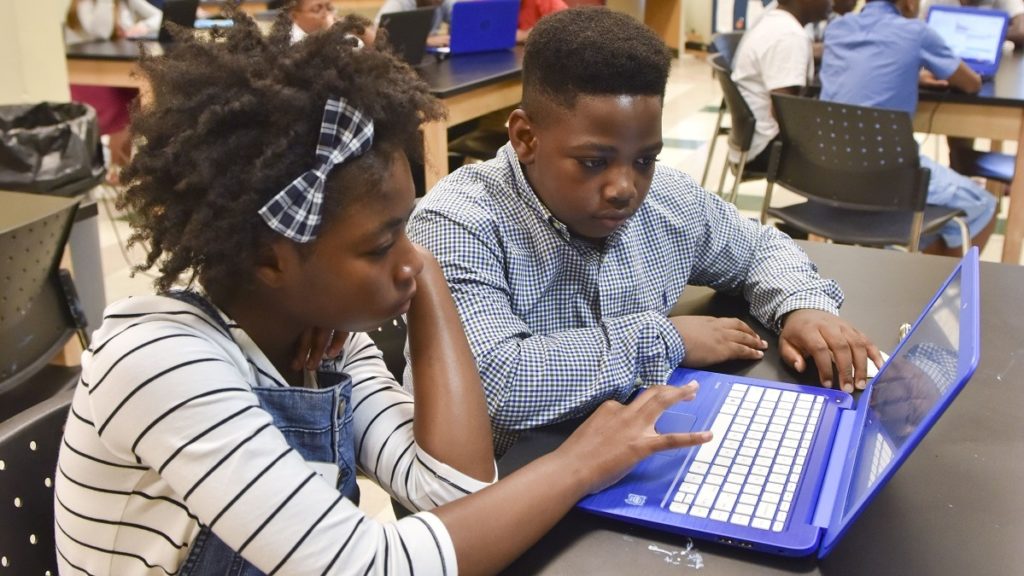
Every second Sunday of each month, Luke Robinson, 15, and his dad, Jason, travel about 80 miles from Winfield to the McWane Science Center in downtown Birmingham to participate in TechBirmingham’s coding class. The Robinsons are motivated to travel for two hours and devote another hour and a half on Sunday afternoons not only because of the lack of youth-oriented coding camps in Winfield but also because Luke is interested in computer animation. “I’m pretty passionate about computers,” Luke said. “Back home, they don’t really have any coding classes like this. This is my opportunity to do coding with other people.” Young people like Luke are taking advantage of coding camps and classes that will position them for careers in a world that’s becoming more high-tech. Computer coding — which involves writing programming language that makes computer software, apps and websites operate — is considered one of the fastest-growing fields in the job market. Computer coding “We need a digitally literate workforce,” said Deon Gordon, president of TechBirmingham. “In a lot of ways, every company now is a tech company.” “A lot of people 30 years ago thought we were going to be taken over by robots,” said Nicole Mubarak, director of Women Who Code Birmingham. “But we’ve been taken over more by software as opposed to hardware.” TechBirmingham’s Kids Code class teaches and encourages students to learn and experiment with computer code. (Frank Couch/The Birmingham Times) Because most companies and businesses rely heavily on computer software, the need for coding analysts and specialists is not just limited to jobs in the tech industry. “So many banks, insurance companies and health care providers are concerned about protecting the privacy of their clients’ information, they need to learn how to encrypt their important data,” said Christina Smith, TechBirmingham’s science, technology, engineering and mathematics (STEM) coordinator. TechBirmingham’s coding class, offered since 2015 at McWane, is designed to encourage digital literacy among children in grades three through 12. The free class, offered on the second Sunday of each month from 1:30 p.m. to 3 p.m., operates during the school year. Nearly 40 students participated in its August class. “What we want to do is give all kids access to the skills they’ll need for future jobs,” Smith said. “A lot of it is just learning basic coding skills and the fundamentals, the foundations of what they’re going to need if they want to pursue a career in computer software engineering.” Wave of the future Jajuana Smith of Birmingham said her 10-year-old son, Jalen, had taken a coding class previously, but he didn’t connect with the instructor’s personality and teaching style. She wanted to rekindle his interest before he lost it, so she brought him to the TechBirmingham class. “I needed him to get back in there,” she said. “I need him to grow with it because technology is the wave of the future. You have to be well versed in a lot of things for the new market. Technology is going to be on every career path no matter what you do. I need him to have a strong foundation, so if that’s what he chooses to do, he can do it.” During the coding class, students were divided into two groups. In one class, students learned basic coding encryption; in the other, they learned to use the basic language of Java to build apps. Students work on computer coding during a Kids Code class at McWane Science Center. (Frank Couch/The Birmingham Times) In Jalen’s class, he and another student learned how to crack a simple code. “I really like the fact that you get to interact with other people, meet new friends and still figure something out,” he said. “I’ve done coding, but I’ve never tried to crack a code.” In the app-development class, students created apps to produce music accompanied by dancing tigers and robots. Eight-year-old Sofia Aelterman was disappointed because she couldn’t get her robot to perform popular dance moves. “We were trying to make the robot dab (popularized a few years ago in music by songs like ‘Look at My Dab’ by Atlanta hip-hop group the Migos and in sports by NFL star Cam Newton), but it just wouldn’t dab. It wouldn’t floss, either (another dance that’s performed by characters in video games like Fortnite). We’ll get it next time,” she said. Mubarak, who serves as a volunteer instructor with TechBirmingham’s coding class, said incorporating coding with fun activities keeps kids engaged and sparks their interest. One exercise involved letting students create an app that flushed their homework down a toilet. “The kids get really creative,” she said. “They start seeing what they can do, they get their minds into it and that’s what they come up with — exploding homework and homework that flushes down the toilet. I just look at them and say, ‘Virtually, this is fine. In reality, don’t do it.’” For more information about TechBirmingham and its coding class, visit www.techbirmingham.com or contact Christina Smith at christina@techbirmingham.com. For more information about Women Who Code, visit womenwhocode.com/birmingham or follow them on Twitter @WWCBirmingham. This story originally appeared in The Birmingham Times. Republished with permission from the Alabama NewsCenter.
Personnel note: Deon Gordon as TechBirmingham’s new President

Deon Gordon has been named TechBirmingham’s new President. The Board of Directors for the nonprofit promoting Birmingham’s tech sector selected Gordon as the successor to Jennifer Skjellum from over 50 applicants from more than 12 states. “Deon’s passion, experience, and vision for the future made him the perfect choice to take TechBirmingham to the next level,” said Jay Brandrup, TechBirmingham Board Chairman. “We had such a stellar pool of capable applicants and I think that shows the importance of TechBirmingham’s role in this community.” For the last two years, Gordon serves as the director of business development at REV, an economic development agency dedicated to place-based revitalization and small business development. There, he led the launch of REVeal Kitchen in The Pizitz Food Hall, a restaurant incubator designed to offer low-cost, proof-of-concept opportunities for aspiring restaurateurs. Prior to joining REV, Gordon’s career path included multiple online entrepreneurial ventures and the web/software startup, Chronicle Studio. “I am incredibly honored and excited to build on the great work started by Jennifer Skjellum during her tenure as President and look forward to getting started,” said Gordon. “I remain more convinced than ever that our region’s future prosperity rests upon the existence of a robust and inclusive technology landscape. After participating in the foundational development of our small business ecosystem at REV, I could not be more thrilled to build an inclusive economy for collective impact.” Along with his professional experience, Gordon serves on several boards, including: the Railroad Park Foundation, Birmingham Artwalk, Growing Kings, the Commercial Development Authority of the City of Birmingham, and American Heart Association’s Communications and Marketing Coordinating Committee. He is the recipient of the 2017 A.G. Gaston Award for Outstanding Community Service and, in the same year, was recognized during the 17th Annual Salute to Outstanding African-Americans by the Birmingham NAACP. “Deon has a passion for Birmingham and for working to make our City a better more vibrant place, said David Fleming, president and CEO of REV Birmingham. “He has been instrumental in growing REV’s programs to support small businesses and entrepreneurs. We look forward to working with him in a different capacity in his new role leading TechBirmingham, a very important economic development partner organization in our City. I know he will bring the same passion, collaborative spirit and personal touch to TechBirmingham that he brought to REV Birmingham.” Gordon will assume the role of President December 1. Skjellum will remain in the role until November 30th.
