
Outside groups backing Ted Cruz land big checks in January

The six Republican presidential candidates and two Democratic contenders are due to report on the financial health of their campaigns by midnight Saturday. With Republicans voting in South Carolina and Democrats caucusing in Nevada, the reports on fundraising and spending in January provide a glimpse of who has been thinking ahead in the primary calendar. Most of the outside groups known as super political action committees also must report to the Federal Election Commission by midnight Saturday. Here’s what we know: CRUZ NETWORK GROWS Texas Sen. Ted Cruz has the biggest network of outside groups helping him out — more than half a dozen. A super PAC called Courageous Conservatives has stood out for employing some of the most aggressive tactics, even though it isn’t the best-funded of those pro-Cruz groups. In the lead-up to the South Carolina vote, Courageous Conservatives made thousands of automated phone calls bashing Donald Trump, who has consistently led polls in the state. So who’s paying for all this? The group’s January fundraising report shows it has two donors: Stan Herzog, a Missouri builder, and Christopher Ekstrom, a Dallas investor. Herzog, who gave $60,000 last month, is a seasoned super PAC donor, having put up more than $1 million to back 2012 GOP nominee Mitt Romney. Ekstrom has a relatively short history as a political donor: His $34,500 contribution to Courageous Conservatives last month appears to be his biggest ever. A far better funded pro-Cruz group, Stand for Truth, also filed a January fundraising report. That super PAC raised about $2.5 million in January. Its biggest contributor, Trinity Equity, gave more than $1 million. Corporate records show the Houston company shares an address with Quantum Energy Partners, a private equity firm run by Wil VanLoh, who has given the maximum legal amount to Cruz’s presidential campaign, $5,400. Stand for Truth’s FEC documents show the super PAC spent much of its money on South Carolina advertisements knocking Cruz rival Marco Rubio, a Florida senator. ___ TRUMP TAKEDOWN? NOT SO MUCH A super PAC claiming it would try to take down Trump has not really gotten off the ground. Make America Awesome — a riff on Trump’s “Make America Great Again” slogan — raised just $8,640 in January. That followed a disappointing December, when it raised just $1,711. The super PAC is led by Republican strategist and outspoken Trump antagonist Liz Mair. Perhaps because of its underwhelming funding, the super PAC has done just a few digital ads knocking the celebrity businessman. Republished with permission of the Associated Press.
Jeb Bush, seeking a much-needed revival in SC, calls in family

Jeb Bush has long kept his family at arm’s length in his effort to become commander-in-chief, but with the South Carolina primary looming, he’s embracing them like never before in the state that has historically stood by the Bush family in its previous White House bids. It’s a drastic shift from the approach he took at the start of his campaign hinting at how precarious his fortunes have become. Now, with his back to the wall, Bush is grabbing hold of the legacy, and hoping his front-row view of the world’s most difficult job means more to South Carolina’s military-minded Republican voters than a few awkward exchanges on the campaign trail ahead of Saturday’s critical primary. In Beaufort, S.C., Wednesday, Bush told an audience he had experienced “watching history unfold, in a unique way,” a reference to his father’s and brother’s wartime administrations. Bush’s best-known South Carolina advocate, the state’s senior Sen. Lindsey Graham, echoed that sentiment, stressing that Bush’s family is one of his biggest strengths and assets. “He understands the job because his brother and his father have had that job,” Graham said. Bush said in an Associated Press interview Thursday that his family legacy is actually what sets him apart from the others. “You get insight into things that are personal.” For example, Bush recounted the days when he saw the “burden of leadership that my dad felt” in the weeks leading up to the 1991 Persian Gulf War. “He didn’t talk specifically about what he was doing, or going to do,” Bush said. “You could just see the burden.” Bush also lists dozens of admirals, generals and Medal of Honor recipients who have endorsed him. And he points to his time as governor in charge of Florida’s robust national guard, consultation with military and foreign policy experts and vigorous foreign travel while in office and as a private businessman as evidence. But the family reference is a stark change from a year ago, when Bush, then weighing a potential run, said of his father George H.W. Bush and older brother George W. Bush during a Chicago speech: “I admire their service to the nation and the different decisions they had to make. But I am my own man and my views are shaped by my own thinking and own experiences.” Bush’s frequent family references this week reflect the name’s popularity in South Carolina, where both the former wartime presidents won the first-in-the-South primary. It also suggests how desperate Bush and his supporters are for signs of momentum, despite having built the 2016 race’s largest combined warchest of more than $150 million. And yet he finished sixth in Iowa’s leadoff caucuses on Feb. 1 and fourth in the New Hampshire primary on Feb. 8. Despite his efforts in South Carolina, where his family name still maintains some political clout, Bush’s attempt to gain traction hit a rough patch this week. The week started on a high note — a joyous reception from audiences as he campaigned with his former president brother, who came out of public political isolation to assist his younger brother’s at a critical juncture in his campaign. But the following day, Bush was ridiculed for posting a picture on Twitter of a handgun, inscribed with his name and given to him by a manufacturer in Columbia he visited. On an outdoor campaign stop in Summerville Wednesday, Bush fielded more advice on how to improve his underperforming campaign than questions about policy. That was the same day Rubio won the prized endorsement of South Carolina Gov. Nikki Haley, even after she met with George W. Bush in Columbia. Even little things wrinkled Bush’s efforts this week. In Summerville, his clip-on microphone didn’t work. And in Myrtle Beach, Bush, who has recently abandoned glasses for contact lenses, complained to staff about the lighting as he left the hall rubbing his eyes. Bush was hoping his fortunes would reverse on Friday when he was scheduled to campaign with his 90-year-old mother Barbara Bush, a beloved figure among a segment of South Carolina Republicans. Barry Wynn, a member of Bush’s national finance team and former South Carolina Republican Party chairman, says he is convinced Bush can benefit from the family’s popularity, but he also acknowledges the pressure Bush faces. Wynn and other Bush supporters have said he needs to beat or finish very close to Sens. Ted Cruz of Texas and Marco Rubio of Florida to justify asking donors to help him finance the next round of campaigning, which includes the Nevada caucuses and, more importantly, the Mar. 1 Super Tuesday primaries. All three trailed billionaire Donald Trump in a scrum according to most public polls of primary voters. “We’ve got to make sure that when they cut off the tail here, we’re not the tail,” Wynn said. “And then we have to have the resources to stay in the game.” MaryBeth Lewis of Florence put it more directly to Bush after a stop Thursday at the farmer’s market in her town. “Go get ’em!” she told Bush as she squeezed his hand. “I’m still standing,” Bush replied. Republished with permission of the Associated Press.
Republican 2016 hopefuls get emotional on eve of SC primary

The Republican battle for South Carolina turned deeply personal on the eve of Saturday’s high-stakes presidential primary, as New York businessman Donald Trump eyed a delegate sweep and his Republican rivals fought for a southern surprise. Texas Sen. Ted Cruz, the son of a pastor, evoked “the body of Christ” in his closing message while fending off allegations of campaign misconduct in a state where most Republicans identify as evangelical Christians. At the same time, Trump allies took subtle shots at Pope Francis for questioning the Republican front-runner’s devotion to Christian principles. Ohio Gov. John Kasich opened up about the death of his parents. And Jeb Bush turned to his mother to help revive his underdog campaign. Friday marked an emotionally charged day in the campaign, with 50 delegates up for grabs in Saturday’s primary contest. Candidates were also trying to stoke some badly needed momentum heading into the next phase of the campaign: March 1’s Super Tuesday. Trump appeared to hold a commanding lead less than 24 hours before voting began in South Carolina. With a big win, the billionaire businessman could take home most, if not all, of the state’s 50 delegates. Such a victory would mark a particularly painful blow to Cruz, whose consistent focus on Christian values and southern roots should have given him a distinct advantage here. As the undisputed Republican front-runner, Trump was a popular target in the final-hours’ scramble for votes. “Trump values are not South Carolina values,” the state’s senior senator, Lindsey Graham, charged during a Charleston rally for Bush. Former first lady Barbara Bush offered a positive contrast with her son’s values: “He’s steady. He’s honest. He is modest. He is kind, and he is good.” Trump’s campaign continued trying to brush off an extraordinary criticism from Pope Francis the day before. When asked about Trump’s call to build a massive wall on the U.S.-Mexican border, the leader of the Roman Catholic Church said those who seek to build walls instead of bridges are not Christian. “I say only that this man is not Christian if he has said things like that,” Francis said aboard the Papal plane. Trump called the Pope’s words “disgraceful” on Thursday, but offered a distinctly softer jab as he courted South Carolina voters on Friday. “Yesterday, the Pope was great,” Trump told an audience in Myrtle Beach. “They had him convinced that illegal immigration was like a wonderful thing. Not wonderful for us. It’s wonderful for Mexico.” Added Trump supporter, pastor Mark Burns: “We respect and honor the Pope. But I don’t know … The walls that are around the Vatican are pretty big walls.” Campaigning in the same city, Cruz tried to take advantage of the spiritual spat by highlighting his own religious devotion. “Every minute that you’re not on the phone calling friends and loved ones, spend beseeching God, praying for this country, that this spirit of revival that is sweeping this country continue and grow, and that we awaken the body of Christ,” the Texas senator said. Cruz also took a veiled shot at Trump’s campaign motto, featured on hats, T-shirts and bumper stickers. “It’s easy to say, ‘Let’s Make America Great Again,’” he said. But, he asked, “Do you understand what made America great in the first place?” While Cruz wanted to be on offense, his campaign faced new questions about a website it created this week attacking Rubio’s record. The site features a photo of Rubio shaking hands with President Barack Obama. After Rubio’s team complained, Cruz’s campaign acknowledged that the photo was manufactured using a computer program. “Every picture in a political campaign is photoshopped,” Cruz spokesman Rick Tyler told FOX News when pressed to explain the tactic. Meanwhile, the lesser-known Kasich continued to highlight his compassionate side. In a television ad broadcast across the state, he spoke of his parents’ deaths at the hands of a drunk driver. “I was transformed. I discovered my purpose by discovering the Lord,” Kasich says in the ad. The day before, the Ohio governor hugged for several moments a teary supporter who opened up about his own personal struggles. Speaking to reporters Friday, Kasich recalled a New Hampshire woman who told him about her child’s fight for sobriety and another in South Carolina who talked about her medical problems. “For some reason people feel safe in telling me stuff,” Kasich said. “There’s a bigger message than about me. Forget me, it’s about all of us having to pay more attention to some other people.” The personal and religious appeals come in a state where religious conservatives typically play an outsized role. In South Carolina’s 2012 Republican primary election, two-thirds of the voters identified themselves as born-again or evangelical Christian. Republished with permission of the Associated Press.
Pope on Donald Trump: Anyone who wants border walls isn’t Christian

Asked about Donald Trump‘s views on immigration, Pope Francis said Thursday that anyone who wants to build a wall along the U.S.-Mexican border isn’t Christian. Trump, a leading U.S. Republican presidential candidate, has promised to build a wall along the Mexican border from Texas to California and expel 11 million people who are in the country illegally if elected president. The Pope’s comments en route home from Mexico came hours after he prayed at the Mexico-U.S. border for people who died trying to reach the United States. “A person who thinks only about building walls, wherever they may be, and not building bridges, is not Christian,” Francis said. “This is not in the Gospel.” Not having heard Trump’s border plans independently, Francis said he’d “give him the benefit of the doubt.” But he added: “I’d just say that this man is not Christian if he said it this way.” Texas Sen. Ted Cruz, another Republican presidential contender, has also supported building a border wall, and joked that he will make Trump pay for it. Trump, a Presbyterian, last week criticized Francis’ plans to pray at the border. He said the move was ill-informed and showed Francis to be a political figure being exploited by the Mexican government. “I don’t think he understands the danger of the open border that we have with Mexico,” Trump said in an interview with Fox News. “I think Mexico got him to do it because they want to keep the border just the way it is. They’re making a fortune, and we’re losing.” Asked if he felt he was being used as a pawn of Mexico, Francis said he didn’t know. “I leave that judgment to you, the people.” But he seemed quite pleased to hear that Trump had called him a “political” figure, noting that Aristotle had described the human being as a “political animal.” Republished with permission of the Associated Press.
In new ad, Nikki Haley says Marco Rubio will “bring a conscience to Republicans in Washington”
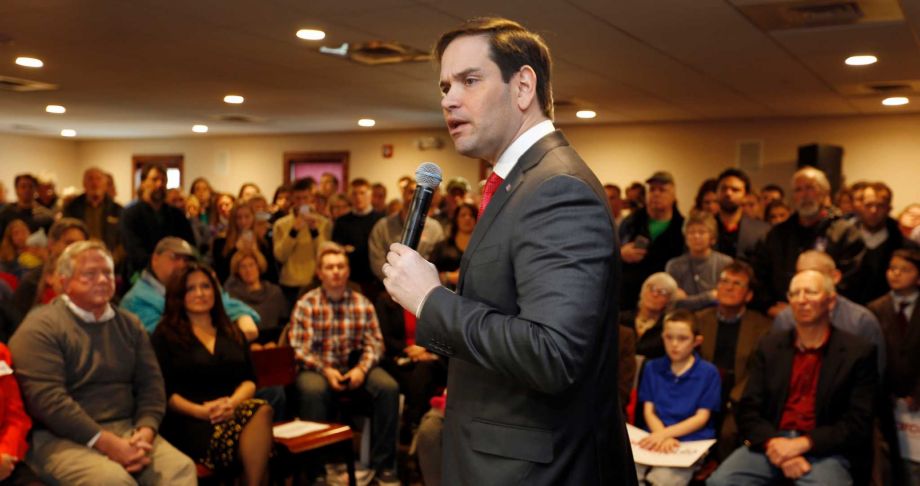
Marco Rubio is the best candidate to “keep America safe.” That’s the message South Carolina Gov. Nikki Haley is hoping to send to voters in a new advertisement released by the Rubio campaign. The advertisement comes just one day after the popular South Carolina Republican endorsed Rubio. “America can’t afford four more years like the last eight. That’s why I’m endorsing Marco Rubio for president. As the wife of a combat veteran, I know Marco will keep America safe,” she is shown saying in the 30-second spot. “And as your governor, I trust Marco to bring a conscience to Republicans in Washington and reign in our out-of- control federal government.” Haley goes on to say she is backing Rubio because “this election is about the future and the future is now.” The endorsement is expected to be a boost in South Carolina for Rubio. He’s in a battle with Ted Cruz for second in the Palmetto State. The endorsement also could mean bad news for former Florida Gov. Jeb Bush — who is in fourth in South Carolina, according to RealClearPolitics polling averages — who had hoped to get Haley’s backing. Bush told NBC’s Peter Alexander earlier this week that her endorsement “would be the most powerful, meaningful one in the state.” Haley is scheduled to hit the campaign trail with Rubio on Friday. The two are expected to be joined by U.S. Sen. Tim Scott and U.S. Rep. Trey Gowdy, both South Carolina Republicans. The South Carolina primary is Saturday.
Ted Cruz may be first Hispanic president, but rejects the label
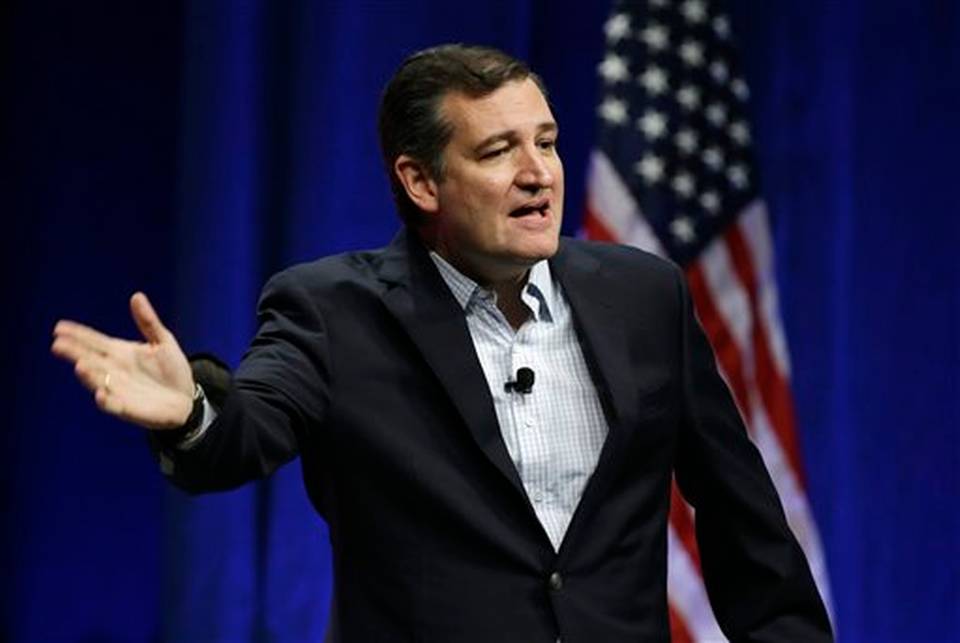
After his big win in the Iowa caucuses, Ted Cruz is one step closer to becoming the first Hispanic president in U.S. history. But that’s not how he wants to be known. Cruz, whose father was born in Cuba, admits that his Spanish-speaking skills are “lousy.” He offers up only the occasional “muchisimas gracias” on the campaign trail. His positions on immigration, including ending birthright citizenship and building a border wall, put him at odds with many Hispanic voters and advocacy groups. They accuse him of ignoring his heritage and issues that matter to many Latinos. Florida Sen. Marco Rubio shares some of the same conservative positions on immigration, some of which antagonize the Hispanic community – an ever-growing and increasingly powerful demographic in American elections. For both of the young senators, their heritage has not defined their supporter base or their political philosophies. But Cruz in particular has risked alienating many Hispanics by surrounding himself with conservatives such as Iowa Rep. Steve King, Cruz’s national campaign co-chairman, who has compared immigrants living in the country illegally to drug mules and livestock. In appealing to conservatives in mostly white Iowa and New Hampshire, it wasn’t necessary for Cruz or Rubio to appeal directly to Hispanic voters. But that will change quickly in Nevada on Feb. 23, where Latinos make up 28 percent of the population. Cruz’s top strategist, Jason Johnson, says the Texas senator can win the general election by capturing just 30 percent of Hispanics – not much more than the 27 percent Mitt Romney got in his failed 2012 White House bid. Instead of luring more Hispanics to his side, Cruz is counting on bringing out millions of mostly white evangelical Christians and working class voters who sat out the past two elections. “In the Democratic Party, you’re the Hispanic guy, you’re the African-American guy, you’re whatever your little bloc is, you’re pigeonholed and simply a quota representative,” Cruz told The Associated Press in a November interview. “One of the reasons I’m a Republican is because we treat people as individuals. … When I ran for Senate in Texas I didn’t run as: ‘Vote for the Hispanic guy.’” Cruz said he ran for the Senate as the strongest conservative and “that’s exactly how I’m running for president.” As a teenager in Cuba, his father Rafael Cruz joined an uprising against Cuban dictator Fulgencio Batista, during which time he was arrested and beaten. In 1957 – two years before Fidel Castro took power – the elder Cruz fled Cuba for the U.S., a story that Cruz often recounts on the campaign trail. He told AP that nothing sums up why he ran for office more than his father’s journey and fulfillment of the American dream. “Being the son of an immigrant who has fled oppression makes you appreciate how precious and fragile our freedom is, and is integral to who I am,” Cruz said. “But I think a great many of Hispanics in this country are tired of being stereotyped or taken for granted by the Democratic Party.” Cruz was born Rafael Edward Cruz in 1970. He spoke no Spanish at home and his parents spoke only English when around him. Cruz described in his 2015 autobiography “A Time for Truth” how as a child he was known by the nickname Felito. “The problem with that name was that it seemed to rhyme with every major corn chip on the market,” Cruz wrote. “Fritos, Cheetos, Doritos and Tostitos – a fact that other young children were quite happy to point out.” Cruz changed his name to Ted when he was 13 – a move that infuriated his father. For about two years, his father, who now travels the country campaigning for him, refused to call him Ted. By distancing himself from his cultural heritage, he’s opening himself to criticism from the other Cuban-American in the race. Rubio and Cruz clashed over their Spanish-speaking skills in last weekend’s GOP debate, with the fluent Rubio criticizing Cruz for not speaking Spanish. Cruz lashed back in heavily accented Spanish, a rare display of his limited knowledge of the language. Alfonso Aguilar, president of the Latino Partnership for Conservative Principles, said Cruz “doesn’t fundamentally understand the Latino community.” The Washington-based group of national conservative and Republican leaders has criticized both Cruz and Donald Trump for their opposition to legalizing people who are in the county illegally. Cruz and Rubio “have turned their back on our community” and are catering to the anti-immigrant fringe of the Republican Party, said Dolores Huerta, a longtime civil rights activist. “They really don’t share the values of the Latino community even though they happen to be Latinos themselves,” Huerta said. “We have to vote our values and for the people who are standing up for us. … We can’t vote for somebody just because they happen to be of Latino descent.” Republished with permission of the Associated Press.
Donald Trump holds commanding lead in SC, says new CNN poll
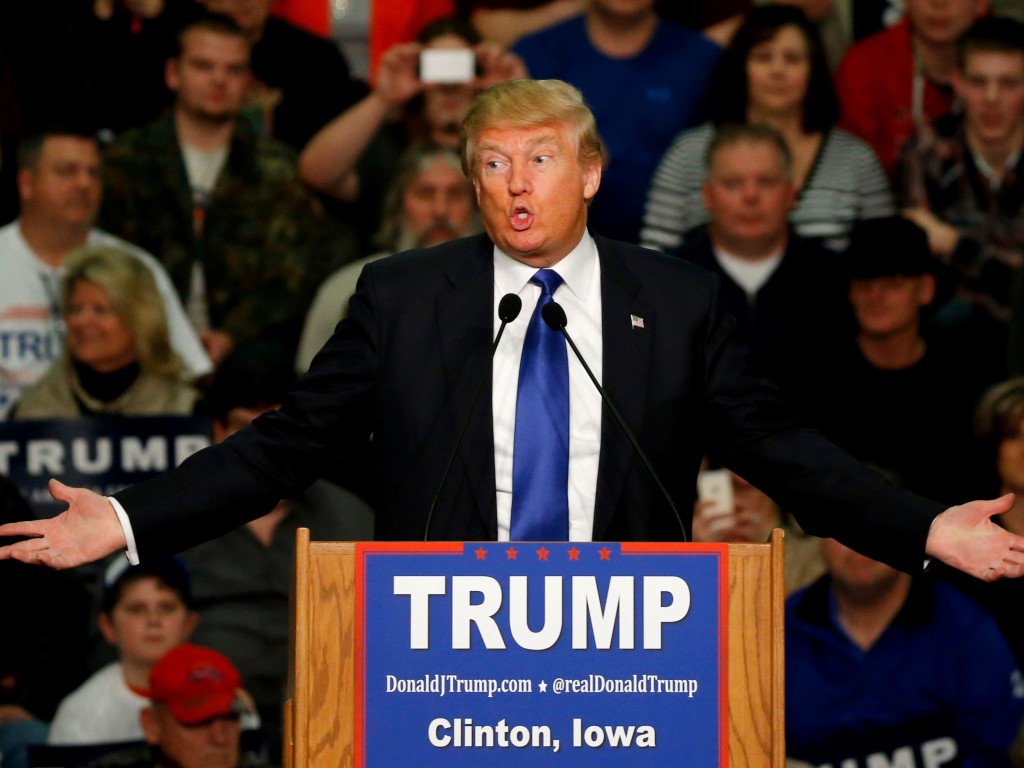
South Carolina Republicans think Donald Trump has the best chance of winning the general election this November, according to a new CNN/ORC International poll. The survey found 53 percent of likely South Carolina Republican primary voters said Trump had the best chance of winning the general election in November. Nineteen percent of respondents said Ted Cruz had the best chance of winning the general election, while 16 percent said Marco Rubio. Trump continues to hold a commanding lead in the polls, with 38 percent of likely Republican primary voters saying they were backing Trump in the primary. Cruz was in second with 22 percent, followed by Rubio at 14 percent and Jeb Bush at 10 percent. Ben Carson is at 6 percent, while John Kasich, who placed second in the New Hampshire primary, is at 4 percent. Fifty-eight percent of Republicans said Trump would be the best person to handle the economy, while 53 percent said he was the best candidate to tackle illegal immigration. On social issues, such as abortion and same-sex marriage, Cruz came out on top, with 28 percent of Republicans saying he would be the best candidate to deal with the issues. In the Democratic race, Hillary Clinton leads Bernie Sanders in South Carolina, 56 percent to 38 percent. The CNN/ORC International poll was conducted from Wednesday through Monday. Results among likely Republican voters have a margin of error of 5 percent; while the margin of error for results among Democratic primary voters is 6 percent.
Donald Trump and Hillary Clinton maintain sizable leads in national NBC News tracking poll
Republicans nationwide think Donald Trump will be their party’s nominee, according to a new NBC News|SurveyMonkey poll. The survey found 56 percent of Republicans and Republican-leaning voters believe Trump will be the eventual Republican nominee; while 22 percent said Ted Cruz would be the nominee. Ten percent of Republicans and Republican-leaning voters said Marco Rubio would be the nominee. The New York businessman continues to lead the Republican field with 38 percent support, followed by Cruz at 18 percent and Rubio at 14 percent. Ben Carson is at 8 percent, whileJohn Kasich is at 7 percent. Jeb Bush rounds out the field with 4 percent. On the Democratic side, Hillary Clinton leads Bernie Sanders, 50 percent to 40 percent. Sixty-six percent of Democrats and Democratic-leaning voters said they believe Clinton will be their party’s eventual nominee. The NBC News|SurveyMonkey weekly tracking poll was conducted from Feb. 8 through Feb. 14. The online survey sampled 13,1
Top Republicans stay quiet on release of their tax returns
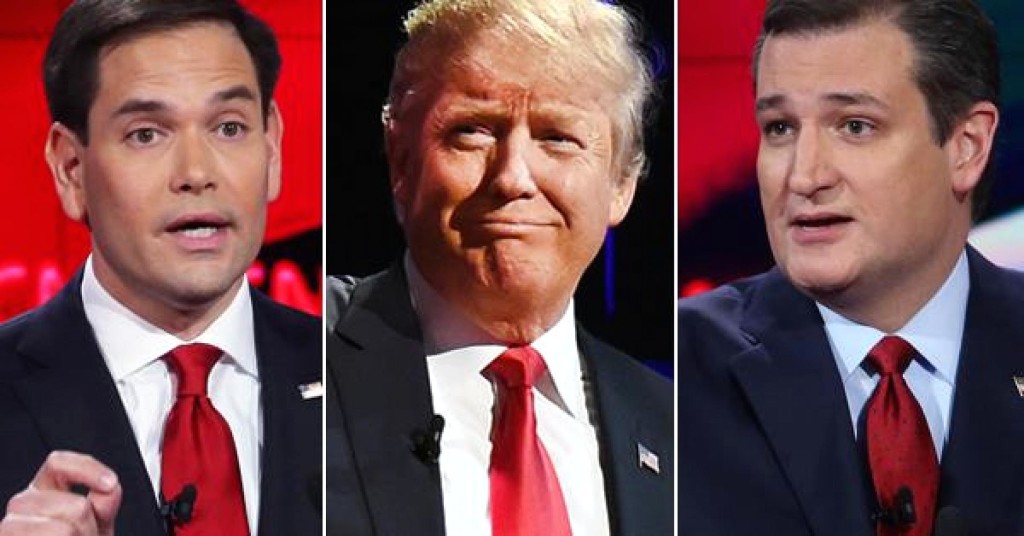
Mitt Romney, the 2012 Republican presidential candidate, offered this year’s hopefuls advice about a hard-learned lesson: Release your tax returns before the primaries and avoid tough scrutiny later. But the top three Republicans leading in national polls don’t appear to be listening. Even as other candidates – most notably Hillary Clinton and Jeb Bush – have already disclosed years’ worth of private tax returns to dispel questions about their personal finances, Donald Trump, Ted Cruz and Marco Rubio have failed to do the same despite promises to do so, sometimes after events that have now come and gone. None of the campaigns will say why they’ve delayed or when the candidates will release their returns. The best explanation: It’s postponing an unpleasant moment, said Joseph Thorndike, a contributing editor for Tax Notes who maintains the organization’s tax history project. “If you say you’re going to do it, you’ve got to do it,” Thorndike said. “I don’t like the disingenuousness of ‘we’re working on it.’” He said the candidates’ tax returns for 2014 were long ago filed with the government. The three Republican candidates have unequivocally said they will disclose their returns. Trump, who broke a promise in 2012 to disclose his returns if Obama produced his long-form birth certificate, said in January that he was preparing to release his “big returns.” The Cruz campaign told the Dallas Morning News in April that Cruz would release his returns soon after they were filed, but he still hasn’t. Shortly before Rubio filed his 2014 taxes last year, he told the Tampa Tribune that he would make them public. The Republican candidates have company on the Democratic side: Bernie Sanders released only excerpts from his 2014 tax returns. The documents – along with separate financial reports filed with the Federal Election Commission- showed little in the way of assets and an income mostly limited to his $174,000 Senate salary and a $5,000 annual pension from being mayor of Burlington, Vermont, from 1981 to 1989. The most interesting of the returns will likely be Trump’s, said Thorndike. Trump posted a photograph of himself on Twitter in October next to a stack of documents several feet tall. “If Donald Trump’s tax returns really are that big as the stack he had next to him, there’s a lot going on in there,” Thorndike said. Interpreting Trump’s wealth likely won’t be easy without access to the tax returns filed by his corporate entities, which Trump is unlikely to provide. But Trump’s personal returns should shed light on how lucrative his business empire truly is. It’s impossible to definitively say what trouble the returns could cause each candidate, but a key interest for Trump and Cruz will be how much they gave to charity. When Trump declared his candidacy last June, his campaign said he had given $100 million to charity over the previous five years. A review of the Donald J. Trump Foundation’s finances by the AP, however, found that none of the money the foundation had given away over that period came from Trump. Trump could have channeled his philanthropy through some other means than the foundation, though the campaign declined to provide any information to the AP. Charitable deductions could be revealing, too. Last January, Trump said he was permanently dedicating the driving range of his Rancho Palos Verdes, California, golf course to open space. Trump said that gift was worth $25 million. The AP’s review, however, found that Trump had never indicated an intention to build on the land and couldn’t have because of zoning laws. Cruz’s charitable donations could be as interesting. The Texas senator released five years of tax returns in January of 2012, revealing that the conservative Christian candidate and his wife had donated less than 1 percent of their $5 million income to charity. Cruz’s stinginess was especially notable since he says that private charity – not government programs – is the best source of aid to the poor. The San Antonio Express News reported that Cruz and his wife had given no money to their church. “All of us are on a faith journey, and I will readily admit that I have not been as faithful in this aspect of my walk as I should have been,” Cruz told the Christian Broadcasting Network in January, noting that the previous disclosures didn’t cover more recent contributions. Tax returns also will offer a better understanding of income from the candidates’ spouses. Cruz’s wife, Heidi, was a former managing director at Goldman Sachs. Rubio’s wife, Janet, worked at an events company that performed work for the family foundation of a major Rubio donor. Then-Sen. Barack Obama was criticized for miserly charitable contributions in 2008, and Clinton’s tax returns drew attention to her and Bill Clinton‘s accumulation of wealth from speaking fees. Romney’s tax returns raised unpleasant questions about preferential tax policies for the rich and his use of offshore investment vehicles – as well as a protracted debate over whether he should release more information. There is no legal requirement to share tax returns with the public, but every major party nominee since 1976 has done so – often well-before winning the nomination. “Four years ago, we were freaking out at Romney about his tax returns,” Thorndike said. Republished with permission of the Associated Press.
Presidential Primary Brief: 266 days until Election Day
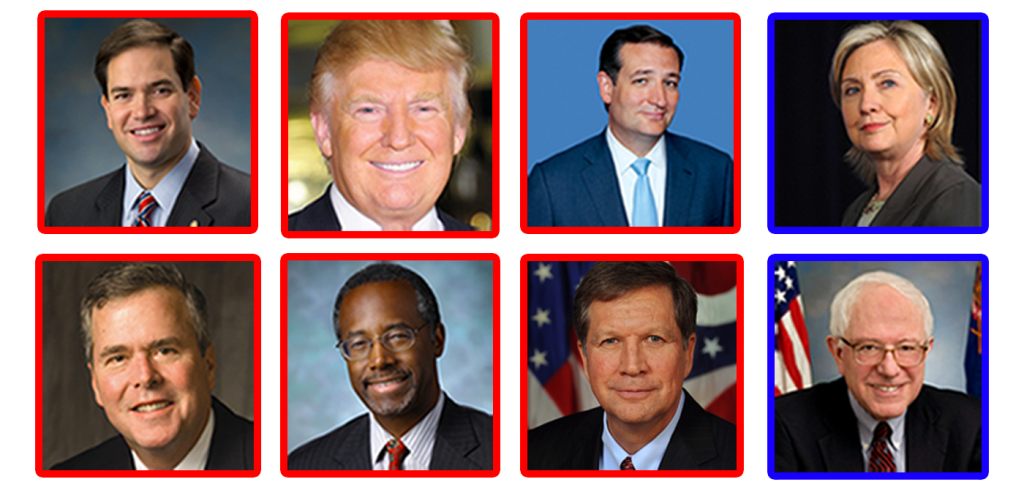
14 days until AL Presidential Primary 266 days until Election Day Convention Dates: Republican July 18-21, 2016, Democratic July 25-28, 2016 Weekly Headlines: Bernie Sanders defeats Hillary Clinton in NH primary Carly Fiorina suspends her presidential bid Chris Christie suspends campaign Press Clips: Michael Bloomberg confirms interest in a 2016 Presidential campaign (US News 2/9/16) As voters head to the polls for the New Hampshire primary today, there’s another twist in the presidential campaign: Former New York Mayor Michael Bloomberg has confirmed for the first time that he is considering a White House run as an independent. “I’m listening to what candidates are saying and what the primary voters appear to be doing,” Bloomberg told the Financial Times. He added: “I find the level of discourse and discussion distressingly banal and an outrage and an insult to the voters.” He said the public deserves “a lot better” and noted that he is “looking at all the options.” Bloomberg, a billionaire who owns a media empire named after him, said he would need to start placing his name on state ballots by early March in order to have a serious chance to win. But victory would be very difficult. Only Gilmore left out of CBS’ Republican debate on Saturday (Politico 2/12/16) Six Republican candidates for president will take the debate stage on Saturday night, leaving only former Gov. Jim Gilmore frozen out of CBS’ prime-time event. Donald Trump, Ted Cruz, Marco Rubio, Jeb Bush, Ben Carson and John Kasich all made the cut, according to CBS’ criteria. It will be one of the smallest showdowns for the Republicans thus far this cycle, which at one point saw 11 people crowded on stage. To qualify for the debate, candidates had to either place in the top five of the New Hampshire primary, place in the top three of the Iowa caucuses, or place among the top five candidates in averages of national and South Carolina polls. New Hampshire runner-up John Kasich is the anti-Donald Trump (US News 2/10/16) Who can stop Trump? As expected, Donald Trump cruised to a crushing victory in New Hampshire on Tuesday night. (Who would have believed last June when Trump entered the race that we’d be yawning at his winning New Hampshire?) Trump blew away his competitors, securing well above 30 percent of the vote – more than double that of the first runner-up. And that’s where the real story of New Hampshire lies: Ohio Gov. John Kasich came from the bottom of the pack to secure a second-place finish. Will he be the savior to deliver us from Trump? Carson: I reassess the future of my campaign every day (Politico 2/12/16) Ben Carson is constantly reassessing his campaign. “I reassess the future of the campaign every day, so of course I will continue to do that,” Carson said on MSNBC’s “Morning Joe” after he was asked what would happen if he didn’t do well in South Carolina. But Carson, who is currently in fifth place in the state, according to the RealClearPolitics polling average, has faith that South Carolina will change his luck. “I think South Carolina is gonna be the turning point,” the retired neurosurgeon said. He added that South Carolina is the type of place he loves to go to. Polls give Donald Trump huge advantage going into South Carolina (AOL News 2/12/16) Coming off of his first political win in New Hampshire, Donald Trump now has his sights set on South Carolina, and a new national poll shows he may be gaining even more momentum across the country. According to a poll from Morning Consult, he has more than double the support of any rival among self-identified Republicans and Republican-leaning independents. Trump holds a commanding 44 percent lead with this key voting bloc. His closest rival, Ted Cruz, only comes in with 17 percent of support. Cruz, Glenn Beck rip Trump on abortion, gay marriage (Politico 2/11/16) Ted Cruz and Glenn Beck unleashed a barrage of criticisms of Donald Trump on religion and social issues here, angling for support from voters in one of the most conservative parts of the state. At the massive Morningstar Fellowship Church, Cruz laced into Trump as weak on abortion, gay marriage and gun rights while Beck suggested Trump has never cracked open a Bible. “Too many people right now are looking at a guy like Donald Trump and believing that that man has ever opened a Bible. That’s the biggest crock of bullcrap I’ve ever heard. We all know it,” Beck said. Millennials paving the way: 2016 Presidential election (Huffington Post 2/12/16) How can it be a surprise that Millennials are excited about Senator Bernie Sanders? The Iowa caucus and New Hampshire primary were clear signs that Millennials could carry the 2016 presidential election. And the proof is in the numbers; over 80 percent of Democratic participants under the age of 30 voted for Senator Sanders according to a recent CNN poll. Obama reportedly received only 57 percent in 2008. So why are so many Millennials “feeling the Bern?” As GOP nomination fight gets more feisty, so does Marco Rubio (ABC News 2/12/16) Following a disappointing fifth place finish in New Hampshire, Marco Rubio is going on the offensive. Hoping for a better performance in Saturday’s South Carolina primary, Rubio has spent the last few days repeatedly blasting Donald Trump, Jeb Bush and Ted Cruz at various campaign stops in the Palmetto State. “Donald Trump has zero foreign policy experience,” Rubio said in Okatie, South Carolina. “Negotiating a hotel deal in another country is not foreign policy experience.” He also slammed Trump for recently using a vulgar word to refer to Cruz. Meet the super-rich driving the 2016 election (USA Today 2/8/16) Nearly half the money pouring into all federal super PACs came from just 107 people or groups that each gave $1 million or more to influence the outcome of this year’s presidential and congressional races, a USA TODAY analysis of new campaign finance reports shows.
Marco Rubio in rivals’ crosshairs for GOP’s South Carolina debate
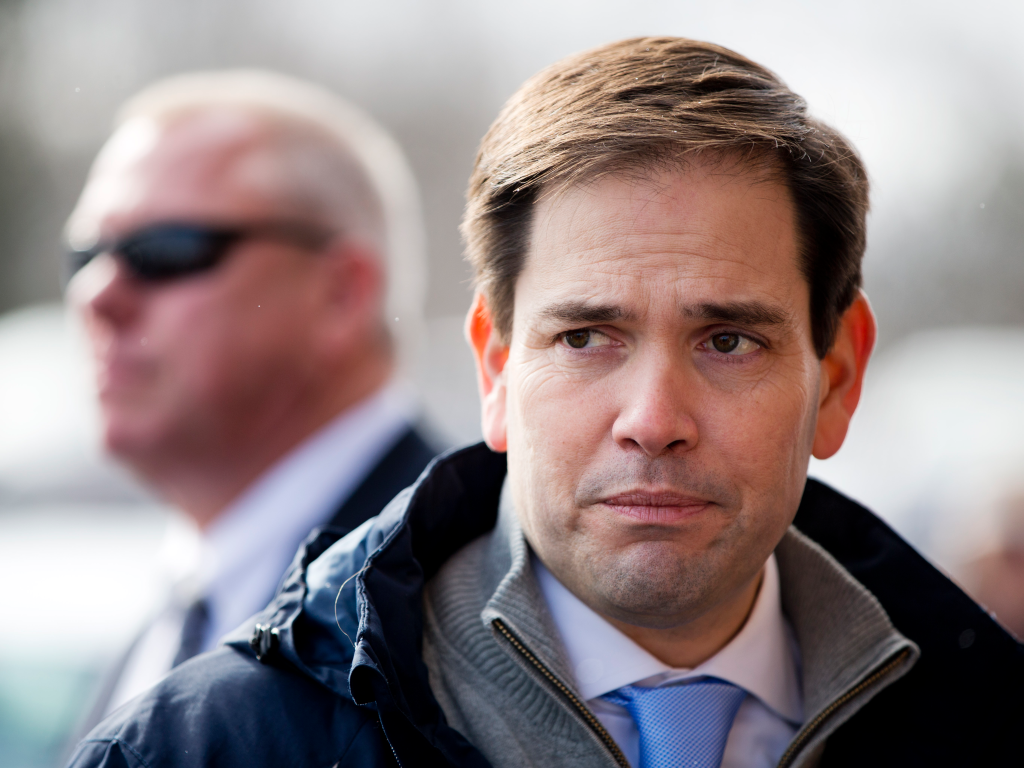
Marco Rubio enters Saturday night’s Republican presidential debate facing immense pressure to right his campaign after faltering badly in the last contest and finishing a disappointing fifth in New Hampshire. Rubio’s stumble re-energized some of his rivals as the race heads to the South and reignited questions about whether the 44-year-old first-term senator has the experience to be president. While he’s sought to shed some of his reliance on well-rehearsed talking points in recent days, the debate will be a prime test of whether he can rebound. Just six contenders will face off Saturday in Greenville, South Carolina, far from the long line of candidates who took the stage in earlier GOP debates. But even with a streamlined field, the Republican race remains deeply uncertain. Texas Sen. Ted Cruz and celebrity billionaire Donald Trump each have a state in their win column after respective victories in Iowa and New Hampshire, and both appear to be in a strong position heading into South Carolina’s Feb. 20 Republican primary. They’ve been sparring from afar for weeks but have so far kept their acrimony off the debate stage. Whether that pattern continues in Saturday’s contest is unknown. Cruz released a television advertisement before the debate accusing the real estate mogul of a “pattern of sleaze,” spurring Trump to fire back on Twitter with another round of questions about his Canadian-born rival’s eligibility to be president. If Cruz “doesn’t clean up his act, stop cheating, & doing negative ads, I have standing to sue him for not being a natural born citizen,” Trump wrote. While Trump will be standing at center stage, signifying his lead in national preference polls, Rubio will be the center of attention. Florida’s junior senator entered the last debate facing criticism from rivals who said that while he delivers a good speech and sharp answers in debates, he lacked depth. He played into that characterization when he repeated the same practiced line multiple times under pressure from New Jersey Gov. Chris Christie. Rubio’s poor performance has created a potential opening for former Florida Gov. Jeb Bush and Ohio Gov. John Kasich. Bush in particular will need a solid showing in South Carolina, given his prominent political family’s ties to the state, while Kasich is just hoping to remain viable until the race heads to friendly territory for the Midwestern governor. Katon Dawson, former chairman of the South Carolina GOP, said he expects the debate to have more of an effect on his state’s voters than the results in either Iowa or New Hampshire. “In the last couple of races, we have seen our voters hold their final pick until a couple of days before,” Dawson said. “After the church bells ring on Sunday, people are going to start paying a lot of attention.” Also on stage Saturday will be Ben Carson, the retired neurosurgeon who has struggled to stay relevant in the debates as his standing in the race sharply slipped. Carson pledged that he wouldn’t allow himself to be ignored. “I’m going to be much more boisterous,” he said on Fox TV. Poor showings in Iowa and New Hampshire led some frequent debate participants, including Christie and Kentucky Sen. Rand Paul, to end their campaigns. Nearly all lower polling candidates who have populated undercard debates have also all ended their White House bids.
Presidential contenders fight for minority voters in South Carolina
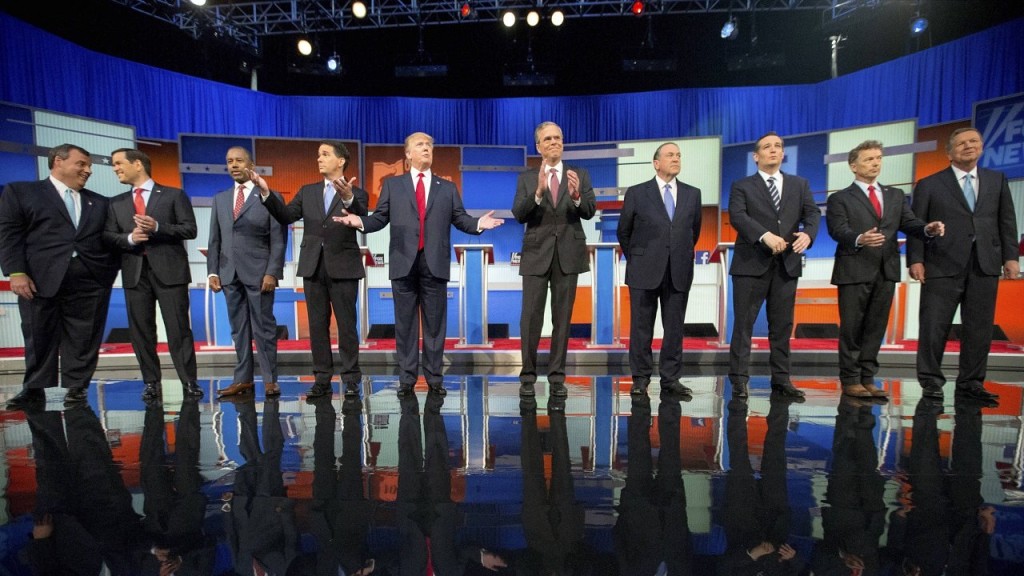
Presidential candidates in both parties battled for the crucial backing of blacks and Hispanics on Friday as the race shifted toward states with more minority voters. Republicans crisscrossed South Carolina looking to derail billionaire Donald Trump and Texas Sen. Ted Cruz, who each came to the state with a burst of momentum after the first two nomination contests. Several candidates embraced the chaos as they felt out the best strategies to survive South Carolina and advance into a grueling March primary schedule, when 58 percent of the party’s delegate total will be at stake. Former Florida Gov. Jeb Bush was embracing his family ties. Bush on Friday defended his decision to bring his brother, former President George W. Bush, to South Carolina to help him campaign. Speaking to ABC’s “Good Morning America,” Jeb Bush said recruiting the former president wasn’t a sign of desperation, as Trump has suggested. George W. Bush, who is slated to campaign for his brother on Monday, left the White House in January 2009 with low approval ratings. “This is the beginning of the campaign,” and “for my brother to speak on behalf of the skills I have to lead this country will be quite helpful,” Jeb Bush said. He later picked up the endorsement of South Carolina’s former first lady Iris Campbell, a longtime Bush family ally. Bush’s rival in the fight for the moderate establishment was still introducing himself to South Carolina voters. In a new biographical ad, Ohio Gov. John Kasich notes that his parents’ death in a drunk-driving crash in 1987 “transformed” him and helped him find his faith. A second new ad promises a whirlwind of activity in the first 100 days of a Kasich presidency — “no excuses, no surrender,” says a narrator with a hint of a Southern accent. Florida Sen. March Rubio, looking to re-establish his footing after a fifth-place finish in New Hampshire, lashed out at Trump, Cruz and Bush Thursday saying none of them possesses foreign policy experience required of a commander in chief. Trump was the only Republican to bypass South Carolina on Friday, redirecting his typically unconventional campaign to Florida, where he planned to hold a rally in Tampa. Meanwhile, at Thursday’s Democratic debate in Milwaukee, Hillary Clinton, who has cast herself as the rightful heir to President Barack Obama‘s legacy, accused rival Bernie Sanders of diminishing the president’s record and short-changing Obama’s leadership. “The kind of criticism I hear from Sen. Sanders, I expect from Republicans. I do not expect it from someone seeking the Democratic nomination,” Clinton said in a sharp exchange at the close of the two-hour debate. Her biting comments followed an interview in which Sanders suggested Obama hadn’t succeeded in closing the gap between Congress and the American people — something the president himself has acknowledged. Sanders responded: “Madam Secretary, that is a low blow.” And he noted that Clinton was the only one on the stage who ran against Obama in 2008. Long viewed as the overwhelming front-runner in the Democratic race, Clinton has been caught off guard by Sanders’ strength, particularly his visceral connection with Americans frustrated by the current political and economic systems. Clinton’s own campaign message has looked muddled compared to Sanders’ ringing call for a “political revolution,” and her connections to Wall Street have given the Vermont senator an easy way to link her to the systems his supporters want to overhaul. Clinton was scheduled to campaign in South Carolina on Friday, after which, the two Democratic rivals were scheduled to attend a dinner event in Minnesota. Republished with permission of the Associated Press.
