
Democrats’ letter urges amendment to National Defense Authorization Act

Vetting human rights security cooperation programs is the focus of a letter sent to the House and Senate Armed Services Committees by a pair of Democrats. California Congresswoman Sara Jacobs, Maryland Senator Chris Van Hollen, and 13 other federal legislators are urging the committees to include their amendment that would require vetting of human rights in cooperation programs within the fiscal year 2023 National Defense Authorization Act conference pact. According to the letter sent to Chairman Jack Reed, D-RI; Chairman Adam Smith, D-WA; Ranking Member Jim Inhofe, R-OK; and Ranking Member Mike Rogers, R-AL, members are pushing for House-ratified provisions of the Upholding Human Rights Abroad Act that would, if enacted, close loopholes in the Leahy Laws that would “guarantee human rights vetting” of U.S. security assistance that would prevent taxpayer funds from aiding human rights abusers. “This provision would strengthen the U.S. commitment to human rights by increasing vetting measures to ensure that recipients of U.S. support have not committed human rights violations or violations of international humanitarian law,” the members wrote in the letter. “Consistent with the Department of Defense Leahy Law, this provision allows for the use of a national security waiver.” The members wrote that the provisions would give the flexibility that would “continue to address U.S. national security priorities” that would allow the State Department to “undertake this additional vetting.” “This provision would help prevent civilian harm, ensure partner compliance with human rights, and improve intended long-term outcomes toward good governance, rule of law, peace, and human rights promotion,” the members wrote. The letter was also signed by Senators Dick Durbin, D-Ill; Patrick Leahy, D-VT; and Richard Blumenthal, D-CT; and Representatives Jason Crow, D-CO; Chrissy Houlahan, D-PA; Tom Malinowski, D-NJ; Joaquin Castro, D-TX; Albio Sires, D-NJ; Dina Titus, D-NV; Ted Lieu, D-CA; Colin Allred, D-TX-32; Gerry Connolly, D-VA; and Dean Phillips, D-MN. Republished with the permission of The Center Square.
House passes gun control bill after Buffalo, Uvalde attacks

The House passed a wide-ranging gun control bill Wednesday in response to recent mass shootings in Buffalo, New York, and Uvalde, Texas, that would raise the age limit for purchasing a semi-automatic rifle and prohibit the sale of ammunition magazines with a capacity of more than 15 rounds. The legislation passed by a mostly party-line vote of 223-204. It has almost no chance of becoming law as the Senate pursues negotiations focused on improving mental health programs, bolstering school security, and enhancing background checks. But the House bill does allow Democratic lawmakers a chance to frame for voters in November where they stand on policies that polls show are widely supported. “We can’t save every life, but my God, shouldn’t we try? America, we hear you, and today in the House, we are taking the action you are demanding,” said Rep. Veronica Escobar, D-Texas. “Take note of who is with you and who is not.” The push comes after a House committee heard wrenching testimony from recent shooting victims and family members, including from 11-year-old girl Miah Cerrillo, who covered herself with a dead classmate’s blood to avoid being shot at the Uvalde elementary school. The seemingly never-ending cycle of mass shootings in the United States has rarely stirred Congress to act. But the shooting of 19 children and two teachers in Uvalde has revived efforts in a way that has lawmakers from both parties talking about the need to respond. “It’s sickening, it’s sickening that our children are forced to live in this constant fear,” said House Speaker Nancy Pelosi, D-Calif. Pelosi said the House vote would “make history by making progress.” But it’s unclear where the House measure will go after Wednesday’s vote, given that Republicans were adamant in their opposition. “The answer is not to destroy the Second Amendment, but that is exactly where the Democrats want to go,” said Rep. Jim Jordan, R-Ohio. The work to find common ground is mostly taking place in the Senate, where support from 10 Republicans will be needed to get a bill signed into law. Nearly a dozen Democratic and Republican senators met privately for an hour Wednesday in hopes of reaching a framework for compromise legislation by week’s end. Participants said more conversations were needed about a plan that is expected to propose modest steps. In a measure of the political peril that efforts to curb guns pose for Republicans, five of the six lead Senate GOP negotiators do not face reelection until 2026. They are Sens. Bill Cassidy of Louisiana, Susan Collins of Maine, John Cornyn of Texas, Lindsey Graham of South Carolina, and Thom Tillis of North Carolina. The sixth, Pat Toomey of Pennsylvania, is retiring in January. It’s also notable that none of the six is seeking the Republican presidential nomination. While Cornyn has said the talks are serious, he has not joined the chorus of Democrats saying the outlines of a deal could be reached by the end of this week. He told reporters Wednesday that he considers having an agreement before Congress begins a recess in late June to be “an aspirational goal.” The House bill stitches together a variety of proposals Democrats had introduced before the recent shootings in Buffalo and Uvalde. The suspects in the shootings at the Uvalde elementary school and Buffalo supermarket were both just 18, authorities say, when they bought the semi-automatic weapons used in the attacks. The bill would increase the minimum age to buy such weapons to 21. “A person under 21 cannot buy a Budweiser. We should not let a person under 21 buy an AR-15 weapon of war,” said Rep. Ted Lieu, D-Calif. Republicans have noted that a U.S. appeals court ruling last month found California’s ban on the sale of semi-automatic weapons to adults under 21 was unconstitutional. “This is unconstitutional, and it’s immoral. Why is it immoral? Because we’re telling 18, 19, and 20-year-olds to register for the draft. You can go die for your country. We expect you to defend us, but we’re not going to give you the tools to defend yourself and your family,” said Rep. Thomas Massie, R-Ky. The House bill also includes incentives designed to increase the use of safe gun storage devices and creates penalties for violating safe storage requirements, providing for a fine and imprisonment of up to five years if a gun is not properly stored and is subsequently used by a minor to injure or kill themselves or another individual. It also builds on the Biden administration’s executive action banning fast-action “bump-stock” devices and “ghost guns” that are assembled without serial numbers. The House is also expected to approve a bill Thursday that would allow families, police, and others to ask federal courts to order the removal of firearms from people who are believed to be at extreme risk of harming themselves or others. Nineteen states and the District of Columbia currently have such “red flag laws.” Under the House bill, a judge could issue an order to temporarily remove and store the firearms until a hearing can be held no longer than two weeks later to determine whether the firearms should be returned or kept for a specific period. Republished with the permission of The Associated Press.
Donald Trump faces ‘incitement of insurrection’ impeachment charge
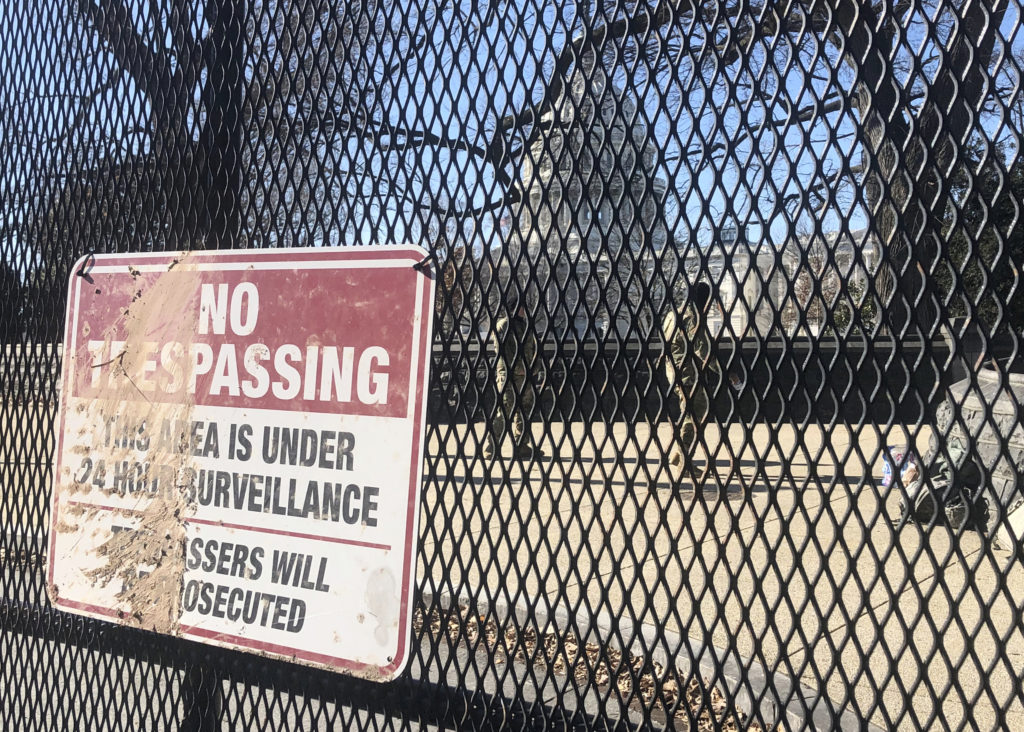
As the House prepares for impeachment, President Donald Trump faces a single charge — “incitement of insurrection” — over the deadly riot at the U.S. Capitol, according to a draft of the articles obtained by The Associated Press. Lawmakers are set to introduce the legislation Monday, with voting mid-week. Pelosi’s leadership team also will seek a quick vote on a resolution calling on Vice President Mike Pence and Cabinet officials to invoke the 25th Amendment. The four-page impeachment bill draws from Trump’s own false statements about his election defeat to Democrat Joe Biden; his pressure on state officials in Georgia to “find” him more votes; and his White House rally ahead of the Capitol siege, in which he encouraged thousands of supporters to “fight like hell” before they stormed the building on Wednesday. A violent and largely white mob of Trump supporters overpowered police, broke through security lines and windows, and rampaged through the Capitol, forcing lawmakers to scatter as they were finalizing Biden’s victory over Trump in the Electoral College. “President Trump gravely endangered the security of the United States and its institutions of Government,” the legislation said. The bill from Reps. David Cicilline of Rhode Island, Ted Lieu of California, Jamie Raskin of Maryland, and Jerrold Nadler of New York, said Trump threatened “the integrity of the democratic system, interfered with the peaceful transition of power” and “betrayed” trust. “He will remain a threat to national security, democracy, and the Constitution if allowed to remain in office,” they wrote. Rep. Adam Schiff, D-Ca., said Monday on CBS, “We need to move forward with alacrity.” House Speaker Nancy Pelosi says the House will proceed with legislation to impeach Trump as she pushes the vice president and the Cabinet to invoke constitutional authority to force him out, warning that Trump is a threat to democracy after the deadly assault on the Capitol. A Republican senator, Pat Toomey of Pennsylvania, joined Republican Sen. Lisa Murkowski of Alaska over the weekend in calling for Trump to “resign and go away as soon as possible.” Lawmakers warned of the damage the president could still do before Joe Biden is inaugurated Jan. 20. Trump, holed up at the White House, was increasingly isolated after a mob rioted in the Capitol in support of his false claims of election fraud. Judges across the country, including some nominated by Trump, repeatedly dismissed cases and Attorney General William Barr, a Trump ally, said there was no sign of any widespread fraud. “We will act with urgency, because this President represents an imminent threat,” Pelosi said in a letter late Sunday to colleagues emphasizing the need for quick action. “The horror of the ongoing assault on our democracy perpetrated by this President is intensified and so is the immediate need for action.” During an interview on “60 Minutes” aired Sunday, Pelosi invoked the Watergate era when Republicans in the Senate told President Richard Nixon, “It’s over.” “That’s what has to happen now,” she said. Pence has given no indication he would act on the 25th Amendment. If he does not, the House would move toward impeachment. Toomey said he doubted impeachment could be done before Biden is inaugurated, even though a growing number of lawmakers say that step is necessary to ensure Trump can never hold elected office again. “I think the president has disqualified himself from ever, certainly, serving in office again,” Toomey said. “I don’t think he is electable in any way.” Murkowski, long exasperated with the president, told the Anchorage Daily News on Friday that Trump simply “needs to get out.” A third, Sen. Roy Blunt, R-Mo., did not go that far, but on Sunday he warned Trump to be “very careful” in his final days in office. On impeachment, House Democrats would likely delay for 100 days sending articles of impeachment to the Senate for trial, to allow Biden to focus on other priorities. Sen. Marco Rubio, R-Fla., said that instead of coming together, Democrats want to “talk about ridiculous things like ‘Let’s impeach a president’” with just days left in office. Still, some Republicans might be supportive. Nebraska Sen. Ben Sasse said he would take a look at any articles that the House sent over. Illinois Rep. Adam Kinzinger, a frequent Trump critic, said he would “vote the right way” if the matter were put in front of him. The Democratic effort to stamp Trump’s presidential record — for the second time — with the indelible mark of impeachment advanced rapidly after the riot. Rep. David Cicilline, D-R.I, a leader of the House effort to draft impeachment articles accusing Trump of inciting insurrection, said Sunday that his group had 200-plus co-sponsors. Potentially complicating Pelosi’s decision about impeachment was what it meant for Biden and the beginning of his presidency. While reiterating that he had long viewed Trump as unfit for office, Biden on Friday sidestepped a question about impeachment, saying what Congress did “is for them to decide.” Republished with the permission of the Associated Press.
Chaotic scene as Republicans disrupt impeachment deposition

Republicans briefly brought the Democrat-led impeachment investigation to a halt when around two dozen GOP House members stormed into a closed-door deposition with a Defense Department official. Democrats said the move compromised national security because some of the Republicans took electronic devices into a secure room. The protest by Republican lawmakers on Wednesday captured national attention, drawing the focus away from the testimony of a top U.S. diplomat who told lawmakers just a day earlier that he was told President Donald Trump was withholding military aid from Ukraine unless the country’s president pledged to investigate Democrats. The maneuver delayed a deposition with Laura Cooper, a senior Defense Department official who oversees Ukraine policy, until midafternoon. The interview began roughly five hours behind schedule, after a security check by Capitol officials, and ended after roughly four hours. As a series of diplomats have been interviewed in the impeachment probe, many Republicans have been silent on the president’s conduct. But they have been outspoken about their disdain for Democrats and the impeachment process, saying it is unfair to them even though they have been in the room questioning witnesses and hearing the testimony. “The members have just had it, and they want to be able to see and represent their constituents and find out what’s going on,” said Ohio Rep. Jim Jordan, the top Republican on the House Oversight and Reform panel. That committee is one of three leading the investigation, and its members are allowed into the closed-door hearings. Lawmakers described a chaotic scene. Rep. Debbie Wasserman Schultz, Democrat – Florida, said she had just walked into the room when the Republican lawmakers blew past Capitol police officers and Democratic staffers. The staff member who was checking identification at the entrance was “basically overcome” by the Republicans, she said. “Literally some of them were just screaming about the president and what we’re doing to him and that we have nothing and just all things that were supportive of the president,” Wasserman Schultz said. Later when the deposition began, Cooper answered questions from lawmakers and staffers in response to a subpoena, an official working on the impeachment inquiry said. She explained to lawmakers the process of distributing military aid and was asked whether the appropriate steps were followed on Ukraine, according to a person familiar with the interview. The official working on the impeachment inquiry and the person familiar with the interview spoke on the condition of anonymity to discuss the closed-door testimony. “The president’s allies in Congress are trying to make it even more difficult for these witnesses to cooperate,” said Adam Schiff, the chairman of the House intelligence committee. Democrats deny that Republicans are being treated unfairly, noting they have had equal time to question witnesses and full access to the meetings. Schiff says closed-door hearings are necessary to prevent witnesses from concealing the truth and has promised to release the transcripts when it will not affect the investigation. They also said the Republicans — several of whom do not sit on one of the three committees — compromised security at Wednesday’s closed-door deposition. The interviews are being held in what is called a Sensitive Compartmented Information Facility, or SCIF, which is a secure room where members can hear classified information. Several lawmakers leaving the facility said that some of the Republicans had their cellphones, even though electronics are not allowed. All members of Congress are familiar with the protocol of the SCIF, since they are often invited to classified briefings, and there are several such rooms around the Capitol. Several Republicans appeared to be tweeting from the secure room. North Carolina Rep. Mark Walker tweeted: “UPDATE: We are in the SCIF and every GOP Member is quietly listening.” Rep. Bennie Thompson, Democrat – Mississippi, who chairs the House Homeland Security Committee, alleged that Republicans “intentionally brought their electronic devices” into the secure area, violating congressional rules and the oath they take to gain access to classified information. The “unprecedented breach of security raises serious concerns” for committee chairs who maintain secure facilities in the Capitol, Thompson wrote in a letter to the House sergeant at arms asking for action to be taken against members of Congress involved in the breach.Sen. Lindsey Graham, Republican – South Carolina, criticized his Republican colleagues for the tactic, calling them “nuts” to make a “run on the SCIF.” “That’s not the way to do it,” he said. Graham later tweeted that he initially believed Republicans had taken the room by force and that it was actually a “peaceful protest,” adding his House GOP colleagues had “good reason to be upset.” The Republicans who took part in the protest were unbowed. Rep. Steve Scalise, the No. 2 House Republican, said Democrats are running a “Soviet-style process” that should “not be allowed in the United States of America.” “We’re not going to be bullied,” he said. The standoff came the day after William Taylor testified that he was told Trump withheld military aid to Ukraine until the country’s president went public with a promise to investigate Democrats. Trump wanted to put Ukraine’s leader “in a public box,” Taylor recalled. Democratic Rep. Ted Lieu of California said Republicans did not want to hear from Cooper because they were “freaked out” by that testimony. “They know more facts are going to be delivered that are absolutely damning to the president of the United States,” Lieu said. Associated Press writers Alan Fram, Robert Burns and Padmananda Rama contributed to this report. By Michael Balsamo and Mary Clare Jalonick Associated Press Republished with the permission of the Associated Press.
Donald Trump stands by ‘culture’ criticism of European immigration

President Donald Trump pressed ahead Friday with his complaints that European immigration policies are changing the “fabric of Europe” and destroying European culture. During a news conference with British Prime Minster Theresa May, Trump backtracked on the criticism of May that he made in an explosive interview released as he began his visit to the country. But he reiterated his belief that Europe’s decision to accept migrants from Middle Eastern and African countries is “a very negative thing for Europe.” Standing next to May at Chequers, the prime minister’s official country estate, Trump acknowledged that his remarks were “politically not necessarily correct.” But he said European countries need to “watch themselves.” “You are changing culture, you are changing a lot of things,” he said, adding, “You see the same terror attacks that I do.” Trump was reiterating a position he articulated in an interview released Thursday by The Sun, in which he also criticized May’s handling of Brexit negotiations and said “I think allowing millions and millions of people to come into Europe is very, very sad.” May quickly rebutted Trump during their joint appearance, saying the U.K. has a “proud history of welcoming people who are fleeing persecution to our country.” “Over the years, overall immigration has been good for the U.K.,” she added. “It’s brought people with different backgrounds, different outlooks here to the U.K. and we’ve seen them contributing to our society and our economy.” Critics have faulted the president for using language that echoes white supremacist laments about the loss of white power. Rep. Adriano Espaillat, D-N.Y., born in the Dominican Republic, said Trump was “trying to throw gasoline on fire and begin a culture war, and it’s unfortunate that he’s divisive in the United States and he’s divisive in Europe as well.” “We all tout our nation as being a nation of immigrants,” Espaillat said. “For him to characterize that as something negative that we should avoid is sort of going against the most important and fundamental tenets of our country.” Rep. Ted Lieu, D-Calif., born in Taipei, Taiwan, said American culture is constantly changing through immigration. “That’s what makes our country amazing and great,” Lieu said. “It is a continual renewal of our American ideals set forth in our Constitution and Declaration of Independence with every new successive generation.” Trump said he believes that the U.K.’s Brexit vote in 2016 was in part a response to lax European immigration laws, and he has frequently tried to use Europe as a cautionary tale for the U.S., where he is seeking to implement more hawkish migration policies. Trump has used tough rhetoric on immigration to motivate his political base at home, at times using racial or ethnic undertones. During the 2016 presidential campaign, he drew global condemnation for a call to ban Muslim immigration to the U.S. Since entering the White House, he has enacted travel restrictions for citizens from some Muslim-majority countries, curtailed refugee admissions to the U.S. and called for “extreme vetting” of those entering the U.S. He drew fire from Democrats earlier this year for describing MS-13 gang members, many of them immigrants to the U.S., as “animals.” Republished with the permission of the Associated Press.
Democratic lawmakers seek criminal corruption probe of EPA’s Scott Pruitt
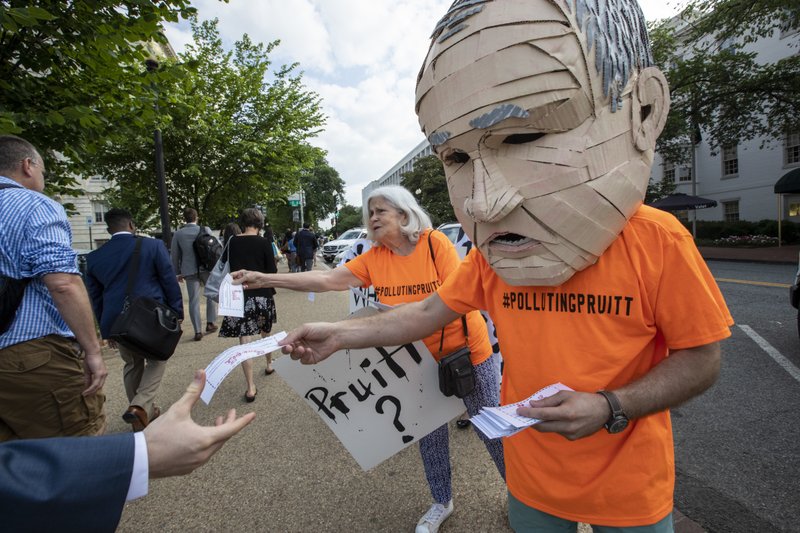
House Democrats on Friday formally requested that the Justice Department investigate Environmental Protection Agency Administrator Scott Pruitt for potential criminal conduct. In a letter to FBI Director Chris Wray and Justice criminal division chief John Cronan, six Democratic lawmakers with oversight of Pruitt’s agency allege he repeatedly violated federal anti-corruption laws by seeking to leverage his government position for personal gain. As evidence, the Democrats cite Pruitt’s $50-a-night lease of a Capitol Hill condo tied to a lobbyist seeking to influence his agency, directing an EPA aide to contact a senior Chick-fil-A executive as part of an effort to land his family a franchise, and a $2,000 payment to his wife from organizers of a conference the administrator then attended at taxpayer expense. A spokesman for Pruitt did not immediately respond to messages seeking comment. The letter was signed by Democratic Reps. Gerald Connolly and Donald Beyer of Virginia, Jamie Raskin of Maryland, Ruben Gallego of Arizona, Pramila Jayapal of Washington and Ted Lieu of California. Connolly is a senior member of the House Committee on Oversight and Government Reform and serves as the ranking Democrat on the Subcommittee on Government Operations. President Donald Trump signaled Friday he is still standing by his embattled EPA chief, even as Pruitt’s support among other Republicans has started to erode. “Scott Pruitt is doing a great job within the walls of the EPA,” Trump told reporters at the White House. “I mean, we’re setting records. Outside he’s being attacked very viciously by the press. And I’m not saying that he’s blameless. But we’ll see what happens.” For his part, Pruitt sought to laugh off the controversy this week over his using government resources to seek a “business opportunity” with the fast-food fried chicken chain whose owners are known for supporting conservative Christian causes, including outspoken opposition to same-sex marriage. “I mean, look, my wife is an entrepreneur herself. I love, she loves, we love Chick-fil-A as a franchise of faith,” Pruitt said in a TV interview on Wednesday. In their letter, the House Democrats make their case that Pruitt’s conduct rises to the level of criminal conduct. “At the very least, we know that federal ethics laws bar public officials from using their position or staff for private gain,” the Democrats wrote to Wray and Cronan. “Administrator Pruitt has certainly done just that. Further, his actions related to his wife’s employment and the quid-pro-quo condo situation with industry lobbyists may have crossed a line into criminal conduct punishable by fines or even by time in prison.” Republished with the permission of the Associated Press.
