
Federal judges review Alabama’s new congressional map, lack of 2nd majority-Black district
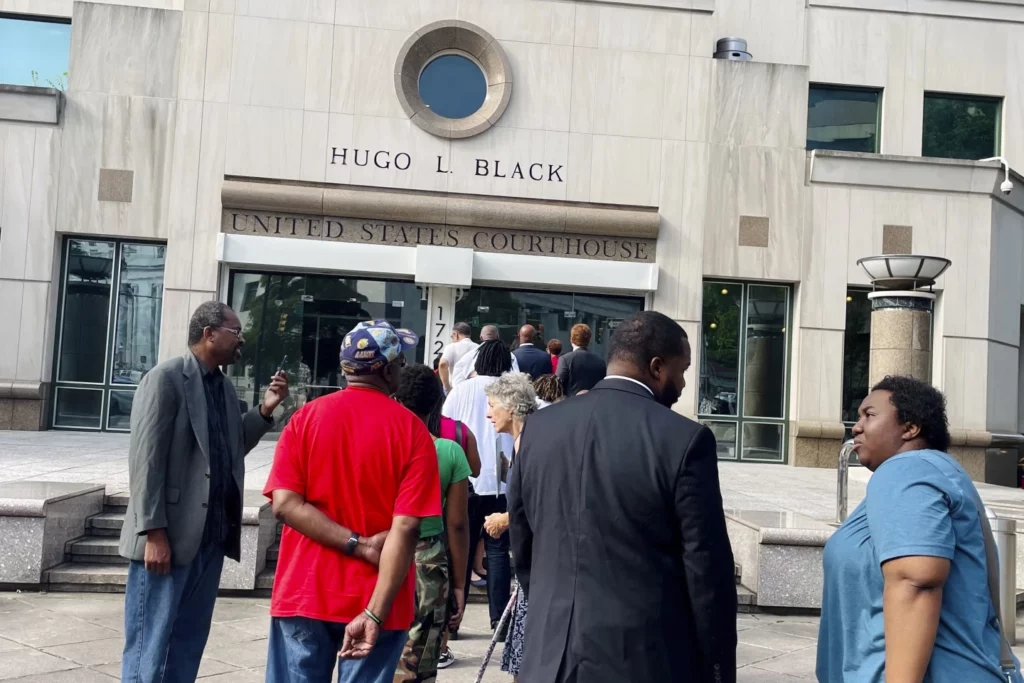
Federal judges reviewing Alabama’s new congressional map on Monday sharply questioned if state lawmakers ignored the court’s directive to create a second-majority Black district, so minority voters have a fair opportunity to influence elections. The three-judge panel held a hearing as they weigh whether to let the map stand or to step in and draw new congressional districts for the state. The panel heard arguments Monday but did not indicate when it would rule. Alabama was forced to draw new district lines after the U.S. Supreme Court, in a surprise June decision, upheld the panel’s earlier finding that the state’s then-map — which had just one Black-majority district out of seven in a state where more than one in four residents is Black — likely violated the federal Voting Rights Act. Lawyers for voters in the case argued Monday that the new plan, which maintains one majority-Black district, still discriminates against Black voters. They said it flouts the panel’s 2022 finding that Alabama should have two districts where Black voters comprise a majority or “something quite close to it.” All three judges pointedly asked the state’s lawyer whether Alabama had ignored their finding that the state should have a second district where Black voters have an opportunity to elect their preferred candidates. Judge Judge Terry F. Moorer asked if Alabama had chosen to “deliberately disregard” the court’s instruction. Judge Stan Marcus asked the state, “Were you not required to draw a new map (that provides a reasonable) opportunity (district for Black voters)?” Edmund LaCour, Alabama’s solicitor general, said the redrawn map was as “close as you get” to creating a second majority-Black district without violating the U.S. Constitution or traditional redistricting criteria. “I think it is close as you get without violating the Constitution,” LaCour said. LaCour accused the plaintiffs of seeking a “racial gerrymander” over traditional guidelines for drawing districts, such as keeping districts compact and keeping communities of interest together. Abha Khanna, an attorney representing one group of plaintiffs in the case, said Alabama chose “defiance over compliance.” “Alabama has chosen instead to thumb its nose at this court and to thumb its nose at the nation’s highest court and to thumb its nose at its own Black citizens,” Khanna said. Khanna said Alabama essentially changed nothing for Black voters by passing a map that maintained a single majority-Black district. White voters will continue to Alabama Republicans, who have been reluctant to create a Democratic-leaning district, boosted the percentage of Black voters in the majority-white 2nd Congressional District, now represented by Republican Rep. Barry Moore, from about 30% to 39.9%. State leaders are engaging in a high-stakes wager that the panel will accept their proposal or that the state will prevail in a second round of appeals to the Supreme Court which could again test the requirements of the Voting Rights Act. The panel in 2022 issued a preliminary injunction blocking the state’s then-map. During the court hearing, a judge asked the sides about next steps and whether they were starting anew in the review of the map. The high-stakes hearing drew a large number of spectators to the federal courthouse in Birmingham, where an overflow room was opened to accommodate the large crowd. Plaintiffs in the Supreme Court case attended, with many wearing T-shirts printed with their proposed map, which would have two majority-Black districts. Former U.S. Attorney General Eric Holder, chairman of the National Democratic Redistricting Committee, said in a statement that Alabama’s new map “denies Black Alabamians their lawfully protected rights.” “Alabama’s latest congressional map is a continuation of the state’s sordid history of defying court orders intended to protect the rights of Black voters,” Holder said. Republished with the permission of The Associated Press.
Alabama woman embezzled $200K from church, gets 5 years

An Alabama woman has been sentenced to five years in prison for wire fraud after she was convicted of embezzling more than $200,000 from the church where she worked for 12 years. U.S. District Judge Terry F. Moorer also sentenced Sharon Collins, 53, of Foley, to three years of supervised release and ordered her to pay more than $211,000 in restitution, al.com reported. Collins worked as a financial secretary for the First Baptist Church in Foley between May 2007 and July 2019. She was responsible for managing the church’s accounting system, preparing financial reports, and managing church-issued credit cards. According to prosecutors, Collins used church funds to make hundreds of electronic transactions using unauthorized church-issued credit cards to cover the costs of trips to New Orleans and Las Vegas, a cruise, jewelry, and funding a bachelor’s degree. Prosecutors said Collins later admitted to making several false statements, including lying about having the church’s approval to make the purchases. Republished with the permission of The Associated Press.
Annemarie Axon confirmed as U.S. District Judge
U.S. Sen. Richard Shelby released at statement on Wednesday celebrating the confirmation vote for U.S. District Judge for the Northern District of Alabama, Annemarie Carney Axon. Axon, who nominated for the position by President Donald Trump in 2017, appeared before the Senate Judiciary Committee for the consideration of her nomination this week. “It is critically important for a judge to be fair, open-minded, courteous, and respectful to the attorneys and parties in each case,” Axon told the committee; promising to “conduct [herself] and [her] courtroom in a manner that strives to leave people with the conviction that they were treated fairly, respectfully, and that [she] followed the law, regardless of the outcome.” She then ended her hearing with a statement, saying that “our democracy demands an independent judiciary whose decisions are based exclusively on the law, as it is written.” Shelby congratulated Axon in a news release, saying “Annemarie Axon is exceptionally qualified to be a U.S. district judge. Her strong, respectful temperament and commitment to impartiality make her well-suited for this esteemed position. Alabama’s district judges must be confirmed as swiftly as possible to ensure the efficiency of our judicial system. These judges serve as the backbone of the United States Judicial Branch, and I am honored to have played a part in Axon’s confirmation today.” Axon was one of seven Alabama judicial nominees awaiting confirmation from the Judiciary Committee. The other nominees include: Terry F. Moorer Jeffrey Beaverstock Emily Coody Marks Liles Burke Andrew Brasher Corey Maze Axon is currently a member of the Wallace, Jordan, Ratliff, & Brandt, LLC, legal team in Birmingham, where she focuses on fiduciary and probate litigation. Her legal career began in 2000 at the Edwards & Angell, LLP, firm in Rhode Island. She is still a member of both the Alabama and Rhode Island State Bar Associations. “We are extremely proud of Annemarie and congratulate her on her confirmation. Selfishly we hate to lose Annemarie as a valuable and integral member of our firm, but we know her temperament and sound judgment will make her a great federal judge,” said Jay Clark, managing member at Wallace Jordan. She also serves as the President of the YWCA Junior Board, a member of the Girls on the Run Board of Directors, and a member of the Mountain Brook City Schools Foundation Board.
Donald Trump announces renomination of five Alabama judicial nominees
President Donald Trump on Friday announced his intent to renominate five Alabamians who were nominated to be Federal judges last year, along with 16 other nominees from across the country. According to the White House, Trump looks forward to the swift confirmation of these nominees, which include: Annemarie Carney Axon | if confirmed, will serve as a District Judge on the United States District Court for the Northern District of Alabama Axon is a member of Wallace, Jordan, Ratliff, & Brandt, LLC, a Birmingham-based law firm where her practice is devoted entirely to litigation, with a concentration in fiduciary and probate litigation. In addition to fiduciary litigation, Annemarie’s experience includes litigation involving state and federal environmental laws, federal securities law, state immunity under 42 U.S.C. 1983, and general contract and tort law. After graduating law school, she clerked for Judge Inge P. Johnson for the same district court she’s been nominated to. She received her B.A. in History and Political Science from the University of Alabama and her J.D. from the University of Alabama School of Law. Liles C. Burke | if confirmed, he will serve as District Judge on the United States District Court for the Northern District of Alabama Judge Burke serves as an Associate Judge on the Alabama Court of Criminal Appeals. Prior to his elevation to the Court of Appeals, Burke served as a Marshall County District Judge, as Acting Circuit Judge, and as a City of Arab Municipal Judge. Prior to ascending to the bench, Judge Burke practiced at the law firm of Burke & Beuoy, P.C., where he represented businesses and individuals in general practice, including domestic, criminal, civil litigation, juvenile, and probate matters. He has also served as a Municipal Prosecutor and Municipal Attorney, and currently serves in the Alabama Army National Guard Judge Advocate General’s (JAG) Corps. He received his B.A. from the University of Alabama and J.D. from the University of Alabama School of Law. Jeffrey Uhlman Beaverstock | if confirmed, he will serve as a District Judge on the U.S. District Court for the Southern District of Alabama Beaverstock is a partner in the Mobile, Ala., office of Burr & Forman, LLP, where his practice focuses on civil and commercial litigation in State and Federal courts. Before entering the practice of law, Beaverstock served on active duty for four years as an Airborne Ranger Infantry Officer in the U.S. Army, and has served in the U.S. Army Reserve since leaving active duty. He currently holds the rank of Lieutenant Colonel in the Judge Advocate General’s Corps of the U.S. Army (Reserve) and is the Chief of Contract and Administrative Law for the 377th Theater Sustainment Command. Beaverstock earned his B.A. from The Citadel, where he was selected as the Distinguished Military Graduate and as the Most Outstanding Army Cadet. He earned his J.D. from the University of Alabama School of Law, where he served as managing editor of the Alabama Law Review. Emily Coody Marks | if confirmed, she will serve as a District Judge on the U.S. District Court for the Middle District of Alabama Emily Marks is a partner in the Montgomery, Ala. office of Ball, Ball, Matthews & Novak, P.A., where she has practiced since joining the firm as an associate in 1998. There, she specializes in labor and employment law, civil rights law, and appellate practice, and routinely lectures on these topics before employers and other members of the bar. Marks earned her B.A., magna cum laude, from Spring Hill College, and her J.D. from the University of Alabama School of Law, where she served as chair of the John A. Campbell Moot Court Board and as a senior editor of the University of Alabama Law & Psychology Review. Terry F. Moorer |if confirmed, he will serve as a District Judge on the U.S. District Court for the Southern District of Alabama Sworn in as Magistrate Judge in 2007, Moorer is expected to be the nominee for the U.S. District Court for the Middle District of Alabama. A retired Col. in the Alabama National Guard, Moorer was the primary architect of the Alabama Code of Military Justice. He has a J.D. degree from The University of Alabama Law School, a B.A. degree from Huntingdon College, as well as A.A. degree from Marion Military Institute. Prior to his appointment as Magistrate Judge, he was an Assistant U.S. Attorney in the Middle District of Alabama from 1990-2007. From 2001-2007, he served as the Lead Task Force Attorney for the Organized Crime Drug Enforcement Task Force, where he was responsible for coordinating the investigation of and prosecution of major narcotics trafficking.
