
Akiesha Anderson: Alabama’s grocery tax reduction: A penny saved, a better future paved
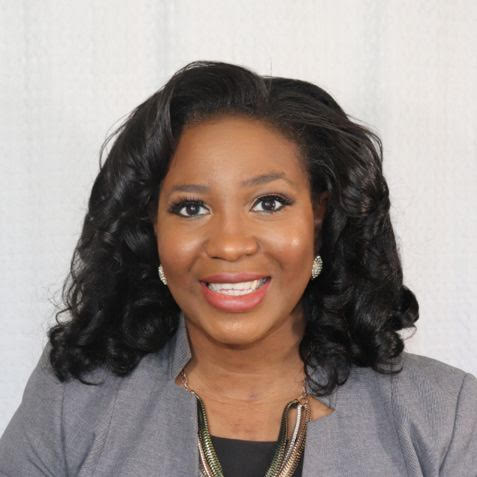
The first stop on the road to untaxing groceries in Alabama is straight ahead. Lawmakers achieved a significant victory for the people this year by passing legislation to cut the state’s 4-cent grocery tax by half. That change will begin this Labor Day weekend, as the first 1-cent reduction takes effect September 1. Ultimately, this small change likely will result in large savings for Alabamians who are working hard to make ends meet. Once the new law is fully implemented, many families will have hundreds of dollars more available each year to spend on food or other expenses. For decades, Alabama Arise has focused on reducing and ultimately eliminating the state sales tax on groceries, which essentially taxes survival. At the beginning of the 2023 legislative session, Alabama stood as one of only three states with no tax break on groceries. Thanks to determined advocacy by Arise members and other advocates, our state is off that shameful list at last. The story behind the legislative triumph Arise collaborated this year with many partners and lawmakers to introduce and pass the grocery tax reduction. That list includes the Alabama Grocers Association, Lt. Gov. Will Ainsworth, Sens. Andrew Jones and Merika Coleman, and Reps. Danny Garrett and Penni McClammy. This year’s breakthrough also would not have happened without other legislative champions who laid the groundwork for this moment, including former Reps. John Knight and Thad McClammy, former Sen. Hank Sanders and Reps. Laura Hall, and Mary Moore. The grocery tax law’s passage is a testament to the importance of continuing to hold the line and fight for change for as long as it takes. It’s also a testament to the importance of seizing the moment when opportunity arrives. Something spectacular happened this year as the stars finally aligned after decades of advocacy. When this year’s session began, many Alabamians were struggling with inflation and higher costs for essentials like eggs and bread. Simultaneously, the state was witnessing strong revenue growth. As elected officials began talking about one-time tax rebates, advocates recognized an opportune moment to make permanent progress on reducing the state grocery tax. And the revenue growth ensured this reduction would not cause severe harm to funding for our children’s public schools. A positive step forward State leaders seized this window of opportunity and united across partisan lines to reduce the grocery tax. It was amazing to witness the culmination of decades of hard work. And it was inspiring to see nearly every legislator co-sponsoring this monumental legislation. Many lawmakers tout this as the state’s largest tax cut ever, and it is one that will provide the biggest everyday benefit to people with low incomes. Ultimately, Alabama Arise remains dedicated to transforming the state’s regressive tax system into a more progressive one. Progressive tax systems levy taxes based on one’s ability to pay, whereas regressive systems work in the reverse. The grocery tax has long exemplified regressive taxation, burdening those with fewer resources by requiring them to pay proportionally more than wealthier individuals. Reducing the state grocery tax is a step in the right direction for tax justice. This penny saved is symbolic of a better future being paved for Alabama. What lies ahead Arise will continue advocating to eliminate the state grocery tax while protecting Education Trust Fund revenues. We look forward to working with the new Joint Study Commission on Grocery Taxation to find a sustainable path forward. Rebalancing Alabama’s upside-down tax system will require both lower taxes for people with low incomes and higher taxes for wealthy households and highly profitable corporations that can afford to pay more. As this year’s grocery tax reduction takes effect, we celebrate its many champions – most notably the Alabamians who stayed vigilant to ensure their voices translated into tangible policy improvements. We also celebrate this policy change as a symbol of progress and unity, and as a testament to what state leaders can accomplish when they put partisanship aside to pass legislation with profound benefits for individuals and communities. Cheers to eliminating the first cent, and to the ongoing journey toward a more prosperous and equitable Alabama! Akiesha Anderson is policy and advocacy director of Alabama Arise, a statewide, member-led nonprofit organization advancing public policies to improve the lives of Alabamians who are marginalized by poverty. Arise’s membership includes faith-based, community, nonprofit and civic groups, grassroots leaders, and individuals from across Alabama.
As grocery prices soar, push grows to end sales tax on food
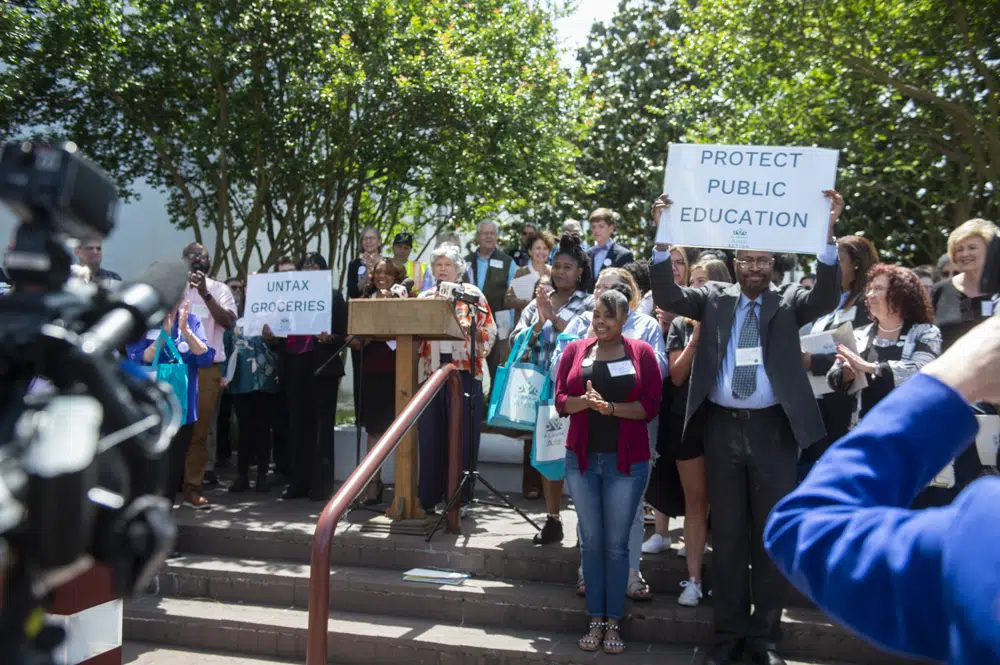
Alabama is one of only three states that tax groceries at the same rate as other purchases. But as food prices soar — and as the state sees a record budget surplus — Alabama lawmakers are considering removing, or phasing out, the state’s 4% sales tax on food. Competing proposals are being introduced by Democrats and Republicans in the Alabama Legislature to end the sales tax on all, or at least some, groceries. While the idea has been proposed for decades in Montgomery, it has gained traction this session. Alabama Arise, an organization that lobbies for policies that would benefit low-income families, said the average Alabama family spends $600 a year on the state grocery tax, and removing it would be a lasting benefit to families struggling to make ends meet. “Our families are hurting. We can’t afford to pay 4% on top of already expensive food,” Robyn Hyden, executive director of Alabama Arise, said during a Tuesday press conference and rally outside the Alabama Statehouse. Only Alabama, Mississippi, and South Dakota still tax groceries at the full state sales tax rate. South Dakota Gov. Kristi Noem had urged lawmakers to remove that state’s sales tax on groceries, but lawmakers instead approved a general sales tax cut. Various lawmakers, mostly Democrats, have proposed removing the state sales tax on food since at least the early 1990s, but the proposals were never approved, partly because of the projected blow to education funding. The tax on groceries provides more than $600 million annually to schools, according to estimates from the Legislative Services Agency. Alabama primarily uses sales and income tax collections to provide the state’s share of education funding. Soaring grocery prices, coupled with a record budget surplus, have lawmakers in both parties throwing their support behind the idea. But the proposals vary on if the tax would be removed on all food items and if the revenue stream would be replaced. “We can all agree on this: That the tax on groceries is just plain, wrong and unfair,” Sen. Merika Coleman, D-Pleasant Grove, said. Coleman’s proposal would let voters decide whether to remove the state sales tax on food and replace the money by ending the deduction that allows Alabamians to deduct federal income tax payments before computing their state income taxes. She said the tax break disproportionately lowers taxes for the wealthiest people. “Let them choose whether they prefer a tax loophole that mostly benefits the richest few or if they want a grocery tax cut that benefits everyone,” Coleman said. The Alabama Republican Party on Tuesday released a survey of registered voters that it said showed a vast majority support removing the sales tax on food. “One of the core beliefs of the Republican Party is that government exists for the benefit of the people, not the other way around. We want to help those families and individuals struggling with food prices right now. It’s time to end the grocery tax,” Alabama Republican Party Chairman John Wahl said in a statement. Republican Sen. Arthur Orr, who chairs the Senate Finance and Taxation Education budget-writing committee, has proposed to phase out the state sales tax on some foods, such as milk, eggs, vegetables, fruit, whole-grain bread, and baby formula. The bill would use the list of food items that are covered by the federal Women, Infants and Children nutrition program to decide what would be untaxed. Orr said last week that would offer relief to families while also limiting the blow to the education budget. That WIC definition, if used, would leave the state sales tax on meat, desserts, and many other items. Others have discussed using the list of foods eligible under the Supplemental Nutrition Assistance Program. That would remove the state tax on most grocery items, but leave it on items such as alcoholic beverages or prepared meals that are hot at the point of sale. The Legislative Services Agency estimated that would cost the state $608 million annually. Hyden said their organization supports the “broadest possible” proposal for removing the tax on food, as well as proposals that would protect education funding. State Rep. Penni McClammy, the daughter of the late Rep. Thad McClammy, said during the Alabama Arise press conference that she has shared the difficult decisions many families face in trying to stretch a budget at the grocery store. “I was a caregiver. I know what it feels like to make decisions on buying Depends, Ensure, medication. What we call healthy food is the most expensive food in the grocery store,” McClammy, D-Montgomery, said. Republished with the permission of The Associated Press.
Steve Flowers: We lost some good ones in 2021
As has been my custom for 18 years, I like for my yearend column to be a remembrance of Alabama political figures who have passed away during the year. We lost some good ones this year. We lost our oldest past governor, John Patterson in June. Governor Patterson passed away at age 99 at his ancestral home in rural Tallapoosa County surrounded by his family. Patterson was Governor from 1959-1963. He defeated George Wallace in the 1958 Governor’s Race, which featured a field of 14 candidates. He is the only man to beat George Wallace in a governor’s race. Patterson was Attorney General of Alabama prior to being elected Governor. He subsequently was appointed to the Court of Criminal Appeals by Wallace and was reelected numerous times and retired as a Judge of the Alabama Court of Appeals. He was a treasure trove of Alabama political history. He was Governor during a turbulent time in Alabama history. Former Alabama Attorney General Jimmy Evans died in February at 81. Evans was a native of Montgomery and was Montgomery County District Attorney prior to being elected Attorney General. Retired Alfa lobbyist Milton Parsons passed away in March at 91. Milton was renowned on Goat Hill as a straight arrow and straight shooter. He was an honest, trustworthy, Christian gentleman. He was Alfa’s chief lobbyist for 50 years. He was a devoted family man and devout Christian. Former Troy mayor, Jimmy Lunsford died in May at 78. He was mayor of Troy for 30 years. Economic development was his forte. He was a tremendous steward of the city’s finances. He left Troy in good shape financially. Former Mobile congressman Sonny Callahan passed away at 88 in late June. He was one of a long line of popular and effective congressmen from the first district. The list includes Frank Boykin, Jack Edwards, Jo Bonner, Bradley Byrne, and Sonny. Congressman Callahan served 10 terms in the U.S. House of Representatives. Prior to his two decades in Congress, he served in the Alabama House of Representatives and then six years in the State Senate. He was successful in the trucking business in conjunction with his legislative and congressional career. State Representative Thad McClammy of Montgomery passed away at 79 in August. McClammy represented parts of Montgomery County for 27 years. I had the privilege to serve with Thad in the legislature. He was a real gentleman. His word was as good as gold. He had a tremendous turnout for his funeral. State Senator Kirk Hatcher did a fabulous job singing two favorite hymns. Former State Legislator and longtime Geneva County Probate Judge Harold Wise died in August at 96 years old. He lived an amazing and colorful life. He was a loved and respected Geneva County political figure. He was the uncle to Supreme Court Justice Kelli Wise. Kelli adored him. He was her mentor. She says he sparked her love of politics and her desire to have a career in public service. Retired Winston-Marion County Circuit Judge Bobby Aderholt passed away in September at 85. He was a 50-year public servant, as well as lay minister. People say he probably married or buried half the folks in and around Haleyville and that part of Northwest Alabama. There was a tremendous turnout for his funeral. He was revered. State Senator Greg Reed sang at his funeral. Judge Aderholt was the father of our senior congressman, Robert Aderholt who is completing his 25th year in Congress. Former State Senator Jim Preuitt of Talladega died in September at 86. He was also a State Representative and Probate Judge of Talladega County. He was a successful businessman and family man. We lost some good ones this year. Happy New Year! Steve Flowers is Alabama’s leading political columnist. His weekly column appears in over 60 Alabama Newspapers. Steve served 16 years in the state legislature. Steve may be reached at www.steveflowers.us.
Steve Flowers: Incumbency prevails in 2022 State House races
Folks, believe it or not, we are closing in on six months before next year’s election year. The primary election is set for May 24, 2022. In Alabama, all our major constitutional officers are on the ballot next year. The governor’s office is the premier race in the state, and that coveted and powerful post is set for its four-year quadrennial run. Therefore, this big political year is referred to as the gubernatorial year. Those of us who follow Alabama politics have been salivating with anticipation for a cavalcade of great races. However, the power of incumbency has devasted the big year into a yawn. All the major state offices are held by popular incumbents, who are either running unopposed or have minimal opposition. The consolation prize was that there would be the legislative races. After all, this is where the real power in the state rests. You can simply look at where the special interest and PAC money is spent to verify that fact. However, the omnipotent power of incumbency has also encroached on those races. The Alabama House of Representatives has 105 members. There are 77 Republicans and 28 Democrats. The large majority of incumbents are running for reelection – both Republicans and Democrats. The overwhelming majority of these incumbents will have no opposition. However, in the House, there will be some major changes in leadership because of retirement or moving on to new posts. Speaker of the House Mac McCutcheon is not running for reelection. This has created an interesting and spirited race within the Republican Caucus ranks for Speaker. In addition, Victor Gaston of Mobile, who is Speaker Pro Tem, is also retiring. Bill Poole of Tuscaloosa, who chaired the powerful House Ways and Means Education Budget Committee, has left the House to be the State Finance Director. House Rules Committee Chairman Mike Jones of Andalusia is running for the open Senate seat of retiring Senator Jimmy Holley. Two of the freshman House members are running for statewide office. Wes Allen of Troy is running for Secretary of State, and Andrew Sorrell of Tuscumbia is running for State Auditor. In addition, Connie Rowe of Jasper is leaving the House to become an administrative assistant to Lt. Gov. Will Ainsworth. Some of the veteran House members who are choosing to hang up their legislative cleats include Howard Sanderford of Huntsville, Mike Ball of Huntsville, K.L. Brown of Jacksonville, Kerry Rich of Marshall, Allen Farley of Jefferson, Harry Shiver of Baldwin, Mike Holmes of Elmore, and Becky Nordgren of Etowah. The most noteworthy retiree may be Representative Steve McMillan of Baldwin County, who is retiring after serving close to 43 years in the House. Steve has been a quiet yet very effective voice for the people of Baldwin County. They all will be missed. Some of the high profile and powerful members of the House, who will return for another four years with no or token opposition, are Steve Clouse of Ozark, Nathaniel Ledbetter of Dekalb County, and Danny Garrett, Jim Carns, David Wheeler, and David Faulkner of Jefferson. Danny Garrett has ascended to Chairman of the House Ways and Means Education. Other leaders returning are Chris Pringle, Reed Ingram, Randall Shedd, Tracy Estes, Chris Sells, David Standridge, Ginny Shaver, Jim Hill, Alan Baker, Joe Lovvorn, Chris Blackshear, Kyle South, Paul Lee, Jeff Sorrells, Rhett Marques, Steve Hurst, Joe Faust, and Margie Wilcox. The Democratic leadership will remain intact. There is an illustrious array of House Democratic leaders, including Anthony Daniels, Chris England, Laura Hall, Peb Warren, Barbara Boyd, A.J. McCampbell, Berry Forte, Dexter Grimsley, Thomas Jackson, Kevin Lawrence, Mary Moore, Juandalynn Givan, and veteran John Rogers. Two of the Democratic House veterans from Jefferson County, Louise Alexander and Merika Coleman, are both running for an open Jefferson County Senate Seat, leaving both their House seats up for grabs. There may be an increase in the number of females in the House of Representatives. It has already begun with the election of Cynthia Almond of Tuscaloosa, who was elected without opposition to replace Bill Poole. In addition, Patrice Penni McClammy won the Montgomery District 76 seat of her late father, Thad McClammy. She won with no opposition. See you next week. Steve Flowers is Alabama’s leading political columnist. His weekly column appears in over 60 Alabama papers. He served 16 years in the state legislature. Steve may be reached at www.steveflowers.us.
Kay Ivey announces special election dates for Rep. Thad McClammy’s seat
Governor Kay Ivey signed a proclamation today to set special election dates for Alabama House District 76. Rep. Thad McClammy previously held this seat. McClammy, a Democrat from Montgomery, died of natural causes last week. He was 78. He was laid to rest last weekend. Ivey set the special primary election for Tuesday, November 16, 2021; the special primary runoff, if necessary, for Tuesday, December 14, 2021; and the special general election for Tuesday, March 1, 2022. “Rep. Thad McClammy, respected by many, was a true statesman and leaves large shoes to fill. I have announced the special election so that the people of Montgomery can continue to be afforded a voice in the Alabama Legislature,” Governor Ivey said. “I encourage the folks in House District 76 to get out and vote during this special election.” The deadline for qualifying with major political parties will be Tuesday, September 14, 2021, at 5:00 p.m. The deadline for all independent candidates and/or minor parties is Tuesday, November 16, 2021, at 5:00 p.m.
Thad McClammy, 78, dies of natural causes
An Alabama state representative died Saturday of natural causes, the House of Representatives said in a news release. State Rep Thad McClammy, a Democrat from Montgomery, died of natural causes, the statement said. He was 78. McClammy was first elected to the Alabama House of Representatives in 1994 to represent District 76, which includes east, south, and western sections of the city of Montgomery. A graduate of both Alabama State University and Auburn University at Montgomery, he was a real estate broker and developer. “The people of District 76 have lost not only their champion in the House but also a very fine man, and I’ve lost a friend,” House Speaker Mac McCutcheon, R-Monrovia, said. “I was honored to serve with Thad and watched how he took care of the people in his district every day. My wife Deb and I send our heartfelt condolences to his family.” Gov. Kay Ivey ordered flags lowered in honor of McClammy. “Thad was a great man and loyal Democrat who served his constituents well. We express our deepest condolences to his family and friends. He will be truly missed,” the Alabama Democratic Party said in a statement. McClammy was chairman of the Montgomery County Legislation Committee and served as the ranking minority member on the House Judiciary Committee and the House Military and Veterans’ Affairs Committee. He also served on the House Financial Services Committee. McClammy was always gracious and solution-oriented, said Republican Rep. Steve Clouse, who was elected to the House the same year as McClammy. “He was just a great guy, he was always very friendly and tried to find a solution and not be divisive,” Clouse said. Funeral arrangements are pending. Republished with the permission of the Associated Press.
Push for greater equality: Adline Clarke proposes ‘gender pay gap’ bill

It’s a fact: women earn less than men. According to the U.S. Department of Labor, women who worked full-time, year-round in 2014 earned on average, 79% of men’s median annual earnings. That’s not sitting well with one Alabama lawmaker who’s hoping her gender pay gap legislation makes it across the finish line as the 2018 legislative session nears its close. HB368, sponsored by Mobile-Democrat State Rep. Adline Clarke, would prohibit employers from paying their employees less than the wage they would pay a member of the opposite sex for a similar job or responsibilities when viewed as a composite of skill, effort, and responsibility, as specified. Alabama is one of only two states, along with Mississippi, without an equal pay law. “Nearly every state has a law prohibiting employers differently based solely on gender. I’m disappointed. I would have thought we would have passed a long long before now,” Clarke told AL.com “Timing is everything.” However, HB368, also known as the “Gender Pay Gap,” would not just make wage inequality illegal, but would also add several provisions to the law including: Requires an employer to affirmatively demonstrate that a wage differential is based upon one or more specified factors Prohibits an employer from discharging, or in any manner discriminating against. or retaliating against an employee for the enforcement of these provisions Provides for enforcement of the bill Provides that an employer may not prohibit an employee from disclosing the employee’s own wages, discussing the wages of others, inquiring about another employee’s wages, or aiding or encouraging any other employee to exercise his or her rights under these provisions And requires an employer to maintain a record of wages paid to his 15 or her employee for a certain amount of time. The proposal, filed on Feb. 1, is scheduled to appear before the Alabama House State Government Committee on March 21. Alexander City-Republican State Rep. Mark Tuggle, the committee’s chairman, hopes to have Clarke’s proposal on the committee agenda next week. The bill currently has 26 co-sponsors, both Republicans and Democrats: Autauga County-Democrat Kelvin Lawrence Mobile County-Democrat Barbara Drummond Barbour County-Democrat Barry Forte Perry County-Democrat Prince Chestnut Jefferson County-Democrat Rolanda Hollis Madison County-Democrat Anthony Daniels Jefferson County-Democrat Rod Scott Tallapoosa County-Democrat Pebblin Warren Choctaw County-Democrat Elaine Beech Madison County-Democrat Laura Hall Jefferson County-Democrat Merika Coleman Jefferson County-Democrat Mary Moore Mobile County-Democrat Napolean Bracy Blount County-Republican Connie Rowe Shelby County-Republican April Weaver Talladega County-Democrat Barbara Boyd Jefferson County-Democrat Juandalynn Givan Etowah County-Republican Becky Nordgren Morgan County-Republican Terri Collins Montgomery County-Democrat John F. Knight Montgomery County-Democrat Thad McClammy Tuscaloosa County-Democrat Artis McCampbell Mobile County-Democrat James Buskey Bibb County-Democrat Ralph Howard Lauderdale County-Democrat Marcel Black Houston County-Democrat Dexter Grimsley
