
NYT op-ed takes on Birmingham minimum wage hike
The New York Times posted an Opinion-Editorial (Op-Ed) by Lucas Guttentag on Monday, in which he takes on what he views as racial discrimination in the state to block Birmingham’s minimum wage hike. In 2016, the state legislature voted in favor of HB174 — also known as the Alabama Uniform Minimum Wage and Right to Work Act — a bill that would block cities from setting individual minimum wage rules. Then Governor Robert Bentley signed the bill less than an hour after the vote, effectively blocking the Magic City’s efforts. Fast food workers and civil rights groups acted quickly, filing a lawsuit, and arguing that the law was “tainted with racial animus’ since it was pushed by white suburban Republican legislators in the majority-white Alabama Legislature and disproportionately affected black workers in the majority black city,” the Associated Press reported. In July, a federal appeals court reversed a judge’s earlier ruling to dismiss the lawsuit, saying that “Alabama’s white-majority legislature had discriminated against the black-majority city in barring it from setting its own minimum wage,” according to CBS News. “As the case moves forward, it could provide similar cities with a legal road map for challenging this modern-day tool of racial subjugation,” Guttentag wrote in his Op-Ed. “These are the majority-black and -brown localities deprived by majority white state legislatures of the authority to enact local ordinances raising the wages of its residents.” “The court’s ruling is a victory for the more than 40,000 low-wage Birmingham residents who were robbed of a much-needed pay raise and who will now get their day in court,” Guttentag continued. “But more profoundly, this case — originating in a town where America’s history of racial violence faced some of its most pivotal confrontations — could now open the door for communities of color across the country to challenge racially discriminatory laws that deny localities the power to improve the lives of people of color.”
The New York Times a favorite Donald Trump target — and interview venue
President Donald Trump has repeatedly denounced The New York Times as “fake news,” yet he’s granted more interviews to its reporters since taking office than any other media outlet except for Fox News Channel. The latest provided the newspaper with its top headline on Thursday, a wide-ranging talk during which the president said he never would have appointed Attorney General Jeff Sessions had he known Sessions would recuse himself from overseeing the investigation into Russia’s involvement in the last election, and warned Special Counsel Robert Mueller against looking into the Trump family finances. “There is so much about him that is so incredibly contradictory, you can just add this to a very long list,” said Kyle Pope, editor and publisher of the Columbia Journalism Review. This was Trump’s fifth Times interview since his inauguration six months ago, not including a brief encounter with Times magazine writer Mark Leibovich during a visit to the White House this spring. As president-elect, Trump traveled to the Times office to meet with its editorial board, and gave another interview to Michael Shear and David Sanger as president-elect. Trump called Times reporter Maggie Haberman shortly after his inauguration to discuss his new life. He’s sat down with Fox News reporters seven times as president, said Mark Knoller, the CBS News White House correspondent who keeps a running count of presidential interviews. The Times’ most heated competitor, The Washington Post, has gotten one interview, he said. Trump frequently praises Fox News, yet you don’t have to search very hard through his Twitter feed to find condemnations of the Times. He’s specifically attacked the Times more than 20 times on Twitter this year. In addition to calling the Times “fake news,” an epithet he’s also used for CNN and others, he’s repeatedly labeled the newspaper as “failing,” a description the company’s executives say is at odds with the facts. On Jan. 29, five days after Haberman’s first interview with him as president was printed, Trump raged on Twitter: “Somebody with aptitude and conviction should buy the FAKE NEWS and failing @nytimes and either run it correctly or let it fold with dignity.” Trump said on March 30 that the Times has “disgraced the media world” and gotten him wrong for two years. The Times “has become a joke,” he wrote on Feb. 24. And the newspaper was lumped in with NBC, CBS, ABC and CNN as “an enemy of the American people.” All of this feels familiar to L. Timothy O’Brien, author of “TrumpNation: The Art of Being the Donald.” As a Times reporter who covered Trump’s real estate business for several years, O’Brien was courted by Trump with invitations to his home and airplane. Yet Trump also called his editors to complain when displeased with O’Brien’s stories, he said. “Donald Trump is a kid from Queens,” O’Brien said. “He grew up in New York. I think he’s always regarded coverage in The New York Times as something akin to the Good Housekeeping seal of approval.” His deep need for approval from the Times leads to him being particularly hurt when the newspaper writes something that displeases him, O’Brien said. Yet Trump doesn’t lose sight of the newspaper’s importance, he said. Trump doesn’t have the same relationship with CNN, the news organization that he attacks most frequently, and often quite personally by citing Jeff Zucker, the network’s top executive. CNN hasn’t interviewed Trump as president. Yet CNN employs Haberman as a contributor, and she’s often on the air to talk about Trump, including Wednesday night after the latest Times interview was released. Haberman has interviewed Trump four of the five times the newspaper has talked to him as president, twice with colleagues and twice by herself. Haberman’s pushing also led to a previously off-the-record conversation with reporters on Air Force One being placed on the record. Even after getting the most recent interview, the Times on Thursday posted a fact-check that said Trump “made a number of misleading and false claims about health insurance, his legislative accomplishments, the biography of his deputy attorney general and French history.” Television critic James Poniewozik published a piece Thursday where he called Trump’s favorite morning show “Fox & Friends” ”an interactive magic mirror for Donald J. Trump.” Trump’s relationship with the Times is one of the things that make his “war on the media” feel false, even as it has real implications by leading to increased harassment and attacks on the media by others, Pope said. “It’s a very calculated move that he knows will enliven his base,” he said. “It’s a fake news war for him.” There’s a telling exchange at the end of the most recent Times interview, where he asks the reporters to “just treat it fairly.” He left the reporters with the clear impression that “if you’re fair to me, see you soon,” interviewer Michael S. Schmidt said in a Times podcast. Pope found that telling, as both an implicit threat and indication of how much Trump valued the newspaper. Republished with permission of The Associated Press.
White House bars major news outlets from gaggle
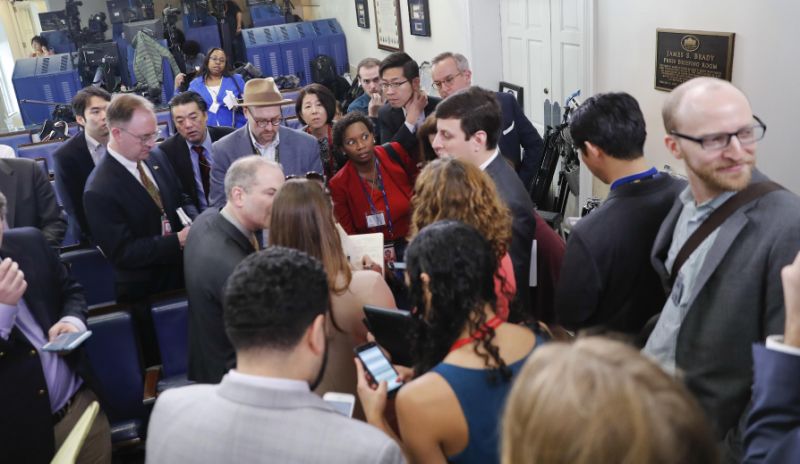
News organizations including The New York Times, the Los Angeles Times, CNN and POLITICO were blocked from joining an informal, on the record White House press briefing Friday. The Associated Press chose not to participate in the gaggle following the move by White House press secretary Sean Spicer. “The AP believes the public should have as much access to the president as possible,” Lauren Easton, the AP’s director of media relations, said in a statement. Several news organizations were allowed in, including the conservative website Breitbart News. The site’s former executive chairman, Steve Bannon, is chief strategist to President Donald Trump. The White House defended the decision not to include some news organizations. “We invited the pool so everyone was represented. We decided to add a couple of additional people beyond the pool. Nothing more than that,” said White House spokeswoman Sarah Sanders. Earlier Friday in a speech before the Conservative Political Action Conference, President Donald Trump railed against the media. Reaction from barred media outlets was swift. “Nothing like this has ever happened at the White House in our long history of covering multiple administrations of different parties. We strongly protest the exclusion of The New York Times and the other news organizations. Free media access to a transparent government is obviously of crucial national interest,” Dean Baquet, the Times’ executive editor, said in a statement. “This is an unacceptable development by the Trump White House. Apparently, this is how they retaliate when you report facts they don’t like. We’ll keep reporting regardless,” CNN said in a statement. Republished with permission of The Associated Press.
N.Y. Times throws shade on Robert Bentley appointing Luther Strange to U.S. Senate
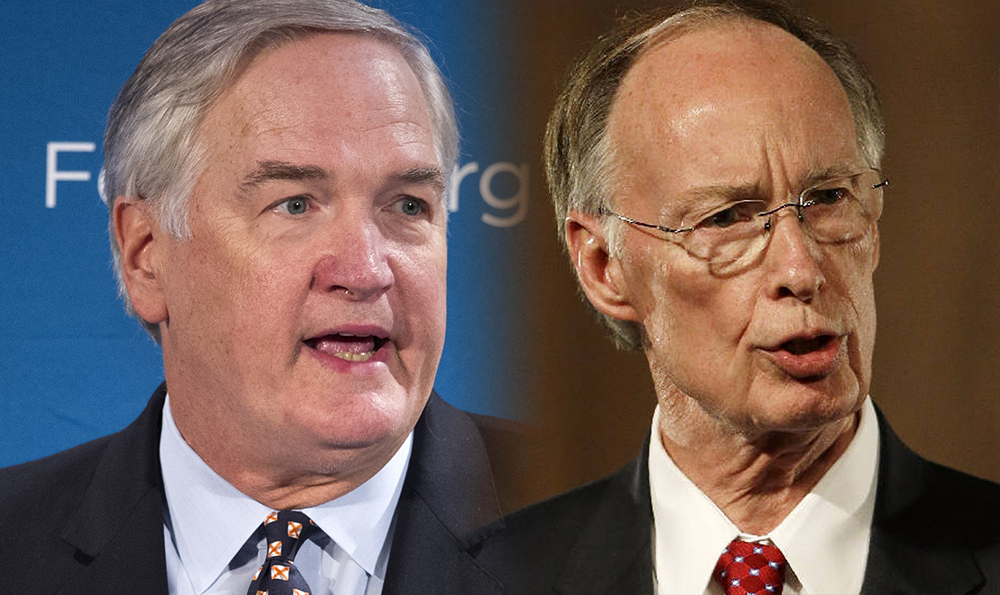
A new article in The New York Times casts a shadow on Gov. Robert Bentley’s appointment of former Attorney General Luther Strange to the U.S. Senate. Author Alan Blinder writes that Strange, who was elected Alabama Attorney General in 2010 and 2014, has seen his popularity wane after accepting the appointment, especially considering his former office was in spearheading an investigation into the scandal-plagued governor. Though no state lawmakers have come forward with evidence, many have publicly opined that Strange’s appointment was an attempt Bentley to quash the investigation. Whether or not that was Bentley’s goal, Strange was quoted after his appointment that speculation about inquiries on Bentley was “unfair to him and unfair to the process,” adding that “we have never said in our office that we are investigating the governor.” Strange also deflected any appearance of impropriety by saying prosecutors in the Attorney General’s office would “relentlessly pursue the rule of law.” “My own commitment to rooting out corruption in government speaks for itself,” he said. “That vow has never wavered and will continue to guide me as I serve the people of Alabama in the U.S. Senate.” Strange’s replacement, Steven Marshall, confirmed soon after he took the job that there was indeed an investigation into Bentley and he appointed a special prosecutor to take the reigns on the case. Matt Hart, one of the lawyers responsible for the conviction of former House Speaker Michael Hubbard, is also involved in the inquiry. Still, some state lawmakers say the cloud surrounding Strange’s appointment could hamstring him during the 2018 special election to decide former U.S. Sen. Jeff Sessions permanent replacement. “He would have been solid, and he probably would have beaten the governor’s appointment,” said Republican State Rep. Corey Harbison, adding that “Luther’s ambition to become a United States senator caused him to do things that I don’t think he would have done in normal circumstances.”
Donald Trump says White House ‘fine-tuned machine,’ despite turmoil

Donald Trump mounted an aggressive defense of his young presidency Thursday, lambasting reports that his campaign advisers had inappropriate contact with Russian officials and vowing to crack down on the leaking of classified information. Nearly a month into his presidency, Trump insisted in a freewheeling White House news conference that his new administration had made “significant progress” and took credit for an optimistic business climate and a rising stock market. The president denounced media reports of a chaotic start to his administration marked by his contentious executive order — rejected by a federal appeals court — to place a ban on travelers from seven predominantly Muslim nations. Trump said he would announce a “new and very comprehensive order to protect our people” next week. “This administration is running like a fine-tuned machine,” Trump declared in a lengthy news conference that saw the new commander in chief repeatedly interrupting reporters’ questions and airing his grievances. Throughout the encounter the new president delivered recurring criticism of the news media, accusing it of being “out of control” and promising to take his message “straight to the people.” He dismissed recent reports in The New York Times and on CNN that Trump campaign aides had been in contact with Russian officials before his election. Trump called Paul Manafort, his former campaign manager who has ties to Ukraine and Russia, a “respected man.” Pressed repeatedly, Trump said that “nobody that I know of” on his campaign staff had contacted Russian officials. He called such reports a “ruse” and said he had “nothing to do with Russia.” Trump added, “Russia is fake news. This is fake news put out by the media.” Amid reports of widespread leaks within his administration, Trump also warned that he would clamp down on the dissemination of sensitive information, saying he had asked the Justice Department to investigate. “Those are criminal leaks,” adding, “The leaks are real. The news is fake.” He blamed any problems on the outgoing Obama administration. “I inherited a mess at home and abroad — a mess,” Trump said. The president announced that Alexander Acosta, the dean of the Florida International University law school, would be his nominee for Labor secretary. That came a day after fast-food executive Andrew Puzder withdrew his nomination for Labor after losing support among Republican senators. Trump, a reality television star and real estate mogul who was elected as an outsider intent on change, said his ousted national security adviser, Michael Flynn, was “just doing his job” in talking with Russian officials before the inauguration. But he said he was “not happy” with how Flynn described his phone call with a Russian diplomat to Vice President Mike Pence. Trump knew for weeks that Flynn had misled Pence but did not inform the vice president, according to a timeline of events supplied by the White House. Trump said he had identified a strong replacement for Flynn, which made the decision to let him go easier. Trump is said to favor Vice Admiral Robert Harward, a former Navy SEAL, as his next national security adviser, according to a White House official. Harward met with top White House officials last week and has the backing of Defense Secretary Jim Mattis. He was meeting with officials later Thursday. Addressing immigration, one of the biggest issues of the past campaign, Trump said it was difficult dealing with the policy known as DACA, which allows young adults to get work permits and Social Security numbers and protects them from deportation. Referring to the Deferred Action for Childhood Arrivals rule, he said he would “deal with DACA with heart.” While Trump has promised to halt illegal immigration as a cornerstone of his administration, he has also promised to focus on people who have committed crimes. He said he had the “best lawyers” working on the policy now and the “new executive order is being tailored to the decision we got from the court.” Earlier in the day, Trump had a breakfast meeting with some of his staunchest House supporters. The White House has said Trump asked for Flynn’s resignation because he had misled Vice President Mike Pence over his dealings with Russia and whether he had discussed sanctions with Russia’s ambassador to the U.S. before Trump’s Jan. 20 inauguration. Flynn previously had denied those conversations to Pence and other top officials. On Thursday, he warned in a pair of tweets that “lowlife leakers” of classified information will be caught. As journalists were being escorted out of the breakfast meeting, Trump responded to a reporter’s question on the subject by saying: “We’re going to find the leakers” and “they’re going to pay a big price.” Republished with permission of The Associated Press.
Alabama ranks among the states college grads are most likely to leave

What to do after college can be a daunting challenge for many graduates. Grads are faced with many major life decisions, like where they will land a job and what city they want to live in. In a recent study, The New York Times found many young people with college degrees — are leaving struggling regions of America for cities, specifically for cities in Southern and coastal states. And despite fitting both of those attributes, Alabama is actually losing college-educated workers to other nearby states. According to the Times, there are clear economic reasons for their choice. “Dense metro areas tend to produce more jobs and make workers more productive. Wages, for all kinds of workers, are also higher.” In the regional competition for the most skilled and most mobile workers in America, Alabama appears to be at a disadvantage leaving the local economy struggling to find skilled workers. Which is precisely why the state recently launched AlabamaWorks — an effort to transform the state’s workforce development efforts into one unified system, seamlessly linking employers looking for skilled workers with Alabamians seeking jobs or job training. “Keeping young college graduates would help alleviate the effects of globalization and technological change on these local economies,” said the Times.
Martin Dyckman: The road to Middle East stability isn’t through war

Remember “freedom fries?” That was how some Americans expressed their spite toward France when that nation, with vastly more experience than ours in the Middle East, wisely declined the opportunity to participate in George W. Bush‘s ego-driven war on Iraq. There was a congresswoman from Florida who called for exhuming our military graves and bringing the remains home. She was ignorant of the fact that a grateful France had ceded those sites to the United States forever. The heartbreakingly beautiful cemetery atop the Normandy beachhead is as much American soil as Arlington itself. But in Paris on Friday, France paid a terrible price for the chaos we created when we invaded Iraq and destroyed its government with no thought of history or of the consequences beyond the premature boast, “Mission accomplished.” The evil we didn’t know proved to be worse than the evil we did. Saddam Hussein, for all his crimes, was a stabilizing influence on Iraq and an effective counterweight to Iran – which, unlike Iraq, had declared its enmity of the U.S. and remains an essential ally of the Syrian dictatorship that provides the so-called Islamic State with a plausible raison d’etre. When Bush’s civilian viceroy sacked the entire Iraqi army, he created legions of recruits for al-Qaida and its successor, the Islamic State of Iraq and Syria – aka ISIS. Our failure in nation-building created a corrupt prime minister, Nouri Kamal al- Maliki, whose refusal to renew the status of forces agreement gave President Obama no choice, whatever other he might have chosen, but to bring all our troops home. No president of either party could have left them there exposed to Iraqi laws, arrests and prosecutions. To understand this history is to be warned against repeating it. But America doesn’t learn that lesson very well. Vietnam should have taught us the difficulty of imposing our values on a different culture and to be leery of war where our national interest is not at stake. But the only lesson the politicians took to heart from that unpopular lost war was to abandon the draft and fight the next one with a volunteer force, a force that has been cruelly abused with too many successive combat deployments. In the aftermath of the Paris massacres, we will be hearing again, from the usual suspects, that it’s time to unleash American military might to whatever extent it takes to exterminate ISIS. But even if we could do that – and we can’t – something else would take its place, just as the burgeoning ISIS supplanted a decapitated al-Qaida. The Democratic presidential candidates were right as they agreed, in their separate ways Friday night, that the fight against ISIS must be led by the Muslim states that are the radical movement’s primary intended victims. The United States can help, and should. We are helping already, as are the French, and there is surely more that we can do, short of sending sophisticated weapons to dubious allies who might surrender them to ISIS. But it cannot be seen as an American war, or as French or British. The more important point is that the ultimate solution can not be military. That can only prolong the strife and suffering. By coincidence, the Imam of Asheville’s Muslim community, Egyptian-born Mohamed Taha, was the scheduled speaker Sunday at a brunch sponsored by the Brotherhood of my Reform Jewish congregation. It was well-attended. He talked mainly about the beliefs of Islam and its many similarities to Judaism, and its devotion to peace. But the slaughter at Paris hovered over the morning. “These people,” he said, speaking of ISIS and its ilk, “they are extremists. The majority of Muslims don’t consider these people as Muslims. Mohamed warned against such people … they take some verse of the Koran and they twist its meaning. “They don’t,” he added, “consider us as Muslims.” To defeat the jihadists, he said, requires overcoming the conditions they exploit. “They live in poverty,” he said of the populations where the jihadists enlist most of their support. “They have nothing. We have to help them to establish good countries, good communities. They have nothing in this life, so the extremists promise them everything in the next life.” The solution is not military. The wiser of our American experts on the Middle East, notably including The New York Times columnist Thomas Friedman, have been saying that for years. After World War II, the United States deployed a non-military solution, the Marshall Plan, to help a ravaged Europe rise to its feet in democracy rather than communism. We surely could use a Marshall plan for the Middle East. But how to help the people there to their feet without having the assistance stolen by the corruption that is endemic among the rulers there? I asked that question. Taha acknowledged the difficulty. It begins, he said, with affording an American education, steeped in American traditions and values, to Middle Eastern students who want to study here. Inevitably, perhaps, some few of those students will have other values in mind, like those who prepared here for 9/11. And in the aftermath of Paris, there are politicians who would slam the door, to students as well as refugees, for fear of the few who would exploit our hospitality. But that would be a mistake. It would betray that our values are not, in truth, what we would wish them to be. It would postpone the redemption of the Middle East and perpetuate a war that cannot be won by arms alone. Martin Dyckman is a retired associate editor of the newspaper formerly known as the St. Petersburg Times. He lives in Asheville, North Carolina.
Martin Dyckman: Winner-take-all winner could be Trump

Our next president may well owe the office to arrogant billionaires or be one himself. Meanwhile, The New York Times reports that fewer than 400 families account for nearly half the $388-million already invested in that election still more than a year away. Did America shed blood to be rid of monarchy only to have it come to this? And yet the vast moral and political corruption unleashed by the U.S. Supreme Court’s confusion of free spending with free speech is only one of four ways in which government of the people, for the people and by the people has gone off the track. Voting districts in nearly every state are drawn by the party in power to control the outcomes. The elections themselves are monopolized by two increasingly polarized political parties, excluding the increasing numbers of citizens who want nothing to do with either of them. The elections, whether primary or general, can be won with much less than majorities by unpopular candidates who would not be the second choices of most voters. Florida is powerless to control the money. That will take a constitutional amendment or the election of a president who would insist that his or her Supreme Court nominees agree that the Buckley and Citizens United cases were wrongly decided. Florida has made inroads on the gerrymandering through the adoption of the Fair Districts initiatives five years ago and the state Supreme Court’s willingness to enforce them. But that fortunate condition is imperiled by the next four court appointments, which will be controlled by Rick Scott‘s nominating commission. Time is running very short for people who believe in judicial independence to do something about that. The “All Voters Vote” initiative petitions now circulating would break the shared monopoly of the Republicans and Democrats by allowing everyone to vote in an open primary that could nominate two candidates of the same party — or of no party — for state offices and Congress. That’s good for the growing number of voters who claim no party — presently 27 percent — or who identify with the Greens and other minor parties. To that extent, it would be a significant improvement for everyone. Jim Smith, the former Florida secretary of state and a supporter of the initiative, acknowledges that it hasn’t done much to change the lineup of elected officials in Louisiana and California, the other two open-primary states. He is right, however, in saying that it has “changed the conversation — and it’s a conversation that a broader spectrum of voters want to hear candidates talk about.” Republican candidates in districts with sizable Democratic minorities would have to think twice about toeing the Tea Party line. Democratic candidates in safely blue districts would need to court Republican votes for the first time. But “Top Two” is still vulnerable to the winner-take-all weakness. In 1991, a 12-candidate field in Louisiana’s open primary left voters with a dismal runoff choice: former Gov. Edwin Edwards, whose corruption was flagrant, or David Duke, a former Ku Klux Klan grand wizard and an avowed Nazi. There were bumper stickers saying, “Elect the crook — it’s important,” and so the voters did. Edwards went to federal prison in 2002. That same year, 16 candidates sought the French presidency. Nearly everyone assumed there would be a runoff between a conservative, Jacques Chirac, whose ethics were as suspect as Edwards’, and the prime minister, Socialist Lionel Jospin. Chirac ran first, as expected, with 19.8 percent of the vote. But Jospin was edged out of the running by Jean Marie le Pen of the far right National Front, an ultranationalist party. Although nearly two-thirds of the voters had preferred other candidates, their final options were, as in Louisiana, between two obviously unappealing politicians: a suspected crook and a presumed fascist. (Chirac won.) There’s a way to avoid such dismal outcomes. It’s called ranked-choice voting, a task that computer science makes simple. To see how simple — and have some fun — go to this website: www.fairvote.org. There are links on the page to exercises where you can cast rank-ordered votes for political parties and for the Republican and Democratic presidential candidates. Here’s how the presidential game played out for me and for other participants on Monday. In the Republican poll, Donald Trump led the first round, but with only 18 percent. Bobby Jindal ran last and was eliminated. The second-choice votes of his supporters were distributed. There were 15 more rounds, all conducted instantly by computer. Marco Rubio fell out in the 12th and Jeb Bush in the 13th. In the 16th and last round, Trump finally gave way to Rand Paul, who won the nomination with 51.28 percent support. Bernie Sanders led the Democrats with 46 percent. Hillary Clinton ran third, trailing Joe Biden, who isn’t an announced candidate. Martin O’Malley ran last, with 6 percent, and the second choices of his supporters were counted. Clinton was gone in the fourth round. In the sixth and final, Sanders’s support increased to 51.9 percent and he became the nominee. These results are hardly scientific and not necessarily predictive. The samples were small and self-selected. Anyone could vote in either race, and the biases were obviously liberal. But they’re interesting nonetheless. The two “nominees,” Paul and Sanders, project more authenticity than nearly all the others. As for Trump, he piled up more second-choice votes than everyone except Paul. If the Republican Party of Florida still insists on a March 15 winner-take-all primary, which will be well after many of the trailing and financially poorer candidates have dropped out, Trump could easily win it all. Martin Dyckman is a retired associate editor of the St. Petersburg Times. He lives in Western North Carolina.
