
The end of an era? Tea party class of House Republicans fades
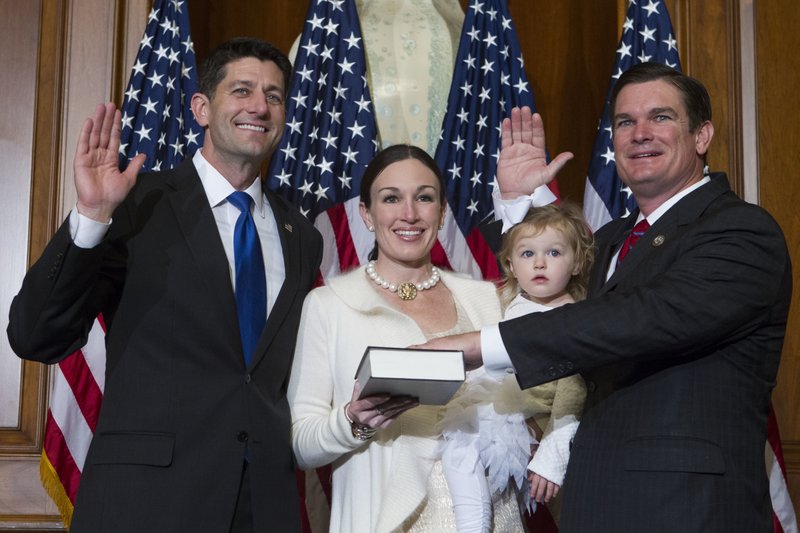
The Republican newcomers stunned Washington back in 2010 when they seized the House majority with bold promises to cut taxes and spending and to roll back what many viewed as Barack Obama’s presidential overreach. But don’t call them tea party Republicans any more. Eight years later, the House Tea Party Caucus is long gone. So, too, are almost half the 87 new House Republicans elected in the biggest GOP wave since the 1920s. Some, including current Secretary of State Mike Pompeo and White House budget director Mick Mulvaney, joined the executive branch. Others slipped back to private life. Several are senators. Now, with control of the House again at stake this fall and just three dozen of them seeking re-election, the tea party revolt shows the limits of riding a campaign wave into the reality of governing. Rep. Austin Scott, R-Ga., who was president of that freshman class, objects to the tea party brand that he says was slapped on the group by the media and the Obama administration. It’s a label some lawmakers now would rather forget. “We weren’t who you all said we were,” Scott said. He prefers to call it the class of “small-business owners” or those who wanted to “stop the growth of the federal government.” Despite all those yellow “Don’t Tread on Me” flags and anti-Obama health law rallies, Scott said the new Republican lawmakers wanted to work with the president, if only Obama would have engaged them. “We didn’t come to take over the country,” he said. Yet change Washington they did, with a hard-charging, often unruly governing style that bucked convention, toppled GOP leaders and in many ways set the stage for the rise of Donald Trump. By some measures, the tea party Republicans have been successful. The “Pledge to America,” a 21-page manifesto drafted by House Republican leadership, outlined the promises. Among them: “stop out of control spending,” ″reform Congress” and “end economic uncertainty.” They forced Congress into making drastic spending cuts, in part by threatening to default on the nation’s debt, turning a once-routine vote to raise the U.S. borrowing limit into a cudgel during the annual budget fights. Republicans halted environmental, consumer and workplace protection rules, and that rollback continues today. Perhaps most notably, the GOP majority passed $1.5 trillion in tax cuts that Trump signed into law, delivering on the tea party slogan penned on so many protest signs: “Taxed Enough Already.” But former Rep. Tim Huelskamp, R-Kan., said the “most egregious failure” was the GOP’s inability to undo the Affordable Care Act, Obama’s signature domestic achievement. Huelskamp said the class never really stuck together. When he arrived that first week in Washington in January 2011, he was stunned to find the leadership slate already set with then-Rep. John Boehner, R-Ohio, as speaker-in-waiting, facing little resistance. “That was a sign: The establishment in Washington was happy to have our votes, but not to follow our agenda,” said Huelskamp, who lost a primary election in 2016 to a political newcomer and now runs the conservative Heartland Institute. It was “just a clear misunderstanding of what the people wanted.” Over time, budget deals were struck with Democrats, boosting spending back to almost what it was before the revolt. Combined with the tax package, the GOP-led Congress is on track to push annual deficits near $1 trillion next year, as high as during the early years of the Obama administration when the government struggled with a deep recession. Maya MacGuineas, president at the Committee for a Responsible Federal Budget, said Republicans talked a good game promising to balance the budget, but with control of Congress — and now the White House — they failed to tackle the tough tax-and-spending challenges needed to get there. “That’s a whole lot of talk and zero follow through,” she said. Other proposals to improve transparency in government — a pledge to “read the bill” and post legislation three days before votes — remain works in progress. House bills are typically made public, but sometimes just before midnight to conform with the three-day rule. Frustrations within the ranks grew, and the new class splintered. Not all of them had been favorites of their local tea party groups. Some joined other conservatives to form the House Freedom Caucus, which nudged Boehner to early retirement in 2015. Former Florida Rep. Allen West, among the more prominent class members who lost re-election and is now a Fox News contributor living in Texas, said the challenge for House Republicans heading into the fall election is, “Who are they? What do they stand for?” House Republicans are wrestling with a midterm message at a pivotal moment for a party that Boehner says no longer exists. “There is no Republican Party. There’s Trump’s party,” Boehner said at a recent policy conference in Michigan. Boehner’s successor as speaker, Rep. Paul Ryan, R-Wis., also is stepping aside. He was a conservative up-and-comer long before the tea party, but has run into many of the same challenges Boehner faced in managing a fractured majority. He will retire after this term. In fact, there are an unusually high number of House Republicans retiring this year, including nearly a dozen from the tea party class. Several are running to be governors or senators, though some have already lost in primaries. Others, including Rep. Trey Gowdy, R-S.C., another rising star, are simply moving on. Some resigned this year amid ethics scandals. Jenny Beth Martin, a co-founder of Tea Party Patriots, says every movement “goes through phases.” As the group looks to elect the next “Tea Party 100″ members of the House, it’s seeking “tested and proven” candidates beyond the “citizen legislators” who powered the early days. Another 2010 leader, South Carolina’s Tim Scott, now a senator, says he has no problem with the tea party label that’s now etched in history. But he reminds his colleagues as they campaign that to keep the majority they must also eventually govern and that “promises made should be promises kept.” Republished
On more than one issue, Republican Donald Trump sounds like a Democrat

As he tries to charm Republicans still skeptical of his presidential candidacy, Donald Trump has a challenge: On several key issues, he sounds an awful lot like a Democrat. And on some points of policy, such as trade and national defense, the billionaire businessman could even find himself running to the left of Hillary Clinton, his likely Democratic rival in the general election. Trump is a classic Republican in many ways. He rails against environmental and corporate regulations, proposes dramatically lower tax rates and holds firm on opposing abortion rights. But the presumptive GOP nominee doesn’t fit neatly into a traditional ideological box. “I think I’m running on common sense,” he said in a recent interview with The Associated Press. “I think I’m running on what’s right. I don’t think in terms of labels.” Perhaps Trump’s clearest break with Republican orthodoxy is on trade, which the party’s 2012 platform said was “crucial for our economy” and a path to “more American jobs, higher wages, and a better standard of living.” Trump says his views on trade are “not really different” from the rest of his party’s, yet he pledges to rip up existing deals negotiated by “stupid leaders” who failed to put American workers first. He regularly slams the North American Free Trade Agreement involving the U.S, Mexico and Canada, and opposes a pending Asia-Pacific pact, positions shared by Democratic candidate Bernie Sanders. “The problem is the ideologues, the very conservative group, would say everything has to be totally free trade,” Trump said. “But you can’t have free trade if the deals are going to be bad. And that’s what we have.” Trump long has maintained that he has no plans to scale back Social Security benefits or raise its qualifying retirement age. The position puts him in line with Clinton. She has said she would “defend and expand” Social Security, has ruled out a higher retirement age and opposes reductions in cost-of-living adjustments or other benefits. “There is tremendous waste, fraud and abuse, but I’m leaving it the way it is,” Trump recently told Fox Business Network. It’s a stance at odds with the country’s top-ranked elected Republican, House Speaker Paul Ryan of Wisconsin, who has advocated fundamental changes to Social Security and other entitlement programs. But it’s also one that Trump argues keeps him in line with the wishes of most voters. “Remember the wheelchair being pushed over the cliff when you had Ryan chosen as your vice president?” Trump told South Carolina voters this year, referring to then-vice presidential candidate Ryan’s budget plan. “That was the end of that campaign.” Ryan was Mitt Romney‘s running mate in 2012. Complicating the efforts to define Trump is his penchant for offering contradictory ideas about policy. He also has taken recently to saying that all of his plans are merely suggestions, open to later negotiation. Trump’s tax plan, for instance, released last fall, called for lowering the rate paid by the wealthiest people in the United States from 39.6 percent to 25 percent and slashing the corporate tax rate from 35 percent to 15 percent. Trump described it as a massive boon for the middle class. Outside experts concluded it disproportionately benefited the rich and would balloon the federal deficit. Close to clinching the nomination, Trump now appears to be pulling away from his own proposal. While he still wants to lower taxes for the wealthy and businesses, he now says his plan was just a starting point for discussions and he would like to see the middle class benefit more from whatever changes he seeks in tax law. “We have to go to Congress, we have to go to the Senate, we have to go to our congressmen and women and we have to negotiate a deal,” Trump said recently. “So it really is a proposal, but it’s a very steep proposal.” Trump has a similar take on the minimum wage. Trump said at a GOP primary debate that wages are too high, and later made clear that he does not support a federal minimum wage. Yet when speaking about the issue, he says he recognizes the difficulty of surviving on the current minimum wage of $7.25 an hour. “I am open to doing something with it,” he told CNN this month. On foreign policy, Trump already appears working to paint Clinton as a national security hawk who would too easily lead the country into conflict. “On foreign policy, Hillary is trigger happy,” Trump said at a recent rally, He listed the countries where the U.S. had intervened militarily during her tenure as secretary of state and pointed to her vote to authorize the Iraq war while she was in the Senate. Trump’s own “America First” approach appears to lean more toward isolationism. One of his foreign policy advisers, Walid Phares, recently described it as a “third way.” “This doesn’t fit any of the boxes,” Phares said. Clinton has advocated using “smart power,” a combination of diplomatic, legal, economic, political and cultural tools to expand American influence. She believes the U.S. has a unique ability to rally the world to defeat international threats. She argues the country must be an active participant on the world stage, particularly as part of international alliances such as NATO. Trump has criticized the military alliance, questioning a structure that sees the U.S. pay for most of its costs. “The best thing about Donald Trump today is he’s not Hillary Clinton, but he’s certainly not a conservative, either,” said GOP Rep. Tim Huelskamp, a member of the ultra-conservative Freedom Caucus and a Ted Cruz supporter in the 2016 race, in an interview with “Fox News Sunday.” Republished with permission of The Associated Press.
