Lawmakers advance bill on permitless carry
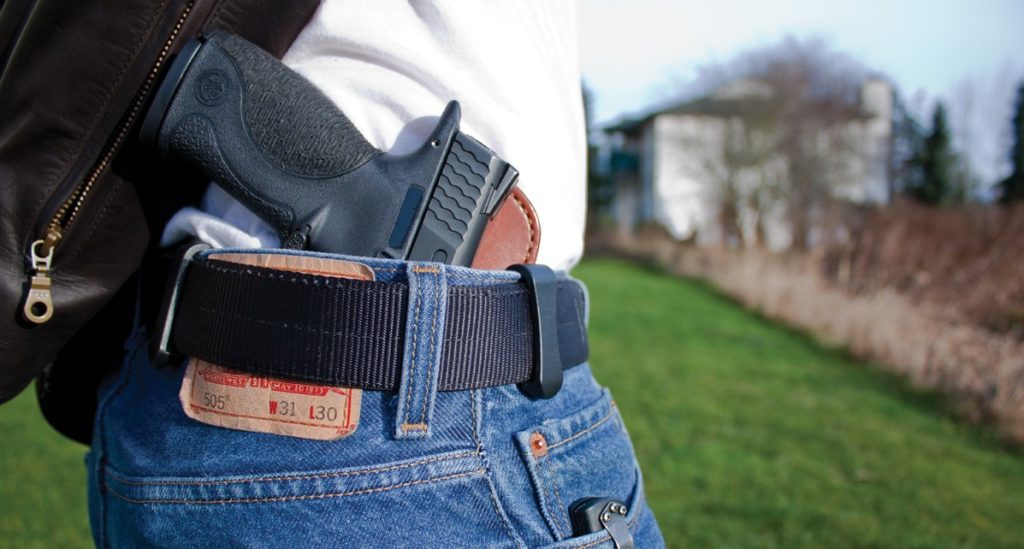
Alabama lawmakers on Wednesday advanced legislation to end the requirement to get a permit to carry a concealed handgun in public. The Senate Judiciary Committee voted 6-4 for the legislation. The bill now moves to the full Alabama Senate. House Republicans have named the bill a priority for the year, but the committee approval came over the objections of law enforcement officials who spoke against it. The legislation, sponsored by Republican Sen. Gerald Allen of Tuscaloosa, would end the requirement to obtain a permit to carry a concealed handgun although people could still get one if they choose. Rep. Shane Stringer, a Republican from Citronelle, has filed similar legislation in the House of Representatives. The proposal, as it has in past years, drew opposition from law enforcement officers during a public hearing Wednesday. Lee County Sheriff Jay Jones told the committee that the bill would take away a valuable tool for law enforcement officers to remove stolen weapons from the streets and to solve and prevent crimes. Edward Delmore, the chief of police for the Gulf Shores Police Department, said officers can now ask a person if they have a permit when they encounter a gun. Delmore said Oklahoma City bomber Timothy McVeigh was initially arrested for carrying a concealed weapon without a permit after a trooper noticed the gun during a traffic stop. “If you pass this, that arrest would not have happened in the same situation here,” he said. Representatives from gun rights groups, including the National Rifle Association, urged lawmakers to advance the bill, arguing that 21 states allow concealed carry without a permit. They argued Alabama already allows open carry— meaning that a person can legally carry a non-concealed handgun — and that it doesn’t make sense to require a permit if the person puts on a jacket or gets in a car. “As an elected official who swore to uphold the constitutions of this state and country, I will always do everything in my power to preserve the rights of Alabamians, especially those granted by the Second Amendment,” Allen said in a statement, commenting on committee passage. Democrats on the committee voted against the legislation. “A life is a way more important than the inconvenience of somebody having to get a permit to carry a gun,” Democratic Sen. Rodger Smitherman of Birmingham said. The bill has been introduced for several years without success, but House Republicans have named the bill a priority for the year. Republished with the permission of the Associated Press.
Joe Biden to name judge Merrick Garland as attorney general

President-elect Joe Biden has selected Merrick Garland, a federal appeals court judge who in 2016 was snubbed by Republicans for a seat on the Supreme Court, as his attorney general, two people familiar with the selection process said Wednesday. In picking Garland, Biden is turning to an experienced judge who held senior positions at the Justice Department decades ago, including as a supervisor of the prosecution of the 1995 Oklahoma City bombing. The pick will force Senate Republicans to contend with the nomination of someone they spurned in 2016 — refusing even to hold hearings when a Supreme Court vacancy arose — but Biden may be banking on Garland’s credentials and reputation for moderation to ensure confirmation. Biden is expected to announce Garland’s appointment on Thursday, along with other senior leaders of the department, including former homeland security adviser Lisa Monaco as deputy attorney general and former Justice Department civil rights chief Vanita Gupta as associate attorney general. He will also name an assistant attorney general for civil rights, Kristen Clarke, the president of Lawyers’ Committee for Civil Rights Under Law, an advocacy group. Garland was selected over other finalists including Alabama Sen. Doug Jones and former Deputy Attorney General Sally Yates. The people familiar with the process spoke on condition of anonymity. One said Biden regards Garland as an attorney general who can restore integrity to the Justice Department and as someone who, having served in the Justice Department under presidents of both political parties, will be respected by nonpartisan career staff. If confirmed, Garland would confront immediate challenges, including an ongoing criminal tax investigation into Biden’s son, Hunter Biden, as well as calls from many Democrats to pursue inquiries into Donald Trump after he leaves office. A special counsel investigation into the origins of the Russia probe also remains open, forcing a new attorney general to decide how to handle it and what to make public. Garland would also inherit a Justice Department that has endured a tumultuous four years and would likely need to focus on not only civil rights issues and an overhaul of national policing policies after months of mass protests over the deaths of Black Americans at the hand of law enforcement. It was unclear how Garland’s selection would be received by Black and Latino advocates who had advocated for a Black attorney general or for someone with a background in civil rights causes and criminal justice reform. But the selection of Gupta and Clarke, two women with significant experience in civil rights, appeared designed to blunt those concerns and offered as a signal that progressive causes will be prioritized in the new administration. Garland would also return to a Justice Department radically different than the one he left. The Sept. 11 attacks were years away, the department’s national security division had not yet been created and a proliferation of aggressive cyber and counterintelligence threats from foreign adversaries have made counties like China, Russia, and North Korea top priorities for federal law enforcement. Monaco brings to the department significant national security experience, including in cybersecurity — an especially urgent issue as the U.S. government confronts a devastating hack of federal agencies that officials have linked to Russia. But some of the issues from Garland’s first stint at the department persist. Tensions between police and minorities, an issue that flared following the 1992 beating of Rodney King in Los Angeles, remain an urgent concern particularly following a summer of racial unrest that roiled American cities after the May killing of George Floyd in Minneapolis. And the FBI has confronted a surge in violence from anti-government and racially motivated extremists. That is a familiar threat to Garland, who as a senior Justice Department official in 1995 helped manage the federal government’s response to the bombing of a government building in Oklahoma City that killed 168 people. The bomber, Timothy McVeigh, was later executed. Garland has called the work the “most important thing I have done” and was known for keeping a framed photo of Oklahoma City’s Alfred P. Murrah Federal Building in his courthouse office in Washington. At the time of the bombing, Garland was 42 and principal associate deputy attorney general, a top lieutenant to Attorney General Janet Reno. He was chosen to go to Oklahoma City, the highest-ranking Justice Department official there, and led the prosecution for a month until a permanent lead prosecutor was named. Garland was selected over other contenders for the job including former Alabama senator Doug Jones, who lost his Senate seat last month, and former Deputy Attorney General Sally Yates. It is rare but not unprecedented for attorneys general to have previously served as judges. It happened in 2007 when President George W. Bush picked Michael Mukasey, a former federal judge in Manhattan, for the job. Eric Holder, President Barack Obama’s first attorney general, had also previously been a Superior Court judge. Garland was put forward by former President Barack Obama for a seat on the Supreme Court in 2016 following the death of Justice Antonin Scalia, but Republicans refused to hold hearings in the final year of Obama’s term. The vacancy was later filled by Justice Neil Gorsuch during the Trump administration. Republican Senate Majority Leader Mitch McConnell refused to let the nomination move forward in the Senate in the final months of Obama’s tenure. He was criticized by Democrats this fall when he took the opposite approach toward confirming President Donald Trump’s Supreme Court pick, Amy Coney Barrett. He said the difference this time around was that the White House and Senate were controlled by the same political parties. One year later, after the firing of FBI Director James Comey, McConnell actually floated Garland’s name as a replacement for that position, though Garland was said to be not interested. Garland has been on the federal appeals court in Washington since 1997. Before that, he had worked in private practice, as well as a federal prosecutor, a senior official in the Justice Department’s criminal division, and as
13 charged in plots against Michigan governor, police
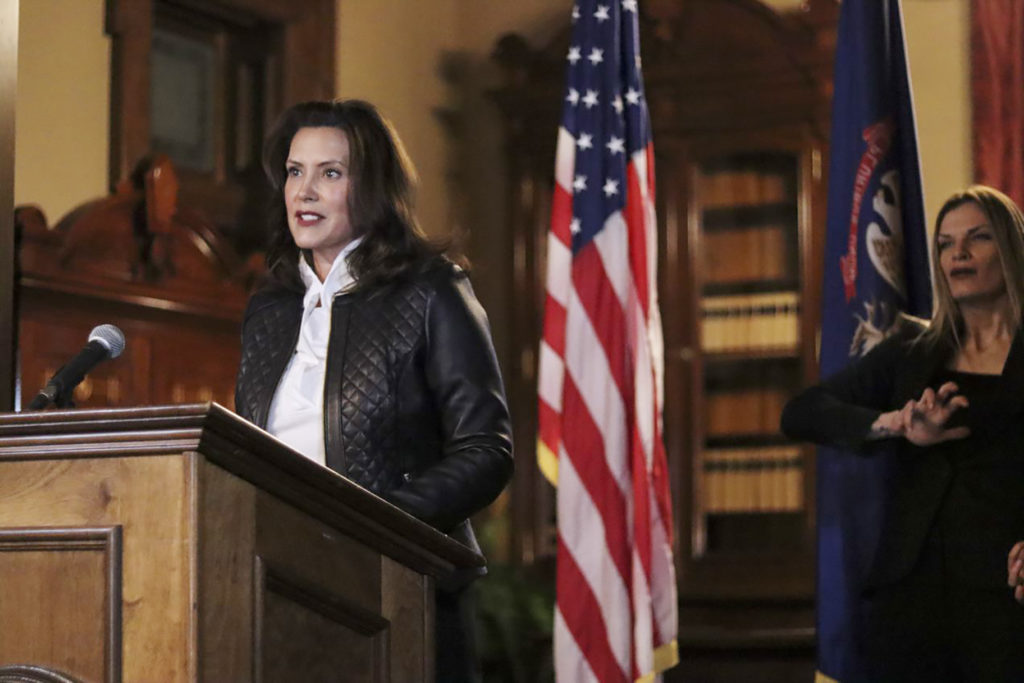
Agents foiled a stunning plot to kidnap Michigan Democratic Gov. Gretchen Whitmer, authorities said Thursday in announcing charges in an alleged scheme that involved months of planning and even rehearsals to snatch her from her vacation home. Six men were charged in federal court with conspiring to kidnap the governor before the Nov. 3 elections in reaction to what they viewed as her “uncontrolled power,” according to a federal complaint. Separately, seven others linked to a paramilitary group called the Wolverine Watchmen were charged in state court for allegedly seeking to storm the Michigan Capitol and seek a “civil war.” The two groups trained together and planned “various acts of violence,” according to the state police. Surveillance for the kidnapping plot took place in August and September, according to an FBI affidavit, and four of the men had planned to meet Wednesday to “make a payment on explosives and exchange tactical gear.” The FBI quoted one of the men as saying Whitmer “has no checks and balances at all. She has uncontrolled power right now. All good things must come to an end.” Authorities said the plots were stopped with the work of undercover agents and informants. The men were arrested Wednesday night. The six charged in federal court face up to life in prison if convicted. The state terrorism charges the other seven men face carry a possible 20-year sentence. Andrew Birge, the U.S. attorney in western Michigan, called the men “violent extremists.” They discussed detonating explosive devices — including under a highway bridge — to divert police from the area near Whitmer’s vacation home and Fox bought a Taser for use in the kidnapping, Birge said. “All of us in Michigan can disagree about politics, but those disagreements should never, ever amount to violence. Violence has been prevented today,” Detroit U.S. Attorney Matthew Schneider told reporters. A few hours later, Whitmer pinned some blame on President Donald Trump, noting that he did not condemn white supremacists in last week’s debate with Joe Biden and instead told a far-right group to “stand back and stand by.” “Hate groups heard the president’s words not as a rebuke but as a rallying cry, as a call to action,” Whitmer said. The White House called Whitmer’s remarks “outlandish.” Whitmer, who was considered as Biden’s running mate and is nearly halfway through a four-year term, has been widely praised for her response to the coronavirus but also sharply criticized by Republican lawmakers and people in conservative areas of the state. The Capitol has been the site of many rallies, including ones with gun-toting protesters calling for her ouster. Whitmer put major restrictions on personal movement and the economy, although many of those limits have been lifted since spring. The governor has exchanged barbs with Trump on social media, with the president declaring in April, “LIBERATE MICHIGAN!” There is no indication in the criminal complaint that the men were inspired by Trump. Authorities also have not publicly said whether the men were angry about Whitmer’s coronavirus orders. The criminal complaint identified the six accused in the plot against Whitmer as Adam Fox, Ty Garbin, Kaleb Franks, Daniel Harris, Brandon Caserta, all of Michigan, and Barry Croft of Delaware. All but Croft appeared Thursday in federal court in Grand Rapids. They asked for court-appointed lawyers and were returned to jail to await detention hearings Tuesday. Fox, who was described as one of the leaders, was living in the basement of a vacuum shop in Grand Rapids. The owner said Fox was opposed to wearing a mask during the pandemic and kept firearms and ammunition at the store. “He was anti-police, anti-government,” Brian Titus told WOOD-TV. “He was afraid if he didn’t stand up for the Second Amendment and his rights that the country is going to go communism and socialism.” The government said the plot against Whitmer appeared to have roots in a June gathering in Dublin, Ohio, attended by more than a dozen people from several states, including Croft and Fox. “The group talked about creating a society that followed the U.S. Bill of Rights and where they could be self-sufficient,” the FBI affidavit said. “They discussed different ways of achieving this goal from peaceful endeavors to violent actions. … Several members talked about murdering ‘tyrants’ or ‘taking’ a sitting governor.” The seven men charged in state court are accused of identifying the homes of law enforcement officers and making violent threats “intended to instigate a civil war,” Attorney General Dana Nessel said. They were identified as Paul Bellar, 21, of Milford; Shawn Fix, 38, of Belleville; Eric Molitor, 36, of Cadillac; Michael Null, 38, of Plainwell; William Null, 38, of Shelbyville; Pete Musico, 42, and Joseph Morrison, 26, who live together in Munith. According to the affidavit, Musico and Morrison are founding members of the Wolverine Watchmen, which authorities described as “an anti-government, anti-law enforcement militia group.” At least three of the 13 defendants were among some armed demonstrators who entered the Senate gallery on April 30 following a larger protest outside the Capitol against Whitmer’s stay-at-home order, said Nessel spokeswoman Kelly Rossman-McKinney. At the time, a senator said the men shouted down at senators who were meeting amid debate over extending the governor’s emergency declaration. The identities of the three men were not immediately available. The Watchmen have met periodically for firearms and tactical training in remote areas “to prepare for the ‘boogaloo,’ a term referencing a violent uprising against the government or impending politically motivated civil war,” state police Det. Sgt. Michael Fink wrote in an affidavit. Some boogaloo promoters insist they are not genuinely advocating for violence. But the boogaloo has been linked to a recent string of domestic terrorism plots, including the arrests of three Nevada men accused of conspiring to incite violence during protests in Las Vegas. Boogaloo supporters have shown up at protests against COVID-19 lockdown orders and racial injustice, carrying rifles and wearing tactical gear over Hawaiian shirts. Michigan became known for anti-government paramilitary activity in the