
House passes defense bill scrapping COVID vaccine mandate
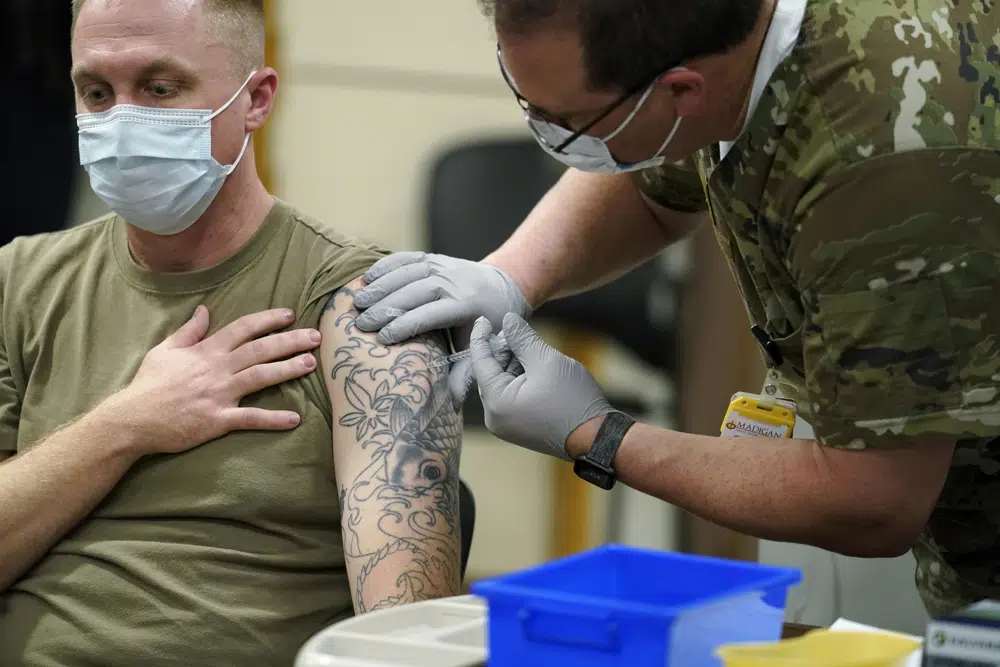
A bill to rescind the COVID-19 vaccine mandate for members of the U.S. military and provide nearly $858 billion for national defense passed the House on Thursday as lawmakers scratch off one of the final items on their yearly to-do list. The bill provides for about $45 billion more for defense programs than President Joe Biden requested, the second consecutive year Congress significantly exceeded his request, as lawmakers seek to boost the nation’s military competitiveness with China and Russia. The House passed the bill by a vote of 350-80. It now goes to the Senate, where it is expected to pass easily, then to the president to be signed into law. To win bipartisan support for the bill, Democrats agreed to Republican demands to scrap the requirement for service members to get a COVID-19 vaccination. The bill directs Defense Secretary Lloyd Austin to rescind his August 2021 memorandum imposing the mandate. Only days earlier, he voiced support for keeping the mandate in effect. Rep. Adam Smith, Democratic chairman of the House Armed Services Committee, told colleagues that the decision to impose the vaccine mandate was the right call at the time. “It saved lives, and it made sure that our force was as ready as it could possibly be in the face of the pandemic,” Smith said. But, he said the directive only required the initial vaccination, and by now, that protection has worn off. “It’s time to update the policy,” Smith said. Republicans said the mandate hurt recruiting and retention efforts. Rep. Mike Rogers, top Republican on the House Armed Services Committee, said he intends in the next Congress to examine who was adversely affected by the mandate, “so we can try to revisit that and make them whole to the extent desirable.” More than 8,000 active-duty service members were discharged for failure to obey a lawful order when they refused the vaccine. “Some of the folks who have moved on are not going to want to come back,” said Rogers, who will become chairman of the Armed Services Committee in the next Congress. Smith said he opposed efforts to reward those service members who disobeyed a military order. “Orders are not optional in the United States military,” Smith said. “And if Congress expresses the opinion that they are, I cannot imagine anything that would more significantly undermine the good order and discipline within our military.” Military leaders have argued that troops for decades have been required to get as many as 17 vaccines in order to maintain the health of the force, particularly those deploying overseas. Recruits arriving at the military academies or at basic training get a regimen of shots on their first day — such as measles, mumps, and rubella — if they aren’t already vaccinated. And they routinely get flu shots in the fall. Service leaders have said that the number of troops who requested religious or other exemptions to any of those required vaccines — prior to the COVID pandemic — was negligible. The politicization of the COVID-19 vaccine, however, triggered an onslaught of exemption requests from troops. As many as 16,000 religious exemptions have been or are still pending, and only about 190 have been approved. Small numbers of temporary and permanent medical exemptions have also been granted. While the rescission of the COVID-19 vaccine mandate has generated much attention, it takes up one paragraph of what is a 4,408-page bill. The defense policy legislation is critical in shaping the military’s future. It sets the maximum number of service members authorized to be in the various branches of the military. It authorizes money for specific major weapons programs, and it establishes pay and benefits. This year’s bill authorizes money to support a $4.6% pay raise for military members and the Defense Department’s civilian workers. The bill also authorizes $800 million in additional security assistance for Ukraine and calls for a report on whether any gaps exist in the oversight of aid to that country. That addresses the concerns of some Republicans who have been calling for a more detailed accounting of how the money has been spent. The legislation received broad support from House members of both political parties. Opposition came from 45 Democrats and 35 Republicans. Some Democrats said the bill authorized too much defense spending. “While working families are being crushed by inflation, we shouldn’t be spending $45 billion MORE than the President requested,” tweeted Rep. Mondaire Jones, D-N.Y. Rep. Troy Nehls, R-Texas, said stripping the vaccine mandate did not go far enough. “We must rehire these heroes with mandatory backpay,” he said of those who were kicked out for refusing the vaccine order. White House press secretary Karine Jean-Pierre defended the Pentagon’s COVID vaccination policy but said Biden would judge the bill “on its entirety.” “What we think happened here is Republicans in Congress have decided that they’d rather fight against the health and well-being of our troops than protecting them,” Jean-Pierre said. “And we believe that it is a mistake.” The defense policy bill also has a variety of environmental measures, such as legislation to boost healthy choral reefs, enhance marine mammal research and eliminate shark fin sales. Lawmakers failed in some instances to attach their priorities to the bill, such as an effort to prevent federal banking regulators from imposing penalties on banks that offer services to cannabis-related businesses. Also left out was legislation from Sen. Joe Manchin, D-W.V.., to speed permits for natural gas pipelines and other energy projects, including a pipeline project in his home state and Virginia. Republished with the permission of The Associated Press.
Kevin McCarthy proposes 5 Republicans to sit on Jan. 6 panel
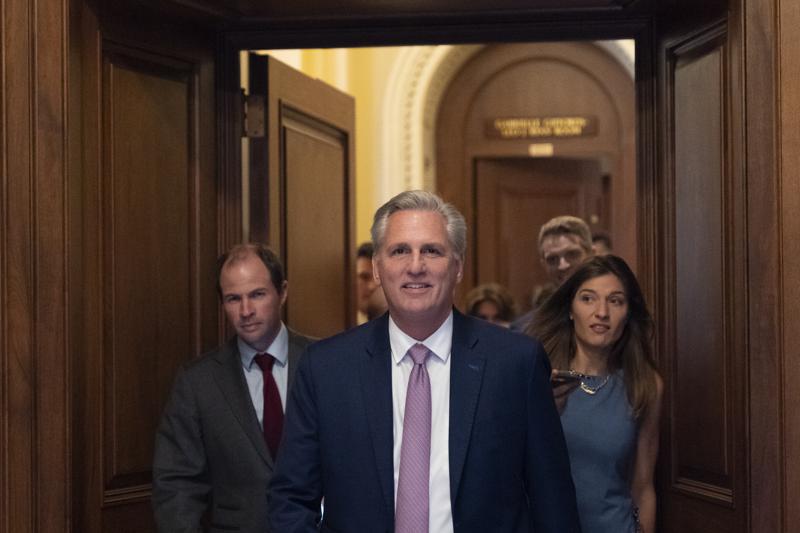
House Republican leader Kevin McCarthy has picked five Republicans to sit on the new select committee to investigate the Jan. 6 insurrection at the Capitol, signaling that Republicans will participate in the investigation that they have staunchly opposed. McCarthy said Monday that he had selected Indiana Rep. Jim Banks, who recently visited former President Donald Trump on trips to the U.S.-Mexico border and Trump’s New Jersey golf club, to be the top Republican on the panel. The Republican leader also tapped Ohio Rep. Jim Jordan, Illinois Rep. Rodney Davis, North Dakota Rep. Kelly Armstrong, and Texas Rep. Troy Nehls to serve on the committee. House Speaker Nancy Pelosi must approve the names before they are final, per committee rules. An aide to Pelosi said she had received notification from McCarthy, but it is unclear when or if she will approve the GOP members. The aide was granted anonymity to discuss the Republican picks ahead of an official announcement. The five Republican men selected by McCarthy have all backed Trump, whose supporters laid siege to the Capitol building on Jan. 6 and interrupted the certification of President Joe Biden’s victory. Banks, Jordan, and Nehls all voted to overturn Biden’s win that day, even after the rioting. Davis and Armstrong were among the minority of Republicans who voted to certify Biden’s win. McCarthy’s picks come after all, but two Republicans opposed the creation of the 13-person select committee in a House vote last month, with most in the GOP arguing that the majority-Democratic panel would conduct a partisan probe. House Democrats originally attempted to create an evenly split, independent commission to investigate the insurrection, but that effort fell short when it was blocked by Senate Republicans. House Republicans have largely remained loyal to Trump despite the violent insurrection of his supporters that sent many of them running for their lives. Banks made clear in a statement Monday evening that he would take a politically combative approach to his leadership on the panel, sharply criticizing the Democrats who had set it up. “Make no mistake, Nancy Pelosi created this committee solely to malign conservatives and to justify the Left’s authoritarian agenda,” Banks said. Jordan, one of Trump’s staunchest defenders through his two impeachments and the top Republican on the House Judiciary Committee, said after the House vote to form the panel that he believed the investigation is “impeachment three” against the former president. Trump was impeached by the House and acquitted by the Senate both times. The members selected by McCarthy had mixed reactions to the insurrection as it happened on Jan. 6. While Jordan led the effort to overturn election results, others tweeted to the rioters to end the violence or condemned it. “Thank you to the Capitol police and all law enforcement,” Armstrong tweeted shortly after the House was evacuated that afternoon. “Rioting is not protesting. This needs to stop. Now.” Around the same time, Davis tweeted: “This is a sad day for our country. The lawlessness has got to stop. Protestors must leave the Capitol so Congress can resume the process of confirming the Electoral College vote.” Nehls, a former sheriff, was one of several members who helped barricade the House doors as rioters tried to beat them down. He tweeted an Associated Press photo of himself holding the door alongside Capitol Police — face to face with rioters who had broken the glass in the entryway. “I was proud to stand shoulder to shoulder with Capitol police barricading entrance to our sacred House chamber while trying to calm the situation talking to protestors,” Nehls tweeted. “What I’m witnessing is a disgrace. We’re better than this. Violence is NEVER the answer. Law and order!” A week later, all five members voted against the impeachment of Trump, who had told his supporters gathered in Washington on Jan. 6 to “fight like hell” to overturn his election defeat. The Democratic chair of the select committee, Mississippi Rep. Bennie Thompson, said Monday evening that he hadn’t seen the GOP names but referred the matter to Pelosi. “It’s up to her,” he said. Pelosi named eight members of the committee earlier this month — seven Democrats and Republican Rep. Liz Cheney of Wyoming, who has strongly criticized Trump and has been the most outspoken member of her caucus against the insurrection. Cheney, who was demoted from GOP leadership in May over her comments, was one of the two Republicans who voted in favor of forming the committee, along with Illinois Rep. Adam Kinzinger. As McCarthy stayed quiet for weeks on Republican participation on the panel, Thompson has said that the committee will have a quorum to conduct business whether GOP members are present or not. The new members will be put to the test at the panel’s first hearing next week, with at least four rank-and-file police officers who battled rioters that day testifying about their experiences. Dozens of police officers were injured as the crowd pushed past them and broke into the Capitol building. Seven people died during and after the rioting, including a woman who was shot by police as she tried to break into the House chamber and three other Trump supporters who suffered medical emergencies. Two police officers died by suicide in the days that followed, and a third officer, Capitol Police Officer Brian Sicknick, collapsed and later died after engaging with the protesters. A medical examiner determined he died of natural causes. Republished with the permission of the Associated Press.
Barry Moore supports Lauren Boebert’s call to censure Joe Biden over border crisis
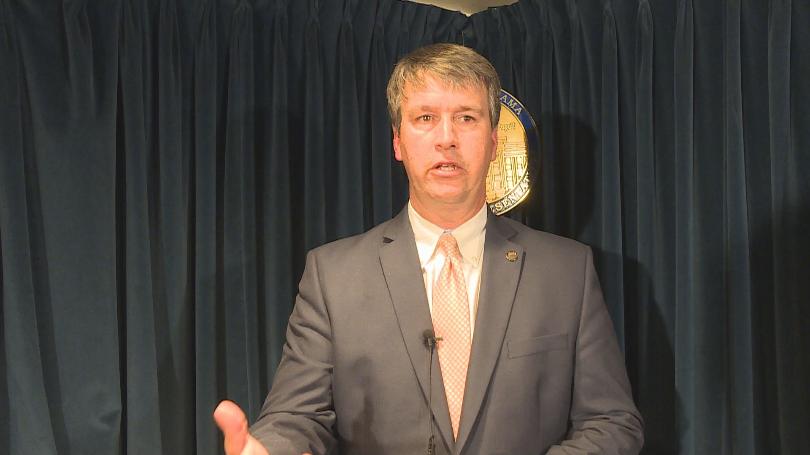
Rep. Barry Moore has joined other leaders to support Rep. Lauren Boebert’s bill to censure President Joe Biden over the border crisis. According to a press release, Moore joined Boebert and other leaders in a press conference to address the resolution. Moore has visited the southern border twice this year. President Biden has not visited the border yet. Some statistics Moore emphasized in his release include: Under President Trump, there were 1,400 children in HHS custody at the border. At one point in June, there were 22,000. Over 1 million illegal aliens have been encountered by CBP since Biden took office, including a record-breaking 180,000 illegal aliens in May. Since Biden took office, CBP arrested 1,413 alien drug smugglers—up from 386 last year. Since Biden took office, CBP arrested 40 alien murderers—up from 3 last year. Since Biden took office, CBP arrested 353 alien sex offenders—up from 156 last year. Since Biden took office, CBP arrested 1,118 aliens for DUIs—up from 364 last year. In just the first four months of Biden’s term, enough fentanyl to kill every American four times over has been interdicted by Border Patrol. Moore stated, “Ensuring the integrity of our borders is one of the most fundamental duties of a president, yet President Biden has destroyed four years of progress at the border to satisfy far-left activists and cheap labor-loving globalists. His reckless determination to reverse every Trump administration policy regardless of the outcome has put every American family and our economy at risk. We must hold President Biden to account for putting politics over the people he has sworn an oath to protect.” Moore stated on Twitter, “President Biden’s dereliction of duty at our southern border is completely unacceptable. Proud to join @RepBoebert in holding Biden accountable for putting politics over the people he has sworn an oath to protect.” President Biden's dereliction of duty at our southern border is completely unacceptable. Proud to join @RepBoebert in holding Biden accountable for putting politics over the people he has sworn an oath to protect. https://t.co/hXhV1H98uQ — Rep. Barry Moore (@RepBarryMoore) June 24, 2021 The bill is supported by: American Principles Project, Citizens for Renewing America, Eagle Forum, Federation for American Immigration Reform (FAIR), Heritage Action, and NumbersUSA. Along with Moore, 22 additional Members of Congress joined Boebert to introduce her bill including: Reps. Andy Biggs, Dan Bishop, Madison Cawthorn, Jeff Duncan, Pat Fallon, Matt Gaetz, Louie Gohmert, Bob Good, Paul Gosar, Morgan Griffith, Diana Harshbarger, Jody Hice, Ronny Jackson, Thomas Massie, Alex Mooney, Troy Nehls, Ralph Norman, Marjorie Taylor Greene, Bill Posey, Lance Gooden, Chip Roy, and Randy Weber.
