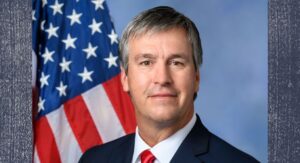
Mo Brooks calls for Anthony Fauci’s termination in midst of controversial email release
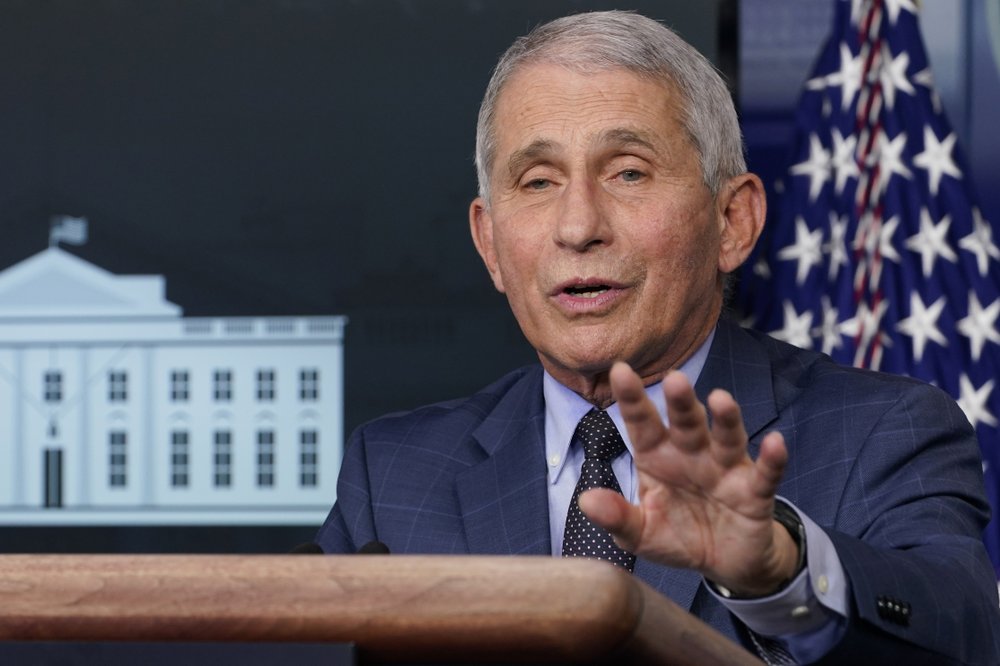
Dr. Anthony Fauci, arguably America’s most well-recognized health official in the battle against COVID-19, assumed a central role in political controversy following a newly released slough of last year’s emails, giving rise to concerns about COVID-19’s origin and the controversial scientific research U.S taxpayers have funded. Yesterday, Congressman Mo Brooks (AL-05) joined several of his colleagues in a news conference to discuss auditing the correspondence and financial statements of Dr. Fauci. Fauci is no stranger to the spotlight, as the immunologist was one of the world’s most frequently-cited scientists across all scientific journals from 1983 to 2002, in addition to the world’s 10th most-cited HIV/AIDS researcher from 1996-2006. He has advised seven Presidents and was awarded a Presidential Medal of Freedom by President George H.W. Bush in 2008 for his efforts on an AIDS relief program. Serving as director of the National Institute of Allergy and Infectious Diseases (NIAID) since 1984, Fauci is perhaps more widely recognized for leading the nation’s COVID-19 response as a White House coronavirus advisor during the Trump Administration. He continues to lead the nation’s pandemic response during his current role as chief medical advisor in the Biden Administration. However, Fauci’s consistently shifting narratives throughout the pandemic, in addition to frequent opposition towards President Donald Trump’s leadership, resulted in a sizable number of public critics, many of which included Trump White House officials. Peter Navarro, a Harvard-trained economist and China hawk who served as a top trade and economic policy advisor to President Trump, publicly criticized Dr. Fauci in a USA Today op-ed, outlining the many instances Fauci was mistaken during the pandemic. USA Today promptly attached a remorseful precursor to the article; an apologetic note addressed to readers for publishing any criticism of Fauci. One of the most notable examples Navarro specifies is the predictive memos he sent in January and February 2020, which grimly anticipated COVID-19 to be a deadly and impactful global pandemic. Senior officials shrugged off these warnings, including Fauci, due to Navarro’s hawkish views on China. “The lack of immune protection or an existing cure or vaccine would leave Americans defenseless in the case of a full-blown coronavirus outbreak on US soil,” Navarro’s January 29 memo to the National Security Council states. “The lack of protection elevates the risk of the coronavirus evolving into a full-blown pandemic, imperiling the lives of millions of Americans.” Weeks after Navarro’s warning was sent out, Fauci assured the media just how worried the American people should be about the pandemic when he expressed, “The danger of getting coronavirus now is just minusculely low,” Fauci stated. “As of today, on the 17th of February, the risk is really relatively low.” Since then, public criticism of Fauci continues to escalate as 3,000 pages of his emails from March and April 2020 were obtained under the Freedom of Information Act (FOIA) following a lawsuit filed by taxpayer watchdog group, the White Coast Waste Project. “Taxpayers have a right to know what the NIH knew about how its money was being spent at the Wuhan animal lab, and what NIH knew about a potential lab leak in late 2019 and early 2020,” stated Justin Goodman, vice president of advocacy and public policy at the White Coat Waste Project. “Transparency and accountability at home and abroad are critical in the quest to identify the origin of the COVID-19 pandemic in order to prevent another outbreak.” Fauci’s obtained emails point to the fact that he was indeed warned of the possibility that COVID-19 was engineered, a theory he remained adamantly opposed to throughout the pandemic. Kristian Andersen, the head of a viral genomics lab at Scripps Research in La Jolla, CA, emailed Fauci in February 2020 entertaining the possibility of COVID-19’s lab-based origin, “The unusual features of the virus make up a really small part of the genome (<0.1%) so one has to look really closely at all the sequences to see that some of the features (potentially) look engineered.” This week, Anderson addressed his involvement in these recently released emails, assuring that his newfound research discourages any lab-based scenarios while also claiming it is scientifically impossible to determine the origins of the pandemic, “As we stated in our article last March, it is currently impossible to prove or disprove specific hypotheses of SARS-CoV-2 origin.” Additionally, these emails raise questions surrounding the type of research U.S. taxpayers are funding. Under Fauci’s four-decade-long leadership, the NAIAD resides within the National Institute of Health (NIH), which allocates 80% of its federal funds to scientific research, including grants to foreign organizations. Fauci swore under oath that no taxpayer funds were used to fund research in Wuhan. However, in a later congressional hearing, he stated that the NIH earmarked $600,000 to study coronaviruses in Wuhan. NIH Director Dr. Francis Collins confirmed that $3.7 million in federal funds were sent to EcoHealth Alliance, a global nonprofit, of which $600,000 went to the Wuhan Institute of Virology (WIV). Fauci’s emails show a message received from the President of EcoHealth Alliance, Peter Daszak, thanking him for rejecting any lab-leak theories in April 2020. Daszak wrote to Fauci, “I just wanted to say a personal thank you on behalf of our staff and collaborators, for publicly standing up and stating that the scientific evidence supports a natural origin for COVID-19 from a bat-to-human spillover, not a lab release from the Wuhan Institute of Virology.” Daszak adds, “Your comments are brave, and coming from your trusted voice, will help dispel the myths being spun around the virus’ origins.” These concerns have led Congressional Republicans, including House Minority Leader Kevin McCarthy (R-CA), to call for Fauci’s dismissal from his role as NIAID director. Yesterday, Congressman Mo Brooks joined GOP lawmakers in a press conference to announce his support of the Fire Fauci Act. The bill would bring Dr. Fauci’s taxpayer salary to $0 and will require the Senate to confirm another individual to fill his position. “Dr. Fauci is consistent in just one thing and that is inconsistency,” Brooks said. “Why
Mo Brooks proposes State of the Union be moved to Senate Chamber
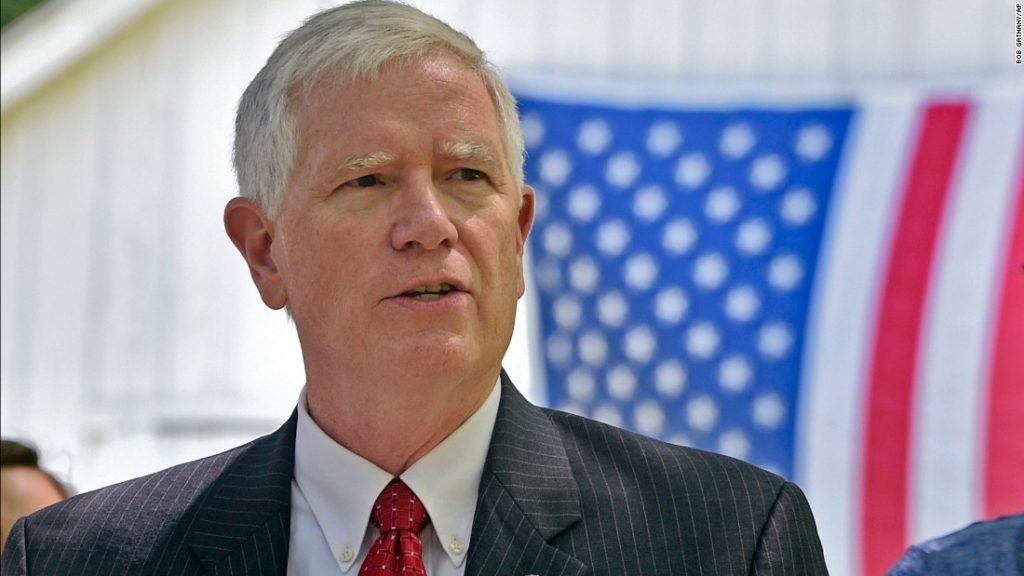
With the government shutdown stretching to nearly a month, Speaker of the House Nancy Pelosi asked President Donald Trump to postpone the upcoming State of the Union address. In a letter to the president on Wednesday, she wrote, Given the security concerns and unless the government re-opens this week, I suggest that we work together to determine another suitable date after government has re-opened for this address or for you to consider delivering your State of the Union address in writing to the Congress on January 29th. Kirstjen Nielsen, Secretary of Homeland Security, took to Twitter to ensure the public that the State of the Union can go ahead as planned. The Department of Homeland Security and the US Secret Service are fully prepared to support and secure the State of the Union. We thank the Service for their mission focus and dedication and for all they do each day to secure our homeland. — Secretary Kirstjen M. Nielsen (@SecNielsen) January 16, 2019 Thursday, Alabama 5th District Rep. Republican Mo Brooks called for President Trump to move the speech from the House to the Senate Chamber in response, In a letter to the president, Vice President Pence, and Senate Majority Leader Mitch McConnell, Brooks called Pelosi’s request “hyper partisan.” He concluded his letter by saying, I most strongly encourage Vice-President Mike Pence, in his Constitutional capacity as the presiding officer of the Senate, and Senate Majority Leader Mitch McConnell, to invite President Trump to report to the American people on the state of the union in the Senate Chamber. While traditionally these addresses have been held in the House Chamber due to its larger size, inasmuch as House Democrats apparently do not want to hear from the President anyway, overcrowding of the Senate chamber should not be an issue. I urge President Trump, Vice-President Pence (as President of the Senate), and Leader McConnell to maintain January 29, 2019 as the date on which President Trump can address the American people from the Senate Chamber, thus putting President Trump with our first president, George Washington, who also gave his first State of the Union address in the Capitol’s Senate Chamber. Brooks also responded to Pelosi on Wednesday, saying she was using the address as a “political bargaining chip.”
Sarah Sanders replaces Sean Spicer as press secretary
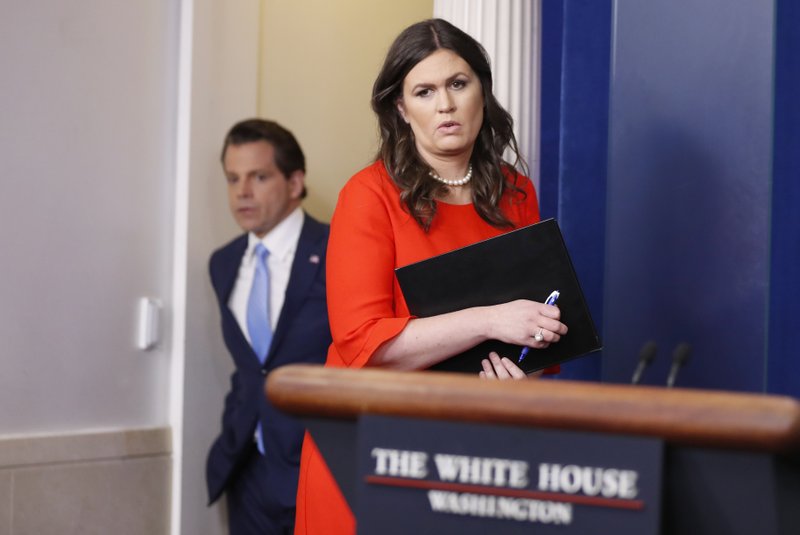
The Latest on changes to the White House communications staff (all times local): 2:45 p.m. New York financier Anthony Scaramucci has been formally named White House communications director and Sarah Huckabee Sanders has been promoted to press secretary in the Trump White House’s latest shakeup. Trump says in a statement read by Sanders that he’s “grateful” for departing press secretary Sean Spicer’s “work on behalf of my administration and the American people.” He adds: “just look at his great television ratings!” Scaramucci also is addressing reporters at the White House. He calls Spicer “a true American patriot” and says he hopes Spicer “goes on to make a tremendous amount of money.” ___ 2 p.m. Outgoing press Secretary Sean Spicer says that he chose to resign from his position to give incoming communications director Anthony Scaramucci a fresh start. Spicer says during a brief phone conversation with The Associated Press following his announced departure that, “we’re at the point where” the president “could benefit from a clean slate.” He says he felt it would be best for Scaramucci to be able to build his own operation “and chart a new way forward.” Spicer is also complimenting Scaramucci, a New York financier and frequent defender of the president who was a staple at Trump Tower during the president’s transition. Spicer says of Scaramucci’s hiring: “It’ll be great, he’s a tough guy.” ___ 1:50 p.m. White House press secretary Sean Spicer says it’s been “an honor” and “privilege” to serve President Donald Trump and the country. Spicer resigned Friday in protest over the hiring of a new White House communications director. He says in a tweet that he will continue his service through August. One person with knowledge of the situation said Spicer objected to the hiring of New York financier Anthony Scaramucci’s lack of qualifications for the communications role. The person spoke on condition of anonymity because they were not authorized to discuss the personnel matter publicly. ___ 1 p.m. White House deputy press secretary Sarah Huckabee Sanders will be conducting an on-camera briefing on Friday afternoon, following White House press secretary Sean Spicer’s resignation. Spicer announced his departure after President Donald Trump hired a new White House communications director, ending his rocky six-month tenure as Trump’s top spokesman. Sanders has been handling most of the briefing duties in recent weeks, and most briefings have been off-camera. The last on-camera White House briefing was held on June 29. ___ 12:35 p.m. White House chief of staff Reince Priebus says he supports incoming communications director Anthony Scaramucci “100 percent.” His comments come moments after White House press secretary Sean Spicer resigned over Scaramucci’s hiring. Priebus and Spicer spent years working closely together at the Republican National Committee. Priebus has also reportedly opposed hiring Scaramucci for various administration positions. Priebus told The Associated Press that he and Scaramucci are “very good friends.” He says it’s “all good here” at the White House. ___ 12:07 p.m. White House press secretary Sean Spicer is resigning his position, according to two people with knowledge of the decision. One of those people said Spicer is quitting because of objections over the appointment of a new White House communications director, New York financier Anthony Scaramucci. The people with knowledge of the decision insisted on anonymity because they were not authorized to discuss the personnel matter publicly. Republished with permission of The Associated Press.
Alabama politics in review: 2016 more interesting than expected
This past year in Alabama politics was surprisingly more interesting than was expected. The judicial inquiry commission removed Supreme Court Chief Justice Roy Moore from the bench for telling the probate judges in the state to not perform marriage ceremonies for gay people. He said marriage should be between a man and a woman, as do most people in Alabama. This removal by this vague panel of former lawyers and judges has caused legislators to call for an investigation of who this panel is and how they have this much power. More importantly, Judge Moore’s views and martyrdom has catapulted him into an early frontrunner position for the governorship of Alabama in next year’s upcoming election. He is prohibited from running for the Court again because he is 72 and Alabama law does not allow someone to run for judgeships after age 70. Therefore, it was expected that he was going to run for governor. However, his expulsion has propelled his polling numbers to strategic levels. Our good ole Dr. Gov. Robert Bentley’s saga played out over the year. It is titillating and fun to follow. However, it has pretty much rendered him somewhat irrelevant as governor. Donald J. Trump’s victory for the presidency is, of course, the biggest political story of 2016. It overshadows our shenanigans in Alabama. Trump is very popular in Alabama. His victories in our GOP primary and in the November General Election were record setting vote tallies for the Heart of Dixie. As we enter 2017, the beginning of the Trump presidency will be the news. His administration will and has already affected Alabama politics significantly. His Attorney General will be our own Senator Jeff Sessions. Our Senior Senator Richard Shelby has had one seat for 30 years and Sessions has been in the other seat for 20 years. Therefore, this open seat is a rarity and will be coveted. By law, the Governor appoints the holder of the vacant seat, which will be for an interim time. The election for the seat will probably occur at the same time as the governor’s race, which will be 17 months from now in the GOP primary in June 2018. The most qualified person to take the seat would be someone from our state congressional delegation, especially someone who has served in Congress from Alabama for a decade or more. The two who fit that bill and who are the most imminently qualified are Congressman Robert Aderholt and former Congressman Jo Bonner. Aderholt, who hails from Haleyville, has represented the 4th Congressional District for 20 years. That district runs from the Mississippi line to the Georgia line across north central Alabama and includes Jasper, Cullman, Gadsden and Tuscaloosa. Aderholt got to Washington at the amazingly young age of 31. Therefore, he is only 51 years old and is our most senior and thus most powerful congressman. He is a ranking member of the powerful Appropriations Committee and is in line to be chairman soon. He would be risking a lot and probably has the same power as a freshman U.S. Senator. He is on course to follow in the footsteps of his predecessor Tom Bevill, who was referred to as Alabama’s third senator. Jo Bonner represented Baldwin and Mobile in the 1st District for over a decade. He left a couple of years ago to accept an Economic Development position at the University of Alabama. He is very well-liked and respected in Washington and was positioned for a leadership post in the GOP Congress. His erudite and sincere demeanor would make him an effective Senator immediately, he also served in the House with a third of the Senators. The most likely to win the seat in the 2018 Election is Attorney General Luther Strange. He has run statewide three times successfully and has over a three-million-dollar head start name identification-wise. None of these three men have or will seek Bentley’s appointment. They all realize how unpopular Bentley is and know the history of appointments in Alabama politics. Bentley could redeem some respect and relevance if he went hat in hand to President Donald Trump and offered Trump his appointment. In that case, the governor’s choice would be Trump’s choice. The best choice to bridge the gap may be Perry Hooper Jr., who trumped for Trump in Alabama. See you next week. ___ Steve Flowers is Alabama’s leading political columnist. His weekly column appears in over 60 Alabama newspapers. He served 16 years in the state Legislature. Steve may be reached at www.steveflowers.us.
Rio2016, Election2016, PokemonGo top global Twitter trends

The Rio Olympics, the American presidential election and Pokemon Go were the top global trends on Twitter in 2016. The social media site says Rio2016 was the most tweeted-about topic around the world, followed by Election2016 and PokemonGo. Euro2016, Oscars, Brexit, Trump and BlackLivesMatter also made the top 10. A Spanish gamer known as elrubius originated the year’s most popular tweet: It reads “Limonada” (lemonade) and was retweeted more than 1.3 million times. One Direction’s Harry Styles had the second most-repeated post — quoting a Taylor Swift song — with more than 700,000 retweets. A postelection tweet from Hillary Clinton encouraging little girls to recognize their power and seize opportunities was the third most popular of the year with 634,560 retweets. Republished with permission of The Associated Press.
Joe Henderson: Can America bridge the Great Divide?

Pundits and political pros have been talking about the Great Divide Among Americans, and we all know it is there. It always has been. People in a country this large and diverse are going to have different ways of looking at things, but we usually come together at some point and work out the problems. At least, that’s how it used to be. I’m starting to wonder, though, if those days are gone for good. For Exhibit A, I bring you The Washington Post/ABC News poll released Sunday. The Post wrote, “Never in the history of the Post-ABC poll have the two major party nominees been viewed as harshly as (Hillary) Clinton and (Donald) Trump.” That’s some plain talk, but let’s make it even more blunt. Boiled down to its essence, this poll indicates about half of the registered voters in America will literally hate whoever wins the election to lead this country. When Clinton supporters were asked why they would vote for her, 48 percent said it’s because they oppose Trump. It was the same story with Trump, where 53 percent of respondents said they’ll go for him because they can’t stomach Clinton. And 86 percent of those people said they could never vote for Clinton. Also, there’s this nugget: 48 percent of Trump’s supporters said he doesn’t represent the GOP’s core values, but they’ll vote for him anyway because they hate Hillary that much. Maybe we should have seen this coming, because there is no compromise on some of the sharpest issues that divide us. There is never going to be middle ground on a hot-button issue like abortion, but now you stir divisive topics like LGBT rights, immigration, climate change, gun control, police behavior and, yes, even the national debt into the stew. With so many information outlets available masquerading as “news services,” people aligned with one side or the other can find a source that reinforces their beliefs. And discourse being what it is – Trump has raised shouting and debasement to an art form – voila! Hatred becomes a platform. Bringing the nation together is a noble sentiment, and either Trump or Clinton will vow to do that come November. The numbers say that will be just another campaign promise neither can keep.
Donald Trump pulls off clean sweep of 5 Northeast primaries
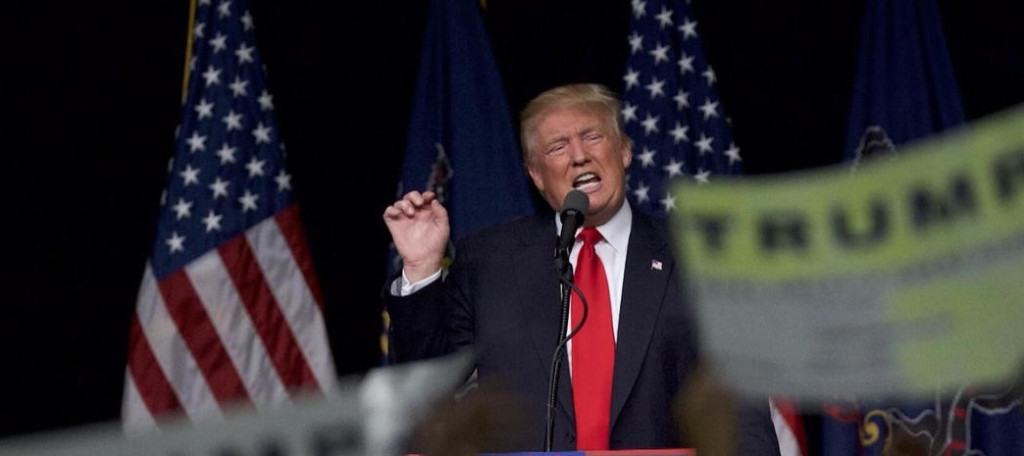
Donald Trump swept all five Republican primaries Tuesday, a commanding showing across the Northeast that keeps the Republican front-runner on his narrow path to the GOP nomination. Hillary Clinton carried Democratic contests in Maryland and Delaware, the start of what her campaign hoped would be a strong night for the former secretary of state. Trump’s victories came in Maryland, as well as Connecticut, Delaware, Pennsylvania and Rhode Island. His strong showing was a blow to rivals who are running out of ways to stop the brash billionaire. Clinton aimed to emerge from Tuesday’s contests on the brink of becoming the first woman nominated by a major party. She’s already increasingly looking past rival Bernie Sanders, even as the Vermont senator vows to stay in the race until primary voting ends in June. Sanders spent Tuesday campaigning in West Virginia, where he drew several thousand people to a lively evening rally. He urged his supporters to recognize that they are “powerful people if you choose to exercise that power.” Still, there were some signs that Sanders’ campaign was coming to grips with his difficult position. Top aide Tad Devine said that after Tuesday’s results were known, “we’ll decide what we’re going to do going forward.” Trump’s victories padded his delegate totals, yet the Republican contest remains chaotic. The businessman is the only candidate left in the three-person race who could possibly clinch the nomination through the regular voting process, yet he could still fall short of the 1,237 delegates he needs. GOP rivals Ted Cruz and John Kasich are desperately trying to keep him from that magic number and push the race to a convention fight, where complicated rules would govern the nominating process. The Texas senator and Ohio governor even took the rare step of announcing plans to coordinate in upcoming contests to try to minimize Trump’s delegate totals. But that effort did little to stop Trump from a big showing in the Northeast. Cruz spent Tuesday in Indiana, which votes next week. Indiana is one of Cruz’s last best chances to slow Trump, and Kasich’s campaign is pulling out of the state to give him a better opportunity to do so. “Tonight this campaign moves back to more favorable terrain,” Cruz said during an evening rally in Knightstown, Indiana. His event was held at the “Hoosier gym,” where some scenes were filmed for the 1986 movie, “Hoosiers,” starring Gene Hackman as the coach of a small-town Indiana basketball team that wins the state championship. Trump has railed against his rivals’ coordination, panning it as “pathetic,” and has also cast efforts to push the nomination fight to the convention as evidence of a rigged process that favors political insiders. Yet there’s no doubt Trump is trying to lead a party deeply divided by his candidacy. In Pennsylvania, exit polls showed nearly 4 in 10 GOP voters said they would be excited by Trump becoming president, but the prospect of the real estate mogul in the White House scares a quarter of those who cast ballots in the state’s Republican primary. In another potential general election warning sign for Republicans, 6 in 10 GOP voters in Pennsylvania said the Republican campaign has divided the party — a sharp contrast to the 7 in 10 Democratic voters in the state who said the race between Clinton and Sanders has energized their party. The exit polls were conducted by Edison Research for The Associated Press and television networks. With his three victories Tuesday, Trump will win at least half of the 118 delegates up for grabs in Tuesday’s contests. And he has a chance to win a lot more. In Pennsylvania, Trump collected 17 delegates for winning the state. An additional 54 delegates are elected directly by voters — three in each congressional district. However, their names are listed on the ballot with no information about which presidential candidate they support. Those delegates will attend the GOP convention as free agents, able to vote for the candidate of their choice. Democrats award delegates proportionally, which allowed Clinton to maintain her lead over Sanders even as he rattled off a string of wins in previous contests. According to the AP count, Clinton has 1,946 delegates while Sanders has 1,192. That count includes delegates won in primaries and caucuses, as well as superdelegates — party insiders who can back the candidate of their choice, regardless of how their state votes. Clinton’s campaign is eager for Sanders to tone down his attacks on the former secretary of state if he’s going to continue in the race. She’s been reminding voters of the 2008 Democratic primary, when she endorsed Barack Obama after a tough campaign and urged her supporters to rally around her former rival. Ahead of Tuesday’s results, Senate Democratic leader Harry Reid said that while Sanders has run a “unique and powerful” campaign, he does not believe the Vermont senator will be the party’s nominee. According to exit polls, less than a fifth of Democratic voters said they would not support Clinton if she gets the nomination. The exit polls were conducted in Connecticut, Pennsylvania and Maryland. Republished with permission of the Associated Press.
Donald Trump bristles at Ted Cruz-John Kasich collaboration
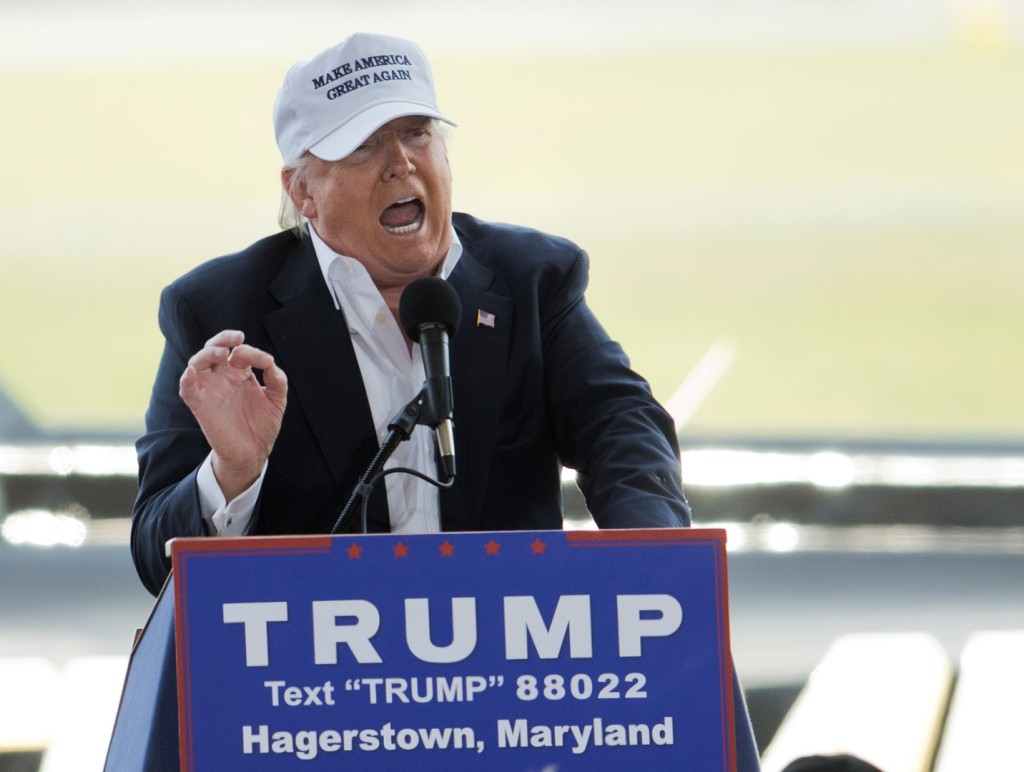
Donald Trump says an extraordinary collaboration between Ted Cruz and John Kasich aimed at unifying the anti-Trump vote in some remaining primaries is a desperate move by “mathematically dead” rivals. Such collusion would be illegal in many industries, the Republican presidential front-runner said, but it’s illustrative of “everything that is wrong in Washington and our political system.” Under the arrangement outlined Sunday, Kasich, the Ohio governor, will step back in the May 3 Indiana contest to let Cruz bid for voters who don’t like Trump. Cruz, a Texas senator, will do the same for Kasich in Oregon and New Mexico. The arrangement does not address the five Northeastern states set to vote Tuesday, where Trump is expected to add to his already overwhelming delegate lead. Yet the shift offers increasingly desperate Trump foes a glimmer of hope in their long and frustrating fight to halt the billionaire’s rise. Trump said in a statement the Cruz-Kasich compact joins two “puppets of donors and special interests” who have no path to the nomination. Cruz’s campaign manager, Jeff Roe, said in a statement explaining the new plans that Trump would be soundly defeated by the Democratic nominee, whether it’s Hillary Clinton or Bernie Sanders. “Having Donald Trump at the top of the ticket in November would be a sure disaster for Republicans,” he said. Added Kasich’s chief strategist, John Weaver, “Our goal is to have an open convention in Cleveland, where we are confident a candidate capable of uniting the party and winning in November will emerge as the nominee.” The announcement marks a sharp reversal for Cruz’s team, which aggressively opposed coordinating anti-Trump efforts with Kasich as recently as late last week. And the agreement applies only to Indiana, Oregon and New Mexico — three of the 15 states remaining on the Republican primary calendar. As Kasich backs out of Indiana, Cruz promised he would not compete in Oregon on May 17 and New Mexico on June 7. Trump campaigned Sunday in Maryland, which will vote on Tuesday along with Rhode Island, Connecticut, Pennsylvania and Delaware. Speaking to several thousand people in an airplane hangar in Hagerstown, Maryland, Sunday evening, Trump stressed repeatedly that he expects to win the 1,237 delegates needed in the first round of voting in Cleveland to stave off a contested convention. “I only care about the first,” he said. “We’re not going for the second and third and fourth and fifth.” As recently as three days ago Kasich’s campaign announced investments in Indiana, including the opening of two offices and the creation of a campaign leadership team. His campaign on Sunday night canceled a town-hall meeting and gathering in Indianapolis scheduled to watch the results of Tuesday’s primaries. Both campaigns encouraged allied super PACs and other outside groups to “honor the commitments.” On the Democratic side Sunday, underdog Sanders rallied thousands of voters in two New England states and offered mixed signals on how hard he would push his differences with the commanding front-runner, Clinton. The Vermont senator largely steered clear of Clinton at a Rhode Island park, but hours later delivered a sharp critique before more than 14,000 supporters in New Haven, Connecticut. Sanders reiterated his call for Clinton to release transcripts of lucrative Wall Street speeches she delivered after leaving the State Department in early 2013. Republished with permission of the Associated Press.
How Donald Trump can lock up GOP nomination before the convention
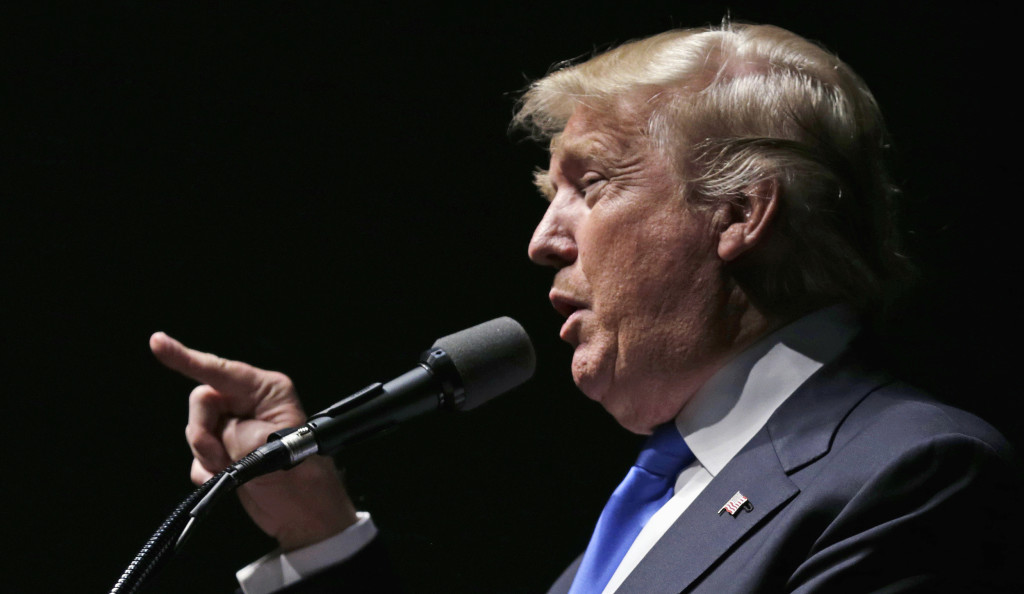
To all the political junkies yearning for a contested Republican convention this summer: not so fast. It’s still possible for Donald Trump to clinch the nomination by the end of the primaries on June 7. His path is narrow and perilous. But it’s plausible and starts with a big victory Tuesday in his home state New York primary. Trump is the only candidate with a realistic chance of reaching the 1,237 delegates needed to clinch the nomination before the July convention in Cleveland. His rivals, Texas Sen. Ted Cruz and Ohio Gov. John Kasich, can only hope to stop him. If Cruz and Kasich are successful, politicos across the country will have the summer of their dreams — a convention with an uncertain outcome. But Trump can put an end to those dreams, and he can do it without any of the 150 or so delegates who will go to the convention free to support the candidate of their choice. What comes next isn’t a prediction, but rather, a way in which Trump could win the nomination outright on June 7. To be sure, Trump will have to start doing a lot better than he has so far. He gets that chance starting Tuesday, beginning the day with 744 delegates. ___ NEW YORK There are 95 delegates at stake in the Empire State, and it’s important for Trump to win a big majority of them. It won’t be easy. There are 14 statewide delegates and three delegates in each congressional district. If a candidate gets more than 50 percent of the statewide vote, he gets all 14 delegates. Otherwise, he has to share them with other candidates. If a candidate gets more than 50 percent of the vote in a congressional district, he gets all three delegates. Otherwise, again, he has to share. Trump leads statewide in the most recent preference polls, with right around 50 percent. New York is a large and diverse state, so he probably won’t win all the congressional districts. Let’s say Trump does make it to 50 percent, but Kasich or Cruz wins five congressional districts; Trump will take 77 delegates on the night. Trump’s running total: 821 delegates. ___ APRIL 26 Five states have primaries on April 26, with 172 delegates at stake: Pennsylvania, Connecticut, Delaware, Maryland and Rhode Island. Pennsylvania could be trouble for Trump. The state has a unique system in which 54 delegates — three from each congressional district — are listed by name on the ballot, with no information for voters to know which candidate they support. That means even if Trump wins Pennsylvania, he’s only guaranteed to claim 17 of the state’s 71 delegates. Connecticut awards 13 delegates to the statewide winner and three to the winner of each congressional district, for a total of 28. The New York real estate mogul needs to win his neighboring state. If he does well, he could get 22 delegates. Delaware’s 16 delegates are winner-take-all, increasing the importance of this small state. If Trump loses Delaware, he has to make it up elsewhere. Maryland awards 14 delegates to the statewide winner and three to the winner of each congressional district, for a total of 38. Recent polls show Trump with a significant lead. If he does well, he could get 32 delegates. Trump can afford to lose Rhode Island, which awards its 19 delegates proportionally. In all, it’s a day on which we’ll say Trump claims 93 delegates. Trump’s running total: 914. ___ MAY Five states hold contests in May, with a total of 199 delegates at stake: Indiana, Nebraska, West Virginia, Oregon and Washington State. Indiana’s May 3 primary is important for Trump. The state awards 30 delegates to the statewide winner and three delegates to the winner of each congressional district, for a total of 57. If Trump can win the state and a majority of the congressional districts, he could collect 45 delegates. West Virginia is another unique state in which voters elect 31 delegates in the May 10 primary. In West Virginia, however, the delegates will be listed on the ballot along with the presidential candidate they support. If Trump does well here, he could pick up 20 or more delegates. Nebraska’s 36 delegates are winner-take-all. But if Nebraska is like its neighbors Kansas and Iowa, two states Cruz won earlier in the race, Trump can’t count on these delegates. Oregon and Washington state award delegates proportionally, so even the losers get some. We’ll give Trump 70 delegates for the month. Trump’s running total: 984. ___ JUNE 7 This could be Trump’s D-Day. Or his Waterloo. Five states vote on June 7, with 303 delegates up for grabs. The biggest prize is California, along with New Jersey, South Dakota, Montana and New Mexico. The only state Trump can afford to lose is New Mexico, which awards 24 delegates proportionally. New Jersey, South Dakota and Montana are winner-take-all, with a total of 107 delegates. California is more complicated, with 172 delegates at stake. The statewide winner gets only 13. The other 159 are awarded according to the results in individual congressional districts. Each of the state’s 53 congressional districts has three delegates. You win the district, you get all three. For Trump to clinch the nomination on June 7 — the last day of the primary season — he has to win a big majority of California’s congressional districts. If he wins 39 districts, he gets 130 delegates. On the last voting day of the primary campaign, we’ll say Trump wins 242 delegates. Trump’s running total: 1,226 — or 11 delegates short of the magic number. ___ OH, WAIT! Missouri has certified the results of its March 15 primary, with Trump beating Cruz by 1,965 votes. If the results survive a potential recount, Trump wins Missouri and another 12 delegates. Trump’s total: 1,238. Cue the balloons. *** Republished with permission of the Associated Press.
Ted Cruz, Bernie Sanders emerge victorious in Wisconsin primaries
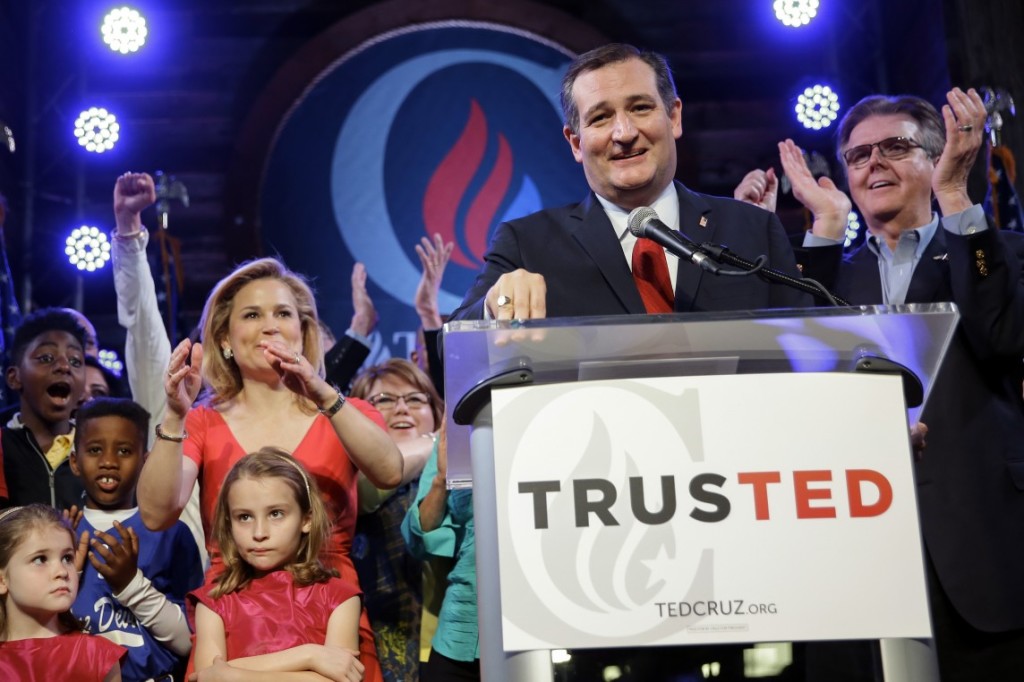
Republican Ted Cruz stormed to a commanding victory in Wisconsin Tuesday, denting front-runner Donald Trump‘s chances of capturing the GOP nomination before the party’s convention. Democrat Bernie Sanders triumphed over Hillary Clinton but still faces a mathematically difficult path to the White House. Trump’s defeat capped one of the worst periods of his campaign, a brutal stretch that highlighted his weaknesses with women and raised questions about his policy depth. While the billionaire businessman still leads the Republican field, Cruz and an array of anti-Trump forces hope Wisconsin signals the start of his decline. “Tonight is a turning point,” Cruz told cheering supporters at a victory rally. “It is a call from the hardworking people of Wisconsin to America. We have a choice. A real choice.” Cruz, a Texas senator with a complicated relationship with Republican leaders, also cast his victory as a moment for unity in a party that has been roiled by a contentious primary campaign. But Trump was unbowed. His campaign put out a biting statement: “Ted Cruz is worse than a puppet— he is a Trojan horse, being used by the party bosses attempting to steal the nomination from Mr. Trump.” Sanders’s sweeping win in virtually every county in Wisconsin, except Milwaukee, gives him greater incentive to keep competing against Clinton. But he still trails her in the pledged delegate count and has so far been unable to persuade superdelegates— the party officials who can back any candidate — to drop their allegiance to the former secretary of state and back his campaign. At a raucous rally in Wyoming, Sanders cast his victory as a sign of mounting momentum for his campaign. “With our victory tonight is Wisconsin, we have now won 7 out of 8 of the last caucuses and primaries,” he declared. The results in Wisconsin make it likely both parties’ primaries will continue deep into the spring, draping front-runners Trump and Clinton in uncertainty and preventing both from fully setting their sights on the general election. With an overwhelming white electorate and liberal pockets of voters, Wisconsin was favorable territory for Sanders. In a sign of Clinton’s low expectations in the Midwestern state, she spent Tuesday night at a fundraiser with top donors in New York City. Clinton congratulated Sanders on Twitter and thanked her supporters in Wisconsin. “To all the voters and volunteers who poured your hearts into this campaign: Forward!” she wrote. Sanders’ win will net him a handful of additional delegates, but he’ll still lag Clinton significantly. With 86 delegates at stake in Wisconsin, Sanders will pick up at least 44 and Clinton will gain at least 28. That means Sanders must still win 67 percent of the remaining delegates and uncommitted superdelegates in order to win the Democratic presidential nomination. While Trump has been the dominant force in the Republican race, he battled a series of campaign controversies in the lead-up to Wisconsin, including his campaign manager’s legal problems following an altercation with a female reporter and his own awkward stumbles in clarifying his views on abortion. Wisconsin’s Republican establishment, including Gov. Scott Walker, has also campaigned aggressively against the businessman. Exit polls in the state underscored the concerns about Trump that are surging through some corners of the Republican Party. A majority of Republican voters said they’re either concerned or scared of a potential Trump presidency. More than a third said they were scared about what Trump would do as president, and about 2 in 10 said they were concerned, according to surveys conducted by Edison Research for The Associated Press and television networks. The Texas senator was poised to collect most of Wisconsin’s 42 Republican delegates. Trump still has a narrow path to claim the nomination by the end of the primaries on June 7. But by losing Wisconsin, the real estate mogul has little room for error in upcoming contests. Complicating the primary landscape for both Cruz and Trump is the continuing candidacy of John Kasich. The Ohio governor’s only victory has come in his home state, but he’s still picking up delegates that could otherwise help Trump inch closer to the nomination or help Cruz catch up. To win a prolonged convention fight, a candidate would need support from the individuals selected as delegates. The process of selecting those delegates is tedious, and will test the mettle of Trump’s slim campaign operation. Cruz prevailed in an early organizational test in North Dakota, scooping up endorsements from delegates who were selected at the party’s state convention over the weekend. While all 28 go to the national convention as free agents, 10 said in interviews they were committed to Cruz. None has so far endorsed Trump. Despite the concern among some Wisconsin Republicans about Trump becoming president, nearly 6 in 10 GOP voters there said the party should nominate the candidate with the most support in the primaries, which so far would be Trump. Even among voters who favored Cruz, 4 in 10 said the candidate with the most support going into the convention should be the party’s nominee. Republished with permission of the Associated Press.
Ted Cruz, Bernie Sanders angle for wins in Wisconsin primaries
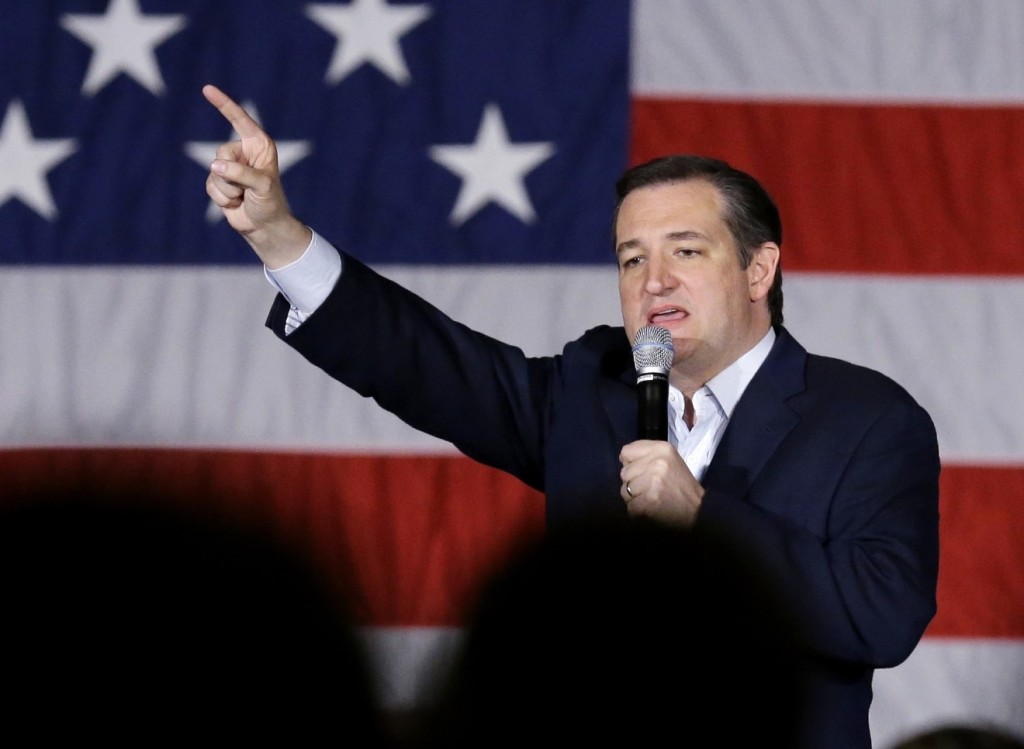
Republican Ted Cruz and Democrat Bernie Sanders are angling for victories in Tuesday’s Wisconsin presidential primaries that could give their campaigns a needed boost, but still leave them with mathematically challenging paths to their parties’ nominations. While Sanders remains a force in the Democratic primary, a win over Hillary Clinton in Wisconsin would do little to significantly cut into her lead in delegates that will decide the party’s nomination. The stakes are higher for Cruz, who trails Donald Trump in the GOP race and sees Wisconsin as a crucial state in his effort to push the party toward a convention fight. “We are seeing victory after victory after victory in the grassroots,” Cruz said during a campaign stop Monday. “What we are seeing in Wisconsin is the unity of the Republican Party manifesting.” With the White House and control of Congress at stake in November, leaders of both parties are eager to turn their attention toward the general election. Clinton would enter the fall campaign saddled with persistent questions about her honesty and trustworthiness, but also with a significant demographic advantage. It’s an edge Democrats believe would be magnified in a race against Trump, who has made controversial comments about immigrants and women. For Trump, the long lead-up to Wisconsin’s contest has included one of the worst stretches of his candidacy. He was embroiled in a spat involving Cruz’s wife, which he now says he regrets, was sidetracked by his campaign manager’s legal problems after an altercation with a female reporter, and stumbled awkwardly in comments about abortion. While Trump is the only Republican with a realistic path to clinching the nomination ahead of the Republican convention, a big loss in Wisconsin would greatly reduce his chances of reaching the 1,237 delegates needed to do so before the GOP gathers in Cleveland. Cruz headed into Tuesday’s contest with the backing of much of the state’s Republican leaders, including Gov. Scott Walker, but Trump made a spirited final push in the state and predicted a “really, really big victory.” “If we do well here, it’s over,” he said. “If we don’t win here, it’s not over.” Complicating the primary landscape for both Cruz and Trump is the continuing candidacy of John Kasich. The Ohio governor’s only victory has come in his home state, but he’s still picking up delegates that would otherwise help Trump inch closer to the nomination or help Cruz catch up. Trump has grown increasingly frustrated with the governor and has joined Cruz in calling for Kasich to end his campaign. Kasich cast Trump’s focus on him as a sign that he’s best positioned to win over the businessman’s supporters. “They’re not really his people,” Kasich said. “They’re Americans who are worried about, they’re really most worried about their kids, are their kids going to have a good life?” If Cruz wins all of Wisconsin’s 42 delegates, Trump would need to win 57 percent of those remaining to clinch the GOP nomination before the convention. So far, Trump has won 48 percent of the delegates awarded. To win a prolonged convention fight, a candidate would need support from the individuals selected as delegates. The process of selecting those delegates is tedious, and will test the mettle of Trump’s slim campaign operation. Cruz prevailed in an early organizational test in North Dakota, scooping up endorsements from delegates who were selected at the party’s state convention over the weekend. While all 28 of the state’s delegates go to the national convention as free agents, 10 said in interviews that they were committed to Cruz. None has so far endorsed Trump. Paul Lorentz, was in line at 6:30 a.m. in Sun Prairie, Wisconsin, Tuesday to cast a vote for Kasich saying he typically votes Democratic in the general election and Republican in Wisconsin’s open primary, in order to sway that side to a better candidate. “My hope is always to have two acceptable candidates running for president,” Lorentz said. Among Democrats, Clinton has 1,243 delegates to Sanders’ 980 based on primaries and caucuses. When including superdelegates, or party officials who can back any candidate, Clinton holds an even wider lead — 1,712 to Sanders’ 1,011. It takes 2,383 delegates to win the Democratic nomination. Sanders would need to win 67 percent of the remaining delegates and uncommitted superdelegates to catch up to Clinton. So far, he’s only winning 37 percent. Even if Sanders wins in Wisconsin, he’s unlikely to gain much ground. Because Democrats award delegates proportionally, a narrow victory by either candidate on Tuesday would mean that both Sanders and Clinton would get a similar number of delegates. Carrie-Ann Todd, a 39-year-old mother saddled with student debt, said she voted for Sanders on Tuesday given his efforts to address the cost of college. “I’m paying more on my student loans than I am on my cars,” Todd says. “I don’t know if he’ll get any support if he gets into the White House, but it’s worth a shot.” Republished with permission of the Associated Press.
Donald Trump works to right campaign before Wisconsin votes

Donald Trump worked to right his campaign on Sunday after a shaky week, brushing off verbal missteps about abortion, nuclear weapons and GOP rival Ted Cruz as he cast forward to Tuesday’s Republican presidential primary in Wisconsin. Trump, acknowledging the possibility of a loss to Cruz in Wisconsin, said it would be better to win the state but was confident he would capture the nomination regardless. He acknowledged that the past few days had marked a difficult patch for his campaign. “I think I get there anyway” — meaning the nomination — Trump told “Fox News Sunday. The Republican race is overshadowed by a persistent effort by Trump’s rivals in the campaign and the party to force the nomination fight into the July convention. Amid talk of the Republican establishment trying to block the front-runner, GOP Chairman Reince Priebus said the nomination process will be clear, open and transparent. Cameras will be there “at every step of the way” at the convention, he said on ABC’s “This Week.” If the race isn’t settled after all the primary contests, then “we’re going to have a multi-ballot convention,” with more and more delegates free to pick a candidate of their choice in each round. But Priebus was clear: “Nothing can get stolen from anyone.” On the Democratic side, the race between Hillary Clinton and Bernie Sanders has grown increasingly bitter, too, though it has not matched the GOP contest for raw hostility. Their attention will quickly turn to an even more consequential contest, in New York on April 19, where Clinton hopes to avoid an upset in the state she served as senator. Clinton told NBC’s “Meet the Press” that she was confident the two campaigns could settle on a debate date before that primary. In recent days, Clinton has taken issue with Sanders’ suggestions that her campaign is being aided by fossil-fuel interests, and in the broadcast interview, she accused Sanders’ aides of doing insufficient research about her record of standing up to oil and gas companies. “We were not lying,” Sanders told CNN’s “State of the Union.” ”We were telling the truth.” Wisconsin has emerged as a proving ground for anti-Trump forces as the front-runner’s campaign hit a rough patch. Cruz has little chance to overtake Trump in the delegate hunt before the convention. Ohio Gov. Kasich has none. Both hope to deny Trump a delegate majority in what’s left of the primary season, forcing the nomination to be settled at a contested convention at which one of them might emerge. Kasich expressed confidence that Republicans would have an “open convention,” but suggested it wouldn’t involve the type of unseemly chaos that party leaders fear will play out on national television, dampening their prospects for winning the presidency and possibly House and Senate races, too. Kasich told ABC that a contested convention will be “so much fun.” “Kids will spend less time focusing on Bieber and Kardashian and more time focusing on how we elect presidents,” Kasich said. “It will be so cool.” Republished with permission of the Associated Press.