
Floyd Carter Sr., one of the remaining Tuskegee Airmen and NYPD veteran, dies at 95
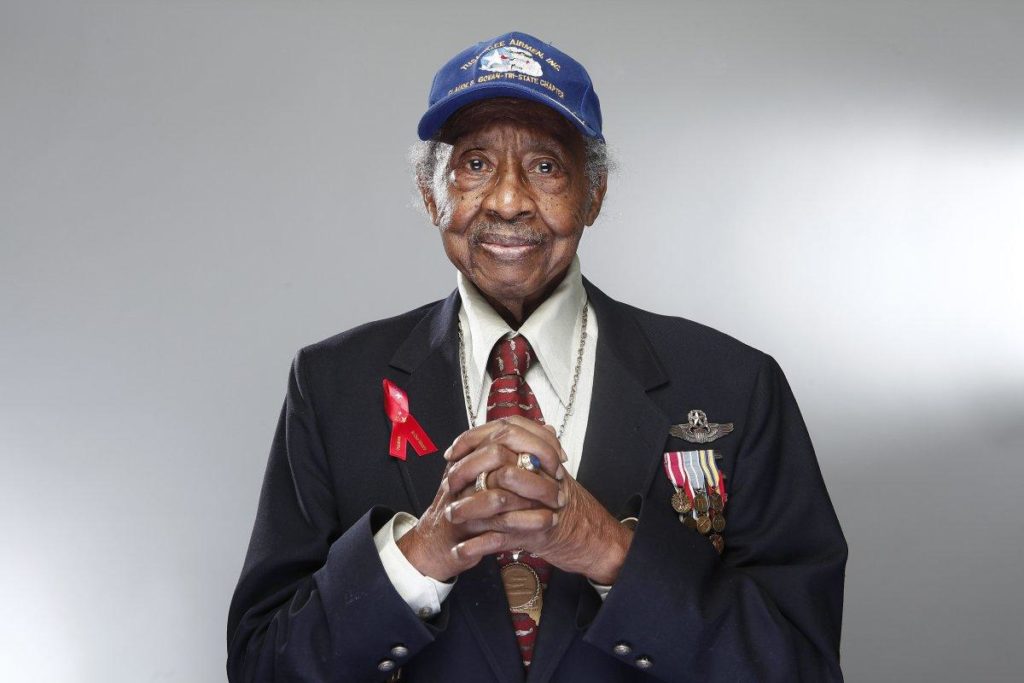
Floyd Carter Sr., one of the remaining members of the famed all-African-American Tuskegee Airmen, died Thurs., March 8. He was 95. Carter joined the Army Air Corps in 1944 and was commissioned a year later as a 2nd lt. bombardier navigator. In 1946, he received his pilot wings and transferred to the Air Force Reserves the following year where he went on to fly with trailblazing Tuskegee Airmen. According to the Daily News, he during the Korean and Vietnam wars, and led the first squadron of supply-laden planes into Berlin during the famed Cold War airlift of 1948-49. During the Tet Offensive, Carter flew U.S. supplies and troops into South Vietnam. The term ‘‘Tuskegee Airmen’’ refers to all who were involved in a program the War Department established as a segregated unit in the Army Air Force (AAF) which was termed the ‘‘Tuskegee Experiment.’’ Trained at Tuskegee Army Air Field in Tuskegee, Ala., these men had to overcome biased notions of their fighting ability. their heroic service led to the greater achievement of integrating the U.S. Armed Forces—a watershed event in American history. Their brave actions broke forever the myths that allowed segregation, inequity and injustice toward African-Americans to exist in our military. In March 2007, then-President George W. Bush, on behalf of the U.S. Congress, awarded the Congressional Gold Medal to Carter and the Tuskegee Airmen. “I thank you for the honor you have brought to our country, and the medal you are about to receive means that our country honors you,” Bush said to the roughly 300-member audience of surviving airmen, Tuskegee Airmen widows, and other relatives, prior to presenting the congressional award. Not only was Carter a decorated combat vet of three wars, he was also a 27-year veteran of the NYPD. He joined the force in 1953, became a detective within three years, and retired 27 years later in 1980. While serving on the NYPD, Carter worked as a bodyguard for visiting heads of state. His son Floyd Jr., recalls him spending time with Cuban leader Fidel Castro and Soviet head Nikita Khrushchev. The NYPD stopped to remember Carter following his passing. “We mourn the loss of a true American Hero. Lt. Col. Floyd J. Carter, USAF Ret. Famous Tuskegee Airmen & a Congressional Medal of Honor recipient, served WWII, Korea & Vietnam wars. Retired from NYPD, 26 yrs as a Det. 2nd Grade. Our Community & Nation has lost a giant,” Tweeted the NYPD 47th Precinct. We mourn the loss of a true American Hero. Lt. Col. Floyd J. Carter, USAF Ret. Famous Tuskegee Airmen & a Congressional Medal of Honor recipient, served WWII, Korea & Vietnam wars. Retired from NYPD, 26 yrs as a Det. 2nd Grade. Our Community & Nation has lost a giant. pic.twitter.com/6J3bzgdQyu — NYPD 47th Precinct (@NYPD47Pct) March 9, 2018 The NYPD echoed the 47th precints sentiments on Twitter. “We are saddened by the death of 27-year vet of the NYPD – Detective Floyd Carter Sr. Det. Carter dedicated his life serving our nation & NYC. He was one of the remainig Tuskegee Airmen & a vet of 3 wars. He inspired many to follow in his footsteps. #Hero,” they also tweeted. We are saddened by the death of 27-year vet of the NYPD – Detective Floyd Carter Sr. Det. Carter dedicated his life serving our nation & NYC. He was one of the remainig Tuskegee Airmen & a vet of 3 wars. He inspired many to follow in his footsteps. #Hero https://t.co/0q4jPSnLO4 pic.twitter.com/vThiYqCaEd — NYPD NEWS (@NYPDnews) March 11, 2018 Carter is survived by his wife Atherine, their two children Floyd Jr. and Rozalind, grandchildren and great-grand children.
Italian ambassador visits Tuskegee to support Leonardo T-100 project

Italian Ambassador Armando Varricchio and Leonardo DRS Chief Executive William Lynn III on Monday visited the historic home base of the Tuskegee Airmen, where the aerospace company wants to manufacture the U.S. Air Force’s next-generation trainer aircraft. If Leonardo’s T-100 jet trainer is selected by the Air Force, the company plans to build a manufacturing facility at Moton Field, where the celebrated Tuskegee Airmen trained before being deployed to Italy in World War II. The project will create 750 jobs in Tuskegee. Varricchio said he was impressed by the community’s eagerness to see the T-100 project become a reality. “I can tell you that it is my first visit here, but it will not be my last,” he said during a lunch with community leaders. “I will spare no effort because we want Tuskegee to be not just a place of memory but a place of the future. “Let’s move ahead,” he added. “Let’s work together.” Job-creation engine With an Air Force decision expected in the summer, Lynn said Leonardo DRS is prepared to launch the T-100 program quickly once the aircraft is selected. The Leonardo trainer is already being used by the air forces of Israel, Poland, Singapore and Italy, and it’s complemented by a sophisticated, integrated ground-based simulation system. “It would create jobs all across the U.S.,” Lynn said. “The engines would be built in Arizona. The training simulators would be built in Florida. We have suppliers in almost every state, so it would be thousands of jobs.” Last November, Leonardo officials told an Alabama delegation visiting the company’s Italian manufacturing plant that preparations for the Tuskegee facility were on track. After their Tuskegee visit, Varricchio, Lynn and a Leonardo team traveled to Montgomery for talks with Gov. Kay Ivey and Commerce Secretary Greg Canfield, followed by a dinner. Long-standing bonds Varricchio said he sees the Leonardo project as a way to “connect the dots that are linking Italy and the United States.” While in Tuskegee, the ambassador toured a museum dedicated to the accomplishments of the Tuskegee Airmen, who were based at an airfield in Ramitelli during their stay in Italy. “I was very moved walking around in the beautiful museum that was retracing the memory of those heroes, those brave men who are not forgotten in Italy,” he said. “What they did when they came to Italy, during those difficult times, that was the moment that bonds were created – and those bonds are more present than ever.” This story originally appeared on the Alabama Department of Commerce’s Made in Alabama website. Republished with permission from the Alabama NewsCenter.
Tuskegee mayor: T-100 manufacturing facility will lift region
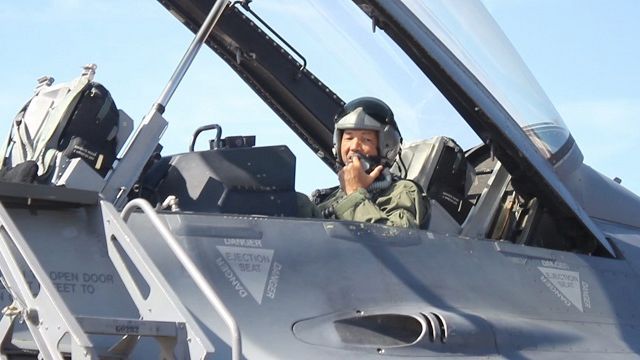
Sitting in the back seat of an F-16 jet on a flight over Tuskegee, Mayor Tony Haygood looked down at Moton Field and envisioned the historic airfield’s future as the production site of the U.S. Air Force’s next jet training aircraft. “From that height, it is amazing how you can see the whole layout of things at Moton Field and where the runway expansion would be,” Haygood said. “There’s plenty of space for it, and we’ll be doing some other improvements.” Earlier this year, global aerospace company Leonardo selected Moton Field as the manufacturing site for its T-100 advanced trainer jet if the Air Force chooses the aircraft as its next-generation trainer. The project would bring 750 jobs to the airfield where the pilots of the Tuskegee Airmen received their training. Haygood, who is traveling to Italy with an Alabama delegation to tour a Leonardo aircraft factory this week, said an in-depth look at the company’s manufacturing operation will assist Macon County’s preparations for the Tuskegee facility. “This is like advance preparation that gives us an opportunity to see, hear and understand how we need to get ready,” he said. Made In Alabama caught up with Haygood in Tuskegee before the Alabama team departed so he could share his insights on the Leonardo T-100 jet trainer project planned for Moton Field. Here’s what he said. Q: What would the Leonardo T-100 manufacturing facility mean for Tuskegee and the region? A: It would be a tremendous boost to this community. For Tuskegee, it would be the largest project we’ve had in our history. It would be a big boost for the entire economy of south central Alabama and would impact the entire state as well. For us, it would mean high-quality jobs, and it would trigger a revitalization of our entire economy. Q: How have Tuskegee and Macon County been preparing for a project of this magnitude? A: We have been working within the region, with Auburn, Montgomery and other cities, to position ourselves as a viable site for economic development. Having the runway at Moton Field, and the space around it, allows us to pursue this project. We’re capable of expanding the runway to 8,000 feet. We have water service at the site. We have a major interstate – I-85 — right there and CSX railway there. So we have the basic ingredients in terms of transportation and location. Q: Can the area provide the workforce for the Leonardo T-100 facility? A: We can provide a quality workforce, and we will have assistance from the state. Go back to the Tuskegee Airmen. People didn’t think they could fly advanced aircraft, but given the opportunity and the training, they not only flew, they excelled. It’s really the same story today. Give people the opportunity, give them the support, and we can develop the workforce and the expertise that is needed. Click here to read more. Republished with permission from the Alabama NewsCenter.
Team aims to find site of missing Tuskegee Airman’s plane
Unless they’re named Indiana and wear a fedora, archaeologists typically don’t attempt to solve historical mysteries in a single summer. But that’s exactly what University of New Orleans archaeologist D. Ryan Gray is hoping to do this summer when he leads a team of students and others to southern Austria, to investigate a site where they believe one of the famed Tuskegee Airmen went down near the end of World War II. The site, close to the Italian border and the Austrian town of Villach, is near the last reported sighting of Capt. Lawrence Dickson, a pilot with the 332nd Fighter Group of the 100th Fighter Squadron. Just after midday Dec. 23, 1944, Dickson was flying a reconnaissance mission in his P-51D when he radioed his wingman, 2nd Lt. Robert Martin, that he was having problems and was going to have to eject. Martin told authorities that he saw Dickson’s canopy jettison but never saw Dickson’s parachute, though possibly because it blended with the snow covering the ground. Since then, Dickson has been classified as missing. Dickson and Martin were both black pilots in World War II, when the U.S. armed forces were still segregated. The 332nd Fighter Group was made up of black pilots who had trained at the Tuskegee Institute in Alabama and became known as the Tuskegee Airmen. Officials with the Defense POW/MIA Accounting Agency, whose mission is to account for all missing U.S. service members, won’t confirm that the crash site Gray will be investigating is suspected to be Dickson’s. But a review of documents, as well as accounts from locals who said they witnessed the crash, has led some experts to believe the site is worth exploring. Gray said he is excited about the challenge of excavating an aircraft from World War II, something he’s never done before. And there is the added bonus of perhaps being able to bring a war hero home. “We are hoping to resolve this case this summer,” he said of a five-week dig season. Unlike typical archaeological excavations, which are painstakingly meticulous and intentionally slow in order to be comprehensive, this one has a different objective: to confirm the type of plane that crashed there and then identify any human remains that may be found. If that is accomplished, then the POW/MIA agency will begin the process of preparing a proper recovery. Gray and the 13 UNO students will have ample help in their efforts. They will be joined by two students from the University of Innsbruck, in Austria, as well as academic staff there who have a special interest in World War II and aircraft archaeology. They also will get help from Tom Czekanski, a senior curator at the National World War II Museum in New Orleans who is an expert on P-51s, the plane Dickson flew. Czekanski said he plans to look for the P-51’s notable characteristics: a Packard-built Merlin engine, a type of propeller known as a Hamilton Standard or the type of wheels and struts that formed the landing gear. “Those are all distinctive for the P-51,” he said. And though Czekanski is excited about maybe finding the plane, he is even more hopeful that the team can bring some closure to the 70-year-old case. “I think the most rewarding part will be if we can find the remains of an individual who’s been lost and be able to bring him home,” he said. “That’s the meaningful point of this.” Republished with permission of The Associated Press.
Tuskegee Airmen receive Congressional Gold Medal
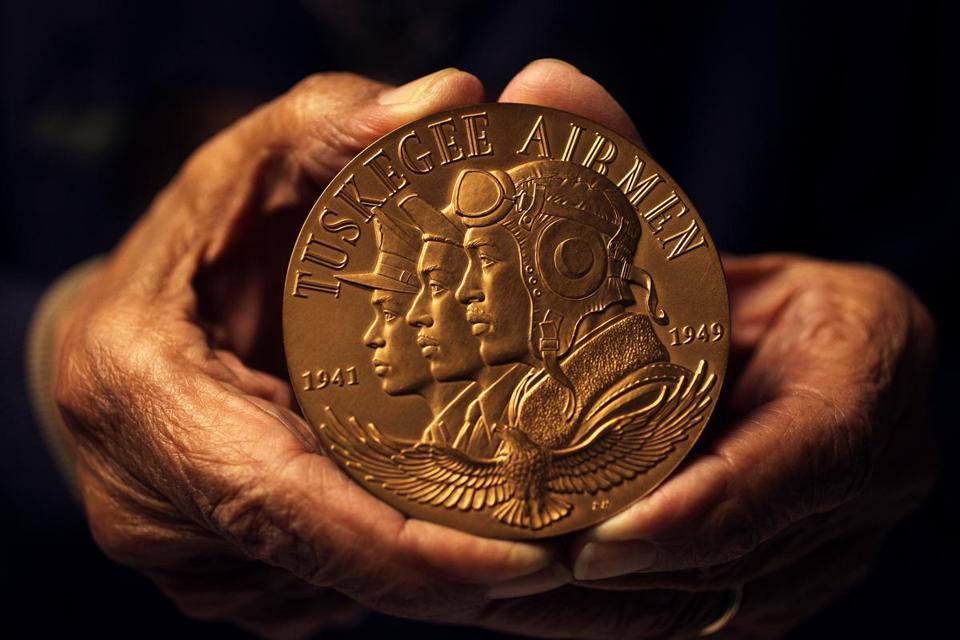
Five members of the famed Tuskegee Airmen were honored with Congressional Gold Medals during a Veterans Day ceremony held at the National Warplane Museum on Friday. Since the American Revolution, Congress has commissioned gold medals as its highest expression of national appreciation for distinguished achievements and contributions. An act of Congress in 2006 secured the Congressional Gold Medal for all Tuskegee Experience participants from 1941 to 1949. Wallace C. Higgins and Herbert Thorpe were presented with medals at the ceremony. Thorpe also received a medal on behalf of his late brother, Richard Thorpe. Leland H. Pennington and Robert M. Johnson were also honored and their families received medals on their behalf. The Tuskegee Airmen were recruited into an Army Air Corps program called the “Tuskegee Experience” that trained Blacks to fly and maintain combat aircraft during World War II. They included pilots, navigators, bombardiers, maintenance and support staff, instructors, and all the personnel who kept the planes in the air. They trained as a segregated unit at an air base in Tuskegee, Ala. proving to the world that African-Americans could serve in roles beyond the mess hall or supply depot. The unit helped pave the way for desegregation of the military.
Roscoe Brown, Jr., Tuskegee Airman and educator, dies at 94
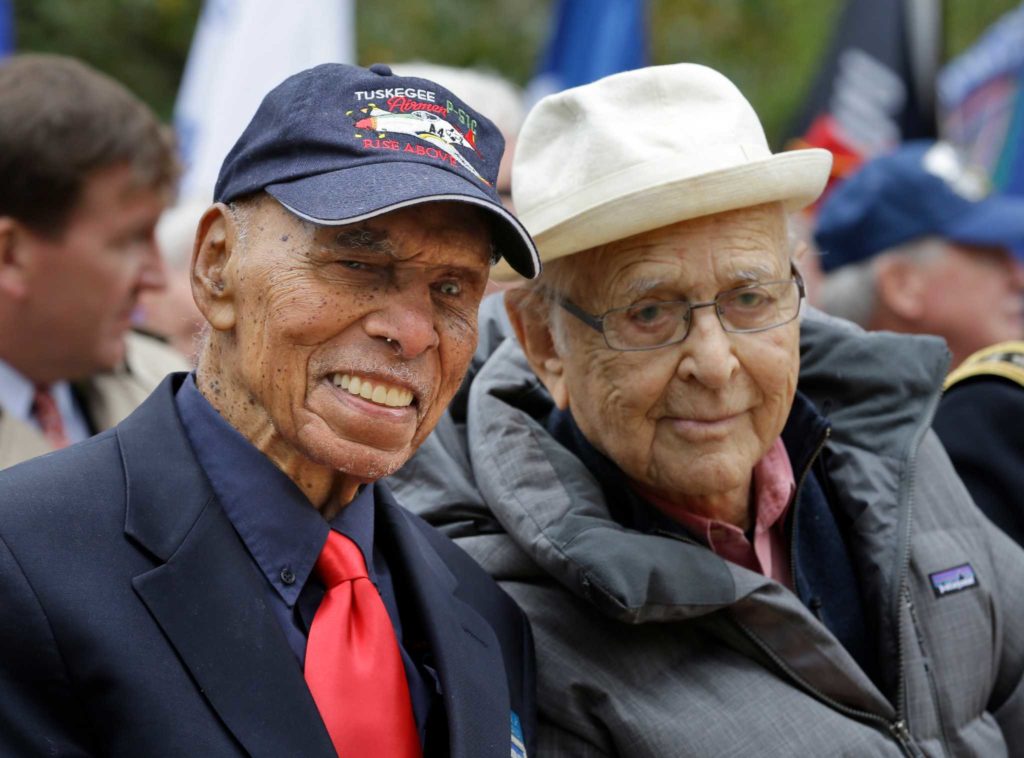
Roscoe Brown Jr., who served with the all-black Tuskegee Airmen during World War II and was a longtime New York City educator, has died. Brown died Saturday at a hospital in the Bronx after breaking his hip in a recent fall, his granddaughter Lisa Bodine said. He was 94. In 2007, Brown and five other airmen accepted the Congressional Gold Medal on behalf of the Tuskegee Airmen. President George W. Bush and Congress awarded the airmen with one of the nation’s highest honors for fighting to defend their country even as they faced bigotry at home. At the time, Brown told The Associated Press that receiving the medal was one of the greatest days in the history of the Tuskegee Airmen. Brown was a commander of the 100th Fighter Squadron of the 332nd Fighter Group, and is credited with being the first U.S. pilot to shoot down an advanced German military jet, the family noted. He earned numerous awards including the Distinguished Flying Cross. Nearly 1,000 fighter pilots trained as a segregated Army Air Corps unit at the Tuskegee, Alabama, air base. Not allowed to practice or fight with their white counterparts, the Tuskegee Airmen distinguished themselves by painting the tails of their airplanes red, which led to them becoming known as the “Red Tails.” Their story was told in a 2012 movie of the same name, on which Brown was an adviser. In a 2011 interview with WNBC-TV, Brown noted that the Civil War occurred only about 70 years before World War II. “I didn’t understand the brutality of the Civil War, but when I was a Tuskegee Airman, I knew that I was good, I knew that I had to challenge the system, and I loved to fly.” “My message to young people is to keep on working,” he added. “You’ve got to be better, you’ve got to be disciplined, you’ve got to believe. And if you believe you can overcome. … That’s the story of the Tuskegee Airmen.” A native of Washington, D.C., Brown held a doctorate from New York University. He served as president of the Bronx Community College at the City University of New York and director of the Institute of Afro-American Affairs at New York University. He was later professor at The City University of New York Graduate Center and director of the Center for Urban Education Policy. For many years, he also hosted “African American Legends,” a public affairs show produced by CUNY TV. During his 17 years at the Bronx Community College, “Dr. Brown intensified the college’s outreach to New York City’s economic and educational institutions through partnerships with business and industry,” said CUNY Chancellor James Milliken. “With his leadership, new programs were developed in high growth professions in the fields of health, technology and human services.” Republished with permission of The Associated Press.
