
2023 could see highest number of people on food stamps since 2016
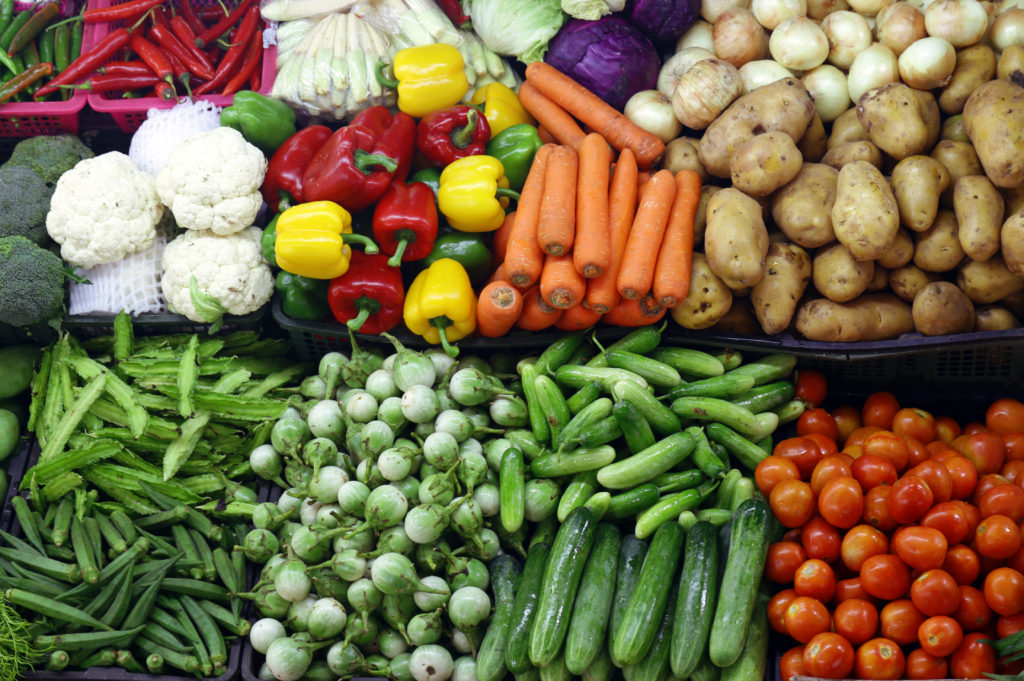
By Shirleen Guerra | The Center Square (The Center Square) – The 2023 fiscal year is on track to average the highest number of individuals on food stamps in the U.S. since 2016. There were 42,329,101 on food assistance on average each month on through the first nine months of the fiscal year, as of June 2023, according to the U.S. Department of Agriculture. The fiscal year is completed at the end of September. That’s the most people on food assistance since the fiscal year 2016 monthly average of 44,219,363. The fiscal year 2023 overall cost of the Supplemental Nutrition Assistance Program, formerly known as food stamps, will be the first time in two years that emergency pandemic relief was not included the full year. Most states dropped the extra COVID-19 stipend by March 2023. In 2016, the yearly cost of the Supplemental Nutrition Assistance Program was $66.5 billion, or $84.2 billion when adjusted for inflation. Through the first three quarters of fiscal year 2023, the costs are $85.1 billion, which projects to $113.5 billion for the full year. In fiscal year 2022, the SNAP program cost almost $114 billion. Republished with the permission of The Center Square.
Terri Sewell announces over $34 million in USDA funds to expand rural internet access in Lowndes County

Congresswoman Terri Sewell announced on Thursday that the United States Department of Agriculture (USDA) is investing $34,781,800 to increase broadband connectivity and internet services throughout Lowndes County. This funding is a part of USDA’s ReConnect Program and will be used to connect a prospective 4,646 people, 154 farms, 96 businesses, and three public schools to high-speed internet in Lowndes County. “As we saw during the COVID-19 pandemic, access to reliable high-speed internet is critical to the success of our communities,” said Rep. Sewell in a statement.“This $34 million investment represents a major step forward in our continued effort to connect rural Alabamians with broadband. I’m proud to partner with USDA Rural Development to ensure that Alabamians everywhere have access to the internet connectivity they need and deserve.” “Communities across rural Alabama need access to high-speed internet in order to participate in the modern digital landscape,” said USDA Rural Development Alabama State Director, Nivory Gordon. “Whether it is for learning, conducting business, connecting with loved ones, or providing services which are not available locally, the lack of high-speed internet access has a direct impact on the quality of life for our rural families. That’s why we here at USDA are working with high-speed internet providers to continue to connect rural Alabama to the world.” Hayneville Telephone Company is receiving a grant of $34,781,800 to deploy a fiber-to-the-premises network that will connect residents, farms, businesses, and schools to high-speed internet in Lowndes County, Alabama. The Hayneville Telephone Company Inc. will make high-speed internet affordable by participating in the FCC’s Affordable Connectivity and Lifeline programs. This project will be funded with a grant announced from the third funding round of the ReConnect Program. There is strong bipartisan for broadband expansion in both Washington and Montgomery. Expanding the broadband network has economic, healthcare, and education benefits for rural communities. Broadband access also makes rural communities more attractive for young people as they consider their futures and where they want to settle. To be eligible for ReConnect Program funding, an applicant must serve an area that does not have access to service at speeds of 100 megabits per second (Mbps) (download) and 20 Mbps (upload). The applicant must also commit to building facilities capable of providing high-speed internet service with speeds of 100 Mbps (download and upload) to every location in its proposed service area. Visit USDA website to learn more about this and other investment resources for rural areas from the USDA. Sewell is in her sixth term representing Alabama’s Seventh Congressional District. Sewell, a native of Selma and a former attorney for the city of Birmingham, faces Republican nominee Beatrice Nichols and Libertarian nominee Gavin Goodman in the November 8 general election. The 2021 redistricting by the Alabama Legislature made the Seventh Congressional District a much more diverse and competitive district than it was in the past. Polls open on Tuesday at 7:00 am and close at 7:00 pm. Voters wanting to participate in any Alabama election need to bring a photo ID with them to the polls. To connect with the author of this story, or to comment, email brandonmreporter@gmail.com.
Alabama to expand broadband in rural counties through federal program
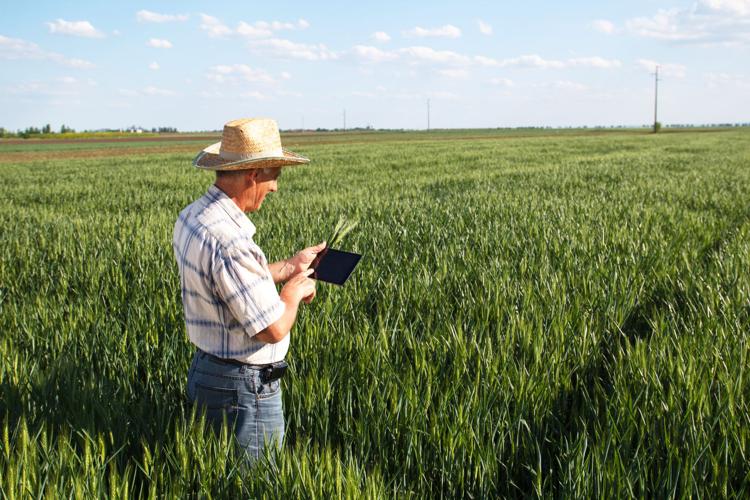
A federal investment aimed at improving broadband in rural areas in Alabama is in the works. Through the U.S. Department of Agriculture’s Rural Development ReConnect loan/grant program, according to a release, Alabama stands to rake in $28,817,588 in grants and another $24,865,787 as part of a loan that will extend high-speed internet access in 10 counties as part of the third round of grants. The funding was announced by USDA Secretary Tom Vilsack. “President [Joe] Biden’s commitment to high-speed internet in rural communities is foundational to ensuring that the nation’s economy continues to expand from the bottom up and the middle out,” Vilsack said in a release. “High-speed internet will improve the rural economy. It will help rural businesses grow and get access to new markets. It will help rural residents get access to more and better health care and educational opportunities. USDA knows rural America is America’s backbone, and prosperity here means prosperity for all.” A loan and grant, according to the release, totaling $49,731,574 will be used to construct a fiber-to-the premises network that will provide high-speed internet access to 15,989 people, 608 businesses, 52 education facilities, and 407 farms in Choctaw, Clarke, Dallas, Marengo, Perry and Wilcox counties. Pine Belt Telephone Company, the release reads, will work to ensure high-speed internet is affordable through the Federal Communications Commission’s Affordable Connectivity Program and is aimed at serving communities in Choctaw, Dallas, and Clarke counties that are deemed socially vulnerable. A second grant totaling $3,951,801, according to the release, will be delivered to Butler, Crenshaw, Lowndes, and Montgomery counties that will serve 1,812 people, 30 businesses, 53 farms, and four public schools. The FCC’s Affordable Connectivity and Lifeline Program will be used by Mon-Cre Telephone Cooperative Inc. to ensure discounts are made to qualifying users. Funding for the projects, according to the release, comes from the Infrastructure Investment and Jobs Act. Republished with the permission of The Center Square.
AG Steve Marshall sues Joe Biden over school food assistance plan
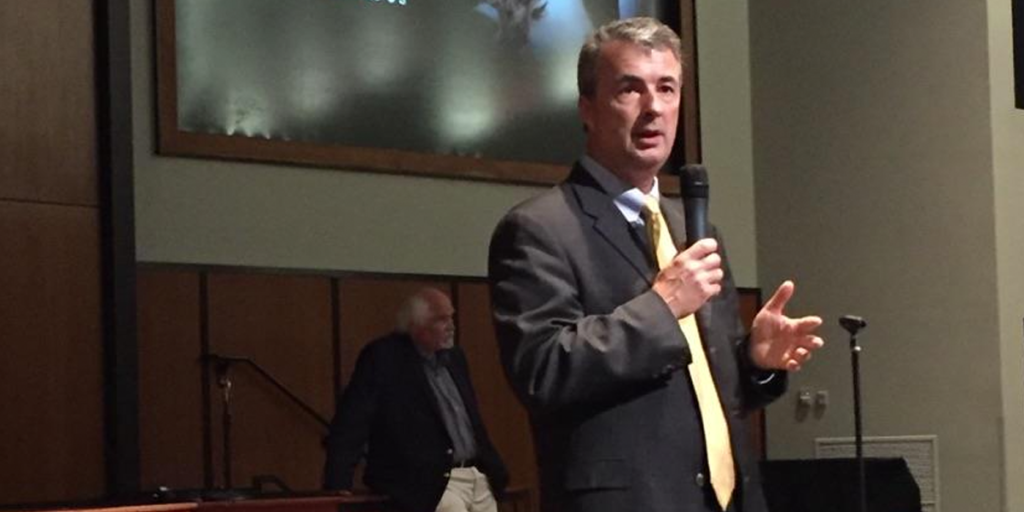
Attorney General Steve Marshall filed a lawsuit against the Biden administration over its new guidance could withhold federal nutritional assistance if schools have anti-trans policies like sex-separated bathrooms. According to Marshall’s press release, schools would risk forfeiting lunch money for their neediest students if they engage in “sex discrimination,” such as having sex-separated bathrooms or sports teams for boys and girls. AG Marshall argued that the policy was a part of Joe Biden’s ‘radical agenda.’ “Joe Biden and his administration are obsessed with imposing their extremist sexual politics on the people of our great nation, adults and children alike,” stated Marshall. “Their latest plan—which comes at a time of skyrocketing inflation and food costs, as well as a looming recession—is to hold schoolchildren’s food hostage unless their schools submit to the left’s radical ‘gender identity’ agenda. This immoral and illegal scheme cannot stand. That is why I, along with 21 of my attorney general colleagues, have filed suit in federal court to block it.” On May 5, 2022, the U.S. Department of Agriculture (USDA) announced that it would interpret the prohibition on discrimination based on sex found in Title IX of the Education Amendments of 1972 and in the Food and Nutrition Act of 2008, to include discrimination based on sexual orientation and gender identity. The USDA issued this interpretation to help ensure its programs are open, accessible, and help promote food and nutrition security, regardless of demographics. “USDA is committed to administering all its programs with equity and fairness and serving those in need with the highest dignity. A key step in advancing these principles is rooting out discrimination in any form – including discrimination based on sexual orientation and gender identity,” said Secretary of Agriculture Tom Vilsack. “At the same time, we must recognize the vulnerability of the LGBTQI+ communities and provide them with an avenue to grieve any discrimination they face. We hope that by standing firm against these inequities, we will help bring about much-needed change.” In the lawsuit, the attorneys general argue that the USDA’s guidance is unlawful because it conflicts with the requirements of Title IX and the Food and Nutrition Act and was issued without providing the State and other stakeholders the opportunity for input, as required by the Administrative Procedures Act. The attorneys general argue that the USDA premised its guidance on an obvious misreading and misapplication of the U.S. Supreme Court’s holding in Bostock v. Clayton County. The guidance imposes new and unlawful regulatory measures on state agencies and operators receiving federal financial assistance from the USDA and thus threatens essential nutritional services for Alabama’s most vulnerable children. The USDA announced the new guidance, arguing that it is consistent with the Supreme Court’s decision in Bostock v. Clayton County. In that decision, the Court held that the prohibition on sex discrimination under Title VII of the Civil Rights Act of 1964 extends to discrimination based on sexual orientation and gender identity. The National School Lunch Program services nearly 30 million schoolchildren each day, many of whom rely on it for breakfast, lunch, or both. Approximately 100,000 public and nonprofit private schools and residential childcare institutions receive federal funding to provide subsidized free or reduced-price meals for qualifying children. AG Marshall filed the lawsuit with attorneys general from Alaska, Arizona, Arkansas, Georgia, Indiana, Kansas, Kentucky, Louisiana, Mississippi, Missouri, Montana, Nebraska, Ohio, Oklahoma, South Carolina, South Dakota, Tennessee, Texas, Utah, Virginia, and West Virginia.
USDA awards over $1.4 million to southeastern states to increase access to healthy foods for kids

The U.S. Department of Agriculture (USDA) Food and Nutrition Services’ Southeast Regional Office announced that 23 organizations have been awarded more than $1.4 million to fund Farm to School projects in the region. In Alabama, the Alabama Department of Agriculture and Industries received $100,000 to build on improved access to local foods by developing more resources and providing training accessible by all public and private schools in the state. The University Charter School received $50,000 to plan to establish a comprehensive agriculture education program for K-12 students to positively impact students and the community through an innovative partnership with The University of West Alabama and the surrounding rural communities. The USDA Farm to School grant helps child nutrition program operators incorporate local foods in the National School Lunch Program and its associated programs, as well as the Summer Food Service Program and Child and Adult Care Food Program. This is accomplished through training, technical assistance, and research. “These project grants will educate children about where their food comes from and also increase the amount of locally produced foods served in child nutrition programs,” stated Willie C. Taylor, Southeast Regional Administrator, USDA Food and Nutrition Service. “Our appreciation is extended to these organizations that will operate projects that ultimately support USDA’s commitment to advance nutrition security.” “The expansion of Farm to School is more important than ever for our kids,” stated Agriculture Secretary Tom Vilsack. “When schools and local producers work together, children benefit from higher-quality foods on their plates, and program operators have stable sources for the products they need.” “States and school districts with strong Farm to School programs have been more resilient in the face of recent supply chain disruptions, compared to operators lacking relationships with local producers,” commented Stacy Dean, deputy undersecretary for Food, Nutrition, and Consumer Services. “The Farm to School program deserves to be at the forefront of long-term solutions that operators can lean on to ensure nutritious, local products are always within reach.” The 23 grant recipients in the Southeast are listed below. Alabama Alabama Department of Agriculture and Industries University Charter School Florida Duval County Public Schools Florida Impact, Inc. Florida Introduces Physical Activity and Nutrition to Youth Happy Goat, Inc. Orlando Science Center, Inc. Star of the Sea Foundation, Inc. Tampa Urban Benefit Farms, Inc. The School District of Lee County Georgia Baldwin County Board of Education Kentucky Frankfort Independent Board of Education Hardin County Schools North Carolina Community Enrichment Initiatives, Inc. Eliada Homes, Inc South Carolina Hub City Farmers Market School District of Greenville County Upstate Circle of Friends Tennessee Cheatham County Schools Gibson County Special School District Northwest Tennessee Local Food Network Shelby County Board of Education Trenton Special School District
Alabama legislators file bills that seek to end grocery tax
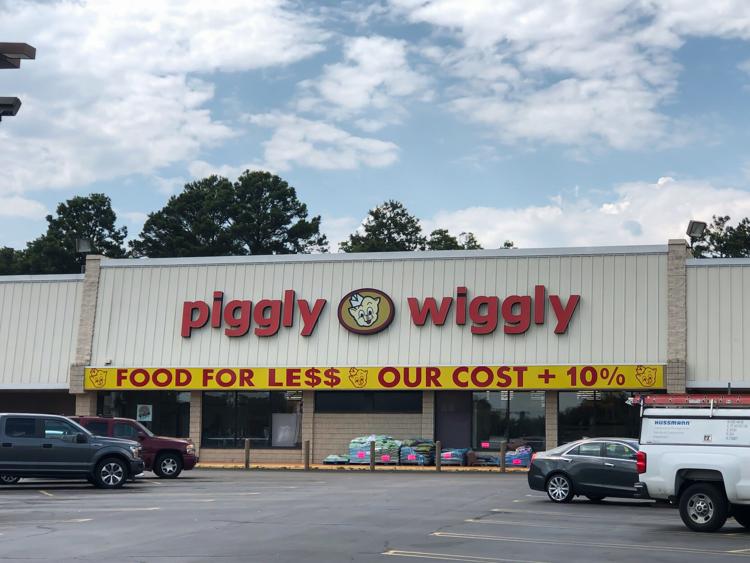
A pair of Alabama legislators have introduced bills in their respective chambers that would eliminate the state’s sales tax on groceries. HB 174, sponsored by Rep. Mike Holmes, R-Wetumpka, and SB 43, sponsored by Sen. Andrew Jones, R-Montgomery, would eliminate the state tax on food. Both bills are designed to put more money in the pockets of state residents. The bills, however, would take different paths to being enacted. HB 174 would be enacted through ratification by the Legislature and Gov. Kay Ivey’s signature, while SB 43 would appear on November’s ballot as a proposed constitutional amendment. Under the state’s existing law, a sales tax of 4% is assessed on food sales. Counties and municipalities throughout the state, however, levy their own local taxes on food, according to the United States Department of Agriculture. Under both bills, local municipalities would retain the power to excise taxes on food. Tuscaloosa and Cullman counties, according to the report, have the highest grocery tax rate in the state at 9%, which includes the 4% state grocery tax. Grocery taxes in the majority of the state’s counties are between 6% and 8%, while some counties have a 4% to 6% grocery tax. A handful of counties have a grocery tax between 8% and 9%. HB 174, if enacted, would exempt the sales of food from sales and use taxes beginning September 1. If SB 43 is enacted through a ballot referendum, it would go into effect on January 1, 2023. Holmes said he introduced the legislation to give state residents a tax break. “We wanted to be sure we didn’t try and replace the grocery tax revenue with a tax revenue stream from somewhere else,” Holmes said. “We didn’t want to shift a tax from one group to another.” Holmes said last year from tax sources, Alabama generated $7.6 billion in revenue. This year, he said, the state is anticipating $12.2 billion in tax revenue. “That is where it is going to hit the hardest,” Holmes said of the legislation benefiting all residents. “It will hit everyone equally. Everybody has to have groceries. That was a place I could go to help the working class, even down to the poverty level and even the upper class, to get everyone a tax break.” Holmes said counties and municipalities will still be able to have their own grocery tax. “I’m really hopeful we can get this done,” said Holmes, who is not running for re-election. “I’m hanging a lot on the fact we can get across-the-aisle support. We have a supermajority, but if we can get half of their votes, we can get it done and do it right.” The Alabama Policy Institute said it is in favor of repealing the grocery tax. “Groceries are exempt from state sales tax in most of the country, with only thirteen states taxing groceries at all,” API President and CEO Caleb Crosby said. “Out of thirteen states that do tax groceries, only Alabama, Mississippi, and South Dakota tax them at the full amount without any credit or rebate. “With state budgets hitting record high after record high, it is … time for Alabama to end this tax. The fact is that Montgomery is flush with cash. State leaders need not pretend that the sales tax on our bread and milk is essential.” Phil Williams, a former state senator who serves as the Institute’s chief policy officer, said, “it is time to pursue this matter without the old fallback of raising taxes elsewhere.” “This should be a matter of giving back, not amending to avoid a true tax cut,” he said. By Brent Addleman | The Center Square Republished with the permission of The Center Square.
$360 million investment for Medical West Hospital in Bessemer
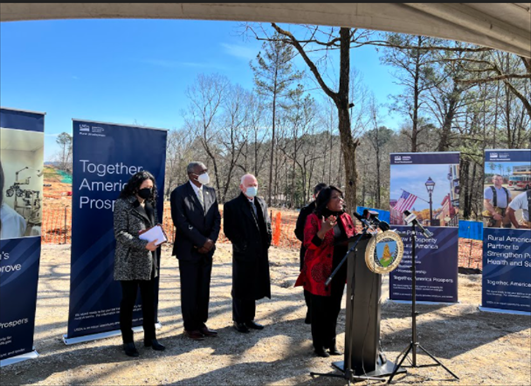
Yesterday U.S. Rep. Terri Sewell welcomed U.S. Department of Agriculture (USDA) Deputy Secretary Jewel Bronaugh and Undersecretary for Rural Development Xochitl Torres Small to Medical West Hospital in Bessemer. During the visit, Deputy Secretary Bronaugh announced more than $1 billion in investments by the USDA, including $360 million for the construction of the Medical West Hospital in Bessemer. Bessemer’s Medical West Hospital Authority will use this $360 million Community Facilities Direct Loan to build a 405,186- square-foot facility located to serve rural west Jefferson County, rural west Tuscaloosa County, and other surrounding rural communities. This project will benefit approximately 333,000 rural people in these communities. Medical West Hospital is one of 737 projects that USDA is helping to fund. The projects will finance emergency response vehicles and equipment; build or improve hospitals and clinics and help fund other essential community facilities. “I was so pleased to welcome USDA Deputy Secretary Bronaugh and Undersecretary Torres Small to Alabama today!” said Rep. Sewell. “I want to thank them and the rest of the Biden-Harris Administration for their commitment to Alabama’s 7th Congressional District and for bringing transformational investments like this right here to our doorstep. Thanks to this $360 million investment, the construction of Medical West Hospital in Bessemer will expand access to critical health care services for thousands of residents in Jefferson and Tuscaloosa Counties and the surrounding rural communities.” “The Biden-Harris Administration has made investing in infrastructure improvements a top priority,” said Deputy Secretary Bronaugh. “These loans and grants will help rural communities invest in facilities and services that are vital to all communities, such as health care facilities, schools, libraries, and first responder vehicles and equipment. When we invest in essential services in rural America, we build opportunity and prosperity for the people who call rural communities home.” Rural Development provides loans and grants to help expand economic opportunities, create jobs, and improve the quality of life for Americans in rural areas. This assistance supports infrastructure improvements, business development, housing, and community facilities. Bronaugh emphasized the critical role that Senator Richard Shelby had in fighting for additional funding for the Community Facilities Direct Loans. Shelby commented on Twitter, “This funding will significantly increase access to health care, education, and public services in rural communities. I will continue to support projects that improve the lives of all Alabamians and appreciate @USDA’s support of @medwesthopital’s new facility.”
Richard Shelby announces $43.3M for new agricultural facility in Auburn

Auburn University will be receiving $43.3 million in federal funds to construct a new U.S. Department of Agriculture (USDA) Agricultural Research Service (ARS) National Soil Dynamics Laboratory as part of the agency’s capital improvement strategy, U.S. Senator Richard Shelby announced Monday. “I am proud to have secured funding for the new ARS facility in Auburn,” Shelby aid. “The soil lab will serve as an outlet for the USDA to complete research that will improve crop and livestock production for Alabama and the entire nation. I look forward to the work that will result from the partnership between Auburn and the USDA, and I am confident the project will continue to enhance our state’s thriving agriculture industry.” The $43.3 million in funding for the new ARS National Soil Dynamics Laboratory was provided through the H. J. Res 31: the Consolidated Appropriations Act, 2019, the final Fiscal Year 2019 appropriations package signed into law on February 15, 2019. Research done at the facility will focus on improving the productive and sustainable use of soil and water resources for increased crop and livestock production. The funding will allow for relocation and construction of the new facility, which will take the place of the current laboratory at Auburn. “The new facility will further Auburn’s drive to inspire through life-changing innovation,” said Auburn President Steven Leath. “Auburn will deepen its relationship with the USDA, more opportunities will emerge for our students and faculty and Auburn will be in a better position to solve real-world problems. Once again, Sen. Shelby has proven himself a champion of science and research that improves quality of life and fosters economic opportunity for farmers in Alabama and across the nation. We’re grateful to him for making it happen.” Agriculture is Alabama’s top revenue producing industry, generating an annual state-wide impact of over $70 billion. With over nine million acres of farmland and more than 48,500 farms, the state is a national leader in food production and a global competitor in the poultry, catfish, timber, cotton, and livestock industries.
Doug Jones encourages Alabama rural entities to apply for broadband infrastructure loans, grants
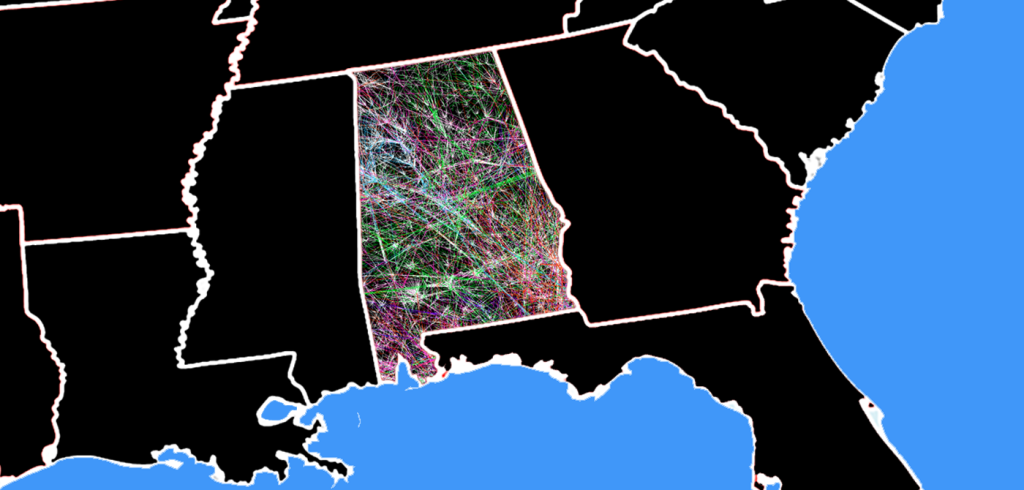
On Friday, the U.S. Department of Agriculture (USDA) announced it is offering up to $600 million in loans and grants to help build broadband infrastructure in rural America. Later that day, Alabama U.S. Senator Doug Jones encouraged eligible rural Alabama entities to apply for the loans to help expand their broadband infrastructure. Telecommunication companies, rural electric cooperatives and utilities, internet service providers, and municipalities may apply for funding through USDA’s new ReConnect Program to connect rural areas that currently have insufficient broadband service. This broadband pilot program is covered through funds secured in the fiscal year 2018 budget as designated by Congress. USDA Rural Development is the primary agency delivering the program, with assistance from other federal partners. “Today, more than ever, high-speed internet is no longer a luxury, but a necessity,” said Jones. “Students rely on connectivity for their education, hospitals and health care providers use telehealth capabilities to reach rural communities, and small businesses need the internet to thrive. It provides economic opportunity, strengthens our communities and connects our workforce throughout Alabama and the nation. This USDA funding is a great opportunity to close the broadband gaps that exist in Alabama and I encourage any eligible entity in the state to apply.” The USDA will make available approximately $200 million for grants (applications due to USDA by April 29, 2019), as well as $200 million for loan and grant combinations (applications due May 29, 2019), and $200 million for low-interest loans (applications due by June 28, 2019). To help customers with the application process, USDA is holding a series of online webinars and regional in-person workshops. The full list of upcoming public webinars and workshops can be found at the ReConnect Program’s resource portal here.
Uniontown gets a $23.4 million wastewater solution from the USDA
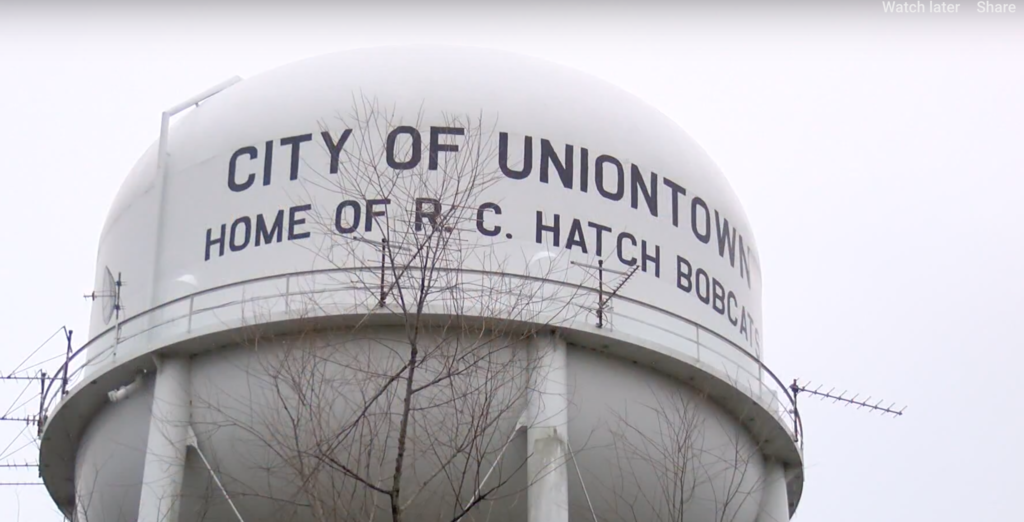
The U.S. Department of Agriculture (USDA) announced a $23.4 million grant to address an ongoing wastewater treatment crisis in Uniontown, Ala. USDA will work with the municipality to create an outside board which will oversee the development of a new wastewater system for Uniontown residents. Alabama 7th District U.S. Rep. Terri Sewell calls the grant “a huge victory” for Uniontown. “Today’s grant announcement is a huge victory for Uniontown that will have a real-life impact for thousands of Alabamians living in the rural Black Belt,” said Sewell. “No American family should have to live without access to safe wastewater treatment in the 21st Century. I have met with families in rural Alabama who struggle with the health and economic challenges created by failing wastewater systems. Every day, their stories inspire my fight in Congress for stronger investments in our wastewater infrastructure. USDA’s assistance in Uniontown is an important step forward, but the wastewater crisis facing Alabama’s rural Black Belt is not over. We must continue fighting for Uniontown, Lowndes County, and all of our state’s residents who have to live with inadequate basic resources.” For over a decade, failing wastewater infrastructure has created enormous health and economic challenges for communities in rural Alabama. Since 2016, the issue has received national and international attention, with the release of a United Nations-sponsored report this year highlighting the failure of wastewater infrastructure in Alabama’s rural Black Belt. Alabama’s senior U.S. Sen. Richard Shelby helped lead the efforts to secure the funding. Along with Sewell, he was joined by U.S. Sen. Doug Jones, Alabama 4th District U.S. Rep. Robert Aderholt and USDA State Rural Development Director Chris Beeker. “Water and wastewater systems across the country are aging, overburdened, and in need of replacement,” said Shelby. “Failure to invest in these water projects has devastating economic and public health consequences. The dire situation in Uniontown is a prime example of a number of communities across Alabama in need of upgrades and repairs. I am proud to have led the efforts to create momentum for this project, and I would like to thank USDA for providing this critical funding. I remain committed to fighting for these greatly needed resources to combat our state’s growing infrastructure needs.” The USDA grant This $23,437,500 USDA Rural Development grant for Uniontown will enable a major infrastructure redesign and rehabilitation. The project will include construction of an interconnection between the city of Uniontown and the city of Demopolis which will pump wastewater to Demopolis for treatment. Once this collection system is operational, the treatment of wastewater through the city of Uniontown’s existing lagoon and spray field system will be eradicated. The lagoons and spray field serving the city of Uniontown will be decommissioned and reclaimed, which will eliminate wastewater overflow and assist the city to better comply with environmental regulatory requirements. Approximately 2,810 customers in the city of Uniontown and the surrounding area are served by this wastewater system.
City hopes to fill empty downtown Birmingham building with two federal agencies

The City of Birmingham, Ala. is looking to fill an empty downtown building with two federal agencies. The former Liberty National Building is one of the largest office spaces in the Magic City and has sat vacant since 2010. The city is now hoping to fill the building with the national headquarters of two U.S. Department of Agriculture (USDA) agencies: the National Institute of Food and Agriculture (NIFA), whose purpose is to to consolidate all federally funded agricultural research, and the Economic Research Service (ERS), which provides key indicators, outlook analysis, and a wealth of data on the U.S. food and agricultural system. In August, the Trump Administration announced plans to move the two government agencies out of Washington, D.C. where their headquarters are located currently. “The need for a proposed NIFA facility would be approximately 90,000 square feet to house approximately 360 employees. The need for a proposed ERS facility would be up to 70,000 square feet to house up to 260 employees,” read a Federal Register notice requesting “expressions of interest” for the relocation of ERS and NIFA. The notice notes that both the ERS and the NIFA are now housed in space rented from the General Services Administration, and that the lease for the NFIA offices is expiring. According to the Birmingham Business Journal, the City of Birmingham is preparing a bid for the two agencies. Incentives to relocate to Birmingham will be included in the bid, but have yet to be disclosed. Agriculture Secretary Sonny Perdue said in a news release the USDA would pay relocation expenses, as the agencies have had a hard time recruiting staff, especially graduates of land-grant colleges. But part of the appeal of relocating to Alabama could be that the state has three land-grant universities: Alabama A&M, Tuskegee, and Auburn University.
USDA describes $328M oil spill restoration plan for Gulf

The U.S. Department of Agriculture says it’s focusing conservation programs along the Gulf of Mexico in a $328 million plan to help recovery from the 2010 oil spill. Undersecretary Robert Bonnie says the agency will use that focus through 2018 as it helps coastal producers plan improvements to improve water quality and improve coastal ecosystems under several Farm Bill programs. Louisiana State University AgCenter Associate Vice President Rogers Leonard says the oil spill tie-in is a new twist to existing programs, and will bring in a broader audience. Gulf Coast farmers will be interested in the amount of money available, he said. Bonnie described the plan Monday at a Mississippi timber plot where the owner has worked with USDA’s Natural Resources Conservation Service to help improve downstream water quality. Republished with permission of the Associated Press.
