
Martha Roby: U.S. service academies nomination deadline is quickly approaching

It’s hard to believe we’re already halfway through the month of October. November will be here before we know it, and with it comes Veterans Day. This is a uniquely special holiday, and as it approaches, I encourage you to take some time to reflect on the endless sacrifices made by those who have worn the uniform. It is a tremendous honor to serve the Second District, which is home to two of our nation’s finest military installations, thousands of active duty and reserve personnel, and a large veteran population. Working on behalf of our servicemembers and veterans has always been a top priority of mine in Congress, and it continues to be one of the most rewarding parts of my job. With Veterans Day on the horizon, I am personally reminded of the great debt of gratitude we owe the men and women of our military. As this important holiday nears, I believe now is an appropriate time to remind high school seniors in the Second District that the deadline to apply for nomination to the United States service academies through my office is less than one month away on November 8th at 5:00 p.m. Central Time. If you or someone you know is interested in pursuing this fantastic opportunity, please remember to submit all necessary materials to my Montgomery office by the deadline. As a member of Congress, one of my distinct privileges each year is to nominate candidates for appointment to four of the five service academies: The United States Military Academy at West Point, the United States Naval Academy, the United States Air Force Academy, and the United States Merchant Marine Academy. The fifth service academy, the United States Coast Guard Academy, does not require a congressional nomination for appointment. I can nominate up to ten individuals for each vacant slot allotted to the Second District. If you are pursuing entry to one of our nation’s distinguished service academies and endeavor to serve our country, I would like to offer my sincere gratitude and wish you the very best. It is because of our veterans, active duty personnel, and young leaders with hearts for serving this nation that we enjoy our uniquely American freedoms. In the spirit of the upcoming Veterans Day holiday, I offer my sincerest thanks to all who have served our country in uniform. It is an honor to represent you in Congress, and I hope you will call on me if I can ever be of assistance to you. If you are a high school senior in the Second District and are interested in learning more about obtaining a nomination to the service academies from my office, please contact my staff in Montgomery by calling (334) 262-7718. Additional application information is also available on my website: www.roby.house.gov/student-resources/service-academy-nominations. Martha Roby represents Alabama’s Second Congressional District. She lives in Montgomery, Alabama, with her husband Riley and their two children.
Military base cuts affect schools, target ranges, and maintenance facilities

The Pentagon will cut funding from military projects like schools, target ranges and maintenance facilities to pay for the construction of 175 miles of fencing along the U.S.-Mexico border, diverting a total $3.6 billion to President Donald Trump’s long-promised barrier. Projects in 23 states, 19 countries and three U.S. territories would be stalled or killed by the plan, though just $1.1 billion in cuts would strike the continental U.S., according to a list released Wednesday by the Pentagon. Almost $700 million would come from projects in U.S. territories, with another $1.8 billion coming from projects on overseas bases. Trump’s move would take the biggest step yet in delivering on his promise to build a wall to block immigrants from entering the country illegally. But it may come at the expense of projects that the Pentagon acknowledged may be difficult to fund anew. Capitol Hill Democrats, outraged over Trump’s use of an emergency order for the wall, promised they won’t approve money to revive them. A senior defense official told reporters the Pentagon is having conversations with members of Congress to urge them to restore the funding. The official agreed that the department has “a lot of work ahead of us,” considering that Congress has given no guarantee it will provide money for the defunded projects. The official was not authorized to discuss the details publicly so spoke on condition of anonymity. In addition, new stretches of fencing proposed along the Rio Grande and through a wildlife refuge in Arizona promise to ignite legal battles that could delay the wall projects as well.The military base projects facing the chopping block tend to address less urgent needs like new parking at the U.S. Military Academy at West Point, New York, and a variety of small arms ranges at bases in Wisconsin and Oklahoma. But a “cyber ops facility” in Hampton, Virginia, and the expansion of a missile defense field at Fort Greeley, Alaska, face the ax, too. Trump has so far succeeded in building replacement barriers within the 654 miles of fencing built during the Obama and Bush administrations. The funding shift will allow for about 115 miles of new pedestrian fencing in areas where there isn’t any now. “The wall is being built. It’s going up rapidly,” Trump said Wednesday. “And we think by the end of next year, which will be sometime right after the election actually, but we think we’re going to have close to 500 miles of wall, which will be complete.” New stretches of fencing are sure to spark legal battles with angry landowners and environmentalists. The Pentagon plan also fuels the persistent controversy between the Trump administration and Congress over immigration policies and the funding of the border wall. “It doesn’t take any input from the local communities. It will take away from the private property rights,” said Rep. Henry Cuellar, Democrat-Texas. “We are going to do everything we can to stop the president.” Cuellar suggested Democrats will look at a must-pass funding bill this month — required to prevent a government shutdown Oct. 1 — to try to take on Trump. But a more likely venue for the battle could be ongoing House-Senate negotiations over the annual Pentagon policy measure. Lawmakers who refused earlier this year to approve nearly $6 billion for the wall must now decide if they will restore the projects that are being used to provide the money. “To pay for his xenophobic border wall boondoggle, President Trump is about to weaken our national security by stealing billions of dollars from our military,” said Rep. Debbie Wasserman Schultz, Democrat-Florida, who chairs a key military construction panel. “The House of Representatives will not backfill any projects he steals from today.” One of the Senate’s most endangered Republicans in the 2020 election, Arizona Sen. Martha McSally, reported that her state is getting nicked for just $30 million from a project that was being delayed anyway. Georgia, where two potentially competitive Senate races loom next year, would be spared entirely, though powerful Senate Majority Leader Mitch McConnell, Republican-Kentucky, himself facing re-election, would lose a $63 million middle school at Fort Campbell. “We need to secure our border and protect our military; we can and should do both,” McSally said. “I went to the mat to fight for Arizona projects and succeeded.”Elaine McCusker, the Pentagon comptroller, said the now-unfunded projects are not being canceled. Instead, the Pentagon is saying the military projects are being “deferred.” Congress approved $1.375 billion for wall construction in this year’s budget, same as the previous year and far less than the $5.7 billion that the White House sought. Trump grudgingly accepted the money to end a 35-day government shutdown in February but simultaneously declared a national emergency to take money from other government accounts, identifying up to $8.1 billion for wall construction. The transferred funds include $600 million from the Treasury Department’s asset forfeiture fund, $2.5 billion from Defense Department counterdrug activities and now the $3.6 billion pot for military housing construction announced Tuesday. The Pentagon reviewed the list of military projects and said none that provided housing or critical infrastructure for troops would be affected, in the wake of recent scandals over poor living quarters for service members in several parts of the country. Defense officials also said they would focus on projects set to begin in 2020 and beyond, with the hope that the money could eventually be restored by Congress. The government will spend the military housing money on 11 wall projects in California, Arizona and Texas, the administration said in a filing Tuesday in a lawsuit brought by the American Civil Liberties Union. The most expensive is for 52 miles (84 kilometers) in Laredo, Texas, at a cost of $1.27 billion. The Laredo project and one in El Centro, California, are on private property, which would require purchase or confiscation, according to the court filing. Two projects in Arizona are on land overseen by the Navy and will be the first to be built, no earlier
Donald Trump taps conservative Kansas congressman for CIA
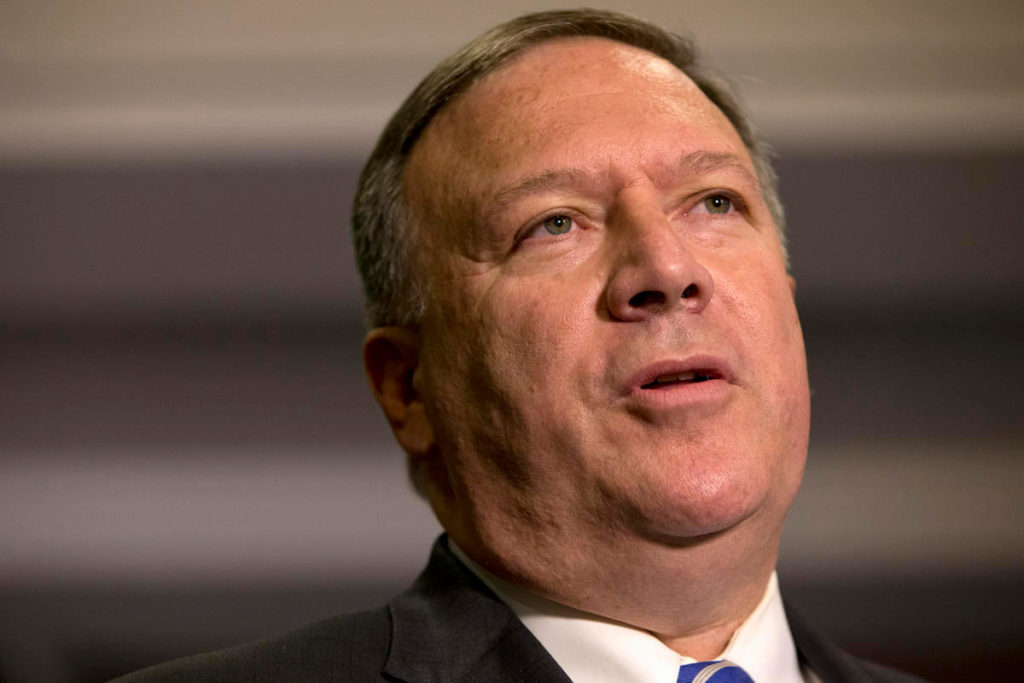
Mike Pompeo, Donald Trump‘s pick to be director of the CIA, is a hard-line Republican congressman who shares the president-elect’s pugnacious worldview and, like Trump, spent years as a businessman before becoming a politician. Pompeo has heavily criticized the landmark Iran nuclear deal, blasted Hillary Clinton over the attack on a U.S. diplomatic outpost in Libya and her use of a private email server, and believes Edward Snowden is a traitor who deserves a death sentence. He also supports restoring the National Security Agency’s bulk collection of telephone metadata, a contentious terror-fighting tool Congress eliminated after Snowden’s revelations. Before taking over the spy agency, the Kansas lawmaker has to be confirmed by the GOP-led Senate. One issue that could dominate the confirmation hearing is Pompeo’s view on using harsh interrogation techniques on detainees. Trump has backed these techniques, saying, “We should go tougher than waterboarding,” which simulates drowning. During the campaign, Trump suggested that he would push to change laws that prohibit waterboarding and other harsh techniques. He said that banning those methods puts the U.S. at a strategic disadvantage against Islamic State militants. Pompeo two years ago rejected accusations that U.S. intelligence and military personnel were “torturers” for harshly interrogating terror suspects captured after 9/11. “These men and women are not torturers, they are patriots,” Pompeo said in 2014 after the Senate released its report on the enhanced interrogation techniques used by the CIA. In a statement Friday, Pompeo said he was “honored and humbled” to accept Trump’s nomination. He called the decision to leave Congress difficult but said the “opportunity to lead the world’s finest intelligence warriors” is a call to service that he could not ignore.” Sen. Mark Warner of Virginia, who will be the top Democrat on the Senate Intelligence committee beginning in January, said in a statement that he would vigorously oversee the CIA to ensure it adheres “to America’s principles and international obligations.” Michael Hayden, former director of the CIA and the National Security Agency, said Friday he was “heartened” by Trump’s decision to pick Pompeo, calling him a “serious man.” Pompeo, 52, was elected to Congress during the tea party wave of 2010. He served on the House Select Benghazi Committee to probe the 2012 attack on the U.S. diplomatic outpost in Benghazi that killed U.S. Ambassador Chris Stevens and three other Americans. The panel’s final report this summer sharply criticized the Obama administration for a series of mistakes but produced no new evidence pointing to wrongdoing by Clinton, who was secretary of state at the time. Pompeo and fellow Republican Jim Jordan of Ohio, however, issued a separate report slamming Clinton and the administration. Pompeo called the former first lady and senator “morally reprehensible.” He also has been a fierce critic of the nuclear deal with Iran that President Barack Obama has championed. The accord granted Tehran sanctions relief for rolling back its nuclear weapons program. Pompeo has said Muslim leaders are “potentially complicit” in terrorist attacks if they do not denounce violence carried out in the name of Islam. “They must cite the Quran as evidence that the murder of innocents is not permitted,” he said in a 2013 House floor speech. A member of the House intelligence committee, Pompeo denounced Snowden, a former NSA contractor who stole and leaked highly classified documents to journalists, revealing the agency’s program for gathering the phone records of millions of Americans. During an appearance on C-SPAN in February, Pompeo said Snowden should receive the death penalty for his actions. “He should be brought back from Russia and given due process and I think the proper outcome would be that he would be given a death sentence,” Pompeo said. Snowden, who spoke Friday from Moscow via a video link during an event of the Norwegian chapter of PEN in Oslo, Norway, criticized Pompeo’s selection to lead the spy agency. “In my country, the new CIA director believes dissidents should be put to death,” Snowden said. Pompeo also has fought against Obama’s attempts to close the detention center at Guantánamo Bay, Cuba, and opposed moving prisoners to the U.S., including Fort Leavenworth in Kansas. He has maintained the detainees at Guantánamo are well taken care of and in May 2013 downplayed the extent of a hunger strike by prisoners. Pompeo, appearing on MSNBC, said it looked to him like they had put on weight. Pompeo was born in Orange, California, and lives in Wichita, Kansas. He enrolled as a teenager at the U.S. Military Academy at West Point and graduated first in his class in 1986. According to biographical information on his House website, Pompeo served as a “cavalry officer patrolling the Iron Curtain before the fall of the Berlin Wall.” He is a graduate of Harvard Law School and was editor of the Harvard Law Review. After college, he set up Thayer Aerospace and was its chief executive officer for more than 10 years. Later he was president of Sentry International, a company that sold equipment for oil fields and manufacturing. Republished with permission of The Associated Press
