
US proposes tariffs on $50 billion in Chinese imports
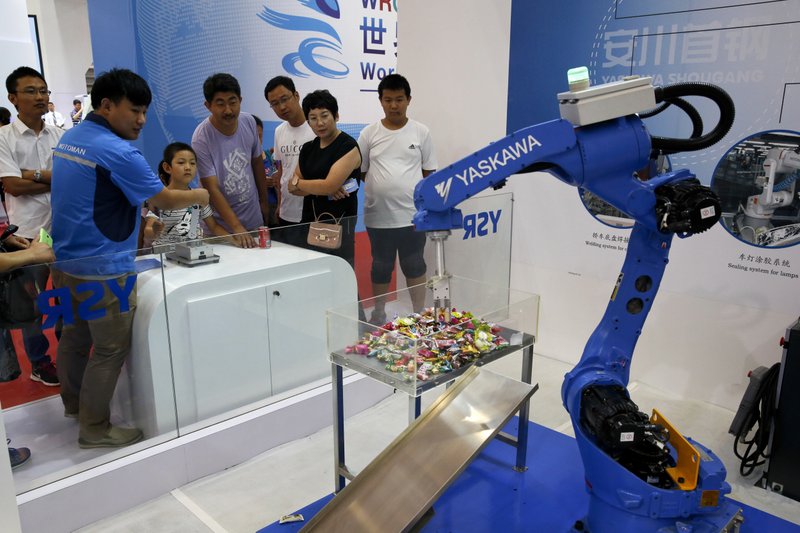
The Trump administration on Tuesday escalated its aggressive actions on trade by proposing 25 percent tariffs on $50 billion in Chinese imports to protest Beijing’s policies that require foreign companies to hand over their technology. China immediately said it would retaliate against the new tariffs, which target high-tech industries that Beijing has been nurturing, from advanced manufacturing and aerospace to information technology and robotics. The Office of the U.S. Trade Representative issued a list targeting 1,300 Chinese products, including industrial robots and telecommunications equipment. The suggested tariffs wouldn’t take effect right away: A public comment period will last until May 11, and a hearing on the tariffs is set for May 15. Companies and consumers will have the opportunity to lobby to have some products taken off the list or have others added. The latest U.S. move risks heightening trade tensions with China, which on Monday had slapped taxes on $3 billion in U.S. products in response to earlier U.S. tariffs on steel and aluminum imports. “China’s going to be compelled to lash back,” warned Philip Levy, a senior fellow at the Chicago Council on Global Affairs and an economic adviser to President George W. Bush. The cherry industry in Washington state is worried its exports to China will be hurt by a growing trade war that escalated Monday when that country raised import duties on a $3 billion list of products. (April 3) Early Wednesday in Beijing, China’s Commerce Ministry said it “strongly condemns and firmly opposes” the proposed U.S. tariffs and warned of retaliatory action. “We will prepare equal measures for U.S. products with the same scale” according to regulations in Chinese trade law, a ministry spokesman said in comments carried by the official Xinhua News Agency. The U.S. sanctions are intended to punish China for deploying strong-arm tactics in its drive to become a global technology power. These include pressuring American companies to share technology to gain access to the Chinese market, forcing U.S. firms to license their technology in China on unfavorable terms and even hacking into U.S. companies’ computers to steal trade secrets. The administration sought to draw up the list of targeted Chinese goods in a way that might limit the impact of the tariffs — a tax on imports — on American consumers while hitting Chinese imports that benefit from Beijing’s sharp-elbowed tech policies. But some critics warned that Americans will end up being hurt. “If you’re hitting $50 billion in trade, you’re inevitably going to hurt somebody, and somebody is going to complain,” said Rod Hunter, a former economic official at the National Security Council and now a partner at Baker & McKenzie LLP. Kathy Bostjancic of Oxford Economics predicted that the tariffs “would have just a marginal impact on the U.S. economy” — unless they spark “a tit-for-tat retaliation that results in a broad-based global trade war.” Representatives of American business, which have complained for years that China has pilfered U.S. technology and discriminated against U.S. companies, were nevertheless critical of the administration’s latest action. “Unilateral tariffs may do more harm than good and do little to address the problems in China’s (intellectual property) and tech transfer policies,” said John Frisbie, president of the U.S.-China Business Council. Even some technology groups that are contending directly with Chinese competition expressed misgivings. “The Trump administration is right to push back against China’s abuse of economic and trade policy,” said Robert Atkinson, president of the Information Technology and Innovation Foundation think tank. However, he said the proposed U.S. tariffs “would hurt companies in the U.S. by raising the prices and reducing consumption of the capital equipment they rely on to produce their goods and services.” “The focus should be on things that will create the most leverage over China without raising prices and dampening investment in the kinds of machinery, equipment, and other technology that drives innovation and productivity across the economy,” Atkinson added. The United States has become increasingly frustrated with China’s aggressive efforts to overtake American technological supremacy. And many have argued that Washington needed to respond aggressively. “The Chinese are bad trading partners because they steal intellectual property,” said Derek Scissors, a China specialist at the conservative American Enterprise Institute. In January, a federal court in Wisconsin convicted a Chinese manufacturer of wind turbines, Sinovel Wind Group, of stealing trade secrets from the American company AMSC and nearly putting it out of business. And in 2014, a Pennsylvania grand jury indicted five officers in the Chinese People’s Liberation Army on charges of hacking into the computers of Westinghouse, US Steel and other major American companies to steal information that would benefit their Chinese competitors. To target China, Trump dusted off a Cold War weapon for trade disputes: Section 301 of the U.S. Trade Act of 1974, which lets the president unilaterally impose tariffs. It was meant for a world in which much of global commerce wasn’t covered by trade agreements. With the arrival in 1995 of the Geneva-based World Trade Organization, Section 301 largely faded from use. Dean Pinkert of the law firm Hughes Hubbard & Reed, found it reassuring that the administration didn’t completely bypass the WTO: As part of its complaint, the U.S. is bringing a WTO case against Chinese licensing policies that put U.S. companies at a disadvantage. China has been urging the United States to seek a negotiated solution and warning that it would retaliate against any trade sanctions. Beijing could counterpunch by targeting American businesses that depend on the Chinese market: Aircraft manufacturer Boeing, for instance, or American soybean farmers, who send nearly 60 percent of their exports to China. Rural America has been especially worried about the risk of a trade war. Farmers are especially vulnerable targets in trade spats because they rely so much on foreign sales. “Beijing right now is trying to motivate US stakeholders to press the Trump Administration to enter into direct negotiations with China and reach a settlement before tariffs are imposed,” the Eurasia Group consultancy said in a
John McMillan: Global trade vital to Alabama ag, industry

As Agriculture & Industries Commissioner, I work closely with the Alabama farming and business communities to grow the economy and create prosperity for our state. This provides firsthand knowledge that one of the most important factors in generating this kind of growth and prosperity is international trade. That’s why Congress needs to take a bold step and pass Trade Promotion Authority (TPA). TPA has been in the national news quite a bit lately, and garnered a fair share of controversy. But much of what one reads or hears about TPA is misleading or misinformed. Heated rhetoric aside, TPA is nothing more than an agreement between Congress and a U.S. president as to how they will work together to negotiate, consider, and vote on international trade agreements. TPA allows both branches of the federal government to participate in trade development and set up an expedited process for trade deals. TPA does not take power away from Congress and give it to President Barack Obama. Presidents can negotiate trade deals any time they want — with or without TPA, they still need Congressional approval of any trade deal they negotiate. In fact, TPA provides for more oversight of and transparency from the administration, and gives Congress a voice in the entirety of the process, instead of just a vote at the end. TPA also makes sure the public has its say by requiring any agreement to be published for public review 60 days before it can be finalized. Why is TPA necessary? Because Congress is Congress, and no matter how beneficial a trade agreement would be for the nation, there will always be one or two legislators who have a political axe to grind who will hold up the process. TPA makes sure the narrow interests of the very few don’t trump the broad interests of the very many. In doing so, it lets our potential trade partners know they can rely on the terms of the agreements they negotiate with a president and that they will not be changed or unduly delayed by a highly politicized Congress. That’s why it is so important to get TPA back on the books for our state. Alabama is a major exporter, and our farms and businesses count on new global markets to grow their businesses and create jobs. Without TPA, we cannot finalize the kinds of deals that open up these markets. TPA is not some abstract federal legislative issue — it has a direct impact on Alabama’s economy and the 90,000 jobs supported by Alabama exports. Recently, U.S. Trade Representative Michael Froman described Alabama as an “exporting powerhouse,” and said that Alabama “exports are supporting well-paying jobs.” These are not understatements: In 2014, Alabama exported $19.5 billion in goods. In 2013, almost 4,000 companies exported from the state, more than 80 percent of which were small- and medium-sized companies. It’s no surprise, then, that a recent poll found that an overwhelming majority of Alabamians support free trade. Last week the U.S. Senate voted in favor of TPA with a strong, bipartisan majority. I strongly urge Reps. Robert Aderholt, Gary Palmer and Terri Sewell — as well as the rest of Alabama’s congressional delegation — to support TPA as it moves through the U.S. House of Representatives. John McMillan is the Commissioner of Agriculture & Industries for the state of Alabama. You may contact him at john.mcmillan@agi.alabama.gov.
