
Budget calls for un-earmarking education funds to square General Fund
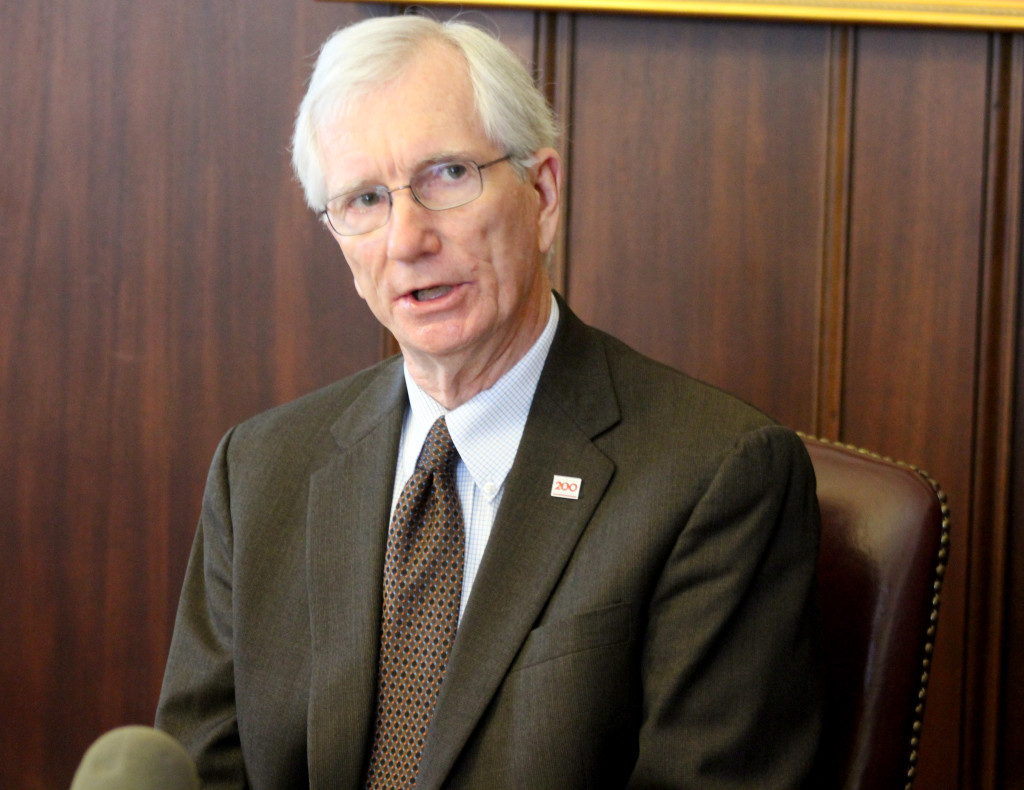
Alabama Finance Director Bill Newton held a newss conference Tuesday to break down proposals from Gov. Robert Bentley concerning this year’s General Fund and Education Trust Fund (ETF) budgets. The governor proposed un-earmarking $181 million from the ETF, $150 million from use taxes and $31 million from insurance premium taxes, in an effort to square the General Fund. This year’s General Fund budget will total $1.93 billion, up from last year’s $1.85 billion budget, and provide a $100 million increase to Medicaid, a $70 million increase to the Department of Corrections, a $10 million increase to the Alabama Department of Public Health and a $5 million increase for the Department of Human Resources. The budget also calls for a 2.5 percent decrease in funding for the legislative branch, district attorneys, the finance department and the forensic science department, as well as a 5 percent decrease for agriculture and industry, military and the Department of Youth Services. The proposal also includes a 2 percent cost of living raise for education and state employees, with level funding for state employees’ healthcare at $825 monthly for each employee. Newton also addressed Bentley’s plan to close all of Alabama’s prisons and open four new facilities, saying the “significant savings” from eliminating the inefficient facilities would pay for the cost of construction, which is slated to be completed within three years. This year’s ETF will have an appropriation of $6.31 billion, up from last year’s $5.95 billion, of which the $181 million moved to the General Fund will be made up from the Budget Stabilization Fund, one of the state’s two savings accounts. K12 programs in the state will see an increase to $3.99 billion from last year’s $3.84 billion and an increase for universities from $1 billion last year to $1.08 billion this year. A new line item includes $40 million to fund the governor’s proposal to provide broadband internet to rural parts of the state. Additionally, an increase of more than $5 million will be allocated for textbooks, providing about $60 per student.
Cam Ward: Un-earmarking is a common-sense solution to budget issues
Budget cuts. Tax increases. Agency restructurings. We’ve heard and seen it all over the past several months since the Legislature first came to order in early March. Since that time, there has been a regular session and two special sessions. Throughout each, a lot of ideas were bounced off the wall – some stuck, some got shot down, and some still have legs. State senators and representatives came forward with ways they thought the $200 million hole in the General Fund budget should be filled. On one side you had those who believed government services should be unilaterally slashed without regard to the impact on our citizens. On the other side was Governor Bentley with a $541 million tax increase that also gave equal disregard to the impact on Alabamians. Most legislators, including myself, believed a more responsible solution was a mix of targeted cuts to state agencies, small revenue increases, and continued reform of high cost state services, like Medicaid and prisons. This was the budget solution ultimately passed the Legislature and was signed by Governor Bentley in September. Most state agencies were asked to make cuts ranging from 1% to 5%. A $0.25 increase in the cigarette tax was passed to fund the exploding cost of Medicaid, while reforms to our state prison system and Medicaid will save taxpayers hundreds of millions of dollars over the coming years. Yet, there are still grave fiscal challenges ahead for Alabama. The growing number of senior citizens in our state means the cost of the Medicaid program will continue to rise over the coming decade. Even now, Medicaid consumes 37% of the state’s General Fund budget, which funds all non-education expenses. For Alabama to thrive in the coming decade, the Legislature must have flexibility to allocate state tax dollars in the most efficient manner possible. Currently, 91% of Alabama’s tax dollars are earmarked for specific departments or programs. Alabama has the highest percentage of earmarked revenue in the nation, and the next highest is Michigan with only 63%. The national average is just 24%. That means Alabama has nearly four-times the earmarks of the average state. Earmarking leads to apathy in state government since state agencies are assured specific sources of funding, and there isn’t incentive to show they are using current funds efficiently. Bureaucrats can rest easy in the knowledge that a stream of taxpayer dollars is earmarked just for their programs. I believe government can and does provide essential functions for our citizens. But there should pressure on the agencies each year to become as efficient as possible, in order that you, the taxpayer, can keep more of your hard-earned income. That is why I have authored a bill that will significantly reduce the number of earmarks in the state budget. Under this legislation, more than $450 million in state revenue will be un-earmarked. It represents about 15 percent of the total earmarked state General Fund dollars, leaving protected the funds that draw down federal matches or fund critical services. Just as a business or family must have some flexibility in yearly budgeting to respond to changing priorities, the Legislature needs the ability to move resources to meet changing needs for our state. Both excessive debt and high levels of taxation will mire an economy in sluggish growth. Republicans in the Legislature have stood firm against the Governor’s calls for massive, broad-based tax hikes. Yet, the challenge of fully funding essential programs like Pre-K for our children and Medicaid for the elderly can only be met if the Legislature has the flexibility to move funds on an as-needed basis. Un-earmarking state revenue to create more flexibility is the crucial next step to ensure we deliver a sound financial future to our children and grandchildren. We have seen the dire consequences of debt and high tax rates in countries like Greece, states like Illinois, and cities like Detroit. For Alabama to continue to afford the low tax rates we enjoy, the Legislature needs additional flexibility to more smartly allocate existing resources. That’s exactly why we need this un-earmarking bill to pass in the 2016 legislative session. Republican Senator Cam Ward represents District 14 in the Alabama State Senate, which includes all or parts of Shelby, Bibb, Chilton, Hale, and Jefferson Counties. He serves as Chairman of the Senate Judiciary Committee.
