
Alabama exports surging in unexpected corners of the world
It’s clear that 2016 was a stellar year for Alabama exports, with rising shipments in a number of markets worldwide, signaling even more optimism for the future. The top five destinations for state goods and services – Canada, China, Germany, Mexico and the United Kingdom – remained relatively unchanged from 2015 and most showed year-over-year growth. Overall, Alabama-made goods were shipped to 189 countries. A number of them, while not among the top five, showed significant growth in 2016, including Kuwait, Russia, Taiwan and the United Arab Emirates. The Alabama Department of Commerce is always studying trade trends among state businesses and manufacturers, using the information to plan seminars and trips aimed at helping companies boost their export business, said Hilda Lockhart, director of Commerce’s Office of International Trade. Economic engine With Alabama’s 2016 exports reaching a record $20.55 billion, increasing 6.4 percent from the previous year, officials are looking to build on that momentum, Lockhart said. “We know rising exports for Alabama companies in overseas markets means greater potential for new jobs and investment back home,” Lockhart said. “International trade is truly a local economic engine, and Alabama workers and communities benefit from the growth.” U.S. Commerce Department figures show the state’s exports have risen 15 percent since 2011 and 48 percent since 2006. Vehicles are the state’s top export, by a large margin. Other key categories include chemicals, primary metals, paper products and non-electrical machinery, a category that includes combustion engines, agricultural machinery, metalworking machine tools and much more. Lockhart offered a closer look at some of the fastest-growing markets for Alabama exports, and what’s driving them: KUWAIT: Alabama’s exports to the Persian Gulf country increased to $104.9 million in 2016, a 285 percent spike from the previous year. The largest increases were in fabricated metal products, chemicals and paper. “This year Alabama was Kuwait’s No. 1 trading partner in the nation for fabricated metal products, perhaps due to the country’s recent expenditures on various hydrocarbon and petrochemical refineries, such as the $10 billion Olefins 3 plant,” Lockhart said. Currently in the pre-execution phase, the Olefins 3 plant will produce 1.4 million tons of ethylene a year when it is completed. The petrochemical is commonly used in the manufacturing process. RUSSIA: Shipments of state exports to Russia rebounded in 2016 to $102.1 million, after a poor showing the previous year, with major increases in the export of non-electrical machinery, chemicals and paper. Alabama was Russia’s No. 5 trading partner among U.S. states for non-electrical machinery products.Russia’s demand for machinery is “driven by the government’s strategy to modernize Russian industry across several sectors, including power generation, transportation, defense, automotive and aerospace,” according to the U.S. Foreign Commercial Service. Lockhart said the drop in exports in 2015 likely occurred because of the contraction in the price of oil that year, which caused a recession in Russia and other oil-producing countries. TAIWAN: Exports from Alabama to Taiwan nearly doubled in 2016, increasing to approximately $200 million. The largest gains were in chemicals, computer and electronic products, and paper. “Chemical exports alone accounted for more than half of the 2016 total, showing a two-year increase from $19.6 million in 2014 to $102.7 million in 2016,” Lockhart said. The state was Taiwan’s No. 6 trading partner in the nation for chemicals, predominantly in the category of basic chemicals, which include industrial gases used in the semiconductor production process. Lockhart said the semiconductor industry, including manufacturing, design and packaging, is a cornerstone of the Taiwanese IT economy, so it is likely that the increased exports are feeding into this sector. UAE: Alabama firms shipped $467.8 million in exports to the United Arab Emirates in 2016, an increase of more than 100 percent compared to exports just two years earlier. Much of the growth took place in the categories of transportation equipment, non-electrical machinery and chemicals. The state was the UAE’s No. 5 trading partner in the U.S. for transportation equipment, with this category alone accounting for $396.2 million of the export total for the year. “Aerospace products make up the bulk of these transportation equipment exports as the UAE develops its burgeoning satellite and Mars mission programs, expands its military and increases investment in the commercial airline industry,” Lockhart said. Meanwhile, other up and coming markets have shown significant growth over the past five years, and they could be potential targets of new, increased efforts to fuel trade, Lockhart said. The countries include Vietnam, Oman, the Bahamas, Denmark, Finland, Kenya, Liberia, Hungary and Bosnia-Herzegovina. This story originally appeared on the Alabama Department of Commerce’s Made in Alabama website. Republished with permission of Alabama NewsCenter.
Marco Rubio says next step in Syria is negotiating regime change

Sen. Marco Rubio says the next step in Syria should be to work with Sunni governments to discuss “an alternative” government in Syria. Rubio is a Florida Republican and onetime rival of President Donald Trump. The conservative tells NBC’s “Today” show that Trump should reach out to Saudi Arabia and the United Arab Emirates, as well as Turkey, to discuss ways to get Syrian President Bashar Assad to step down and create a new regime. Assad has not responded to diplomatic pressure in the past, but Rubio says the military strikes could change that. He says, “We need to now move forward through a combination of diplomacy and, quite frankly, the support of groups on ground, particularly non-jihadist Sunni groups, to create alternatives to the Assad regime.” Republished with permission of The Associated Press.
In a first, Emirati foreign minister defends Donald Trump visa ban
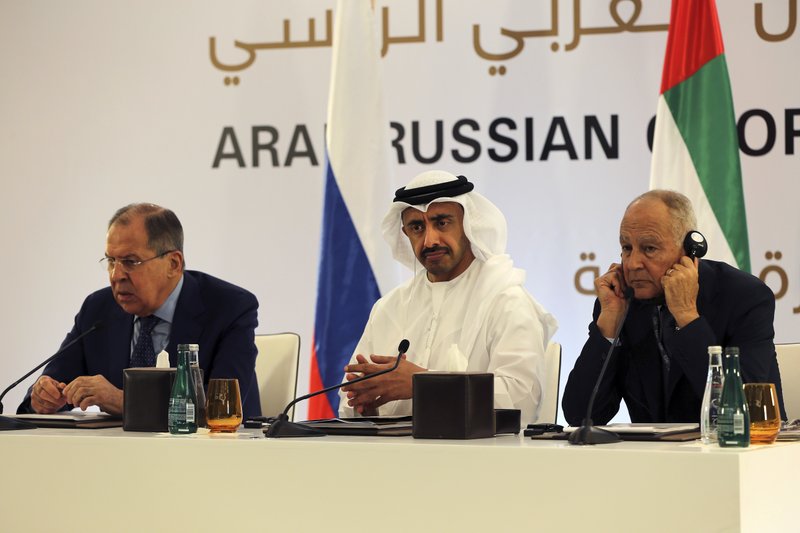
The United Arab Emirates‘ top diplomat on Wednesday came out in defense of President Donald Trump‘s order temporarily barring citizens from seven Muslim-majority countries from entering the United States. The comments by Sheikh Abdullah bin Zayed Al Nahyan, the Gulf federation’s foreign minister, could help bolster the administration’s assertion that the directive was not intended as a ban against Muslims. The UAE minister said the U.S. was within its rights to take what he said was a “sovereign decision” concerning immigration — the first such remarks in support of Trump’s move from the Gulf Arab region — and he voiced faith in the American administration’s assurances that the move was not based on religion. Sheikh Abdullah also noted that most of the world’s Muslim-majority countries were not covered by the order, which halts entry for 90 days to citizens of Iraq, Syria, Iran, Sudan, Libya, Somalia and Yemen. “This is a temporary ban and it will be revised in three months, so it is important that we put into consideration this point,” he said following talks with his Russian counterpart in the Emirati capital, Abu Dhabi. “Some of these countries that were on this list are countries that face structural problems,” he continued. “These countries should try to solve these issues … and these circumstances before trying to solve this issue with the United States.” The Emirates is one of the United States’ closest Arab allies. It is part of the U.S.-led coalition fighting the Islamic State group and hosts American troops and warplanes taking part in the anti-IS campaign. It is also home to a center backed by the U.S. that aims to counter extremist propaganda online. The seven-state federation prides itself on being a tolerant, forward-looking nation that also embraces its traditional Arab and Islamic heritage. The local population is dwarfed some four-to-one by foreign residents, many of whom are not Muslim. Trump made a point of speaking with the powerful Abu Dhabi crown prince, Sheikh Mohammed bin Zayed, and Saudi King Salman in his first calls to Arab allies this week. Sheikh Mohammed is the foreign minister’s brother and is likely to be the next Emirati president. America’s largest Arab export market, the Emirates also has commercial connections to the new U.S. president. Trump has lent his name to a soon-to-open golf course and real-estate project being developed in the Emirati city of Dubai, the Middle East’s commercial hub. The Abu Dhabi tourism office is a tenant of Trump Tower in New York. Sheikh Abdullah and Sergey Lavrov discussed a range of regional issues including the war in Syria during their meeting, which included Arab League Secretary-General Ahmed Aboul Gheit. Trump’s order also includes a suspension of refugee admissions for 120 days, and bans Syrian refugees from entering indefinitely. Lavrov expressed a willingness to engage with the new U.S. administration on the establishment of safe zones in Syria, something that Trump has expressed interest in creating. But he suggested more details were needed. “As I understand it, when the Americans are talking about safe zones, first of all they are interested in reducing the number of immigrants — especially through Syria — from going to the West,” he said. Republished with permission of The Associated Press.
Dubai’s DAMAC confirms offering $2B in deals to Donald Trump
Dubai-based developer DAMAC Properties said Wednesday it recently offered $2 billion in deals to President-elect Donald Trump‘s company, which rejected them. The developer already has partnered with the Trump Organization to manage and run two golf courses in the glamorous city in the United Arab Emirates. One will open just weeks after his inauguration as America’s 45th president. DAMAC spokesman Niall McLoughlin told The Associated Press on Wednesday that the offer to Trump’s firm involved “a variety of different properties deals.” McLoughlin declined to be more specific, other than to say that “the discussions took place as stated in the media briefing.” Trump said Wednesday at his first news conference since his election that he had turned down the deal, offering the decision as evidence of his commitment to avoiding conflicts of interest. “Over the weekend, I was offered $2 billion to do a deal in Dubai with a very, very, very amazing man, a great, great developer from the Middle East,” Trump said. “And I turned it down. I didn’t have to turn it down. … But I don’t want to take advantage of something.” DAMAC is run by Dubai-based billionaire Hussain Sajwani – not Hussain Damac as Trump said at the news conference. One of the Trump Organization’s subsidiaries received from $1 million to $5 million from DAMAC, according to a Federal Election Committee report submitted in May. Republish with permission of The Associated Press.
Golf club shows pitfalls of Donald Trump presidency
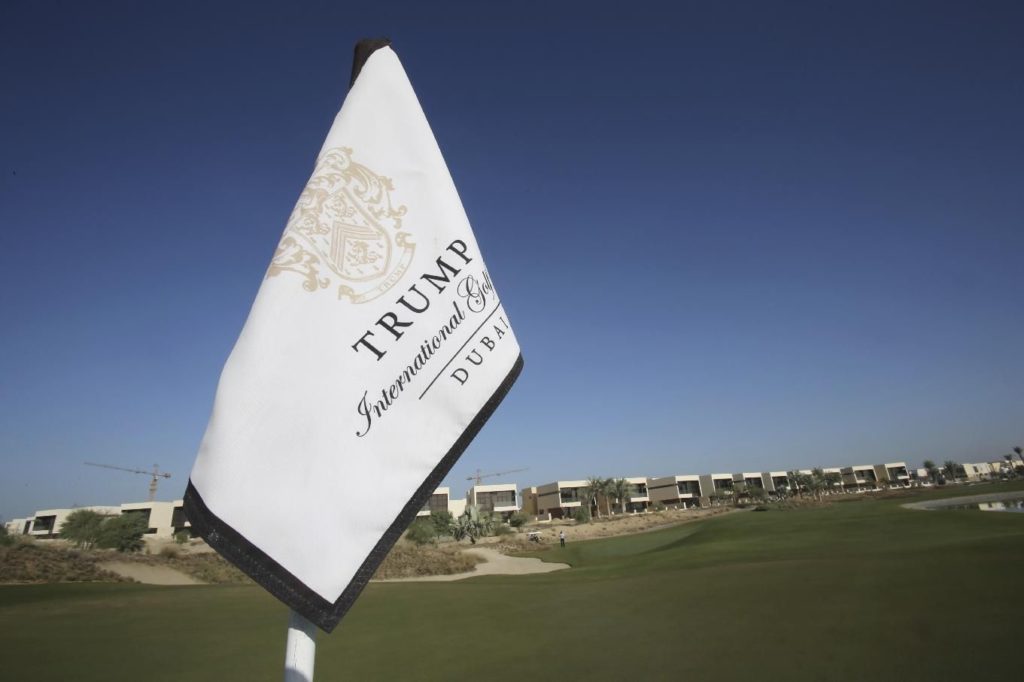
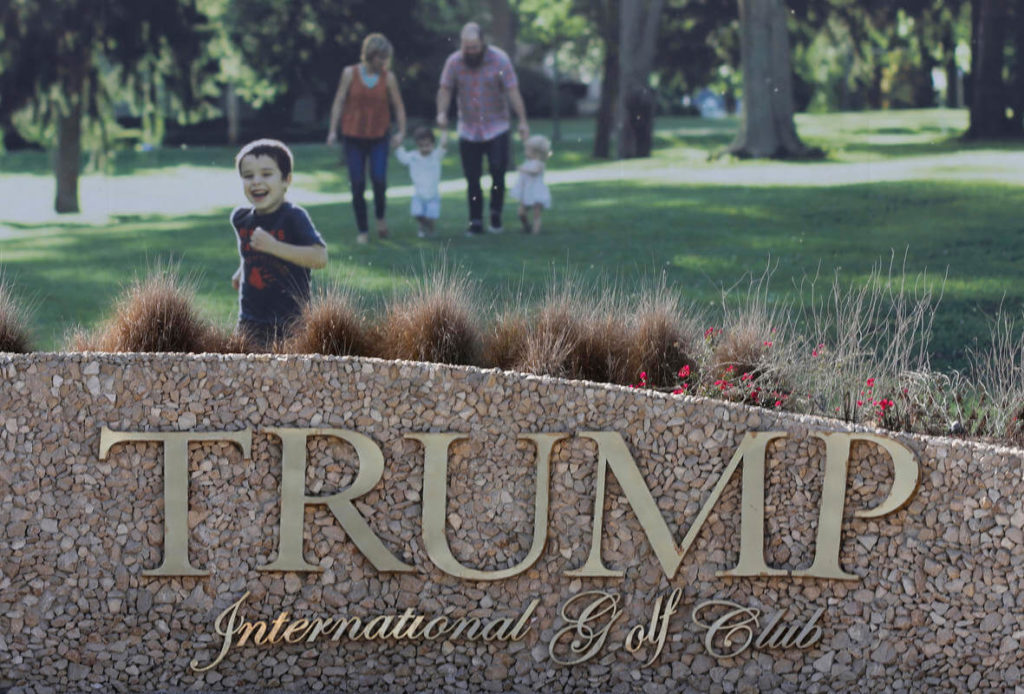
The decorative clock bearing the name of America’s incoming 45th president has yet to start at the Trump International Golf Club in Dubai, but the developers behind the project already are counting the money they’ve made. The 18-hole course is likely to be the first Trump-connected property to open after his Jan. 20 inauguration as president, joining his organization’s projects stretching from Bali to Panama. It also encapsulates the host of worries of possible conflicts of interest circulating around a president who is very different from America’s past leaders. While the Oval Office has always been home to the wealthy, Donald Trump represents the first franchise president. Could foreign governments pressure or please Trump through his international businesses? Should projects bearing his name receive additional security? And how close should his ties remain to business executives operating in areas with far different opinions about human rights and justice? “There has never been anything remotely like this — not even close,” said Robert W. Gordon, a legal historian and ethics expert who teaches at Stanford University. “Trump himself tends to treat his businesses and his public policy as sort of extensions of himself. He seems to be completely unembarrassed about scrambling up and conflating his business enterprise and the actions and policies of the U.S. government.” The Trump International Golf Club in Dubai — the sheikhdom in the United Arab Emirates home to a futuristic skyline crowned by the world’s tallest building — is due to open in February and be managed by Trump Organization employees. The course sits along a road that begins near the sail-shaped Burj al-Arab luxury hotel and passes by a mall with its own artificial ski slope. The luxury continues onto the par-71 Trump course, designed by American golf architect Gil Hanse, where wrinkled fairways lead to putting greens made smooth with silica sand brushed in between micro-blades of grass. It is set inside Akoya, a massive housing development of 2,600 villas and 7,000 apartments developed by Dubai-based luxury real estate DAMAC Properties. Another Trump-managed golf course is planned for another even larger DAMAC project under development further down the road. Billionaire Hussain Sajwani, who founded DAMAC Properties in 2002, met Trump some 10 years ago and the two men hit it off over their real estate experiences, said Niall McLoughlin, a senior vice president for communications and marketing at the firm. “When we approached them in 2013 about the golf course, he, of course, knew who DAMAC was,” McLoughlin told The Associated Press on a recent trip to the golf course. “They subsequently cemented the family relationship as well. … A lot of our dealings have been with Eric, a lot of our dealings have been with Ivanka. They have traveled here — and Donald Jr.” Sajwani and his family also attended a New Year’s Eve party at Trump’s Mar-a-Lago Club in Florida, with the incoming president describing them from on stage as “the most beautiful people from Dubai.” Trump received between $1 million to $5 million from DAMAC, according to a Federal Election Committee report submitted in May. It’s unclear how much the contract will be worth once the golf course opens and starts operating. McLoughlin declined to offer specific figures. It is the first Trump venture in the Arab world. His first proposed project in Dubai, a 62-story tower with state-backed developer Nakheel, became a victim of the sheikhdom’s 2009 financial crisis. By 2014, Trump knocked a golf ball down the fairway of what would become the golf course at Akoya. Sajwani called Trump a “great man” during the tour, and DAMAC later designed some 100 Trump-branded villas at the property, selling from 5 million dirhams ($1.3 million) to over 15 million dirhams ($4 million). With Trump set to be sworn in as president, security analysts have suggested properties bearing his name could be targets. His campaign pledge calling for a “total and complete shutdown” of Muslims entering the U.S., followed by his proposal to conduct “extreme vetting” of immigrants, also sparked regional anger. The Trump logos on the golf course even came down for a short time. Still, the United Arab Emirates, a staunch U.S. ally in the war against the Islamic State group and host to some 5,000 American military personnel, remains a peaceful corner of the Middle East. “Dubai is one of the safest cities in the world,” McLoughlin said. “Dubai has proved itself to be safe. We have no extra concerns about this golf course.” Dubai police did not respond to a request for comment about security at the property. Financial matters raise other questions. DAMAC, a private company, purchased the property for Akoya from Dubai’s government in 2012 for around $350 million. Dubai’s government ultimately answers to the emirate’s hereditary ruler, Sheikh Mohammed bin Rashid Al Maktoum, who also is the UAE’s vice president and prime minister. All services to the property — electricity, water, roads — come at the discretion of the government. The club’s bar will need government approvals to serve alcohol, not to mention other regulatory issues. That could raise concerns about the so-called “emoluments clause” of the U.S. Constitution, which bars public officials from accepting gifts or payments from foreign governments and companies controlled by them without the consent of Congress. Any negotiations involving the Trump brand at the least could create the appearance of impropriety, legal experts warn. “He has so many properties that his business interests become an obvious target for both bribes and threats,” said Gordon, the Stanford law professor. “The dangers really come in two directions: One is that foreign powers will try to use Trump’s interests as a way of bribing him into public policies in a way that are friendly to them or use them put pressure on him.” Trump has said he will step away from managing his business empire while in office, but has offered few details other than to say his executives “will run it with my children.” Erik Jensen, a law professor emeritus
Revelers bid adieu to a year of conflicts, celebrity deaths

As 2016 draws to a close, revelers around the world are bidding a weary adieu to a year filled with political surprises, prolonged conflicts and deaths of legendary celebrities. How people are ushering in the new year: AUSTRALIA Sydney sent up a dazzling tribute to 2016’s fallen icons with a New Year’s Eve fireworks display honoring the late singer David Bowie and late actor Gene Wilder, becoming the first major city to bid a bittersweet adieu to a turbulent year. The glittering display over Sydney’s famed harbor and bridge featured Saturn and star-shaped fireworks set to “Space Oddity,” the classic song by Bowie — one of the seemingly endless parade of beloved entertainers who died in 2016. Wilder was also honored as the bridge lit up in a rainbow of colors while a song from Wilder’s famed film “Willy Wonka and the Chocolate Factory” played. “This year, sadly, we saw the loss of many music and entertainment legends around the world,” fireworks show co-producer Catherine Flanagan said. “So celebrating their music as part of Sydney New Year’s Eve fireworks displays is an opportunity to reflect on the year that has been and what the future may hold.” ___ LAS VEGAS More than 300,000 visitors are expected to descend on Las Vegas for an extravagant New Year’s Eve celebration. Nightclubs are pulling out all the stops with performances from DJ Calvin Harris, rappers T-Pain and Kendrick Lamar and artists Drake and Bruno Mars. The city’s celebrity chefs have crafted elaborate prix fixe menus complete with caviar and champagne toasts. An eight-minute fireworks show will kick off at the stroke of midnight, with rockets launching from the tops of half a dozen casinos. Federal officials have ranked the celebration just below the Super Bowl and on par with the festivities in Times Square. FBI and Secret Service agents will work alongside local police departments that are putting all hands on deck for the big night. ___ GERMANY In Berlin the mood was more somber than celebratory. “I don’t like the way politics is going,” said Daniel Brandt. “Fears are being fanned and people are so angry with each other.” The tone of public debate in Germany has become shriller over the past two years with the influx of hundreds of thousands of migrants. Some Germans blame Chancellor Angela Merkel for attacks such as the recent rampage in Berlin, where a failed asylum-seeker from Tunisia rammed a truck into a crowded Christmas market, killing 12 people and injuring dozens more. As the country heads for a general election in which the anti-immigration Alternative for Germany party is expected to poll strongly, Brandt said he was hoping for “proper solutions to our problems.” Two Israeli tourists, on a visit to the German capital, seemed at a loss when asked about their wishes for 2017. “Peace on Earth. Just happiness, really,” said Nathan and Libat, declining to give their last names. Walking by the Reichstag, Germany’s Parliament building, Hamed Noori said 2016 had been a good year. “I came to Germany from Afghanistan,” he said. “Life is better here.” Birgitta Bergquist, a recent retiree visiting Berlin from Sweden, said she looked forward to spending more time with her 3-year-old granddaughter. “And we hope the family stays healthy.” Nicole Durand-Nusser, originally from France but living in Berlin for almost 50 years, said 2016 had been a difficult year: “Brexit, Trump, Erdogan — it’s all getting worse. “I’m a convinced European and I hope Europe doesn’t collapse in 2017,” she said. ___ TURKEY Neslihan Dogruol, a restaurant owner in a chic Istanbul neighborhood, said she hopes for peace in 2017 following a year filled with “unrest and death.” “2016 affected everyone badly,” she said, referring to major attacks that hit Turkey in the past year. The restaurant, adorned with snowflakes and tiny decorative lights for the evening, will have fewer people for dinner. “There is a serious gap between 2015 and 2016 in terms of business, people are going out less,” Dogruol said, adding that she expects more people to come for drinks. Security measures were heightened in major Turkish cities. Traffic leading up to key squares in Istanbul and the capital, Ankara, will be closed, police said. In Istanbul, 17,000 police officers have been put on duty, some camouflaged as Santa Claus and others as street vendors, Turkey’s state-run Anadolu news agency reported on Friday. Ankara and Istanbul were targeted by bomb attacks in 2016, killing more than 180 people. Turkey has been in the throes of violence, combatting the Islamic State group, Kurdish militants and a coup attempt blamed on the U.S.-based cleric Fethullah Gulen. ___ RUSSIA President Vladimir Putin invoked a bit of seasonal enchantment in his New Year’s Eve remarks to the nation. “Each of us may become something of a magician on the night of the New Year,” Putin said in a short televised address broadcast in the closing minutes of 2016 in each of Russia’s 11 time zones. “To do this we simply need to treat our parents with love and gratitude, take care of our children and families, respect our colleagues at work, nurture our friendships, defend truth and justice, be merciful and help those who are in need of support. This is the whole secret,” he said. New Year’s Eve is Russia’s major gift-giving holiday, and big Russian cities were awash in festive lights and decorations. The Moscow subway offered a special holiday train, festooned with lights and artificial greenery. “I wish for the next year to better than this,” said rider Alexander Pisaryev. “We are waiting for good, for peace and order,” said another, Valentina Daineka. ___ THE VATICAN Pope Francis has called on the faithful to help young people find a place in society, noting the paradox of “a culture that idolizes youth” and yet has made no place for the young. Francis said during vespers marking New Year’s Eve that young people have been “pushed to the margins of public life, forcing them to migrate
