
Dems force delays in votes on Jeff Sessions, Steve Mnuchin, Tom Price
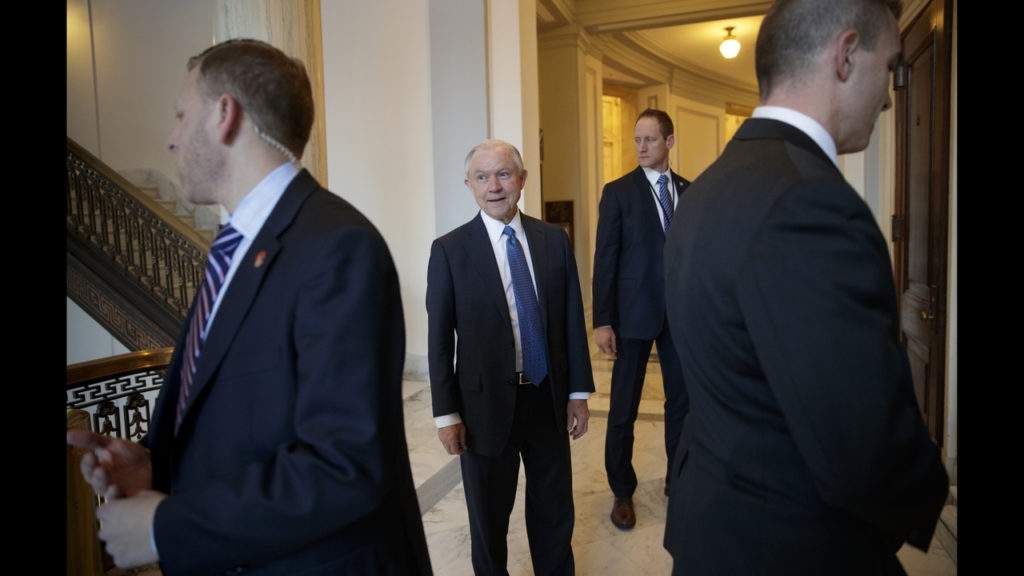
Democrats forced delays Tuesday in planned Senate committee votes on President Donald Trump‘s picks for Health and Treasury secretaries and attorney general, amid growing Democratic surliness over the administration’s aggressive early moves against refugees and an expected bitter battle over filling the Supreme Court vacancy. Democrats abruptly boycotted a Senate Finance Committee meeting called to vote on Rep. Tom Price, R-Ga., the Health nominee and Steve Mnuchin, Trump’s Treasury selection, saying both had misled Congress about their financial backgrounds. The Democrats’ action prevented the Finance panel from acting because under committee rules, 13 of its members — including at least one Democrat — must be present for votes. It was unclear when the panel would reschedule to votes. At the Senate Judiciary Committee, a meeting considering Sen. Jeff Sessions, R-Ala., to be attorney general lasted so long — chiefly because of lengthy Democratic speeches — that Chairman Charles Grassley, R-Iowa, said the panel would meet again Wednesday. The meeting on Sessions’ nomination was coming with Democrats and demonstrators around the country in an uproar over Trump’s executive order temporarily blocking refugees. Even some Republicans were warning it could hinder anti-terrorism efforts. Not everything ground to a halt. The Senate education committee voted 12-11 to send Trump’s pick to head the Education Department, Betsy DeVos, to the full Senate for a confirmation vote. The Senate Energy and Natural Resources Committee quickly approved former Texas Gov. Rick Perry as Energy secretary by 16-7, and Rep. Ryan Zinke, R-Mont., to head Interior by 16-6. And the full Senate easily confirmed Elaine Chao to become transportation secretary by a 93-6 vote. Chao was labor secretary under President George W. Bush, and is wife of Senate Majority Leader Mitch McConnell, R-Ky. Just before the Finance committee was scheduled to vote on Price and Mnuchin, Democrats called a briefing for reporters and announced their plan to force a delay. Sen. Debbie Stabenow, D-Mich., said Price and Mnuchin would hold positions “that directly affect peoples’ lives every day. The truth matters.” Finance Committee Chairman Orrin Hatch, R-Utah, accused Democrats of “a lack of desire to fulfill their constitutional responsibilities.” “They ought to stop posturing and acting like idiots,” he said. In 2013 when Democrats controlled the Senate, Republicans boycotted a committee vote on Gina McCarthy to head the Environmental Protection Agency, temporarily stalling it. Democrats cited one report in The Wall Street Journal that Price received a special, discounted offer to buy stock in a biomedical company, which contradicted his testimony to Congress. They said another report in The Columbus Dispatch showed documents revealing that Mnuchin had not been truthful with the Senate in the confirmation process in comments about how his bank OneWest had handled home foreclosures. Republicans have supported both men, and both have strongly defended their actions. Democrats have opposed Price, a seven-term congressional veteran, for his staunch backing of his party’s drive to scuttle Obama’s health care law and to reshape Medicare and Medicaid, which help older and low-income people afford medical care. They’ve also assailed Price for buying stocks of health care firms, accusing him of using insider information and conflicts of interest for backing legislation that could help his investments. Price says his trades were largely managed by brokers and that he’s followed congressional ethics rules. Democrats have criticized Mnuchin for not initially revealing nearly $100 million in assets, and were expected to vote against both nominees. They’ve also accused him of failing to protect homeowners from foreclosures and criticized him for not initially disclosing all his assets. DeVos, a wealthy GOP donor and conservative activist, has long supported charter schools and allowing school choice. That’s prompted opposition from Democrats and teachers’ unions who view her stance as a threat to federal dollars that support public education. Critics have also mocked her for suggesting that guns could be justified in schools to protect students from grizzly bears. Two prominent Republicans on the education committee, Sens. Susan Collins of Maine and Lisa Murkowski of Alaska, said they remained uncertain if they will vote for her on the Senate floor. Murkowski said DeVos has yet to prove that she deeply cares about America’s struggling schools and its children. Republished with permission of the Associated Press.
Promises, pomp and protests as Donald Trump sworn in
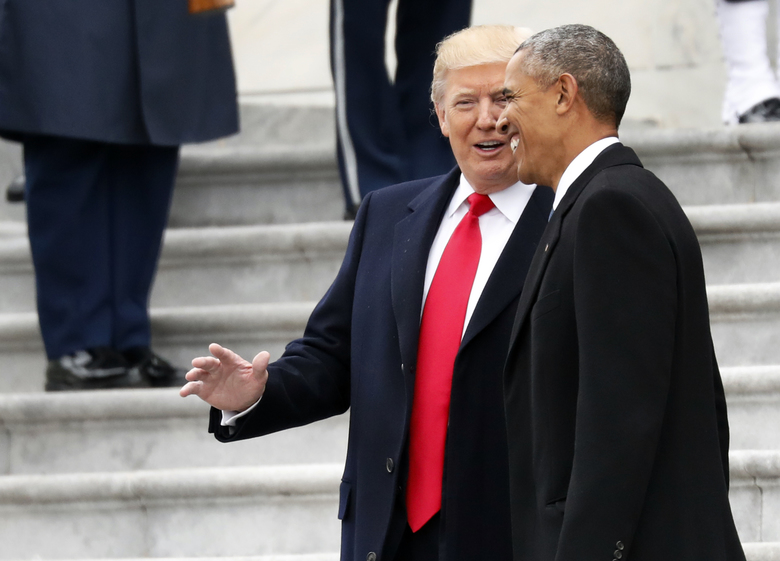
Pledging to empower America’s “forgotten men and women,” Donald Trump was sworn in as the 45th president of the United States Friday, taking command of a deeply divided nation and ushering in an unpredictable era in Washington. His victory gives Republicans control of the White House for the first time in eight years. Looking out over the crowd sprawled across the National Mall, Trump painted a bleak picture of the nation he now leads, lamenting “American carnage,” shuttered factories and depleted U.S. leadership. President Barack Obama, the man he replaced, sat behind him stoically. Trump’s address lasted just 16 minutes. While his inauguration did draw crowds to the nation’s capital, the numbers appeared smaller than for past celebrations. Demonstrations unfolded at various security checkpoints near the Capitol as police helped ticket-holders get through. After the swearing-in, more protesters registered their rage in the streets of Washington. Police in riot gear deployed pepper spray and made numerous arrests after protesters smashed the windows of downtown businesses, denouncing capitalism and Trump. The new president’s first words as commander in chief were an unapologetic reprisal of the economic populism and nationalism that fueled his improbable campaign. He vowed to stir “new national pride,” bring jobs back to the United States, and “eradicate completely” Islamic terrorism. “From this day forward, a new vision will govern our land. From this day forward, it’s going to be only, ‘America First,’” Trump said. His address lasted just 16 minutes. While Trump’s inauguration did draw crowds to the nation’s capital, the numbers appeared smaller than for past celebrations. In a remarkable scene, Trump ripped into Washington’s longtime leaders as he stood among them at the U.S. Capitol. For too long, he said, “a small group in our nation’s capital has reaped the rewards of government while the people have borne the cost.” For Republicans eager to be back in the White House, there was little mention of the party’s bedrock principles: small government, social conservativism and robust American leadership around the world. Trump, who is taking office as one of the most unpopular incoming presidents in modern history, made only oblique references to those who may be infuriated and fearful of his presidency. “To all Americans in every city near and far, small and large from mountain to mountain, from ocean to ocean, hear these words: You will never be ignored again,” he said. The new president was sworn in by Chief Justice John Roberts, reciting the 35-word oath with his hand placed upon two Bibles, one used by his family and another during President Abraham Lincoln’s inauguration. Trump and wife, Melania, bid Obama and outgoing first lady Michelle Obama farewell as they departed the Capitol grounds in a government helicopter. Trump and Obama’s political paths have been linked in remarkable ways. Before running for the White House, the billionaire businessman led efforts to promote falsehoods about the 44th president’s citizenship and claim on the office. Obama addressed a staff gathering at Joint Base Andrews before departing for a vacation in California. “You proved the power of hope,” he said. Trump’s journey to the inauguration was as unlikely as any in recent American history. He defied his party’s establishment, befuddled the media and toppled two political dynasties on his way to victory. His message, calling for a resurgence of white, working-class corners of America, was packaged in defiant stump speeches railing against political correctness. He used social media to dominate the national conversation and challenge conventions about political discourse. After years of Democratic control of the White House and deadlock in Washington, his was a blast of fresh air for millions. But Trump’s call for restrictive immigration measures and his caustic campaign rhetoric about women and minorities angered millions. And Trump’s swearing-in was shadowed by questions about his ties to Russia, which U.S. intelligence agencies have determined worked to tip the 2016 election in his favor. More than 60 House Democrats refused to attend his swearing in ceremony in the shadow of the Capitol dome. One Democrat who did sit among the dignitaries was Hillary Clinton, Trump’s vanquished campaign rival who was widely expected by both parties to be the one taking the oath of office. At a post-ceremony luncheon at the Capitol, Trump asked the Republicans and Democrats present to recognize her, and those in the room rose and applauded. At 70, Trump is the oldest person to be sworn in as president, marking a generational step backward after two terms for Obama, one of the youngest presidents to serve as commander in chief. Trump takes charge of an economy that has recovered from the Great Recession but has nonetheless left millions of Americans feeling left behind. The nation’s longest war is still being waged in Afghanistan and U.S. troops are battling the Islamic State in Iraq and Syria. The American health care system was expanded to reach millions more Americans during Obama’s tenure, but at considerable financial costs. Trump has vowed to dismantle and rebuild it. Trump faces challenges as the first president to take office without ever having held a political position or served in the military. He has stacked his Cabinet with established Washington figures and wealthy business leaders. Though his team’s conservative bent has been cheered by many Republicans, the overwhelmingly white and male Cabinet has been criticized for a lack of diversity. Before attending an inaugural luncheon, Trump signed his first series of orders, including the official nominations for his Cabinet. He joked with lawmakers, including House Democratic leader Nancy Pelosi, and handed out presidential pens. In a show of solidarity, all of the living American presidents attended Trump’s inaugural, except for 92-year-old George H.W. Bush, who was hospitalized this week with pneumonia. His wife, Barbara, was also admitted to the hospital after falling ill. Republished with permission of The Associated Press.
First day goal? Make White House feel like home for Donald Trump
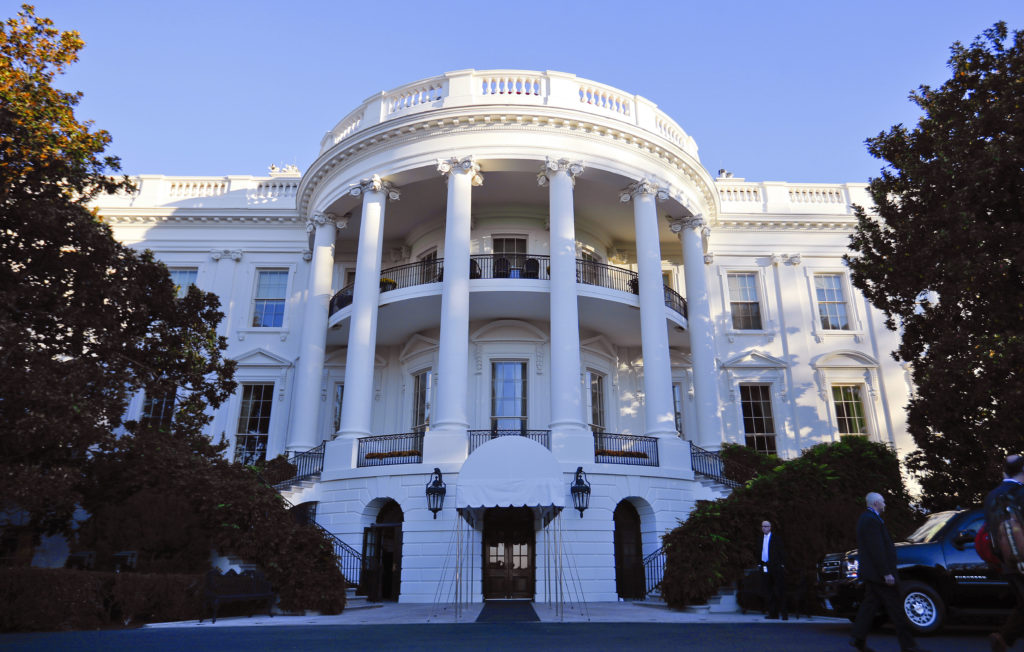
It’s supposed to feel just like home when Donald Trump steps inside the White House residence for the first time as president on Inauguration Day. His clothes will be hanging in the closet. The kitchen will be stocked with his favorite foods. Windows will have been washed, carpets vacuumed or replaced, and fresh linens and towels will be in all the bedrooms and baths. No packed or half-empty boxes will be lying around either, unlike a typical home move. Trump and his wife, Melania, can thank the nearly 100 butlers, maids, plumbers, electricians and other staffers who maintain the private living areas of the White House. The crew will have just the hours between Trump’s swearing-in and the end of the inaugural parade to remove all traces of President Barack Obama and his family and make the Trumps feel at home. “I’ve called it, for years, organized chaos,” says Gary Walters, a former White House chief usher who oversaw the move in-move out process for four presidents. The “chaos” breaks out moments after the outgoing president and the president-elect depart the White House for the oath-taking ceremony at the Capitol. However, the process itself starts after the November election when the White House chief usher reaches out to the incoming president’s team to begin coordinating the new First Family’s big move. Melania Trump toured the living quarters in November when she accompanied her husband to the White House for his postelection meeting with Obama. Trump, the businessman and reality TV star, now lives primarily at his three-story penthouse at Trump Tower on New York’s Fifth Avenue, and may continue to spend considerable time there because his wife and their 10-year-old son, Barron, plan to remain in New York until the school year ends. The Obamas started packing up their belongings weeks ago. Crates and boxes lined hallways and filled the East Room last week. Mrs. Obama isn’t doing a lot of packing herself, but she recently said in an interview with Oprah Winfrey that “I’m doing a lot of pointing” to indicate what needs to be boxed up. Obama told CBS’ “60 Minutes” that he’s taking books, clothes, mementos and furniture bought since he became president. He and the first lady didn’t bring many large items with them because they left their home in Chicago intact. They also won’t be going far when they leave the White House. After vacation in Palm Springs, California, the Obamas will settle into a rented mansion in Washington’s upscale Kalorama neighborhood. In a break with tradition, they plan to stay in the capital for a few years so their 15-year-old daughter, Sasha, can graduate from her private high school. One of their new neighbors will be Trump’s eldest daughter, Ivanka Trump, and her husband, Jared, who will become a senior adviser to his father-in-law. The couple plan to move into a mansion in the same neighborhood with their three young children. As the transition of power takes place at the Capitol on Friday, the White House residence staff oversees the transition from one family to another in a manner befitting an HGTV special. Moving trucks for each family are positioned nearby and are directed through tight security to the White House when they get the all-clear. Residence staff members are broken up into groups and given specific assignments. Some will pack the Obama family’s remaining items, and another group will carry them out to the truck. Other staffers will bring the Trumps’ things into the White House while still others unpack and put them in their designated places. All the while, “you’re changing sheets and you’re changing towels and the housekeepers are working feverishly,” said Anita McBride, who was chief of staff to first lady Laura Bush. But, adds Walters, “the end product is that when the new president and first lady come through the North Portico door after the parade that they walk into their home. Everything is in place.” For Trump, a real estate mogul whose brand is flashy luxury, the move may mean bringing some of his flamboyant style to the White House. Trump’s penthouse in Manhattan and his hotels are known for their marble columns, crystal chandeliers and gold. Earlier, before welcoming the president-elect for a pre-inaugural reception, the outgoing president, the chief usher and the residence staff traditionally meet for what often is an emotional goodbye. Over the years, the staff often becomes attached and protective of the president and his family, particularly those who serve two terms. In Obama’s case, many of those assigned to the residence are people of color and have been especially proud to serve America’s first black president and his family. Trump is expected to follow tradition and stay at Blair House, the government guest house across from the White House, before the inauguration. But how might he spend his first night at the White House? Trump is thinking about sleeping in the famed Lincoln Bedroom. He said so during a recent lunch with historian Douglas Brinkley and other guests at Trump’s South Florida club. A guest at the lunch recalled the conversation and Brinkley confirmed its accuracy. Republished with permission of The Associated Press.
