
Alabama activist takes on Harvey Weinstein’s billionaire friend Paul Tudor Jones

A newly established group, Women United, has released local digital and TV ads in the Charlottesville, Va. in an effort to hold Harvey Weinstein’s billionaire friends accountable for aiding and abetting his pattern of abuse. The visionary behind the group is Birmingham’s own Catrena Norris Carter. The 30-year veteran of both the civil rights and women’s movements in America is seeking to take on one of the longtime members of The Weinstein Company board of directors, the billionaire Paul Tudor Jones. Women United describe him as “untouchable” saying he has “shown a pattern of belittling and disregarding women.” They continued, “Paul Tudor Jones was an enabler to his personal friend, Weinstein. As a long term and supportive board member, Jones aided and assisted Weinstein, allowing him to continue preying on woman after woman and making himself an accessory to the abuse and harassment.” Which is why Women United will be attending Wednesday night’s University of Virginia (UVA) vs. Louisville basketball game with petitions asking the public to join them in requesting the removal of the Jones name from all UVA buildings. Along with volunteers, Carter will be walking around UVA throughout the week to have the Jones name removed. In October 2017, the Harvey Weinstein scandal arose when over 100 women came forward with claims of sexual assault and abuse against Weinstein. These allegations go as far back as the 1970’s. Even after the allegations against Weinstein went public, Jones maintained a direct relationship with him both as a business partner and as a personal friend. Following the allegations he emailed Weinstein, proclaiming, “I love you,” and telling him that “everyone would soon forget about the allegations.” But his personal support of Weinstein isn’t the only reason Women United are taking a stand against him. They also say he has an outdated, sexist view on modern day women in the workplace. When asked at a UVA function why industrial trading was mostly men, he said when women have children, it becomes a “focus killer.” Specifically, Jones told an audience of University of Virginia students, alumni and others that it is difficult for mothers to be successful traders because connecting with a child is a focus “killer.” As long as women continue having children, he said, the industry is likely to be dominated by men. “As soon as that baby’s lips touched that girl’s bosom, forget it,” Jones said, motioning to his chest. In the video of the event Jones says, “every single investment idea . . . every desire to understand what is going to make this go up or go down is going to be overwhelmed by the most beautiful experience . . . which a man will never share.” As the video goes on, he says, “You will never see as many great women investors or traders as men — period, end of story.” But in the ad released by Women United, Founder Catrena Carter states, “No has always meant no. Now, we have to go further. No more excusing inexcusable behavior toward women. No more allowing those who protect monsters like Harvey Weinstein to go unnamed. No more looking the other way when billionaires choose predators over victims. It’s time to stand together and fight.” According to a press release, Women United is a next phase of the #MeToo movement. In addition to releasing ads, the group will also be launching grassroots efforts to shine a light on the structure of powerful and successful men that allow abuse to go unchecked and unreported. “Until these men are exposed, the culture of tolerating assaults on women will continue,” said Carter. Watch Women United’s video ad below: Learn more about Women United, watch the newly released ad, and sign the petition here: https://www.womenunitednow.org/
Darryl Paulson: Voters don’t understand or like the Electoral College

Here are a few basic facts about the electoral-college system. First, very few voters understand how it works. Second, most voters hate the system. Third, the system is almost impossible to change. Those who drafted the Constitution had little trust in democracy. James Madison, in The Federalist Papers, wrote that unfettered majorities tend toward “tyranny.” John Adams, signer of the Declaration of Independence and second President, noted that “Democracy never lasts long. It soon wastes, exhausts, and murders itself. There never was a democracy that did not commit suicide.” Reflecting their distrust of democracy, the drafters of the Constitution wanted to create a process where the president would be indirectly selected. Direct election was rejected because they believed that most voters were incapable of making a wise choice. Voters would likely vote for a well-known person, especially one from a voter’s home state. A Committee of Eleven was appointed and they recommended a compromise where each state would appoint presidential electors equal to the number of representatives and senators. The electors would cast a vote for president and vice president. The candidate with the most votes would be president and the candidate with the second highest vote would be vice president. The compromise was accepted and Alexander Hamilton described the electoral-college plan “if the manner of it be not perfect, it is at least excellent.” The compromise worked until the 1800 presidential election when electors cast an equal number of votes for Thomas Jefferson, who the Anti-Federalists wanted to be president and Aaron Burr, who they wanted as vice president. After 36 ballots, the House selected Jefferson as president. The 12th Amendment, adopted in 1804, separated the electoral vote for president and vice president. There is little doubt that Americans hate the Electoral College system and prefer the direct election of the president. The system has allowed the election of four presidents who lost the popular vote, but won the electoral vote. In 1824, Andrew Jackson won the popular vote, but lost when the House selected John Quincy Adams. In 1876, Samuel Tilden won the popular vote by a quarter million votes, but lost the electoral vote to Republican Rutherford B. Hayes. In 1888, Grover Cleveland received more popular votes but lost to Republican Benjamin Harrison. Finally, in 2000, Democrat Al Gore won the popular vote, but lost the election when Florida’s electoral votes were awarded to George W. Bush. Another complaint about the electoral college is that the winner-take-all feature does not reflect the popular will. A candidate with a plurality of the popular vote would win all of a state’s electoral votes in a three or four person race. Critics contend that the system discourages candidates from campaigning in states that they are sure to win or lose. No sense wasting time and money campaigning in those states. Instead, all of the attention is focused on a half-dozen competitive states like Florida and Ohio. If no candidate gets a majority of the electoral votes (270), the election is thrown into the House of Representatives. Each state, regardless of population, gets one vote. The least populated state has one vote; the most populated state gets one vote. If a state delegation’s vote is equally split, they get no vote until the deadlock is broken. Although reforms of the system have been pushed, the likelihood of reform is small. Small states, which have disproportionate power under the plan, are not likely to give up that power to support direct election. Supporters of direct election argue that it is the most democratic, which is precisely why the drafters of the Constitution dismissed it. Supporters also argue that it would force candidates to conduct national campaigns since every vote would matter. Critics of direct election argue that it would create gridlock in close elections. Imagine having to review over 100 million votes in a close election to see if they should be counted or dismissed. Would voters have confidence if a candidate won by a few thousand votes? What does the electoral-college system tell us about 2016. Hillary Clinton is a flawed candidate seeking a third consecutive win for Democrats, something that is difficult to do. However, we know that Republicans are not happy with either Donald Trump or Ted Cruz. The possibility of a contested convention further muddies Republican chances. A look at the electoral-college maps shows that Democrats usually win fewer states than Republicans, but they win the states with large numbers of electoral votes. While the electoral-college map of America looks overwhelmingly red, it is likely the Republicans will end up feeling blue. Larry Sabato, of the University of Virginia, projects that in a Clinton-Trump election, Clinton is likely to win 347 electoral votes to Trump’s 191. If so, an easy Clinton victory means there will be no pressure to reform the electoral-college system. *** Darryl Paulson is Professor Emeritus of Government at USF St. Petersburg.
“Crystal Ball” suggests Marco Rubio offer John Kasich VP spot in exchange for his backing
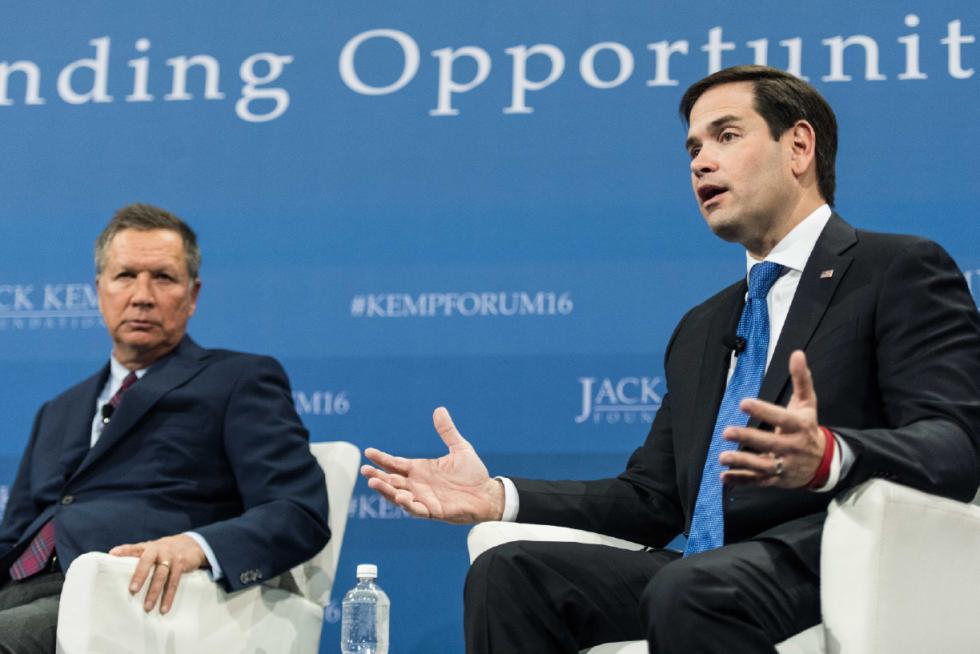
As Marco Rubio continues to gain steam in the race for the Republican nomination, a leading political expert is looking into his crystal ball to make a few predictions. Larry Sabato, the director of the University of Virginia’s Center for Politics and editor in chief of “Sabato’s Crystal Ball,” suggested Rubio “consider a daring gambit.” The bold move? Openly offering John Kasich “the vice presidential slot in exchange for Ohio governor’s support.” In the Saturday “Crystal Ball” piece, Sabato and his team said Ronald Reagan did something similar in his 1976 campaign. It was right before the Republican convention, and “while it didn’t work out it shook up conventional wisdom. It is a tactic worth considering.” The “Crystal Ball” story continues: “If Rubio can somehow push Kasich out after Bush’s exit, it seems reasonable to think that the lion’s share of their supporters would go to him, and in a three-way race, that could be enough for Rubio to start getting the victories he has failed to secure so far. However, Kasich seems inclined to continue to run, and the Republican power brokers who favor a Rubio-Kasich ticket probably won’t take the risks necessary to make this happen.” Kasich came in fifth in South Carolina on Saturday, with 7.6 percent support. Jeb Bush came in fourth with 7.8 percent of the vote. Bush announced Saturday he was bowing out of the race. Kasich is still plugging along, on Sunday telling John Dickerson on Face the Nation that his team is “going to go on March the 1st to a number of states where we think we’re going to do well.” “So it’s a matter of continuing on … and being able to take advantage of grassroots,” he said on the show. “We now have some Bush people who have come our way, both from a political point of view and a fundraising point of view and we’re going to keep struggling to make sure that we can be out there, keep putting the resources to be in a position of doing well.” Rubio came in second in South Carolina with 22.5 percent of the vote. He now heads to Nevada, where Republicans will caucus on Feb. 23. Recent polling averages show Rubio is battling it out with Ted Cruz for second in Nevada.
