
Paul Manafort firm received Ukraine ledger payout
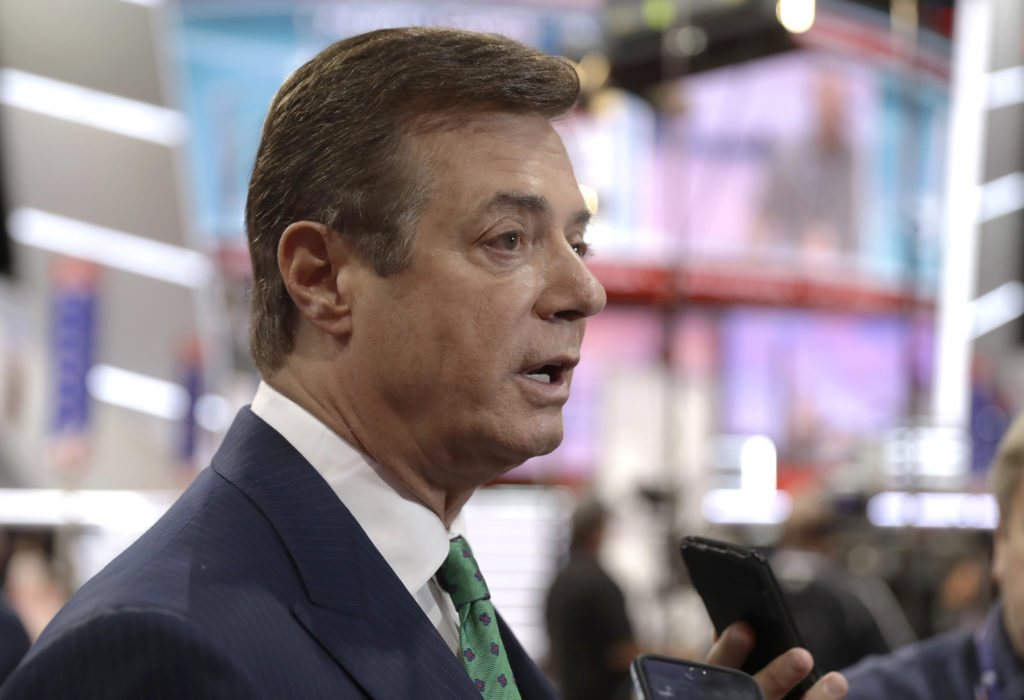
Last August, a handwritten ledger surfaced in Ukraine with dollar amounts and dates next to the name of Paul Manafort, who was then Donald Trump‘s campaign chairman. Ukrainian investigators called it evidence of off-the-books payments from a pro-Russian political party — and part of a larger pattern of corruption under the country’s former president. Manafort, who worked for the party as an international political consultant, has publicly questioned the ledger’s authenticity. Now, financial records newly obtained by The Associated Press confirm that at least $1.2 million in payments listed in the ledger next to Manafort’s name were actually received by his consulting firm in the United States. They include payments in 2007 and 2009, providing the first evidence that Manafort’s firm received at least some money listed in the so-called Black Ledger. The two payments came years before Manafort became involved in Trump’s campaign, but for the first time bolster the credibility of the ledger. They also put the ledger in a new light, as federal prosecutors in the U.S. have been investigating Manafort’s work in Eastern Europe as part of a larger anti-corruption probe. Separately, Manafort is also under scrutiny as part of congressional and FBI investigations into possible contacts between Trump associates and Russia’s government under President Vladimir Putin during the 2016 U.S. presidential campaign. The payments detailed in the ledger and confirmed by the documents obtained by the AP are unrelated to the 2016 presidential campaign and came years before Manafort worked as Trump’s unpaid campaign chairman. In a statement to the AP, Manafort did not deny that his firm received the money but said “any wire transactions received by my company are legitimate payments for political consulting work that was provided. I invoiced my clients and they paid via wire transfer, which I received through a U.S. bank.” Manafort noted that he agreed to be paid according to his “clients’ preferred financial institutions and instructions.” Previously, Manafort and his spokesman, Jason Maloni, have maintained the ledger was fabricated and said no public evidence existed that Manafort or others received payments recorded in it. The AP, however, identified in the records two payments received by Manafort that aligned with the ledger: one for $750,000 that a Ukrainian lawmaker said last month was part of a money-laundering effort that should be investigated by U.S. authorities. The other was $455,249 and also matched a ledger entry. The newly obtained records also expand the global scope of Manafort’s financial activities related to his Ukrainian political consulting, because both payments came from companies once registered in the Central American country of Belize. Last month, the AP reported that the U.S. government has examined Manafort’s financial transactions in the Mediterranean country of Cyprus as part of its probe. Federal prosecutors have been looking into Manafort’s work for years as part of an effort to recover Ukrainian assets stolen after the 2014 ouster of Ukrainian President Viktor Yanukovych, who fled to Russia. No charges have been filed as part of the investigation. Manafort, a longtime Republican political operative, led the presidential campaign from March until August last year when Trump asked him to resign. The resignation came after a tumultuous week in which The New York Times revealed that Manafort’s name appeared in the Ukraine ledger — although the newspaper said at the time that officials were unsure whether Manafort actually received the money — and after the AP separately reported that he had orchestrated a covert Washington lobbying operation until 2014 on behalf of Ukraine’s pro-Russian Party of Regions. Officials with the Ukrainian National Anti-Corruption Bureau, which is investigating corruption under Yanukovych, have said they believe the ledger is genuine. But they have previously noted that they have no way of knowing whether Manafort received the money listed next to his name. The bureau said it is not investigating Manafort because he is not a Ukrainian citizen. Still, Manafort’s work continues to draw attention in Ukrainian politics. Last month, Ukrainian lawmaker Serhiy Leshchenko revealed an invoice bearing the letterhead of Manafort’s namesake company, Davis Manafort, that Leshchenko said was crafted to conceal a payment to Manafort as a purchase of 501 computers. The AP provided to Manafort the amounts of the payments, dates and number of the bank account where they were received. Manafort told the AP that he was unable to review his own banking records showing receipt of the payments because his bank destroyed the records after a standard 7-year retention period. He said Tuesday the “computer sales contract is a fraud.” “The signature is not mine, and I didn’t sell computers,” he said in a statement. “What is clear, however, is individuals with political motivations are taking disparate pieces of information and distorting their significance through a campaign of smear and innuendo.” Leshchenko said last month the 2009 invoice was one of about 50 pages of documents, including private paperwork and copies of employee-issued debit cards, that were found in Manafort’s former Kiev office by a new tenant. The amount of the invoice — $750,000 — and the payment date of Oct. 14, 2009, matches one entry on the ledger indicating payments to Manafort from the Party of Regions. The invoice was addressed to Neocom Systems Ltd., a company formerly registered in Belize, and included the account and routing numbers and postal address for Manafort’s account at a branch of Wachovia National Bank in Alexandria, Virginia. The AP had previously been unable to independently verify the $750,000 payment went to a Manafort company, but the newly obtained financial records reflect Manafort’s receipt of that payment. The records show that Davis Manafort received the amount from Neocom Systems the day after the date of the invoice. Leshchenko contended to AP that Yanukovych, as Ukraine’s leader, paid Manafort money that came from his government’s budget and was “stolen from Ukrainian citizens.” He said: “Money received by Manafort has to be returned to the Ukrainian people.” Leshchenko said U.S. authorities should investigate what he described as corrupt deals between Manafort and
Paul Manafort had plan to benefit Vladamir Putin government

President Donald Trump‘s former campaign chairman, Paul Manafort, secretly worked for a Russian billionaire to advance the interests of Russian President Vladimir Putin a decade ago and proposed an ambitious political strategy to undermine anti-Russian opposition across former Soviet republics, The Associated Press has learned. The work appears to contradict assertions by the Trump administration and Manafort himself that he never worked for Russian interests. Manafort proposed in a confidential strategy plan as early as June 2005 that he would influence politics, business dealings and news coverage inside the United States, Europe and the former Soviet republics to benefit the Putin government, even as U.S.-Russia relations under Republican President George W. Bush grew worse. Manafort pitched the plans to Russian aluminum magnate Oleg Deripaska, a close Putin ally with whom Manafort eventually signed a $10 million annual contract beginning in 2006, according to interviews with several people familiar with payments to Manafort and business records obtained by the AP. Manafort and Deripaska maintained a business relationship until at least 2009, according to one person familiar with the work. “We are now of the belief that this model can greatly benefit the Putin Government if employed at the correct levels with the appropriate commitment to success,” Manafort wrote in the 2005 memo to Deripaska. The effort, Manafort wrote, “will be offering a great service that can re-focus, both internally and externally, the policies of the Putin government.” Manafort’s plans were laid out in documents obtained by the AP that included strategy memoranda and records showing international wire transfers for millions of dollars. How much work Manafort performed under the contract was unclear. The disclosure comes as Trump campaign advisers are the subject of an FBI probe and two congressional investigations. Investigators are reviewing whether the Trump campaign and its associates coordinated with Moscow to meddle in the 2016 campaign. Manafort has dismissed the investigations as politically motivated and misguided, and said he never worked for Russian interests. The documents obtained by AP show Manafort’s ties to Russia were closer than previously revealed. In a statement to the AP, Manafort confirmed that he worked for Deripaska in various countries but said the work was being unfairly cast as “inappropriate or nefarious” as part of a “smear campaign.” “I worked with Oleg Deripaska almost a decade ago representing him on business and personal matters in countries where he had investments,” Manafort said. “My work for Mr. Deripaska did not involve representing Russia’s political interests.” Deripaska became one of Russia’s wealthiest men under Putin, buying assets abroad in ways widely perceived to benefit the Kremlin’s interests. U.S. diplomatic cables from 2006 described Deripaska as “among the 2-3 oligarchs Putin turns to on a regular basis” and “a more-or-less permanent fixture on Putin’s trips abroad.” In response to questions about Manafort’s consulting firm, a spokesman for Deripaska in 2008 — at least three years after they began working together — said Deripaska had never hired the firm. Another Deripaska spokesman in Moscow last week declined to answer AP’s questions. Manafort worked as Trump’s unpaid campaign chairman last year from March until August. Trump asked Manafort to resign after AP revealed that Manafort had orchestrated a covert Washington lobbying operation until 2014 on behalf of Ukraine’s ruling pro-Russian political party. The newly obtained business records link Manafort more directly to Putin’s interests in the region. According to those records and people with direct knowledge of Manafort’s work for Deripaska, Manafort made plans to open an office in Moscow, and at least some of Manafort’s work in Ukraine was directed by Deripaska, not local political interests there. The Moscow office never opened. Manafort has been a leading focus of the U.S. intelligence investigation of Trump’s associates and Russia, according to a U.S. official. The person spoke on condition of anonymity because details of the investigation were confidential. Meanwhile, federal criminal prosecutors became interested in Manafort’s activities years ago as part of a broad investigation to recover stolen Ukraine assets after the ouster of pro-Russian President Viktor Yanukovych there in early 2014. No U.S. criminal charges have ever been filed in the case. FBI Director James Comey, in confirming to Congress the federal intelligence investigation this week, declined to say whether Manafort was a target. Manafort’s name was mentioned 28 times during the hearing of the House Intelligence Committee, mostly about his work in Ukraine. No one mentioned Deripaska. White House spokesman Sean Spicer said Monday that Manafort “played a very limited role for a very limited amount of time” in the campaign, even though as Trump’s presidential campaign chairman he led it during the crucial run-up to the Republican National Convention. Manafort and his associates remain in Trump’s orbit. Manafort told a colleague this year that he continues to speak with Trump by telephone. Manafort’s former business partner in eastern Europe, Rick Gates, has been seen inside the White House on a number of occasions. Gates has since helped plan Trump’s inauguration and now runs a nonprofit organization, America First Policies, to back the White House agenda. Gates, whose name does not appear in the documents, told the AP that he joined Manafort’s firm in 2006 and was aware Manafort had a relationship with Deripaska, but he was not aware of the work described in the memos. Gates said his work was focused on domestic U.S. lobbying and political consulting in Ukraine at the time. He said he stopped working for Manafort’s firm in March 2016 when he joined Trump’s presidential campaign. Manafort told Deripaska in 2005 that he was pushing policies as part of his work in Ukraine “at the highest levels of the U.S. government — the White House, Capitol Hill and the State Department,” according to the documents. He also said he had hired a “leading international law firm with close ties to President Bush to support our client’s interests,” but he did not identify the firm. Manafort also said he was employing unidentified legal experts for the effort at leading universities and
