
Doug Burgum focusing on economy, energy, national security in presidential announcement
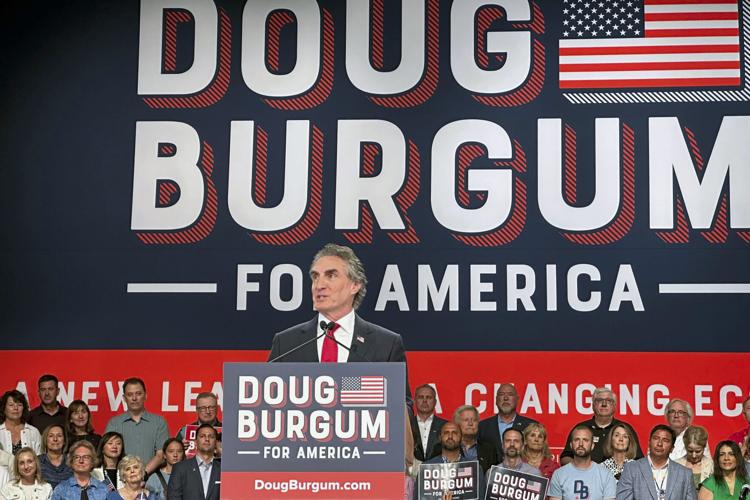
North Dakota Gov. Doug Burgum officially announced his bid for the Republican nomination for president on Wednesday, saying he will focus on the economy, energy, and national security. The two-term governor did not mention his competitors but centered his speech in Fargo on President Joe Biden and said, “he has to go.” “The economy needs to be the absolute top priority,” Burgum said. “Every small business owner and every family in our country is feeling the corrosive hidden tax on their lives driven by the Biden-induced inflation.” Burgum said he would focus on “innovation over-regulation.” “Regulation looks backwards. Innovation looks towards the future,” Burgum said. “The Biden administration is obsessed with creating mountains of red tape.” Energy policies in the U.S. need to change, Burgum said. “We need to stop buying energy from our energy and start selling energy to our allies,” he said. “America produces energy cleaner and safer than anywhere else in the world. If you care about the global environment, you should be fighting to have every drop of energy produced in the United States.” Burgum was first elected governor in 2016 and was reelected in 2020. He was a political unknown at the time. Burgum started a software company in the 1980s that he sold to Microsoft in 2001. Five years later, he started a real estate development firm and, later, a venture capital firm. The governor cited his upbringing in the small town of Arthur, where his family operated a grain elevator, as an example of what he hoped the country would be. “Small-town values are at the core of America, and frankly, big cities could use more ideas and more values from small towns right now,” he said. Burgum enters a crowded field for the Republican nomination, including former President Donald Trump and Florida Gov. Ron DeSantis. Earlier this week, New Jersey Gov. Chris Christie and former Vice-President Mike Pence formally announced their intentions to run for president. Also vying for the job are radio host and commentator Larry Elder, former South Carolina Gov. Nikki Haley, businessman Vivek Ramaswamy, U.S. Sen. Tim Scott, R-S.C., and former Arkansas Gov. Asa Hutchinson. Republished with the permission of The Center Square.
Ron DeSantis announces 2024 White House bid in Twitter announcement plagued by glitches
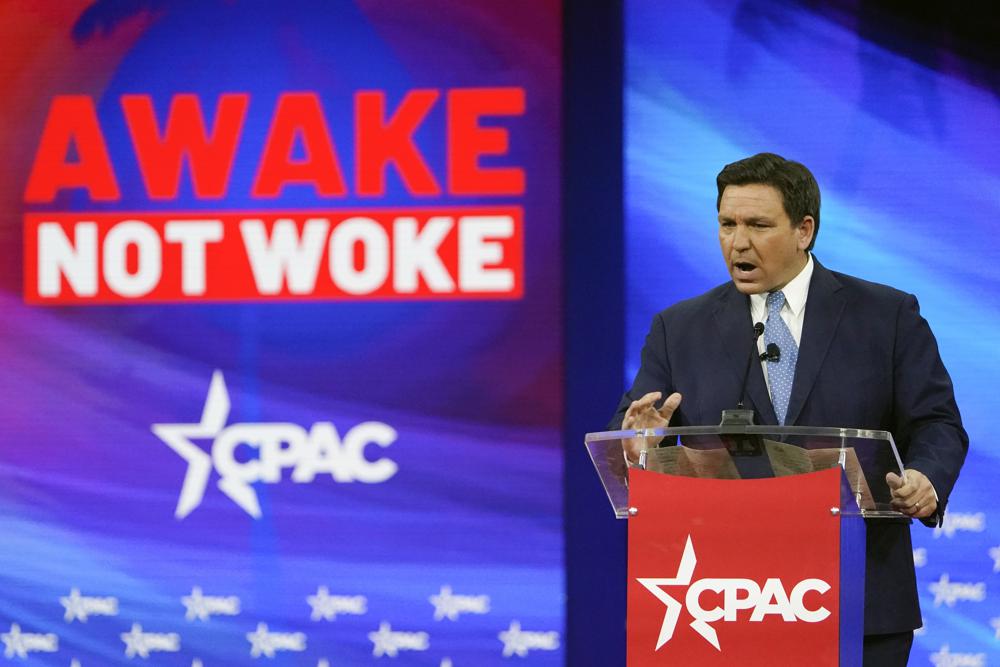
Florida Gov. Ron DeSantis launched his 2024 presidential campaign on Wednesday with firm words but a disastrous Twitter announcement that did little to counter criticism that the 44-year-old Republican may not be ready to take on former President Donald Trump. While he tried to project confidence, DeSantis’ unusual decision to announce his campaign in an online conversation with Twitter CEO Elon Musk ultimately backfired. The audio stream crashed repeatedly, making it virtually impossible for most users to hear the new presidential candidate in real-time. “American decline is not inevitable, it is a choice. And we should choose a new direction — a path that will lead to American revitalization,” DeSantis said on the glitchy stream, racing through his conservative accomplishments. “I am running for president of the United States to lead our great American comeback.” While his critics in both parties delighted in the rocky start, DeSantis’ announcement marks a new chapter in his extraordinary rise from little-known congressman to two-term governor to a leading figure in the nation’s bitter fights over race, gender, abortion, and other divisive issues. DeSantis’ path to the Republican presidential nomination will not be an easy one. He enters the race looking up at Trump in early polls while facing serious questions about his far-right policies, his campaign-trail personality, and his lack of relationships across the Republican ecosystem. He has generated significant interest among GOP primary voters by casting himself as a younger and more electable version of the 76-year-old former president. He did not mention Trump even once in his discussion with Musk, which ultimately spanned more than an hour. But he said he was ready to fight. “Buckle up when I get in there because the status quo is not acceptable,” DeSantis said. The ultimate Republican nominee is expected to face Democratic President Joe Biden on the general election ballot in November 2024. DeSantis joins a field that also includes former U.N. Ambassador Nikki Haley, Sen. Tim Scott of South Carolina, former Arkansas Gov. Asa Hutchinson, and biotech entrepreneur Vivek Ramaswamy. Former Vice President Mike Pence is also considered a likely presidential candidate but has not yet announced a bid. The governor has been courting primary voters in key states for much of the year and using an allied super political action committee to build a large political organization that was essentially a campaign in waiting and claims at least $30 million in the bank. In choosing Twitter on Wednesday evening, DeSantis tried to take a page out of the playbook that helped turn businessman-TV celebrity Trump into a political star. It did not go as planned. The online event started off with technical glitches that Musk said were due to “straining” servers because so many people were trying to listen to the audio-only event. More than 20 minutes passed beyond the scheduled start time with users getting kicked off, hearing microphone feedback, hold music, and other technical problems. “You can tell by the mistakes that it’s real,” said Musk. DeSantis’ Republican opponents piled on. The lead strategist for Haley’s super PAC, Mark Harris, was merciless: “Failed soft launch? Check. Failed announcement? Double check. We look forward to Ron DeSantis’ failed campaign.” “This is a disaster. Not surprising,” tweeted senior Trump adviser Chris LaCivita. DeSantis, who likely would not have become the Florida governor without Trump’s endorsement, has adopted the former president’s fiery personality, his populist policies, and even some of his rhetoric and mannerisms. Yet DeSantis has one thing his rival does not: a credible claim that he may be more electable than Trump, who faces multiple legal threats, including criminal charges in New York, and who presided over Republican losses in three consecutive national elections. DeSantis, just six months ago, won his reelection in Florida by a stunning 19 percentage points — even as Republicans in many other states struggled. He also scored several major policy victories during the Republican-controlled Legislature’s spring session. Aware of DeSantis’ draw, Trump has been almost singularly focused on undermining his political appeal for months. Trump and his team believe that DeSantis may be Trump’s only legitimate threat for the nomination. Hours before the announcement, Trump argued in a social media post that “Ron DeSanctus” cannot win the general election or the GOP primary because of his previous votes in Congress on Social Security and Medicare. “He desperately needs a personality transplant and, to the best of my knowledge, they are not medically available yet,” Trump added. “A disloyal person!” The kitchen-sink attacks and nicknames won’t be DeSantis’ only hurdle. He is a political heavyweight in Florida and a regular on Fox News, but allies acknowledge that most primary voters in other states don’t know him well. Despite his lengthy resume, friends and foes alike note that DeSantis struggles to display the campaign-trail charisma and quick-on-your-feet thinking that often defines successful candidates at the national level. He has gone to great lengths to avoid unscripted public appearances and media scrutiny while governor, which is difficult, if not impossible, as a presidential contender. The Florida governor spent most of Wednesday behind closed doors. In an example of his level of media avoidance, his official Twitter account for governor posted a photo shortly after the FEC filing — a bill signing surrounded by dozens of bikers for legislation to help reduce motorcycle accidents in Florida. The media was not notified of the event ahead of time. Late Wednesday, DeSantis’ office announced that he signed a broad election law bill that contains a provision allowing him to run for president without resigning his post as governor, exempting himself from a state rule known as “resign to run.” Would-be supporters also worry that DeSantis has refused to invest in relationships with party leaders or fellow elected officials, raising questions about his ability to build the coalition he would ultimately need to beat Trump. By contrast, Trump has scooped up an army of endorsements in key states, including Florida. Beyond the primary, DeSantis’ greatest longer-term challenge may rest with the far-right policies he enacted as governor as an unapologetic leader in what he calls his “war on woke.” “We will never surrender
Ex-Arkansas Gov. Asa Hutchinson launches GOP 2024 bid, calls on Donald Trump to drop out
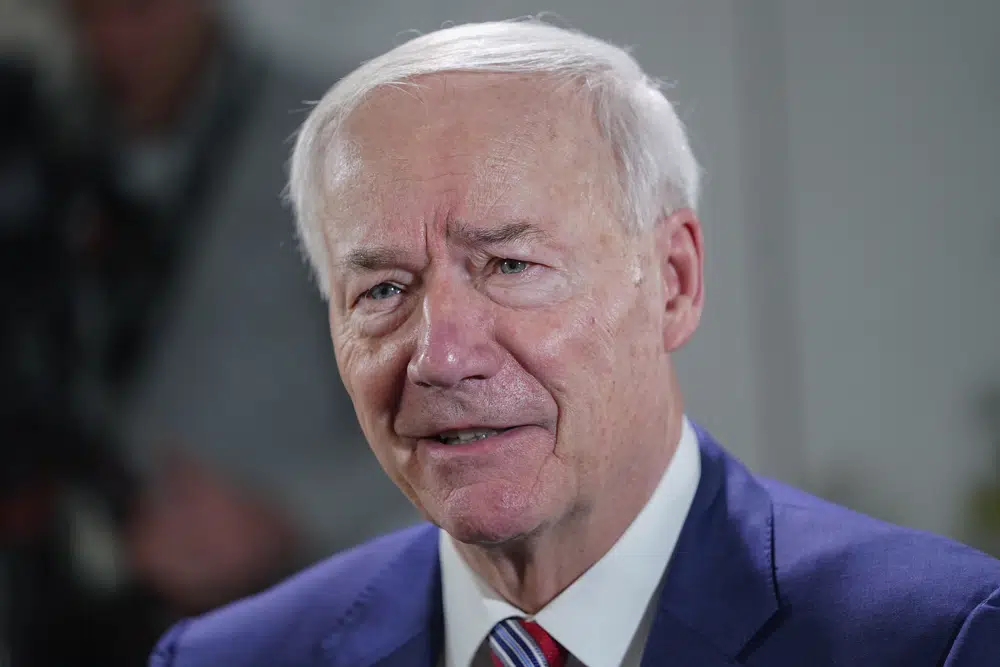
Asa Hutchinson, who spent two terms as governor of Arkansas, will seek the Republican presidential nomination, positioning himself as an alternative to Donald Trump just days after the former president was indicted by a grand jury in New York. In an interview that aired Sunday on ABC’s “This Week,” Hutchinson said Trump should drop out of the race, arguing “the office is more important than any individual person.” “I’m running because I believe that I am the right time for America, the right candidate for our country and its future,” he said. “I’m convinced that people want leaders that appeal to the best of America and not simply appeal to our worst instincts.” Hutchinson is the first Republican to announce a campaign after Trump became the first former U.S. president to face criminal charges. His candidacy will test the GOP’s appetite for those who speak out against Trump. Others who have criticized Trump, including former Maryland Gov. Larry Hogan, have opted against a campaign, sensing the difficulty of prevailing in a primary. And in a sign of Trump’s continued grip on the Republican base, most in the party — even those considering challenging him for the nomination — have defended him against the New York indictment. That, at least for now, leaves Hutchinson as a distinct outlier among Republicans. In addition to Trump, Hutchinson joins a Republican field that also includes former U.N. Ambassador Nikki Haley and entrepreneur Vivek Ramaswamy. Florida Gov. Ron DeSantis is expected to jump into the race in the summer, while U.S. Sen. Tim Scott of South Carolina, former Secretary of State Mike Pompeo, and former Vice President Mike Pence are among those considering bids. Hutchinson, 72, left office in January after eight years as governor. He has ramped up his criticism of the former president in recent months, calling another Trump presidential nomination the “worst scenario” for Republicans and saying it will likely benefit President Joe Biden’s chances in 2024. The former governor, who was term-limited, has been a fixture in Arkansas politics since the 1980s when the state was predominantly Democratic. A former congressman, he was one of the House managers prosecuting the impeachment case against President Bill Clinton. Hutchinson served as President George W. Bush’s head of the Drug Enforcement Administration and was an undersecretary of the Department of Homeland Security. As governor, Hutchinson championed a series of income tax cuts as the state’s budget surpluses grew. He signed several abortion restrictions into law, including a ban on the procedure that took effect when the U.S. Supreme Court struck down Roe v. Wade last year. Hutchinson, however, has said he regretted that the measure did not include exceptions for rape or incest. Hutchinson earned the ire of Trump and social conservatives last year when he vetoed legislation banning gender-affirming medical care for children. Arkansas’ majority-Republican Legislature overrode Hutchinson’s veto and enacted the ban, which has been temporarily blocked by a federal judge. Trump called Hutchinson a “RINO” — a Republican In Name Only — for the veto. Hutchinson’s successor, former White House press secretary Sarah Huckabee Sanders, has said she would have signed the legislation. Hutchinson, who signed other restrictions on transgender youth into law, said the Arkansas ban went too far and that he would have signed the measure if it had focused only on surgery. Hutchinson endorsed Sanders’ bid for governor. Sanders hasn’t publicly endorsed Trump or anyone else yet in the 2024 presidential race. She has avoided direct criticism of her predecessor, even as she split from him on several policies. Among the bills she’s signed since taking office is legislation intended to reinstate the ban on gender-affirming care for minors that Hutchinson opposed by making it easier to sue providers of such care. She’s also dissolved five panels Hutchinson had formed to advise him on the state’s response to the COVID-19 pandemic, saying she wanted the state to focus on other health challenges. Although he has supported Trump’s policies, Hutchinson has become increasingly critical of the former president’s rhetoric and lies about the 2020 presidential election. He said Trump’s call to terminate parts of the Constitution to overturn the election hurt the country. Hutchinson also criticized Trump for meeting with white nationalist leader Nick Fuentes and the rapper Ye, who has praised Adolf Hitler and spewed antisemitic conspiracy theories. Hutchinson has contrasted that meeting to his own background as a U.S. attorney who prosecuted white supremacists in Arkansas in the 1980s. An opponent of the federal health care law, Hutchinson, after taking office, supported keeping Arkansas’ version of Medicaid expansion. But he championed a work requirement for the law that was blocked by a federal judge. During the COVID-19 pandemic, Hutchinson tried to push back against misinformation about the virus with daily news conferences and a series of town halls he held around the state aimed at encouraging people to get vaccinated. Hutchinson infuriated death penalty opponents in 2017 when he ordered eight executions over a two-week period, scheduling them before one of the state’s lethal injection drugs was set to expire. The state ultimately carried out four of the executions. The former governor is known more for talking policy than for fiery speeches, often flanked by charts and graphs at his news conferences at the state Capitol. Instead of picking fights on Twitter, he tweets out Bible verses every Sunday morning. Hutchinson, who graduated from the evangelical college Bob Jones University in South Carolina, said in the ABC interview that he considers himself part of the evangelical community. “I believe that the evangelical community understands that we need to have a leader that can distance themselves from some of the bad instincts that drive Mr. Trump,” he said. “And I hope that we can do that in the future.” Republished with the permission of The Associated Press.
Dan Sutter: Making sense of woke business
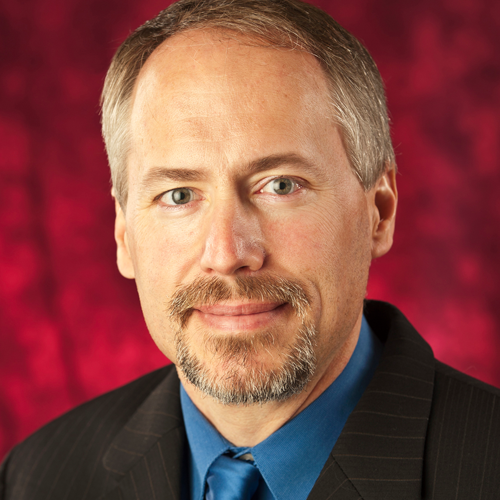
Major League Baseball’s moving the 2021 All-Star Game from Atlanta over Georgia’s new voting law symbolizes businesses’ new willingness to take sides on political issues, typically the progressive side. Businesses previously avoided offending potential customers or employees. Selling to both Republicans and Democrats maximizes profit! Vivek Ramaswamy explores the causes and consequences of “woke” business in Woke Inc: Inside Corporate America’s Social Justice Scam. The book offers numerous valuable insights and creative analyses. Mr. Ramaswamy is the child of immigrants from India who grew up in Ohio. He attended Harvard for undergrad and Yale Law School and worked in pharmaceuticals including as CEO of Roivant Sciences, before stepping down in 2021. Progressive business leaders emphasize “stakeholders” (workers, suppliers, communities, etc.) over stockholders, the owners. Mr. Ramaswamy sees stakeholderism as a ploy. A CEO serving many masters need not follow orders from any: “By becoming accountable to literally everyone, they become accountable to no one.” Managers with a fiduciary duty to the stockholders can be held accountable. Many companies cultivate glowing reputations to cover their misdemeanors. Mr. Ramaswamy highlights Volkswagen, hailed as the world’s most sustainable automaker. “Clean diesel” cars briefly made VW the world’s top automaker. Except the company was using “defeat devices” to cheat on emissions tests. The author views finance’s wokeness as an arranged marriage. The financial crisis bailouts sparked Occupy Wall Street and big fines from the Federal government. Goldman Sachs and others led on wokeness to deflect attention from their misdeeds. Employees often push wokeness. Mr. Ramaswamy notes that Roivant’s Ivy League grads arrived woke. The New York Times’ newsroom staff have similarly staged numerous woke revolts. Leftists view everything as political, so making all institutions advance progressive social goals fits the game plan. Mr. Ramaswamy believes that corporate politics seriously threatens our democracy. Politics – based on one person, one vote – should decide questions like inequality or climate change. CEOs have excessive influence when corporations do politics. Making businesses maximize profit was “about protecting the rest of society from a Frankensteinian corporate monster.” Woke business involves firings for politically incorrect views. Google fired engineer James Damore in 2017 for questioning its’ gender equity hiring policy. Just this month, software company Outreach fired Griffin Green for his Tik Tok videos. Sexist and racist behaviors can disrupt workplaces; as a free market economist, I grant managers significant discretion on company business. But managers seem to be placating the social media mob while performing scant due diligence. What to do about this? Mr. Ramawarmy suggests using existing laws against religious discrimination: “[S]ince wokeness is a religion, employers can’t impose it upon their employees.” Does “wokeness” qualify as religion? Columbia University’s John McWhorter provides a strong affirmative argument in Woke Racism. Social media censorship is another element of woke business. Let’s grant social media bias against conservatives. Again, the question is what to do. I believe that only governments can censor. A media company only denies a speaker the use of its platform and cannot prevent the speaker from using other platforms. Mr. Ramaswamy offers another intriguing suggestion. Criminal law holds that the police cannot have someone conduct an otherwise illegal search. Twitter and Facebook act as government agents in censoring political speech. Again, existing law can address a problem. The problem of woke business, I think, goes beyond an opportunistic scam. Corporate America’s use of wokeness as a cover for making profit likely stems from an unwillingness or inability to defend the morality of business. Notre Dame’s James Otteson observes how many people believe that business should “give back.” But only those who have done wrong must give back. Professor Otteson argues that “Honorable business is neither morally suspicious nor even morally neutral: it is a positive creator of both material and moral value.” Wokeness will not protect business for long because progressives, as Mr. Ramawarmy notes, are hostile to business. This arranged marriage will not produce lasting bliss for corporate America. Daniel Sutter is the Charles G. Koch Professor of Economics with the Manuel H. Johnson Center for Political Economy at Troy University and host of Econversations on TrojanVision. The opinions expressed in this column are the author’s and do not necessarily reflect the views of Troy University.
