
Gardendale’s Grayson Phillips named one of America’s top 10 youth volunteers of 2018
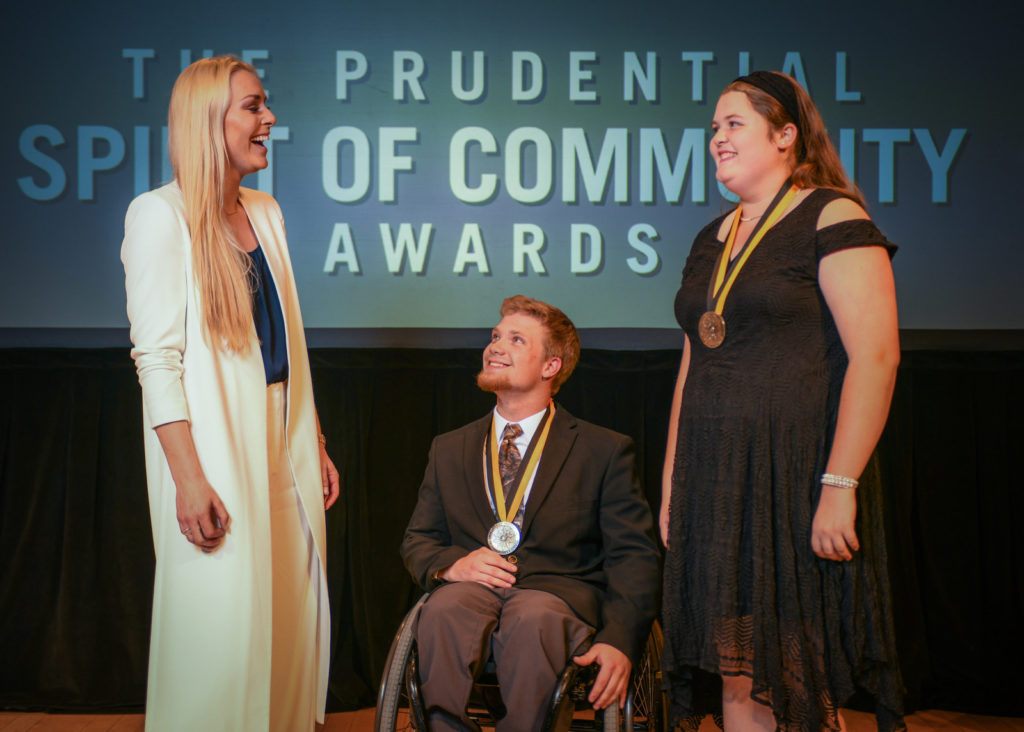
A senior at Essential Church School, 18 year old Grayson Phillips of Gardendale, Ala. started a nonprofit at only 15 to buy all-terrain power wheelchairs for disabled children and young adults that allow them to safely navigate the great outdoors with their peers. On Monday, Phillips efforts earned him national recognition. Selected from a field of more than 29,000 youth volunteers from across the country, Phillips has earned the title of National Honoree by The Prudential Spirit of Community Awards, along with a personal award of $5,000, an engraved gold medallion, a crystal trophy for his school, and a $5,000 grant from The Prudential Foundation for a nonprofit charitable organization of his choice. Phillips, who was born with spina bifida, knew all too well the frustration of not being able to easily follow his fellow Boy Scouts during campouts and other outdoor activities. “I was constantly getting stuck in the mud or in the sand in the woods and on the beach in my manual wheelchair,” Phillips said. But after raising money to buy his own Action Track chair and seeing how dramatically it changed his life, he wanted others with disabilities to experience the same freedom. Thus, he created the nonprofit. To publicize his organization and fundraising events, Phillips created a website, utilized social media, sent out press releases, and set up a booth at outdoor expos. He asked local businesses for donations, and spoke at schools to recruit volunteers. Thus far, Phillips has provided all-terrain power wheelchairs worth more than $84,000 to seven people who have a passion for the outdoors, but not the money to buy their own. They include a Mississippi girl with cerebral palsy who loves the beach, a girl in North Carolina who now can go hunting, and an Alabama boy who used his new chair to help clean up his community during a church service day. “It is important to me to help as many disabled kids as possible get outdoors because I know what it feels like to experience independence for the first time,” explained Phillips. State honorees Also honored this week in Washington, D.C., was Katherine Huggins, 14, of Florence, Ala. who was presented a state award. Grayson and Katherine were named Alabama’s top youth volunteers in February, and were officially recognized last night at the Smithsonian’s National Museum of Natural History along with the top two youth volunteers in each other state and the District of Columbia. At that event, each of the 102 State Honorees for 2018 received $1,000 awards as well as personal congratulations from Olympic gold medalist and World Cup champion Lindsey Vonn. The honorees each also received engraved silver medallions and all-expense-paid trips with a parent to Washington, D.C., for this week’s recognition events. Huggins, a member of Girl Scouts of North-Central Alabama and an eighth-grader at Wilson High School, delivered 25 clear storage containers filled with small stuffed animals to every volunteer fire department in her county so that firefighters could give them to children suffering the effects of fire, car accidents and domestic upheaval. In the past, Huggins had donated some of her own stuffed animals to local fire and police departments to send out with officers and firefighters on calls involving children. But last year, she and a friend who also loves stuffed animals decided to do more. They came up with the idea of collecting and donating new and gently-used stuffed animals for all of their county’s volunteer fire departments to deliver. “I knew the city had programs, but the county did not,” explained Huggins. “I felt it was important that the kids in the county have a comfort item.” To get local fire departments on board, Huggings met with fire officials and spoke at two meetings of the county firefighters association. Then she made flyers and posted them around town to solicit stuffed animal donations. She enlisted the help of friends and family to collect the animals, which she washed, sorted, and packed into 25 clear storage containers labeled “Tender Hearts.” The containers were then delivered to fire stations throughout the county so that officials responding to emergencies would have a furry friend to leave behind with a frightened child. The project has since led Huggings to other volunteer opportunities, including making a fire safety poster, donating stuffed animals to a library, and supervising activities for young children. Prudential Spirit of Community Awards The Prudential Spirit of Community Awards is a national youth recognition program sponsored by Prudential Financial in partnership with the National Association of Secondary School Principals (NASSP). “These honorees exemplify something we’ve known for a long time – that young volunteers have the power to bring meaningful change to their communities,” said John Strangfeld, chairman and CEO of Prudential Financial, Inc. “These students have shown leadership and determination well beyond their years, and it’s a privilege to celebrate their service.” “Through their acts of service, these honorees drive home a powerful lesson for their peers: that one student really can make a difference,” added Daniel P. Kelley, president of NASSP. “We are honored to shine a spotlight on the compassion, drive and ingenuity of each of these young volunteers.” Phillips was among 10 national honorees.
Kevin Sweeny: Ground game — do or die

In the election of 1840, Abraham Lincoln served as a Whig presidential elector in Illinois. In his push to elect the “Tippecanoe and Tyler, too” ticket, he sent a ten-point edict to all committee members containing a field plan of operations. Much has changed in the landscape of political campaigns since 1840, but the importance of a well-organized, strong field operation has never waned. It is a mainstay in the campaigning ecosystem and part of a successful formula to forge a path to victory and campaigns which ignore its impact, do so at their own candidate’s peril. A generation ago, many political scientists were signaling the death of the ground game. TV, mail and even the Internet would render such campaign expenditures obsolete. However, over the last few election cycles, the opposite has proved true. Moreover, deeply established ground games have had a tremendous impact in municipal and state elections, local referendums and state ballot initiatives, to federal elections. Recent cycles have confirmed staffing a field operations campaign with a well-trained and competent workforce to help a candidate interact voters still matters. From getting petitions signed, voters registered, identifying early voters, canvassing door to door, and staffing the polls on Election Day, field campaigns still matter. Their greatest impact is at the local and state levels. Despite this, field operation’s budgets pale in comparison to advertisements. However, in-person mobilization appears to be one of the more effective expenditures a campaign can make with limited resources, increasing voter turnout by as much as 10 percent according to a recent study. Contemporary political campaigns utilize a broad set of tools and methods for finding and contacting voters, more than at any point in electoral history. Much has been written about the roles of technology, big data and social media in recent campaigns. However, at the same time, there has been a corresponding rise in old-fashioned campaign techniques, particularly establishing a competent ground game. Field offices, typically but not always placed in strategic locations around a district or state help to transform basic campaign information into real voter contacts. Field offices often serve as the first and last point of contact between a political campaign and the electorate. A campaign’s headquarters gathers important and timely information on voters and in turn relays such information to the field manager. They, in turn, instruct their field workers to pinpoint a calculated message to a structured group of voters. Typically, the most effective of these field workers are well-trained volunteers who live locally. While campaigns rely on a certain percentage of outside paid field workers, by far these local volunteers are most successful in distributing campaign information. Campaign volunteers are typically true believers in a cause, person or organization. They usually act purely on the belief they are making their community a better place. While obviously paid workers are vital to a campaign, no one was ever paid to start a real revolution. A first-rate example of the impact of a competent ground game is best illustrated by recent presidential elections and field work impact. Because the Democratic Party keeps better field data than the Republican Party, I will use them as an example. In a recent experiment, the 2012 presidential election was replicated with all things being equal. However, in this replication, Obama had no real field offices for volunteers. The results showed Obama would have lost 248,000 votes nationwide. A further dive into these numbers points to Obama losing Florida and therefore the presidency. Continued runs by political scientists Seth Masket, Josh Darr and Matthew Levendusky show running the same field simulations in the 2008 election gave Obama his victory in North Carolina, Florida and Indiana. Recent claims of Obama being able to win the presidency without a ground game simply do not hold water. After a recent election, a British Election Study showed one-on-one field contact made all the difference in local campaigns, by as much as 14 percent. Furthermore, a simple face-to-face meeting at the door by a campaign or candidate yielded a 97 percent likelihood of the voter casting their ballot for those who made contact with them. Moreover, the study showed it is not just a one-time face-to-face contact which matters, the contact must be constant. Parties lost upward of 16 percent of those who were only approached at the door once and never followed up on. Suffice to say, field offices increase turnout and vote share for the candidates and organizations who take the time to adequately fund and staff them. Lastly, and one of my personal favorite incentives of producing a solid ground game on top of being able to ascertain if your campaign’s message is resonating among the electorate is it creates a legion of loyal volunteers who are prepared to carry on the legacy of the candidate or party. This legacy of political skill can prove to be invaluable not only to the volunteer but to the organization and the electorate as a whole. Well trained and passionate volunteers evolve into the next generation of campaign managers, consultants and operatives. They understand not only the complexities associated with running a political campaign, but they also make meaningful connections with the governing, consultant and economic classes. Moreover, they gain a broader understanding of the issues faced by the electorate and the campaign they represent. Some will even eventually step into the fray and become candidates themselves. Two examples of this evolving legacy quickly come to mind. The first is the losing “YES!” campaign for Scottish independence which morphed its field operation into a supportive role for the SNP (Scottish National Party). In return, the field campaigns for “YES!” handed the SNP the most seats in their party’s history and now the SNP is the outright ruling party in Holyrood. Another example much closer to home is Jeb Bush’s grassroots push on education issues dating as far back as his first unsuccessful run for Governor in 1994. The political initiatives are still pushed by a network of
