
There’s one last way you can still register to vote for the March 3 primary
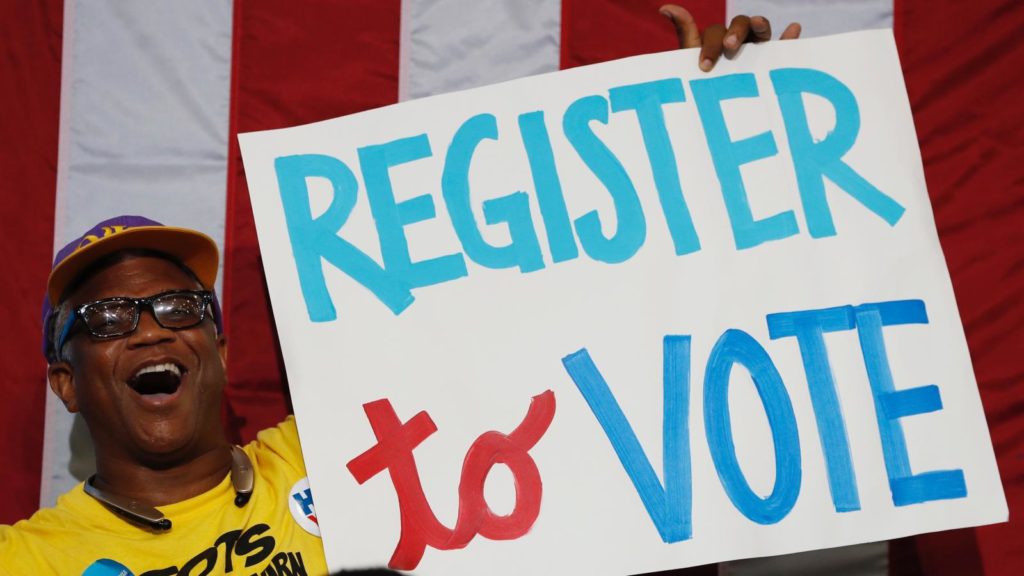
With the March 3 primary election just around the corner, Alabama Secretary of State John Merrill is reminding Alabamians of one final way they can still register to vote in the primary. Alabamians are elligible to register to vote electronically through midnight February 17. This would allow them the opportunity to vote in several extremely important elections that will determine their representation at the local, state, and federal level this yaer. “Voting is fundamental to our representative democracy, which is why the civic participation of all eligible Alabamians is critical to our success as a state. In order for this to happen, however, we need all eligible U.S. citizens that are residents of the State of Alabama to be registered to vote and to have a government-issued photo ID,” encouraged Merrill. Alabama residents may register to vote by visiting their local board of registrars, on our website “AlabamaVotes.gov,” or on the mobile app “Vote for Alabama.” Eligible Alabamians can obtain a free voter photo identification card by visiting their local board of registrars, the Office of the Secretary of State, or attending one of the mobile photo ID units in their area. The list of counties that will soon be visited can be found on the state’s website. “I encourage all eligible residents of Alabama to take the time to register to vote and obtain a photo ID so those who are interested will be able to participate in the electoral process!” added Merrill. Voter requirements To submit an application to register to vote, you must meet the following requirements: You must be a citizen of the United States. You must live in the State of Alabama. You must be at least 18 years of age on or before election day. You must not be barred from voting by reason of a disqualifying felony conviction. You must not have been judged “mentally incompetent” in a court of law.
Monday is last day to register to vote in Alabama
Are you ready to vote? Monday is the last day to register to vote in Alabama. November’s mid-term election is just 15 days away. If you aren’t registered to vote yet, here’s what you need to do: Alabamians who are at least 18 years old, a U.S. citizen, have not been convicted of a disqualifying felony or declared “mentally incompetent” by a court may register one of three ways: Via an electronic voter application through the Alabama Secretary of State’s website here. By using the Vote for Alabama app. Available here. Via a mail the application. You may download and print a copy of the form here. In person at your local Board of Registrars’ office. Office locations can be found here. As well as when you are applying for or renewing a State of Alabama driver’s license or nondriver identification card; at state and local government offices when applying or recertifying for Aid to Dependent Children, SNAP, TANF, Food Stamps, WIC, Medicaid, or Rehabilitation Services; at public libraries; and at armed forces recruiting stations. Not sure if you’re registered? Want to find your polling place? Check here. Voting absentee Alabama voters who will be away from their county or residence or otherwise unable to go to the polls have until Nov. 1 to apply for an absentee ballot. According to the Secretary of State’s office, a voter may cast an absentee ballot if he or she: WILL BE ABSENT FROM THE COUNTY on election day IS ILL OR HAS A PHYSICAL DISABILITY that prevents a trip to the polling place IS A REGISTERED ALABAMA VOTER LIVING OUTSIDE THE COUNTY, such as a member of the armed forces, a voter employed outside the United States, a college student, or a spouse or child of such a person IS AN APPOINTED ELECTION OFFICER OR POLL WATCHER at a polling place other than his or her regular polling place WORKS A REQUIRED SHIFT, 10-HOURS OR MORE, that coincides with polling hours Nov. 5 is the last day for voters are eligible to hand-deliver or postmark an absentee ballot.
Terri Sewell calls Georgia voter verification law ‘voter suppression’
More than 6.9 million Georgians are registered to vote in next month’s general election, the Georgia Secretary of State’s Office reported Wednesday. Secretary of State Brian Kemp announced Georgia shattered the all-time voter registration record with over 6,915,000 active and inactive voters on the rolls. Kemp expects the total number to break 7,000,000 voters at any moment as counties continue to process forms received by yesterday’s deadline. “Despite what you hear or read, the numbers are clear. While outside agitators disparage this office and falsely attack us, we have kept our heads down and remained focused on ensuring secure, accessible, and fair elections for all voters. The fact is that it has never been easier to register to vote and get engaged in the electoral process in Georgia, and we are incredibly proud to report this new record.” But despite the record numbers, some are still frustrated with the state’s voter registration process as there are currently more than 53,000 voter registration applications that were not immediately approved because they failed to clear the state’s “exact match” standard. According to Georgia law, if a registering voter’s information on a their registration form does not match the information in a federal or state database, the applicant’s status is marked “pending.” From there, applicants have 26 months to provide up-to-date information. They are also able to present the information at the polls and be eligible to vote a regular ballot on the spot Alabama 7th District U.S. Rep. Terri Sewell for one, is calling this “voter suppression.” “This voter suppression needs to stop. Voters are supposed to choose their lawmakers, not the other way around,” Sewell posted on Facebook. Two groups, the Lawyers’ Committee and the Campaign Legal Center, have filed a lawsuit against Kemp regarding the voter verification practice, alleging that the exact match system violates the Voting Rights Act, the National Voter Registration Act, and the U.S. Constitution. It remains to be seen what will happen to the more than 53,000 applications in waiting. The voter registration deadline in Georgia was Tuesday, October 9.
John Merrill orders registrars back to school to conduct voter registration drives
Alabama Secretary of State John Merrill is ordering members of the Alabama Board of Registrars to go back to school. That is, he is asking all registrars — those tasked with registering voters in and outside the office — to return to all schools of higher learning (two-year, four-year, technical schools, trade schools, liberal arts schools, private schools, etc.) in their respective county to register students to vote no later than October 22, the last day tor register to vote. Merrill’s office says each school will have a scheduled time no later than Friday, October 5. The Alabama Board of Registrars’ offices are required to be available to the people of Alabama who attend Alabama’s many two and four-year universities. While many registrars already completed these trips once this year, registrars have been instructed to return to conduct drives for any students not yet registered to vote or need to submit a voter update form to make voting easier in their location. These efforts are a part of Merrill’s ongoing efforts to ensure each and every eligible U.S. citizen that is a resident of Alabama is a registered voter with a photo ID. How to register to vote Alabamians who are at least 18 years old, a U.S. citizen, have not been convicted of a disqualifying felony or declared “mentally incompetent” by a court may register one of three ways: Via an electronic voter application through the Alabama Secretary of State’s website here. By using the Vote for Alabama app. Available here. Via a mail the application. You may download and print a copy of the form here. In person at your local Board of Registrars’ office. Office locations can be found here. As well as when you are applying for or renewing a State of Alabama driver’s license or nondriver identification card; at state and local government offices when applying or recertifying for Aid to Dependent Children, SNAP, TANF, Food Stamps, WIC, Medicaid, or Rehabilitation Services; at public libraries; and at armed forces recruiting stations. Not sure if you’re registered? Want to find your polling place? Check here.
It’s National Voter Registration Day — are you registered to vote?
Every year millions of Americans find themselves unable to vote because they miss a registration deadline, don’t update their registration, or aren’t sure how to register. Which is why National Voter Registration Day creates the perfect opportunity for Americans and Alabamians alike to take a moment to register to vote if they’ve not already done so. State residents have just under 30 days to to register to vote in the Nov. 6 general election — for a bevy of federal statewide and local races — by Monday, Oct. 22. The deadline is set according to the Secretary of State’s office, which mandates the 15th day before an election as the voter registration deadline. “Since I became Secretary of State, we have registered more than a million new voters who have helped us shatter state records for voter registration and participation in our elections,” said Secretary of State John Merrill. “But we also want our voter rolls to be up-to-date, so we are urging everyone to take a moment to make sure their current address is correct in the state system. We are pleased to participate in this special day that encourages more participation in our electoral process. We continue to work daily to make sure every eligible U.S. citizen in our state is registered to vote and has a photo ID. We want to make it easy to vote and hard to cheat.” How to register to vote Alabamians who are at least 18 years old, a U.S. citizen, have not been convicted of a disqualifying felony or declared “mentally incompetent” by a court may register one of three ways: Via an electronic voter application through the Alabama Secretary of State’s website here. By using the Vote for Alabama app. Available here. Via a mail the application. You may download and print a copy of the form here. In person at your local Board of Registrars’ office. Office locations can be found here. As well as when you are applying for or renewing a State of Alabama driver’s license or nondriver identification card; at state and local government offices when applying or recertifying for Aid to Dependent Children, SNAP, TANF, Food Stamps, WIC, Medicaid, or Rehabilitation Services; at public libraries; and at armed forces recruiting stations. Not sure if you’re registered? Want to find your polling place? Check here. Voting absentee Alabama voters who will be away from their county or residence or otherwise unable to go to the polls have until Nov. 1 to apply for an absentee ballot. According to the Secretary of State’s office, a voter may cast an absentee ballot if he or she: WILL BE ABSENT FROM THE COUNTY on election day IS ILL OR HAS A PHYSICAL DISABILITY that prevents a trip to the polling place IS A REGISTERED ALABAMA VOTER LIVING OUTSIDE THE COUNTY, such as a member of the armed forces, a voter employed outside the United States, a college student, or a spouse or child of such a person IS AN APPOINTED ELECTION OFFICER OR POLL WATCHER at a polling place other than his or her regular polling place WORKS A REQUIRED SHIFT, 10-HOURS OR MORE, that coincides with polling hours Nov. 5 is the last day for voters are eligible to hand-deliver or postmark an absentee ballot.
Voter registration deadline for July 17 runoff election is Monday
Monday, July 2 is the deadline for Alabamians to register to vote if they want to cast a ballot in the upcoming July 17 primary runoff election, according to the Secretary of State’s office. State law mandates the 15th day before an election as the voter registration deadline. How to register to vote Alabamians who are at least 18 years old, a U.S. citizen, have not been convicted of a disqualifying felony or declared “mentally incompetent” by a court may register one of three ways: Via an electronic voter application through the Alabama Secretary of State’s website here. Via a mail the application. You may download and print a copy of the form here. In person at your local Board of Registrars’ office. Office locations can be found here.
Voter registration deadline Monday for special election
Alabama voters have until Monday, Nov. 27, 2017 to register to vote in the upcoming special election where they will decide between Democratic nominee Doug Jones and Republican nominee Roy Moore to be the state’s next U.S. Senator. Residents have three way to register: In person at their local county board of registrars’ office by the close of business (typically 5 p.m.); Online by 11:59 p.m.; Or postmarked no later than Monday. Monday’s deadline also applies to voters who have moved and need to update their registration. For information on voter registration from the secretary of state, click here.
Alabamians have one week left to register for August 15 primary

Alabamians looking to vote in the Aug. 15 primary election for Attorney General Jeff Sessions’ former Senate seat have one week left to get on the voter rolls. Those unsure of their registration status can check through the Alabama Secretary of State’s website, while first-time Alabama voters can register online, by mail or at their local Board of Registrars, Driver License Division or Department of Public Safety office. Voters will also need to remember to bring a government issued photo ID, such as a driver license or U.S. passport, to their polling place to be allowed to vote. Voters can look up their polling place through the Secretary of State’s website. Both special primary elections feature crowded slates. On the Republican side, sitting U.S. Sen. Luther Strange is running against CD 5 U.S. Rep. Mo Brooks, former Alabama Chief Justice Roy Moore, Montrose state Sen. Trip Pittman, Randy Brinson, Bryan Peeples, James Baretta, Joseph Breault, and Mary Maxwell. Democrats vying for the seat include former U.S. Attorney Doug Jones, activist Michael Hansen, Will Boyd, Vann Caldwell, Jason Fisher, Robert Kennedy, Jr. (no, not that one), and Charles Nana. Voter registration closes down in Alabama 15 days before any election. The deadline for the Sept. 26 special runoff election, if needed, is Sept. 11, while the deadline for the Dec. 12 general election is Nov. 27.
Donald Trump’s voter fraud expert registered in 3 states

A man who President Donald Trump has promoted as an authority on voter fraud was registered to vote in multiple states during the 2016 presidential election, the Associated Press has learned. Gregg Phillips, whose unsubstantiated claim that the election was marred by 3 million illegal votes was tweeted by the president, was listed on the rolls in Alabama, Texas and Mississippi, according to voting records and election officials in those states. He voted only in Alabama in November, records show. In a post earlier this month, Phillips described “an amazing effort” by volunteers tied to True the Vote, an organization whose board he sits on, who he said found “thousands of duplicate records and registrations of dead people.” Trump has made an issue of people who are registered to vote in more than one state, using it as one of the bedrocks of his overall contention that voter fraud is rampant in the U.S. and that voting by 3 to 5 million immigrants illegally in the country cost him the popular vote in November. The AP found that Phillips was registered in Alabama and Texas under the name Gregg Allen Phillips, with the identical Social Security number. Mississippi records list him under the name Gregg A. Phillips, and that record includes the final four digits of Phillips’ Social Security number, his correct date of birth and a prior address matching one once attached to Gregg Allen Phillips. He has lived in all three states. At the time of November’s presidential election, Phillips’ status was “inactive” in Mississippi and suspended in Texas. Officials in both states told the AP that Phillips could have voted, however, by producing identification and updating his address at the polls. Citing concerns about voters registered in several states, the president last week called for a major investigation into his claim of voter fraud, despite his campaign lawyer’s conclusion that the 2016 election was “not tainted.” “When you look at the people that are registered, dead, illegal and two states, and some cases maybe three states, we have a lot to look into,” Trump said in an ABC interview. Reached by telephone Monday, Phillips said he was unaware of his multiple registrations but asked, “Why would I know or care?” “Doesn’t that just demonstrate how broken the system is?” he asked. “That is not fraud — that is a broken system. We need a national ID that travels with people.” Phillips has been in the national spotlight since Nov. 11, when he tweeted without evidence that his completed analysis of voter registrations concluded the “number of non-citizen votes exceeded 3 million.” Thousands of people liked and retweeted the claim, which led to a viral article three days later on InfoWars.com, a site known to traffic in conspiracy theories. Phillips also has previously tweeted about the dangers of “inactive voters” being able to vote in U.S. elections. “There is already law that compels states to remove inactive voters. Many don’t,” Phillips tweeted Nov. 29. According to media reports, five Trump family members or top administration officials also were registered to vote in two states during the 2016 election — chief White House strategist Stephen Bannon; Press Secretary Sean Spicer; Treasury Secretary nominee Steven Mnuchin; Tiffany Trump, the president’s youngest daughter; and Jared Kushner, Trump’s son-in-law and a senior White House adviser. The Houston-based True the Vote has challenged the validity of voter rolls in numerous states. On Friday, Phillips tweeted that the conservative group “will lead the analysis” of widespread voter fraud, and suggested in a CNN interview that it might release the underlying data in a few months. Shortly after Phillips appeared on CNN on Friday, Trump tweeted: “Look forward to seeing the final results of VoteStand. Gregg Phillips and crew say at least 3,000,000 votes were illegal. We must do better!” Republished with permission of The Associated Press.
Sean Spicer cites ‘studies’ to back Donald Trump voter claim
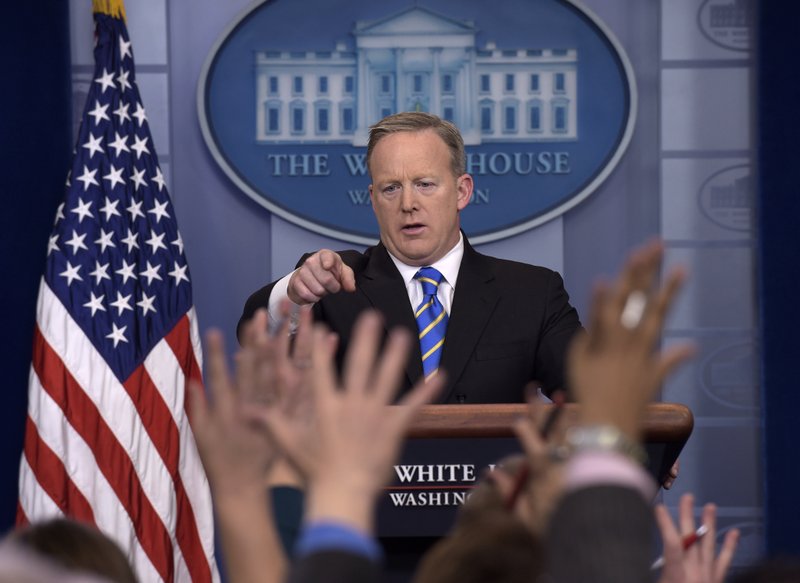
The Latest on President Donald Trump (all times local): 2 p.m. A spokesman says President Donald Trump’s belief that there were millions of illegal votes cast in the November election is based on “studies and evidence.” But spokesman Sean Spicer did not provide examples of that evidence. Trump first made the false claim during the transition. He reiterated the statement in a meeting Monday night with lawmakers, blaming illegal ballots for his loss of the popular vote. Spicer says Trump “continues to maintain that belief.” There has been no evidence to support the claims that there was widespread voter fraud in the election. Spicer’s only attempt to support Trump’s assertion was to point a 2008 Pew Research survey that showed a need to update voter registration systems. __ 1:55 p.m. An Agriculture Department research agency has banned the release of news releases, photos and other material to the public. In a memo to employees at USDA’s Agricultural Research Service, chief of staff Sharon Drumm said the agency would immediately cease releasing any “public-facing” documents. “This includes, but is not limited to, news releases, photos, fact sheets, news feeds, and social media content,” read the email memo obtained by The Associated Press. A statement released by ARS spokesman Christopher Bentley said the agency “values and is committed to maintaining the free flow of information between our scientists and the American public as we strive to find solutions to agricultural problems affecting America.” The statement said some material would still be available on the agency’s website. Buzzfeed News first reported the memo. __ 1:50 p.m. The White House says President Donald Trump has accepted House Speaker Paul Ryan‘s invitation to address a joint session of Congress on Feb. 28. Ryan announced the invitation on Tuesday and informed reporters after a meeting with House Republicans. Ryan had met with Trump Monday night at the White House. Trump also met with Republican and Democratic congressional leaders on Monday. Trump was meeting Tuesday at the White House with top Senate leaders. The speech will be Trump’s first to Congress. He was sworn into office on Friday. __ 12:45 p.m. The Trump administration has instituted a media blackout at the Environmental Protection Agency and barred staff from awarding any new contracts or grants. Emails sent to EPA staff since President Donald Trump’s inauguration on Friday and reviewed by The Associated Press detailed the specific prohibitions banning press releases, blog updates or posts to the agency’s social media accounts. The Trump administration has also ordered a “temporary suspension” of all new business activities at the department, including issuing task orders or work assignments to EPA contractors. The orders are expected to have a significant and immediate impact on EPA activities nationwide. The EPA did not respond to phone calls and emails requesting comment Monday or Tuesday. ___ 12:25 p.m. President Donald Trump is hanging up some new art in the White House press area — and it’s none too subtle. The panoramic photo shows the crowds gathered near the U.S. Capitol for Trump’s inauguration on Friday. It’s a nod to the ongoing interest the president has in making it clear that his event was well-attended. Trump tweeted: “A photo delivered yesterday that will be displayed in the upper/lower press hall. Thank you Abbas!” For emphasis, the official Twitter account of the president retweeted the @realDonaldTrump message. The photo was taken by Washington-area photographer Abbas Shirmohammadi, and it notes the wrong date — Jan. 21, although it does appear to depict the correct event. Trump and press secretary Sean Spicer have taken pains to play up the crowd size, sometimes exaggerating the number in attendance. They’ve excoriated the media for what they said is an effort to downplay enthusiasm for Trump’s inauguration. __ 11:50 a.m. President Donald Trump has taken steps to streamline the permitting process for manufacturing. He also wants pipelines to be made in the U.S. and an expedited process for environmental reviews and approvals. The steps came as Trump signed executive actions to advance construction of the Keystone XL and Dakota Access oil pipelines. Former President Barack Obama blocked construction in late 2015 of the Keystone line from Canada to the U.S. Meanwhile, the Army Corps of Engineers is studying alternative routes for the Dakota Access pipeline. Trump describes the regulatory process as a “tangled up mess.” He says if the answer is no, it should be a quick no. If the answer is yes, Trump says “let’s start building.” ___ 11:35 a.m. President Donald Trump says he will announce his pick to fill the vacant Supreme Court seat sometime next week. Trump told reporters in the Oval Office on Tuesday that he’ll be “making my decision this week” and “we’ll be announcing it next week.” “We have some outstanding candidates,” the president said. “And we’ll pick a truly great Supreme Court justice.” The Supreme Court has only had eight justices since Justice Antonin Scalia died last year. President Barack Obama nominated a replacement but Republicans in the Senate refused to bring the choice up for a vote. During his campaign, Trump publicly identified nearly two dozen candidates for the vacancy. __ 11:25 a.m. President Donald Trump has signed executive actions to advance the construction of the Keystone XL and Dakota Access oil pipelines. Trump tells reporters in the Oval Office that the moves on the pipelines will be subject to the terms and conditions being renegotiated by the U.S. President Barack Obama killed the proposed Keystone XL pipeline in late 2015, saying it would hurt American efforts to reach a global climate change deal. The pipeline would run from Canada to U.S. refineries in the Gulf Coast. The U.S. government needs to approve the pipeline because it crossed the border. The Army decided last year to explore alternate routes for the Dakota pipeline after the Standing Rock Sioux tribe and its supporters said the pipeline threatened drinking water and Native American cultural sites. __ 10:50 a.m. FBI Director James Comey is staying in his
John Merrill announces record-breaking 3.3 million voters registered in Alabama
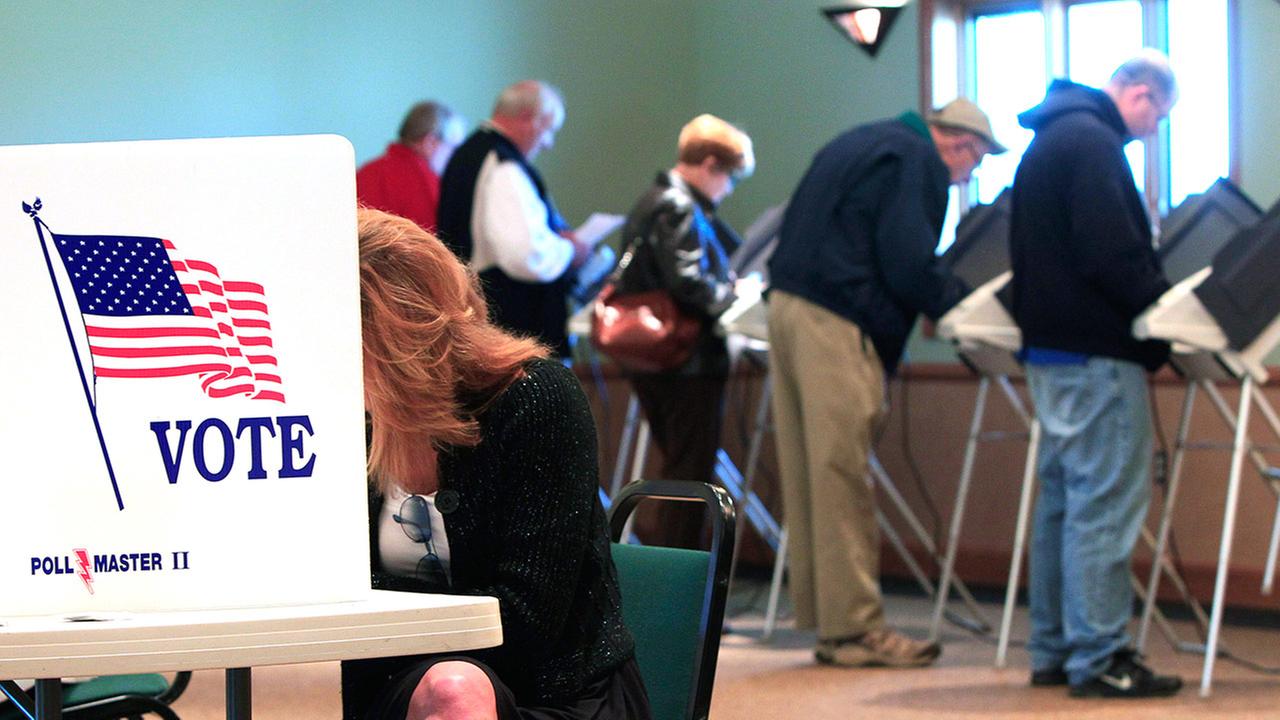
Alabama registered a record-breaking 3.3 million people to vote in the November election, the secretary of state’s office said Monday. “When we took office in January of 2015, we committed to make sure every eligible U.S. citizen that is a resident of Alabama be registered to vote and have a valid photo ID,” said Alabama Secretary of State John Merrill. “With the help of our very capable team and the people of Alabama we have made great strides to accomplish this goal, and for that I say thank you.” As of Monday morning, the number of registered voters is 3,330,802. Merrill credits the registration of an additional 584,252 voters this year to initiatives like online voter registration, the ERIC mailing, and a new partnership with the Alabama Law Enforcement Agency, among others. Alabama does not require residents to register by party, so it is unknown whether Republicans or Democrats gained the most new voters. This will be the first presidential election using Alabama’s new photo identification requirement for voting. Merrill continued, “On Nov. 8 don’t forget to bring your valid photo ID, and if you need one call us at (334) 242-7200! We want to see you at the polls!” Valid forms of photo ID include: Valid Driver’s License Valid Non-driver ID Valid Alabama Photo Voter ID Valid State-issued ID (Alabama or any other state) Valid Federal-issued ID Valid U.S. Passport Valid Employee ID from Federal Government, State of Alabama, County Government, Municipality, Board, Authority, or other entity of this state Valid student or employee ID from a college or university in the State of Alabama (including postgraduate technical or professional schools) Valid Military ID Valid Tribal ID The last day to register in time for the Nov. 8 Election was Oct. 24. Alabama voting links: Locate your polling place Proposed amendments on 2016 ballot Sample ballots Military and overseas voter services
For Hillary Clinton, election likely to be won or lost in October

Each night, Hillary Clinton‘s data experts head to a conference room on the 11th floor of her Brooklyn headquarters, to start counting votes. The sessions in the “early voter boiler room,” as it’s been dubbed by campaign aides, stretch into the early hours of the morning. The team pores over turnout patterns in states where advance voting is already underway, projects how many votes Clinton and Republican Donald Trump have already received, and updates crucial targeting lists of the voters she still needs. For Clinton, October is when she’s likely to win or lose the election, not Nov. 8. By the third week of this month, Clinton’s campaign hopes to have a solid enough sample of the early vote to know whether the Democrat is on track to win the White House. “Many battleground states are already voting so every day is Election Day,” said Matt Dover, Clinton’s voter analytics director. In several competitive states, including North Carolina, Iowa, Colorado, Florida and Nevada, at least 45 percent of the total vote is expected to come in early. Initial metrics show good news for Clinton in North Carolina, a must-win state for Trump. There are modestly positive signs for the Republican in Iowa, but that’s a state the Democrat can likely afford to lose. The Republican National Committee, which oversees early voting and turnout operations for Trump, is also encouraging supporters to take advantage of opportunities to cast ballots before Nov. 8. The party has significantly stepped up its analytics and voter-targeting operations since being outmatched by Democrats in the past two presidential elections, but the 2016 race is the first test of its strength in a national election. Despite improvements, the RNC system was always intended to be a complement to whatever operations the eventual GOP nominee brought to the table. Trump arrived in the general election with intense enthusiasm among his core supporters but few ways to harness it into trackable voter data. Unlike Clinton, whose travel schedule is being built around voter registration deadlines and the start of early voting in key states, Trump’s battleground stops haven’t been pegged to those benchmarks. However, there is a noticeably more robust registration effort at Trump rallies and the candidate himself is making explicit early voting appeals to supporters. “Get those ballots in because the only way this is going to be taken away (is) if we’re foolish or if we let people take it away from us,” Trump said Monday during a rally in Colorado. “I hate to interrupt my speech with these minor details but they’re very important, right?” Republicans traditionally do well initially with mail-in absentee balloting before Democrats surpass them during in-person early voting. That makes the start of in-person voting a key indicator as to whether core Democratic constituencies, such as young people and non-whites, show up. “For me, voting early is a matter of convenience, and if I don’t do it I’m unlikely to vote at all,” said Joseph Wozniak, 23, of Macon, Georgia. A recent college graduate who declined to say who he is supporting in the election, Wozniak is working on early vote efforts for the non-partisan organization Democracy Works. Thirty-seven states allow voting with little restriction before Election Day, either in person or via mail. By the third week in October, 34 of those states will be voting. Iowa was the first of the battlegrounds to start in-person voting last Thursday. Of the 39,435 people who have cast ballots, 58 percent were Democrats and 25 percent were Republicans — but that was much closer than in 2012. In North Carolina, buoyed by strong voter interest, Clinton appears to hold an edge with Democratic ballots submitted so far currently leading Republican ones, 40 to 35 percent. At this point in 2012, Republicans had opened a wide lead over Democrats in ballots, due in part to strong support among older whites. For 2016, Clinton officials pointed in particular to a 13 percent increase in African-American and a 40 percent jump in Latino mail-in ballot requests. To them, it’s a hopeful sign that non-whites and young people will be engaged this election, part of a shift in campaign strategy to more strongly mobilize less reliable, sporadic voters first. Still, the campaign said it will have a much clearer picture once in-person voting begins in the state on Oct. 20. Similarly in Florida, absentee balloting began only Tuesday, but already more than 2.5 million people — nearly one-third of the total number of votes cast in 2012 — have requested ballots. In-person voting doesn’t begin until Oct. 24, so state Democrats are now strongly urging voters to vote by mail — including in a letter from President Barack Obama paid for by the party. “In Florida, voting is easier than ever because now you can vote by mail,” he writes. “It’s the fastest and most convenient way to make your voice heard.” In Obama’s historic 2008 race, he ran up such big early voting advantages in four battlegrounds — Colorado, Florida, Iowa and North Carolina — that his rival, John McCain, couldn’t catch up, despite winning the Election Day vote in those states, according to AP data. If all goes according to the Clinton campaign’s plan, early ballots soon enough will start to unequivocally point in the same direction. Republished with permission of the Associated Press.
