
Steve Flowers: Dr. Wayne Flynt’s “Afternoons with Harper Lee”

Renowned Alabama historian Dr. Wayne Flynt has chronicled and penned a marvelous book appropriately entitled Afternoons with Harper Lee. This gem is published by New South Books with editing by Randall Williams. It is receiving worldwide acclaim. If you are a fan of Harper Lee and her novel, To Kill a Mockingbird, it is a great read. Nelle Harper Lee was born in Monroeville in 1926 and died in Monroeville ninety years later in 2016. It was fitting that Dr. Wayne Flynt would give her eulogy. Her book, To Kill A Mockingbird, is one of the five most bought and read books in the history of the world. It is second only to the Bible in most countries. In secular Great Britain, it surpasses the Bible and is number one. Dr. Wayne Flynt is probably the most significant and accomplished historian of Alabama history in my lifetime. He taught history to over 60,000 undergraduate and graduate students at Auburn University for over 28 years. He was beloved, and he loves Auburn. He is very proud of his 43 car tag, as he often told Nelle’s accomplished sister Alice. Dr. Flynt taught history at Samford University for 12 years before beginning his 28 years at Auburn University. During his illustrious career of 40 years, he authored 14 books, all centered around Southern politics, history, and Southern culture. He is very proud of his heritage of being the son of a sharecropper and growing up in the Appalachian culture of rural Calhoun County. It is so poetic that the most renowned southern Alabama historian of this century would write the most revealing and detailed history of Alabama and arguably the world’s most famous author of this century. He tells Nelle Harper Lee’s story explicitly and with authenticity. Dr. Flynt and his beloved wife, Dorothy “Dartie,” of 60 years, became Harper Lee’s best friends in the twilight of her life. Wayne and Dartie Flynt journeyed from Auburn to Monroeville and spent 64 afternoons over 12 years visiting and chronicling Harper Lee’s life story as she lived in a modest retirement home in Monroeville even though the royalties from the book were over a million dollars a year. The book is part memoir and part biography. It truly tells the intimate story of legendary author Harper Lee. It encompasses her life and intertwines it with Alabama history. It is like we Alabamians like to say, “They were sitting on a big front porch swapping life stories.” Flynt and Lee were both Southern storytellers. They were often joined by Nelle Harper Lee’s two sisters, Alice Lee and Louise Lee Conner. Alice Lee was ten years older than Nelle and was famous in her own right. She was one of the first female lawyers in Alabama. She was one of Monroeville’s most prominent lawyers for close to 80 years. She practiced law until she was over 100 years old and was a leader in the Alabama Methodist Church. Louise Conner introduced the Flynt’s to Nelle Harper. They met at a History and Heritage Festival in Eufaula in 1983. Nelle Harper Lee was the classic recluse. She was very private and very secretive; she liked to drink and curse and speak her mind. She never married and never really dated. She wore frumpy, dowdy, non-stylish clothing and disdained being around people and speaking in public. She lived most of her life in her modest apartment in New York City. She lived there mostly from ages 23-81, 58 years, with only brief journeys home to Monroeville, Alabama, by train as she did not fly. New York City gave her the anonymity she desired. The book tells of her celebrity and meeting other famous people who desired to meet her, including Presidents Lyndon Johnson, George Bush, and Barack Obama. She especially liked Lady Bird Johnson, who also had Alabama roots. She adored Gregory Peck, who was the star of the movie To Kill A Mockingbird. He won an Oscar and every award imaginable for his role as Atticus Finch in the movie. Only after a stroke in 2007 at 81 did Nelle Harper Lee return home to Monroeville. Dr. Flynt is also an accomplished ordained Baptist preacher. He is a true kind-hearted gentleman who speaks kindly of everyone in his book. He and Dartie grew to love the foul-tempered, eccentric, cynical, opinionated, irascible, uninhibited, very private, and reclusive author. He discerns and captures her true humility. She really felt and often said modestly, “But all I did was write a book.” She wrote a pretty good one, and so did Flynt. See you next week. Steve Flowers is Alabama’s leading political columnist. His weekly column appears in over 60 Alabama newspapers. He served 16 years in the state legislature. Steve may be reached at: www.steveflowers.us.
Proposal in Alabama to up protection for Confederate statues
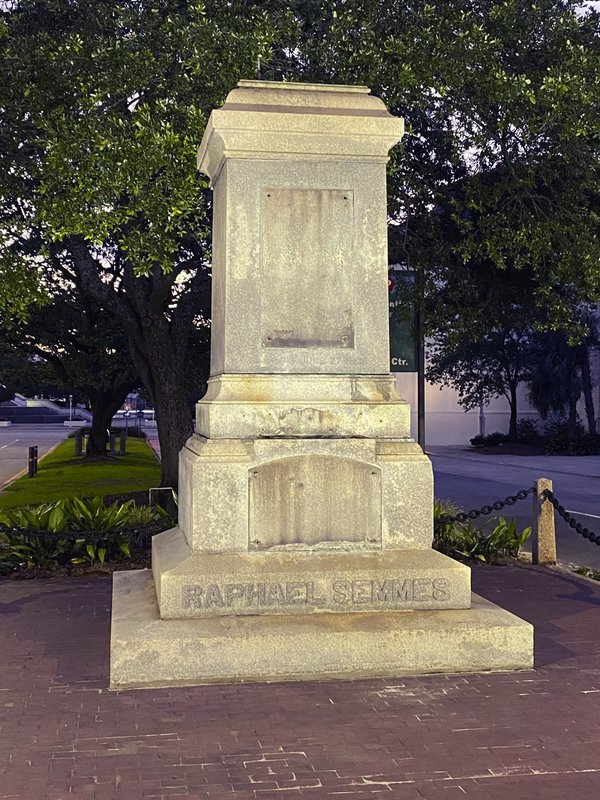
An Alabama lawmaker who disputes that slavery was the cause of the Civil War has proposed fining cities $10,000 a day for taking down Confederate and other longstanding monuments, a bill that drew contentious debate on Wednesday. The House State Government Committee held a public hearing on the bill by Republican Rep. Mike Holmes of Wetumpka that would dramatically increase fines for violating the 2017 Memorial Preservation Act. Current law levies a flat $25,000 fine, which some cities have paid as a cost of removing controversial monuments to other locations. “It’s a deterrent. The citizens of Alabama are upset at the damaging and destroying of these monuments,” Holmes said after the meeting. Holmes said he brought the bill as cities and counties began removing Confederate emblems. The bill drew heated debate as Black lawmakers described why the monuments are viewed as offensive. Some speakers at the public hearing claimed that the Civil War was not about slavery, a notion that is contrary to the widely accepted view that it was the root cause of the conflict. “Some of these monuments are a disgrace to some of us,” said Rep. Rolanda Hollis, a Black Democrat from Birmingham. “People that look like me, they were kidnapped. They were raped. They were beaten and nothing was done about it.” Holmes on Wednesday, and earlier this session, said he did not believe the Civil War was about slavery. Several speakers in favor of the bill repeated that view, which drew a sharp rebuke from some Black lawmakers. “It further shows white supremacy,” Democratic Rep. Juandalynn Givan, D-Birmingham, said of Holmes’ bill. “Why would you fine somebody $10,000 a day? That is ludicrous. But yet you say you are here for the people. And then you don’t know why the freaking war was fought,” Givan said, adding that “maybe they need to get a book and read.” The House Judiciary Committee earlier rejected a bill by Givan that would let cities and counties move the monuments to another location, such as a local park or state agency land, for preservation. The local governments would have to pay for the relocation. Committee Chairman Chris Pringle said it he was not sure when the bill will get a committee vote. Holmes told reporters Wednesday that he did not believe the Civil War was about slavery. “It was a tax thing. Tariffs going in and out of the ports,” Holmes said. Asked about Alabama’s 1861 Articles of Secession that says Alabama wanted to form a new government with other slave states, Holmes replied, “I’ve never seen that. Do you have proof of that?” After being shown the document on the Alabama’s bicentennial website, Holmes said he didn’t read it that way. “It is the desire and purpose of Alabama to meet the slaveholding state of the South who may approve such purpose in order to frame a provisional as well as Permanent Government upon the Principles of the Constitution of the United States,” the document reads. Historian Wayne Flynt, a former Auburn University history professor and the author of more than a dozen books, including co-writing “Alabama: A History of a Deep South State, said that slavery was the “key to the Civil War” but he said white southerners sometimes resisted that because they don’t want to admit their ancestors would fight to maintain slavery. “Coming to terms with history is something that we don’t do well in Alabama. Coming to terms with history admits that slavery was morally wrong, that it was a travesty of Christianity and therefore we could not possibly have done that,” Flynt said. “I’m sorry I’m not still teaching Alabama history because I would enroll them for free in my class,” Flynt quipped. Republished with the permission of the Associated Press.
