
U.S. says China balloon could collect intelligence signals
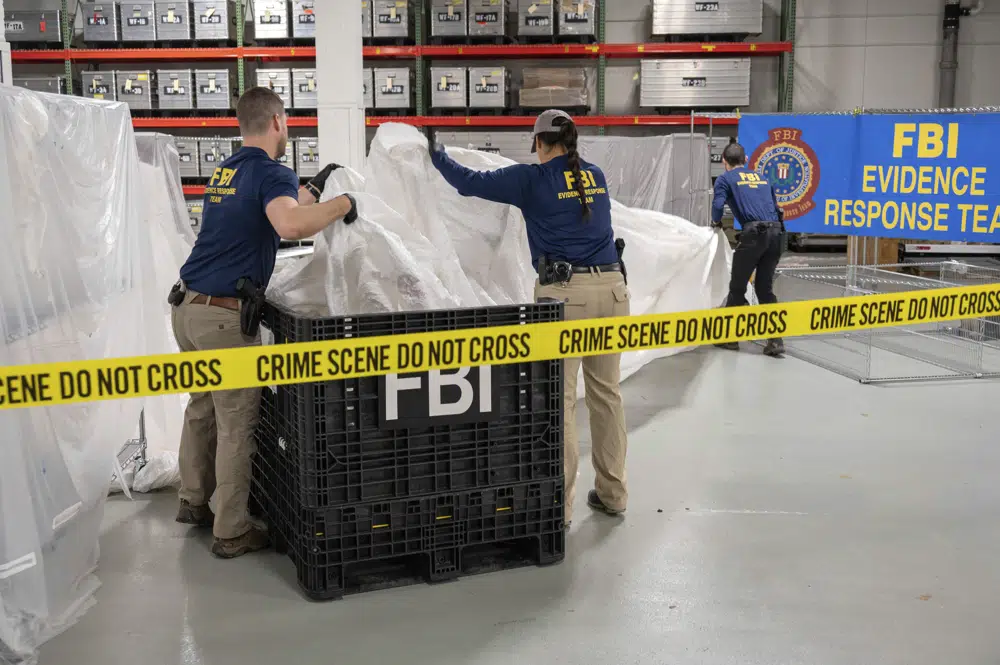
The China balloon shot down by the U.S. was equipped to detect and collect intelligence signals as part of a huge, military-linked aerial surveillance program that targeted more than 40 countries, the Biden administration declared Thursday, citing imagery from American U-2 spy planes. A fleet of balloons operates under the direction of the People’s Liberation Army and is used specifically for spying, outfitted with high-tech equipment designed to gather sensitive information from targets across the globe, the U.S. said. Similar balloons have sailed over five continents, according to the administration. A statement from a senior State Department official offered the most detail to date linking China’s military to the balloon that was shot down by the U.S. last weekend over the Atlantic Ocean. The public details outlining the program’s scope and capabilities were meant to refute China’s persistent denials that the balloon was used for spying, including a claim Thursday that U.S. accusations about the balloon amount to “information warfare.” On Capitol Hill, the House voted unanimously to condemn China for a “brazen violation” of U.S. sovereignty and efforts to “deceive the international community through false claims about its intelligence collection campaigns.” Republicans have criticized President Joe Biden for not acting sooner to down the balloon, but both parties’ lawmakers came together on the vote, 419-0. In Beijing, before the U.S. offered its new information, Chinese Foreign Ministry spokesperson Mao Ning repeated her nation’s insistence that the large unmanned balloon was a civilian meteorological airship that had blown off course and that the U.S. had “overreacted” by shooting it down. “It is irresponsible,” Mao said. The latest accusations, she said, “may be part of the U.S. side’s information warfare against China.” Underscoring the tensions, China’s defense minister refused to take a phone call from Defense Secretary Lloyd Austin to discuss the balloon issue on Saturday, the Pentagon said. Secretary of State Antony Blinken canceled a planned weekend trip to Beijing. The U.S. flatly contradicted China’s version of events, saying that imagery of the balloon collected by American U-2 spy planes as it crossed the country showed that it was “capable of conducting signals intelligence collection” with multiple antennas and other equipment designed to upload sensitive information and solar panels to power them. Jedidiah Royal, the U.S. assistant defense secretary for the Indo-Pacific, told a Senate Appropriations subcommittee that the military has “some very good guesses” about what intelligence China was seeking. More information was expected to be provided in a classified setting. Senior FBI officials who briefed reporters on the condition of anonymity under ground rules set by the bureau said just a few pieces of the balloon had arrived at the FBI’s Quantico, Virginia, lab for investigation. So far, investigators have parts of the balloon canopy, wiring, and what one official called “a very small amount of electronics.” The official said it was “very early for us to assess what the intent was and how the device was operating.” According to two U.S. officials, the balloon recovery efforts were temporarily suspended on Thursday due to high seas. They said some balloon debris was intact on the ocean floor, and divers had recovered potentially high-value equipment over the past day and a half. Another official said that some of the recovered equipment components had English writing or markings on them, but it wasn’t clear if they were American parts or from another English-speaking country. The official said the more highly technical parts recovered did not have any overt markings. Much of the debris is concentrated in two separate sections of an area 15 football fields long and 15 fields across, according to the officials who spoke on condition of anonymity because of the sensitivity of the collection process. The State Department official, providing details to reporters by email, also on condition of anonymity, said an analysis of the balloon debris was “inconsistent” with China’s explanation that it was a weather balloon that went off course. The U.S. is reaching out to countries that have also been targeted, the official said, to discuss the scope of the Chinese surveillance program, and is looking into potential action that “supported the balloon’s incursion into U.S. airspace.” The official said the U.S. has confidence that the manufacturer of the balloon shot down on Saturday has “a direct relationship with China’s military and is an approved vendor of the” army. The official cited information from an official PLA procurement portal as evidence of the connection between the company and the military. State Department spokesman Ned Price would not identify the other countries the U.S. says have also been targeted. Nor would he reveal how the U.S. knows there have been Chinese incursions over those countries’ territory, saying to do so could compromise intelligence sources and methods. The release of new information appeared to be part of a coordinated administration response, with multiple officials appearing before congressional committees to face questions about the balloon. Testifying before the Senate Foreign Relations Committee, Deputy Secretary of State Wendy Sherman said officials had taken “all necessary steps to protect sensitive information” and had been able to study and scrutinize the balloon and its equipment. “We will continue to answer the dangers posed by the PRC with determination and resolve,” Sherman said, referring to the People’s Republic of China. “We will make clear to the PRC that violations of our sovereignty and the sovereignty of other countries are unacceptable.” At a separate Senate subcommittee hearing, lawmakers repeatedly pressed administration officials, including Pentagon military leaders, about why the balloon was not shot down over sparsely populated areas of Alaska. And they questioned whether allowing the balloon to transit such a large area set a precedent for future spying efforts by China and others. “It defies belief that there was not a single opportunity to safely shoot this spy balloon prior to the coast of South Carolina,” said Sen. Susan Collins, R-Maine. “By the administration’s logic, we would allow the Chinese to fly surveillance balloons over the Pentagon or other sensitive sites and populated areas.”
Madeleine Albright, 1st female U.S. secretary of state, dies
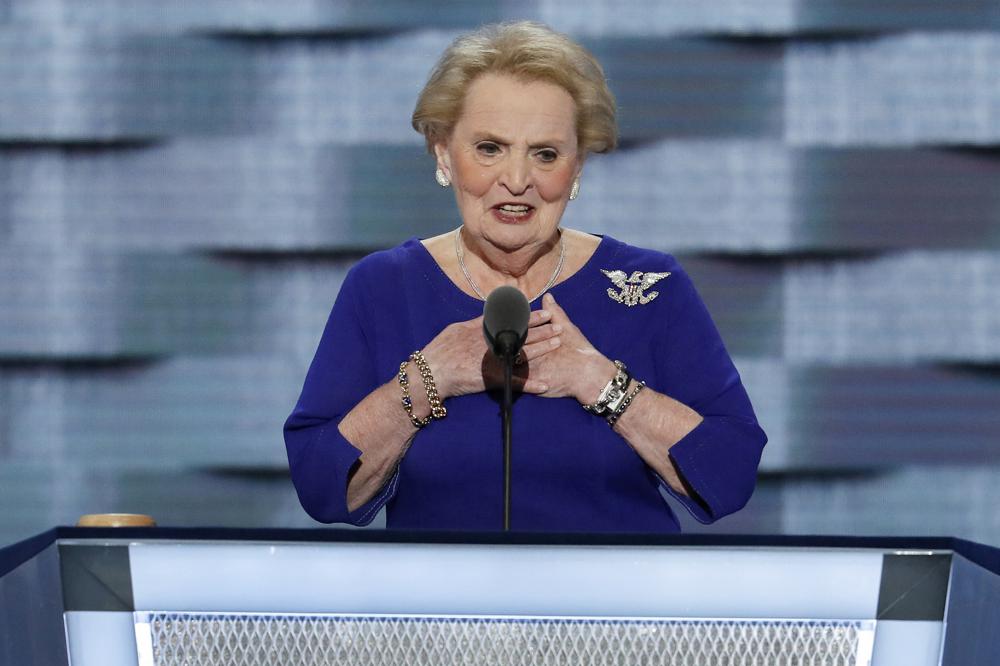
Madeleine Albright, a child refugee from Nazi- and then Soviet-dominated Eastern Europe who rose to become the first female secretary of state and a mentor to many current and former American statesmen and women, died Wednesday of cancer, her family said. She was 84. A lifelong Democrat who nonetheless worked to bring Republicans into her orbit, Albright was chosen in 1996 by President Bill Clinton to be America’s top diplomat, elevating her from U.S. ambassador to the United Nations, where she had been only the second woman to hold that job. As secretary of state, Albright was the highest-ranking woman in the history of the U.S. government. She was not in the line of succession to the presidency, however, because she was born in what was then Czechoslovakia. Still, she was universally admired for breaking a glass ceiling, even by her political detractors. “We have lost a loving mother, grandmother, sister, aunt, and friend,” her family said in a statement. President Joe Biden ordered flags at the White House and other federal buildings and grounds to be flown at half-staff until March 27. Outpourings of condolences came quickly. Biden said, “America had no more committed champion of democracy and human rights than Secretary Albright, who knew personally and wrote powerfully of the perils of autocracy.” “When I think of Madeleine,” Biden added, “I will always remember her fervent faith that ‘America is the indispensable nation.’” Secretary of State Antony Blinken said Albright was “a brilliant diplomat, a visionary leader, a courageous trailblazer, a dedicated mentor, and a great and good person who loved the U.S. deeply and devoted her life to serving it.” Clinton called her “one of the finest Secretaries of State, an outstanding U.N. Ambassador, a brilliant professor, and an extraordinary human being.” “And through it all,” Clinton added, “even until our last conversation just two weeks ago, she never lost her great sense of humor or her determination to go out with her boots on, supporting Ukraine in its fight to preserve freedom and democracy.” Former President George W. Bush said Albright “lived out the American dream and helped others realize it. … She served with distinction as a foreign-born foreign minister who understood firsthand the importance of free societies for peace in our world.” Linda Thomas-Greenfield, U.S. envoy to the United Nations, honored Albright as a “trailblazer and a luminary” in remarks on the General Assembly floor. In 2012, President Barack Obama awarded Albright the Medal of Freedom, the nation’s highest civilian honor, saying her life was an inspiration to all Americans. Albright remained outspoken through the years. After leaving office, she criticized Bush for using “the shock of force” rather than alliances to foster diplomacy and said Bush had driven away moderate Arab leaders and created the potential for a dangerous rift with European allies. As a refugee from Czechoslovakia who saw the horrors of both Nazi Germany and the Iron Curtain, she was not a dove, and she played a leading role in pressing for the Clinton administration to get militarily involved in the conflict in Kosovo. She also took a hard line on Cuba, famously saying at the United Nations that the Cuban shootdown of a civilian plane was not “cojones” but rather “cowardice.” Albright advised women “to act in a more confident manner” and “to ask questions when they occur and don’t wait to ask.” “It took me quite a long time to develop a voice, and now that I have it, I am not going to be silent,” she told HuffPost Living in 2010. When the Senate Foreign Relations Committee asked her in January 2007 whether she approved of Bush’s proposed “surge” in U.S. troops in bloodied Iraq, she responded: “I think we need a surge in diplomacy. We are viewed in the Middle East as a colonial power, and our motives are suspect.” Albright was an internationalist whose point of view was shaped in part by her background. Her family fled Czechoslovakia in 1939 as the Nazis took over their country, and she spent the war years in London. After the war, as the Soviet Union took over vast chunks of Eastern Europe, her father, a Czech diplomat, brought his family to the United States. As secretary of state, Albright played a key role in persuading Clinton to go to war against the Yugoslav leader Slobodan Milosevic over his treatment of Kosovar Albanians in 1999. As U.N. ambassador, she advocated a tough U.S. foreign policy, particularly in the case of Milosevic’s treatment of Bosnia and NATO’s intervention in Kosovo, was eventually dubbed “Madeleine’s War.” “My mindset is Munich,” she said frequently, referring to the German city where the Western allies abandoned her homeland to the Nazis. Albright helped win Senate ratification of NATO’s expansion and a treaty imposing international restrictions on chemical weapons. She led a successful fight to keep Egyptian diplomat Boutros Boutros-Ghali from a second term as secretary-general of the United Nations. He accused her of deception and posing as a friend. And she once exclaimed to Colin Powell, then chairman of the Joint Chiefs of Staff, who would later succeed her as secretary of state: “What’s the point of having this superb military you’re always talking about if we can’t use it?” Powell, who died last year, recalled in a memoir that Albright’s comment almost made him have an “aneurysm.” Despite her championing of diplomacy in the Middle East and a late Clinton-era foray to North Korea, which made her the highest-ranking U.S. official to visit the Stalinist state, Albright drew criticism for her support of sanctions against Iraq that many blame for humanitarian suffering in the country under Saddam Hussein. “I am an eternal optimist,” Albright said in 1998, amid an effort as secretary of state to promote peace in the Middle East. But she said getting Israel to pull back on the West Bank and the Palestinians to rout terrorists posed serious problems. Albright made limited progress at first in trying to expand the
