
Hillary Clinton lining up policy priorities for 2017, if she wins

Hillary Clinton‘s advisers are crafting a domestic policy agenda for the opening months of a potential presidency that is centered on three issues with some level of Republican support: an infrastructure package that emphasizes job creation, criminal justice reform, and immigration legislation — with the promise of quick executive action if a bill fails in Congress. Clinton’s campaign aides and transition team have been emphasizing the trio of priorities in conversations with lawmakers and advocacy groups, according to several people involved in those discussions. While Clinton has spoken frequently about each subject in campaign appearances, her advisers’ discussions provide new insight into how the Democrat might approach her first months in the White House, should she defeat Donald Trump on Nov. 8. People with knowledge of Clinton’s planning insisted on anonymity because they were not authorized to discuss the private conversations publicly. Clinton campaign officials would not comment on the emerging agenda, saying Clinton is focused squarely on defeating Trump and helping Democrats take control of the Senate, which would improve her chances of securing passage of her policy priorities. “Anyone who thinks that our candidate or the campaign is focused on the transition is mistaken,” said Jennifer Palmieri, Clinton’s communications director. “Hillary Clinton is superstitious.” Clinton has led national and battleground state polls in recent weeks, though Trump sees a new FBI email inquiry as an opening to overtake the Democrat in the election’s closing days. If Clinton wins, immigration is expected be among the most complex domestic policy issues she hopes to tackle in 2017. Some Republican leaders, desperate to boost their party’s appeal with Hispanics, have backed legislation, but the party’s right wing keeps resisting, and may be more emboldened by the popularity of Trump’s hardline immigration policies with some GOP voters. Clinton’s team has actively looked for ways to avoid the traps that have sunk President Barack Obama‘s bid for an immigration overhaul in 2013. Sweeping legislation that included a path to citizenship for millions of people illegally in the U.S. passed the Senate that year, but Republican leaders in the House refused to put the measure up for a vote. Advocacy groups have discussed with Clinton aides the prospect of pushing the House to act on immigration first this time around, testing the will of a chamber that is expected to stay in Republican hands. However, that approach is largely contingent on Paul Ryan remaining speaker of the House. The Wisconsin lawmaker has spoken favorably of the need to address the nation’s fractured immigration laws. But he may face an internal revolt that forces him out of his leadership post, given the anger among some House Republicans over his lukewarm support for Trump during the general election. Asked whether Ryan would be willing to work with Clinton on immigration legislation, spokeswoman AshLee Strong said: “Speaker Ryan is focused on beating Democrats in November, including Hillary Clinton.” In another break from Obama’s immigration strategy, Clinton aides have signaled plans to wield the threat of executive action more aggressively during the legislative process. Obama spent years insisting only Congress could change immigration laws, though he later took executive actions to keep millions of people in the U.S. illegally from deportation. “We’re long past time when a president can simply say, I really supported (immigration reform), but Congress didn’t do it,” said Clarissa Martinez De Castro of the National Council of La Raza, a group that advocates immigration reform. Some of Obama’s executive actions on immigration have been challenged in the courts. The Supreme Court, which is down one justice, deadlocked 4-4 on a decision about the legality of the executive actions. If Clinton is elected, she would presumably nominate a ninth justice inclined to uphold the measures. Beyond the pitched battle potentially ahead on immigration, it’s clear Clinton’s team is looking for ways she could court bipartisan support for other policies. Clinton aides have been telling Democrats that she plans to push swiftly for a package of criminal justice reforms, seizing on an issue with broad Republican backing. She could ask lawmakers to pick up a package of reforms that stalled in the Senate earlier this fall, legislation aimed at reducing mandatory minimum sentences for some non-violent offenders and reducing the money the U.S. spends on incarcerations. “There’s going to be a very important effort for bipartisan cooperation together on this,” Clinton said of criminal justice reform in a radio interview Thursday. Advisers say Clinton does not view gun control, a more politically risky issue even among some Democratic members of Congress, as part of a criminal justice package. Clinton’s other main priority should she win appears to be moving swiftly on a multibillion-dollar infrastructure package aimed at boosting economic growth and creating jobs. She’s proposed spending $275 billion on new road, sewer and other infrastructure projects. Republicans are broadly supportive of infrastructure investments. But as with the numerous fiscal fights between Obama and congressional Republicans, paying for the spending bill could become a point of contention. Clinton’s plan states that “business tax reform” would finance her agenda, which would include $250 billion in direct funding over five years and $25 billion to seed an infrastructure bank. While the details of the tax reforms are unclear, New York Sen. Chuck Schumer has said the money could come from letting companies pay a lower tax rate on their overseas earnings. Republished with permission of the Associated Press.
For Hillary Clinton, struggle to change public perception persists
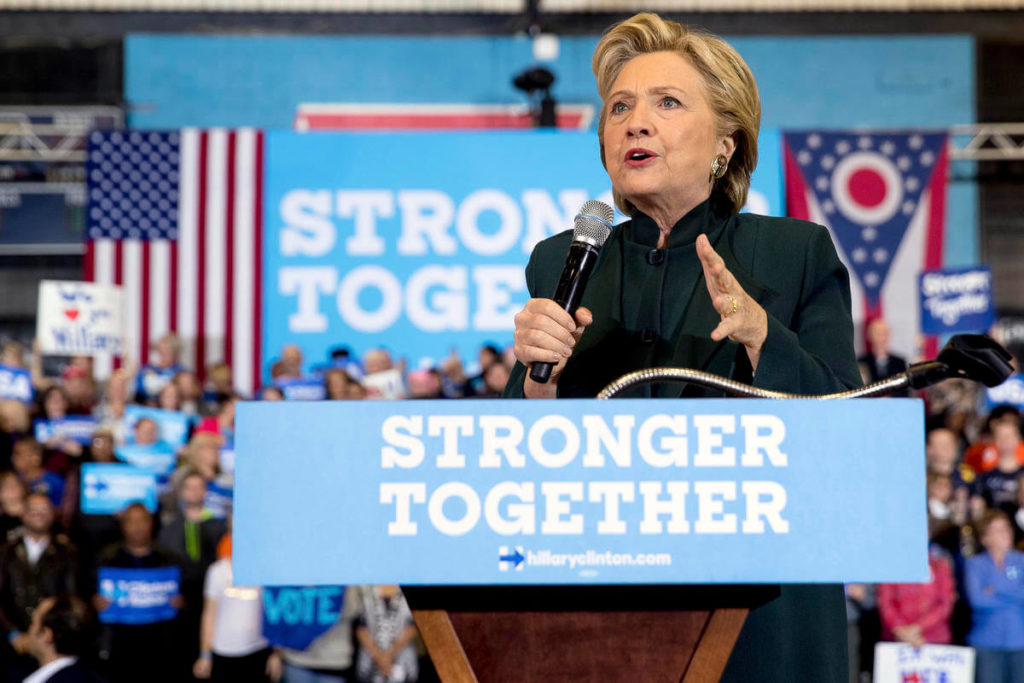
Hillary Clinton bested Donald Trump in three debates. She leads in many preference polls of the most competitive states. Barring a significant shift in the next two weeks, she is in a strong position to become the first woman elected U.S. president. But Clinton will end the campaign still struggling to change the minds of millions of voters who don’t think well of her, a glaring liability should the Democratic nominee move on to the White House. While many see her as better prepared to be commander in chief than Trump, she is consistently viewed unfavorably by more than half of the country. Most voters also consider her dishonest. Clinton’s advisers have spent months trying to erase that perception. They’ve set up small events where she had more intimate conversations with voters. They’ve tested a seemingly endless stream of messages aimed at assuring the public that the former secretary of state was in the race to do more than fulfill her own political ambitions. As Clinton starts making her closing argument to voters, her team appears to have come to terms that the mission remains unfulfilled. “Honest and trustworthy has become our most talked about metric because it’s not great,” said Jennifer Palmieri, Clinton’s communications director. “But we’ve never thought it’s the metric people make a decision on.” If Clinton wins, that theory may be proven true. Just 36 percent of voters believe Clinton is honest and trustworthy, according to a recent Washington Post/ABC News poll. That’s compared with about 60 percent who believe she has the qualifications and temperament to be commander in chief. The public’s perception of Clinton has bounced up and down throughout her time in public life. Her favorability rating fell below 50 percent at times during her years as first lady, but rose to its high water mark then and while she was as secretary of state under President Barack Obama. Democrats blame some of the current negative personal perceptions of Clinton on the hard-charging tactics she’s used to try to discredit Trump, though they believe her sustained assault on Trump’s character and temperament has been crucial. Party operatives also say Trump’s personal attacks on Clinton have made it all but impossible for more positive messages to break through. He’s called her a “liar,” a “nasty woman” and pledged to put her in jail. “When you’re under relentless assault from a reality TV star, it’s hard to come out of that with anybody feeling good about anyone,” said Bill Burton, a former Obama aide. Still, Clinton’s advisers acknowledge that some of her troubles have been of her own making, including her penchant for privacy. She’s spent nearly the entire campaign struggling to explain why she used a private email server in the basement of her home while she led the State Department. She hid a pneumonia diagnosis this fall from nearly all of her senior staff, then left the public unaware of her condition and whereabouts for 90 minutes after the illness caused her to rush out of a public event in New York. “She is a politician that does not seek to be the center of attention and is inherently more private than most politicians, certainly presidential candidates,” Palmieri said. “That doesn’t always serve you great in a campaign for president.” Clinton frequently shoots down questions about the public’s negative perceptions by saying she’s viewed more positively when she’s doing a job rather than running for one. There’s some evidence to back that up. When she ran for re-election to the Senate from New York in 2006, she won with 67 percent of the vote, a big jump from the 55 percent share from her first race in 2000. Her approval rating when she left the State Department, where her job kept her out of day-to-day politics, sat at an enviable 65 percent, according to the Pew Research Center. But if Clinton is elected president, she won’t have the luxury she had as secretary of state to stay away from the political fray — with Republicans in Washington in the opposition, and possibly Trump, too. The businessman keeps flirting with the idea he could contest the election results if he loses. There are also persistent rumors that, if he loses, he might try to harness the enthusiasm of his millions of supporters into some type of media venture. “The notion that Trump is going to go quietly into the night and wish her Godspeed is highly unlikely,” said David Axelrod, another former Obama adviser. “She’s going to have to contend with that and whatever it is he chooses to make his vehicle.” Clinton has begun acknowledging the challenge that could await her in the White House, if she wins, centering her closing argument to voters on a call for unity after a bitter campaign. “My name may be on the ballot, but the question really is who are we as a country, what are our values, what kind of a future do we want to create together,” she said Friday at a rally in Ohio. Some Democrats see the transition — the two-month-plus stretch between the Nov. 8 election and the Jan. 20 inauguration — as a crucial opportunity for her to signal, if she wins, that a Clinton White House would be different from a Clinton campaign. In a nod to bipartisanship, she could nominate a Republican for her Cabinet. Clinton could start moving on some of her more broadly popular policy proposals as a way of boosting her appeal, assuming no crisis demands immediate action. Still, Axelrod said changing the public’s view of Clinton will be a “long-term project.” “There’s no silver bullet to turn around years of wear and tear on her image,” he said. Republished with permission of the Associated Press.
Top Hillary Clinton aide links Roger Stone to Russian email hacking
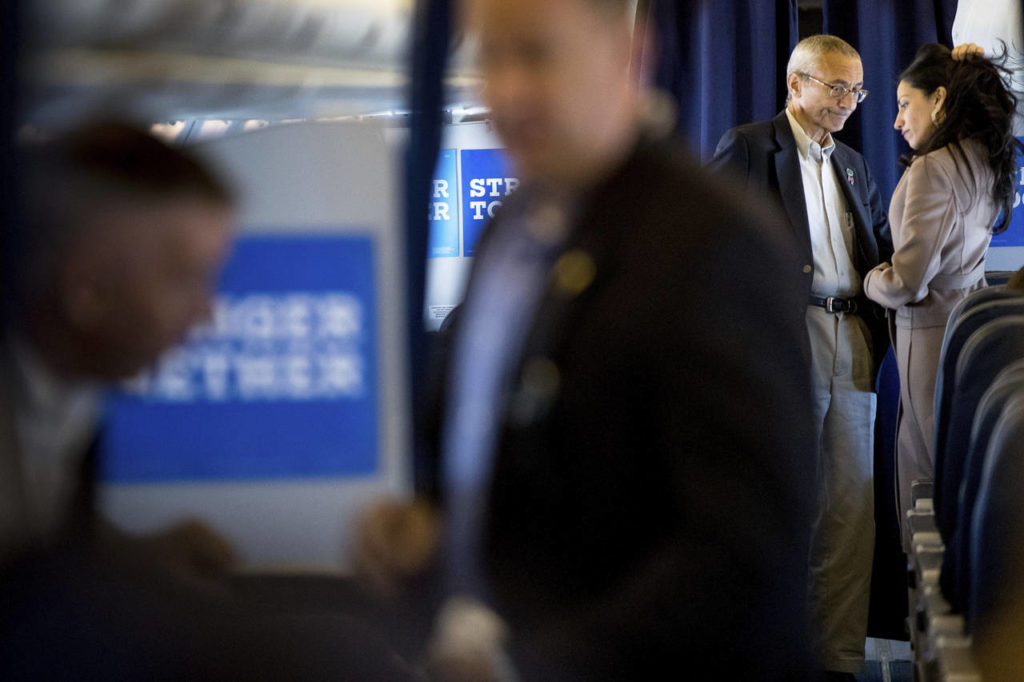
Hillary Clinton‘s top adviser said the FBI is investigating Russia’s possible role in hacking thousands of his personal emails, an intrusion he said Donald Trump’s campaign may have been aware of in advance. If true, the assertion from Clinton campaign chairman John Podesta would amount to an extraordinary link between Russia and an American presidential campaign. Podesta said the alleged ties could be driven either by Trump’s policy positions, which at times echo the Kremlin, or the Republican’s “deep engagement and ties with Russian interests in his business affairs.” To Podesta, the central figure in the swirling controversy is longtime Trump adviser Roger Stone, who has said he has been in touch with WikiLeaks founder Julian Assange. Podesta also raised as evidence an August tweet in which Stone said Podesta’s “time in the barrel” was coming. The tweet was sent shortly after WikiLeaks published scores of hacked emails from other Democratic officials. “I think it’s a reasonable assumption, or at least a reasonable conclusion, that Mr. Stone and the Trump campaign had advance warning about what Assange was going to do,” Podesta told reporters aboard the Clinton campaign plane. Podesta acknowledged the evidence was “circumstantial.” Stone, in an email to The Associated Press late Tuesday, said Podesta’s accusations were “categorically false” and “without foundation.” WikiLeaks tweeted Wednesday that it “has had no contact with Roger Stone.” Podesta said the FBI contacted him over the weekend and confirmed it was investigating the hacking of his account as part of the ongoing probe in other Democratic Party hackings by groups with Russian ties. Last week, intelligence officials said they believed the individuals responsible are working for Russian intelligence and coordinating with Assange on the political hacking. Russian Ambassador to the U.S. Sergey Kislyak dismissed the accusations as untrue. “We are watching very carefully the election campaign in this country,” Kislyak said Tuesday at a discussion of bilateral affairs at Johns Hopkins University’s campus in Washington. “We don’t interfere (in) the internal affairs of the United States, neither by my statements nor by electronic or other means.” Clinton has repeatedly accused her opponent of being soft on Russia, pointing to his praise of Russian President Vladimir Putin as a strong leader, his suggestion that he would rethink sanctions against Russian officials, his sharp criticism of NATO and other policy positions. While Podesta didn’t directly accuse Trump of assisting in any Russian meddling with American campaigns, he suggested Trump was either “willfully ignoring” intelligence officials’ warnings about Russian government involvement or “an unwitting agent of the Russian Federation.” The Clinton campaign would not confirm the authenticity of Podesta’s leaked emails, noting that Russian hackers often fabricate documents. “The pattern is they hack, they leak truthful things, and then they build up to leaking documents that are either doctored or wholly fabricated,” said Jennifer Palmieri, Clinton’s communications director. Trump seized on the hacked emails at a rally Tuesday night in Florida, alleging the documents show that “Clinton is the vessel (of) a corrupt global establishment that’s raiding our country and surrounding the sovereignty of our nation.” Also citing WikiLeaks, Trump said: “The Department of Justice fed information to the Clinton campaign about the email investigation so that the campaign could be prepared to cover up for her crimes. What is going on?” In May 2015, Clinton spokesman Brian Fallon alerted staffers that the Justice Department was proposing to publish Clinton’s work-related emails by January in response to requests by news organizations. Fallon, a former Justice Department spokesman, wrote that unspecified “DOJ folks” told him there was a court hearing planned soon in the case. The dates of court hearings would have been publicly posted in advance on the court’s docket. Fallon did not respond to a request for comment from AP. The Justice Department declined to discuss Fallon’s email. Still, Trump said, “This is collusion and corruption of the highest order and is one more reason why l will ask my attorney general to appoint a special prosecutor,” following up on his debate threat to put Clinton in jail. WikiLeaks dropped the first batch of Podesta’s emails shortly after news organizations released a video in which Trump is heard making sexually predatory comments about women. That video has deeply damaged Trump’s campaign, leading several Republicans to revoke their support for the businessman. Podesta said Tuesday the timing of his emails’ release was an “awfully curious coincidence.” “Mr. Assange wanted to change the subject,” Podesta said. “He didn’t succeed in doing that.” Republished with permission of the Associated Press.
