
Donald Trump trial gets go-ahead after emotional, graphic first day
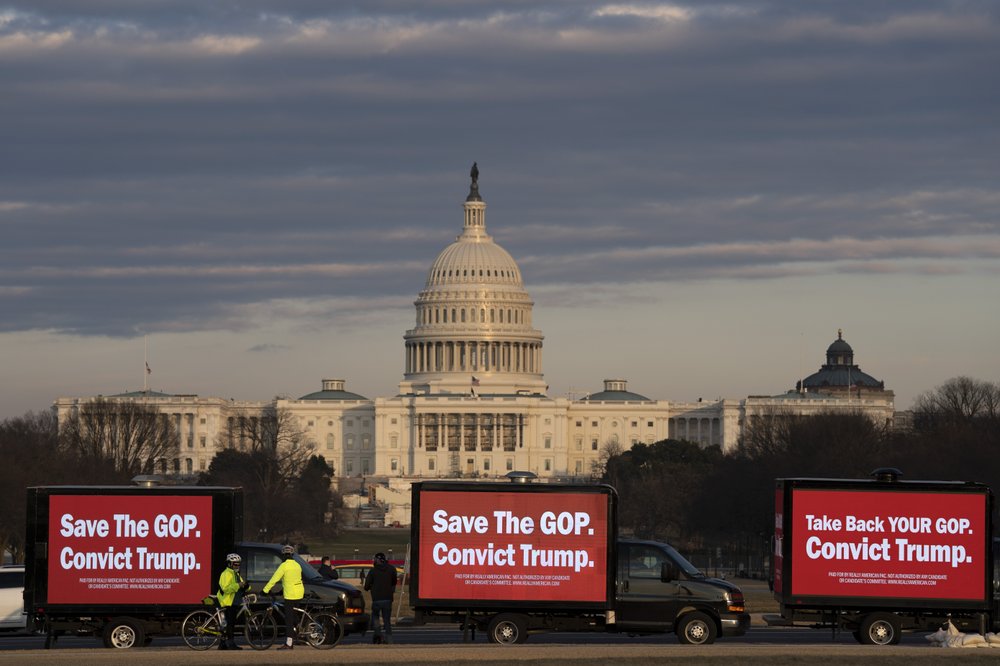
House prosecutors on Tuesday wrenched senators and the nation back to the deadly attack on Congress as they opened Donald Trump’s historic second impeachment trial with graphic video of the insurrection and Trump’s own calls for a rally crowd to march to the iconic building and “fight like hell” against his reelection defeat. The detailed and emotional presentation by Democrats was followed by meandering and occasionally confrontational arguments from the Trump defense team, which insisted that his remarks were protected by the First Amendment and asserted that he cannot be convicted as a former president. Even Trump’s backers in the Senate winced, several saying his lawyers were not helpful to his case. The senators sitting as jurors, many of whom fled for safety themselves the day of the attack, watched and listened, unable to avoid the jarring video of Trump supporters battling past police to storm the halls, Trump flags waving. While many minds are made up, the senators will face their own moment to decide whether to convict or acquit Trump of the sole charge of “incitement of insurrection.” The heavy emotional weight of the trial punctuates Trump’s enduring legacy as the first president to face an impeachment trial after leaving office and the first to be twice impeached. The Jan. 6 Capitol siege stunned the world as hundreds of rioters ransacked the building to try to stop the certification of Democrat Joe Biden’s victory, a domestic attack on the nation’s seat of government unlike any in its history. Five people died. “That’s a high crime and misdemeanor,” Rep. Jamie Raskin, D-Md., declared in opening remarks. “If that’s not an impeachable offense, then there’s no such thing.” Trump’s lawyers insist he is not guilty, his fiery words just figures of speech. In a key early test, senators rejected an effort by Trump’s allies to halt the trial, instead affirming the Senate’s authority under the Constitution to decide the case. They voted 56-44 to confirm their jurisdiction, ruling that impeaching a president after he leaves office is constitutionally permissible. Six Republicans joined the Democrats. Security remained extremely tight at the Capitol on Tuesday, a changed place after the attack, fenced off with razor wire and with armed National Guard troops on patrol. The nine House managers walked across the shuttered building to prosecute the case before the Senate. White House press secretary Jen Psaki said Biden would not be watching the trial of his predecessor. “Joe Biden is the president, he’s not a pundit, he’s not going to opine on back and forth arguments,” she said. With senators gathered as the court of impeachment, sworn to deliver impartial justice, the trial started with the Democratic House managers’ gripping recollections, as they described police officers maimed in the chaos and rioters parading in the very chamber where the trial was being held. Trump’s team countered that the Constitution doesn’t allow impeachment at this late date. Though the trial now proceeds, that’s a legal issue that could resonate with Republicans eager to acquit Trump without being seen as condoning his behavior. Lead lawyer Bruce Castor said he shifted his planned approach after hearing the prosecutors’ opening and instead spoke conversationally to the senators, saying Trump’s team would do nothing but denounce the “repugnant” attack and “in the strongest possible way denounce the rioters.” He appealed to the senators as “patriots first,” and encouraged them to be “cool-headed” as they assess the arguments. Trump attorney David Schoen turned the trial toward starkly partisan tones, saying the Democrats were fueled by a “base hatred” of the former president. Republicans made it clear that they were unhappy with Trump’s defense, many of them saying they didn’t understand where it was going — particularly Castor’s opening. Louisiana Sen. Bill Cassidy, who voted with Democrats to move forward with the trial, said that Trump’s team did a “terrible job.” Maine Sen. Susan Collins, who also voted with Democrats, said she was “perplexed.” Sen. Lisa Murkowski of Alaska said it was a “missed opportunity” for the defense. The early defense struggles also underscored the uphill battle that Trump’s lawyers face in defending conduct that preceded an insurrection that senators themselves personally experienced. Though they will almost certainly win Trump’s acquittal — by virtue of the composition of the Senate — they nonetheless face a challenge of defanging the emotion from a trial centered on events that remain raw and visceral, even for Republicans. At one pivotal point, Raskin told his personal story of bringing his family to the Capitol the day of the riot, to witness the certification of the Electoral College vote, only to have his daughter and son-in-law hiding in an office, fearing for their lives. “Senators, this cannot be our future,” Raskin said through tears. “This cannot be the future of America.” The House prosecutors had argued there is no “January exception” for a president to avoid impeachment on his way out the door. Rep. Joe Neguse, D-Colo., referred to the corruption case of William Belknap, a war secretary in the Grant administration, who was impeached, tried and ultimately acquitted by the Senate after leaving office. If Congress stands by, “it would invite future presidents to use their power without any fear of accountability,” he said. On the vote, six Republicans joined with Democrats pursue the trial, just one more than on a similar vote last week. Cassidy joined Collins, Murkowski, Mitt Romney of Utah, Ben Sasse of Nebraska, and Pat Toomey of Pennsylvania. But the total of 56 was still far from the two-thirds threshold of 67 votes that would be needed for conviction. It appears unlikely that the House prosecutors will call witnesses, in part because the senators were witnesses themselves. At his Mar-a-Lago club in Florida, Trump has declined a request to testify. Presidential impeachment trials have been conducted only three times before, leading to acquittals for Andrew Johnson, Bill Clinton and then Trump last year. Because of the COVID-19 crisis, senators were allowed to spread out, including in the “marble room” just off
Donald Trump impeached after Capitol riot in historic second charge

President Donald Trump was impeached by the U.S. House for a historic second time Wednesday, charged with “incitement of insurrection” over the deadly mob siege of the Capitol in a swift and stunning collapse of his final days in office. With the Capitol secured by armed National Guard troops inside and out, the House voted 232-197 to impeach Trump. The proceedings moved at lightning speed, with lawmakers voting just one week after violent pro-Trump loyalists stormed the U.S. Capitol after the president’s calls for them to “fight like hell” against the election results. Ten Republicans fled Trump, joining Democrats who said he needed to be held accountable and warned ominously of a “clear and present danger” if Congress should leave him unchecked before Democrat Joe Biden’s inauguration Jan. 20. Trump is the only U.S. president to be twice impeached. It was the most bipartisan presidential impeachment in modern times, more so than against Bill Clinton in 1998. The Capitol insurrection stunned and angered lawmakers, who were sent scrambling for safety as the mob descended, and it revealed the fragility of the nation’s history of peaceful transfers of power. The riot also forced a reckoning among some Republicans, who have stood by Trump throughout his presidency and largely allowed him to spread false attacks against the integrity of the 2020 election. House Speaker Nancy Pelosi invoked Abraham Lincoln and the Bible, imploring lawmakers to uphold their oath to defend the Constitution from all enemies, foreign “and domestic.” She said of Trump: “He must go, he is a clear and present danger to the nation that we all love.” Holed up at the White House, watching the proceedings on TV, Trump took no responsibility for the bloody riot seen around the world, but issued a statement urging “NO violence, NO lawbreaking and NO vandalism of any kind” to disrupt Biden’s ascension to the White House. In the face of the accusations against him and with the FBI warning of more violence, Trump said, “That is not what I stand for, and it is not what America stands for. I call on ALL Americans to help ease tensions and calm tempers.” Trump was first impeached by the House in 2019 over his dealings with Ukraine, but the Senate voted in 2020 acquit. He is the first to be impeached twice. None has been convicted by the Senate, but Republicans said Wednesday that could change in the rapidly shifting political environment as officeholders, donors, big business and others peel away from the defeated president. The soonest Republican Senate leader Mitch McConnell would start an impeachment trial is next Tuesday, the day before Trump is already set to leave the White House, McConnell’s office said. The legislation is also intended to prevent Trump from ever running again. McConnell believes Trump committed impeachable offenses and considers the Democrats’ impeachment drive an opportunity to reduce the divisive, chaotic president’s hold on the GOP, a Republican strategist told The Associated Press on Wednesday. McConnell told major donors over the weekend that he was through with Trump, said the strategist, who demanded anonymity to describe McConnell’s conversations. In a note to colleagues Wednesday, McConnell said he had “not made a final decision on how I will vote.” Unlike his first time, Trump faces this impeachment as a weakened leader, having lost his own reelection as well as the Senate Republican majority. Even Trump ally Kevin McCarthy, the House Republican leader, shifted his position and said Wednesday the president bears responsibility for the horrifying day at the Capitol. In making a case for the “high crimes and misdemeanors” demanded in the Constitution, the four-page impeachment resolution approved Wednesday relies on Trump’s own incendiary rhetoric and the falsehoods he spread about Biden’s election victory, including at a rally near the White House on the day of the Jan. 6 attack on the Capitol. A Capitol Police officer died from injuries suffered in the riot, and police shot and killed a woman during the siege. Three other people died in what authorities said were medical emergencies. The riot delayed the tally of Electoral College votes which was the last step in finalizing Biden’s victory. Ten Republican lawmakers, including third-ranking House GOP leader Liz Cheney of Wyoming, voted to impeach Trump, cleaving the Republican leadership, and the party itself. Cheney, whose father is the former Republican vice president, said of Trump’s actions summoning the mob that “there has never been a greater betrayal by a President” of his office. Trump was said to be livid with perceived disloyalty from McConnell and Cheney. With the team around Trump hollowed out and his Twitter account silenced by the social media company, the president was deeply frustrated that he could not hit back, according to White House officials and Republicans close to the West Wing who weren’t authorized to speak publicly about private conversations. From the White House, Trump leaned on Sen. Lindsey Graham of South Carolina to push Republican senators to resist, while chief of staff Mark Meadows called some of his former colleagues on Capitol Hill. The president’s sturdy popularity with the GOP lawmakers’ constituents still had some sway, and most House Republicans voted not to impeach. Security was exceptionally tight at the Capitol, with tall fences around the complex. Metal-detector screenings were required for lawmakers entering the House chamber, where a week earlier lawmakers huddled inside as police, guns drawn, barricade the door from rioters. “We are debating this historic measure at a crime scene,” said Rep. Jim McGovern, D-Mass. During the debate, some Republicans repeated the falsehoods spread by Trump about the election and argued that the president has been treated unfairly by Democrats from the day he took office. Other Republicans argued the impeachment was a rushed sham and complained about a double standard applied to his supporters but not to the liberal left. Some simply appealed for the nation to move on. Rep. Tom McClintock of California said, “Every movement has a lunatic fringe.” Yet Democratic Rep. Jason Crow, D-Colo. and others recounted the harrowing
