
BCA, Alabama Technology Network announce Manufacturer of the Year awards
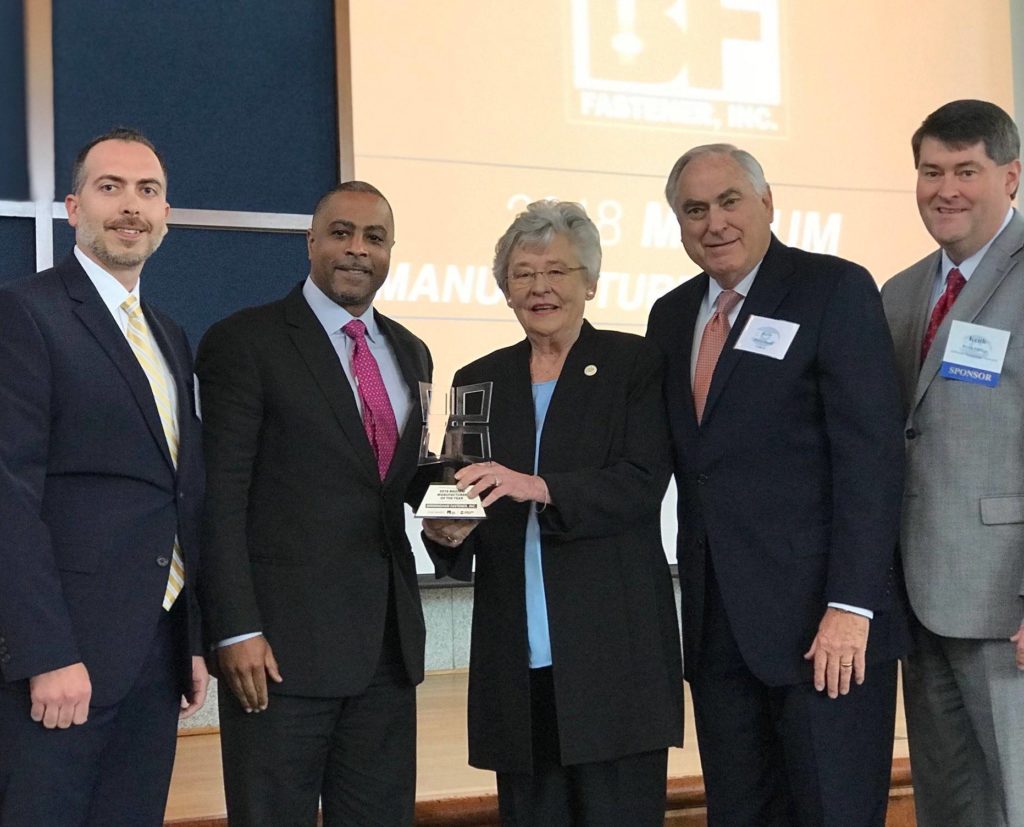
The Business Council of Alabama and the Alabama Technology Network announced the 2018 Manufacturer of the Year (MOTY) winners on Wednesday. The winners were announced during an awards luncheon ceremony at the Alabama Activity Center in Montgomery, Ala. Awards were broken down into large, medium, and small manufacturer categories. This years winner are: Large Manufacturer of the Year (400 or more employees): ADTRAN Inc., Huntsville Medium Manufacturer of the Year (100 to 399 employees): Birmingham Fastener & Supply Inc., Birmingham Small Manufacturer of the Year (1 to 99 employees): Ecovery LLC, Loxley Governor Kay Ivey was the keynote speaker for the ceremony. “From automobiles to aerospace to everyday products and equipment, whether for our own use or for export around the globe, Alabama’s manufacturers create high-quality jobs and produce substantial economic benefits,” Ivey said. “Our manufacturers are very important to us and we are committed to helping them succeed and thrive.” Each year, the MOTY awards recognize manufacturing enterprises in Alabama who exhibit excellence in leadership, performance, profitability, and workforce relations. An independent panel of judges select the winners based on their performance in several categories including: customer focus, operating excellence, employee commitment, profitable growth, continuous improvement, and investment in training and retraining. BCA Chairman Perry Hand, chairman of Volkert Inc. recognized MOTY finalists for 2018. “The annual Manufacturer of the Year Awards seek to honor Alabama manufacturers – from the largest industrial employers to the smallest businesses – for displaying efficiency, safety, and excellence in their products and the process for making them,” said William J. Canary, president and CEO of the BCA. “Quite simply, manufacturing is an economic engine powering the state’s economy.” ATN Executive Director Keith Phillips said; “The companies acknowledged today represent the best in Alabama manufacturing and the use of technology. Now in its 19th year, the Alabama Technology Network and the Business Council of Alabama are honored to salute Alabama’s best manufacturers for their valuable participation in not only the state’s economy but also the economies of their employees and the suppliers who do business with them.” More about the 2018 Manufacturers of the Year ADTRAN Inc.: Since its creation in 1985, ADTRAN Inc. in Huntsville, Ala. has been a worldwide leader in the information and communications technology industry. After AT&Ts divestiture of the Regional Bell Operating Companies, ADTRAN founder Mark C. Smith saw an opportunity to supply network equipment to the new Regional Bell businesses and thousands of independent telephone companies. From an initial seven employees to a workforce of almost 2,200 today, including 1,500 in Huntsville, ADTRAN serves more than 2,400 customers in 68 countries. The publicly traded company has shown consistent revenue growth, devises ways to cut costs, supports employee education and career development, encourages and supports community involvement, and supports more than 200 organizations. ADTRAN is a two-time winner, having won a MOTY award in 2010. Birmingham Fastener & Supply Inc.: Birmingham Fastener & Supply Inc. has successfully built a manufacturing company by valuing customers and people, providing quality products with customer service, and emphasizing development of its people. Founded by the late Howard P. Tinney in 1980, Birmingham Fastener & Supply is the South’s largest and most diversified fastener supplier. It makes and distributes fasteners for structural steel fabrication, metal building manufacturers, transportation, water works and utilities, original equipment manufacturers, agricultural equipment manufacturers, construction and maintenance, and repair and operations industries. Birmingham Fastener & Supply provides two scholarships a year through Wallace State Community College, education assistance to employees, and partners with Workshops Inc. that focuses on training people with disabilities. Ecovery LLC: Ecovery LLC in Loxley was formed in 2008 by Larry Sloan and Walter Norris originally to recycle and process electronic waste such as computers, televisions, and cell phones. In 2013, the company shifted to processing primarily copper and aluminum radiators from commercial and residential HVAC units. Ecovery LLC separates, shreds, and re-packages the pure raw material to fit customer needs. Ecovery also melts aluminum flakes from the shredding operation and mixes it with other scrap to produce recycled secondary ingots. Ecovery has two plants that employed 66 men and women in 2017.
AT&T expands high-speed internet across Alabama

AT&T has expanded it’s high-speed internet service across the Sate of Alabama, impacting over 37,000 Alabama locations in parts of 32 counties. “The thousands of dedicated men and women who work for AT&T and call Alabama home are proud to provide the connectivity Alabama’s residents and businesses demand,” said president of AT&T Alabama, Wayne Hutchens.“ The expansion is in compliance with the FCC’s “Connect America Fund” which has committed to providing the approximately 23 million Americans, in rural areas without access to the internet, access to at least 10/Mbps fixed broadband. “In today’s digital economy, access to high-speed internet is critical, and I’m excited to see AT&T’s continued investment and innovation,” added Anniston-Republican and Senate President Pro Tem Del Marsh. “Using multiple technologies to enhance internet access across our state, we can close the remaining gaps and continue competing for the best jobs and grow economic opportunity for all Alabama.” The expansions take place mostly in rural areas, with few urban area expansion. AT&T has also expanded their AT&T Fiber network to over 150,000 locations in Alabama. Customers who purchase the “internet 1000” service can download 25 songs in one second, or a 90-minute HD movie in less that 34. “I am thankful for the leadership of our elected officials who work to ensure a pro-consumer business environment and am delighted to see so many Alabama residents benefiting from this innovative technology made possible by private investment,” said Business Council of Alabama President and CEO William J. Canary. According to a press release, parts of these counties in Alabama are now eligible for this service from AT&T: Autauga, Barbour, Bibb, Blount, Butler, Calhoun, Chambers, Chilton, Coosa, Cullman, Elmore, Escambia, Franklin, Greene, Hale, Jefferson, Lauderdale, Lawrence, Limestone, Lowndes, Macon, Marengo, Montgomery, Morgan, Russell, Shelby, Sumter, Talladega, Tallapoosa, Tuscaloosa, Walker and Winston.
William J. Canary: The future belongs to the brave

The truth is the Alabama of today is one that our grandparents wouldn’t recognize. For more than two decades, Alabama has been landing one significant economic development project after another, transforming the state into an epicenter for the aerospace, automotive, and defense industries. Companies looking where to locate are attracted to our state’s business-friendly labor policies and focus on workforce development. Alabama’s right-to-work status has been a tremendous advantage, as Alabama is one of only 11 states that has constitutionally protected the right to work. However, the recent U.S. Senate special election and the spotlight it shone on Alabama threatened to bring the advancements of the last 25 years to a screeching halt. The Republican candidate, Roy Moore, with a knack for incendiary comments, made him – and Alabama – fodder for national news and international attention. Alabama U.S. Senator Richard Shelby announced publicly that while not voting for the Democratic candidate, he would be writing in a “distinguished Republican.” Now, supporters of Judge Moore are blaming Senator Shelby – and not their candidate – for the lopsided loss. With financing from an out-of-state investor, Moore supporters are seeking to have Senator Shelby censured by the Alabama Republican Party. The Business Council of Alabama and its leadership will mobilize and energize the business community to oppose all efforts to adopt this negative resolution that works against the business community, the economic well-being of Alabama, and our No. 1 advocate in Washington, D.C. – Senator Richard Shelby. I have publicly urged the Republican Party to adopt a resolution that commends Senator Shelby for his service to Alabama. If you look at the economic development projects in Alabama, there is one constant: Senator Richard Shelby. He deserves better than a fringe element of the GOP attacking him by not telling the truth – seeking revenge for their losing campaign. The recent announcements of Montgomery landing the F-35 Lightning mission and Huntsville gaining the joint Toyota-Mazda facility goes to Senator Shelby and his unwavering courage and leadership to stand his ground for Alabama. In my opinion, without his principled stand, the Toyota-Mazda plant would have gone to North Carolina – especially if Mr. Moore had been elected. Let’s put the past behind us and move on. If we don’t, the business community in Alabama needs to determine the best way to invest its resources with organizations and movements that will move Alabama forward… period, starting today! ••• William J. Canary is the president and CEO of the Business Council of Alabama
William J. Canary: The timing for tax reform is right

Congress returns to Washington facing enormous challenges. These include passing a domestic tax cut that is important for this and future generations. President Donald Trump has suggested a tax cut to reduce the unbelievable domestic income tax rate for corporations, including manufacturers, of 39 percent, to a competitive 15 percent. In addition, Congress must lower the tax rate for the two-thirds of manufacturers that pay taxes at individual tax rates as pass-through entities. The pass-through rate on small business owners can be as high as 44 percent, according the National Association of Manufacturers. These small businesses are the backbone of our economy and create the majority of jobs. A 2015 NAM study concluded that a reform package like this could add more than $12 trillion in Gross Domestic Product over 10 years, deliver more than 6.5 million jobs to the U.S. economy, and increase investment by more than $3.3 trillion, NAM Chairman David Farr said in a recent speech to the Economic Club of New York. (Farr is chairman and CEO of Emerson, a global manufacturer.) Combined with overarching regulations, the burdensome tax rate makes it harder for manufacturers to meet intense competition for business and jobs. A tax rate of 39 percent – higher when you throw in state and local taxes – is a crushing obstacle when competing against manufacturers in the top 35 industrialized nations who enjoy a tax rate, on average, half that of the United States. A tax cut will create jobs for Alabama manufacturers that compete internationally against lower tax rates. This nation’s bountiful resources, which include willing investors and hard-working men and women (a recent study showed that Americans are among the hardest-working in the world), can be stifled by a non-competitive tax code. The timing for tax reform is right. As the market is proving, businesses and individuals have been investing in anticipation of a tax cut and its effect on manufacturers, jobs, and our families’ standards of living. ••• William J. Canary is president and CEO of the Business Council of Alabama, the state’s exclusive representative of the National Association of Manufacturers and the U.S. Chamber of Commerce.
William J. Canary: Data system is a tool for education improvement

The Alabama Legislature is considering HB 97 by Rep. Terri Collins, R-Decatur, and SB 153 by Sen. Bobby Singleton, D-Greensboro, to establish a smart and secure statewide system to measure student achievement over time. Incredibly, Alabama currently does not have a statewide platform for collecting longitudinal data that are gathered from year to year to plot change. There are no means to measure how something at one point in time affects outcomes later. But a longitudinal data system would enable us to learn if high school enrollment in advanced courses or performance on state tests improve student readiness for college, what college-level programs ensure that more students succeed, and at what cost. Shouldn’t legislators who direct our very limited dollars know which initiatives show the best evidence of increasing student achievement? Shouldn’t school administrators have the information and resources to effectively manage? And shouldn’t teachers have the data to help their instruction improve students? A secure longitudinal data system – personal information would not be identifiable – would utilize performance records from early childhood education through the workforce to evaluate the progress of education and workforce programs. The purpose is to look at how groups of students advance through education and training, to determine which programs are successful and those that are not, learn which groups may need early intervention to help them succeed, what programs that are best practices and can be incorporated into other areas, and workforce outcomes of participants in both higher education and workforce training programs. We have the pieces that will let our children succeed. Now is the time to gather those pieces and use the data to know what works, and perhaps more importantly, what does not. Let the facts, not our opinions, guide decisions so that all Alabama students can excel. ••• William J. Canary is president and CEO of the Business Council of Alabama.
William J. Canary: Public charter schools provide value to business’s future

Citizens from across Alabama again this month will gather in Montgomery for School Choice Week scheduled Jan. 22-28 to show support for improving the quality of education and expanding access to highly effective schools. The Business Council of Alabama will participate in Alabama’s National School Choice Week rally at the Renaissance Montgomery Hotel & Conference Center on Jan. 27 at 11 a.m. Please join hundreds of students, parents, educators, legislators, and business leaders who believe that no child in Alabama should receive less than an adequate education simply due to his or her ZIP code or street address. With the BCA’s urging, the Legislature passed the Alabama School Choice and Student Opportunity Act in 2015. Alabama is now the 43rd state with a charter school law that allows parents to enroll their children in adequate schools without having to move. The potential is great for two public charter schools this fall. Stay tuned. In schools where the absence of student achievement is obvious and previous efforts to improve performance have failed, parents and students should be offered options for likely success. Competition forces businesses to improve quality, services, and products. School choice does the same by providing failing schools incentives to improve or risk losing students. If Alabama is to continue to attract the aerospace, automobile, and rocket manufacturing facilities that have made us the envy of the rest of the nation, and if we are going to foster growth of our biotech, high-tech, and research industries, we must provide our children the education and skills that those jobs demand. The future is for all of us. At the BCA we are dedicated to doing our part. ••• William J. Canary is president and CEO of the Business Council of Alabama.
Personnel note: Business Council of Alabama announces staff changes

On Tuesday, Business Council of Alabama President and CEO William J. Canary announced new titles and duties for several BCA staff members. “I am pleased to announce new position titles and responsibilities for five BCA staff members who hold key positions and make valuable contributions to our effort to advocate for Alabama business owners, employees, and families,” Canary said. “With their new duties we will continue to move ahead with confidence and provide the same high level of service both internally and externally to our members.” Below are the staff changes: Patricia A. Everett has been named Accountant and Deputy Treasurer for ProgressPAC. Everett has been with the BCA since 2009. She is an accountant who interned with the BCA while attending Huntingdon College and is responsible for daily general accounting and maintaining the books and reporting for ProgressPAC. Elaine J. Fincannon, CAE, is Senior Vice President for Investor Relations, Services and Development for the BCA. She serves as part of the BCA’s Advocacy Team. In addition to providing services to BCA-member companies, Fincannon serves as a BCA liaison to Alabama chambers of commerce and works with The Partnership between the BCA and the Chamber of Commerce Association of Alabama on programs such as the Small Business Alliance of Alabama. Nancy Wall Hewston has been named Senior Vice President for Communications, Strategic Information and Federal Affairs where she is responsible for the development and integration of the BCA’s communication strategy to promote the BCA and its policy agenda to its key audiences, including BCA members, federal and state policymakers, opinion leaders, media, national and state partner organizations, and the public. Hewston also is responsible for the development and implementation of the BCA’s federal legislative agenda. Hewston joined the BCA in 2010 after nearly a decade on Capitol Hill. Kimberly Langley has been named Director of Investor Relations where she is responsible for the BCA’s membership database, membership renewal notices, and new member processing for Investor Relations. She joined the BCA in 1997, where she worked for the BCA’s former legislative tracking service, Alabama Business Network, before eventually joining Investor Relations in 2001. Cherry Smith Ragan has been named Office Manager/Executive Assistant for Finance & Administration. Ragan’s duties include assisting in daily office and front desk operations, providing support to the Senior Vice President for Finance and Administration/CFO, President and CEO, Director of Finance and Senior Vice President of Government Affairs and Chief of Staff. Ragan has been with the BCA since 1997.
Alabama Legislature passes new transportation funds allocation formula
The Alabama legislature nearly unanimously passed a new funding formula for the state’s roads and bridges Wednesday evening, in what legislators and outside groups are celebrating as a return to greater local control of transportation funds. The bill, SB180, establishes the Alabama Transportation Safety Fund, which will receive revenues designated for “maintenance, improvement, replacement, and construction of state, county, and municipal roads and bridges within the state.” Under the new bill the first $32,000,000 in transportation revenues levied under any new tax or revenue measures will be divided equally among Alabama’s 67 counties, with $500,000 going directly to each county commission for use solely on roads and bridges. Though he is against increasing the proposed gas tax, Representative Will Ainsworth (R-Guntersville) says the bill is a step in the right direction for local control and equitable distribution of funds should they lose that battle. “We wanted to make sure the revenue was distributed fairly, and that it would go to all areas of the state, not just large projects,” Ainsworth told Alabama Today. “The bill guarantees money is going to go to counties with rural areas as well. From my standpoint it protects my constituents in Marshall County, if they were to pass the tax, to make sure Marshall County residents get their fair share.” The bill also provides for the public notice of, and periodic reporting on new projects taken on by the Alabama Department of Transportation. The Business Council of Alabama also praised the bill’s passage, saying it “paves the way for the first new investment in Alabama’s road and bridge infrastructure in the last quarter-century.” The BCA, which heavily supports increasing the state’s gas tax, called SB180 “heavily responsible and accountable” in a press release Wednesday afternoon. “The Senate for its previous passage of SB 180 and now House members deserve praise for supporting this responsible and accountable legislation,” said BCA President and CEO William J. Canary. “A well-supported surface transportation system is as important to manufacturing, wholesale, and retail businesses and industries for profitability and job creation as any other component of a successful business model.” “Today, Alabama legislators exercised true leadership by voting in favor of SB 180,” added Jim Page, CEO of the West Alabama Chamber of Commerce and spokesperson for the Alliance for Alabama’s Infrastructure. “We applaud the members of the legislature who recognize that we can no longer ignore Alabama’s crumbling infrastructure. If our state wants to remain economically competitive and keep our citizens safe, then we must invest in and protect funding for our roads and bridges.” The proposed gas tax increase, which would raise Alabama’s tax on fuel to the average of its neighboring states, is currently on the House calendar, but with only 8 days left in the 2016 Regular Session, would need to overcome several obstacles and move quickly to become law.
Conservative legislators ask colleagues to “Stop the Gas Tax”

https://www.youtube.com/watch?v=llTMdXbnZ-s&feature=youtu.be In a video published on Rep. Will Ainsworth‘s YouTube account, several conservative Republican state legislators proclaim their opposition to a proposed fuel tax increase currently making its way through the state legislature. The bill, sponsored by Rep. Mac McCutcheon, would raise the gasoline tax by 6 cents per gallon initially, but could be reassessed every four years to be adjusted to equal the average of Alabama’s neighboring states. In the video, published Thursday, Reps. Ainsworth, Mike Holmes, Phil Williams, Arnold Mooney, Ed Henry, Allen Farley, and Mack Butler join with Sens. Bill Holtzclaw, Paul Bussman, Paul Sanford, and Phil Williams to express their disapproval for the legislation. Ainsworth was the only member of the House Transportation, Utilities and Infrastructure Committee to vocally dissent to the bill in committee when it was overwhelmingly passed with a voice vote. Proponents of the bill, including Jeremy L. Arthur, the president and CEO of the Chamber of Commerce Association of Alabama, and William J. Canary, president and CEO of the Business Council of Alabama, say the increased tax is a much-needed investment in the state’s infrastructure and ability to recruit jobs and businesses. Ainsworth maintains that he isn’t arguing the importance of infrastructure spending, but believes Alabama should get its fiscal house in order first. “No one argues the importance of infrastructure spending in Alabama,” he said in the video. “However, before we look at that we need to cut waste, reduce the size of government, and look at best practices in other states.” Other opponents of the legislation made a similar argument, citing the state’s unusual budgeting process, as well as the high number of government employees. “Why should we raise the Alabama gas tax when we already transfer $63.5 million away from the Department of Transportation to support other government services?” Sanford said. “I don’t see how we can talk about raising fuel tax at the gas pumps when for a number of years, there have been several of us at the State House have tried to get a conversation going about looking at our 91-94 percent earmarked budgets,” Farley said. “Alabama is seventh in the nation in full-time employment, both state and local, that is not education. We need to deal with the size of government, and cut it.” The legislature will likely take up the bill when it returns from spring break on Tuesday.
J. Arthur/W. Canary: Legislature, invest in our roads and create a better future for Alabama
There is a proposal in the Alabama Legislature that includes reforms to the way we spend money on transportation infrastructure and adds much-needed investment for Alabama’s roads and bridges. Our crumbling infrastructure is an issue that affects all 67 counties and every single city in the state. According to the American Society of Civil Engineers‘ 2015 Report Card for Alabama’s Infrastructure, our roads received a grade of D+, and our bridges received a grade of C-. These grades illustrate the fact our state’s infrastructure – the roads and bridges our family, friends and loved ones rely on – is failing. We depend on roads and bridges when our children leave the house every morning on the school bus; We depend on efficient infrastructure because it creates jobs, promotes commerce and helps us export goods effectively; and We depend on these investments to create jobs and to protect our families. Not one single state legislator has denied Alabama’s infrastructure is important for all of those reasons or that additional investments are needed. Yet, there are still some who will oppose the current proposal, which is a very reasonable piece of legislation designed for those who use our infrastructure. In addition, this legislation includes many, many compromises reached with numerous stakeholders, legislators and the administration. Some legislators will oppose this plan despite the fact that it will provide a much needed economic boost to the very communities they represent. Each and every day, all of us are faced with yes-or-no scenarios. It is simply 50-50. For many saying NO is safe. NO goals, NO direction, NO ambition, NO vision, and NO plan. As a rule NO’s don’t move us forward. Instead, they could say YES! YES, I have decided to show courage. YES, I have goals and a plan. Here is where it gets tricky … It is not always easy to say YES. YES means taking chances, being courageous, putting oneself out there, and embracing the future. When we open ourselves to YES, amazing opportunities and exciting possibilities. If transportation infrastructure is important to you, educate lawmakers on the importance of infrastructure to your community. For lawmakers who may say “NO” to this plan, they must have a plan of their own to fix our state’s infrastructure. Otherwise, they are not doing the job they were sent to Montgomery to do: solve problems to fix our roads to create a better future for Alabama. It is their responsibility to do nothing less! • • • Jeremy L. Arthur is the president and CEO of the Chamber of Commerce Association of Alabama. William J. Canary is the president and CEO of the Business Council of Alabama.
William J. Canary: State and federal proposals will provide a fair, level playing field for all Alabama workers

Article I of Alabama’s 1901 Constitution guarantees certain unique rights to our citizens. In addition to mirroring constitutional guarantees in the U.S. Bill of Rights, Alabama’s governing document bestows the right to have civil disputes heard in a court of law, the right to avoid imprisonment because of outstanding debts, and even the right to freely navigate public streams and waters. Missing among these, however, is one of the most important and fundamental rights for most of us – the right to work and provide for our families. The Alabama Legislature is working to correct that oversight. During a high-water mark of labor union activity more than 60 years ago, legislators in Montgomery noticed some disturbing trends. Non-union workers in certain plants, factories, and industries were being intimidated or pushed out by union members who wanted a “closed shop” workplace, and potential industrial prospects were reluctant to locate here in order to avoid the sometimes outrageous demands of organized labor. To combat these threats to our economic development progress, in 1953 the Legislature passed a right-to-work statute. But today, we are seeing history repeat itself as union activity is once again on the rise and threatening our ability to create jobs and opportunity. Just two months ago, the United Auto Workers were able to gain a foothold in organizing the Volkswagen plant in Chattanooga, Tenn. Closer to home, workers at the Golden Dragon Copper facility in Wilcox County moved to join the United Steelworkers union by a razor-thin 75-74 vote. As a result, it is time for Alabama to enshrine the right to work in our Constitution and send a loud message to economic developers and potential industrial prospects that we remain open for business. The provisions of the amendment are simple: it further establishes Alabama as a right-to-work state with constitutional protections that prevent labor organizations from forcing employees to join. At the same time, the amendment prevents employers from denying union membership to workers who wish to join. In some states, labor unions force non-union employees to pay a “fee” in lieu of membership dues because they, too, could potentially benefit from any collective bargaining negotiations with management. Alabama’s proposed constitutional amendment prohibits that practice. The measure also prohibits labor unions from creating monopolies and preventing other organized labor groups from representing workers. The Alabama House has passed the constitutional amendment and sent it to the Senate for consideration. If approved, the amendment will appear on the November 2016 General Election ballot for ratification. Similar efforts on the federal level are progressing. America’s labor laws have not been substantively reformed since 1947, but our nation’s economy and workforce have since changed significantly. For that reason, the federal Employee Rights Act seeks to pull American labor relations firmly into the 21st Century. Because of its commonsense reforms, the Employee Rights Act commands strong cross-party appeal and enjoys high favorability, even in union households. Currently, union members have to opt out of seeing their union dues used for political purposes, and they are often forced to give up certain workplace protections in the process. Far too often, union members see their dues being used to support the election of candidates who are on the opposite extreme of their own political leanings. This federal proposal would make political spending purely optional and require unions to get positive consent from members before proceeding rather than requiring them to opt out. It also guarantees secret ballot votes on any initial decision to join a union, which means employees can vote their consciences without fear of reprisal from union bosses. Both of these fair, reasonable, and level-headed measures being considered by the Legislature and Congress are designed to ensure that union and non-union workers and businesses may peacefully coexist in a calm workplace environment, which will help grow new investments, new jobs, and new opportunities. Because without jobs and the workers they require, the question of union or non-union quickly becomes moot. William J. Canary is President and CEO of the Business Council of Alabama.
William J. Canary: Public charter schools are valuable to business’ future

We are encouraged by the progress made toward creating public charter schools, schools that promise to be a vital part of the well-educated workforce that will work in and run Alabama businesses well into the middle of this century. Last year, thousands of parents, students, and teachers gathered in Montgomery for School Choice Week to urge the Legislature to give parents a choice. With the Business Council of Alabama’s urging, the Legislature responded and passed the Alabama School Choice and Student Opportunity Act. Alabama is now the 43rd state with a charter school law. Later this month, people from across Alabama again will gather in Montgomery for School Choice Week that is designated Jan. 25-29, to show support for improving the quality of education and expanding access to highly effective schools. The Alabama celebration of School Choice Week will be 11 a.m. Jan. 26 on the south lawn of the Capitol. We encourage participation in this endeavor that is an important part of Alabama’s goal of growing our role as a leader in a global economy. Students are expected to enroll next year in inaugural public charter schools that are now being planned, giving parents a say in where their children attend school without having to move. Public charter schools will be innovative in teaching and managing. Public charter schools will be held accountable and will have safety and health regulations. Students also will take state assessment exams. If parents and their children find public charter school are good learning environments and foster high academic expectations, then the schools will continue to turn out students that their parents envision. Right now if you have money or you can afford to move, you might send your children to private school. The BCA believes that all children deserve a chance for a quality education and that all parents should be given the opportunity to seek it. Charter schools can be an attractive alternative to parents of children who, due to geography, are locked into a situation where they cannot reach their full potential. Public charter schools will be another tool to use as we strive for education excellence and prepare our children for a fulfilling future. In 2014, the Business Education Alliance of Alabama – an organization that joins education and business – called for pursuing the goal of attaining a 90 percent high school graduation rate by the year 2020. Right now our graduation rate is 86 percent and increasing. While that is good news, one-third of our students need remedial courses for college and student proficiency of mastery of content is well below average. The success of Alabama’s business community depends on a public education system that produces graduates with skills required for the 21st century work place. If Alabama is to continue to attract the aerospace, automobile, and rocket manufacturing facilities that have made us the envy of the rest of the nation, and if we are going to foster growth of our biotech, high-tech, and research industries, we must provide our children the education and skills that those jobs demand. At the BCA we are dedicated to doing our part because the future is for all of us. William J. Canary is president and CEO of the Business Council of Alabama.
