
Kay Ivey and Condoleezza Rice release Alabama Innovation Commission recommendations to boost innovation, entrepreneurship
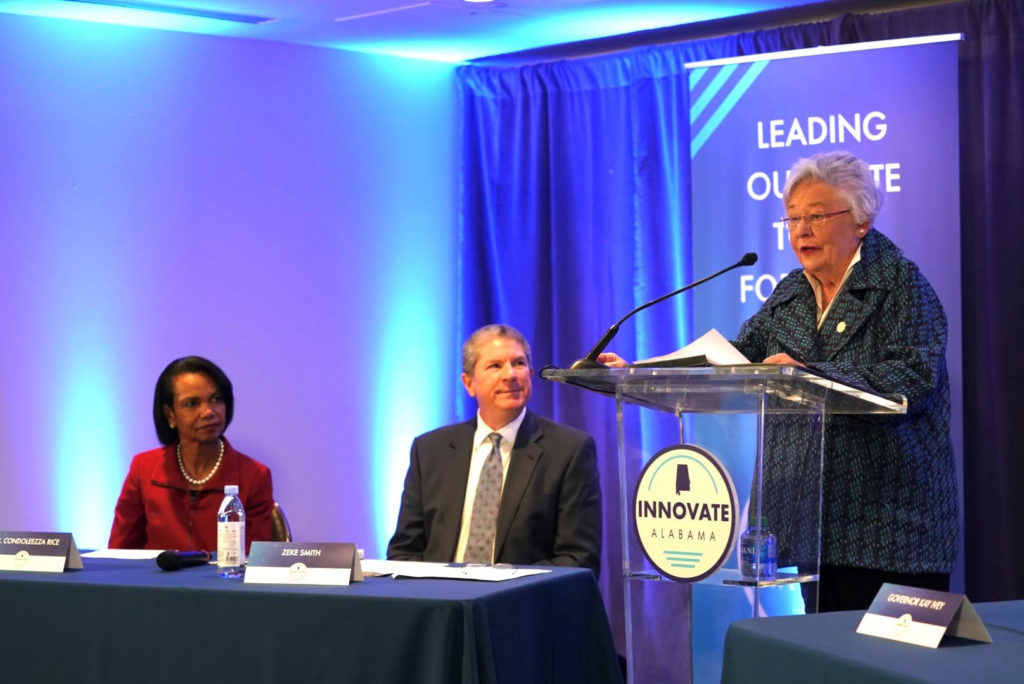
Governor Kay Ivey and Condoleezza Rice, 66th U.S. secretary of state and director of the Hoover Institution, joined state leaders on Tuesday to share the Alabama Innovation Commission’s policy recommendations and announce the Alabama Innovation Corporation board of directors. Governor Ivey established the commission and its advisory council in July 2020. “The Alabama Innovation Commission has done incredible work, and I’m excited to see how we as a state can implement smart policies that will foster innovation and develop a talented workforce for the future,” stated Governor Ivey. “I’m inspired by the promising growth for Alabama’s economy, and I look forward to working with the Alabama Legislature and the Alabama Innovation Corporation to help Alabama reach new heights.” Alabama Innovation Commission (Innovate Alabama) is the state’s first commission focused on entrepreneurship, technology, and innovation. The commission brings together private-sector experts and policymakers to develop forward-thinking policies that work to create a strong economy to help Alabama remain competitive in the 21st century. Ivey commented on Twitter, “Alabama. Where you can dream big, play hard, and live comfortably. We’re building a better state – a place where equitable opportunity exists. Now, we have a playbook to take us there.” The commission, led by Alabama Finance Director Bill Poole and state Sen. Greg Reed, includes a six-member advisory council of innovation leaders in Alabama and those outside the state who have strong ties to Alabama. The advisory council, led by Alabama Power Executive Vice President Zeke Smith, included innovation leaders from across the nation, and a partnership with Hoover Institution research scholars led by Director Rice, to support the commission’s work. “I’m proud to be a daughter of Alabama and believe that Alabama’s education, job training, and workforce development can be second to none. This state is poised for an even greater future here, and we are excited to be a part of that,” said Dr. Rice. “The Hoover Institution will continue to partner with the state and the Alabama Innovation Corporation to support this initiative as Alabama continues to push for strengthening its economy so life can be good for all Alabamians.” State Finance Director and Innovation Commission Chair Bill Poole added, “I’m proud of the commission’s work and know that its efforts will have a tremendous impact on our state. The ideas, recommendations, and strategies in this report give us a path forward for how Alabama can be a leader in the fields of innovation, technology, and research. I look forward to seeing partners from private, and public sectors continue working together through the Innovation Corporation to grow our economy.” Members of the Innovation Corporation board of directors are: Governor Kay Ivey (ex-officio) Alabama Speaker of the House Mac McCutcheon (ex-officio) Senate President Pro Tempore Greg Reed (ex-officio) House Minority Leader Anthony Daniels (ex-officio) Senator Minority Leader Bobby Singleton (ex-officio) Rich Bielen – President and CEO, Protective Life Corporation (at-large director) Dr. Michael Chambers – Assistant Vice President for Research Innovation, University of South Alabama (at-large director) Abe Harper – President, Harper Technologies (at-large director) David King – President, Dynetics (at-large director) Bill Poole – Director, Alabama Department of Finance (chairman) Britney Summerville – Founder, Birmingham Bound (at-large director) The policy recommendations and findings detailed five areas that address current challenges. Entrepreneurship and Access to Capital: Identifying and supporting opportunities to fuel entrepreneurial development at every stage of business growth. Talent Attraction and Retention: Recruiting and retaining a workforce with the skills, knowledge and credentials necessary to create innovation ecosystems throughout the state. Increasing Commercialization: Fostering an environment that increases commercialization activities, research and development efforts and supports the state’s economy as a whole. Bridging Digital and Economic Divides: Leveraging initiatives and resources that support growth throughout Alabama. Knowledge Economy: Developing a skilled workforce ready to meet the demands of the future. “These policy recommendations are a culmination of 18 months of hard work, time, and effort from a variety of different highly qualified individuals and organizations working together to chart a strong path forward for our state’s economy, and I couldn’t be any happier with the product that the commission was able to produce,” said Sen. Reed. “This report outlines a road map to spurring entrepreneurship, startup businesses, and innovation in our state, and I look forward to seeing the impact it will have on the future of Alabama.”
Alabama economic group announces partnership with Stanford

An Alabama economic development group is partnering with an institution at Stanford University in California. The aim is to promote economic growth and business innovation in Alabama. The Alabama Innovation Commission recently announced the partnership with the Hoover Institution at Stanford, The Tuscaloosa News reported. The two groups intend to incorporate intellectual resources into recommendations for practical and timely applications. A key goal of the partnership between the Alabama group, also known as Innovate Alabama, and the Hoover Institution will be recruitment and retention of companies and jobs, the newspaper reported. Another goal: Developing innovation hubs and marketing of startup companies. The Alabama group is chaired by state Rep. Bill Poole. “I am confident that the work that the Alabama Innovation Commission and the Hoover Institution will produce through this partnership will have a profound impact on the future economic trajectory of our state,” said Poole, a Republican who also chairs the Ways and Means Education Budget Committee in the Alabama House of Representatives. “We must all work together on initiatives like this to create smart solutions that will continue to make Alabama an attractive state for business investment and job creation,” he added. Alabama Gov. Kay Ivey established the 15-member Alabama Innovation Commission in July 2020 as the state’s first statewide commission focused on entrepreneurship, technology and innovation. The Hoover Institution seeks to improve humanity by advancing ideas that promote economic opportunity and prosperity while securing and safeguarding peace for America and the world, according to its website. “This partnership with the Hoover Institution will help accelerate our state’s focus on entrepreneurship and innovation,” said Zeke Smith, executive vice president of external affairs for Alabama Power and president of the Alabama Innovation Commission’s Advisory Council. “Developing strategic partnerships and leveraging outside investments has proven to be a successful approach in building a policy portfolio and determining best practices. Republished with the permission of the Associated Press.
Success Plus initiative aims to add 500,000 high-skilled workers

A new strategic workforce development initiative targets the addition of 500,000 high-skilled employees to Alabama’s workforce by 2025 in response to increasing employer demands for the higher levels of talent needed in modern workplaces. Representatives of the Alabama Workforce Council, a group of high-level business leaders from across the state, presented Gov. Kay Ivey with a report on the Success Plus initiative, which aims to prepare a pipeline of workers with industry-recognized skills obtained through earning certificates, credentials or degrees. “Success Plus research recognizes that Alabama will need to add as many as 500,000 high-skilled employees to the workforce by 2025 to fill industry’s labor needs and compete for new businesses, which would equate to approximately 60 percent of the state’s working-age population,” the report says. Ivey said the initiative is needed because the skills required to compete in 21st century workplaces are shifting. “In order to stay competitive in a global economy, Alabama must prepare our workforce to be ready for the jobs of tomorrow,” she said. “We will be working with business and industry to ensure we have the training necessary to equip Alabamians with the skills needed for these high-tech, high-skill jobs.” Read the Success Plus report. Creating pathways Representatives of the Alabama Workforce Council’s Statewide Educational Attainment Committee presented Ivey with its Success Plus report at an announcement event at the Mobile shipyard of manufacturer Austal, which employs more than 4,000 people. “Today’s economy is changing and evolving rapidly,” said the committee’s chairman, Jeff Lynn of the Alabama Community College System. “More and more skill training, in addition to a high school degree, is essential to citizens looking to build a career, improve their lives and provide opportunities for their families.” In addition to laying out a series of goals and measurements, Success Plus aims to improve access to educational opportunities, create pathways and defined routes that show people how to advance a career, and encourage collaboration among private and public entities. Zeke Smith, chairman of the Alabama Workforce Council, said Success Plus is a natural extension of AlabamaWorks, a unified system that aims to link employers with job seekers and create career paths for young people. “Success Plus will provide my team with another tool to utilize on the recruitment tool so that we can build on the economic development momentum we have going today,” said Greg Canfield, secretary of the Alabama Department of Commerce. “This initiative will underscore our commitment to providing a trained workforce and will give companies yet another reason to invest and create jobs in Alabama.” Republished with the permission of the Alabama Newscenter.
