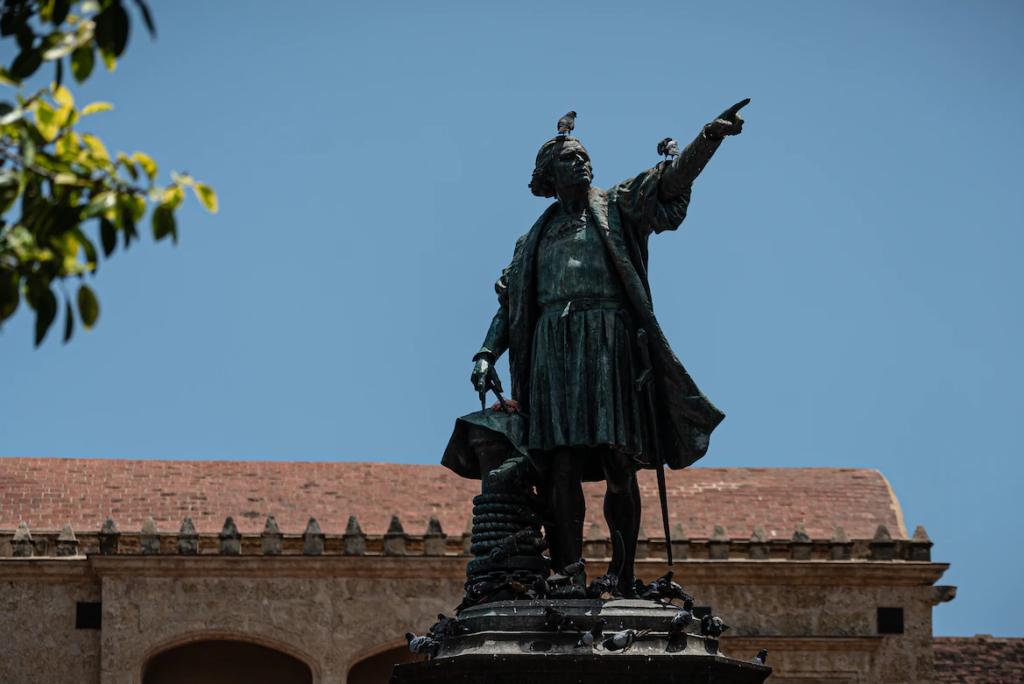
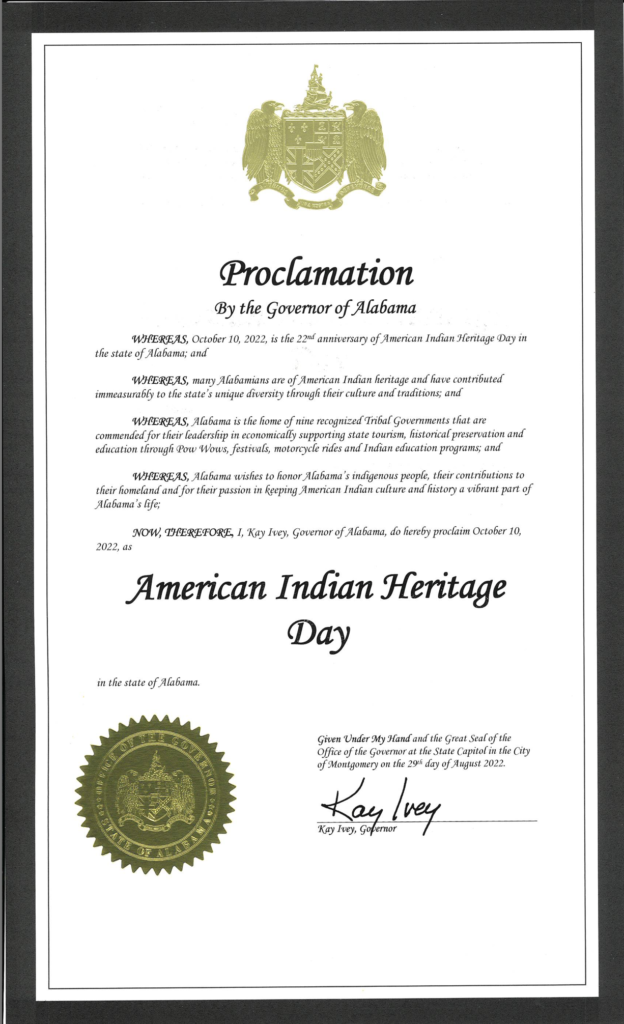
Today, October 10, is a federal and state holiday honoring Admiral Christopher Columbus for his fifteenth-century voyage of discovering the Americas. Courthouses, banks, government offices, most schools, and some businesses are closed today. Additionally, Governor Kay Ivey has declared today “American Indian Heritage Day.” She signed the resolution declaring the holiday on the same day as one that declared the month of November 2022, American Indian Heritage Month.
It is the 22nd year that American Indian Heritage Day has been recognized in Alabama alongside Columbus Day. Activists across the nation continue discussions on the pros and cons of celebrating Columbus.
The story of his life, as recounted by Britannica.com, highlights many of his accomplishments. Columbus was born in Genoa, Italy. The Italian sailor believed that the globe was much smaller than it really is, so a voyage to the west would take the mariner to India and China, which traded with Europe via a land route that went through Muslim countries. Since the Muslims and the Christians were often in a perpetual war, that land route, called “the silk road,” could be cut off.
Many people say that Columbus proved that the world was round. Most educated people at the time knew that the Earth was not flat, and the scholars of the age had even correctly calculated the circumference of the Earth. Those correct calculations, which Columbus rejected, showed that a sailing vessel that went west would run out of food and water long before they ever saw Asia. What nobody knew was that North America and South America were out there.
Leif Erikson had actually made the voyage to North America via Iceland and Greenland in the eleventh century, but there is no evidence that Columbus knew of the Viking’s voyages. Columbus also did not take the same route but rather relied on favorable “trade winds” that took ships westward.
Columbus presented his proposal to Portugal. The Portuguese were the best mariners in the world, but they were in the process of developing a sea route around Africa at the time, and King John II’s very well-educated advisors told him that Columbus’s math was wrong and that going west to India would be suicide.
Columbus then turned to Spanish monarchs Ferdinand and Isabella. The two Catholic monarchs were in the process of conquering the last Muslim Spanish kingdom, which would finish a centuries-long Reconquista that Christian Spaniards had been fighting for centuries. Columbus then sent his brother Bartholomew to England to present his proposal to King Henry VII, but Bartholomew was captured by pirates so never made it to the English court.
Finally, the Spanish took Aragon in 1491 and greenlighted Columbus’s expedition after years of lobbying by Columbus. Columbus left Spain on August 3, 1492, with three ships – the Nina, the Pinta, and the Santa Maria. The voyage took five weeks. Many of the sailors on board the ships had given up hope that they would make landfall. Then on October 7, Columbus and his crew spotted large flocks of birds. The crew knew that birds need land to nest, so they were close to a coast. They reached the Bahamas on October 12, 1492.
Columbus named the islands San Salvador. Columbus discovered Cuba and Haiti and misidentified the people that he met as Indians, thinking that he had reached islands off of the coast of India. Columbus returned to Europe in 1493, shocking his critics who thought they would never see the admiral again.
Columbus took three more voyages discovering more lands, but never discovering India. Ferdinand and Isabella had promised to make Columbus a noble, ruling all the lands that he discovered for Spain. As the lands Columbus was discovering were much more vast than Spain, honoring that promise would have made the Italian sea captain and his family the most powerful Spanish noble – by far – a reality that the Spanish court did not like at all.
The Arawak Indians and other tribes the Spanish came into contact with, were no match for the militaristic Spanish, who had guns, armor, horses, cannons, steel blades, and generations of martial experience from the Reconquista. The Indians were forced into service of their conquerors, any dissent was crushed, and the women were taken by their conquerors. Reports quickly made their way to the Spanish court, and the crown became tired of Columbus and the deal they had agreed to back in 1492. Columbus was arrested for mistreating the Indians, whom the crown viewed as Spanish subjects. They brought Columbus back to Spain in chains.
Historians have criticized Columbus for the treatment of the Indians. Columbus relied on the people he left in charge of the settlements he created, and they were often brutal despots. Given the violent history of Spanish society at that point and that the Indians they encountered had no history of serfdom, that clash of cultures was not going to go well, no matter who was in charge.
To connect with the author of this story, or to comment, email brandonmreporter@gmail.com.