Alabama Attorney General Steve Marshall’s office announced in a statement late on Tuesday that the state will appeal Tuesday’s ruling by the federal three-judge panel rejecting the Alabama Legislature’s latest congressional redistricting map.
Marshall’s office said, “While we are disappointed in (Tuesday’s) decision, we strongly believe that the legislature’s map complies with the Voting Rights Act and the recent decision of the U.S. Supreme Court.’
In filed papers with the Court, Alabama Secretary of State Wes Allen disclosed an intent to appeal the three-judge panel decision.
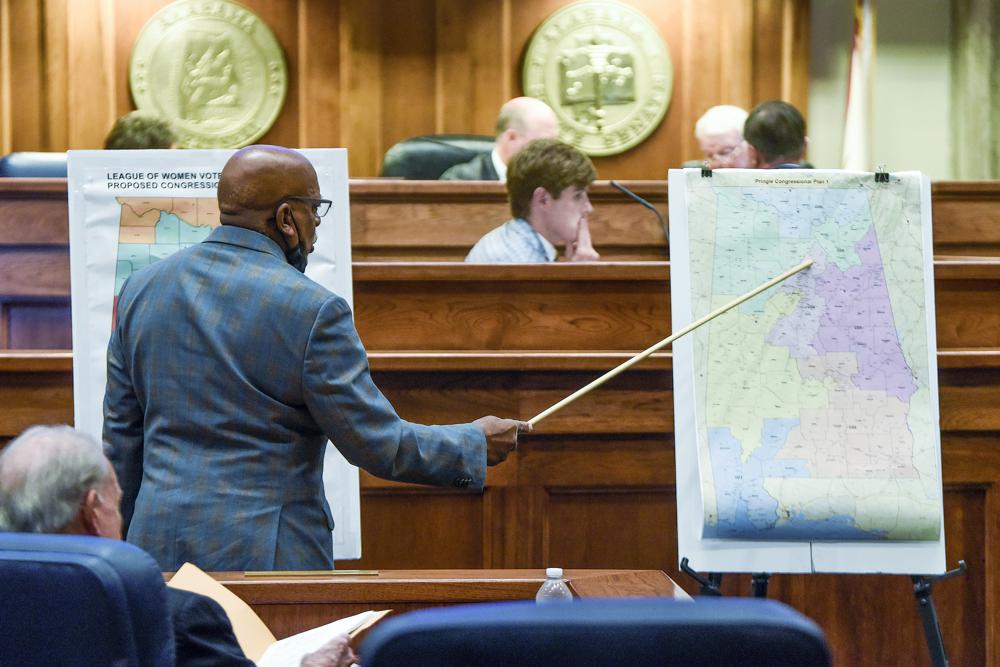
The Legislature passed a new congressional redistricting map in a July special session. In June, the state was ordered to create a map with two majority-minority districts or something close to it by the three-judge panel. The Republican supermajority of the Alabama Legislature ignored the instructions of the court order and instead just increased the percentage of Black Voters in Alabama’s Second Congressional District from 30% to 39.9% and called it an “opportunity district.”
The three-judge panel wrote that that partisan new map still violates the Voting Rights Act of 1965 and ordered a court-appointed special master to draw Alabama’s new congressional district lines.
“We are deeply troubled that the state enacted a map that the state readily admits does not provide the remedy we said federal law requires,” the Judges wrote in their order on Tuesday.
The state disagrees and will appeal to the Eleventh Circuit Court of Appeals and the U.S. Supreme Court.
Legislators close to the redistricting told Alabama Today that appealing this case to the Supreme Court was always the plan and that they expected the three-judge panel would find against the state’s map. Marshall himself, in recent remarks to the Alabama Republican Party Executive Committee in Montgomery, expressed skepticism that the three-judge panel would find in favor of the state but that the state would appeal.
The same three-judge panel ruled in 2022 that Alabama’s 2021 congressional redistricting map also violated the Voting Rights Act and ordered the state Legislature to draw a new map. Instead, the state defied the Court by refusing to draw a new map. The state appealed then to the U.S. Supreme Court. The Supreme Court initially stayed the three-judge panel order of a new map and allowed the 2022 congressional elections to proceed under the 2021 map. The Supreme Court, however, eventually ruled in June in favor of the civil rights groups suing the state and upheld the three-judge panel’s 2022 preliminary ruling that the state had likely violated the Voting Rights Act. The Supreme ruled 5 to 4 that the 2021 congressional redistricting map likely does violate the Voting Rights Act and referred the case back to the three-judge panel.
The majority decision was written by Chief Justice John Roberts and supported by the three liberal justices. Brett Kavanaugh was the deciding vote. The state is staking its case on Kavanaugh reversing himself and instead finding in favor of the State of Alabama when the state makes its case before the Court for a second time.
The Supreme Court is under no obligation to even hear this case.
Also at issue is whether the 2024 congressional elections will use the July map drawn by the Legislature or the new map that the three-judge panel ordered on Tuesday for a special master to draw. The special master won’t be finished with that new map until September 25. The state has said it needs to have a map in place by October 1, as major party qualifying for the election will begin next month. If the Court agrees to hear the state’s appeal, it will take months for the legal process, and the major party primaries are set for March 5. At this point, no one in the State of Alabama knows with any certainty which congressional district they live in moving forward.
The state contends it cannot draw a map with two majority-minority districts that is suitably compact and doesn’t divide communities of interest. The state has argued that dividing Mobile County or putting Mobile and Baldwin Counties (the two Alabama Gulf Coast counties) in separate congressional districts is unreasonable. They also say that the Wiregrass region of southeast Alabama should not be divided.
The civil rights groups suing the state argue that these concerns are secondary to the Voting Rights Act. They demand that communities of color be allowed to pick their own congressional representation.
To connect with the author of this story or to comment, email brandonmreporter@gmail.com.
Related
Share via: