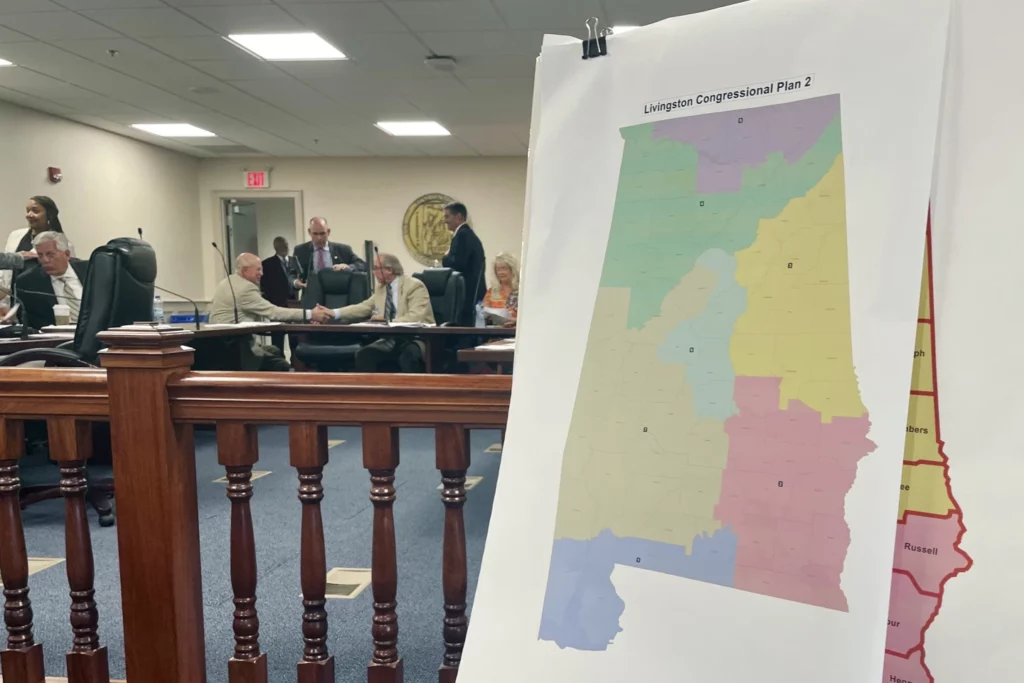
On Tuesday, a federal three-judge panel will meet to consider three Alabama congressional redistricting maps drawn by the court-appointed special master Richard Allen. The court appointed Allen after rejecting a map drawn by the Alabama Legislature in a July special session, which the judge said violates Section 2 of the Voting Rights Act of 1965.
The court rejected a motion by Alabama Attorney General Steve Marshall to stay the proceeding while the State appeals. The U.S. Supreme Court has also rejected Marshall’s request for a stay.
The three maps dramatically redraw Alabama’s Congressional Districts 1 and 2, putting Republican incumbents Jerry Carl and Barry Moore in the same districts. In the three plans, Congressional District 2 could have between 48.7% Black voters and 50.1%, depending on which plan the court approves.
“We have an opportunity to elect a 2nd Democrat to the U.S. House, win state races, and re-elect President [Joe] Biden so that he may complete his historic agenda,” Alabama Democratic Party Chairman Randy Kelley said. “Alabama has benefited greatly from President Biden’s policies, including the Bipartisan Infrastructure Law, with over $3.2 billion allocated for roads, bridges, high-speed internet, and other major projects. We will do our part by winning seats for local, state, and national offices.”
If one of these three maps is adopted, given the fact that over 80% of White Alabamians vote Republican and over 90% of Black Alabamians vote Democratic, this means that Democrats have a likely chance of winning Congressional District 2 in the 2024 election.
The three maps comply with the three-judge panel’s order that the congressional redistricting map includes two majority-minority districts “or something close to it.”
In 2021, the Alabama Legislature passed congressional redistricting that closely followed the existing seven congressional districts, which included one majority-minority district – the Seventh Congressional District.
In 2022, the three-judge panel declared that the 2021 redistricting likely violated the Voting Rights Act of 1965 and ordered the Legislature to draw a new map.
The state appealed to the Supreme Court, and the court stayed the order of the three-judge panel.
In June, the Supreme Court ruled that the three-judge panel’s order had likely been right. In a 5 to 4 Supreme Court ruling, the Court remanded the case back to the three-judge panel who ordered the state legislature to prepare a new congressional redistricting map with two majority-minority districts “or something close to that.”
In July, the Alabama Legislature met in a special session to consider redistricting. Instead of following the court’s orders, the Legislature merely increased the Black voting age population in CD2 from 30% to 39.9%.
The three-judge panel accused the Legislature of defying the court and threw out the 2023 redistricting map. They then appointed a special master and ordered him to prepare new congressional redistricts for the state.
He created three maps, all dividing Mobile County between Congressional District 1 and Congressional District 2 – something the Legislature claimed they could not do.
Marshall has vowed to continue to appeal.
To connect with the author of this story or to comment, email brandonmreporter@gmail.com.
Related
Share via: