
Donald Trump’s campaign investment tops $43 million

Donald Trump poured more than $7.5 million of his own money into his presidential campaign in April, bringing his total personal investment to more than $43 million since he declared his candidacy, new campaign finance reports filed late Friday show. The billionaire businessman, who swatted away 16 Republican rivals and relied heavily on wall-to-wall media coverage of his outsized personality and often inflammatory remarks, reported spending about $56 million during the primary, which lasted until his final two rivals, Texas Sen. Ted Cruz and Ohio Gov. John Kasich, dropped out of the race at the beginning of May. In April alone, Trump spent nearly $9.4 million, according to his monthly filing with the Federal Election Commission. Trump’s largest expense in April, about $2.6 million, was for advertisements. The campaign also spent more than $930,000 on direct mail. Other big-ticket items included roughly $585,000 in airfare paid to Trump’s TAG Air Inc. While much of Trump’s money has come from his own pocket, he reported about $1.7 million in donations last month. Those contributions have come largely from people buying Trump’s campaign merchandise, including the red “Make America Great Again” ball caps, and giving online through his campaign website. Trump didn’t begin developing a team of fundraisers until recently, after he became the presumptive GOP nominee. Almost all of Trump’s personal investment has come in the form of loans. That leaves open the possibility that he can repay himself now that he’s aggressively seeking donations. A new fundraising agreement he struck with the Republican National Committee and 11 state parties explicitly seeks contributions for his primary campaign. Yet Trump said in a statement this week that he has “absolutely no intention” of paying himself back. Instead, he will be able to use any primary money he raises, in increments of up to $2,700 per donor, on expenses such as salaries, advertising and voter outreach over the next nine weeks. After the GOP convention in late July, Trump will officially become the nominee and be restricted to spending money that’s earmarked for the general election. His likely rival, Democrat Hillary Clinton, has a head start on building a war chest for the November election. She partnered with Democratic parties months ago and has been raising millions of dollars for them. In April alone, she collected almost $800,000 in campaign money for the general election. By contrast, Trump will hold his first campaign fundraiser next week, an event in Los Angeles where the minimum price of admission is $25,000, according to the invitation. Those donations are to be split among Trump’s campaign and his Republican Party allies. In addition to the Trump campaign’s financial health, the filings also show that when Cruz dropped out, money wasn’t the issue: He had $9.4 million in his campaign coffers at the end of April, just days before his defeat May 3 in the Indiana primary prompted him to end his bid. At the time, Cruz said he left the race because he saw no path forward. Republished with permission of The Associated Press.
Florida lawmaker proposes vanity plate for Auburn University
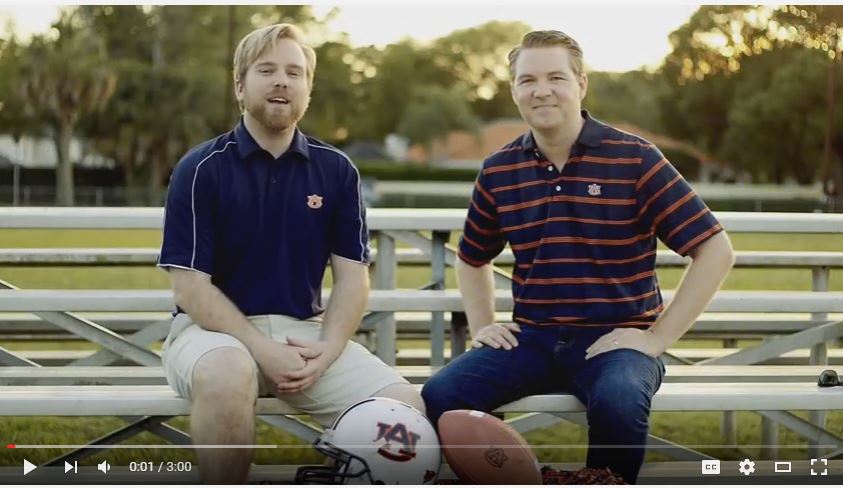
As it was once said, “the sun never sets on the British Empire.” But were they referring to Auburn University? Florida-based communications guru Kevin Cate and state Rep. Jamie Grant released a three-minute YouTube video Friday espousing a joint piety to their alma mater, Alabama’s Auburn University. Grant, a Republican who represents Hillsborough County and parts of Tampa, plans on filing a bill in the Florida Legislature to create an Auburn specialty license plate, one of over 100 specialty tags offered by the Sunshine State. What makes the effort particularly noteworthy is that it would be the first collegiate specialty tag honoring an out-of-state school. However, there is a slight complication (minuscule, some would say) – Florida law. Since state statutes are not clear on the issue of whether a specialty tag could be created for a non-Florida school, another bill would have to be introduced and passed by lawmakers, many of whom (we assume) are not particularly big fans of the Auburn War Eagles. Admittedly, it would not be an easy task. But what’s all this have to do with the British Empire, you ask? As mentioned earlier, Cate, a Democratic communications expert and one of the sharpest minds in the state of Florida, took to YouTube to promote the idea of an Auburn license plate for Floridians. The video is titled, appropriately enough: “Auburn Licence Plate for Floridians.” “Licence?” As in the British English spelling of “license”? For the casual observer, the mistake (at least we hope it was a typo) has overshadowed what would otherwise be a heartening bipartisan bond between Cate, a prominent Democratic operative, and Grant, an up-and-coming Republican. To Cate’s credit, as of Saturday, the misspelling was fixed. Nevertheless, these two “bitter members” of the Auburn family — who are only seeking to show their college pride – could have certainly benefited from a little help from their friends … Merriam-Webster. That, or we could just hum a few bars of “God Save the Queen.” For those interested in supporting an Auburn licence plate in Florida, visit iwantmyfloridaauburnplate.com.
Darryl Paulson: Donald Trump goes a-courting

On May 18, 2016, Republican presidential nominee Donald Trump released a list of 11 judges that he would “most likely” use to select his appointees to the Supreme Court. The list of 11 names included 11 whites and eight males. Six of the 11 were appointees of George W. Bush, and the other five are currently serving on their states’ supreme court. The average age of the potential nominees is 50, compared to the average age of 68.75 on the current court. The youngest nominee is David Stras of the Minnesota Supreme Court. Stras, if nominated, would be the youngest candidate put forward for the court since the FDR administration. The response to Trump’s list of potential nominees was as expected. On the political left, Nan Aron of the Alliance for Justice Action Campaign, said the nominees “reflect a radical-right ideology that threatens fundamental rights.” Ilyse Hogue, president of NARAL Pro-Choice America, called the list “a woman’s nightmare,” and said the judges would overturn Roe vs. Wade. Conservative attorney John Woo praised Trump for starting to unify the party. “Everyone on the list,” noted Woo, “is an outstanding legal scholar.” Woo called the selections a Federal Society all-star list of conservative jurisprudence.” Carrie Severino of the Judicial Crisis Network, said the nominees have “a record of putting the law and Constitution ahead of their political preferences.” The Trump campaign said the list was “compiled, first and foremost, based on constitutional principles, with input from highly respected conservatives and Republican Party leadership.” The following is a quick summary of Trump’s potential nominees to the Supreme Court: Stephen Colloton: Member of the Court of Appeals 8th Circuit since 2003. Clerked for Chief Justice William Rehnquist. Allison Eid: Colorado Supreme Court justice since her 2006 appointment by Republican Governor Bill Owens. Clerked for Clarence Thomas. Raymond Gruender: Appointed to Court of Appeals for 8th Circuit by George W. Bush in 2004. On the Heritage Foundation list of possible conservative appointees to the Supreme Court. Thomas Hardiman: On the Court of Appeals for 3rd Circuit since 2007. Appointed by George W. Bush and unanimously confirmed. Clerked for Antonin Scalia. Raymond Kethledge: On the Court of Appeals for 6th Circuit since appointed by George W. Bush in 2008. Clerked for Justice Anthony Kennedy. Joan Larson: Appointed to Michigan Supreme Court in 2015 by Republican Governor Rick Snyder. Clerked for Scalia. Thomas Lee: Associate Justice on Utah Supreme Court since 2010. Brother of Utah U.S. Sen. Mike Lee, a Trump critic, and backer of Ted Cruz. William Pryor: On Circuit Court of Appeals for 11th Circuit since 2004. On Heritage Foundation list of conservative appointees to the Supreme Court. David Stras: On the Minnesota Supreme Court since 2010. Appointed by Republican Governor Tim Pawlenty. Clerked for Clarence Thomas. Diane Sykes: On Circuit Court of Appeals for 7th Circuit since 2004. Previously on the Wisconsin Supreme Court. Ex-wife of conservative radio host Charlie Sykes, who was an outspoken critic of Trump during the campaign. Don Willett: Appointed to Texas Supreme Court by Republican Governor Rick Perry in 2005. Willett was a frequent Twitter critic of Trump during the campaign. Among his Tweets: Can’t wait till Trump rips his face Mission Impossible-style & reveals a laughing Ruth Bader Ginsburg (Aug. 27, 2015). Low-energy Trump University has never made it to #MarchMadness. Or even the #NIT. Sad! (March 15, 2016). We’ll rebuild the Death Star. It’ll be amazing, believe me. And the rebels will pay for it (April 8, 2016). Whenever lists are announced, there is an interest in both who is on the list and who has been left off. Missing from Trump’s list of possible court nominees are Judge Brett Kavanaugh of the DC Circuit Court and former Bush Administration Solicitor General Paul Clement. Both Kavanaugh and Clement appear on most lists of conservative court nominees. It is unusual to put out such a list before assuming office. Why would Trump put out such a lengthy list at this time? First, it is an attempt to solidify support among the Republican base, in particular among those who are skeptical of Trump’s conservative credentials. Second, Trump may be trying to show he is open-minded by selecting several individuals who clearly were not Trump supporters during the campaign. Finally, several of Trump’s nominees come from battleground states such as Colorado, Minnesota, Michigan and Texas that Trump needs to win if he hopes to get elected. Although many conservatives and Republicans were pleasantly surprised by the names on Trump’s list, some are still skeptical. Conservative writer Charles Krauthammer noted that Trump said that nominations “would most likely be from the list.” “Most likely” leaves too much wiggle room for many of Trump’s critics, who note he has flip-flopped on many issues during the campaign and, sometimes, on the same day. ___ Darryl Paulson is professor emeritus of government at USF St. Petersburg.
