
Bradley Byrne: 2018 – Year in review
2018 was a landmark year in many ways for Alabama and the United States. From defense funding to town halls, agriculture to Red Snapper, there was much to celebrate this year and much to anticipate in the next. Join me as we take a look back at the past year. I kicked things off in January by celebrating my 100th Town Hall Meeting in Grove Hill. I always enjoy meeting the folks in our area and hearing about the issues that matter most to them. This year, I hosted 25 town hall meetings throughout Southwest Alabama. We made real strides in 2018 when it comes to our national defense, including passing much needed funding for Alabama’s many defense priorities. I was proud to vote in favor of a funding bill that allows for the construction of three Littoral Combat Ships (LCS) and one Expeditionary Fast Transport (EPF), which are built by Austal USA in Mobile. This funding helps us move toward a 355-ship Navy. This marked the first time in ten years that we were able to fully fund our military on time, and in a bipartisan way. We funded critical Alabama defense priorities like the Austal shipyard; additional UH-60M Black Hawk, Lakota, and Apache helicopters, which are critical to the Army aviation mission at Fort Rucker in the Wiregrass; $22.4 million went to the Stryker Upgrade program, which supports the work at the Anniston Army Depot; and we increased funding to address cyber threats to our missile defense systems, which is critical to Redstone Arsenal in Huntsville. This year, we were able to celebrate great developments for our local fishermen and coastal communities. In April, a 47-day Red Snapper season for recreational fishermen was announced. And just this December, NOAA Fisheries published a new rule to increase the annual catch limits and annual catch targets for the Red Snapper fishery in the Gulf of Mexico. These latest numbers further drive us forward in the fight for greater state control over the Red Snapper fishery. Thanks to bipartisan reforms to our career and technical education programs, we are better able to give students tangible skills that help them succeed in real-world careers. In July, the House passed the Strengthening Career and Technical Education for the 21st Century Act, which made reforms to the Carl D. Perkins Career and Technical Education Act to ensure more Americans enter the workforce with the skills they need. In 2018, we made real progress on infrastructure. We passed critical legislation to support our nation’s water infrastructure, including the Port of Mobile. We are also closer than ever before to building the I-10 Bridge. And lastly, we were able to reach a bipartisan agreement on the 2018 Farm Bill to benefit our farmers and foresters in Alabama. The Farm Bill will allow for improved crop protections and loan options for farmers, incentivize rural development, support animal disease prevention and management, and will continue our nation’s commitment to agriculture and farmers. I am especially pleased to see the substantial resources provided to improve rural broadband access to communities. The many victories we were able to secure for the American people cannot be condensed into this brief article, but rest assured that this year, Alabama and the America are better off for the accomplishments made by the 115th Congress. The next year will bring many changes with the Democrat majority in the House, but my New Year’s Resolution is simple: I will continue to fight for the people of Alabama each and every day. From all of my staff, my family, and myself, we wish you a Happy New Year! Bradley Byrne is a member of U.S. Congress representing Alabama’s 1st Congressional District.
Secretary of State’s Office begins legal action to recover unpaid campaign finance fines
The Alabama Secretary of State’s Office is standing up to political action committees and candidate committees who failed to pay their campaign finance fines during the 2018 election cycle. On Thursday, Alabama Secretary of State John Merrill announced he is enforcing a 2015-495 in 2015 law that allows his office to issue fines when Principle Campaign Committees (PCCs) or Political Action Committees (PACs) don’t file their monthly, weekly, or daily campaign finance reports on time. The fines are serve as a deterrent to filing elections late and keeping pertinent donor information away from voters. There are 24 unpaid penalties among the nine noncompliant committees listed below: Burton Leflore Diedre Willis Franklin Edwards John Moton, Jr. Richard Dickerson Roderick Clark Terrence Johnson Veronica Johnson William Hobbs According to state law, all funds collected are deposited directly into the state general fund. The Fair Campaign Practices Act does not protect the people of Alabama when campaigns and their committees avoid transparent reporting of the campaign’s financial activity. This law was established to provide the people of Alabama with a concise report of the financial activity of those seeking public office in Alabama.
Alabama AG Steve Marshall to review if Senate race tactics violated law
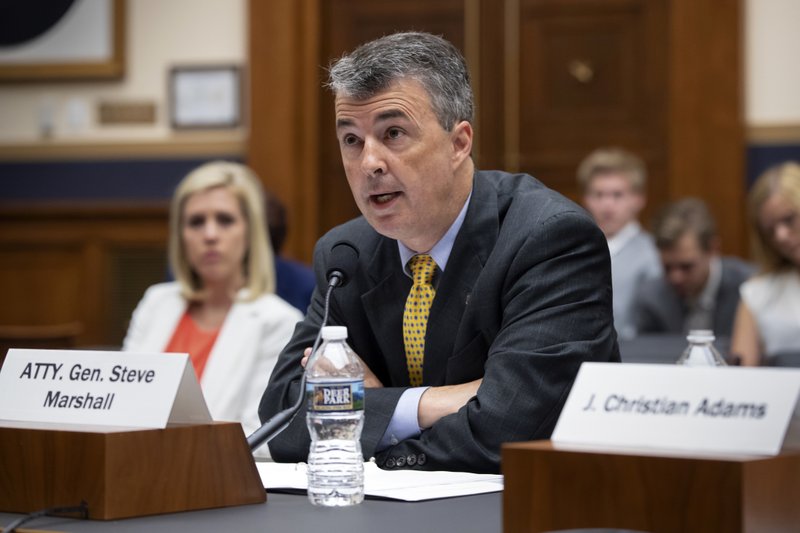
Alabama’s attorney general said Thursday that his office is reviewing whether allegedly deceptive social media tactics used in last year’s U.S. Senate race might have violated the law. Attorney General Steve Marshall told The Washington Post that reports about the effort are concerning. He said he wants to explore the issue, but stopped short of saying that his office is opening a formal investigation. “The impact it had on the election is something that’s significant for us to explore, and we’ll go from there,” Marshall, a Republican, told the newspaper. The Washington Post and New York Times reported that a social media researcher acknowledged testing misleading online tactics during Sen. Doug Jones’ 2017 campaign against Republican Roy Moore. The newspapers said operators posed as conservative voters on a Facebook page and that Twitter accounts were used to make it appear that Russian bots were following Moore. Rich Hobson, who was Moore’s campaign manager in the 2017 race, said the campaign reported concerns to social media platforms last year. “We suspected that someone or some group was interfering and we complained to Facebook as early as June 2017,” Hobson told The Associated Press on Thursday. It is unclear how far the effort reached. Some news outlets reported last year about Moore’s campaign receiving a swell in Twitter followers with Russian names. The Moore campaign said at the time it had reported the matter to Twitter, and suggested political opponents were behind the matter and were trying to plant a negative story with media members. Hobson said he could not recall the name of a Facebook page that raised concern. The newspapers reported that Jonathon Morgan, chief executive of Texas-based research firm New Knowledge, acknowledged being paid by American Engagement Technologies to experiment on a small scale. Morgan in a statement last week said his involvement was as a researcher with “the intention to better understand and report on the tactics and effects of social media disinformation.” “I did not participate in any campaign to influence the public and any characterization to the contrary misrepresents the research goals, methods and outcomes of the project,” Morgan said in a statement. The reports drew condemnation on both sides of the political aisle in Alabama, where Jones recently marked a year since becoming the first Democrat elected to the U.S. Senate from the state in a quarter-century. Jones called for an investigation into the matter. He told reporters last week that his campaign didn’t know anything about the effort at the time. And Jones says he is “as outraged as everyone else” about the allegations. Alabama Republican Party Chairwoman Terry Lathan called the revelation “deeply disturbing.” Internet entrepreneur Reid Hoffman this week apologized for donations he made that he said unknowingly helped fund the effort. “I categorically disavow the use of misinformation to sway an election,” Hoffman wrote. Alabama Secretary of State John Merrill said Thursday that there were multiple concerns raised during the 2017 race about misleading social media tactics. Merrill said it is clear that there needs to be “more policing done by the social media platform executives.” Republished with permission from the Associated Press.
No solution to shutdown in sight before Dems take House
The partial government shutdown will almost certainly be handed off to a divided government to solve in the new year — the first big confrontation between President Donald Trump and newly empowered Democrats — as agreement eludes Washington in the waning days of the Republican monopoly on power. Now nearly a week old, the impasse is idling hundreds of thousands of federal workers and beginning to pinch citizens who count on varied public services. Gates are closed at some national parks, the government won’t issue new federal flood insurance policies and in New York, the chief judge of Manhattan federal courts suspended work on civil cases involving U.S. government lawyers, including several civil lawsuits in which Trump himself is a defendant. Congress is closing out the week without a resolution in sight over the issue holding up an agreement — Trump’s demand for money to build a border wall with Mexico and Democrats’ refusal to give him what he wants. That sets up a struggle upfront when Democrats take control of the House on Jan. 3. Trump raised the stakes on Friday, reissuing threats to shut the U.S.-Mexico border to pressure Congress to fund the wall and to cease aid to three Central American countries from which many migrants have fled. The president also has signaled he welcomes the fight as he heads toward his own bid for re-election in 2020, tweeting Thursday evening that Democrats may be able to block him now, “but we have the issue, Border Security. 2020!” With another long holiday weekend coming, just days before House Republicans relinquish control, there is little expectation of a quick fix. “We are far apart,” White House press secretary Sarah Sanders told CBS on Friday, claiming of Democrats, “They’ve left the table all together.” House Democratic leader Nancy Pelosi has vowed to pass legislation as soon as she takes the gavel, which is expected when the new Congress convenes, to reopen the nine shuttered departments and dozens of agencies now hit by the partial shutdown. “If they can’t do it before Jan. 3, then we will do it,” said Rep. Jim McGovern, D-Mass., incoming chairman of the Rules Committee. “We’re going to do the responsible thing. We’re going to behave like adults and do our job.” But even that may be difficult without a compromise because the Senate will remain in Republican hands and Trump’s signature will be needed to turn any bill into law. Negotiations continue between Democrats and Republicans on Capitol Hill, but there’s only so much Congress can do without the president. Trump is not budging, having panned Democratic offers to keep money at current levels — $1.3 billion for border fencing, but not the wall. Senate Republicans approved that compromise in an earlier bill with Democrats but now say they won’t be voting on any more unless something is agreed to by all sides, including Trump. “I think it’s obvious that until the president decides he can sign something — or something is presented to him — that we are where we are,” said Sen. Pat Roberts, R-Kan., who opened the Senate on Thursday for a session that only lasted minutes. “Call it anything,” he added, “barrier, fence, I won’t say the ‘w’ word.” Trump long promised that Mexico would pay for the wall, but Mexico refuses to do so. Federal workers and contractors forced to stay home or work without pay are experiencing mounting stress from the impasse. As the partial shutdown stretched toward a second week, Ethan James, 21, a minimum-wage contractor sidelined from his job as an office worker at the Interior Department, wondered if he’d be able to make his rent. Contractors, unlike most federal employees, may never get back pay for being idled. “I’m getting nervous,” he said. “I live check to check right now.” For those without a financial cushion, even a few days of lost wages during the shutdown could have dire consequences. Roughly federal 420,000 workers were deemed essential and are working unpaid, unable to take any sick days or vacation. An additional 380,000 are staying home without pay. Like James, Mary Morrow, a components engineer on contract for NASA, is in a predicament. In addition to caring for a family largely on her own, she’s got a mortgage. “I have three teenage boys, it’s near Christmas time and we just spent money, there are credit card bills and normal bills and it’s really nerve-wracking,” she said. “It’s scary.” Steve Reaves, president of Federal Emergency Management Agency union, said the shutdown could have consequences that stretch beyond a temporary suspension of salary. Many federal government jobs require a security clearance, he said, and missed mortgage payments or deepening debt could hurt their clearance. David Dollard, a Federal Bureau of Prisons employee and chief steward for the American Federation of Government Employees Local 709 union in Colorado, said at least two agency employees lost their homes after the 2013 shutdown suspended their salaries. Bureau of Prisons employees are considered essential, and must work without pay. The agency is already understaffed, Dollard said. Shutdown conditions make everything worse. “You start out at $44,000 a year, there’s not much room for anything else as far saving money for the next government shutdown, so it puts staff in a very hard situation,” he said. “We’ve got single fathers who have child support, alimony. It’s very hard to figure out what you’re going to do.” Candice Nesbitt, 51, has worked for 1½ years for the U.S. Coast Guard, the only branch of the military affected by the shutdown. About 44,000 Coast Guard employees are working this week without pay; 6,000, including Nesbitt, have been furloughed. Nesbitt worked for a contractor but took a pay cut in exchange for the stability of a government job. She has a mortgage, is the guardian of her special needs, 5-year-old grandson, and makes about $45,000 a year, she said. Any lapse in payment could plunge her into debt. “It shakes me to the core,” she
