Donald Trump signed Bibles in Alabama. Heresy? Many religious leaders say no
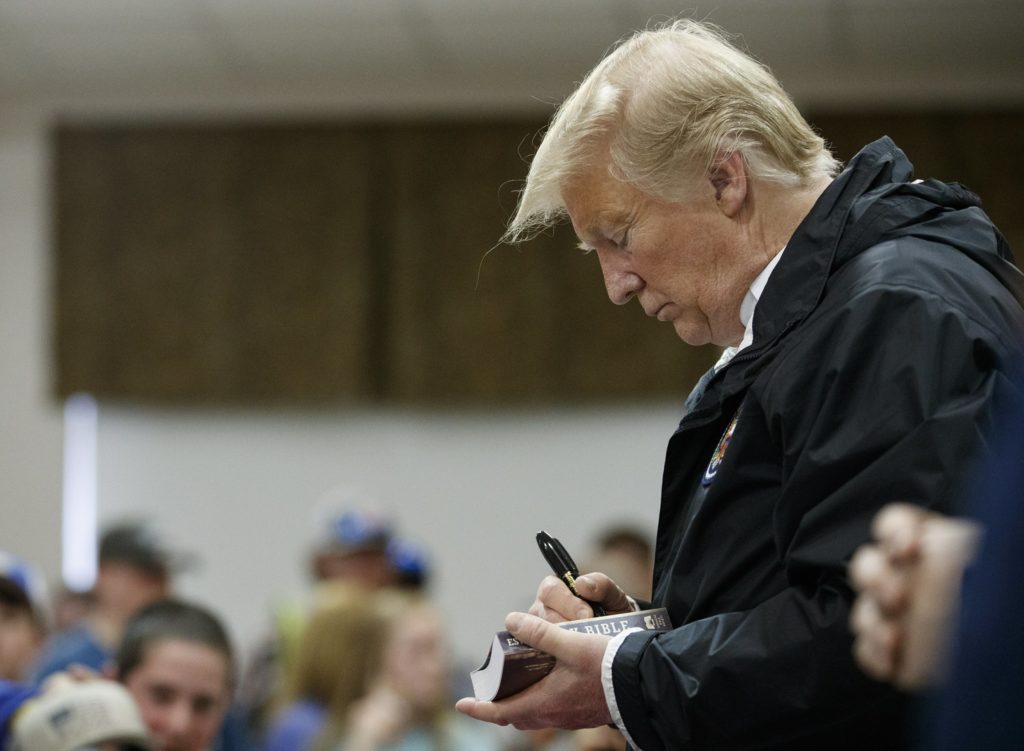
President Donald Trump was just doing what he could to raise spirits when he signed Bibles at an Alabama church for survivors of a tornado outbreak, many religious leaders say, though some are offended and others say he could have handled it differently. Hershael York, dean of the Southern Baptist Theological Seminary School of Theology in Louisville, Kentucky, said he didn’t have a problem with Trump signing Bibles, like former presidents have, because he was asked and because it was important to the people who were asking. “Though we don’t have a national faith, there is faith in our nation, and so it’s not at all surprising that people would have politicians sign their Bibles,” he said. “Those Bibles are meaningful to them and apparently these politicians are, too.” But the Rev. Donnie Anderson, executive minister of the Rhode Island State Council of Churches, said she was offended by the way Trump scrawled his signature Friday as he autographed Bibles and other things, including hats, and posed for photos. She viewed it, she said, as a “calculated political move” by the Republican president to court his evangelical voting base. Presidents have a long history of signing Bibles, though earlier presidents typically signed them as gifts to send with a spiritual message. President Ronald Reagan signed a Bible that was sent secretly to Iranian officials in 1986. President Franklin Roosevelt signed the family Bible his attorney general used to take the oath of office in 1939. It would have been different, Anderson said, if Trump had signed a Bible out of the limelight for someone with whom he had a close connection. “For me, the Bible is a very important part of my faith, and I don’t think it should be used as a political ploy,” she said. “I saw it being used just as something out there to symbolize his support for the evangelical community, and it shouldn’t be used in that way. People should have more respect for Scripture.” York said that he, personally, would not ask a politician to sign a Bible, but that he has been asked to sign Bibles after he preaches. It feels awkward, he said, but he doesn’t refuse. “If it’s meaningful to them to have signatures in their Bible, I’m willing to do that,” he said. A request for comment was left with the White House on Saturday, a day after Trump visited Alabama to survey the devastation and pay respects to tornado victims. The tornado carved a path of destruction nearly a mile wide, killing 23 people, including four children and a couple in their 80s, with 10 victims belonging to a single extended family. At the Providence Baptist Church in the Beauregard community in Alabama, the Rev. Rusty Sowell said, the president’s visit was uplifting and will help bring attention to a community that will need a long time to recover. Before leaving the church, Trump posed for a photograph with a fifth-grade volunteer and signed the child’s Bible, said Ada Ingram, a local volunteer. The president also signed her sister’s Bible, Ingram said. In photos from the visit, Trump is shown signing the cover of a Bible. Trump should have at least signed inside in a less ostentatious way, said the Rev. Dr. Kevin Cassiday-Maloney. “It just felt like hubris,” said Cassiday-Maloney, pastor at the First Congregational United Church of Christ in Fargo, North Dakota. “It almost felt like a desecration of the holy book to put his signature on the front writ large, literally.” He doesn’t think politicians should sign Bibles, he said, because it could be seen as a blurring of church and state and an endorsement of Christianity over other religions. It would have been out of line if Trump had brought Bibles and given them out, but that wasn’t the case, said James Coffin, executive director of the Interfaith Council of Central Florida. “Too much is being made out of something that doesn’t deserve that kind of attention,” he said. Bill Leonard, the founding dean and professor of divinity emeritus at the Wake Forest University School of Divinity in Winston-Salem, North Carolina, woke up to Facebook posts Saturday morning by former students who were upset about Trump signing the Bibles because they don’t view him as an appropriate example of spiritual guidance. But, Leonard said, it’s important to remember that signing Bibles is an old tradition, particularly in Southern churches. Leonard said he would have viewed it as more problematic if the signings were done at a political rally. He doesn’t see how Trump could have refused at the church. “It would’ve been worse if he had said no because it would’ve seemed unkind, and this was at least one way he could show his concern along with his visit,” he said. “In this setting, where tragedy has occurred and where he comes for this brief visit, we need to have some grace about that for these folks.” Republished with permission from the Associated Press.
Did your state senator vote for or against the gas tax? Here’s the full list
After weeklong special session, the Alabama State Senate voted 28-6 in favor of Gov. Kay Ivey‘s plan to raise the state’s gas tax by 10 cents as a means to fund infrastructure improvements on Tuesday. Ivey signed the bill into law Tuesday afternoon. Here’s the full list of who voted for and against the gas tax bill: Voted in favor of the gas tax Greg Albritton Gerald Allen Billy Beasley David Burkette Tom Butler Clyde Chambliss Donnie Chesteen Linda Coleman-Madison Chris Elliot Sam Givhan Garlan Gudger Jim Holley Andrew Jones Steve Livingston Del Marsh Tim Melson Arthur Orr Randy Price Greg Reed Sanders-Fortier Clay Scofield David Sessions Bobby Singleton Rodger Smitherman J.T. Waggoner Cam Ward Tom Whatley Jack Williams Voted against the gas tax Will Barfoot Vivian Davis Figures Jim McClendon Dan Roberts Shay Shelnutt Larry Stutts No vote Priscilla Dunn
Kay Ivey signs gas tax in law, first increase set for Sept. 1
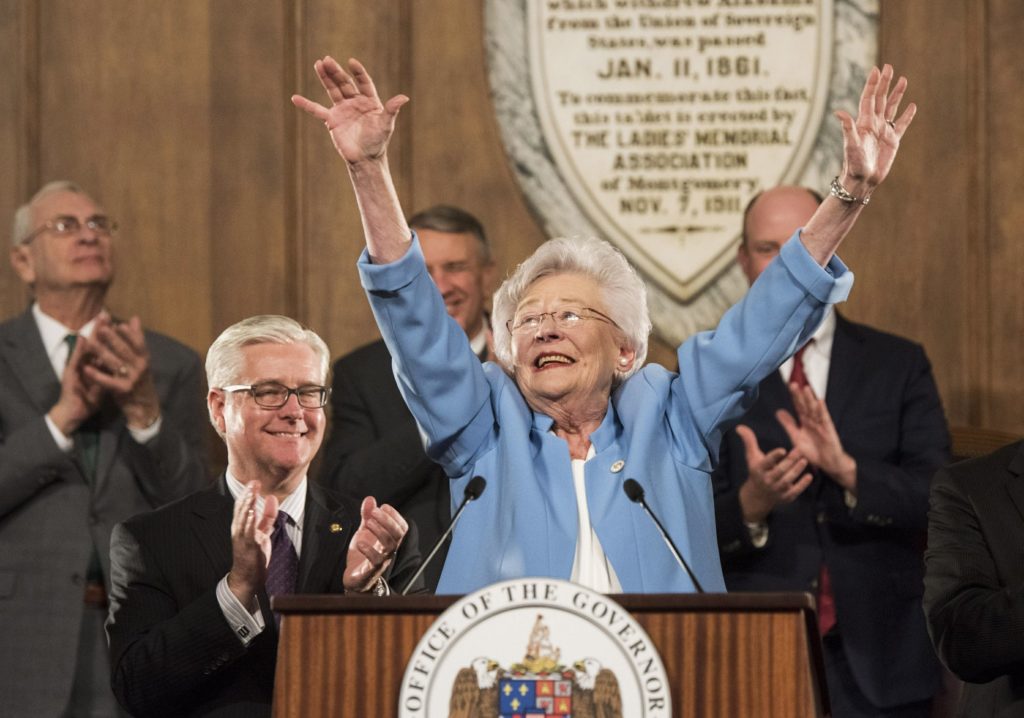
Alabama Gov. Kay Ivey on Tuesday signed a 10-cent-a-gallon gas tax increase into law. She was joined by a bipartisan group of legislators at the bill signing, including bill sponsors Rep. Bill Poole and Sen. Clyde Chambliss. Ivey’s signature comes roughly two-hours after the Alabama Senate approved the House-passed version of the bill, 28-6. The bill was fast-tracked for approval in a special session that Ivey called last week. Ivey did this to lowers the threshold for approval of the legislation. In the regular session, bills connected with the state budget must pass with a three-fifths majority. With 105 members of the State House of Representatives, only 53 members needed to vote in support of it. In the 35 member Senate, 18 was all that was required to approve the bill. It’s all in the details The state currently imposes a flat excise tax of 18 cents-per-gallon on gas and 19 cents-per-gallon on diesel, without adjusting for inflation and other construction and maintenance costs. This combined fuel tax revenue generates 80 percent of Alabama’s transportation funding. The plan’s 10-cent increase will be phased in over the next three years: up 6 cents effective Sept. 1, 2019, up another 2 cents, effective Oct. 1, 2020, and up another 2 cents, effective Oct. 1, 2021. The bill is expected to cost the average Alabama driver roughly $55 a year, or $4.58 a month. That’s according to the Alabama Transportation Institute based on 12,000 annual miles and 22MPG. New revenue generated by the increase will be dispersed between state, county, and municipal governments in Alabama. According to Ivey, these funds are to be used for transportation infrastructure improvement, preservation and maintenance projects. A separate portion of the revenues will go to pay a bond to be issued to finance improvements to the ship channel providing access to the facilities of the Alabama State Docks. The state’s gasoline tax was last increased in 1992.
Alabama Senate overwhelmingly approves Kay Ivey’s 10-cent gas tax hike
Gov. Kay Ivey‘s proposed 10-cent per gallon gas tax increase flew through the Alabama Senate this week on the legislative fast track. The full chamber approved the House-passed version of the Tuesday afternoon, 28-6. Anniston-Republican, Senate President Pro Tempore Del Marsh released the following statement following the approval of the legislation Over the last ten years we have seen unprecedented growth in Alabama. Median income is up 20%, unemployment is at an all-time low. We have dramatically reduced the size of state government, we have over 6,000 fewer state employees today than we did eight years ago which equates to a 15% reduction. However, in this time, our infrastructure has lagged behind and every one agreed that something needed to be done. This bill was passed the correct way. Over the past year my office alone has held over 30 open meetings with legislators, and all interested stakeholders. All voices were heard and nothing was rushed. I want to thank the body for adopting strict oversight and accountability measures. Because of this, there is no doubt that going forward the money which is supposed to be used for infrastructure will be used for road, bridge and port improvements. As a fiscal conservative, it would have been impossible to support any type of revenue measure in the infrastructure package without the oversight and accountability laid out in this bill. I thank the Senate for their support, Sen. Chambliss and Rep. Poole for their leadership on this issue and Governor Ivey for taking this issue head on. This infrastructure package will drive industry in Alabama for years to come and ensure that we continue the strong economic growth that we have enjoyed over the past few years by making sure that we are competitive on the world stage when it comes to recruiting jobs. The plan’s 10-cent increase will be phased in over the next three years: up 6 cents effective Sept. 1, 2019, up another 2 cents, effective October 1, 2020, and up another 2 cents, effective October 1, 2021. It is estimated that it will raise $320 million a year for road construction and maintenance Ivey is expected to sign the bill into law later today, marking the first time the gas tax has been raised since 1992.
Marilyn Singleton: Thought police (oops, Medicare) for all

The new Medicare for All bill (H.R. 1384) has come and hopefully will go the way of the pet rock. Everybody now knows the basics: the government will take care of all medical, dental, vision, pharmacy, and long-term care services with no out-of-pocket expenses. The bill prohibits parallel private insurance, and has the glaring absence of a financing mechanism. But as usual, bills contain hidden gems. Section 104 of the bill tracks the Affordable Care Act’s “anti-discrimination” rule, making it clear that no person can be denied benefits, specifically including abortion and treatment of gender identity issues “by any participating provider.” The bill does not correspondingly reaffirm the federal laws protecting conscience and First Amendment religious freedom rights of medical personnel. Such protections relate to participation in abortion, sterilization, assisted suicide, and other ethical dilemmas. Most sane individuals agree that we do not want our government to control any aspect of our individual lives—particularly not our religious beliefs and moral codes. When the Department of Health and Human Services (HHS) sought to clarify such conscience protections, thousands of commenters offered evidence of discrimination and coercion to violate the tenets of the Oath of Hippocrates and their own ethics. Some left their jobs or left the medical profession entirely when their conscientious objections were not honored. Conscience protections are vital in this time of unabashed devaluing of life. Last year, the Palliative Care and Hospice Education Training Act (PCHETA), passed the House but died in the Senate. This bill would have dedicated $100 million in additional taxpayer dollars to persuade patients to forgo treatment that might prolong life in exchange for a steady stream of increasing doses of narcotics. Already some families feel they are not merely offered hospice as a choice but are steered toward it when their older relatives fall ill, even when the medical prognosis is uncertain. The focus on palliative care and lowering costs by reducing “aggressive” end-of-life treatment is one more incremental under-the-radar step along the road to government control over life and death. A culture of hastening death has gradually evolved, disguised as “death with dignity.” California, Colorado, Oregon, Washington, Montana, Vermont have legalized physician-assisted suicide with 20 other states considering implementing such laws. Subtly devaluing life primes the pump for rationing of medical care at all stages by a government-run program that is the exclusive purveyor of medical “benefits.” Our western counterparts with single payer have discovered that offering fewer benefits is the simplest way to control costs. The “Complete Lives System”—the brainchild of ObamaCare physician architect Ezekiel Emanuel—includes worrisome determinants of who should receive care. The system prioritizes adolescents and persons with “instrumental value,” i.e., individuals with “future usefulness.” This year, legislators were not so subtle. It is bad enough that our elderly are pushed into hospice, but now the compassionate legislators have set their sights on newborns. New York passed, and Virginia floated laws that permit the killing of babies after birth. The U.S. Senate garnered only 53 of the 60 votes needed to pass the Born Alive Survivors Protection Act which would mandate medical care and legal protections to infants born alive after an attempted abortion. Starting in the 1970s, the federal government clearly saw a need to protect medical personnel from the tyranny of the government mandates that could violate religious or moral convictions. Personal liberty is an integral part of our democratic republic. While a physician’s calling is to render treatment to all patients, this is balanced with an individual physician’s moral beliefs. This is no more apparent than in legislation permitting physician assisted suicide and post-delivery “abortions.” Sadly, under threat of discrimination lawsuits, some physicians have acquiesced to patients’ requests for medications and surgical procedures that conflict with their moral code. As anthropologist, Margaret Mead so brilliantly wrote, “One profession, the followers of [Hippocrates], were to be dedicated completely to life under all circumstances…This is a priceless possession which we cannot afford to tarnish, but society always is attempting to make the physician into a killer—to kill the defective child at birth, to leave the sleeping pills beside the bed of the cancer patient. … It is the duty of society to protect the physician from such requests.” We must not let the government bury our conscience and beliefs under layers of bureaucracy. Medicare for All may mean independent thought for none. Dr. Marilyn Singleton is a board-certified anesthesiologist. She is President of the Association of American Physicians and Surgeons (AAPS). She graduated from Stanford and earned her MD at UCSF Medical School. Dr. Singleton completed 2 years of Surgery residency at UCSF, then her Anesthesia residency at Harvard’s Beth Israel Hospital. While still working in the operating room, she attended UC Berkeley Law School, focusing on constitutional law and administrative law. She interned at the National Health Law Project and practiced insurance and health law. She teaches classes in the recognition of elder abuse and constitutional law for non-lawyers. She lives in Oakland, Ca.
Donald Trump’s budget proposal offers preview of upcoming campaign

Frustrated by a divided Congress and rifts within his own party, President Donald Trump is giving little indication in his latest budget proposal of any new policy ambitions for the coming two, or six, years. Trump’s budget plan increases spending on his border wall and the military but is light on fresh ideas heading into his re-election campaign. His budget for the next fiscal year, which has little chance of advancing in Congress, largely focuses on deep spending cuts and pushing more money toward established goals such as his long-promised wall, improving care of veterans and combating opioid abuse. Budgets may offer a president’s vision for the direction of the nation, but Trump’s latest also offers an early window into his upcoming campaign. With the Democratic race to unseat him heating up, Trump is contending with middling approval ratings, energized Democrats and political vulnerabilities in critical states. Like his predecessors, he’ll soon be called on to complete the politically loaded phrase, “Send me back to the White House so that I can …” “I think, as he gets closer to 2020, he will need to lay out what a second term would look like,” said Republican consultant Alex Conant. “Voters always want to know, ‘What have you done for me lately?’ If he doesn’t paint a picture of what his second term will look like, then the Democrats will do it for him.” The White House argues that Trump isn’t just advancing the same policies a second time over, he’s enhancing them with more detail than his first go-round, particularly in the area of trade policy. Following a State of the Union address that contained little new policy, the budget is hardly a surprise. Still, the budget can serve more than one political purpose, argued former Trump campaign aide Barry Bennett, who said the document highlights Trump’s clashes with Democrats over border and military funding. He argued that the Democratic tilt to the left also will benefit Trump as he seeks to frame the argument. Bennett said Trump’s pitch can be: “If your paycheck likes what I’ve done, send me back. If you don’t, they’ll undo it all.” Trump has already addressed much of his laundry-list agenda from 2016, notching victories in many areas while seeking to minimize losses and mixed results. He has cut taxes, exited global accords and installed conservative judges on the courts, including two Supreme Court justices. He has not succeeded in replacing President Barack Obama’s health care law, is still working on renegotiating trade deals and has struggled to secure all the funding he wants for his border wall. In all, the efforts have largely pleased his political base, but satisfaction with past performance is hardly a reliable tactic for expanding your support. Thus far, Trump’s re-election campaign moves have been laser-focused on maintaining his most ardent supporters. It’s a risky wager, laid down by the president himself, that he can overcome weakness with moderate and independent voters by turning out even more loyalists in 2020 than he did in 2016. During his aggressive push to maintain the GOP’s hold over the Senate during the midterm elections, Trump emphasized his hardline immigration rhetoric above all else. He has returned again and again to his long-promised border wall, even forcing the government to partially shut down in an effort to win funding. The latest budget also calls for repealing “Obamacare,” limiting future federal spending on Medicaid for people with lower incomes, as well as breaking out the new Space Force as its own military branch. “We believe that every budget is an opportunity to put forward our vision for the next 10 years,” said acting budget director Russell Vought. Trump’s gamble has skeptics among some in the president’s inner circle, who have pushed the president and the White House to embrace larger policy ideas designed to win over moderates and independents. Aides point to Trump’s cautious embrace of a family medical leave policy pushed by his daughter, Ivanka Trump, as the sort of proposal Trump’s team should spend more time developing ahead of 2020. She is backing new funding for child care in the current proposal. A White House-backed infrastructure plan, the hobbyhorse of Washington election year policy, appears no closer to fruition than when Trump first raised it two years ago, with his budget allocation unchanged from previous years. Trump’s nascent re-election campaign has just begun staffing-up for 2020, with a focus on developing a more professionalized operation than 2016, but has yet to announce a policy staff. Trump’s light policy load is also a function of his increasingly strained relationship with Congress. Under divided control, the White House views it as unlikely that any new proposals can win legislative approval — and plan to be judicious about sending anything to Capitol Hill only to see it defeated. Republished with permission from the Associated Press.
Rauf Bolden: Abusing eminent domain in Orange Beach
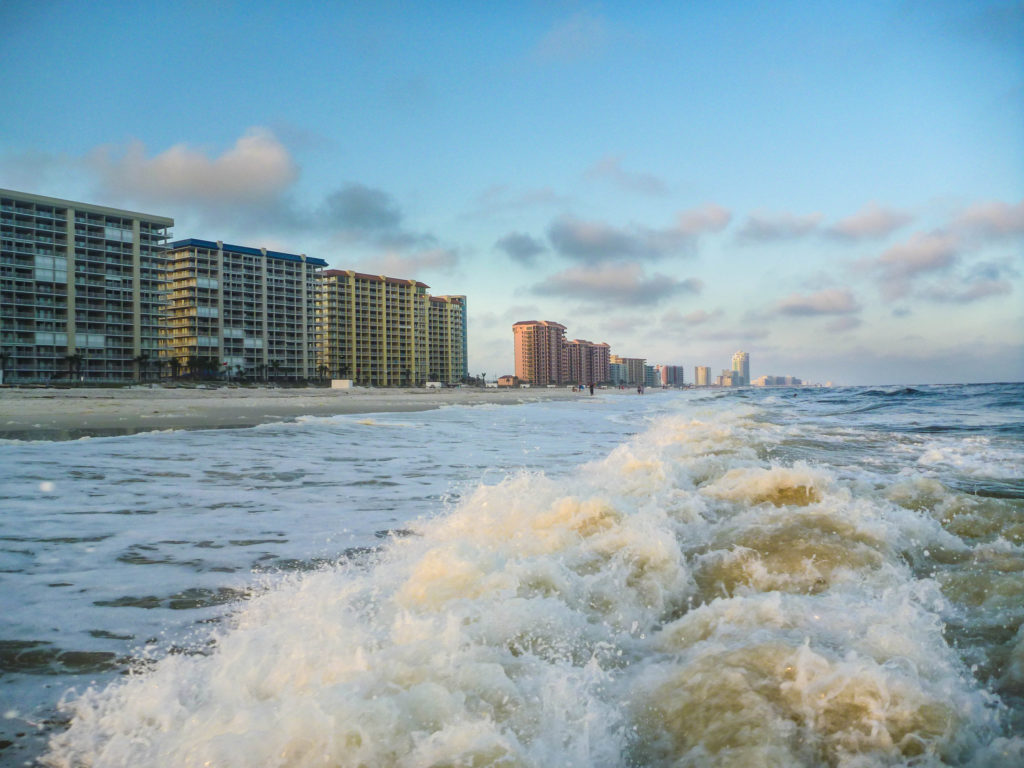
Confiscating properties through eminent domain to build bridges and roads in Orange Beach is abusive. It rails against conservative ideals. Nothing says socialism quite like seizing private lands, getting what the government wants at all cost. “Eminent domain is a necessary evil,” said Mayor Tony Kennon, according to a report in The Islander (April 25, 2018, page 29). His empathy speaks volumes, justifying governmental property seizures, referring to three families who will lose their home-based businesses on land needed for the Flyover Bridge west of the Foley Beach Express. He might as well have told those families, “Too bad!” The Tom Thumb and its associated businesses in the convenience store’s mall, located at the corner of Canal Road and Hwy 161 are also scheduled for seizure under eminent domain, being demolished and replaced by a double turn lane, enabling better traffic flow for vacationers. It’s troubling not knowing what other economic disenfranchisement plans local government has in mind for business owners and families in Orange Beach. How did we get here? The need to increase condominium building on the beach for tax revenues spurred traffic growth. Years ago the zoning laws were not amended, and now it is too late to stop development. Realizing this Mayor Kennon requested help from the state, asking them to widen the arterial roads, countering the traffic problem. One thing led to another, and we now find ourselves in the predicament of having to confiscate private lands to build additional infrastructure, accommodating more tourist traffic, because growth is in an upward spiral. Orange Beach has come a long way since it was a sleepy fishing village on the Alabama Gulf Coast. It is property rights abuses, associated with confiscating private land that bothers me. Where does the power of eminent domain come from? “The Fifth Amendment to the Constitution [U.S.] says ‘nor shall private property be taken for public use, without just compensation.’ This is a tacit recognition of a preexisting power to take private property for public use, rather than a grant of new power.” Eminent domain “appertains to every independent government. It requires no constitutional recognition; it is an attribute of sovereignty [federal and state],” according to a report on Justia. Power derived from “no constitutional recognition” is subjective, and prone to misapplication. This is what I am arguing here. Slow traffic is not a life and death situation, requiring immediate action like flooding. It is simply a time wasting inconvenience. In my opinion, this does not justify confiscating an individual’s property through eminent domain. Some would say the traffic situation is the result poor planning, related to over development, but we are not going to go there. Municipal employees work very hard with the limited resources at their disposal, trying to satiate the political voices, crying for more tax revenue through increased expansion. Can the government’s plan use strong-arm tactics, forcing landowners to sell? The Alabama Constitution (AL Code § 18-1A-22 (2016)) defines the rules of engagement, “In order to compel an agreement on the price to be paid for the property, a condemnor may not arbitrarily advance the time of condemnation, arbitrarily defer negotiations or condemnation, nor take any other action coercive in nature.” On the face of it you do not have to sell if you do not want to, but government has other tools in its arsenal like ruling your property uninhabitable, offering you an assessed value in exchange for taking it off your hands. Receiving a low ball figure for your property won’t make you feel any better, since your plot has other intrinsic value like memories of your children playing under the oak tree that are priceless to you. These intangibles do not fit into the payment equation. “‘Prior to the adoption of the Fourteenth Amendment,’ the power of eminent domain of state governments ‘was unrestrained by any federal authority’ [Green v. Frazier, 253 U.S. 233, 238 (1920)]. The Just Compensation Clause of the Fifth Amendment did not apply to the states [Barron v. Baltimore, 32 U.S. (7 Pet.) 243 (1833)], but it does now. How can we square the circle of fairness? Well-defined property rights are important because they increase economic activity, bolstering standards of living, quality-of-life, and a strong tax base that is inextricably linked to property rights. Having the specter of property confiscations hanging over your head is contrary to the DNA that is baked into Alabamians – no government interference. I guess the days of personal freedom, relating to private property are over, at least in Orange Beach. “In a new study released by the Cato Institute — a libertarian think tank dedicated to the principles of individual liberty, limited government, free markets, and peace — Alabama was ranked 49th in personal freedom,” according to a report by Elizabeth Patton on Alabama Today. Unless Mayor Kennon wants to step up, guaranteeing elevated prices for seized properties, I see no fair solution or happy ending. Property confiscation is a reflection of personal freedom, because government holds all the cards. It is important to argue the seller should get more money than the assessed value of the property, adding a certain “sweetener” for familial memories lost while being forced to vacate his or her land under eminent domain. In a monetary way, better prices increase personal freedom. Mayor Kennon will counter that confiscations for infrastructure improvements in Orange Beach are not the work of the city, but the state. I argue the city is complicit, colluding with the state, ensuring specific infrastructure improvements happen regardless of which family gets hurt. The instincts to confiscate private lands, ostensibly for the greater good is the thin end of the wedge. Local government must be very careful, using this tool, because irreversible damage can occur, affecting the fabric of the community. Mayor Kennon’s motives are honorable, wanting to accommodate the tourists, easing the amount of traffic on the roads during the summer season. I question the methodology of confiscating property to achieve his ends. Would Mayor Tony