
7 Alabama schools chosen to pilot early education program

Alabama is launching a pilot program to help improve student success by aligning effective teaching strategies and improving collaboration among educators , Governor Kay Ivey announced on Monday. “A strong start in the early years of a child’s education ensures a strong finish in their later educational endeavors. Whether a student will find success in school and the workforce is traditionally evidenced in their performance by third grade,” Ivey said. Five Alabama school systems, with a total of seven individual schools, will serve as pilots for the Alabama Pre-K-through-Third-Grade Integrated Approach to Early Learning program. The selected schools are: Barkley Bridge Elementary School (Morgan County) Kinston Elementary School (Coffee County) New Brockton Elementary School (Coffee County) Pleasant Grove Elementary School (Cleburne County) Skyline School (Jackson County) Wetumpka Elementary School (Elmore County) Zion Chapel School (Coffee County) The new program is a joint partnership between the Alabama Department of Early Childhood Education and the Alabama State Department of Education. Each participating school will receive a $15,000 grant for each classroom to purchase age-appropriate classroom materials and improve early learning experiences. Based on research from Harvard University, the University of Washington and others, the program creates a structure for aligning and coordinating academic standards, instructional practices, professional development and developmentally appropriate classroom assessments from pre-k to the third grade. “Children have the most potential for growth from pre-K to third grade, and we are delighted to partner with the Alabama State Department of Education to create new opportunities for local schools to support students during their critical early years of learnings,” commented Jeana Ross, Secretary of the Department of Early Childhood Education. “This approach to early learning combines best practices from our programs to better support strong teaching, student achievement and student success for all students.” Schools participating in the program will also gain access to early childhood education specialists who will help pre-k to third grade teachers implement evidence-based instructional practices. “If we haven’t given our students a strong learning foothold by the third grade, they will be fighting an uphill battle for the rest of their educational careers; this program addresses that truth head-on,” Ivey concluded.
State Dept. of Education announces inaugural state superintendent’s teacher cabinet

After taking the helm of the Alabama State Department of Education (ALSDE) last August, new State Superintendent Michael Sentance called for a new advisory group of educators, which will provide a direct avenue of communication with the state superintendent to discuss important issues regarding education. On Thursday, the ALDSE announced the new group’s — the Superintendent’s Teacher Cabinet for Alabama educators — inaugural members. The selected teachers will serve on the cabinet for one-year terms, with the exception of the soon-to-be-announced 2017-18 Teacher of the Year, who will serve a two-year term. According to the ALDSE, the teachers will meet with Sentance approximately twice each semester, and will also be invited to attend/speak at events pertinent to elevating the teaching profession. There were several hundred applicants, reviewed by ALSDE staff and ultimately chosen by the state superintendent. The inaugural State Superintendent’s Teacher Cabinet includes: Dana Jacobson (Co-Chair) 2016-17 Alabama State Teacher of the Year To be named May 10 (Co-Chair) 2017-18 Alabama State Teacher of the Year Roger Rose Social Studies Teacher Mary G. Montgomery High School, Mobile County Public School System Christy Anders 6th grade Special Education Teacher Muscle Shoals Middle School, Muscle Shoals City School System Michael May Science and Engineering Teacher Athens High School Erica Griffin AP English Language and Composition Teacher Hartselle High School, Hartselle City School System Jennifer Fernandez K-5th grade ESL Teacher Austinville Elementary, Decatur City School System Stephanie Hyatt Reading Teacher and AP English Teacher 9-12th grades Lee High School, Huntsville City Schools Paige Hicks History Teacher Athens High School, Athens City School System Aishia King English/Language Arts Teacher Mary G. Montgomery High School, Mobile County Public School System Brandi Evans 4th grade Teacher W.S. Harlan Elementary School, Covington County School System Andrea Rascoe 6th grade Math Teacher Saraland Middle School, Saraland City School District Julie Ramsay Reading/Reading Intervention, and English Language Arts Teacher Rock Quarry Middle School, Tuscaloosa City School System Jennifer Reaves 6th-8th grade Career and Technical Education Teacher Echols Middle School, Tuscaloosa County School System Darren Ramalho Social Studies/English Teacher, Robert C. Hatch High School, Perry County Schools Kristin Daniel K-2nd grade Art Teacher, Auburn Early Education Center, Auburn Schools Robert Louis Lyda K-2nd grade Music Teacher, Cary Woods Elementary School, Auburn City Schools Judy Hinton Middle School Reading Teacher Birmingham City Schools Rodriquez Leonard 7th grade ELA Teacher John Herbert Phillips International Baccalaureate Academy, Birmingham City Schools Laura Howard Calculus/Algebra II with Trigonometry/Algebra with Finance Teacher Daleville High School, Daleville City Schools Tammy Basaraba 8th grade Science Etowah Middle School, Attalla City Schools Should any Alabama teacher be named a 2017 Milken Educator Award winner, they will automatically be added to the advisory group.
Alabama announces failing schools across state

A whopping 75 schools across the Yellowhammer State have been classified as “failing” according to a long-awaited report by the Alabama State Department of Education (ALSDE) that was released Thursday morning. The list is released under the state’s new Alabama Accountability Act, which requires the ALSDE to designate schools in the bottom 6 percent of standardized test scores as failing. Students in failing schools have the option to transfer to other public schools if those schools will accept them. Families are eligible for a tax credit, and taxpayer-backed scholarships, to help pay for private education as well. Families in the failing schools also have priority for the scholarships, but others may also obtain them. Below is the full list of the 2017 failing schools:
Alabama Board of Education names new state superintendent

Just in time for the new school year, the Alabama Board of Education has selected a new superintendent who will oversee nearly 900 employees at the Alabama State Department of Education (ALSDE). Michael Sentance, former Massachusetts Secretary of Education and regional representative to the U.S. Department of Education, was voted to the position at the Thursday morning board meeting in Montgomery. Last week Gov. Robert Bentley, president of the board, said he wanted a leader who would improve the state’s national education rankings. “It’s very important that we choose a leader that has in mind improved achievement for our students so they can be prepared to live a quality life, get a job, support themselves and support their families,” said Bentley. The board interviewed six educators from across the country last week to replace former superintendent Tommy Bice, who retired this spring after working for four years in the Alabama State Department of Education. The the other five finalists for the position were: — Bill Evers, research fellow at Stanford University — Dee Fowler, superintendent of Madison City Schools — Craig Pouncey, superintendent of Jefferson County Schools and former deputy state superintendent — Jeana Ross, secretary of the Alabama Department of Early Childhood Education — Janet Womack, superintendent of Florence City Schools
Interviews underway for six state Superintendent of Education finalists

The state school board conducted interviews for six state superintendent finalists Thursday. Gov. Robert Bentley, chairman of the state Board of Education, kicked-off the daylong process shortly before 9 a.m. “It’s very important that we choose a leader that has in mind improved achievement for our students so they can be prepared to live a quality life, get a job, support themselves and support their families,” said Bentley. “If education doesn’t do that, then we’ve failed.” The board is interviewing six educators from across the country to replace former superintendent Tommy Bice, who retired this spring after working for four years in the Alabama State Department of Education. Here’s the list of the six candidates vying to lead Alabama’s public school system: Bill Evers: research fellow at Stanford University Dee Fowler: superintendent of Madison City Schools Craig Pouncey: superintendent of Jefferson County Schools and former deputy state superintendent Jeana Ross: secretary of the Alabama Department of Early Childhood Education Michael Sentance: former Massachusetts Secretary of Education and regional representative to the U.S. Department of Education. Janet Womack: superintendent of Florence City Schools Each candidate spent an hour with the state Board of Education where they were allowed a three-minute introduction, and each board member had five minutes to ask individual questions. The board will announce their pick for superintendent Aug. 11.
Andrew A. Yerbey: Diplomas of duplicity

Two weeks ago, Tommy Bice announced his plans to step down as Alabama’s superintendent of education. Reflecting on his tenure, Bice singled out one accomplishment with especial pride: the nearly 90% graduation rate of public-school students in Alabama. This is not, however, an accomplishment that should be celebrated: it will go down as the most pernicious failure of the Bice superintendency. When the high-school diploma has been as devalued as it has, its benefits–economic and otherwise–become a false promise. By way of background, compare the presentation Bice delivered a few months back, emblazoned “Every Child a Graduate,” with a journal article published in 1954, entitled “A High School Diploma for All!” The similarities do not end with semantics. The journal article was penned by the principal of an Alabama school that had undertaken a new approach to graduating its students. The principal encapsulated the “experiment” thus: “It calls for awarding a . . . diploma to any student who has spent three years [grades ten through twelve] in high school. . . . Scholastic achievement is no longer the basis for awarding the diploma.” The mastery of “theoretical” material, such as mathematics and science, was not required for students to graduate. This policy was approved by the Alabama State Department of Education at the time–and has essentially been institutionalized by the Alabama State Department of Education of today. Evidence is provided by the meteoric rise in the graduation rate of public-school students in Alabama. The rate has skyrocketed seventeen points in four years, from 72% in 2011 to 89% in 2015. To put this percentage in perspective, if the graduation rates of the other forty-nine states were to remain unchanged from 2014, then Alabama’s graduation rate would now rank third nationally. The problem, of course, is that Alabama has seen nothing remotely similar occur with regard to scholastic achievement, which remains dismal–among the worst of the worst in the United States. Consider the results of the ACT. The ACT defines college readiness as “about a 75% chance of obtaining a C or higher in the corresponding credit-bearing college courses . . . based on the actual performance of students in college.” In an era of grade inflation, a grade of C in a first-year college course is not a very high benchmark. Yet, the percentage of Alabama students who graduated ready for college-level coursework in English, math, reading, and science was a mere 16% in 2015, down from a mere 18% in 2011; the national average was 28%. It is no wonder, then, that 32% of Alabama public-school graduates who attend college need remediation. Consider the results of the ACT Plan, an assessment (now the ACT Aspire) taken by tenth-graders that predicts success on the ACT. School-level data is available for the ACT Plan, and surveying it shocks the conscience. Assuming that the ACT Plan scores are representative of upperclassmen, more than two dozen high schools in Alabama–with a combined graduation rate of 83%–could have graduated a group of students without a single one of those graduates being college-ready. These schools might be the worst, but they are most certainly not outliers. Consider the results of the National Assessment of Education Progress (NAEP), known as “The Nation’s Report Card” and considered the standard for measuring scholastic achievement. According to the 2015 scores, only 17% and 26% of Alabama eighth-graders are, respectively, proficient in math and reading–with neither score changing significantly since 2011, and both scores remaining significantly below the national average. A recent report by the Urban Institute, which adjusted the 2013 scores to account for student demographics, thereby allowing more accurate state-to-state comparisons, brings it all back home. Ranking forty-eighth in the nation, ahead of only Hawaii and West Virginia, Alabama can “thank God for Mississippi” no longer. Did it not occur to the superintendent that our state having (1) among the worst scholastic achievement in the country and (2) among the highest graduation rate in the country was not a reason for celebration–that it was, in fact, the opposite? It should have, and once did: “We celebrated it–we put up billboards, we gave parties, we put out ice cream, we gave certificates. All we did was lie to our kids and their parents about how successful they were.” That was Bice, back in 2014. He was speaking not about the graduation rate, but about the exit exam, which he lambasted as useless “because . . . 31% of the [students who took the ACT in 2013, the last year of the exit exam] met the college-readiness benchmark in math.” Two years later, in 2015, the same measure was 23%–having plunged eight points, even as the graduation rate soared. “All we did was lie to our kids and their parents about how successful they were,” indeed. The next superintendent will have to rebuild the trust that has been lost in Alabama’s high-school diploma. This means ensuring that it reflects scholastic achievement. This does not mean undue emphasis on standardized tests or a return to the misguided policies of No Child Left Behind. But it will be helpful to glance backward as we go forward, to recall what those policies were meant to combat: “the soft bigotry of low expectations.” How better to describe the act of awarding diplomas without requiring scholastic achievement? • • • Andrew A. Yerbey is Senior Policy Counsel for the Alabama Policy Institute (API). API is an independent, nonpartisan, nonprofit research and educational organization dedicated to the preservation of free markets, limited government, and strong families.
Presidential mock election to give Alabama students opportunity to vote, learn

The Secretary of State’s office, in collaboration with the Alabama State Department of Education (ALSDE), the American Village and the Alabama Independent Schools Association (AISA), will host an “Alabama Votes” Student Mock Election October 25. The program is open to Alabama students in fourth through twelfth grades. “One of the most fundamental rights we as Americans are afforded is our right to vote,” Secretary of State John Merrill said in a press release. “Our students in the state of Alabama have the opportunity to be a powerful voice in the electoral process, and we must do everything we can to educate them on the importance of their right to vote.” The event gives students an early opportunity to become familiar with the electoral process and will generate awareness among Alabama’s student population. Ballots will be distributed to all of Alabama’s 1,500 schools, as well as various home school networks, via the ALSDE and AISA, the data from which will then be forwarded to the central office and on to the Secretary of State’s Office. “The ‘Alabama Votes’ Mock Election is a great way to generate interest and spur excitement among Alabama’s student population about civic responsibility, democratic principles, and the upcoming presidential election,” said ALSDE Superintendent Tommy Bice. “This opportunity gives students a platform to discuss their individual viewpoints on everything from social and domestic issues to foreign policy and economics. The Mock Election will focus squarely on getting young people engaged in the voting process as they simulate voting for a real-life presidential candidate.” The American Village will host a Student Mock election Convention July 12 through 14 for students in ninth through twelfth grade in any of Alabama’s public, private, parochial or home schools. The last day to register for the event is April 22 and can be done from the American Village website.
Alabama officials stress preparedness in shooting situations
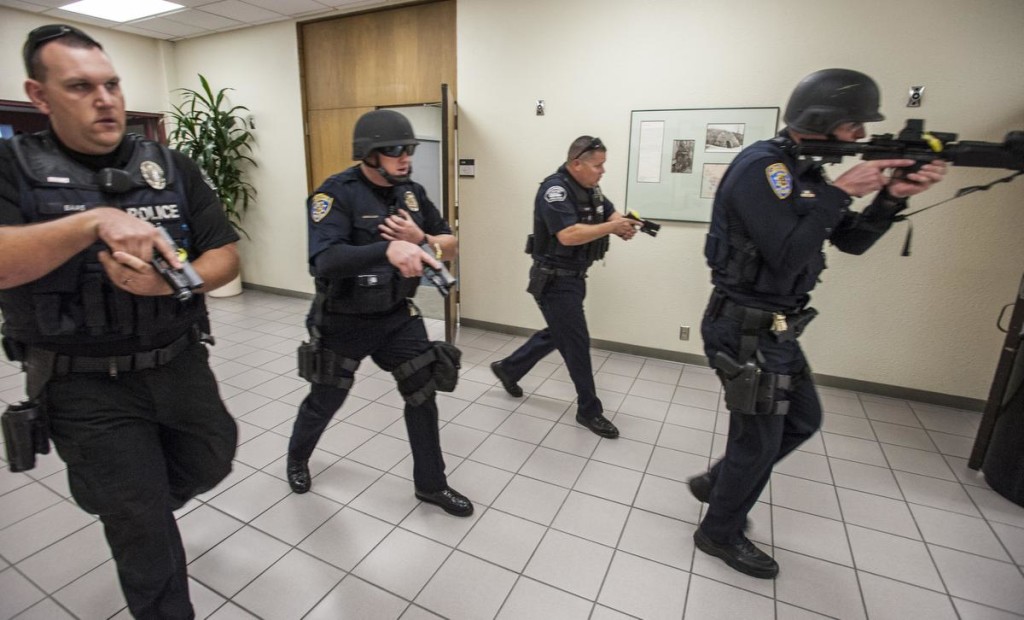
Law enforcement officials in Alabama are making a point for training and preparedness in shooting situations. Alabama Law Enforcement Agency leaders said about 67 percent of law enforcement officers in the state have been trained for active-shooter situations, the TimesDaily reported. That number is up from the approximately 30 percent reported in early 2013. Active shooter situations are different than other emergencies. “It’s the way the call comes in,” said Col. John Richardson, director of public safety. “Most likely, in an active shooter, you’re going to get numerous 911 calls back to back, and you’re going to have someone with probably a high-powered long rifle or fully automatic handgun, and they’re injuring and killing multiple people.” Richardson and other officials spoke about preparedness in the wake of last week’s mass shooting in California. They also demonstrated the computerized training simulator that mimics a workplace shooting with multiple victims and an active shooter. He said the way law enforcement responds to these situations has changed. ALEA Chief of Staff Hal Taylor said this week the average active-shooter situation lasts about 12 minutes or less, which is the average response time for law enforcement in Alabama. Taylor says approximately 10,600 officers who have so far received the training include county sheriff’s deputies and municipal police. “We’re prepared for everything. Anything from a ballgame to a Talladega race,” Taylor said. “Anything that’s big, we’re going to have people there.” ALEA has taught about 18,000 Alabamians the “Run, Hide, Fight” program in case of shootings. Several college campuses within the state are trying to continue to upgrade safety measures. The Alabama State Department of Education encourages “Run, Hide, Fight” training for schools, as well as coordination with local law enforcement. All schools are required to have safety plans. Republished with permission of the Associated Press.
Alabama woman faces dilemma in sending terminally ill son to school

An Alabama teen with a terminal heart condition has not returned to school after a spate of hospitalizations because of what his mother says is a dispute with school officials about how he might die. Alex Hoover‘s case presents something of a legal loophole: His mother has drawn up legal documents known as an advance directive to ensure the 14-year-old is not revived if he goes into cardiac arrest. But officials say they can’t follow that directive if his heart stops at school. Rene Hoover says she does not want her son’s last days spent enduring a battery of medical procedures and medication as a result of his condition, aortic mitral valve stenosis. The condition causes the heart’s mitral valve to narrow and restrict blood flow. “The last procedure we had done, it took us three weeks to get him to go to bed at night because he was afraid that if he went to sleep he would wake up and something would be wrong or that he’d be hurt,” Hoover told The Associated Press. A successful resuscitation and subsequent surgeries are unlikely to significantly improve the teen’s prognosis, she said. “He would have to live his fears every single day,” Hoover said. Alex, of Athens, Alabama, was hospitalized three times over the summer and hasn’t returned to class because Limestone County school board officials have said they won’t recognize the advance directive. His heart valve is too weak to keep up with his growth spurt, and his health has declined over the past year, Rene Hoover said. In Alabama, do-not-resuscitate orders and similar directives apply only to people 19 and older. Alabama State Department of Education spokeswoman Melissa Valdes-Hubert said the department has no policy on advance directives and school staff must decide whether to follow parents’ orders. The school district’s special education director, Tara Bachus, told WAFF-TV that staff would follow standard medical response procedures in an emergency. A teacher visits Alex, who has autism, at home with lessons three times a week, and Rene Hoover said she doubts officials will accept her proposal to take Alex to school for four hours a week on her days off while she sits nearby in case of an emergency. Calls and emails to school district officials from the AP were not returned. Alan Meisel, director of the Center for Bioethics and Health Law at the University of Pittsburgh, questioned whether the teen has the capacity to issue an advance directive. “The fact that the person in question is under 18 simply to me makes it that much clearer that they need not honor the advance directive in this situation,” Meisel said. Aside from liability concerns, school officials likely have concerns over the potential impact on students who could witness the teen’s death, Meisel said. However, Hoover said she simply wants her son to live as fully and normally as possible. “We want him to have comfort and peace,” Hoover said. “Emotionally, it is probably the hardest thing I think a human being could go through; knowing that you have to choose not if your child’s gonna die, but how your child’s gonna die.” Republican state Rep. Mac McCutcheon said he’s considering introducing legislation next year to allow advance directives to cover minors after hearing about Hoover’s case. McCutcheon said medical professionals could take a student with an advance directive to a private area in the event of a medical emergency to lessen the effect on other students and teachers. “What we’re trying to do is get the state into a position to recognize that there should be a law to help juveniles in these situations,” he said. Granting discretion in this area could put school officials, emergency responders and others in a difficult position, Meisel said. “The nice thing about the 18-year-old age is it’s a clear rule, you know when you honor it. You know when you can, or are indeed obligated, to ignore it,” Meisel said. McCutcheon said he’s researching legal issues surrounding advance directives and hopes to present a proposal in 2016. Republished with permission of The Associated Press.
