
Hillary Clinton looks to build organizational edge in Iowa
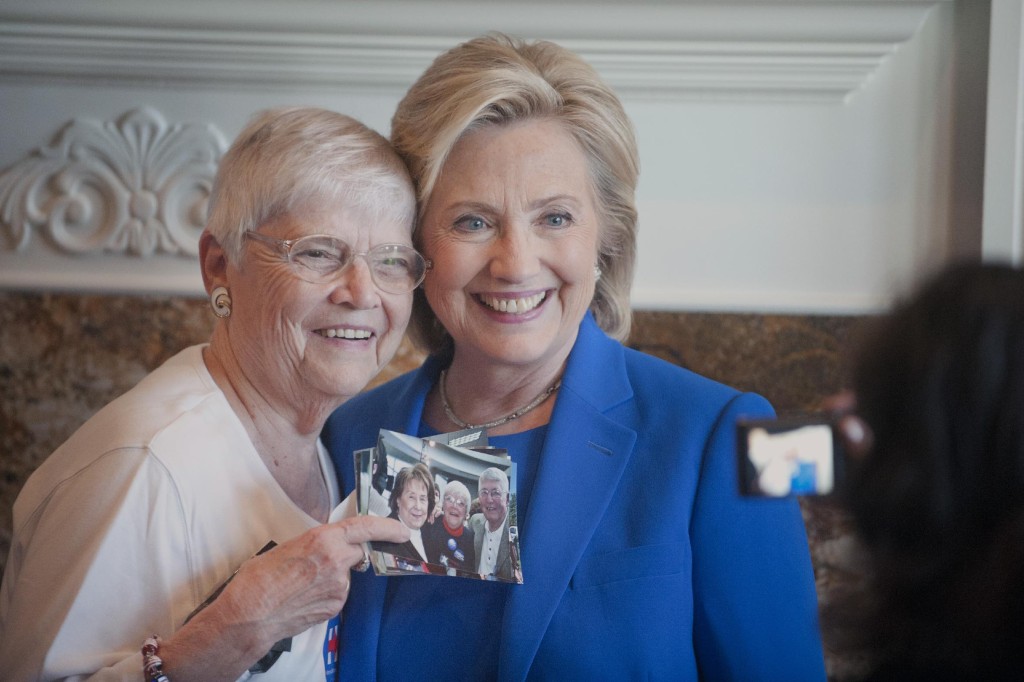
Seeking an army of volunteers, Hillary Rodham Clinton is trying to build an organizational edge in Iowa as some of her lesser-known Democratic rivals clamor for attention in the state that tripped up her first presidential campaign. Clinton flew to Iowa on Saturday night after her high-profile New York kickoff, telling supporters at a Sioux City house party that her campaign would seek to rally the country around an agenda for the future. “Everybody has a role to play,” Clinton said, urging supporters to sign up to join her campaign. Despite her dominant position in the Democratic primaries, Clinton’s allies are trying to erase the memories of her third-place finish in Iowa’s 2008 caucuses, the contest that fueled Barack Obama‘s rise to the White House. The former secretary of state’s Iowa event was streamed online to more than 600 similar gatherings around the country, covering every congressional district in an effort to add volunteers to the campaign’s roster. Clinton planned to address supporters at the Iowa State Fairgrounds in Des Moines on Sunday and then travel to the Mississippi River city of Burlington. But she had company in the state: One of her main Democratic challengers, Vermont Sen. Bernie Sanders, was campaigning across the state during the weekend. Former Virginia Sen. Jim Webb, who is exploring a potential Democratic bid, was holding events in Iowa on Sunday. During her New York speech, Clinton remained silent on some issues of critical importance to the Democratic base, most notably a Pacific Rim trade pact backed by Obama but opposed by organized labor, liberals and others who say it will cost the U.S. jobs. The agreement has not been finalized or submitted to Congress. Sanders, who has opposed the trade deal, again questioned Clinton’s refusal to say where she stood on the Trans-Pacific Partnership. “Most Democrats in the Congress are against it. But I don’t understand how you don’t have a position on this issue,” he said Saturday in Des Moines, where he opened a new campaign office. “You can’t take a position on a trade bill that you can’t see,” Clinton’s campaign manager, Robby Mook, told CBS’ “Face the Nation” on Sunday. Clinton and her advisers are not saying whether she supports legislation in Congress to give the president special negotiation authority on trade deals. In New Hampshire, former Maryland Gov. Martin O’Malley pointed to his executive experience while his campaign noted to supporters in an email that Clinton “didn’t say that she would take any substantive actions to hold Wall Street CEOs accountable for reckless behavior. Nor did she weigh in on the secretive TPP deal that could depress American wages and cost American jobs.” In New York, Clinton offered herself as a fierce advocate for those still struggling from the Great Recession. “I think you know by now that I’ve been called many things by many people,” Clinton said to cheers and laughter from the crowd of roughly 5,500 gathering on New York’s Roosevelt Island in the East River. “Quitter is not one of them.” Hours later in Iowa, Clinton added, “I don’t believe we should ever quit on our country.” Republished with permission of the Associated Press.
Hillary Clinton building vast network of campaign staff, volunteers
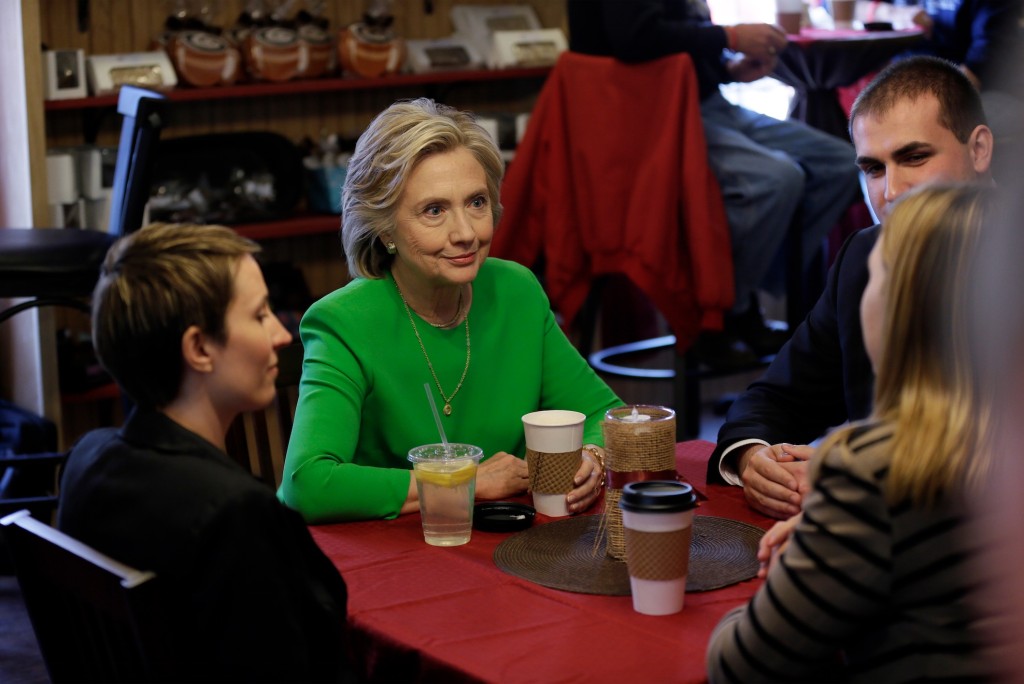
Scott Hogan wanted to know why his batch of potential volunteers was “ready for Hillary.” The campaign staffer didn’t get the answer he wanted, but it was enough to get the conversation started. “To tell you the truth, I like Bernie Sanders for just his honesty, but I don’t think he’s electable,” said Gina Casey, 59, sitting at a conference table at a Democratic Party office. “So, I’m trying to love Hillary and I need to know more.” A former gun control activist hired by Hillary Rodham Clinton‘s presidential campaign to organize the reliably Democratic state, Hogan made the pitch for his boss over Sanders, the independent Vermont senator mounting a longshot challenge for the Democratic nomination. “This campaign is about you,” Hogan told Casey and a handful of other Democrats gathered on a hot Tuesday night in this small southern Minnesota city. “It’s not about me. It’s not about Hillary. It’s about how best to move this country forward.” In a presidential race likely to include more than 20 candidates, none has an operation like Clinton. In just eight weeks since announcing her plans to run for president, Clinton has deployed an army of roughly 100 organizers such as Hogan nationwide and opened 15 offices in early-voting states – far more than any other candidate of either party in the 2016 contest. The overwhelming favorite for her party’s nomination, Clinton doesn’t necessarily need the volunteers now. But worried she will lack the power of a competitive primary to energize the core group of supporters she will need for the general election, Clinton’s team has set off on an early hiring spree that’s all but unprecedented. “You can’t get to a point where the polls are tight and say, `Oh, wow, we need to do some organizing,’” said Marlon Marshall, Clinton’s director of state campaigns and political engagement. “These organizing relationships will create a sense of urgency to let people know why we have to do this work now.” In Iowa, Clinton now has at least 27 paid organizers – three times as many as any of the dozen or so Republicans in the race. Her campaign has hired at least one staff member in every state, the District of Columbia and the U.S. territories. She has two regional directors in California and has even put one person on the payroll in Wyoming, a state that has not voted for a Democratic nominee in more than 50 years. The effort isn’t cheap: Senior campaign aides have set a goal of raising $100 million to pay for Clinton’s primary campaign. While Clinton has so far limited her campaign appearances to the first four states to vote and mostly private fundraisers, her campaign has organized 320 house parties – attracting almost 11,000 people in the 46 other states and the District of Columbia. This weekend, the day after Clinton gives the first major speech of her campaign, her appearance at an event in Iowa will be streamed to a party in every congressional district nationwide. “At this point, it’s more about finding people and getting them involved then convincing them to back Clinton,” said Hogan, as the group of students, retirees, and local activists began to filter into the office Tuesday night. The meeting was the fourth the Indiana native had organized in the state, including one in Minneapolis that attracted 200 participants. “There’s benefits to a place like Minnesota,” he said. “It’s got a ton of Democratic energy and people are really engaged.” Clinton’s campaign staff takes great pains to keep a focus on the primary campaign, insisting they take nothing for granted despite a lead in early polls over Sanders and a few others that often approaches 50 percentage points. Should the Democratic race become competitive, Minnesota – voting on Super Tuesday in the first set of primaries after the first four states – could be decisive. But if not, and Minnesota appears likely to vote as it has since 1972 for the Democratic nominee, the supporters Hogan is organizing now will become a valuable resource to raise funds, make calls and travel to neighboring battleground states such as Iowa and Wisconsin. The staff working now in deep blue states such as Minnesota will be redeployed to battleground states at the end of June, with the goal of having built an engaged volunteer networks to organize small dollar fundraisers and make sure Clinton is represented at local events, like parades and festivals, into the fall. Clinton aides said the early investment will pay dividends in the final weeks of the campaign. Data analyzed by President Barack Obama‘s campaign showed a direct correlation between supporter enthusiasm in the last six weeks before the election and when local operations began in their area, according to former staffers. “The earlier you start, the larger your volunteer structure will be the last two weeks or last month of the campaign, which is ultimately when that investment pays off,” said Mitch Stewart, who oversaw battleground states for Obama’s campaigns and advised the pro-Clinton super PAC Ready for Hillary. In Mankato, the gathering included brainstorming on ways Clinton could spread her message. At one table, a group of women had a suggestion for Hogan: Farmfest. Before Tuesday, they hadn’t considered the idea they should put together a booth for Clinton at the three-day agricultural trade show in August, a must-attend event for political candidates in this part of the state. “Next year will be the more important time to be out there,” said Lori Sellner, a 46-year-old from Sleepy Eye, Minnesota. “This is just earlier than we’ve seen before.” Republished with permission of The Associated Press.
Presidential primary brief: 526 days until Election Day
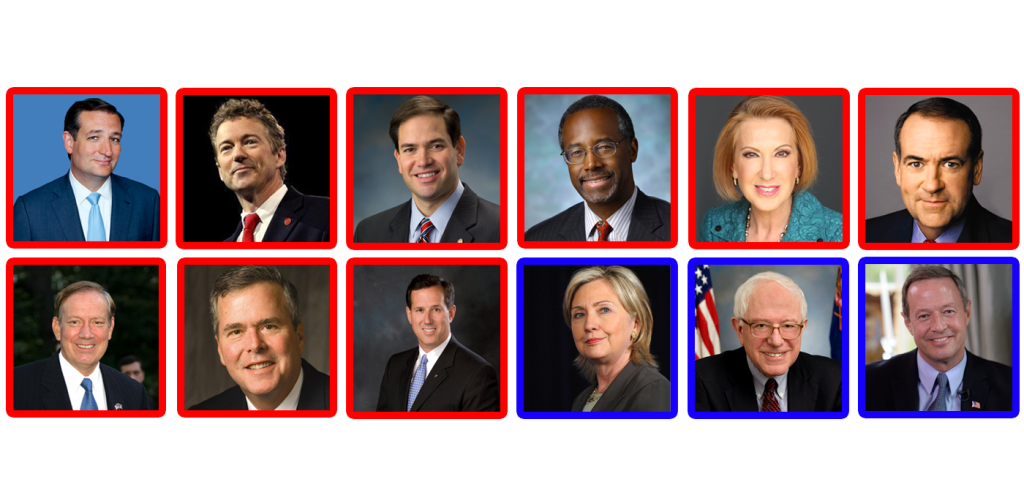
Welcome to the Monday presidential primary brief provided by Alabama Today. Every week you can find your latest headlines on the presidential primary races as we count down the days until Election Day. 266 days until AL Presidential Primary 519 days until Election Day Convention Dates: Republican July 18-21, 2016, Democratic July 25-28, 2016 Weekly Headlines: Lindsey Graham announces presidential candidacy Lincoln Chafee announces presidential bid Rick Perry launches 2016 presidential campaign For more polling data visit RealClearPolitics. Press Clips: On Scott Walker’s performance in Iowa: ‘Unless he really screws up, he should win’ (Business Insider 6/7/15) Scott Walker, a likely Republican presidential contender who is riding high in polls in the early voting state of Iowa, was literally the leader of the pack on Saturday at a gathering of 2016 White House hopefuls. Walker, the governor of neighboring Wisconsin, joined U.S. Senator Joni Ernst at the head of a parade of about 300 motorcycle riders who traveled 39 miles (62 km)to Ernst’s inaugural “Roast and Ride,” a political event combining barbecue and the roar of Harley-‐Davidsons. Christie calls Clinton’s voter law critique ‘ridiculous’ (Politico 6/7/15) New Jersey Gov. Chris Christie says Hillary Clinton’s attack on state voter identification and registration laws is “ridiculous.” “She doesn’t know what she’s talking about,” the Republican governor and likely presidential candidate said in an interview aired Sunday for CBS’s “Face the Nation,” noting his state has early voting. U.S. authorities unlikely to stop 2016 election fundraising free-‐for-‐all (Reuters 6/4/15) White House hopefuls raking in record amounts of money in the 2016 U.S. presidential race are already being accused by watchdog groups of breaking campaign fundraising laws. But the U.S. Department of Justice is unlikely to prosecute possible violations and halt the funding free-for‐all, say current and former department officials. With deadlock in the campaign finance regulator, the Federal Election Commission, watchdog groups are calling on the Justice Department to investigate contenders such as Republican Jeb Bush, who they say has conducted a charade of “non-candidacy” to skirt federal election fundraising laws. Bush’s campaign said on Thursday he would announce his White House bid on June 15. Louisiana Gov. Jindal to make announcement on 2016 presidential election on June 24 (Bayou Buzz 6/3/15) Louisiana Gov. Bobby Jindal, a possible GOP presidential candidate, will make a “major announcement” on the 2016 race on June 24 in New Orleans. That’s according to Jindal’s chief political adviser, Timmy Teepell. Jindal had announced a campaign exploratory committee on May 18. If Jindal decides to run, he’d join a crowded Republican primary that already includes nine major candidates, with more expected to join the fray. Bernie Sanders 2016: Young Americans Say They Support Socialism, But Do They Know What It Is? (International Business Times 6/4/15) Trey Rittersbach doesn’t know Bernie Sanders, but he knows what socialism is – kind of. “It’s redistributing the wealth,” the 19-year-old New York University sophomore said Thursday from a bench in Washington Square Park, then paused to reconsider. “I guess that might be more Communism.” Rittersbach, a Ralph Nader fan with Republican leanings, tried again: “It’s acting to benefit the greater good over personal gain. Capitalism is more personal gain over the greater good.” Christie’s last question on 2016: “Do I want to do it?” (KTYX CBS 19 6/7/15) For Chris Christie, the final question on a potential 2016 bid is: “Do I want to do it?” The New Jersey governor has said he’ll decide whether to join the already-crowded field of candidates vying for the Republican nomination this month as New Jersey wraps up its legislative session. But he’s still weighing what is in his heart. “I go through all the different factors that I need to consider. And when I’m done, I check that off and I move to the next factor. And the factor I’m down to now, John, is do I want to do it? Do I want to do it? In my heart, is this something that I really, absolutely want to do?” he told “Face the Nation” host John Dickerson. Draft Warren groups suspending operations (The Hill 6/2/15) Run Warren Run, an organized, long-‐shot effort to encourage Sen. Elizabeth Warren (D-Mass.) to run for president, will close its doors next week as their hero continues to unequivocally decline those calls. The campaign by Democracy for America and MoveOn.org Political Action will suspend operations Monday after delivering a petition to Warren with 365,000 signatures asking her to run. But the gesture isn’t likely to change the Massachusetts Democrat’s mind, as she’s been resolute in statements rejecting a possible bid. As many progressive Democrats worried about Democratic front‐runner Hillary Clinton’s liberal chops, they coalesced around Warren as their ideal choice. In its six months, Run Warren Run launched feld of\ices in both Iowa and New Hampshire, and held hundreds of rallies to support its effort.
Presidential primary brief: 526 days until Election Day
Welcome to a new Monday presidential primary brief provided by Alabama Today. Every week you can find your latest headlines on the presidential primary races as we count down the days until Election Day. 273 days until AL Presidential Primary 526 days until Election Day Convention Dates: Republican July 18-21 2016, Democratic July 25-28 2016 Weekly Headlines: Lincoln Chafee to announce presidential run on June 3 Rick Santorum runs for White House again George Pataki announces 2016 presidential bid For more polling data visit RealClearPolitics. Press Clips: Pro-‐Rand Paul group gets ready to rumble with anti-‐NSA ad (Politico 5/29/15) A super PAC supporting Sen. Rand Paul (R-‐Ky.) for president has released an ad that treats Sunday’s legislative battle over the Patriot Act more like a monster-‐truck rally or a Wrestle-mania tournament. “Get ready America,” the voiceover in the video says as a bald eagle breathes Gire, a bomb explodes and lightning strikes, “for the biggest brawl for liberty of the century.” Nate Silver: What to watch for in 2016 election (Detroit Free Press 5/29/15) Here are several lessons for the 2016 presidential elections from prognosticator Nate Silver, founder of the phenomenally accurate FiveThirtyEight.com. He spoke Thursday at the Mackinac Policy Conference. The nomination of Democrat Hillary Clinton is inevitable, but the general election will be a toss-‐up. Democrats have a weak bench and Republicans have a Give-‐ring circus of overlapping candidates between moderate, establishment, Christian conservative, tea party and Libertarian. “It’s a real tight for space.” New Jersey Gov. Chris Christie is definitely in trouble and former Florida Gov. Jeb Bush is possibly in trouble. “Its very difficult to win the primary when most of the voters don’t like you,” Silver said of Christie. Ben Carson wins Southern Republican straw poll ahead of 2016 presidential election (Christian Today 5/29/15) Doctor-‐turned-‐politician Ben Carson easily won the Southern Republican Leadership Conference straw poll held in Oklahoma on Saturday in the first major survey on the popularity of at least 17 declared or prospective candidates for the Republican Party’s nomination for the November 2016 election. Carson, a popular social conservative who is a Gierce opponent of Obamacare, won 25.4 percent of the vote. Also getting considerable shares of the vote were Wisconsin Gov. Scott Walker and Texas Sen. Ted Cruz who received 20.5 percent and 16.6 percent of the vote, respectively. Sanders wants to debate Republicans (Politico 5/31/15) Bernie Sanders on Sunday called for a more robust debate schedule beginning this summer. The Vermont senator, challenging front-‐runner Hillary Clinton for the Democratic nomination, also proposed on NBC’s “Meet the Press” some debates with Republican White House hopefuls. “We need a lot more debates in this campaign,” Sanders said. “I hope very much that we can begin with the Democratic candidate debates as early as July and have some Republicans in those debates as well.” Ohio Gov. Kasich looks to announce 2016 presidential bid this summer (WaPo 5/27/15) Ohio Gov. John Kasich, who has been actively gauging reactions to a possible campaign for president in 2016, is now moving rapidly to assemble the staff and financial resources for such a bid and is looking to declare his candidacy sometime after June 30, according to knowledgeable Republicans. The two-‐term governor and former House member is running through a checklist before formally entering the race, but strategists close to Kasich and other longtime friends say there is no doubt that he will soon join the crowded Gield of those vying for the GOP nomination. Marco Rubio won’t compete in Iowa Straw Poll (Politico 5/30/15) Sen. Marco Rubio will not participate in the Iowa Straw Poll, his campaign team confirmed Saturday. The Florida senator and 2016 hopeful’s decision marks the latest blow to the August event long considered a staple on the Republican road to the presidential nomination. Jeb Bush, Sen. Lindsey Graham and Mike Huckabee have all said they won’t participate this cycle. Many, including Gov. Scott Walker and Sens. Rand Paul and Ted Cruz have yet to signal whether they will attend. What impact will frustrated veterans have on 2016 election? (Haaretz 5/25/15) Memorial Day in America moves me to predict that one of the stories to watch is the growing bitterness of the veterans of Iraq and Afghanistan. The Associated Press had a piece of this story over the weekend, when it reported that GIs or ex-‐GIs who fought in Iraq “have been watching in frustration” as “Republican presidential contenders distance themselves from the decision their party enthusiastically supported to invade that country.” O’Malley’s long-‐shot bid gets complicated start (Politico 5/30/15) Martin O’Malley’s presidential bid has always been a long-‐shot, but the odds looked even longer Saturday as he officially kicked off his campaign from Federal Hill Park. The run-‐up to his launch here could hardly have been worse, complicated in recent weeks by unrest in the city where he served as mayor and the unexpected early momentum of another Hillary Clinton challenger: Bernie Sanders. At one time, O’Malley figured to be Clinton’s default rival for the Democratic nomination. He won two terms as governor of Maryland, winning by wide margins, and honed his national fundraising chops as chairman of the Democratic Governors Association. Bernie Sanders facing ‘uphill battle’ in Iowa (USA Today 5/29/15) Sen. Bernie Sanders, (I-VT), began his first visit to Iowa since announcing his run in the Democratic presidential primary with a standing-‐room-‐only crowd in the eastern city of Davenport. The Thursday night turnout was more than even the organizers expected. Kevin Perkins, a Davenport resident and planner of the event, said that the auditorium at St. Ambrose University had been set up to seat 300 people. As people poured in, Perkins and other organizers opened up an adjacent room. Perkins estimated that 750 people showed up in total.
2016 hopefuls parade on the Sunday morning shows
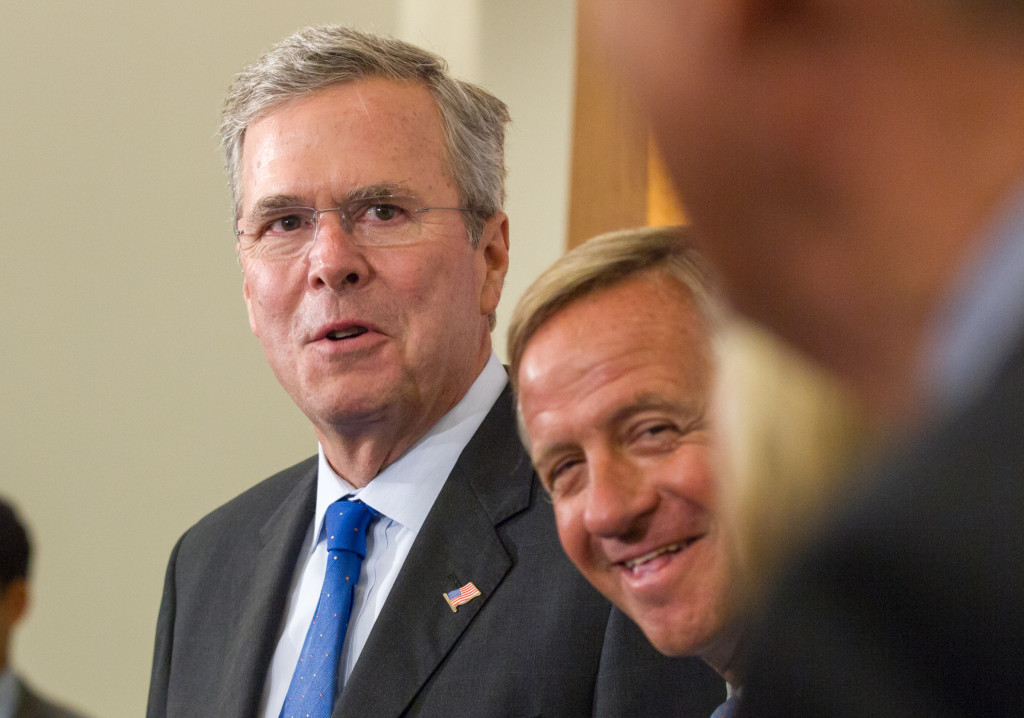
Bernie Sanders is itching to debate and not just with other Democrats running for the party’s presidential nomination. He says Democratic and Republican contenders should be debating each other during the primary season, too. That shakeup is unlikely to happen: Each party is planning its own debates, as usual. But the network news shows Sunday morning were something of a debating society of their own as 10 declared and likely candidates from both parties appeared in a parade of political argument and sound bites, touching on ISIS, personal ambition, immigration, hair color and more. A sampling: Bush on the big question Is some extraterrestrial force keeping Jeb Bush from announcing a presidential candidacy? Pressed on CBS’ Face the Nation, he spoke as if the decision is not his own. “I hope I run,” he said. “I hope, I hope, I’m a candidate in the near future.” What might possibly persuade him not to run? “Who knows?” Bush replied. “I’ve learned not to answer a lot of hypothetical questions.” The former Florida governor said he’ll decide soon after his trip to Europe, which starts in a week. Bush has been campaigning and fundraising for months and the political world would be shocked if he did not enter the Republican nomination race. There are various reasons politicians dance around the question of whether they’re running. One big reason: Once they declare their candidacy, they can no longer work directly with super PACs that are raising money to help them. Bush says he’s already checked with his wife and children they are “totally all in.” That’s if he runs. As he hopes. Why O’Malley? Hillary Rodham Clinton is in the most commanding position by far in the Democratic race. Sanders, a self-described democratic socialist, stepped up in April to take her on and court the party’s left. So what does Martin O’Malley, who entered the contest Saturday, have to offer liberals that Sanders doesn’t? Achievement, he told ABC’s “This Week.” “I have a track record of actually getting things done, not just talking about things,” O’Malley said when asked to compare himself with Sanders, an independent in the Senate who aligns with Democrats. O’Malley served as Maryland governor and Baltimore mayor. Still steamed Presidential candidate Sen. Rand Paul certainly raised hackles in his own party when he blamed the rise of the Islamic State group on Republican hawks, and perhaps none has taken more offense than Louisiana Gov. Bobby Jindal. Jindal was asked Sunday on ABC whether he would support Paul if the Kentucky senator became the Republican nominee. “I don’t think he will be our party’s nominee,” Jindal said. Jindal is expected to say in coming weeks whether he will join the nomination contest. Paul said last week that Republican hawks supported the indiscriminate spread of arms in the region where ISIS operates and some of those weapons have fallen into the hands of extremists. That led Jindal to say Paul is unsuited to be president. The governor says ISIS exists purely because of radical Islam. Bring on the debates “We need a lot more debates in this campaign,” Sanders said on NBC’s Meet the Press. The Vermont senator said the Democratic debates should begin as soon as July and, in a twist, some Republicans should be in the mix. That’s not the plan. The Democratic Party says it will hold six presidential primary debates with its candidates, beginning in the fall. The first Republican debate will be in August, drawn from a much larger field of rivals. Concerning hair Carly Fiorina says she colors her hair, like Clinton does. Fiorina, the former Hewlett-Packard CEO now running for the Republican nomination, told Fox News Sunday she’s just happy to have hair. She lost it for a while when she was battling breast cancer. Clinton told an audience in South Carolina last week that while at age 67 she may not be the youngest candidate in the race, she did have one advantage: “I’ve been coloring my hair for years.” She said most presidents go snow white in office. Republished with permission of The Associated Press.
Bernie Sanders wants Hillary Clinton to take stand on trade deal
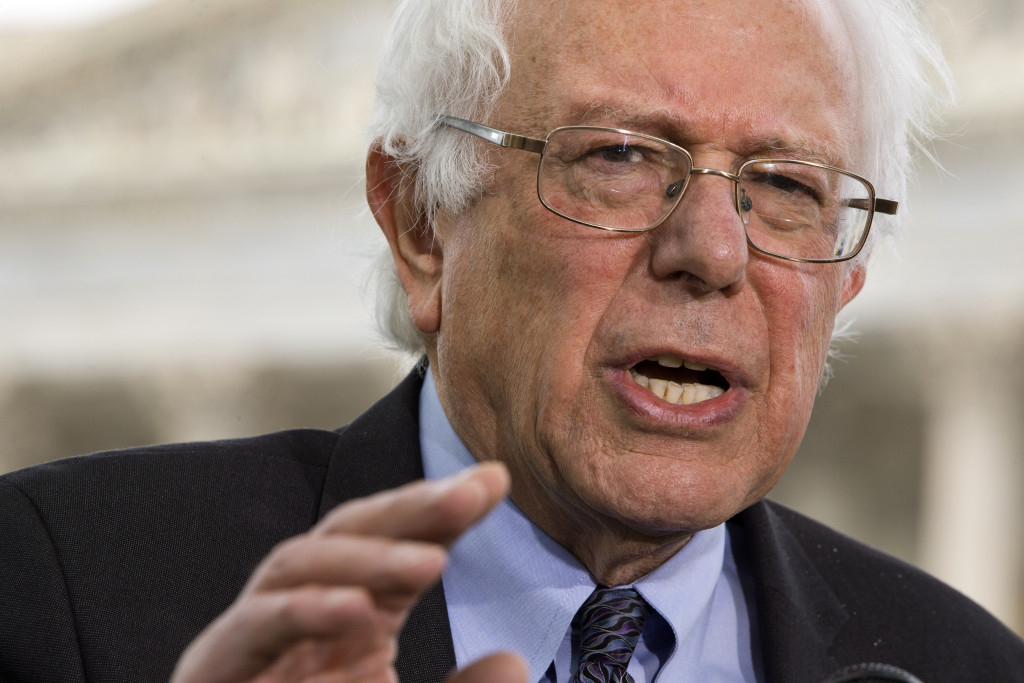
Sen. Bernie Sanders is questioning why Democratic presidential rival Hillary Rodman Clinton won’t take a stand on the emerging trade deal with Pacific nations, which he calls “enormously important issue” she’s been dodging. A day after launching his longshot campaign, the Vermont independent returned to neighboring New Hampshire on Wednesday, where a blunt voter told him she wants him to thrash Clinton in the primary race, not merely siphon some votes away from her. “Why can’t we ask Hillary to give up her spot and give it to you?” Jeanny Aldrich of Chesterfield demanded. “I could be wrong, but I suspect she would disagree with you,” Sanders quipped before saying he’s never run a negative campaign and won’t start now. Instead, he said, the campaign should feature civil debate on serious issues, like the Trans-Pacific Partnership trade deal that would eliminate tariffs and other barriers for the U.S., Canada and Asian countries conducting commerce with each other. Sanders opposes that agreement along with other past trade deals; Clinton has expressed qualms about it but hasn’t weighed in for or against it. “I think these trade agreements have not worked,” Sanders said. “Now, Hillary Clinton can be for the trade agreement — the president is. She can be against the trade agreement — I am, Elizabeth Warren, many others of us are. “But I just don’t know how you don’t have an opinion on this enormously important issue, which is her view. So what I think we need here in New Hampshire and around this country is a serious debate on serious issues.” Clinton’s campaign declined to comment when asked about Sanders’ remarks. During a recent visit to New Hampshire, Clinton said she didn’t yet know enough about the Asian-Pacific trade deal to say where she comes down on the issue. “I want to judge this when I see exactly what’s in it and whether it meets my standards,” Clinton said last week. Sanders, 73, said he is calling on liberals to join him in a “political revolution” to elevate attention to income inequality, a campaign finance overhaul and climate change — issues that have motivated Warren, the Massachusetts senator who appears to be sitting out the 2016 race despite intense interest from liberals in seeing her run. Sanders has long blasted the concentration of wealth in America and assailed a “billionaire class” that he says has taken over politics. “They obviously own much of the economy,” he said. “But what my campaign for president is about, is to say, we are not going to give up. We love this country too much to say that the billionaire class can have it all. We are going to fight back.” “They have the money, they have the power,” he said. “What do we have? We have the people. And when people stand together, we win.” Aldrich, the voter who questioned Sanders, said she doesn’t feel that Clinton represents voters on the left, or even the middle, of the political spectrum. “I think the Republicans are so far to the right, and I think the Clintons took the country way to the right,” she said. Republished with permission of The Associated Press.
Trail translator: They’re all talking “income inequality”
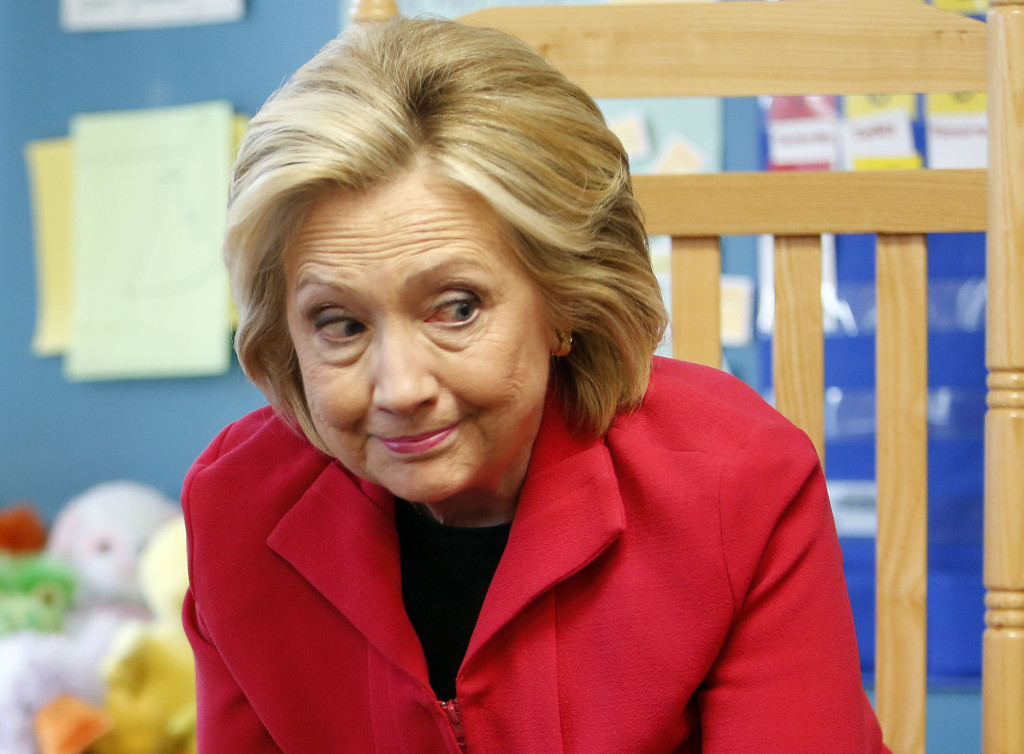
Of all the buzzwords and phrases popping up early in the presidential campaign, “income inequality” must be close to the top of the list. It’s not just Democrats insisting that the nation must deal with it firmly and fast. While Hillary Rodham Clinton and new primary opponent Sen. Bernie Sanders are hitting the idea hard, Republican candidates, too, are playing up the notion that people at the bottom of the economic ladder are getting a raw deal while the rich get richer. Since you’re sure to hear a lot more about income inequality during the next 18 months, here’s a closer look at what it means, where it came from and what the candidates want to do about it. • • • Definition, please In a nutshell, economic inequality refers to the yawning gap between the income of the richest Americans and everyone else. No one disputes that the gap exists, although there is debate about its size. There are all kinds of subtexts associated with this idea, among them: stagnating middle-class incomes, increasing economic power for the privileged few, barriers to upward mobility for the poor and a culture of cronyism in Washington that protects the well-connected. And that churns up feelings of envy, outrage, frustration and despair for candidates to tap into as they try to show they understand the economic angst of the middle class. • • • Origins The prominence of the issue has been building, off and on, for years, as the share of total income and wealth claimed by the richest Americans has grown. Incomes for the highest-earning 1 percent of Americans rose 31 percent from 2009 through 2012, after adjusting for inflation, according to data compiled by Emmanuel Saez, an economist at University of California, Berkeley. For everyone else, it inched up an average of 0.4 percent. The Occupy protest movement of 2011 and 2012 jump-started a global conversation about the wealth gap, with the rallying cry of “We are the 99 percent.” And everyone from Pope Francis to President Barack Obama picked up on it. In 2013, Obama called economic inequality “the defining challenge of our time.” • • • Look who’s talking Just about all the 2016 candidates are chattering about it. And when candidates describe the problem, it’s sometimes hard to distinguish Republicans from Democrats. See if you can guess who’s sounding off here: “The top 1 percent earn a higher share of our income nationally than any year since 1928. The people who have been hammered … are working men and women.” “While the average person is working longer hours for lower wages, we have seen a huge increase in income and wealth inequality, which is now reaching obscene levels.” “The economy is booming for people at the top. It is not booming for the bottom 90 percent of the workforce in America. The bottom 90 percent, which is most of America, has had stagnant wages for 40 years.” “The deck is still stacked in favor of those already at the top. And there’s something wrong with that. There’s something wrong when CEOs make 300 times more than the typical worker.” “Wage stagnation is happening at a time when the cost of everything is going up dramatically. And it’s not just that the cost of everything is going up, we have expenses we didn’t used to have.” “The policy aim of government absolutely should be that government should not contribute to income inequality.” Answers: 1. Republican Sen. Ted Cruz of Texas. 2. Sanders, a Vermont independent who’s running as a Democrat. 3. Republican Mike Huckabee, former governor of Arkansas. 4. Clinton. 5. Republican Sen. Marco Rubio of Florida. 6. Republican Sen. Rand Paul of Kentucky. • • • The solution? There will be huge debate on this over the next year and a half, and Republicans and Democrats offer far different solutions. In general, Republicans like to stress upward mobility — giving those at the bottom more opportunity to move up — rather than taking something away from those at the top. “The American people tend not to be envious people,” says Mike Needham, head of the conservative Heritage Action for America. “People are worried about their opportunity to succeed.” Democrats are inclined to look at increasing taxes for those at the top to allow government to do more for those below. “It’s very difficult to do much about the middle class and the poor without tapping some of the wealth and income at the very top, or at least changing the structure of the economy so that so much wealth and income don’t percolate upward,” says Robert Reich, who was Bill Clinton‘s labor secretary. Most of the candidates are still fleshing out their economic proposals. But they’ve already thrown plenty of ideas in the mix, circling back to classic debates over taxation and the proper role of government. Sanders wants to make the wealthy pay more taxes. Rubio’s pushing a big tax cut to spur growth. Clinton has criticized excessive CEO pay and wants to raise the minimum wage. Cruz wants a “simple flat tax.” Paul pushes “economic freedom zones” offering lower taxes in distressed areas. Former Florida Gov. Jeb Bush wants to give people more opportunities for “earned success.” Christie wants to cut income and corporate tax rates while changing deductions and credits. • • • Odds anything will change? Obama said Tuesday he hopes growing awareness of inequality will help bridge the ideological divide over how to address it. At the same time, progressive Democrats who want to close the gap released a wide-ranging policy agenda, with Sen. Elizabeth Warren of Massachusetts saying it was time to fight those who “want the game to stay rigged.” Skepticism abounds, though. Sanders questions whether Clinton or any of the Republicans are ready to take on the “big-money interests who control so much of our economy.” Paul thinks Democratic policies make income inequality worse. Carly Fiorina, the former technology executive who recently joined the GOP nomination race, says
Bernie Sanders has had consistent message for 4 decades
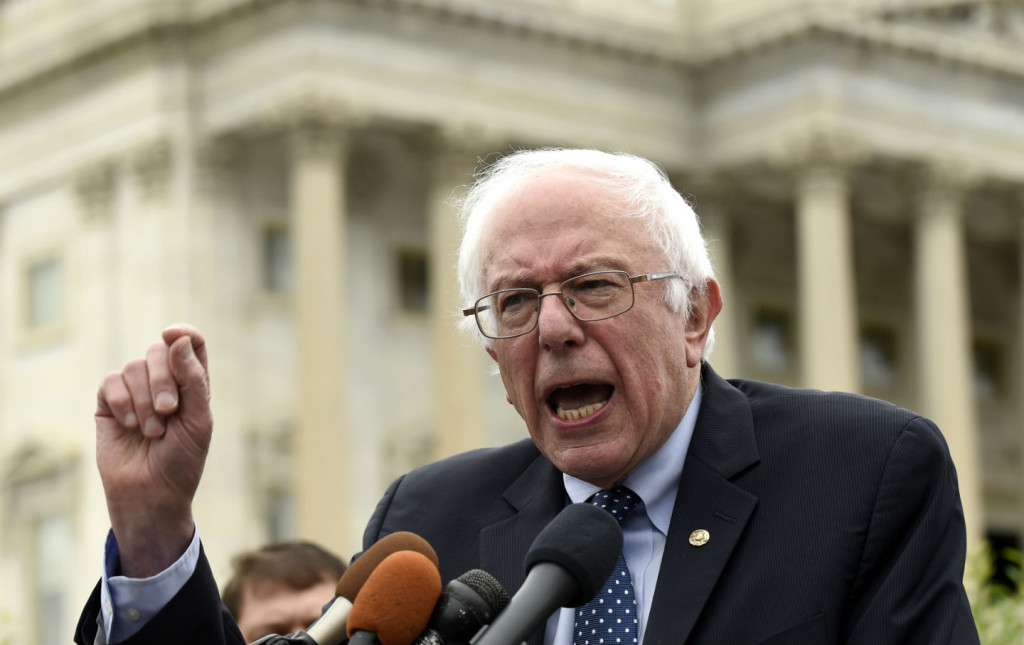
Once a democratic socialist, always a democratic socialist. Once a scold of big money in politics, still a scold. No one can accuse Bernie Sanders of flip-flopping during his four decades in public life. Rock steady, he’s inhabited the same ideological corner from where he now challenges Hillary Rodham Clinton in an improbable quest for the 2016 Democratic presidential nomination. Here he is in 1974, as the 32-year-old candidate for U.S. Senate of a fledgling leftist party in Vermont called Liberty Union: “A handful of banks and billionaires control the economic and political life of America. … America is becoming less and less of a democracy and more and more of an oligarchy.” And now, in an Associated Press interview: “This is a rigged economy, which works for the rich and the powerful, and is not working for ordinary Americans. … You know this country just does not belong to a handful of billionaires.” Some see him as a broken record, others as a person who has been telling the truth all along and just waiting for enough people to listen. “The fascinating thing about Bernie right now is that the agenda has caught up with Bernie,” said Garrison Nelson, a University of Vermont political science professor and longtime Sanders watcher. During Sanders’ near decade as mayor of Burlington in the 1980s, during his eight terms holding Vermont’s lone House seat and during his near decade in the Senate, the message has stayed the same: The rich are absconding with an immorally large part of the country’s wealth, and ordinary people have been getting the short end of the stick. Clinton has gone from opposing same-sex marriage rights to supporting them. Howard Dean, the last Vermont presidential candidate, was a centrist governor who became a liberal representing the “Democratic wing of the Democratic Party,” when he saw the left flank open in the 2004 primary campaign. Sanders, now 73, favored gay marriage rights before it became fashionable in Democratic circles. He voted against the Defense of Marriage Act in the mid-1990s signed by Clinton’s husband, President Bill Clinton. Early in her primary campaign, Clinton has spoken about the gap between the rich and the middle class, in an appeal to the party’s liberal wing. The Republican contenders, too, are taking up the problem of income inequality, although with much different solutions in mind than the Democrats. Steady-as-he-goes Sanders has been at it for decades. He’s admired Canada’s single-payer health care system since way back, talking up “nationalized health care” during his unsuccessful run for Congress in 1988. When Republicans charge that Democrats would bring European-style socialism to the U.S., Sanders says bring it on. “I can hear the Republican attack ad right now: ‘He wants America to look more like Scandinavia,’” George Stephanopoulos said while interviewing Sanders on ABC’s This Week. Sanders replied, “That’s right. That’s right. And what’s wrong with that? What’s wrong when you have more income and wealth equality? What’s wrong when they have a stronger middle class in many ways than we do, a higher minimum wage than we do, and they’re stronger on the environment?” If he’s undergone any transformation, it’s in his political affiliations. He long ago dropped the Liberty Union banner and has run as an Independent in his successful elections in Vermont. He says he remains one “in my heart,” but has caucused with Democrats in Congress. He chose to go for the Democratic nomination and, if he loses the party primaries, says he won’t run for president as an Independent. In an unsuccessful 1986 race for governor as an Independent, Sanders said, “It is time to stop the tweedledee, tweedledum politics of the Republican and Democratic parties.” This time, he’s trying to shake one of the tweedles up from the inside. Republished with permission of The Associated Press.
GOP chairman Reince Priebus: Campaign prep just as important as nominee
Republican National Committee Chairman Reince Priebus cautioned GOP faithful on Friday that they won’t recapture the White House if the party gets too obsessed with choosing its nominee while Democrats continue to outpace Republicans on campaign tactics. “We have become a candidate-crazy party to the detriment of all the mechanics,” Priebus told hundreds of GOP donors and activists at a South Carolina party dinner. Describing the 2012 nomination fight as a “total disaster” and a “traveling circus,” Priebus said the Republican National Committee has learned its lesson. The party is spending millions of dollars this year to build a database that will help identify millions of likely Republican voters — an exercise unabashedly modeled after the success of President Barack Obama‘s two national victories. “Now we’re the ones buying the data licenses so that we know who to target and how to target,” Priebus said. “Somebody has to get that done.” The national GOP also condensed the primary calendar and reduced the number of debates, with the party taking a stronger role in choosing the format and moderators. Now, Priebus said, it’s Republican voters’ responsibility to avoid a “slice-and-dice festival” that he said left the 2012 Republican nominee, Mitt Romney, in a weak position as he tried to unseat Obama. The chairman’s warning comes less than nine months before the Iowa caucuses and New Hampshire primary start the nominating calendar. South Carolina follows a few weeks later; the winner of the GOP primary here captured every Republican presidential nomination from 1980 to 2008. (Newt Gingrich won South Carolina in 2012.) Home-state Sen. Lindsey Graham, who has been traveling in Iowa and New Hampshire, suggested Friday that he was close to launching a formal campaign as he shared the stage with Texas Sen. Ted Cruz, a declared candidate, and potential candidates Rick Santorum and Rick Perry. “As to what happens in the coming months, get ready,” Graham said. “Get ready for a debate that’s been long overdue within the party.” He later added: “To Iowa and New Hampshire, hello. To South Carolina, you have my heart.” Graham would be considered a long-shot, but his aides and backers believe his foreign policy experience in the Senate, his outspoken advocacy for an aggressive U.S. international presence and his blistering critiques of Obama’s international policy can propel him in a crowded field, amid widespread voter concern about security issues. He hit those themes in his brief remarks. “To our enemies, get ready, because there’s a new way of business coming,” he said. “To our friends, get ready for the America you used to know.” The would-be 2016 rivals avoided any intra-party barbs at the GOP affair. “I don’t think there’s anybody in this country that knows foreign policy better than Lindsey Graham,” said Perry, the former Texas governor. Graham praised Santorum, a former Pennsylvania senator, as a champion opponent of abortion. Cruz hailed the “incredible array of talent we have in 2016,” then used the praise to mock the Democratic presidential field, which officially consists of Hillary Rodham Clinton and Bernie Sanders, a Vermont senator who has identified himself as socialist. The Democrats’ primary, Cruz said, for now “consists of a wild-eyed socialist with dangerous views on foreign policy … and Bernie Sanders.” South Carolina Republicans will reconvene Saturday, with former Florida Gov. Jeb Bush joining the list of potential candidates taking the stage. The state’s primary was a key victory for Bush’s father, George H.W. Bush, in 1988 and his brother, George W. Bush, in 2000. Republished with permission of The Associated Press. Photo Credit: AP Photo/Susan Walsh, File
Vermont Sen. Bernie Sanders to run for president
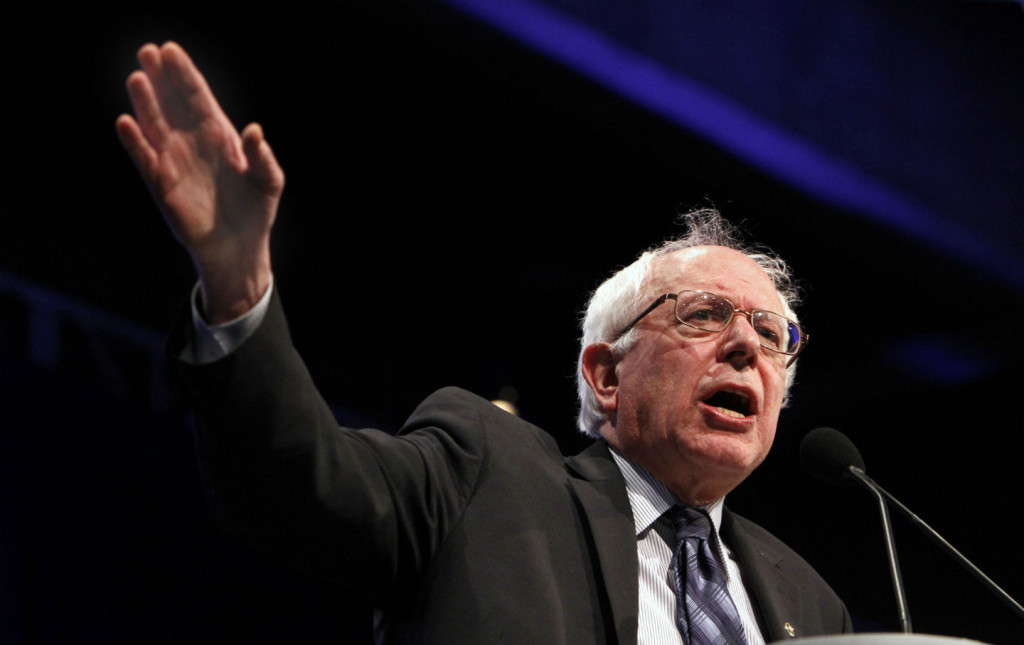
Vermont Sen. Bernie Sanders will announce his plans to seek the Democratic nomination for president on Thursday, presenting a liberal challenge to Hillary Rodham Clinton. Sanders, an independent who describes himself as a “democratic socialist,” will follow a statement with a major campaign kickoff in his home state in several weeks. Two people familiar with his announcement spoke to The Associated Press under condition of anonymity to describe internal planning. Sanders will become the second major Democrat in the race, joining Clinton. He has urged the former secretary of state to speak out strongly about issues related to income inequality and climate change. The former first lady and New York senator is viewed as a heavy favorite in the primary and entered the race this month. The white-haired senator and former mayor of Burlington, Vt., has been a liberal firebrand, blasting the concentration of wealth in America and assailing a “billionaire class” that he says has taken over the nation’s politics. His entry could be embraced by some liberals in the party who have been disenchanted with Clinton and have unsuccessfully urged Massachusetts Sen. Elizabeth Warren to join the race. In recent weeks, Sanders has been a forceful critic of the proposed Trans-Pacific Partnership trade agreement, which would eliminate tariffs and other trade barriers for the U.S., Canada and Asian countries conducting commerce with each other. “One of the key reasons why the middle class in America continues to decline and the gap between the very rich and everyone else is growing wider is because of disastrous trade agreements which have sent millions of decent-paying jobs to China and other low-wage countries,” Sanders said last week. Sanders generated attention in 2010 when he staged a lengthy Senate floor speech opposing a tax agreement by President Barack Obama and Republicans. He has called for universal health care, a massive infrastructure jobs and building program, a more progressive tax structure and reforms to address the U.S. Supreme Court’s Citizens United decision, which Sanders says has unleashed a torrent of money from big donors to political candidates. The senator has generated enthusiasm on college campuses and liberal enclaves in the early voting states of Iowa, New Hampshire and South Carolina and made several trips to court the influential Democratic voters there. “He will add color,” said Lou D’Allesandro, a Democratic state senator from New Hampshire. “He’s not bashful about anything.” Kathy Sullivan, a New Hampshire supporter of Clinton and a member of the Democratic National Committee, said Sanders’ decision was expected. “I know Hillary Clinton has always been expecting for there to be a competitive Democratic primary in New Hampshire,” Sullivan said. “I think he should be taken seriously.” Karl Rhomberg, a Davenport, Iowa, Democratic activist, said that while he expects Clinton “to be the nominee, I expect her to listen to Bernie, listen to (Martin) O’Malley and listen to people from the left.” He added: “If Bernie is going to put a stake on the left side of the field and draw Hillary toward it, that’s OK with me.” Sanders will start his campaign as a distinct underdog against Clinton, who remains the dominant front-runner. The Vermont senator is likely to face other challengers in the primary, such as O’Malley, the former Maryland governor, former Virginia Sen. Jim Webb and ex-Rhode Island Gov. Lincoln Chafee. A feisty voice for liberal policies, Sanders has long championed working-class Americans. He grew up in a Jewish family in Brooklyn — his father, an immigrant from Poland, sold paint for a living —and his views about the distribution of wealth were formed early. “A lack of money in my family was a very significant aspect of my growing up,” Sanders told the AP in December. “Kids in my class would have new jackets, new coats, and I would get hand-me-downs.” After his graduation from the University of Chicago, Sanders moved to Vermont in the 1960s as part of the counterculture, back-to-the-land movement that turned the state from solid Yankee Republican into one of the bluest in the country. Sanders lost several statewide races in the 1970s before he was elected mayor of Burlington in 1981 — a race he won by 10 votes. He was elected to the House a decade later, then won a Senate seat in 2006. He has carried a consistent message during his political career, arguing that the system is rigged in favor of the wealthiest Americans to the disadvantage of the nation’s poor and working class. Associated Press writer Kathleen Ronayne in Concord, N.H., and Catherine Lucey in Des Moines, Iowa, contributed to this report. Republished with permission from The Associated Press.
Marco Rubio tops in GOP presidential pack, best against Hillary Clinton, Q-poll finds
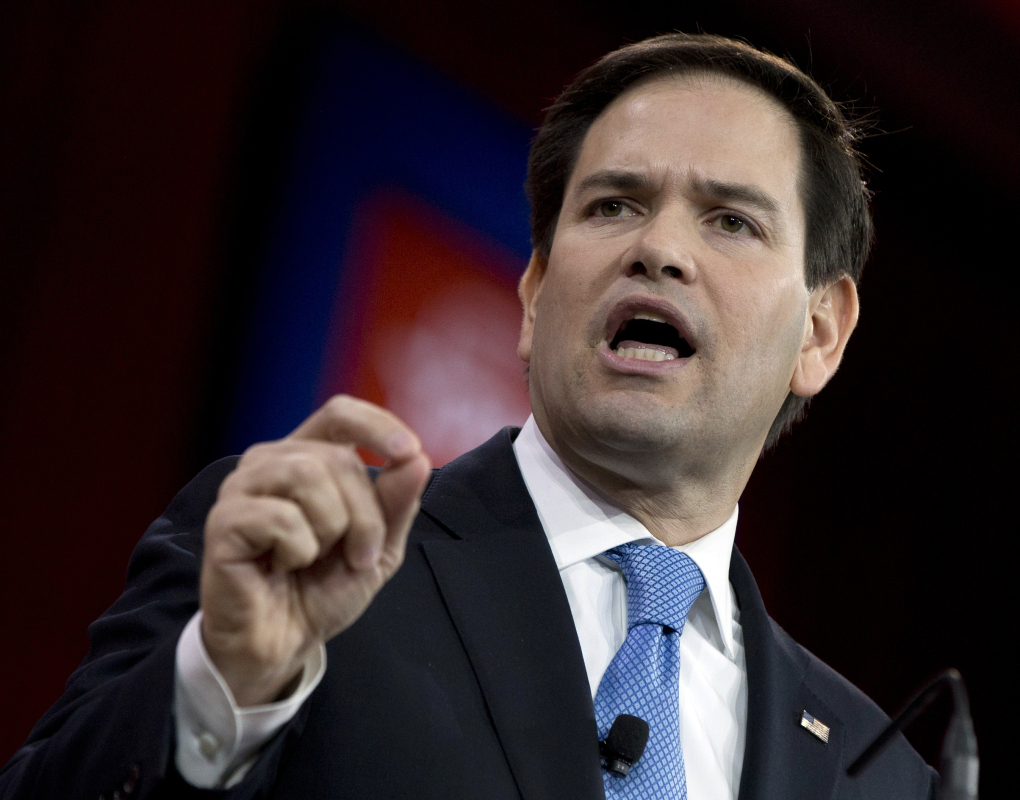
U.S. Sen. Marco Rubio wins the support of 15 percent of Republican primary voters and runs best against Democrat Hillary Clinton, according to a Quinnipiac University National poll released Thursday. The former secretary of state tops the Democratic field with 60 percent and leads top Republican contenders, except Rubio, in head-to-head matchups, the Quinnipiac University Poll finds. The Republican primary field shows Rubio with 15 percent, former Gov. Jeb Bush with 13 percent and Wisconsin Gov. Scott Walker with 11 percent. No other candidate tops 9 percent and 14 percent remain undecided. Bush tops the “no way” list as 17 percent of Republican voters say they would definitely not support him. New Jersey Gov. Chris Christie is next with 16 percent who give him a definite thumbs down, with 10 percent for U.S. Sen. Rand Paul of Kentucky. Clinton owns the Democratic nod with 60 percent, followed by Vice President Joseph Biden with 10 percent and U.S. Sen. Bernie Sanders of Vermont with 8 percent. Former Maryland Gov. Martin O’Malley has 3 percent and 14 percent are undecided. Clinton and Biden each get 7 percent on the “no way” list. “The youngest member of the GOP presidential posse moves to the front of the pack to challenge Hillary Clinton whose position in her own party appears rock solid,” said Tim Malloy, assistant director of the Quinnipiac University Poll. “This is the kind of survey that shoots adrenalin into a campaign. Marco Rubio gets strong enough numbers and favorability ratings to look like a legit threat to Hillary Clinton.” In a general election matchup, Clinton gets 45 percent of American voters to 43 percent for Rubio. She leads other top Republicans: •45-40 percent over Christie; •46-42 percent over Paul; •47-42 percent over former Arkansas Gov. Mike Huckabee; •46-39 percent over Bush; •46-41 percent over Walker; •48-41 percent over U.S. Sen. Ted Cruz of Texas. American voters say 54-38 percent that Clinton is not honest and trustworthy, a lower score than top Republicans. Voters say 62-34 percent that she has strong leadership qualities, besting Republican men by margins of 10 percentage points or higher. Voters are divided 47-47 percent on whether she cares about their needs and problems. Paul cares, voters say 43-35 percent, the best score on this point among Republicans. Voters approve 50-45 percent of the job Clinton did as Secretary of State. They support 53-43 percent a Congressional investigation into her e-mail use, but say 51-44 percent that such an investigation would be politically motivated rather than justified. American voters give Clinton a split 46-47 percent favorability rating. Rubio’s favorability score is 35-25 percent. Other Republicans get negative or divided scores: •29-42 percent for Christie; •33-33 percent for Paul; •33-33 percent of Huckabee; •30-43 percent for Bush; •24-21 percent for Walker, with 54 percent who don’t know enough about him to form an opinion; •25-30 percent for Cruz. “Yes she is a leader, but can she be trusted? Mixed reviews for Hillary Clinton on key character traits,” Malloy said. From April 16-21, Quinnipiac University surveyed 1,353 registered voters nationwide with a margin of error of +/- 2.7 percentage points. Live interviewers call land lines and cell phones. The survey includes 567 Republicans with a margin of error of +/- 4.1 percentage points and 569 Democrats with a margin of error of +/- 4.1 percentage points
A presidential candidate again, Hillary Clinton wants to “champion” everyday Americans
Hillary Rodham Clinton jumped back into presidential politics Sunday, making a much-awaited announcement she will again seek the White House with a promise to be the “champion” of everyday Americans. Clinton opened her bid for the 2016 Democratic nomination by positioning herself as the heir to the diverse coalition of voters who elected her immediate predecessor and former campaign rival, President Barack Obama. She also must appeal to those in her party still leery of her commitment to fighting income inequality. Unlike eight years ago, when she ran as a candidate with a deep résumé in Washington, Clinton and her personal history weren’t the focus of the first message of her campaign. In the online video that heralded her campaign, she made no mention of her time in the Senate and four years as secretary of state, or the prospect she could make history as the nation’s first female president. Instead, the video is collection of voters talking about their lives, their plans and aspirations for the future. Clinton doesn’t appear until the very end. “I’m getting ready to do something, too. I’m running for president,” Clinton said. “Americans have fought their way back from tough economic times, but the deck is still stacked in favor of those at the top. “Every day Americans need a champion, and I want to be that champion, so you can do more than just get by. You can get ahead and stay ahead.” It’s a message that also made an immediate play to win over the support of liberals in her party for whom economic inequality has become a defining issue. They remain skeptical of Clinton’s close ties to Wall Street and the centrist economic policies of the administration of her husband, former President Bill Clinton. Many had hoped Clinton would face a challenge from Massachusetts Sen. Elizabeth Warren, who has said she will not run. “It would do her well electorally to be firmly on the side of average working people who are working harder than ever and still not getting ahead,” said economist Robert Reich, a former labor secretary during the Clinton administration who has known Hillary Clinton for nearly five decades. Unlike some of the Republicans who have entered the race, Clinton was scant on policy specifics on her first day as a candidate. Kentucky Sen. Rand Paul, for example, began his campaign with a website and online videos that described his positions on an array of domestic and foreign policy issues. Clinton also began her campaign for president in 2007 with a video, followed by a splashy rally in Des Moines where she said, “I’m running for president, and I’m in it to win it.” This time around, Clinton will instead head this week to first-to-vote Iowa, looking to connect with voters directly at a community college and small business roundtable in two small towns. “When families are strong, America is strong. So I’m hitting the road to earn your vote. Because it’s your time. And I hope you’ll join me on this journey,” she said in the video. This voter-centric approach was picked with a purpose, her advisers said, to show that Clinton is not taking the nomination for granted. Her campaign said Sunday she would spend the next six to eight weeks in a “ramp-up” period, and she would not hold her first rally and deliver a campaign kickoff speech until May. Clinton is the first high-profile Democrat to get into the race, and she quickly won the endorsement of several leading members of her party, including her home state governor, New York Gov. Andrew Cuomo, and Virginia Sen. Tim Kaine. Still, there are some lesser-known Democrats who are considering challenging her, including former Maryland Gov. Martin O’Malley and Vermont independent Sen. Bernie Sanders. Republished with permission of The Associated Press.
