
Trump administration ready to ease rules on coal-fired power plants
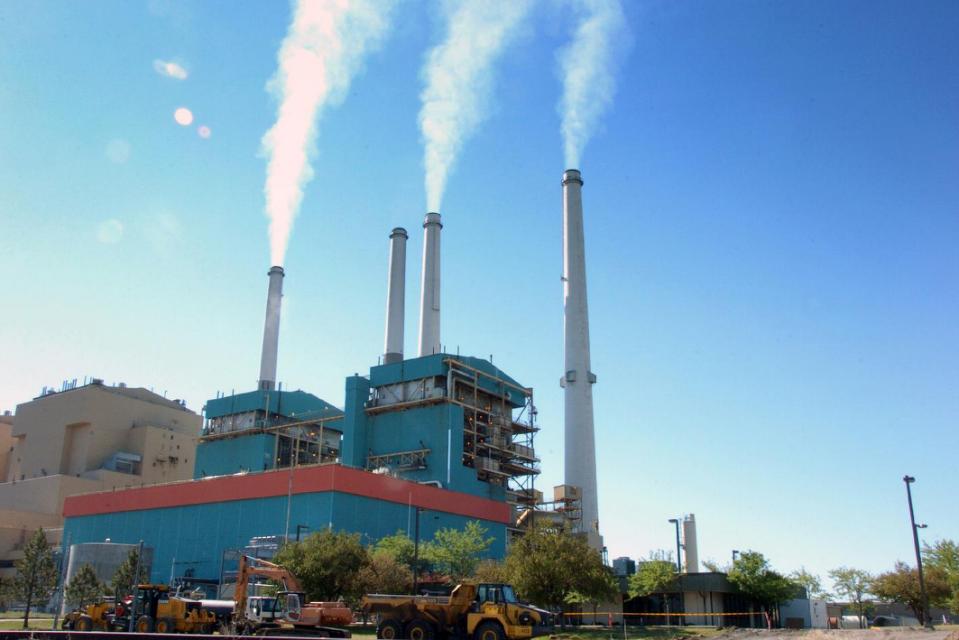
The Trump administration is set to roll back the centerpiece of President Barack Obama’s efforts to slow global warming. It’s expected to propose regulations that give states broad authority to determine how to restrict greenhouse gas emissions from coal-fired power plants. The plan would let states relax pollution rules for power plants that need upgrades. That would reverse an Obama-era push to shift away from coal and toward less-polluting energy sources. The plan is to be announced in coming days. Combined with a planned rollback of car-mileage standards, the plan represents a significant retreat from Obama-era efforts to fight climate change. President Donald Trump has already vowed to pull the U.S. out of the Paris climate agreement as he pushes to revive the coal industry. Republished with the permission of the Associated Press.
US already feeling effects of climate change, report says
A federal climate report says the United States is already feeling the effects of climate change, with temperatures rising dramatically over the last four decades. That’s according to The New York Times, which acquired a draft copy of the report by scientists from 13 federal agencies. The report says extreme heat waves have become more common and extreme cold waves less common since the 1980s. It says emissions of greenhouse gases will affect the degree to which global temperatures continue to rise – a claim President Donald Trump and some members of his cabinet have disputed. One scientist cited anonymously by the Times says he and other researchers are worried that the Trump administration, which must approve the report’s release, will suppress it. Republished with permission of The Associated Press.
Daniel Sutter: Forget Paris
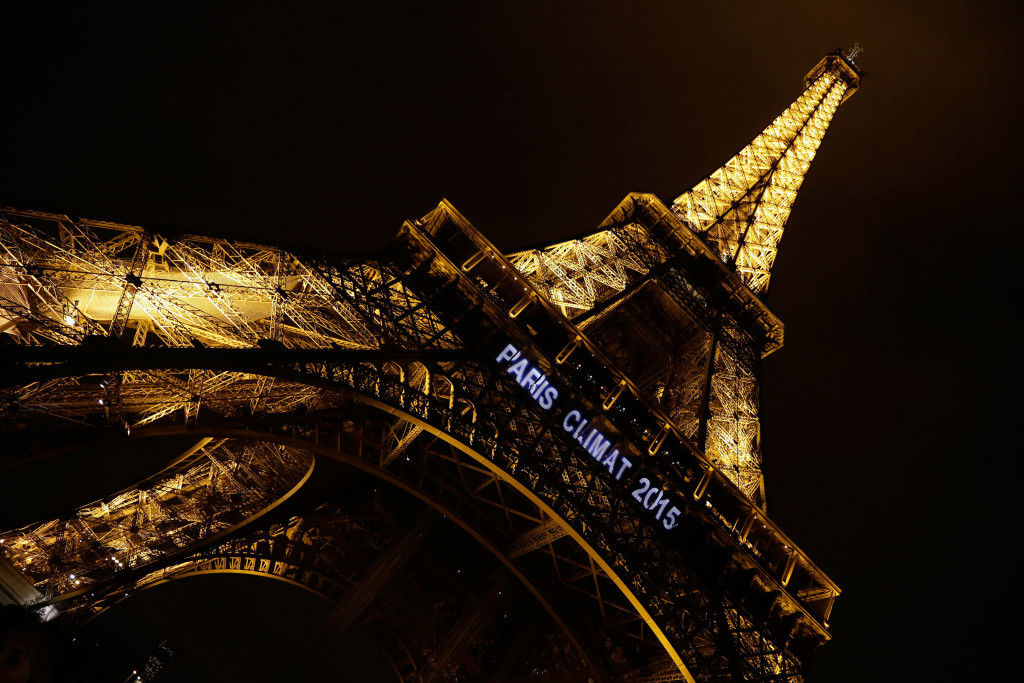
President Donald Trump announced the U.S. withdrawal from the Paris Climate Accord last week, setting off a firestorm of criticism. For instance, a New York Daily News headlined: “Trump to World: Drop Dead.” The withdrawal raises questions about global warming policies and their formulation. President Barack Obama and other world leaders signed the Paris Accord in December 2015. The U.S. and other developed nations promised greenhouse gas emissions cuts in the Accord. The Clean Power Plan, which significant restricts the use of coal, counts towards our promised efforts. Peoples’ responses to the withdrawal seem to depend largely on whether they believe that global warming will prove catastrophic. Warming due to greenhouse gases is not really in doubt; relevant questions involve how much warming will occur, the impacts of warming, and the viability of climate engineering to avoid or reverse warming. Despite the invective hurled at President Trump, the Paris Accord would have done very little to prevent catastrophic global warming. If every nation had delivered as promised (a big if), the Accord would have prevented about 0.2 degrees Celsius warming by 2100 according to leading climate models. The math of atmospheric carbon dioxide concentrations is pretty clear: achieving the recommended targets will take a lot more than driving electric cars. Basically, we would need to stop using fossil fuels by mid-century, bringing almost unimaginable changes to our economy and lives. On the other hand, people who don’t see global warming as a dire threat look forward to Mr. Trump soon voiding the Clean Power Plan. Such a celebration might be premature. The Environmental Protection Agency (EPA) might be committed to the Plan despite the Paris exit. Why? In 2007, the U.S. Supreme Court ruled in Massachusetts v. E.P.A. that the Clean Air Act provided legal authority to regulate carbon dioxide emissions, if the EPA determined that greenhouse gases endangered the environment. In 2009, President Obama’s EPA issued this endangerment finding. As Cato Institute’s Patrick Michaels argued at the recent 12th International Conference on Climate Change, the endangerment finding likely compels implementation of the Clean Power Plan. The process behind imposing these policies is, I think, highly troubling. A lawsuit by environmental groups and sympathetic state attorneys general yielded the 2007 Supreme Court decision. Regulatory actions by the EPA produced the endangerment finding and Clean Power Plan. And finally, we had an international agreement never ratified by the Senate. The process further relied on technicalities and a limitation of the Clean Air Act. The Act requires reduction of pollution to safe levels regardless of cost, and without considering whether we might more easily live with pollution. And yet adaption to a warmer climate is a potential response to global warming. The Clean Air Act gives the EPA authority to regulate “any air pollutant” endangering human well-being. Calling carbon dioxide, which is necessary for life, pollution stretches the plain meaning of the word. Limited government undertakes only those tasks citizens authorize. Meaningful limits require narrowly authorized tasks. Air pollution caused by cars and factories differs markedly from global warming. Action to address global warming should require explicit authorization by citizens. The cap-and-trade proposal of 2010 sought such approval, but failed in the Senate. The Paris Accord was never submitted to the Senate. Enacting the costliest environmental program ever contemplated without approval by our elected representatives is inconsistent with democracy and limited government. Global warming activists interpreted cap-and-trade’s failure as evidence of special interests choking the democratic process. Yet evidence weighs against this interpretation. A 2015 Gallup poll, for instance, found that only 32 percent of Americans worried a great deal about climate change, the same percentage as in 1989. If you doubt such polls, then ask if you or people you know would be willing to give up cars, airplanes, air conditioning and computers over global warming. Our system trusts that Americans have the intelligence and character to determine what is in our best interests. Many Americans are not willing to spend trillions of dollars combatting global warming. We may be wrong, but imposing incredibly costly policies against our wishes is un-American. ••• Daniel Sutter is the Charles G. Koch Professor of Economics with the Manuel H. Johnson Center for Political Economy at Troy University and host of Econversations on TrojanVision. The opinions expressed in this column are the author’s and do not necessarily reflect the views of Troy University.
Mo Brooks defends Donald Trump’s withdrawal from Paris Climate Accord on House floor
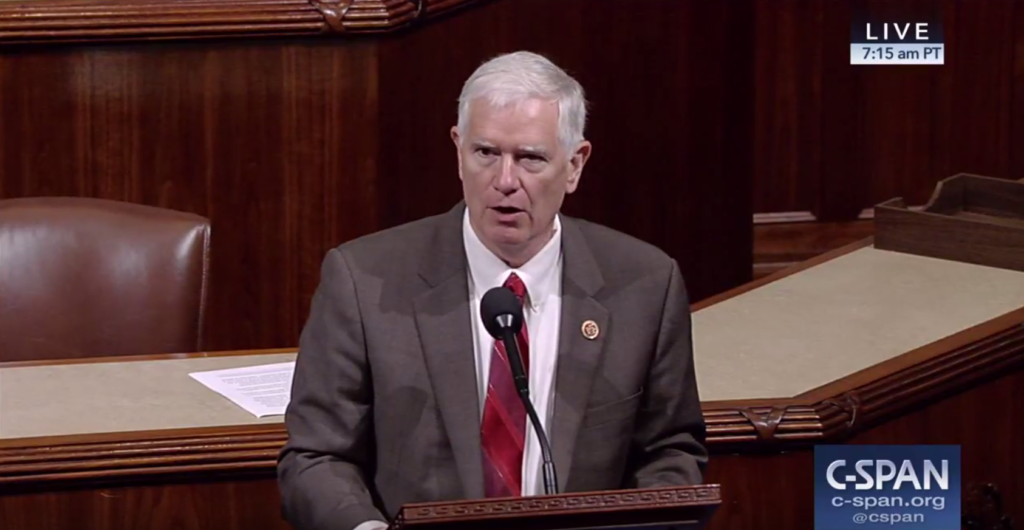
Alabama 5th District U.S. Congressman Mo Brooks appeared on the House floor Wednesday to support President Donald Trump’s decision to withdraw from the Paris Climate Accord. “President Trump is right, America must lead by putting America’s national interest first. The Paris Climate Accord did not do that,” said Brooks. “I am proud that President Trump puts America First. America should not and must not yield even a smidgeon of our national sovereignty to the dictates of other, lesser nations. Despite liberal, climate-scare and socialist Democrat hysteria to the contrary, America has been, and is, by almost every standard, the greatest nation in world history. With an ‘America First’ attitude, America will continue its 75 year streak as the greatest nation in the history of the world, second to none.” Trump announced his decision to withdraw from the agreement that former President Barack Obama signed last week, saying it has disadvantaged the United States all the while benefitting other countries, leaving American businesses and taxpayers to pay the tab. Brooks agreed with Trump’s assessment, calling the accord a “global redistribution of wealth scheme.” “Lest there be any doubt, the Paris Climate Accord intentionally hurt America to the benefit of competitor nations. In a global redistribution of the wealth scheme, the Paris Climate Accord called for America to give away tens of billions of dollars to other countries,” Brooks added. Watch Brooks’ floor speech below:
Does Donald Trump believe in climate change or not? Aides won’t say
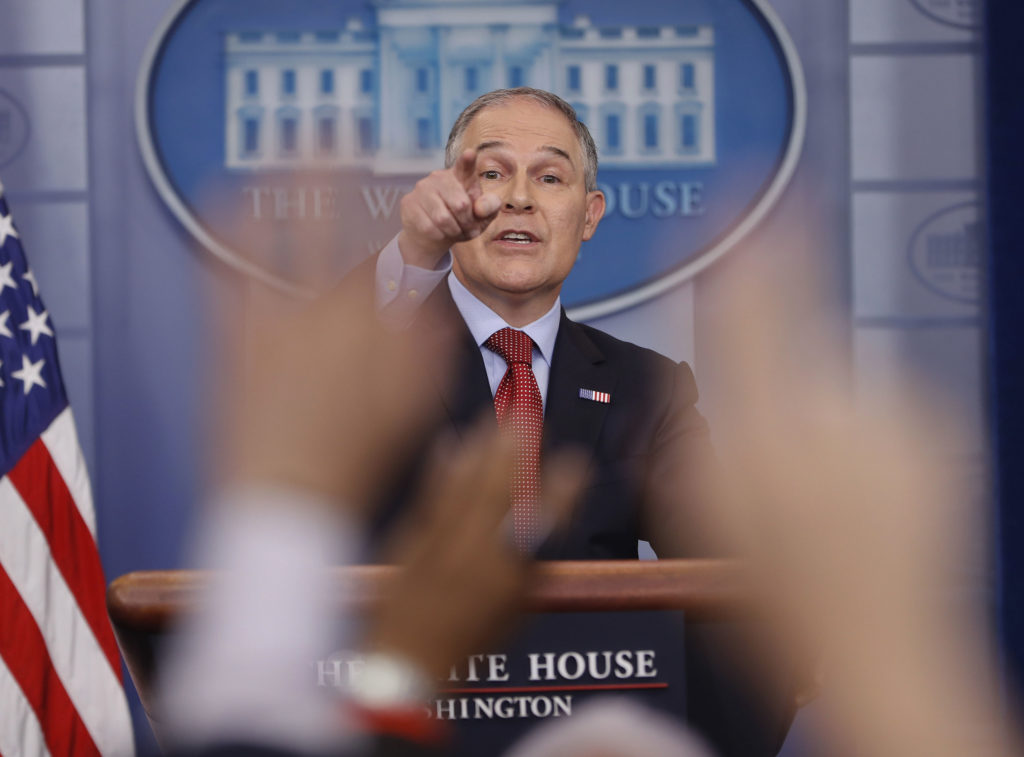
Does he or doesn’t he? Believe in climate change, that is. You’d think that would be an easy enough question the day after President Donald Trump announced he was pulling the U.S. out of the landmark global accord aimed at combating global warming. But don’t bother asking at the White House. “I have not had an opportunity to have that discussion” with the president, responded Press Secretary Sean Spicer on Friday. “You should ask him that,” offered White House Counselor Kellyanne Conway. Environmental Protection Agency chief Scott Pruitt dodged the question, too. The president also ignored it during an unrelated bill-signing. It’s quite a reversal for Trump, who spent years publicly bashing the idea of global warming as a “hoax” and “total con job” in books, interviews and tweets. He openly challenged the scientific consensus that the climate is changing and man-made carbon emissions are largely to blame. “Global warming is an expensive hoax!” he tweeted in 2014. But Trump has been largely silent on the issue since his election last fall. On Thursday, he made scarce mention of it in his lengthy remarks announcing America’s exit from the Paris accord. Instead, he framed his decision as based on economics. Here’s what he’s said before: — TRUMP’S TWEETS: The president’s Twitter feed once was filled with references to “so-called” global warming being a “total con job” based on “faulty science and manipulated data.” An Associated Press search of his Twitter archives revealed at least 90 instances in which he has referred to “global warming” and “climate change” since 2011. In nearly every instance, he expressed skepticism or mockery. “This very expensive GLOBAL WARMING bulls— has got to stop,” he wrote in January 2014, spelling out the vulgarity. Often the president has pointed to cold weather as evidence the climate scientists are wrong. “It’s 46 (really cold) and snowing in New York on Memorial Day — tell the so-called “scientists” that we want global warming right now!” he wrote in May 2013 — one of several instances in which he said that warming would be welcome. “Where the hell is global warming when you need it?” he asked in January 2015. The same message was echoed in the president’s books. In “Great Again: How to Fix Our Crippled America,” Trump made a reference to “the mistaken belief that global climate change is being caused by carbon emissions.” “If you don’t buy that — and I don’t — then what we have is really just an expensive way of making the tree-huggers feel good about themselves,” he wrote. — CANDIDATE AND SKEPTIC: “I’m not a believer in man-made global warming,” Trump told conservative radio host Hugh Hewitt in September 2015, after launching his bid for the White House. He bemoaned the fact that the U.S. was investing money and doing things “to solve a problem that I don’t think in any major fashion exists.” “I am not a believer,” he added, “Unless somebody can prove something to me … I am not a believer and we have much bigger problems.” By March 2016, the president appeared to allow that the climate was changing — but continued to doubt humans were to blame. “I think there’s a change in weather. I am not a great believer in man-made climate change. I’m not a great believer,” he told The Washington Post. “There is certainly a change in weather,” he said. Then-campaign manager, Conway explained Trump’s view this way: “He believes that global warming is naturally occurring. That there are shifts naturally occurring.” — EVOLVING PRESIDENT: In an interview with The New York Times in November, after the election, Trump was asked repeatedly whether he intended to leave the Paris accord and appeared to have a new open-mindedness. “I’m looking at it very closely,” Trump told the newspaper. “I have an open mind to it. We’re going to look very carefully.” He went on to say that he thought “there is some connectivity” between human activity and the changing climate, but that, “It depends on how much.” Asked about the comment several days later, Trump’s now-chief of staff Reince Priebus told Fox News that Trump “has his default position, which is that most of it is a bunch of bunk.” “But he’ll have an open mind and listen to people,” he said. Stay tuned. Republished with permission of The Associated Press.
Despite Donald Trump, cleaner energy growth expected to carry on
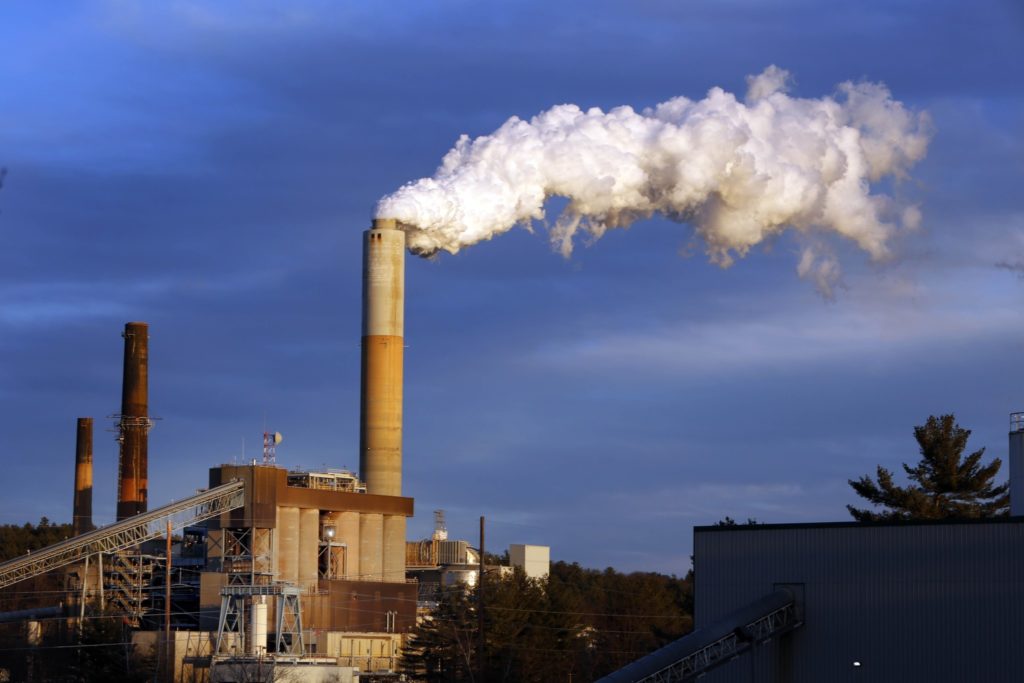
President Donald Trump may abandon U.S. pledges to reduce carbon emissions that contribute to global warming, but that step seems unlikely to stall the push to adopt cleaner forms of energy. Around the world, coal-fired power plants are being shuttered as governments and private companies invest billions in wind turbines and solar farms. Even in regions of the U.S. where coal is plentiful, electric utilities are increasingly shifting to cheaper, cleaner-burning natural gas. In the absence of federal action to address climate change, some left-leaning states such as California and New York are moving ahead with ambitious clean-energy policies of their own. Trump said on Twitter late Wednesday he will announce his decision on whether to pull the United States out of the Paris climate accord during a Rose Garden event Thursday afternoon. The Paris accord was negotiated by President Barack Obama in 2015. A White House official told The Associated Press on Wednesday that Trump is expected to withdraw from the deal, though aides cautioned he had not yet made a final decision. Reports of the impending move by the American president triggered statements of support for the climate accord from scores of world leaders. At a meeting of the G7 in Sicily last week, only Trump refused to reaffirm their nations’ continuing support for the Paris deal, which was signed by nearly 200 countries. “A U.S. withdrawal from Paris will be a disappointment to the climate community, but it may also embolden other countries to fill the void left by the U.S. and take on a greater leadership role,” said Glen Peters, a Norwegian scientist who tracks global carbon emissions. “The declines in U.S. emissions in the last decade have largely happened without strong climate policies, and a withdrawal from the Paris Agreement may have minimal effect on U.S. emissions but give a hit to international morale.” Trump, a Republican who has claimed global warming is a hoax, has moved quickly since taking office to delay or block restrictions on burning of fossil fuels enacted by his predecessor that he claims are holding back economic growth. The president has pledged to reverse decades of decline in coal mining, which now accounts for fewer than 75,000 U.S. jobs. Almost every other industrialized economy in the world is moving in the opposite direction. On April 30, Germany established a new national record for renewable energy use with 85 percent of all electricity produced in the county coming from renewable sources. That same month, Scotland was able to produce an electricity surplus from its wind turbines, producing 136 percent of the energy needed for its 3.3 million households. The Chinese government canceled construction of more than 100 new coal-fired power plants earlier this year, announcing plans to invest at least $360 billion in green-energy projects by 2020. It is a building boom expected to create an estimated 13 million jobs. Though it remains the largest global carbon emitter, China also leads the world in total installed solar and wind capacity. China generates about 20 percent of its electricity from renewable sources, compared to about 13 percent in the U.S. “President Trump is ceding the future to the Germans, the Chinese, the Indians, and other nations rather than having the United States continue to lead the world on clean energy solutions,” said Sen. Ed Markey, D-Mass. “By creating the clean energy technologies here at home and then deploying them around the world, we can have job creation that is good for all creation.” Coal is the dirtiest of fossil fuels, accounting for more than three-quarters of carbon emissions from U.S. power plants despite generating less than 40 percent of the nation’s electricity. Several of the country’s largest coal companies have sought bankruptcy protection in the last year, largely due to competition from natural gas made cheaper and more abundant by hydraulic fracturing. As American utilities have turned away from coal, the nation has seen a corresponding decline in carbon emissions. Still, the United States remains the world’s second largest emitter of carbon dioxide. Scientists warn that any delay in weaning the country off fossil fuels could exacerbate the negative effects of climate change for the rest of the globe. Carbon dioxide stays in the air for 100 years and about one-fifth of what’s accumulated in the atmosphere over the last century came from the United States, more than any other country. “The U.S. pulling out of Paris will not stop the fight against global warming, since almost all other countries are committed to it,” said Stefan Rahmstorf, a German climate researcher. “But it could delay it and any delay could be detrimental, as stopping global warming before critical tipping points are crossed is a race against the clock.” Republished with permission of The Associated Press.
Donald Trump delaying decision on Paris climate deal
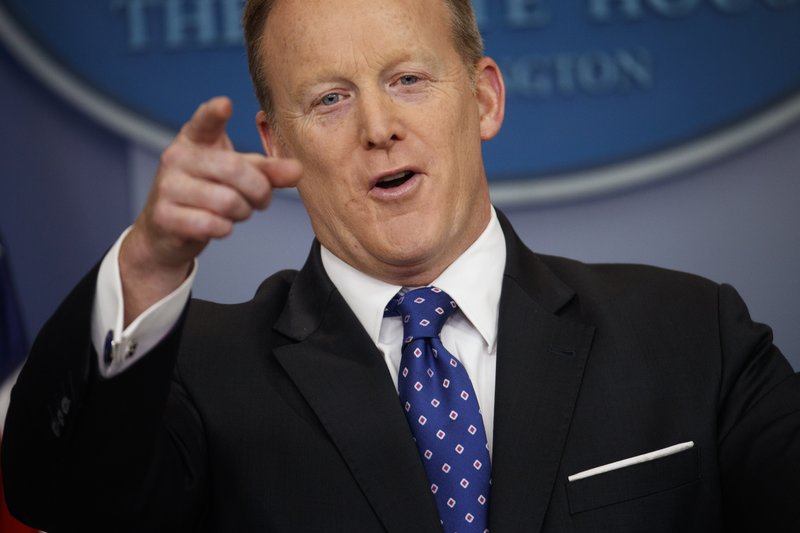
President Donald Trump is delaying a decision on whether to withdraw from a landmark climate deal until after an international summit later this month. That means the president will head to the G7 summit in Italy at the end of May amid continued global uncertainty over whether the United States will remain in the emissions-cutting deal struck in Paris under the Obama administration. White House spokesman Sean Spicer said Tuesday that Trump wants to “continue to meet with his team,” seeking advice from both an economic and an environmental perspective as he works to make a decision. A meeting for top advisers to discuss the deal was set for Tuesday afternoon but was postponed. Trump pledged during the presidential campaign to renegotiate the accord, but he has wavered on the issue since winning the presidency. His top officials have appeared divided about what to do about the deal, under which the United States pledged to significantly reduce planet-warming carbon emissions in the coming decade. Leading up to the expected Tuesday meeting, a number of high-profile businesses spoke out in favor of remaining in the deal. A group including Apple, Google and Walmart signed a letter sent to Trump last week. A larger coalition signed on to ads run in the Washington editions of the New York Times and Wall Street Journal this week. On Instagram Tuesday, renowned jeweler Tiffany and Company wrote a message to the president, saying “we’re still in for bold climate action. Please keep the U.S. in the Paris Climate Agreement.” Ted Halstead, president of the Climate Leadership Council, said that “there is a nearly unanimous position on the part of big business.” Halstead co-authored an opinion piece that ran in the New York Times Tuesday, titled “The Business Case for the Paris Climate Accord.” “American business leaders understand that remaining in the agreement would spur new investment, strengthen American competitiveness, create jobs, ensure American access to global markets and help reduce future business risks associated with the changing climate,” said the piece, written with George P. Shultz, who served as secretary of state under President Ronald Reagan. Opponents of the deal have also lobbied the president this week, with a group of conservative organizations signing a letter saying “the treaty is not in the interest of the American people and the U. S. should therefore not be a party to it.” Signatures on the letter include veteran anti-tax activist Grover Norquist and Myron Ebell, who led transition efforts at EPA prior to the president’s swearing in. The Paris accord, signed by nearly 200 nations in 2015, was never ratified by the Senate due to the staunch oppositions of Republicans. It therefore does not have the force of a binding treaty, and the United States could potentially withdraw from the deal without legal penalty. Secretary of State Rex Tillerson, the former chief executive of the oil company Exxon, said at his Senate confirmation hearing in January that he supports staying in the deal. But Environmental Protection Agency Administrator Scott Pruitt has said the Paris pact “is a bad deal for America” that will cost jobs. Like Trump, Pruitt has questioned the consensus of climate scientists that man-made carbon emissions are the primary driver of global warming. A senior administration official said the president’s inclination has been to leave the pact, but Ivanka Trump set up a review process to make sure he received information from experts in the public and private sector before a making a decision. The official requested anonymity to discuss private conversations. Ivanka Trump, who serves as an adviser to her father, was supposed to meet separately Tuesday with Pruitt Tuesday, but that meeting was also postponed, according to a White House official who requested anonymity to discuss private talks. Republished with permission of The Associated Press.
Donald Trump’s 100-days promises: Fewer than half carried out
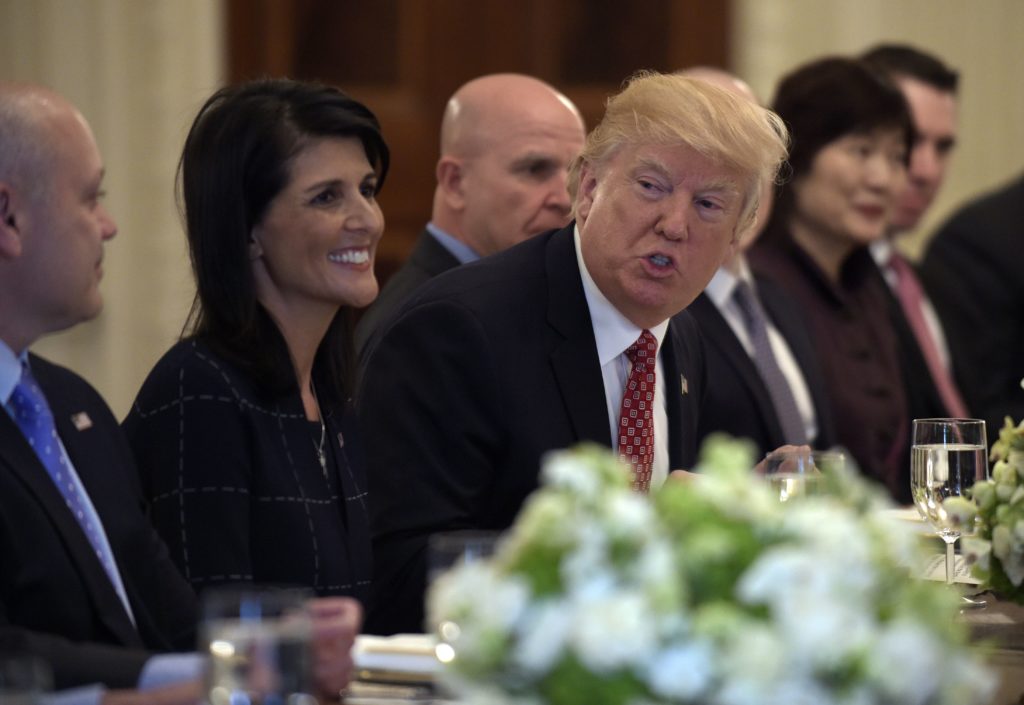
Sure enough, the big trans-Pacific trade deal is toast, climate change action is on the ropes and various regulations from the Obama era have been scrapped. It’s also a safe bet President Donald Trump hasn’t raced a bicycle since Jan. 20, keeping that vow. Add a Supreme Court justice — no small feat — and call these promises kept. But where’s that wall? Or the promised trade punishment against China — will the Chinese get off scot-free from “the greatest theft in the history of the world”? What about that “easy” replacement for Obamacare? How about the trillion-dollar infrastructure plan and huge tax cut that were supposed to be in motion by now? Trump’s road to the White House, paved in big, sometimes impossible pledges, has detoured onto a byway of promises deferred or left behind, an AP analysis found. Of 38 specific promises Trump made in his 100-day “contract” with voters — “This is my pledge to you” — he’s accomplished 10, mostly through executive orders that don’t require legislation, such as withdrawing the U.S. from the Trans-Pacific Partnership trade deal. He’s abandoned several and failed to deliver quickly on others, stymied at times by a divided Republican Party and resistant federal judges. Of 10 promises that require Congress to act, none has been achieved and most have not been introduced. “I’ve done more than any other president in the first 100 days,” the president bragged in a recent interview with AP, even as he criticized the marker as an “artificial barrier.” In truth, his 100-day plan remains mostly a to-do list that will spill over well beyond Saturday, his 100th day. Some of Trump’s promises were obviously hyperbole to begin with. Don’t hold your breath waiting for alleged Army deserter Bowe Bergdahl to be dropped out of an airplane without a parachute, as Trump vowed he’d do at many of his campaign rallies. China’s leader got a fancy dinner, complete with “beautiful” chocolate cake at Mar-a-Lago this month, not the promised “McDonald’s hamburger” and humble pie. But many promises were meant to be taken seriously. Trump clearly owes his supporters a Mexico border wall, even if it doesn’t end up being a foot taller than the Great Wall of China. One page of his 100-day manifesto is devoted to legislation he would fight to pass in 100 days. None of it has been achieved. The other page lists 18 executive actions and intentions he promised to pursue — many on Day One. He has followed through on fewer than a dozen, largely through the use of executive orders, and the White House is boasting that he will set a post-World War II record when he signs more this week. That’s a change in tune. “We need people in Washington that don’t go around signing executive orders because they can’t get people into a room and get some kind of a deal that’s negotiated,” he declared in New Hampshire in March 2015. “We need people that know how to lead, and we don’t have that. We have amateurs.” Efforts to provide affordable child care and paid maternity leave, to make college more affordable and to invest in urban areas have been all but forgotten. That’s despite the advantage of a Republican-controlled Congress, which the White House failed to pull together behind Trump’s first attempt to repeal and replace “Obamacare.” An AP reporter who followed Trump throughout the presidential campaign collected scores of promises he made along the way, from the consequential to the fanciful. Here are some of them, and his progress so far: ___ ENERGY and the ENVIRONMENT: — Lift President Barack Obama‘s roadblocks on the Keystone XL and Dakota Access pipelines. Done. Keystone XL is revived and construction of the Dakota Access is completed. — Lift restrictions on mining coal and drilling for oil and natural gas. Done. Trump has unraveled a number of Obama-era restrictions and initiated a review of the Clean Power Plan, which aimed to restrict greenhouse gas emissions at coal-fired power plants. — Cancel payments to U.N. climate change programs and pull out of the Paris climate accord Nope. Trump has yet to make a decision on Paris. His aides are torn. ___ ECONOMY and TRADE: — Pass a tax overhaul. “Just think about what can be accomplished in the first 100 days of a Trump administration,” he told his supporters again and again in the final weeks of the campaign. “We are going to have the biggest tax cut since Ronald Reagan.” He promised a plan that would reduce rates dramatically both for corporations and the middle class. Nowhere close. Trump has scrapped the tax plan he campaigned on, and his administration’s new package is in its early stages, not only missing the first 100 days but likely to miss a new August deadline set by Treasury Secretary Steven Mnuchin. Some details may emerge this week. —Designate China a currency manipulator, setting the stage for possible trade penalties because “we’re like the piggy bank that’s being robbed. We can’t continue to allow China to rape our country, and that’s what they’re doing.” Abandoned. Trump says he doesn’t want to punish China when it is cooperating in a response to North Korean provocations. He also says China has stopped manipulating its currency for unfair trade advantage. But China was moving away from that behavior well before he took office. Also set aside: repeated vows to slap high tariffs on Chinese imports. —Announce his intention to renegotiate or withdraw from the North American Free Trade Agreement. Backtracked, in essence. A draft of his administration’s plan for NAFTA proposes only a mild rewrite. But in his AP interview, he threatened anew to terminate the deal if his goals are not met in a renegotiation. — Direct his commerce secretary and trade representative to identify all foreign trading abuses that unfairly hurt American workers. Done. Trump has initiated plenty of studies over the past 100 days. — Slap a 35 percent tariff on goods from
Once critical of global deals, Donald Trump slow to pull out of any
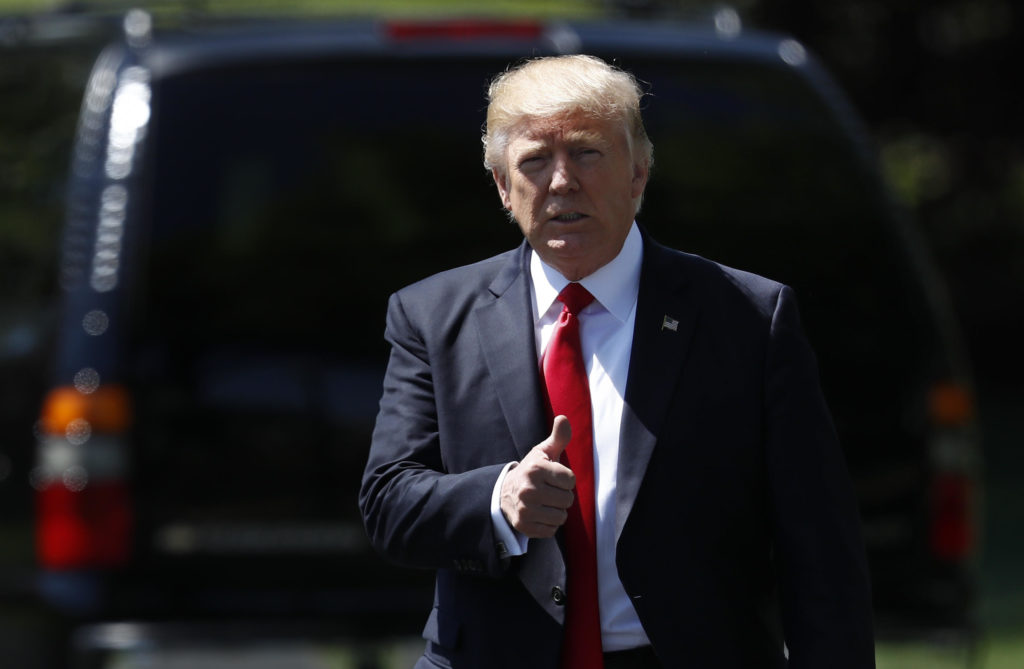
The “America First” president who vowed to extricate America from onerous overseas commitments appears to be warming up to the view that when it comes to global agreements, a deal’s a deal. From NAFTA to the Iran nuclear agreement to the Paris climate accord, President Donald Trump‘s campaign rhetoric is colliding with the reality of governing. Despite repeated pledges to rip up, renegotiate or otherwise alter them, the U.S. has yet to withdraw from any of these economic, environmental or national security deals, as Trump’s past criticism turns to tacit embrace of several key elements of U.S. foreign policy. The administration says it is reviewing these accords and could still pull out of them. A day after certifying Iran’s compliance with the nuclear deal, Secretary of State Rex Tillerson attacked the accord and listed examples of Iran’s bad behavior. His tone suggested that even if Iran is fulfilling the letter of its nuclear commitments, the deal remains on unsure footing. Yet with one exception — an Asia-Pacific trade deal that already had stalled in Congress — Trump’s administration quietly has laid the groundwork to honor the international architecture of deals it has inherited. It’s a sharp shift from the days when Trump was declaring the end of a global-minded America that negotiates away its interests and subsidizes foreigners’ security and prosperity. Trump had called the Iran deal the “worst” ever, and claimed climate change was a hoax. But in place of action, the Trump administration is only reviewing these agreements, as it is doing with much of American foreign policy. Douglas Brinkley, a presidential historian at Rice University, said Trump may be allowing himself to argue in the future that existing deals can be improved without being totally discarded. “That allows him to tell his base that he’s getting a better deal than Bush or Obama got, and yet reassure these institutions that it’s really all being done with a nod and a wink, that Trump doesn’t mean what he says,” Brinkley said. So far, there’s been no major revolt from Trump supporters, despite their expectation he would be an agent of disruption. This week’s reaffirmations of the status quo came via Tillerson’s certification of Iran upholding its nuclear deal obligations and the administration delaying a decision on whether to withdraw from the Paris climate accord. The president had previously spoken about dismantling or withdrawing from both agreements as part of his vision, explained in his inaugural address, that “every decision on trade, on taxes, on immigration, on foreign affairs will be made to benefit American workers and American families.” The Iran certification, made 90 minutes before a midnight Tuesday deadline, means Tehran will continue to enjoy relief from U.S. nuclear sanctions. Among the anti-deal crowd Trump wooed in his presidential bid, the administration’s decision is fueling concerns that Trump may let the 2015 accord stand. Tillerson on Wednesday sought to head off any criticism that the administration was being easy on Iran, describing a broad administration review of Iran policy that includes the nuclear deal and examines if sanctions relief serves U.S. interests. The seven-nation nuclear deal, he said, “fails to achieve the objective of a non-nuclear Iran” and “only delays their goal of becoming a nuclear state.” On the climate agreement, the White House postponed a meeting Tuesday where top aides were to have hashed out differences on what to do about the non-binding international deal forged in Paris in December 2015. The agreement allowed rich and poor countries to set their own goals to reduce carbon dioxide and went into effect last November, after the U.S., China and other countries ratified it. Not all of Trump’s advisers share his skeptical views on climate change — or the Paris pact. Trump’s position on trade deals also has evolved. He had promised to jettison the North American Free Trade Agreement with Mexico and Canada unless he could substantially renegotiate it in America’s favor, blaming NAFTA for devastating the U.S. manufacturing industry by incentivizing the use of cheap labor in Mexico. Now his administration is only focused on marginal changes that would preserve much of the existing agreement, according to draft guidelines that Trump’s trade envoy sent to Congress. The proposal included a controversial provision that lets companies challenge national trade laws through private tribunals. Trump has followed through with a pledge to pull the U.S. out of the Trans-Pacific Partnership, a sweeping free trade deal President Barack Obama negotiated. The agreement was effectively dead before Trump took office after Congress refused to ratify it. Even Trump’s Democratic opponent in the presidential race, Hillary Clinton, opposed the accord. But on NATO, Trump has completely backed off his assertions that the treaty organization is “obsolete.” His Cabinet members have fanned out to foreign capitals to show America’s support for the alliance and his administration now describes the 28-nation body as a pillar of Western security. Republished with permission of The Associated Press.
Donald Trump acts to advance Keystone XL, Dakota Access pipelines
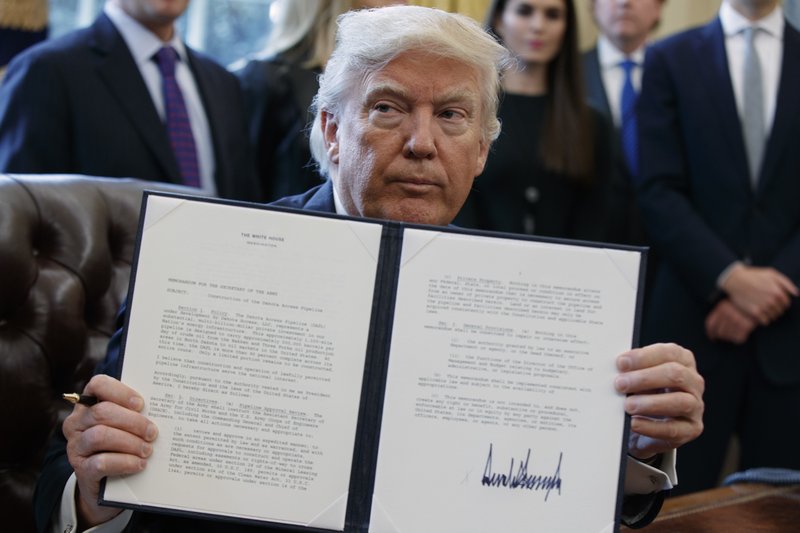
Dealing a blow to former President Barack Obama‘s legacy on climate change, President Donald Trump signed executive actions Tuesday to advance the construction of the Keystone XL and Dakota Access oil pipelines, a move cheered by congressional Republicans and decried by environmentalists. Trump told reporters at the White House that the actions on the pipelines will be subject to the terms and conditions being negotiated by U.S. officials. “From now on we are going to start making pipelines in the United States,” Trump said from the Oval Office. Obama killed the proposed Keystone XL pipeline in late 2015, declaring it would have undercut U.S. efforts to clinch a global climate change deal that was a centerpiece of his environmental legacy. The pipeline would run from Canada to U.S. refineries in the Gulf Coast. A presidential permit is needed to approve the pipeline because it would cross the U.S border. The Army decided last year to explore alternate routes for the Dakota pipeline after the Standing Rock Sioux tribe and its supporters said the pipeline threatened drinking water and Native American cultural sites. The company developing the 1,200-mile pipeline, Texas-based Energy Transfer Partners, disputes that and says the pipeline will be safe. The Dakota pipeline is set to carry North Dakota oil through South Dakota and Iowa to a shipping point in Illinois. “Today’s news is a breath of fresh air, and proof that President Trump won’t let radical special-interest groups stand in the way of doing what’s best for American workers,” said Sen. John Cornyn of Texas, the second-ranking Republican in the Senate. In July, the Army Corps of Engineers granted the company needed permits, but in September the agency said further analysis was needed. On Dec. 4, the assistant army secretary for civil works, Jo-Ellen Darcy, declined to allow the pipeline to be built under Lake Oahe because she said alternate routes needed to be considered. Energy Transfer Partners called the decision politically motivated and said that Obama was delaying the matter until he left office. Nearly 600 pipeline opponents have been arrested in North Dakota since last year. An encampment on Corps land along the pipeline route was home to thousands of protesters who call themselves “water protectors,” though the camp’s population has thinned due to harsh winter weather and a plea by Standing Rock Chairman Dave Archambault for the camp to disband. Trump touted the stalled Keystone project during a late October campaign swing through Florida, saying: “We’re going to approve energy infrastructure projects like the Keystone pipeline and many more.” He listed the project among his top priorities for the first 100 days of his administration, saying it could provide “a lot of jobs, a lot of good things.” Trump also supports the Dakota pipeline. Until last year, Trump owned a small amount of stock in Energy Transfer Partners and at least $100,000 in Phillips 66, an energy company that owns one-quarter of the pipeline. Trump sold the shares last year as part of a wide-ranging stock divestment, a spokesman said. A spokesman said in December that Trump’s support for the Dakota project “has nothing to do with his personal investments and everything to do with promoting policies that benefit all Americans.” Environmental groups blasted the order as a bid by Trump to serve the oil industry. Trump’s nominee for secretary of state, Rex Tillerson, is a former Exxon Mobil CEO, and his pick for energy secretary, former Texas Gov. Rick Perry, owns stock in Energy Transfers. “Donald Trump has been in office for four days and he’s already proving to be the dangerous threat to our climate we feared he would be,” said Michael Brune, executive director of the Sierra Club. He and other activists said the fight against the projects was not over. “It’s a dark day for reason, but we will continue the fight,” said Bill McKibben, co-founder of the environmental group 350.org and a leader of a five-year fight against Keystone XL. McKibben added: “People will mobilize again.” Republished with permission of The Associated Press.
In break with Donald Trump, EPA pick says climate change isn’t hoax
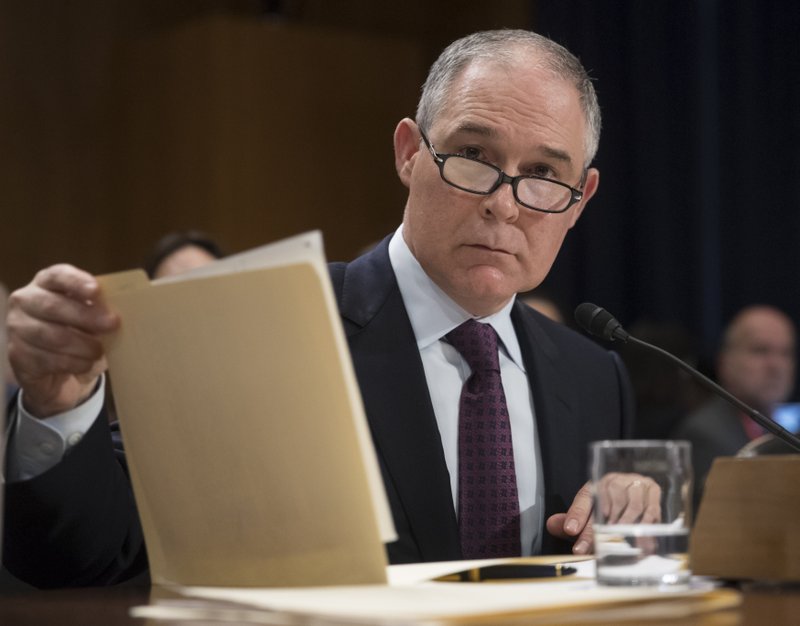
Donald Trump‘s choice to head the Environmental Protection Agency said Wednesday that climate change is real, breaking with both the president-elect and his own past statements. In response to questions from Democrats during his Senate confirmation hearing, Oklahoma Attorney General Scott Pruitt said he disagreed with Trump’s earlier claims that global warming is a hoax created by the Chinese to harm the economic competitiveness of the United States. “I do not believe climate change is a hoax,” Pruitt said. The 48-year-old Republican has previously cast doubt on the extensive body of scientific evidence showing that the planet is warming and man-made carbon emissions are to blame. In a 2016 opinion article, Pruitt suggested that the debate over global warming “is far from settled” and he claimed that “scientists continue to disagree about the degree and extent of global warming and its connection to the actions of mankind.” At the hearing before the Senate Energy and Public Works Committee, Pruitt conceded that human activity contributes “in some manner” to climate change. He continued, however, to question whether the burning of fossil fuels is the primary reason, and refused to say whether sea levels are rising. Pruitt’s testimony came shortly after NASA and the National Oceanic and Atmospheric Administration issued a joint statement affirming that 2016 was officially the hottest year in recorded history. Studies show the Greenland and Antarctic ice sheets have decreased in mass, while the world’s oceans have risen on average nearly 7 inches in the last century. Pressed by Sen. Bernie Sanders, I-Vt., to answer in detail about his beliefs about climate change, Pruitt responded that his personal opinion was “immaterial” to how he would enforce environmental laws. In his current post, Pruitt joined a multistate lawsuit opposing the Obama administration’s plan to limit planet-warming carbon emissions from coal-fired power plants. Pruitt also sued over the EPA’s recent expansion of water bodies regulated under the Clean Water Act. It has been opposed by industries that would be forced to clean up polluted wastewater. The lawsuits are among at least eight pending cases Pruitt has joined against the agency he is in line to lead. Under questioning from Sen. Edward Markey, D-Mass., Pruitt said he has “every willingness to recuse” himself on a case-by-case basis if directed to do so by the EPA’s ethics office. Markey said that was not enough to reassure Americans of his objectivity, adding that Pruitt should commit to a blanket recusal. Pruitt said that if were confirmed by the GOP-run Senate, he would work with states and industry to return the federal watchdog to what he described as its proper role. “Environmental regulations should not occur in an economic vacuum,” Pruitt said. “We can simultaneously pursue the mutual goals of environmental protection and economic growth.” Environmentalists opposing Pruitt’s nomination cite his cozy relationships with oil and gas industry executives who have donated to his political campaigns. As the hearing got underway, shouting could be heard from people who were not allowed in. The room accommodated fewer than 100 people; most seats were taken by congressional staff, reporters and others who were allowed in early. Only a few seats remained for the public. One woman was quickly wrestled out of the room by three police officers as she pulled out a roll of yellow crime scene tape and shouted “We don’t want EPA gutted!” Later, a group of coal miners wearing hard hats were allowed in to show support for Pruitt. Trump has pledged to bring back tens of thousands of lost coal mining jobs once inaugurated, though he has not yet detailed how. The president-elect has also said he will “renegotiate” the international accord to reduce carbon emissions signed in Paris at the end of 2015. Senate Republicans uniformly praised Pruitt what they described as his robust record of enforcing environmental laws “when appropriate.” Court records show scant evidence of Pruitt acting to protect the environment in years as a state regulator. Shortly after Pruitt took office in Oklahoma in 2011, he disbanded the unit responsible for protecting the state’s natural resources. He reassigned his staff to file more than a dozen lawsuits challenging EPA regulations. Senate Democrats focused on Pruitt’s record of siding with polluters in court as he collected campaign contributions from them. Sen. Sheldon Whitehouse, D-R.I., pressed Pruitt on money he raised from energy companies such as Exxon Mobil and Devon Energy, as well as the corporate “dark money” raised by groups with which he is involved that are not required to disclose their donors. Earlier this month, Pruitt resigned from the board of the Rule of Law Defense Fund, a Washington-based group supporting the legal agendas of GOP attorney generals that Whitehouse described as “a complete black hole into which at least $1 million goes.” In his response, Pruitt declined to provide details about whether the group’s donors included fossil fuel companies or utilities with regulatory issues before EPA. Though Pruitt ran unopposed for a second term in 2014, public campaign finance reports show he raised more than $700,000, much of it from people in the energy and utility industries. Pruitt has also faced criticism from environmentalists for failing to take any action to help curb a dramatic spike in earthquake activity in Oklahoma that scientists have linked to the underground disposal of oil and gas wastewater. Pruitt said his support for legal positions advocated by oil and gas companies was in the best interest of Oklahoma, which is economically dependent on the fossil fuel industry. Republished with permission of The Associated Press.
Week 1: Cabinet picks contradict Donald Trump stands on some issues
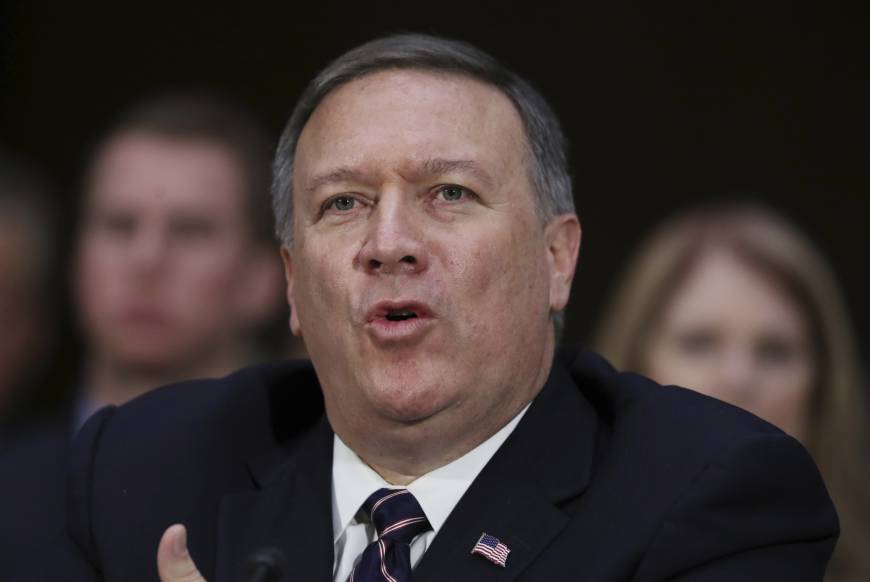
The lack of fireworks surrounding Senate consideration of President-elect Donald Trump‘s Cabinet picks may reflect a slew of statements his choices have made contradicting the billionaire businessman’s position on key issues. Trump acknowledged the differences early Friday, posting a message on his Twitter account saying: “All my Cabinet nominee are looking good and doing a great job. I want them to be themselves and express their own thoughts, not mine!” This week’s confirmation hearings produced an odd political chemistry where, for instance, one of the harshest examinations of a Trump Cabinet choice came from one of Trump’s fellow Republicans, presidential campaign rival Sen. Marco Rubio. Despite Democrats’ dismay over some of Trump’s selections, the hearings were relatively tranquil, with Democrats generally restrained even in quizzing the more contentious picks. The reason, according to a few Democrats: The nominees are proving more palatable than Trump himself. “As I meet members of the Cabinet I’m puzzled because many of them sound reasonable,” said Sen. Dick Durbin of Illinois, the No. 2 Senate Democrat. “Far more reasonable than their president.” That could change in weeks to come, because some of the most potentially explosive hearings are still pending, including the scrutiny of former Goldman Sachs partner Steven Mnuchin for Treasury secretary. Several of Trump’s Cabinet selections this week made statements this week contradicting policy stances espoused by their soon-to-be boss on issues ranging from Russia and NATO to climate change and Muslims. Sen. Jeff Sessions, picked for attorney general, said he’s against any outright ban on immigration by Muslims, in contrast to Trump’s onetime call to suspend admittance of Muslims until U.S. officials could learn more about nature of the threat of extremism. His secretary of state candidate, Rex Tillerson, took a relatively hard line on Washington’s dealings with Russia, even though Trump has been talking about improving relations between Washington and Moscow and held out for days before saying he accepted the intelligence community’s conclusion that Moscow meddled in the U.S. election process. Tillerson demurred, however, when one senator tried to lure him into calling President Vladimir Putin, whom he knows, a “war criminal,” although he emphasized support for NATO commitments that Trump had questioned. The secretary-of-state designate also said the United States should not back away from its efforts against nuclear proliferation, notwithstanding Trump’s suggestion earlier this year that some key U.S. allies like Japan and South Korea provide their own defense. Some of the toughest questioning of Tillerson came not from Democrats but from Rubio, who grilled the Exxon Mobil executive on human rights issues. As Mnuchin’s confirmation hearing approaches, Democrats have set up a website to solicit stories from the thousands of people whose homes were foreclosed on by OneWest Bank while he headed a group of investors who owned the bank. They hope to use Mnuchin’s nomination hearing to attack Trump’s populist appeal with working-class voters and cast themselves as defenders of the middle class. Thus far, though, Republicans are congratulating themselves for generally smooth sailing. And overall, the lack of drama may also be due to the decision by Democrats while in the Senate majority to lower the vote threshold for Cabinet nominees and others from 60 votes to 50, allowing Republicans to ensure approval as long as they can hold their 52-seat majority together. “The purpose of confirmation hearings is to examine the record and views of potential nominees and I think that’s what these hearings are doing,” said Sen. Ted Cruz, R-Texas. “I think it’s likely that all of the Cabinet nominees are going to be confirmed, I think the hearings have gone quite well this week.” A hearing Thursday for neurosurgeon Ben Carson to head the Department of Housing and Urban Development featured some pointed questioning from Massachusetts Sen. Elizabeth Warren, but also warm exchanges between Carson and other committee Democrats. Afterward Carson thanked the panel and said that it “was actually kind of fun.” Sessions was denied confirmation once before by the Senate, but that was three decades ago for a federal judgeship. This time around the Alabaman is a sitting senator and was treated gently, for the most part, by his colleagues, even when Democrats brought up the racial issues that brought him down him last time around. There was potential for drama as Sen. Cory Booker, D-N.J., broke with Senate tradition to testify against his colleague, but it came on the second day of the hearing after Sessions had finished testifying, so he was not even in the room. Tillerson had the rockiest outing thus far, with Rubio pressing him on Russia and Democratic Sen. Jeff Merkley of Oregon confronting him about climate change and other issues. With Rubio and others undecided on supporting Tillerson, his ultimate confirmation is in question. But even with Tillerson, Democrats seemed to pull their punches at times. “I don’t want to argue with you,” Sen. Tom Udall of New Mexico remarked at one point, seeming to speak for several colleagues. And it was practically bipartisan lovefests at the hearings for the choices for Central Intelligence Agency, Kansas Rep. Mike Pompeo; retired Gen. James Mattis for Defense; and retired Gen. John Kelly for Homeland Security. “Pompeo’s very popular, Mattis, Kelly — these are popular selections,” said Sen. John McCain, R-Ariz. The hearings seemed to underscore some emerging dynamics of Trump’s relations with Capitol Hill. Despite his highly unconventional approach, and his lack of Capitol Hill experience, many of his appointees and aides could have been selected by any other Republican, and the Senate is responding accordingly. And even where Trump’s surprising approach raises the potential for problems, congressional Republicans are working overtime to paper them over, not highlight them. “We are in complete sync,” House Speaker Paul Ryan, R-Wis., insisted Thursday in a discussion about a different topic, health care. That could change in weeks to come, as the Senate holds hearings on Mnuchin and other more divisive selections. These include conservative Rep. Tom Price for Health and Human Services; Oklahoma Attorney General Scott Pruitt,
