
Judge: No, teacher-student sex bans are not unconstitutional
An Alabama judge ruled on Tuesday that prohibitions against teachers having sex with students do not violate the Constitution. It may seem obvious, but defense attorneys for Carrie Witt — a Decatur High School teacher and athletics coach charged with having sex with two minors — challenged the principle in a Morgan County District Court proceeding earlier in April. Witt’s counselors, Robert Tuten and Nick Heatherly, filed a motion asking a Judge Brent Craig to throw out their client’s charges on the basis the state law criminalizing student-teacher sexual relationships violate the 1st Amendment to the U.S. Constitution, with its protections of free speech and free association. The judge dismissed that motion, arguing restricting Witt’s right to sex with underage students does indeed limit her rights, but that such a restriction is in the state’s broader interest. “Constitutional liberties may be restrained when the state has a legitimate interest in doing so,” Craig said of his ruling. “The classic example is, while American citizens enjoy the freedom of speech, one cannot yell fire in a crowded movie theater. Freedom of speech can be restricted.” “Teachers are vested with a great deal of trust by the school districts, the parents, the public, and the students themselves,” continued Craig, citing a Kansas case. “Our legislature has sought to preserve that trust by prohibiting teachers from misusing their access to students as a means to obtain sex. A sexually charged learning environment would confuse, disturb, and distract students, thus undermining the quality of education in Kansas.” In other words, though Alabama law deprives her of certain liberties, the state has a valid and defensible reason for doing so. The 42-year-old Witt taught history and social studies and coached the girls’ golf and JV cheerleading squads. The case will continue at a preliminary hearing on May 3, 2016, at 9:00 a.m.
John Merrill, Alabama Interactive offer state’s first online voter info portal

On Monday, Alabama Secretary of State John Merrill announced that his office has partnered with Alabama Interactive, a website that makes a variety of public state records accessible, to provide the state’s first online portal for voter information. According to the Code of Alabama, the Secretary of State “shall provide access to lists and voter history information contained on the central computer to anyone making application, and there shall be a uniform charge for the production of voter lists,” according to a statement released Monday. The newly established portal will offer access to lists and voter history, though requests for municipal voter information must still submit a request to Merrill’s office. Forms for such a request can be downloaded at the Secretary of State’s website. “We are very excited to be able to offer this service to the citizens of Alabama,” Merrill said in Monday’s statement. “This new feature continues my efforts to increase transparency and will allow any interested citizen, candidate or elected official to be able to custom prepare and purchase the voter list they desire without having to contact another person to do it. The system will be secure, cost efficient and provide easy access to the available information.” Lists will cost one cent per voter record requested, as well as a “nominal” processing fee. The portal will not offer “official election results, poll lists, or any other information involved in official election preparation or post-election procedures.”
State gun laws fix take effect this week

A slew of new laws restricting access to guns for mentally ill Alabamians took effect on Tuesday. Residents convicted of any state designated “crime of violence”; misdemeanor domestic violence; or anyone adjudicated mentally unsound or under order of protection can now no longer legally purchase a gun. All residents involuntarily committed for mental illness-related reasons must now be reported to the state by local probate judges (a decision which can be appealed), as must anyone awarded a “not guilty” verdict in a criminal case using an insanity defense. Tuscaloosa state Rep. Chris England – who proposed the law signed over the summer by Gov. Robert Bentley – told AL.com the laws weren’t meant to rein in access specifically for Alabama residents, but rather to bring state statute in line with federal law so the statutes can be enforced by local law enforcement. The legislation “expands it to where the feds already are and hopefully will provide further protection for those in domestic violence situations or prevent those with a mental illness from legally purchasing a weapon,” the Republican lawmaker said. The now-enacted bill also contains two expansions of Yellowhammer State residents’ rights to bear arms: minors are now legally allowed to carry a pistol for training or hunting purposes or for organized competitions; and employees – public or private sector – are now cleared to keep a firearm in their personal vehicle while parked or operated in a parking lot. The new law also gives teeth to one already extant, but unenforced state statute. Carrying a firearm into a facility marked with guards, barriers and signs to the effect of prohibiting firearms is now punishable as a Class C misdemeanor.
Judge takes up State Auditor Jim Zeigler’s case against AG Luther Strange
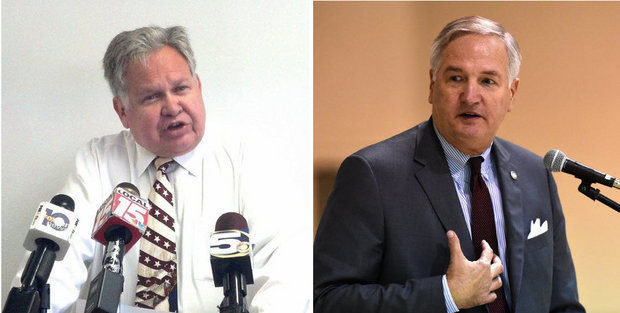
After a Thursday morning hearing where all six defendants filed motions to dismiss, Judge Greg Griffin took under advisement the state auditor’s lawsuit against elected officials he contends misused public money. State Auditor Jim Zeigler, in a complaint that names Alabama Attorney General Luther Strange and five Baldwin County school board members as defendants, says Baldwin officials acted improperly when they used about $250,000 in taxpayer money to campaign for a tax hike this year. The “Build Baldwin Now” campaign, as it was called by supporters, sought to increase tax revenue for new school construction by persuading voters to approve higher tax rates on local property owners during March municipal elections. After the initiative was soundly defeated in almost every locality where it sought the increased rates — 68 percent to 32 percent overall — Zeigler brought forth his case, arguing that the public funds were appropriated to the Baldwin school system to operate schools, not pay for political campaigns. For their part, Strange and the defendants argued Thursday before Montgomery County Circuit Court that Zeigler and two local taxpayers who enjoined his complaint have no legal standing to bring the suit in the first place. They contend the complaint provides no legal “cause of action,” and that the attorney general — in issuing an opinion earlier this summer that the Baldwin school board’s actions were lawful — caused no material damage. Zeigler said in a news release Thursday afternoon the motions “totally missed the point – the plain meaning of the law.” As ever during the proceedings, Zeigler pointed to the Code of Alabama section 17-17-5, which reads “… no person in the employment of the State of Alabama, a county, a city, a local school board, or any other governmental agency, whether classified or unclassified, shall use any state, county, city, local school board, or other governmental agency funds, property, or time, for any political activities.” “The attorney general is throwing legal technicalities against us trying to justify a wrong,” Zeigler said in the statement. “It is illegal and grossly unfair to use taxpayer’s money to campaign in a vote for a tax increase.” The judge did not give a time frame for issuing a decision.
Jim Zeigler files suit in Baldwin County school tax campaign case
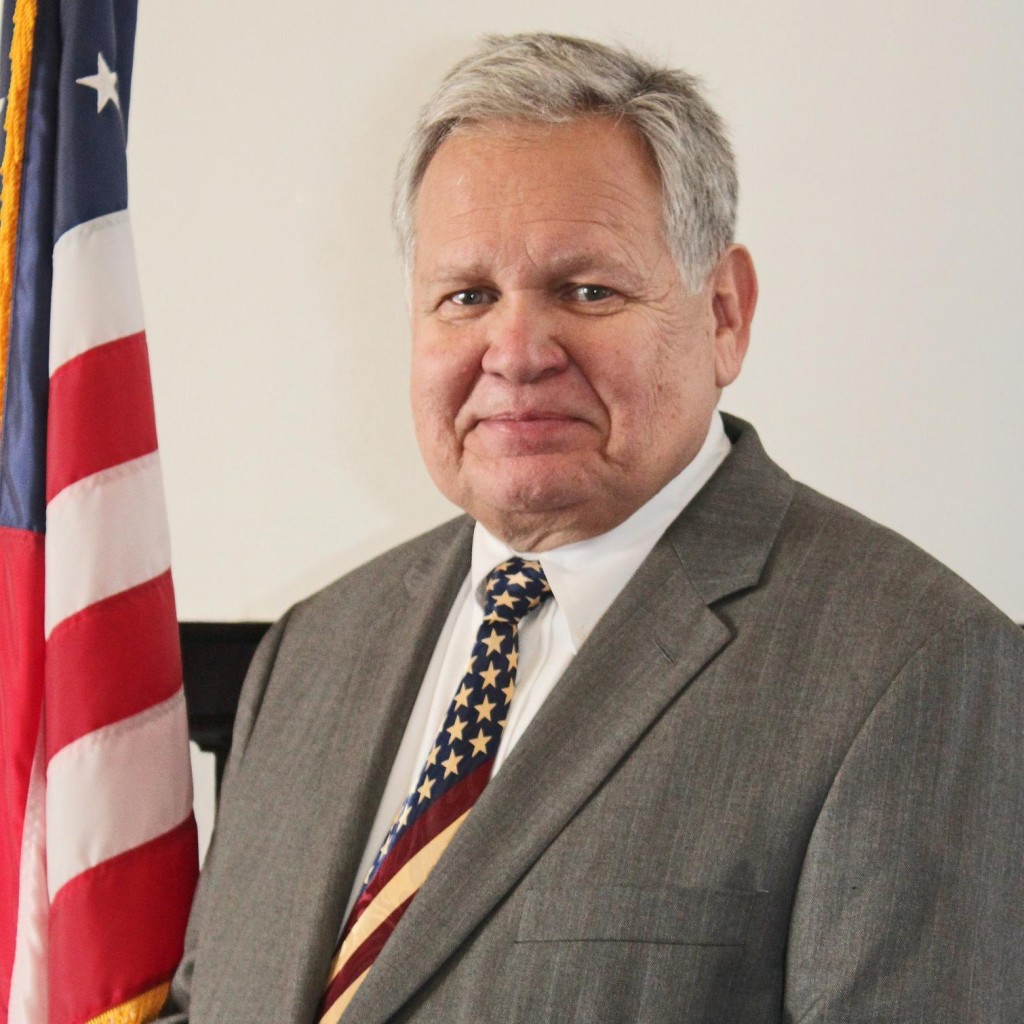
State auditor Jim Zeigler said late Monday morning that he has filed suit to prevent taxpayer dollars from paying for public campaigns to increase local tax receipts. The move is a legal remedy to a legal opinion offered by Attorney General Luther Strange, who permitted local officials with the Baldwin County School Board to leverage public money in order to fund their “Build Baldwin Now” campaign, which sought to increase three local tax rates to build new schools, which the group said was inadequate, and on boarding new teachers. Zeigler said in Loxley Monday morning at the Windscape Hotel that the campaign, reported on widely by state media, represented a violation of a state prohibition against the “improper use of state property, time, etc., for political activities,” under the Code of Alabama 17-17-5(a). “No person in the employment of the State of Alabama, a county, a city, a local school board, or any other governmental agency, whether classified or unclassified, shall use any state, county, city, local school board, or other governmental agency funds, property, or time, for any political activities,” the section mentioned in Zeigler’s complaint reads. The auditor’s case will go before the Circuit Court of Montgomery and seeks “declaratory and injunctive relief” on behalf of Alabama taxpayers, meaning that Zeigler and the other plaintiffs — including Charles L. McMinn and David Peterson — want a judgment that says using public coffers to induce taxpayers into giving more is wrong and that orders any public official doing so to cease and desist. The full text of the complaint can be found here. Zeigler insists his lawsuit serves a purely utilitarian public purpose and is not meant to capitalize on the still-raw feelings many carried away from the March 31 election, which saw a shocking defeat for the school system and a big win for anti-tax groups. “We’re not trying to flame up opinions in Baldwin County where 68 percent of ‘no’ votes were pretty strong,” Zeigler told AL.com last week, responding to such criticism. Alabama Today previously reported that Zeigler would file the lawsuit this week on Friday, but after his announcement the auditor’s office apparently decided to expedite the process.
