
Hacked emails show Hillary Clinton camp discussed ousting Debbie Wasserman Schultz for Jennifer Granholm
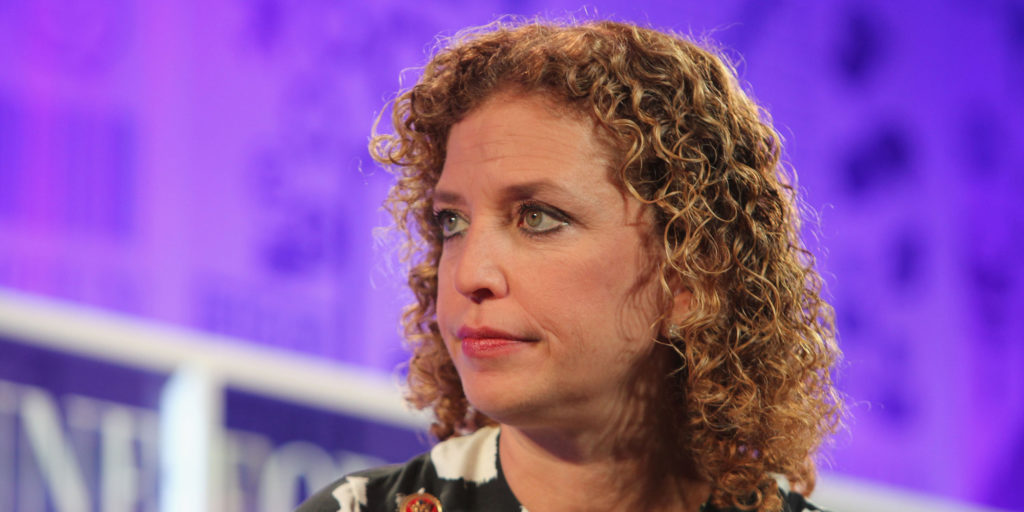
In July, Debbie Wasserman Schultz abruptly resigned as head of the Democratic National Committee, after leaked emails showed party officials conspiring to sabotage the presidential campaign of Vermont Sen. Bernie Sanders. Now, a new email message from the Gmail account of Clinton campaign manager John Podesta — posted by WikiLeaks Tuesday — indicate Hillary Clinton, the candidate campaign officials were considered to be in the tank for, also had serious issues with Wasserman Schultz. Clinton’s staff even discussed ousting her well before her unexpected midsummer exit. On Dec. 17, 2015, Clinton staffer Heather Stone sent out a memo titled “DNC Leadership,” to Podesta, Robby Mook, and Sara Latham. It explained in part the Clinton campaign had encountered challenges in working with Wasserman Schultz, calling for “systemic shifts at the DNC Leadership Level” to facilitate a better working relationship: Though we have reached a working arrangement with them, our dealings with Party leadership have been marked by challenges, often requiring multiple meetings and phone calls to resolve relatively simple matters. We are frequently caught in the middle of poor communication and a difficult relationship between the Chairwoman and the Executive Director. Moreover, leadership at the Committee has been slow to respond to structural challenges within their own operation that could have real impact on our campaign, such as research. Jen O’Malley Dillon has entered into a contract with the DNC as a consultant for the General Election, which addresses some of these challenges and provides a connection for us within the Party. However, this arrangement does not change the need for systemic shifts at the DNC leadership level — to ensure that we have strategic and operational partners within the Committee that can help drive a program and deliver on our General Election imperatives. The memo also said the intention should be to keep Wasserman Schultz as DNC chair up until July’s National Convention. After the convention, however, “we should consider three models for the DNC chairmanship:” Three options discussed would be: — Keep Wasserman Schultz and “work through a chief of staff.” Wasserman Schultz would have been no more than a figurehead in this capacity, the memo states. — Keep Wasserman Schultz in the position, but select someone like former Michigan Gov. Jennifer Granholm as a “General Election Chair.” In that situation, the chief of staff would work with the General Election Chair, while Wasserman Schultz played the role as a chief surrogate. This didn’t seem likely to work, however, as Stone wrote that, “This model has the considerable drawback of creating a two-headed monster with little clarity of who is responsible for different areas of work within the Committee.” — Oust Wasserman Schultz outright for Granholm. “Under this scenario, the convention would represent Congresswoman Wasserman Schultz’s final responsibility to the DNC, and we would use the convention as a clean break between chairs,” wrote Stone. “At the convention, we would honor the Chairwoman’s leadership and service to the Party and introduce the new Chair for the final phase of the campaign.” As it turned out, leaked WikiLeaks emails were released the weekend before the Democratic National Convention in Philadelphia in late July, prompting an outcry among Sanders delegates who always believed Wasserman Schultz was biased for Clinton in her position at the DNC. The uproar was so great, Wasserman Schultz quit the Sunday afternoon before the convention, ultimately replaced by Donna Brazile. Brazile recently left CNN under dubious circumstances following another WikiLeaks release indicating that, while at CNN, she may have passed along a question to Clinton before a debate.
Steven Kurlander: Redefining a political hack: The dangerous obsolescence of the electoral process

Stealing elections, even presidential ones, is an American political tradition dating back to the beginning of our nation. Think about those hanging chads in Florida, or Mayor Daley stuffing the ballot box in Chicago for JFK. But stuffing the ballot box is about to be taken to a new level in the race for the White House — not by Donald Trump or Hillary Clinton, but by the Russian government. Our electoral process has failed to keep up and adapt to tremendous technological changes in the last half-century that impact the exchange, storage, and security of voter information and the election process itself. Our political system is not only broken by being obsolete and inefficient, but extremely vulnerable to hacking and disruption to the point where the integrity of the elections can be greatly impacted. “Cybersecurity experts have long warned that computerized voting systems are vulnerable to hacking, and what once seemed like wild prognostication is increasingly coming true,” writes Elias Groll of Foreign Policy. As the presidential election continues, the Russians are penetrating these vulnerabilities to influence who wins the Oval Office by hacking their way into the American political system, some say to swing the election for Donald Trump. The Washington Post termed the hacking campaign by Russia as “a broad covert Russian operation in the United States to sow public distrust in the upcoming presidential election and in U.S. political institutions.” The most obvious example so far this election cycle was the hacking of the Democratic National Committee and the release of emails by WikiLeaks showing a bias by DNC officials for Hillary Clinton, which impacted the Democratic convention and the Democratic Party itself. In addition, the FBI issued an alert in mid-August after the Arizona and Illinois voter databases were hacked by what is again to be believed Russian operatives. Disinformation, whether planted by a foreign government or a political adversary, is nothing new to politics, particularly when it can be identified as such by our security apparatus. All those WikiLeaks about the DNC did was embarrass Democratic officials for a day and get Congresswoman Debbie Wasserman Schultz fired as chairwoman, which was going to happen anyway. But if the Russians can hack into a Democratic or Republican Party database — or, even worse, the registration lists of various states — how can’t you believe that Putin could not compromise the tabulation of votes on Election Day to swing the election to Trump? In this presidential race, most Americans have already decided who they are not voting for. So they won’t be fooled by the Russians, or anyone else, looking to sway their votes one way or the other or discourage their participation in the electoral process. They are already very displeased with their politicians, and with the choice of Donald Trump or Hillary Clinton too. Now we must question whether their votes will really count, or be counted accurately. There’s really no assurance these vulnerabilities are being adequately addressed and that Americans can be confident the final tabulations of the 2016 election will be accurate and correct. Hacking is not simply a matter of simple voter fraud in the traditional sense that should be considered just another aspect of an American election. It’s about a Russian political hack, not American voters, deciding who is our next American president. ___ Steven Kurlander blogs at Kurly’s Kommentary. He is a communications strategist and an attorney in Monticello, New York, writes for Florida Politics and is a former columnist for the South Florida Sun-Sentinel. He can be emailed at kurly@stevenkurlander.com.
Ousted from DNC, Debbie Wasserman Schultz fighting to stay in House
U.S. Rep. Debbie Wasserman Schultz easily won her South Florida district six times, but a Democratic primary challenge from a Bernie Sanders-backed law professor is making her seventh bid less than a sure bet – and her recent resignation as Democratic National Committee chairwoman hasn’t helped. Tim Canova has raised about $2.8 million thanks to the former presidential candidate’s endorsement, an almost unheard of amount for a first-time candidate and almost as much as Wasserman Schultz’s $3 million. He is running an aggressive campaign, accusing Wasserman Schultz of being a pawn of Wall Street who backs corporate donors over progressive causes. The primary is Aug. 30. “Wasserman Schultz is like a lot of politicians who live in their own little bubble. They are not out and around the people and I have been,” said Canova, 56, who teaches business law at Nova Southeastern University. Wasserman Schultz, 49, re-emerged in public Thursday, six days after the Democratic National Convention and her forced resignation as national party chair following a leaked email scandal. She immediately went on the counter-attack, saying Canova is using “disingenuous half-truths, lies and distortions” to attack her record. She received loud applause Thursday night at a forum on healing the rift between the police and black community that was held at a predominantly African-American mega church. “I have a deep and proud commitment to our community,” she said, listing Social Security, the Affordable Care Act and recovery programs that eased the 2008 financial crisis as examples of progressive policies she helped pass. “My opponent can say whatever he wants, but the people I represent … know better.” She also has the support of Vice President Joe Biden, who will campaign on her behalf at a closed fundraiser Friday evening. In Wasserman Schultz’s previous elections, she never drew a primary opponent in her suburban Fort Lauderdale district or a serious Republican challenge. In general elections, she received at least 60 percent of the vote in a 2-to-1 Democratic district that stretches from the ocean to the Everglades and includes high-rise beachfront hotels and condos, golf resorts and luxury malls and a mix of poor, middle-class, retiree and well-heeled communities. Wasserman Schultz has been perceived as such a powerhouse – and the district so uncompetitive – that former U.S. Rep. Allen West, a tough-talking favorite of conservative Republicans and one of her fiercest critics, ran legally in a neighboring district even though he lived in hers to avoid near-certain defeat. The district favored Clinton over Sanders by a 68 to 31 percent margin in the March presidential primary. “I’ve known Debbie for 25 years and she has always been very, very supportive of the district and environmental matters, which is important to me,” said supporter Lily Sayre, who owns a horse stable in Southwest Ranches, a semi-rural enclave in the district. “I’ve always known her to be forthright and standing by what she believes, whether it helps her politically or not.” The email leaks that cost Wasserman Schultz her DNC post are motivating Canova’s backers, who say they prove what they long believed: that Wasserman Schultz threw aside fairness and neutrality to weaken Sanders’ chances of defeating Clinton in the Democratic primaries. “My family fought in the Revolutionary War, the War of 1812, the Civil War and World War I and World War II, including my father. Some of them lost their lives. No one steals my right to a free vote,” said makeup artist Ellen Kinnally, a Sanders supporter who said she moved into the district specifically to vote for Canova. Wasserman Schultz denies showing favoritism in the presidential race, saying she strictly followed party rules. The leaked emails show that DNC staffers closely tracked their boss’s race. They monitored media coverage and tried to get details of a speech Canova gave by internet to an Alaska progressive group while she spoke at that state’s Democratic convention. They circulated a campaign news release about Canova getting Sander’s endorsement – Wasserman Schultz ordered Canova’s name stricken from its headline. Canova said he began considering a challenge last year when he organized opposition to the Trans-Pacific Partnership trade deal and Wasserman Schultz and her congressional staff never agreed to a meeting. She became the only Democrat in Florida’s House delegation who voted to fast-track the pact’s approval, which had been opposed by labor unions, environmental groups and other liberal constituencies as well as some tea party groups on the Republican side. “She has been taking millions of dollars from the biggest Wall Street banks and corporations and I started looking at her voting record and it is lined up with these corporate interests,” he said. Wasserman Schultz said her staff met with Canova and his group in her district office last year and had their concerns heard. “Unfortunately, that’s been what my opponent has engaged in this entire campaign,” she said. The winner of the Wasserman Schultz-Canova race will likely face Republican Joe Kaufman in November. He lost to Wasserman Schultz by a 63 to 37 percent margin in 2014. Republished with permission of the Associated Press.
Blake Dowling: Consumers can avoid feeling the ‘email Bern’ by hackers

Debbie Wasserman Schultz got to “Feel the Bern” in the form of a hostile crowd of Florida delegates at the Democratic National Committee. Why were these Bern Victims so fired up? The email scandal of course, which led to Schultz’s resignation. The pro-Clinton digital documentation that was revealed in this breach and scandal is a mess. There are several old school rules of thumb that my grandparent’s used to use which were “make sure to get it in writing” and “make sure to not put that in writing.” You should have the same approach to writing emails. “I don’t care if anyone reads this ever.” If it’s not that, delete. Emails can be sent/forwarded to the wrong people, handed over to the courts, watched by the National Security Agency, and for Debbie and the gang at the DNC, hacked. The DNC realized something was wrong going back as far as April. They brought in a professional security firm to analyze their network; they found a breach, blocked it, but it was too late. The bad guys had been inside their world for a year, and they had already taken everything they wanted. It is suspected that a nation state was behind the hack (Russian-backed cybercrime syndicate – Guccifer 2.0 is suspected), and I was asked by the Orlando Sentinel this week how you stop something like that? (See my Q & A with Paul Owens later this week.) The short answer is; you don’t. If you have the resources to build nuclear weapons and fly in space, you can pile up enough code, hackers, hardware and software to perpetuate a successful cyber threat against anyone. Like Bill Clinton and the intern, it’s going to happen eventually. What you need to be thinking about is how to minimize the threat. Your password is your front line of defense. To those of you that have a password that is a variation of the word password or a word that can be found in the dictionary. FAIL. Those rules from information technology experts have been read over and over: use a number, a capital letter, and a symbol in every password gives you some security. There are software programs designed to auto-hack passwords, and by following these protocols, you might just stop a threat in its tracks. The most common attacks are Trojans, Phishing schemes, denial of service (DOS) attacks, Ransomware/Malware (Cryptolocker), and password attacks/brute force attacks. In conjunction with a strong password, put your email somewhere smart. Don’t use a free hosting service for email. There are a dozen examples of free email, but I will minimize my risk of a nasty letter in the mail and not call them by name. You get what you pay for, both in life and email. Use a cloud platform with a “Tier 4” data center. Tier 4 is defined as critical servers and computer systems in a Data Center, with fully redundant subsystems (cooling, power, network links, storage, etc.) and compartmentalized security zones controlled by biometric access control methods. If you have your email on a local server, make sure a state of the art firewall is deployed, and in all cases have up to date hardware with the latest patches, as well as anti-virus and antispam solutions in place. Lastly, if an attack, breach or theft occurs, have a solid backup of your email and data in place. The Russians, Chinese, the 14 people in North Korea with internet access and the wacko next door could all be potential cyber criminals. You can buy kits on the dark web to become a cybercriminal in about seven minutes. So keep thinking defensively, to that end, another way to keep the bad guys out is “two-factor authentication.” This is a method of confirming a user’s identity by utilizing a combination of two different components. These components may be something that the user knows, something that the user possesses or something that is inseparable from the user. An example from everyday life is the withdrawing of money from an ATM. You have to have a bank card (something that the user possesses, 1 factor) and a PIN (personal identification number, 2 factor) allows the transaction to be carried out. The same goes to logging into a commercial site, when they text you a code to enter. Criminals are not getting dumber, but the average American is; see the Pokémon Go craze if you need further evidence. So when it comes to email, keep your eyes wide-open, and security top of mind. Be safe out there. ___ Blake Dowling is chief business development officer at Aegis Business Technologies. His technology columns are published by several organizations. Contact him at dowlingb@aegisbiztech.com or at www.aegisbiztech.com.
Joe Henderson: DNC day one – Hillary Clinton’s apathy problem
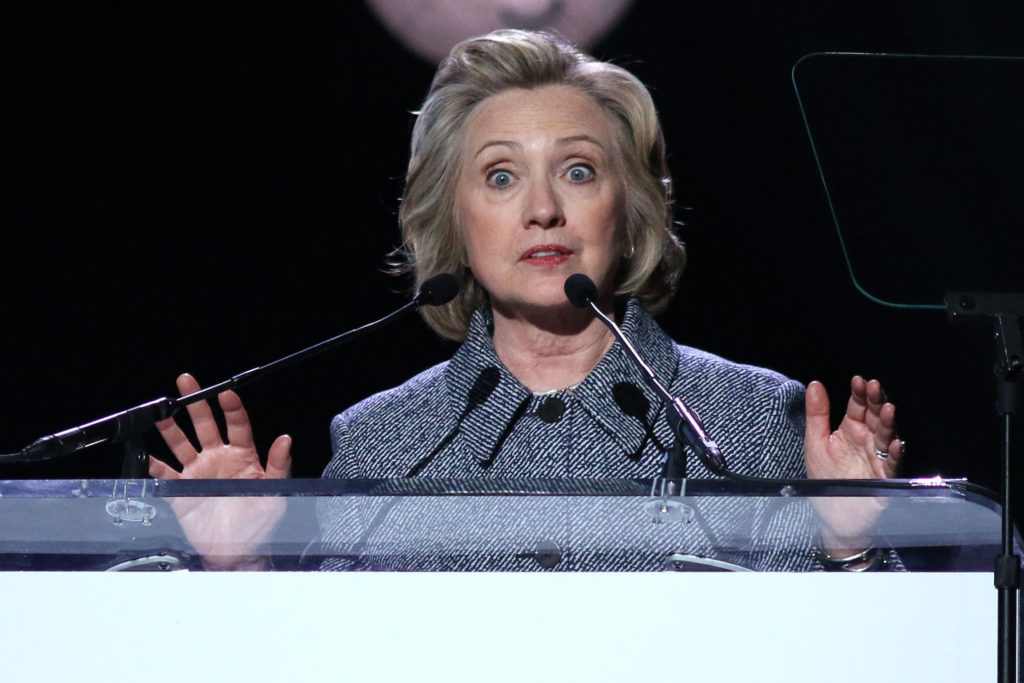
After the first night of the Democratic National Convention, it’s clear that Hillary Clinton’s biggest problem has less to do with emails and big donors and more to do with apathy. That much became apparent after watching Bernie Sanders’ supporters shower their candidate with the kind of full enthusiastic passion that has thus far eluded Clinton. For that matter, the same parallel can be drawn in the Republican Party for the way Donald Trump’s backers are with him no matter what. The lesson Clinton should learn from this, if it’s not already too late, is that both Sanders and Trump reached out to groups often ignored in our national politics. Trump’s campaign will rise or fall on the strength of disaffected white middle-class voters who feel like they pay for everything and receive nothing. For Sanders, it is those thousands of young voters who flocked to him because he cared enough to include them. The bitter lesson for them is that despite all their support, their candidate didn’t win. Yes, comedian and Sanders supporter Sarah Silverman was correct when she scolded the crowd Monday night, “To the Bernie or bust crowd, you’re being ridiculous,” but don’t lose sight of what was really happening. You saw it in the tear-stained faces of Sanders’ supporters when he came out to speak. You heard their cheers when he told them, “We have begun a political revolution to transform America. That revolution, our revolution, continues.” Keyword: “our” revolution. Compare that message of inclusion to Trump’s promise to single-handedly transform America. Republicans have chosen the gunslinger. But many Democrats, in rallying around Sanders, are demanding to be heard. That’s Clinton’s biggest challenge. Sanders gave Clinton the full force of his endorsement. Speaking directly to his backers who have threatened to stay home, he said, “If you think you can sit it out, take a moment to think about the Supreme Court justices Donald Trump would nominate.” What he was actually saying to millions of supporters was this: If you’re disappointed now, just imagine how you’ll feel if Trump is elected. But during the campaign Sanders also expertly painted Clinton as a tool of big money and Wall Street. That’s not an easy image to shake. She can’t win without Sanders’ supporters, but to win them over she has to convince them she has heard their voice. For that, it will take even more work than Sanders simply saying, as he did Monday, “Hillary Clinton must become the next president of the United States.” Sanders’ speech may go down as the most important of the convention. He showed the nation that his support was deep and real, and that his ideas must be taken seriously. He had managed to turn the opening-day narrative away from the WikiLeaks scandal and Debbie Wasserman Schultz. He likely even convinced many of those who supported him to get behind Clinton going forward. Democrats better hope that’s the case. With every poll showing a tight race, especially in the swing states, they need every vote they can get. They may have picked up a few more Monday. Whether they picked up an equal amount of enthusiasm for their candidate, though, is still in question. ___ Joe Henderson has had a 45-year career in newspapers, including the last nearly 42 years at The Tampa Tribune. He has covered a large variety of things, primarily in sports but also hard news. The two intertwined in the decadelong search to bring Major League Baseball to the area. Henderson was also City Hall reporter for two years and covered all sides of the sales tax issue that ultimately led to the construction of Raymond James Stadium. He served as a full-time sports columnist for about 10 years before moving to the metro news columnist for the last 4 ½ years. Henderson has numerous local, state and national writing awards. He has been married to his wife, Elaine, for nearly 35 years and has two grown sons — Ben and Patrick.
Martin Dyckman: Donald Trump, Valdamir Putin and NATO – willful ignorance, or dangerous isolationism?
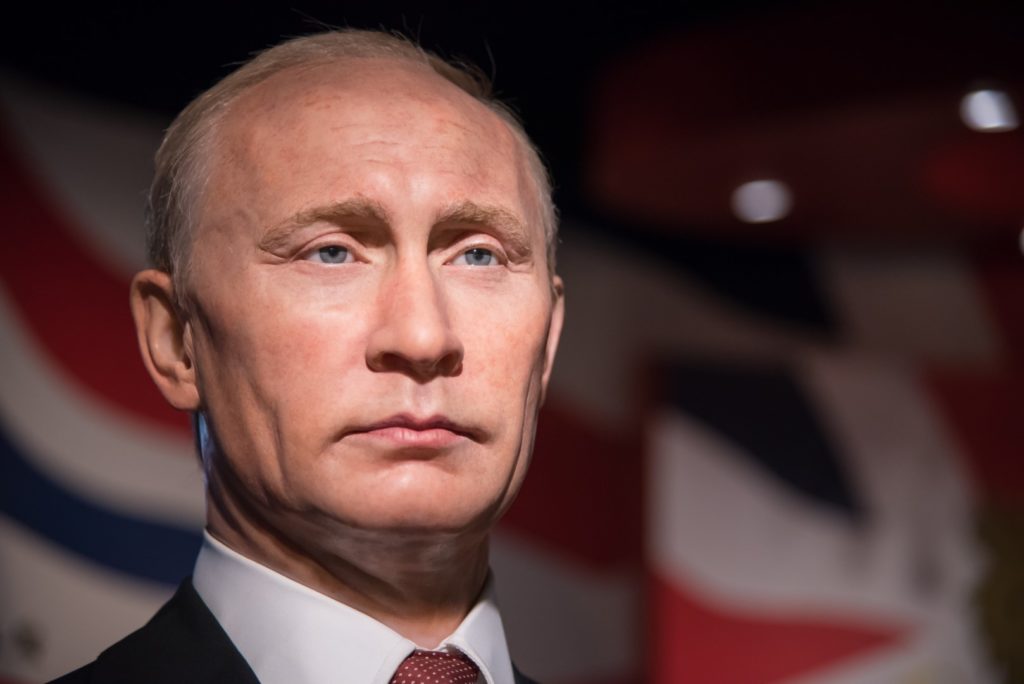
“Vlad, Vlad, is that you?” “Da!” “Donald here. We need to deal. I make great deals. I’ll send you a copy of my book, The Art of the Stea … uh, I mean, Deal.” “I’m sure you do, Donald. What do you want?” “Vlad, I need you to help me beat Hillary Clinton.” “I might be able to do that Donald, but what’s in it for us?” “When I’m president, you can have those little loser countries next door… What do you call them?” “Latvia, Estonia, Lithuania.” “OK. They mean nothing to me. Like I said, they’re losers. But what can you do for me?” “Remember your man Nixon and Watergate? What did they call it? A third-rate burglary? Well, we did better than that. Our guys are first-rate. We have all the secrets from your Democratic National Committee. They won’t look good when they leak, if you know what I mean.” “Good to do business with you, Vlad. Let’s plan on getting together sometime. I have great golf resorts.” “I don’t golf. I swim.” “That too, Vlad. We stock our pools with hot women. And you can bring any friend you like.” “Even Bashar Assad?” “Yeah, Vlad. I might need some tips from him on how to stay in power.” Now, of course, this conversation may not have happened. But it could have. As Donald Trump would say, how do we know that it didn’t? What we do know is that Russian fingerprints are all over the leaked emails that convulsed the Democratic Party on the eve of its convention, forcing the resignation of Chairperson Debbie Wasserman Schultz. And it is a fact that this closely followed Trump’s threat — or was it a promise? — to destroy NATO by abrogating our treaty commitments to defend any and all of its members against any — read Russian — attack. It wasn’t the first time he has questioned NATO’s value, so his Republican apologists shouldn’t be surprised that he has now made his disdain so explicit. NATO is one of the two reasons, the European Union being the other, why there has been no major European war since 1945. That’s without precedent in that continent’s history. Peaceful durations were often measured in months rather than years. It was under NATO’s aegis that the United States and its allies succeeded in ending Serbia’s aggression against Bosnia. It is only NATO that presents any effective obstacle to the transparent neocolonial ambitions of Russia’s new Stalin, Vladimir Putin. There has been nothing as rash as Trump’s undermining of NATO since the British Prime Minister Neville Chamberlin gave Hitler everything he wanted at the Munich conference and declared that he had purchased “peace in our time.” That turned out to be a very short time. Hitler invaded Poland, precipitating World War II and the loss of 60-million lives, merely 11 months later. It’s not hard to imagine the terror that Trump’s words have struck into the Baltic lands that had struggled for centuries to escape Russian rule, losing their liberty in 1940 and regaining it only a half-century later, with the dissolution of the Soviet empire. My wife and I paid a brief, enjoyable visit to Tallinn, the capital of Estonia, during a Baltic cruise in May. It seemed to be a very pleasant country, inhabited by hospitable people. But as our tour guide made plain to us, everyone senses that the Russian hegemony is not yet dead. There are only 1.2-million Estonians, which would be to the Russian bear as a field mouse is to a grizzly. Ethnic Russians comprise 24.8 percent of the population and nearly 30 percent speak Russian as their first language. Estonians with relatives in Russia have the option of holding Russian passports, as our guide said his wife does. It was the presence of sizable ethnic German minorities in Czechoslovakia and Poland that Hitler claimed as pretexts for his aggression. It’s the same rationalization that Putin applies to his poorly disguised war-making in Ukraine. Trump’s couched his irresponsibility in the form of a threat to base our national honor—the fulfillment of a treaty commitment—on his opinion on whether member countries are paying enough for their own defense. Estonia’s president replied promptly, saying that his country has been spending what NATO requires and also sent troops to the war in Afghanistan. “Estonia’s commitment to our NATO obligations is beyond doubt, and so should be the commitments by others,” his spokesman said. “Two world wars have shown that peace in Europe is also important for the security of the United States,” said NATO’s secretary-general, Jens Stoltenberg. Mitch McConnell, who is plainly uncomfortable with his new role as a Trump stooge, was quick to repudiate him on this issue. “NATO is the most important military alliance in world history. I want to reassure our NATO allies that if any of them get attacked, we’ll be there to defend them,” said the Senate majority leader. But that’s an assurance he would be powerless to keep if a president chose to ignore it. It’s the president, not the Congress, who has the power and duty to act in such an event. In speaking as he did to The New York Times last week, Trump either forgot or chose to ignore two telephone interviews with the newspaper’s reports barely four months earlier. Asked whether he would defend Estonia in particular against Russian aggression, here is what he said: “Yeah, I would. It’s a treaty, it’s there. I mean, we defend everybody. (Laughs.) We defend everybody. No matter who it is, we defend everybody. We’re defending the world. But we owe, soon, it’s soon to be $21 trillion. You know, it’s 19 now but it’s soon to be 21 trillion. But we defend everybody. When in doubt, come to the United States. We’ll defend you.” Is this episode yet another example of Trump’s colossal and willful ignorance? Does it mean that at heart he’s a throwback to the American isolationism of the 1930s that
Democratic Convention: what to watch for on Day 1
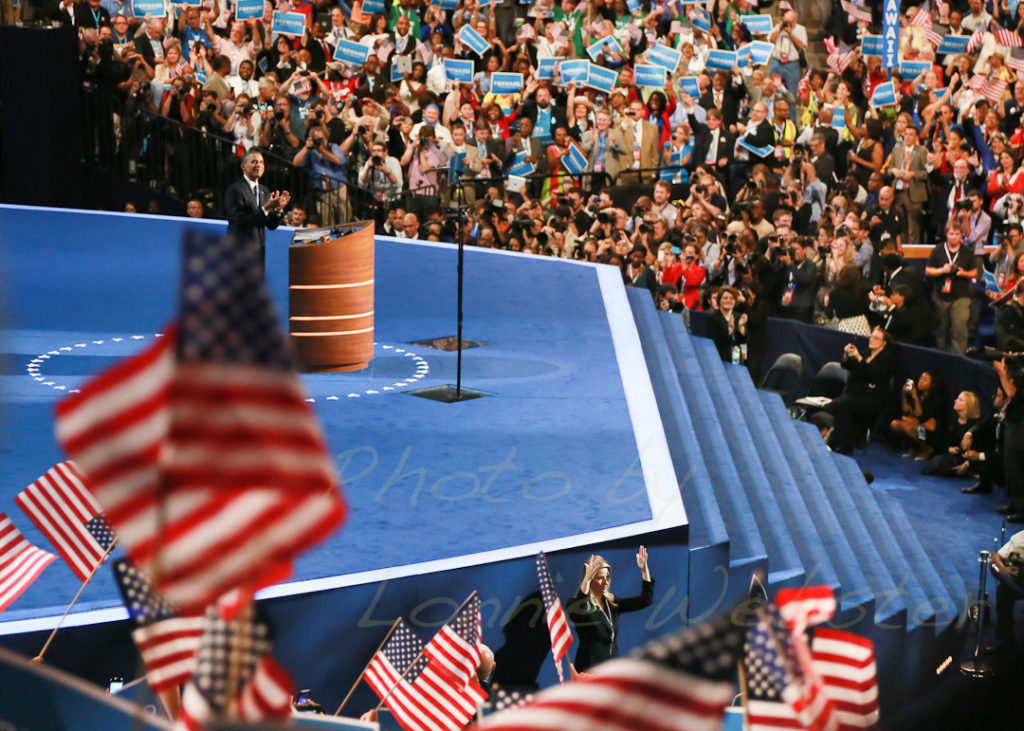
The Democratic National Convention — a four-day event where presidential hopeful Hillary Clinton is poised to officially be selected as the party’s presidential nominee — kicks off in Philadelphia Monday. Following suit of the Republican Convention just last week, Democrats wasted little time Monday showing that their party is just as dysfunctional and divided as their GOP counterparts. In the wake of Friday’s leak of thousands of emails showing DNC officials were attempting to undercut Vermont Sen. Bernie Sanders during his primary campaign against Clinton enraged his delegates and has led to large protests in the City of Brotherly Love. The leak also prompted the resignation of Democratic National Committee Chairwoman Debbie Wasserman Schultz. Monday morning the Florida Congressman was greeted with boos by delegates, and hours later she announced she would not gavel in the convention, recognition her presence on the stage would only further showcase Democrats’ deep divisions. Hoping to reunite the party behind Clinton, the DNC’s Day 1 theme will be “United Together” and will focus on putting the future of American families front and center, where speakers will advocate for building an economy that works for everyone, not just those at the top, and where everyone has a chance to live up to their God-given potential. The full list of Monday’s speakers: Pam Livengood: has been personally affected by the growing substance abuse epidemic Karla & Francisca Ortiz: an American citizen but her parents, including her mother, Francisca, are undocumented and live in fear of deportation Keith Ellison: Democratic U.S. Congressman from Minnesota Lily Eskelsen Garcia: National Education Association President Raul Grijalva: Democratic U.S. Congressman from Arizona Tina Kotek: Oregon House Speaker Mary Kay Henry: SEIU President Joe Kennedy: Democratic U.S. Congressman from Massachusetts Dan Malloy: Governor of Connecticut and Chair of the Democratic Governors Association Sean McGarvey: Building Trades President Jeff Merkley: U.S. Senator from Oregon Linda Sanchez: Democratic U.S. Congresswoman from California Lee Saunders: AFSCME President Randi Weingarten: American Federation of Teachers President Anastasia Somoza: an advocate for Americans with intellectual and developmental disabilities Astrid Silva: a Mexican immigrant who has who has benefited from Mr. Obama’s executive actions deferring deportation Richard L. Trumka: president of the AFL-CIO Elizabeth Warren: Democratic U.S. Senator from Massachusetts Bernie: Sanders: U.S. Senator from Vermont and Hillary Clinton’s chief rival for the Democratic nomination Michelle Obama: First Lady of the United States
Bernie Sanders supporters emboldened after WikiLeaks takes down Debbie Wasserman Schultz

Bernie Sanders will address the Democratic National Convention Monday night, with the expectation he will give a “full-throated” endorsement of Hillary Clinton to be the next president of the United States. But if a small sampling of the hundreds of people who gathered at JFK Plaza in downtown Philadelphia Sunday afternoon is any indication, his most fervent supporters aren’t taking any endorsement from their candidate as a mandate to not follow their conscience. “I’m voting for my conscience and not out of fear,” said Tara Orlando, from Floyd, Virginia. She seemed to believe, as did several of the protesters that FloridaPolitics.com spoke with, that somehow a Sanders victory was still in the cards. “I hope the superdelegates wake up, especially after WikiLeaks has released all those emails to prove that it was hoodwinked,” Orlando said, “and if they want to do the right thing, they’ll nominate Bernie Sanders for the Democratic Party.” The WikiLeaks revelations have ratified the sentiments Sanders, and certainly his most fervent supporters, have felt from very early on in the Democratic primary contest since last summer — that it was rigged for Clinton to ease her way to the nomination. “It’s more of a vindication of something that we believed all along, and it does feel good when you’ve got people more polarized on either side,” said Moira Gearan, also from Floyd, Virginia. “It may be a done deal, but at least people know that things were DONE.” “We felt all along that the process was rigged from the beginning, especially the issue with the superdelegates,” said Reuben Matreger from Fenton, Michigan. Oh yes, the superdelegates, which the Sanders campaign and their supporters abhor as being indicative of a bloated, elitist group of party insiders that is supposed to stop them from nominating an unelectable candidate, a la George McGovern in 1972 and Howard Dean in 2004. The superdelegates are party insiders — in some cases, members of Congress — and they like it the way it is. But on Saturday, the Democratic Party’s Rules Committee ultimately voted to bring a “minority report” to a floor vote this week. What that apparently means is the superdelegates will do their thing this week and overwhelmingly support Clinton for the nomination, but it could be altered going forward. Several Democrats in the crowd said they could not vote for Hillary Clinton under any circumstances. Celeste McKissick from Cleveland held up a sign reading “Hill No.” “If Bernie is not the nominee, it will be Jill Stein who I’ll vote for,” she said, adding Clinton hasn’t been able to do anything to “buy” her vote yet, so she doesn’t believe there’s anything she could say or do before November to be persuaded to vote for the Democratic nominee for president. “I will very likely leave the party,” said Gearan when asked what she’ll do after Clinton accepts the party’s nomination later this week. Long Beach, California resident Dea Montford was a lifelong Democrat, and also said she’s leaving the party if Sanders isn’t nominated this week. She said she’d been turned off by Democratic politics after what she said happened in California during that state’s primary election last month. “What they did there to disenfranchise SOOO many people from voting. No, I can’t support the Democratic Party and the DNC and Wasserman Schultz and Hillary? No.” Sanders addresses the DNC later tonight.
Debbie Wasserman Schultz jeered while attempting to address Florida DNC delegation
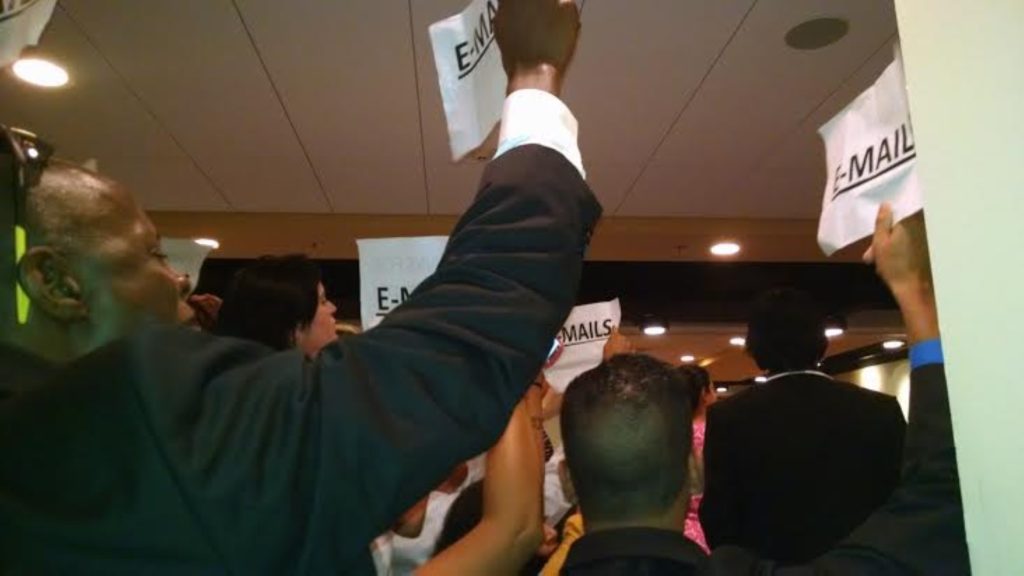
Give credit — or incredible chutzpah — to Debbie Wasserman Schultz, who kept her word and addressed a raucous scene at the Florida delegation breakfast at the Marriott Hotel in downtown Philadelphia Monday morning. It did not go well. Seemingly half the crowd of several hundred people, which included the delegates and other Democrats, stood up and booed her mercilessly. Some held up signs reading, “emails,” referring to the trove of Democratic National Committee emails that were published Friday by WikiLeaks that appeared seemed to show a plot by DNC officials to damage Bernie Sanders during the Democratic primary. That led to her resignation Sunday as DNC chair, though she said she would not do so until after the convention. There were several of Wasserman Schultz constituents wearing T-shirts advocating for her re-election in attendance. There were DWS supporters as well, but they were drowned out by the fervent opposition. “Settle down, everybody,” when Wasserman Schultz took to the podium. Florida Democratic Party Chair Allison Tant tried to quiet down the crowd, to little avail. “Let’s hear from our speaker today.” As members of the crowd and reporters rushed the stage, Mary Lou Ambrose, president of the Largo/Mid-Pinellas Democratic Club said to this reporter, “I want you to know that everybody in Pinellas County disagrees with Debbie Wasserman Schultz, and wants her out.” Wasserman Schultz began her remarks by referencing the latest shooting in Florida, last night in Fort Myers, where two people were killed and 14 others injured. Meanwhile, individual skirmishes between Bernie Sanders supporters and others broke out. “She’s worked against America!” one pro-Bernie speaker shouted. “This is not democracy!” another voice emerged. “We don’t like rigged elections!” came another voice. Boos continued to reign down on her, drowning out her voice in the front part of the room. There were DWS supporters in the room. “Debbie has been a wonderful congresswoman; when my daughter was diagnosed with cancer she reached out to me, her office was as helpful as can be,” said Elaine Geller from Hollywood. “When I lost my daughter she reached out to me and that’s what constituency work is, she knows her constituents. She’s in every event, she knows everybody’s name, she’s friendly with everyone, and really isn’t that what you want in a congressperson?” “I like everything from Debbie, honest, loyal person, she cares so much about her constituents,” said Bina Fink, from Weston, Florida. Fink said she’s spoken with Wasserman Schultz in the past, and questioned her about the questions regarding her neutrality in the presidential race. “I’ve been at private events where I’ve asked her, we’ve asked about Hillary versus Bernie, and I can tell you that my congresswoman told everyone that the both of them are a great pick, both of them are amazing. So I don’t know where this came from, but to all of, she never, never, said vote for one over another.” Sarasota resident Kelly Kirschner, a Sanders supporter, said he doesn’t believe it’s just Bernie fans who think that our politics is not being played fairly these days. “I think there’s consternation all across the country with what many people have felt on both sides of the spectrum that there’s hands on the scale and this is not necessarily the democracy we thought it was that we learned in grade school.” Left undecided as the delegation breakfast ended was whether Wasserman Schultz would convene the convention on Monday morning at the Wells Fargo Center. Based on what happened this morning at the Marriott, it would probably not be a good move for Democrats trying to sell to the country that they’re united trying to defeat Donald Trump this November. Wasserman Schultz left the stage after speaking for a little more than five minutes.
Joe Henderson: Email leaks prove DNC fix was in, disgusting and Nixonian
The Democratic game plan heading into their convention in Philadelphia would seem simple enough. Stay positive, show unity, stay on message, don’t respond to Donald Trump’s tweets, and, by all means, don’t try to scare the bejeebers out of America. Do all that and you should be peachy keen, unless WikiLeaks sends out 19,252 damaging emails with 8,034 attachments where the Democratic hierarchy trashes runner-up candidate Bernie Sanders in a disgusting and Nixonian way. Uh, about that last one … Yeah, the most bizarre presidential election in modern times – maybe ever – just got weirder. After the rumble in Cleveland last week, Republicans left the high road wide open for Democrats with green lights everywhere to give a message of sober judgment and leadership. But WikiLeaks offered documented proof of what everyone pretty much knew anyway, namely that the fix was in to ensure Hillary Clinton was the nominee instead of Sanders. Just when it seemed like Sanders was ready campaign in earnest for Clinton, the emails – including exploring an attack on Sanders’ faith or even that he might be atheist – blew that to smithereens. Hillary does seem to have an issue with emails, does she not? Fortunately for Clinton, there is a patsy to take the fall – Democratic National Chairwoman Debbie Wasserman Schultz. Sanders made her the target Sunday, telling CNN, “I don’t think she is qualified to be the chair of the DNC, not only for these awful emails, which revealed the prejudice of the DNC, but also because we need a party that reaches out to working people and young people, and I don’t think her leadership style is doing that.” Wasserman Schultz quickly caved to the inevitable, resigning Sunday afternoon. But, here you go. I just spent several paragraphs talking about another unforced error by a major political party. Whether that turns into a real thing or a story with a short shelf life probably depends how well Democrats can define themselves in the coming week. State Rep. Janet Cruz of Tampa, the incoming Florida House minority leader and a delegate to the convention, said showing differences between her party and the GOP should be easy – starting with diversity. “What stood out to me in the Republican convention was looking at the delegates on the floor,” she said. “It was a time warp. It was unbelievable. It wasn’t representative of America. They’re angry because their model of diversity isn’t working. “I didn’t see a lot of African-American faces. I didn’t see a lot of Latinos. I saw a lot of white guys and white women. I guarantee you one thing, we have more than 18 African-American delegates.” Even with the WikiLeaks mess, Cruz believes the story at end of the convention will be a united party. “We have a candidate we can believe in,” she said. “We have a candidate we can trust as a leader. The home run for us would be for the delegates to be excited about what’s ahead once the balloons drop.” ___ Joe Henderson has had a 45-year career in newspapers, including the last nearly 42 years at The Tampa Tribune. He has covered a large variety of things, primarily in sports but also hard news. The two intertwined in the decade-long search to bring Major League Baseball to the area. Henderson was also City Hall reporter for two years and covered all sides of the sales tax issue that ultimately led to the construction of Raymond James Stadium. He served as a full-time sports columnist for about 10 years before moving to the metro news columnist for the last 4 ½ years. Henderson has numerous local, state and national writing awards. He has been married to his wife, Elaine, for nearly 35 years and has two grown sons — Ben and Patrick.
Steven Kurlander: In defense of Debbie Wasserman Schultz

With the Democratic coronation of Hillary (and Bill again, too) Clinton slated to begin Monday, it looks like Congresswoman and Democratic National Committee Chairwoman Debbie Wasserman Schultz won’t be waiving her very curly hair, or the gavel as Chairwoman of the convention in Philadelphia. In fact, she resigned her position as Chairwoman before the convention began. David Axelrod, the former senior advisor to President Obama, stated Sunday “I would ask her to step aside. I would ask her to step aside because she’s a distraction in a week that is Hillary Clinton’s week.” CNN indicated that over the weekend the DNC decided not to allow DWS to speak or preside over the convention (the term “quarantined” was used) while Politico reported that DWS herself pulled herself off the convention dais for fear of being booed by Bernie Sanders supporters. The latest trouble for DWS as DNC Chairwoman began after the (obviously calculated) leak of over 20,000 email by WikiLeaks revealed that DWS and staffers at the DNC were working very hard against Bernie Sanders and his campaign. There was one particular email that set off its own shitstorm where it appeared to indicate that the DNC was going to play Sanders as an atheist to weaken his appeal to southern voters. Imagine that. DWS and the DNC working hard to ensure that self-described socialist Bernie would not get the nomination? Jeez, as Gomer Pyle would opine, SURPRISE, SURPRISE, SURPRISE! In reality, the American political system in terms of how we pick our leaders was always and continues to be just plain biased. There’s no fairness about it. Never was. Never will be. The expectation that political operatives like DWS and parties are arbiters of fairness is just plain silly. Her job, from the beginning of the campaign, was to ensure that Hillary (and Bill too) got nominated. Period. Whether you like her or not, both in her role as DNC Chairwoman or as the chief Democratic antagonist in the House (particularly after Congressman Anthony Weiner took one too many selfies), DWS has been the ultimate loyal soldier to the “mainstream” Clinton-Pelosi wing of the Democratic Party-whether it meant getting into contentious fights with Axelrod and the Obama White House or doing everything she could to ensure that Hillary (and Bill again too) sailed through a nomination process that was rigged from the get go. As chairwoman of a splintered and weak Democratic Party, DWS accomplished what Reince Priebus and mainstream Bushy Republicans couldn’t do – keep what would be in normal times a truly unqualified, populist candidate from obtaining the nomination for president. So while DWS was forced to resign by her own benefactors, DWS got the job done for Hillary (and Bill too). She may have in the long run also prevented the Democratic Party from becoming truly irrelevant to the majority of Americans too. No matter what David Axelrod or any other Democrats say, DWS should hold her curls and head high for a job well do
Hacked emails overshadow Democratic National Convention
Hacked emails threatened to overshadow the Democratic Party’s upcoming celebration in Philadelphia as progressives expressed disappointment Sunday over the presidential nomination process. As a result, Rep. Debbie Wasserman Schultz, announced Sunday she will step down as party chair at the end of the party’s convention. Bitterness and frustration among the more progressive wing came after some 19,000 emails were published on the website Wikileaks that suggested the Democratic National Committee played favorites during the primary, when Sanders fell short against Hillary Clinton. In one leaked email, a DNC official wondered whether Bernie Sanders‘ religious beliefs could be used against him, questioning whether the candidate may be an atheist. In televised interviews Sunday, the Vermont senator said the emails proved what he knew was true: The DNC planned to support former Secretary of State Clinton from the start. “I’m not shocked, but I’m disappointed” by the exchanges in the emails, Sanders told ABC’s “This Week.” Sanders had pressed for Wasserman Schultz to quit immediately. He also suggested that Clinton’s choice of running mate, Virginia Sen. Tim Kaine, was a disappointment and that he would have preferred Massachusetts Sen. Elizabeth Warren, a favorite of liberals. “His political views are not my political views. He is more conservative than I am. Would I have preferred to see somebody like an Elizabeth Warren selected by Secretary Clinton? Yes, I would have,” Sanders told NBC’s “Meet the Press.” The Clinton team worked to portray their party’s convention in a different light from the just concluded Republican gathering in Cleveland, where Donald Trump accepted the GOP nomination but party divisions flared when his chief rival, Texas Sen. Ted Cruz, refused to endorse the billionaire businessman. Trump cast himself as the law-and-order candidate in a nation suffering under crime and hobbled by immigration, as the GOP convention stuck to a gloom-and-doom theme. Democrats said they wanted to convey a message of optimism and improving the lives of all Americans. But party disunity also seems to be a factor in Philadelphia, given Sanders’ demands for a new leader and general unhappiness among his many supporters about how the nomination process unfolded.t least one Sanders’ delegate said there was At least one Sanders’ delegate said there was talk of protests during Kaine’s acceptance speech. Norman Solomon, a delegate who supports Bernie Sanders, says there is talk among Sanders’ delegates of walking out during Kaine’s acceptance speech or turning their backs as a show of protest. Solomon said he believes a “vast majority” of Sanders delegates support these kinds of protests to express their dismay. Sanders’ supporters say they are concerned that Kaine is not progressive enough. Dan O’Neal, 68, is a retired school teacher and delegate from Arizona, said Wasserman Schultz has to be censured. “We knew they were stacking the deck against Bernie from the get-go, but this type of stuff coming out is outrageous,” he said. “It proves our point that they’ve tried to marginalize him and make it as difficult as possible.” Trump’s campaign chairman, Paul Manafort, agreed, saying Sanders’ supporters “have a lot to complain about.” “The emails have proven the system was rigged from the start,” Manafort told “Fox News Sunday.” Clinton’s campaign manager, Robby Mook, tried to shift blame away from DNC officials to “Russian state actors” who, he said, may have hacked into DNC computers “for the purpose of helping Donald Trump,” the Republican presidential nominee. How the emails were stolen hasn’t been confirmed. “It was concerning last week that Donald Trump changed the Republican platform to become what some experts would regard as pro-Russian,” Mook said. Clinton is within just days of her long-held ambition to become the party’s official presidential nominee. After the DNC released a slightly trimmed list of superdelegates — those are the party officials who can back any candidate — it now takes 2,382 delegates to formally clinch the nomination. Clinton has 2,814 when including superdelegates, according to an Associated Press count. Sanders has 1,893. Sanders has endorsed Clinton, but his delegates are pushing for a state-by-state tally. The state-by-state roll call is scheduled for Tuesday. Also Sunday, Kaine and his wife, Anne Holton, were back at their longtime church in Richmond, Virginia, a day after he made his campaign debut with Clinton. Kaine, a former choir member at St. Elizabeth Catholic Church, sang a solo during Communion. He later told reporters outside the church: “We needed some prayers today and we got some prayers, and we got some support and it really feels good.” Republished with permission of the Associated Press.
