Former first lady Barbara Bush in failing health
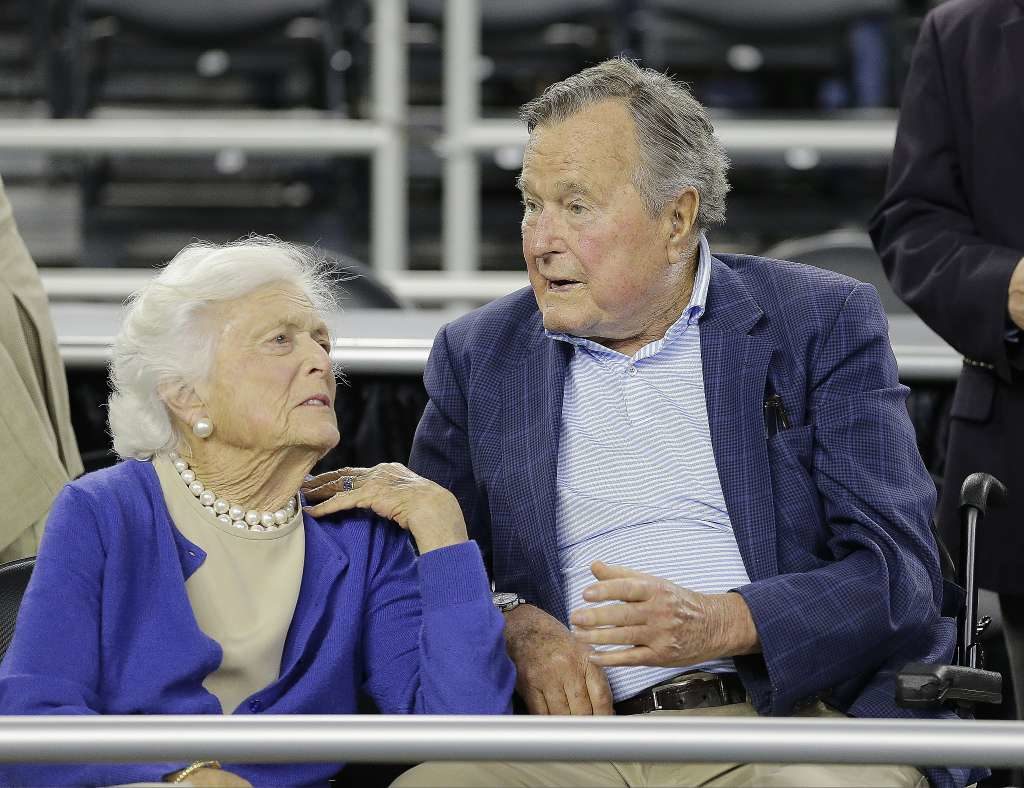
Former first lady Barbara Bush is in “failing health” and won’t seek additional medical treatment, a Bush family spokesman said Sunday. “Following a recent series of hospitalizations, and after consulting her family and doctors, Mrs. Bush, now age 92, has decided not to seek additional medical treatment and will instead focus on comfort care,” spokesman Jim McGrath said in a news release. McGrath did not elaborate as to the nature of Bush’s health problems. She has been treated for decades for Graves’ disease, which is a thyroid condition, had heart surgery in 2009 for a severe narrowing of her main heart valve and was hospitalized a year before that for surgery on a perforated ulcer. “It will not surprise those who know her that Barbara Bush has been a rock in the face of her failing health, worrying not for herself — thanks to her abiding faith — but for others,” McGrath said. “She is surrounded by a family she adores, and appreciates the many kind messages and especially the prayers she is receiving.” Bush, who is at home in Houston, is one of only two first ladies who was also the mother of a president. The other was Abigail Adams, wife of John Adams, the nation’s second president, and mother of John Quincy Adams, the sixth president. Bush married George H.W. Bush on Jan. 6, 1945. They had six children and have been married longer than any presidential couple in American history. Eight years after she and her husband left the White House, Mrs. Bush stood with her husband as their son George W. was sworn in as the 43rd president. President Donald Trump’s press secretary, Sarah Huckabee Sanders, said in a statement Sunday evening that “the President’s and first lady’s prayers are with all of the Bush family during this time.” Bush is known for her white hair and her triple-strand fake pearl necklace. Her brown hair began to gray in the 1950s, while her 3-year-old daughter Pauline, known to her family as Robin, underwent treatment for leukemia and eventually died in October 1953. She later said dyed hair didn’t look good on her and credited the color to the public’s perception of her as “everybody’s grandmother.” Her pearls sparked a national fashion trend when she wore them to her husband’s inauguration in 1989. The pearls became synonymous with Bush, who later said she selected them to hide the wrinkles in her neck. The candid admission only bolstered her common sense and down-to-earth public image. Her 93-year-old husband, the nation’s 41st president who served from 1989 to 1993, also has had health issues in recent years. In April 2017, he was hospitalized in Houston for two weeks for a mild case of pneumonia and chronic bronchitis. He was hospitalized months earlier, also for pneumonia. He has a form of Parkinson’s disease and uses a motorized scooter or a wheelchair for mobility. Before being president, he served as a congressman, CIA director and Ronald Reagan’s vice president. Barbara Pierce Bush was born June 8, 1925, in Rye, New York. Her father was the publisher of McCall’s and Redbook magazines. She and George H.W. Bush married when she was 19 and while he was a young naval aviator. After World War II, the Bushes moved to Texas where he went into the oil business. Along with her memoirs, she’s the author of “C. Fred’s Story” and “Millie’s Book,” based on the lives of her dogs. Proceeds from the books benefited adult and family literacy programs. The Barbara Bush Foundation for Family Literacy began during her White House years with the goal of improving the lives of disadvantaged Americans by boosting literacy among parents and their children. The foundation partners with local programs and had awarded more than $40 million as of 2014 to create or expand more than 1,500 literacy programs nationwide. Republished with the permission of the Associated Press.
Chief of staff Reince Priebus? Some Donald Trump loyalists still dubious
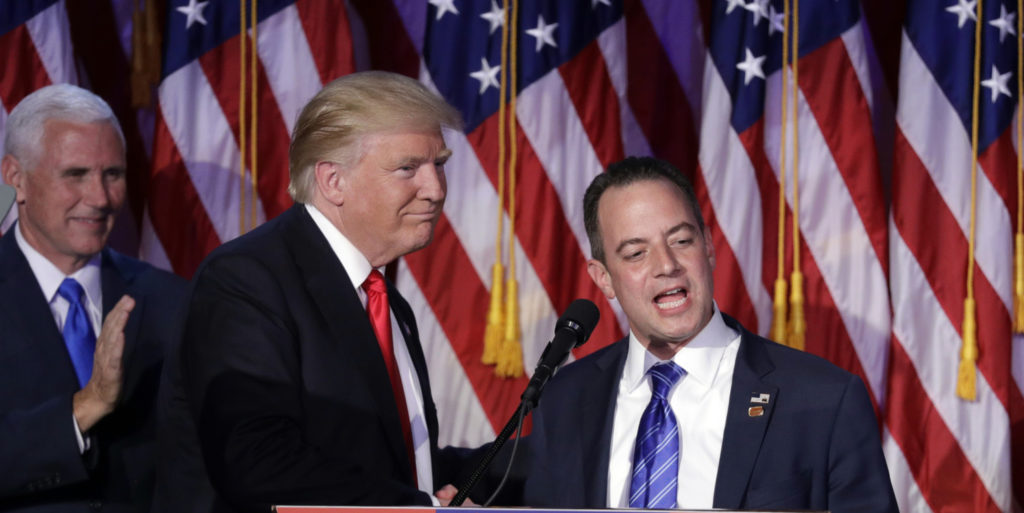
When President-elect Donald Trump tapped Reince Priebus as his chief of staff, Republican leaders cheered the prospect of a close ally having a top White House job. But as Priebus tries to wield his influence and bring more structure to the president-elect’s freewheeling political organization, he’s frustrating some longtime Trump allies who see him as too conventional a pick for an unconventional president. Others fear being left behind as Priebus fills out West Wing jobs. The dismay over Priebus stems in part from a belief among some Trump loyalists that the outgoing Republican National Committee chairman expected Trump to lose the election. They resent the president-elect “rewarding people who thought he wasn’t going to win,” according to one top adviser. Still, Priebus appears to have Trump’s trust. He’s been given wide authority to name senior White House staff, according to people involved in the transition, and in shaping the decision on who will succeed him at the RNC, though deliberations over that post continue. “Reince Priebus has done an outstanding job,” Trump said in a statement to The Associated Press. “All you have to do is look at all of the Republican victories and one in particular.” If Trump runs his White House like past presidents — and that’s hardly a sure thing — Priebus, 44, could hold enormous sway over what issues reach the Oval Office. Chiefs of staff also typically control who has access to the president — no easy task given Trump’s penchant for consulting a wide network of associates before making key decisions. Priebus, a Wisconsin native and father of two young children, comes to the White House with no significant experience in foreign and domestic policy. He has close ties with House Speaker Paul Ryan and other GOP congressional leaders. And he’s seen by those who have worked with him previously as a well-organized manager with little appetite for drama. “One of the things he’ll bring to the White House is an ability to work well with people, to be inclusive, not to get in to intrastaff squabbles,” said Henry Barbour, an RNC member and Priebus ally. Yet internal squabbling and competing factions are a hallmark of Trump’s political and business organizations. He cycled through three campaign managers during his White House run, with the feuds that led up to each shake-up playing out messily in the media. In tapping Priebus as chief of staff, Trump appeared to be setting up another rivalry. He put Steve Bannon, the controversial conservative media executive, at the White House as a senior adviser and called him an equal partner with Priebus. Trump’s influential son-in-law, Jared Kushner, is also weighing a White House role, but will remain a personal power center even without a formal position. Transition officials say Priebus and Bannon have a respectful relationship, and there’s no outright control struggle underway. But Trump’s deliberation over whom to name as secretary of state is seen as an indicator of a tug-of-war, with Bannon among those said to be against Mitt Romney. Priebus is seen as an advocate for Romney and was notably the only adviser who joined Trump for a private dinner with the 2012 GOP presidential nominee. Several Trump advisers described Priebus’ role only on the condition of anonymity in order to speak candidly about the chief of staff. Josh Bolten, who served as President George W. Bush‘s final chief of staff, said he was concerned by the description of Bannon as Priebus’ equal. While presidents usually have multiple influential advisers, Bolten said, it’s imperative for the lines of authority to be clear. “If that were to mean that there’s more than one chief of staff, that’s a recipe for disaster,” Bolten said. Bolten is among several former chiefs of staff Priebus has consulted since the election. He’s spoken at least twice with Denis McDonough, President Barack Obama‘s chief of staff, as recently as last week. Priebus was frequently by Trump’s side in the final weeks of the campaign. After the release of a videotape in which the businessman was heard bragging about predatory behavior with women, Priebus stood by Trump and made clear the RNC would not abandon the party’s nominee. But some Trump advisers contend Priebus and the RNC believed he would lose the election. Indeed, on the Friday before Election Day, top party officials told reporters their data showed Trump falling short by about 30 electoral votes. Some Trump advisers have also blamed Priebus for the messy spectacle around the president-elect’s interview with The New York Times. Trump accused the Times of changing the terms of the interview and tweeted that he would cancel. Then the Times said the terms had not changed, and the interview was back on. One person involved in the situation said it was Priebus who incorrectly led Trump to believe the Times had changed the terms of the interview. “No matter how loyal the overall collection of personalities is to the president, there are always internal rivalries and tugging and pulling,” said John Sununu, who served as chief of staff to President George H.W. Bush and has spoken with Priebus in recent weeks. “It’s up to the chief of staff to deal with all of that.” Republished with permission of The Associated Press.
Jeff Sessions says Bush family should ‘remember the loyalty’ and support Donald Trump
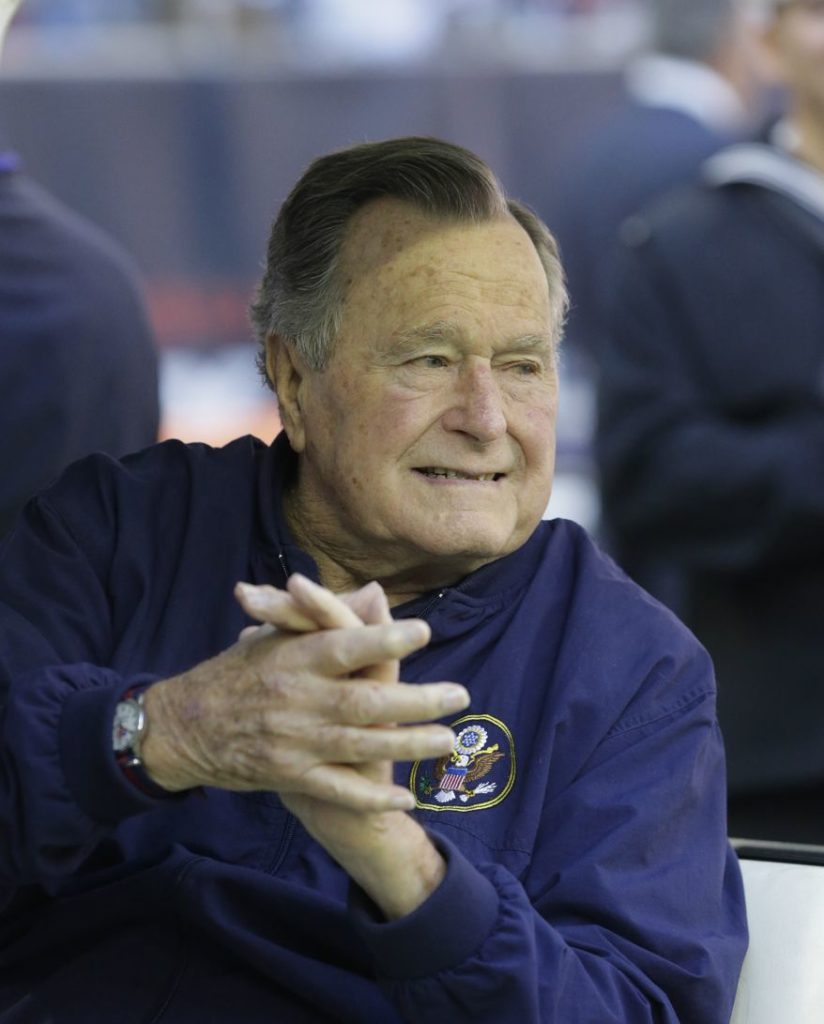
Alabama U.S. Senator Jeff Sessions is not happy with former President George H.W. Bush‘s decision to support Hillary Clinton for president over Republican nominee Donald Trump, and he’s letting everyone know. In an interview with the DC-based Washington Examiner, Sessions went on record saying the Bush family “should remember the loyalty they were given by millions of Americans” as he expressed his frustration with the senior Bush’s decision. “I think they’re not thinking clearly enough about this,” Sessions told the Examiner. “They’re not … appreciating half the American people, virtually, that have been supportive of Republicans. A lot of them preferred somebody other than Bush candidates, but they rallied around them when it came to Nov. 1 So I would hope that we see more rallying.” Sessions was the first senator to back Trump’s White House bid in February this year. The outspoken Alabamian also pointed out “millions of Americans, including this one, worked their hearts out for the Bushes in 1988, 1992, 2000, and 2004. And it wasn’t Bill Clinton that helped the Bushes get elected. It was the same voters, in large part, that elected Ronald Reagan and stand to elect Donald Trump.” Session did clarify that he’s not heard the endorsement from H.W. himself but rather from Democrat Kathleen Hartington Kennedy Townsend. Townsend, a former Maryland Lt. Gov. is daughter of the late Robert F. Kennedy. “Well, you never know,” Sessions elaborated. “That’s just a Democrat reporting what Mr. Bush said. I haven’t heard him say anything.”
Report: Sally Bradshaw says she may vote for Hillary Clinton

A prominent Jeb Bush aide has said she might vote for Hillary Clinton come November. Sally Bradshaw told CNN on Monday that she has left the Republican Party to become an independent. Bradshaw, a close adviser to Bush, also said if the presidential race in Florida is close, she will vote for Clinton come Election Day. “This election cycle is a test,” she told CNN. “As much as I don’t want another four years of (President Barack) Obama‘s policies, I can’t look my children in the eye and tell them I voted for Donald Trump. I can’t tell them to love their neighbor and treat others the way they wanted to be treated, and then vote for Donald Trump. I won’t do it.” Bradshaw is a longtime Bush family supporter, working first on George H.W. Bush’s 1988 presidential campaign. She remained close with the family, and has served Jeb Bush in several capacities over the years, including a significant role in his 2016 presidential bid. Her comments come as Trump criticizes a family of a Muslim soldier killed in action in Iraq in 2004. Bradshaw told CNN that Trump’s remarks were despicable. Bradshaw told CNN she had been considering switching parties for a while, but Trump’s recent comments solidified her decision. She said she had worked hard to make the party “a place where all would feel welcome,” but Trump has taken the GOP in a different direction. While she told CNN she wasn’t sure who she would vote for in November, she said if the race in Florida is close she “will vote for Hillary Clinton.” She said she disagrees with her on several issues, but the country is at a crossroads and “this is a time when country has to take priority over political parties.”
With few political allies, Donald Trump plans celebrity convention

Donald Trump‘s team promises an extraordinary display of political entertainment at this month’s Republican National Convention, with the accent on entertainment. The former reality television star plans to feature his high-profile children at the summer gathering in Cleveland, with the hope they’ll be joined by a number of celebrity supporters. Prospects include former Indiana basketball coach Bobby Knight, New England Patriots quarterback Tom Brady and longtime boxing promoter Don King. “I’m going to be involved, definitely,” said King, who lives in Cleveland and is a passionate supporter of the presumptive Republican nominee. “He’s my man. I love him. He’s going to be the next president.” While those bold-face names have yet to be confirmed, the fact they’re on Trump’s list is a reminder that many of the Republican Party’s biggest stars aren’t willing to appear on his behalf. The GOP’s two living presidents, George H.W. Bush and George W. Bush, its most recent presidential nominee, Mitt Romney, and Ohio’s Republican governor, John Kasich, all plan to avoid the four-day event that traditionally serves as a powerful display of party unity heading into the sprint toward Election Day. “He’s going to have to bring all his skills to bear to make this work, not just in Cleveland, but for the next four months,” said Matt Borges, the Ohio Republican Party chairman. “It won’t be easy, but that’s what he’s got to do.” Trump’s team says he’s up to the challenge. “This is not going to be your typical party convention like years past,” said Trump spokesman Jason Miller. “Donald Trump is better suited than just about any candidate in memory to put together a program that’s outside of Washington and can appeal directly to the American people.” When Hillary Clinton hosts her party at the Democratic National Convention the following week, she’ll face a different issue entirely: how to squeeze in the many popular, prominent Democrats backing her campaign. Along with Clinton and her eventual vice presidential pick, there are sure to be speeches from President Barack Obama, Vice President Joe Biden, first lady Michelle Obama and, of course, the candidate’s husband, former President Bill Clinton. There’s also Massachusetts Sen. Elizabeth Warren, a favorite of progressives and one of Trump’s fiercest critics. Warren is on Clinton’s running-mate shortlist but will surely be slotted for a prominent convention speech even if she’s not selected. By necessity as much as preference, Trump’s team is crafting a far different lineup. Former House Speaker Newt Gingrich, one of the likely speakers, praised Trump’s plan to use his celebrity connections to reach a broader audience. “Trump understands that if he can appeal to consumer America, he drowns political America,” Gingrich told The Associated Press. He said he had little idea of what kind of show to expect, but recalled a recent conversation with a Trump family member who confidently told him, “We know how to do conventions.” “My children are all going to be speaking: Ivanka, Tiffany, Don, Eric. They’re going to be speaking,” Trump said Friday during an appearance at the Western Conservative Summit in Denver. “My wife is going to be speaking at the convention. We’re going to have a great time.” Trump’s campaign has also been in touch with aides to chief primary rival, Texas Sen. Ted Cruz, who has been trying to win a speaking slot. Other national leaders under consideration include former United Nations Ambassador John Bolton, West Virginia Sen. Shelley Moore Capito, Washington Rep. Cathy McMorris Rodgers and Gingrich. Some celebrities backing Trump have passed on the chance to be a part of the show. Among them: former Chicago Bears coach Mike Ditka, who told the Chicago Tribune last week, “I spoke with Mr. Trump this afternoon, and he invited me. But I don’t think I’m going to go.” Clinton’s speaking program, too, isn’t without its uncomfortable riddles. There’s no public sense yet of what role she’ll give to Bernie Sanders, the Vermont senator whose surprisingly strong challenge in the Democratic primary has yet to officially come to an end. Sanders says he’ll vote for Clinton, but he’s yet to formally endorse her and is pushing for changes to the Democratic platform. Ivanka Trump predicted in a recent radio interview the GOP convention would be “a great combination of our great politicians, but also great American businessmen and women and leaders across industry and leaders across really all sectors, from athletes to coaches and everything in between.” “I think it will be a convention unlike any we’ve ever seen,” she said. “It will be substantive. It will be interesting. It will be different. It’s not going to be a ho-hum lineup of, you know, the typical politicians.” And that will still leave room for complaints from Trump’s Republican skeptics. “Whatever you want to say about Trump, he’s been a showman. And I expect something completely different,” said former Kasich adviser Jai Chabria. “I find it hard to believe that that’s going to be enough to put him over the top.” Republished with permission of the Associated Press.
Beat the press: Donald Trump’s contempt for media is calculated
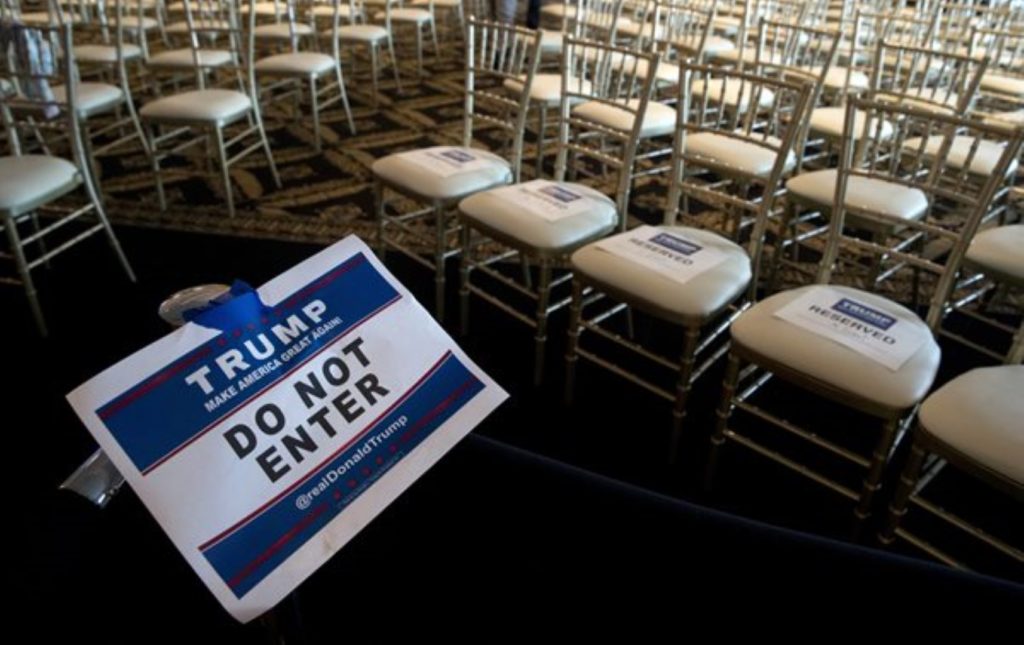
Donald Trump‘s favorite nickname for the news media is the “dishonest press.” He swaps in “disgusting press” from time to time. And sometimes, he puts it all together: “disgusting, dishonest human beings.” The presumptive Republican presidential nominee has a whole menu of takedowns for individual reporters and news organizations. In recent weeks, he’s used his microphone and his tweets to label them “third-rate,” ”not nice,” ”disgraceful,” ”phony,” ”low-life,” ”very unprofessional” and “bad people.” Or, for extra emphasis in a tweet, “BAD.” He’s also been quick to yank or withhold credentials from news organizations whose coverage he doesn’t like — most recently, The Washington Post. Trump seems to be perpetually mad at the press, but there’s a method to his madness. He sees little downside to bashing the media — and plenty of potential benefits. “It’s a truism of American politics that you don’t lose an election by criticizing the media,” said Robert Lichter, president of the private Center for Media and Public Affairs. “It plays well with the public, particularly with Republicans.” While Trump’s language is more incendiary and he lashes out more personally at reporters than typical for past candidates, he’s following a long tradition of modern politicians who shoot barbs at the messenger. Former President Dwight Eisenhower energized the 1964 Republican convention with his complaint about “sensation-seeking columnists and commentators.” Richard Nixon‘s vice president, Spiro Agnew, famously threw shade at “nattering nabobs of negativism” in the press. President George H.W. Bush, who played horseshoes with press photographers and invited reporters to White House picnics and other events, still exhorted voters during his re-election campaign to act on the bumper-sticker slogan: “Annoy the Media: Re-elect Bush.” His wife, Barbara, had some biting advice for Hillary Clinton when the incoming first lady visited the White House in November 1992: “Avoid this crowd like the plague,” Bush told Clinton, sweeping her hand toward the reporters and photographers on the South Lawn. Trump is taking the beat-the-press strategy to a whole new level. In a recent one-month period, he delivered 39 tweets skewering reporters and media organizations, mixed in with a much smaller number of positive and neutral references in his Twitter feed. Just one example: “The media is really on a witch-hunt against me. False reporting, and plenty of it – but we will prevail!” This week, Trump revoked the Post’s credentials, citing what he called the paper’s “incredibly inaccurate coverage and reporting.” Other news organizations he’s banned, either short-term or permanently, include Politico, the Des Moines Register, BuzzFeed, the Daily Beast and the Huffington Post. Post editor Martin Baron called Trump’s latest move “nothing less than a repudiation of the role of a free and independent press.” Kathleen Carroll, executive editor of The Associated Press, said his credentialing bans do a disservice to the public. In the race for the most powerful position on the planet, she said, “the public is interested in what the candidates do and say, and having independent coverage is part of what keeps the public informed.” Why is Trump so quick to pick a fight with the press? For one thing, his over-the-top language can be a successful strategy for changing the subject when he wants to divert attention. Last month, when reporters pressed Trump to document what he’d done with millions of dollars raised for veterans, he turned on them, calling one reporter “a sleaze” and sarcastically referring to another as “a real beauty.” That language itself became a big part of the story, shifting some of the attention away from questions about his handling of the money for veterans. Trump’s constant criticism of the press also helps to inoculate him against future negative news stories. Conservatives, in particular, already are wary of the mainstream media, and Trump’s rhetoric reinforces the message that nothing from the media is to be believed. “Part of what he’s probably decided is that he wants to be very aggressive, to make sure that his supporters routinely discount any kind of news media attack,” former House Speaker Newt Gingrich, a Trump supporter, said in a recent interview with Fox News. With the Republican Party in turmoil over Trump’s candidacy, the billionaire’s broadsides also serve as a unifying theme within the party. GOP faithful may have big differences with Trump on the issues, but they’re at one with him on contempt for the mainstream media. While Trump’s very public display of disdain is strategic, says Lichter, it’s also just “part of his daily dose of pugnacity.” At the same time, though, Trump can be charming in one-on-one interviews, flattering reporters and complimenting their questions. He calls many of them by their first names. He takes questions and offers considerable access, seeming to understand that for all his complaints about the press, he can’t live without them. “You know the press is the most dishonest people ever created by God,” he said at a March press conference. “So I would love to take a few questions from these dishonest people. Go ahead, press.” Republished with permission of The Associated Press.
Chris Christie’s shell-shocked look stirs mockery, befuddlement

Was that really Chris Christie, the brusque, take-a-back-seat-to-no-one governor of New Jersey? Christie’s seemingly shell-shocked gaze as he stood behind Donald Trump on Super Tuesday is generating befuddlement and mockery in his home state and beyond. Conservatives and liberals alike have piled on. His introductory remarks were so subdued and his appearance was so grave that many people joked on the Internet that he looked like a hostage reading a coerced statement. “Gov. Christie, blink twice if you’re in trouble!” one person tweeted. In a move that shocked nearly everyone, especially in Democratic-leaning New Jersey, Christie endorsed Trump last week and has appeared at the billionaire businessman’s side at campaign appearances over the past few days. But after Tuesday night’s appearance, conservative commentator Jonah Goldberg of the anti-Trump National Review imagined Christie was thinking: “My God what have I done?” Others saw the same thing in Christie’s blank stare and robotic words of introduction. Aside from Tuesday night, Christie appears to be fully embracing his surrogate duties. The governor has introduced Trump at a number of enthusiastic rallies and has been Trump’s attack dog, sinking his teeth into Sen. Marco Rubio and vouching for Trump and his family. Back home, the reaction has been fierce. Republican Christine Todd Whitman, the former New Jersey governor and Environmental Protection Agency administrator, told The Star-Ledger of Newark last week she would rather vote for Hillary Clinton than Trump. “I am ashamed that Christie would endorse anyone who has employed the kind of hate mongering and racism that Trump has,” she said. Six Gannett newspapers in New Jersey, including the Asbury Park Press, said he isn’t fit to be governor anymore. They called him a political opportunist who has neglected his duties in the Garden State, and urged him to resign. A Fairleigh Dickinson University poll saw Christie’s approval ratings fall from 33 percent before he backed Trump to 27 percent since. The poll sampled 694 registered New Jersey voters, with a margin of error of plus or minus 3.9 percentage points. “Trump and Christie kind of do belong together, but not running our country,” said Barbara Silverstein of Gibbsboro, New Jersey. “It’s a big show, and it’s pretty pathetic.” In the past few days, the politician with the outsized personality seemed to be shrinking in political stature even if something big — perhaps the No. 2 spot on the ballot with Trump — is his goal. Trump was heard on a microphone telling Christie to get on a plane and go home after Christie was pressed Sunday in an ABC interview about his disagreement with Trump on his proposed ban on Muslims. Christie refers to the candidate, who is supposedly his longtime friend, as “Mr. Trump,” while Trump refers to the governor as “Chris.” Christie defended his endorsement this week on his regular radio call-in show. “I’ve known him personally for 14 years and I believe he is the best person to beat Hillary Clinton,” the governor said, before clarifying that he, Christie, was the best candidate but that Trump is the best of the remaining contenders. Christie wouldn’t discuss on the call-in show whether he was hoping for a vice presidential or Cabinet slot. Asked about his previous criticisms of Trump, Christie said that was a natural part of having to run against him — no different, he said, from George H.W. Bush calling Ronald Reagan‘s policies “voodoo economics” before becoming his vice presidential pick. To Montclair State University political science professor Brigid Harrison, Christie’s seeming thousand-yard stare seemed to reflect sadness. “It really looked like heartbreak and kind of a bitter pill that he was swallowing,” she said. “I still think that in his heart of hearts he thinks he was destined to be president of the United States.” Republished with permission of the Associated Press.
Jeb Bush, seeking a much-needed revival in SC, calls in family

Jeb Bush has long kept his family at arm’s length in his effort to become commander-in-chief, but with the South Carolina primary looming, he’s embracing them like never before in the state that has historically stood by the Bush family in its previous White House bids. It’s a drastic shift from the approach he took at the start of his campaign hinting at how precarious his fortunes have become. Now, with his back to the wall, Bush is grabbing hold of the legacy, and hoping his front-row view of the world’s most difficult job means more to South Carolina’s military-minded Republican voters than a few awkward exchanges on the campaign trail ahead of Saturday’s critical primary. In Beaufort, S.C., Wednesday, Bush told an audience he had experienced “watching history unfold, in a unique way,” a reference to his father’s and brother’s wartime administrations. Bush’s best-known South Carolina advocate, the state’s senior Sen. Lindsey Graham, echoed that sentiment, stressing that Bush’s family is one of his biggest strengths and assets. “He understands the job because his brother and his father have had that job,” Graham said. Bush said in an Associated Press interview Thursday that his family legacy is actually what sets him apart from the others. “You get insight into things that are personal.” For example, Bush recounted the days when he saw the “burden of leadership that my dad felt” in the weeks leading up to the 1991 Persian Gulf War. “He didn’t talk specifically about what he was doing, or going to do,” Bush said. “You could just see the burden.” Bush also lists dozens of admirals, generals and Medal of Honor recipients who have endorsed him. And he points to his time as governor in charge of Florida’s robust national guard, consultation with military and foreign policy experts and vigorous foreign travel while in office and as a private businessman as evidence. But the family reference is a stark change from a year ago, when Bush, then weighing a potential run, said of his father George H.W. Bush and older brother George W. Bush during a Chicago speech: “I admire their service to the nation and the different decisions they had to make. But I am my own man and my views are shaped by my own thinking and own experiences.” Bush’s frequent family references this week reflect the name’s popularity in South Carolina, where both the former wartime presidents won the first-in-the-South primary. It also suggests how desperate Bush and his supporters are for signs of momentum, despite having built the 2016 race’s largest combined warchest of more than $150 million. And yet he finished sixth in Iowa’s leadoff caucuses on Feb. 1 and fourth in the New Hampshire primary on Feb. 8. Despite his efforts in South Carolina, where his family name still maintains some political clout, Bush’s attempt to gain traction hit a rough patch this week. The week started on a high note — a joyous reception from audiences as he campaigned with his former president brother, who came out of public political isolation to assist his younger brother’s at a critical juncture in his campaign. But the following day, Bush was ridiculed for posting a picture on Twitter of a handgun, inscribed with his name and given to him by a manufacturer in Columbia he visited. On an outdoor campaign stop in Summerville Wednesday, Bush fielded more advice on how to improve his underperforming campaign than questions about policy. That was the same day Rubio won the prized endorsement of South Carolina Gov. Nikki Haley, even after she met with George W. Bush in Columbia. Even little things wrinkled Bush’s efforts this week. In Summerville, his clip-on microphone didn’t work. And in Myrtle Beach, Bush, who has recently abandoned glasses for contact lenses, complained to staff about the lighting as he left the hall rubbing his eyes. Bush was hoping his fortunes would reverse on Friday when he was scheduled to campaign with his 90-year-old mother Barbara Bush, a beloved figure among a segment of South Carolina Republicans. Barry Wynn, a member of Bush’s national finance team and former South Carolina Republican Party chairman, says he is convinced Bush can benefit from the family’s popularity, but he also acknowledges the pressure Bush faces. Wynn and other Bush supporters have said he needs to beat or finish very close to Sens. Ted Cruz of Texas and Marco Rubio of Florida to justify asking donors to help him finance the next round of campaigning, which includes the Nevada caucuses and, more importantly, the Mar. 1 Super Tuesday primaries. All three trailed billionaire Donald Trump in a scrum according to most public polls of primary voters. “We’ve got to make sure that when they cut off the tail here, we’re not the tail,” Wynn said. “And then we have to have the resources to stay in the game.” MaryBeth Lewis of Florence put it more directly to Bush after a stop Thursday at the farmer’s market in her town. “Go get ’em!” she told Bush as she squeezed his hand. “I’m still standing,” Bush replied. Republished with permission of the Associated Press.
George W. Bush: From South Carolina cameo to starring role

George W. Bush won a bruising South Carolina presidential primary on his way to the Oval Office, as his father did before him. Now it’s his brother’s turn, and for Jeb Bush, the most consequential foreign policy decisions of his brother’s time in office are suddenly front-and-center of his bid to keep alive his campaign for the Republican presidential nomination — thanks to Donald Trump. The former president had already announced plans to campaign for his younger brother on Monday in South Carolina, marking his most direct entry into the 2016 race to date, when the GOP front-runner used the final debate before the state’s Feb. 20 primary as an opportunity to excoriate George W. Bush’s performance as commander-in-chief. The former president, Trump said, ignored “the advice of his CIA” and “destabilized the Middle East” by invading Iraq on dubious claims that Saddam Hussein had weapons of mass destruction. “I want to tell you: they lied,” Trump said. “They said there were weapons of mass destruction, there were none. And they knew there were none.” Trump didn’t let up as Bush tried to defend his brother, dismissing his suggestion that George W. Bush built a “security apparatus to keep us safe” after the 9/11 attacks. “The World Trade Center came down during your brother’s reign, remember that,” Trump said, adding: “That’s not keeping us safe.” The onslaught — which Jeb Bush called Trump enjoying “blood sport” — was the latest example of the billionaire businessman’s penchant for mocking his rival as a weak, privileged tool of the Republican Party establishment, special interests and well-heeled donors. But the exchange also highlighted the former Florida governor’s embrace of his family name and history as he jockeys with Florida Sen. Marco Rubio and Ohio Gov. John Kasich to emerge from South Carolina as the clear challenger to Trump, who won the New Hampshire primary, and Texas Sen. Ted Cruz, the victor in Iowa’s caucuses. The approach tacks away from Bush’s months-long insistence that he’s running as “my own man,” but could be a perfect fit for South Carolina. Noted South Carolina Sen. Lindsey Graham, who ended his GOP presidential campaign in December and endorsed Jeb Bush in January, said: “The Bush name is golden in my state.” George W. Bush retains wide appeal among Republicans, from evangelicals to chamber of commerce business leaders and retired members of the military. All are prominent in South Carolina, with Bush campaign aide Brett Foster going so far as to say that George W. Bush is “the most popular Republican alive.” After the debate, some Republicans again suggested Trump had gone too far. Bush wasn’t alone on stage leaping to his brother’s defense, with Rubio coming back to the moment to say, “I thank God all the time it was George W. Bush in the White House on 9/11 and not Al Gore.” The attack on George W. Bush carries risk for Trump, given the Bush family’s long social and political ties in South Carolina and the state’s hawkish national security bent, bolstered by more than a half-dozen military installations and a sizable population of veterans who choose to retire in the state. Trump has repeatedly defied predictions that his comments might threaten his perch atop the field. And as he jousted Saturday with Trump, Jeb Bush said, “this is not about my family or his family.” But the Bush family does have a history in the state that’s hard to overlook. In 2000, George W. Bush beat John McCain in a nasty contest, marred by rumors that McCain had an illegitimate black child. McCain adopted a child from Bangladesh. Exit polls showed George W. Bush won nearly every demographic group. George H.W. Bush, the 41st president, won twice here, beating Bob Dole in 1988 and demolishing Pat Buchanan in 1992. One of the elder Bush’s top strategists, Lee Atwater, hailed from South Carolina and remains a legend in GOP campaign annals. Last week, Jeb Bush touted the endorsement of Iris Campbell, the widow of former South Carolina Gov. Carroll Campbell, a national co-chairman of previous Bush presidential campaigns. Yet even as he defended his brother’s presidency at Saturday’s debate, Jeb Bush found a way to distance himself from George W. Bush’s business affairs and to criticize Trump at the same time. The issue: eminent domain. Before entering politics, George W. Bush was part-owner of the Texas Rangers, and their home city of Arlington, Texas, used eminent domain to take private land and build a stadium for the team. Trump has defended such uses of eminent domain as a way to foster economic development. Retorted Bush, who argued eminent domain should be reserved for public infrastructure projects, “There is all sorts of intrigue about where I disagree with my brother. There would be one right there.” Republished with permission of the Associated Press.
Jeb Bush invokes dad’s Iowa victory as hopeful sign of things to come
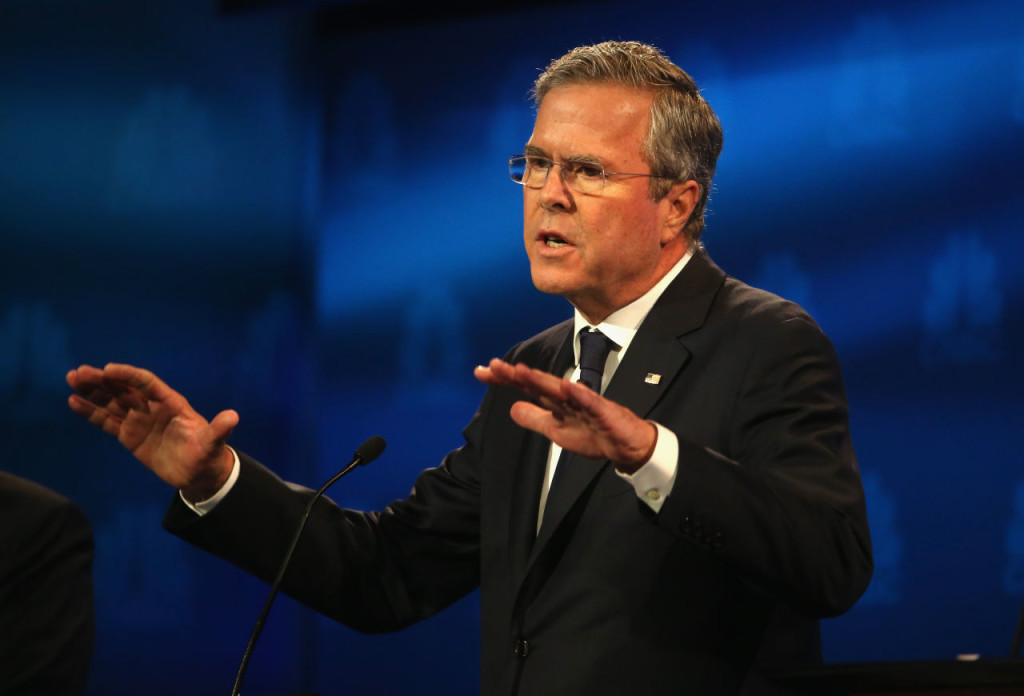
Jeb Bush was never expected to be a serious contender in Iowa, but his paltry total of just 2.8 percent of Iowa caucus voters still has to hurt. That’s after his Super PAC spent nearly $15 million there. The former Florida governor knew the results wouldn’t be pretty. He wasn’t even in Iowa Monday night, instead campaigning at a town hall meeting in New Hampshire. Appearing on “Fox and Friends” early Tuesday, Bush referenced a breaking story from Paris (where French police say five people were arrested with plans to stage attacks on nightspots and leave for Syria), and pivoted to his foreign policy gravitas. “We have a national security threat that is not going to go away, we need someone with a steady hand, someone who can has the backbone to be able to be a commander in chief to lead this country,” he said. Bush refused to play along with Fox anchor Steve Doocy‘s question about what he would do over if he could in Iowa. “I don’t look back,” he said, adding that he looks forward to campaigning in New Hampshire, South Carolina and Nevada. Doocy reminded Bush that the Iowa winner often doesn’t become the GOP nominee, referring to George H.W. Bush‘s surprise victory in 1980. “Yeah, I remember in 1980 we were all excited, with my dad upsettingRonald Reagan in the Iowa caucus. He had big mo, he came here to New Hampshire and it didn’t work out. And many other candidates have the same story.” In fact, it’s been 16 years since Republican caucus-goers here have accurately picked the eventual GOP nominee for president. Some polls have shown Bush with growth in the polls in New Hampshire. The Real Clear Politics average of polls in New Hampshire shows Bush locked in a tight four-man battle for second place, less than a point below Ted Cruz and John Kasich in fourth place with 10.3 percent. All are way behind Donald Trump, however, who dominates currently with a poll average rating of 33 percent.
Bad Blood: Cruz-Bushes tension underscores deeper GOP divide
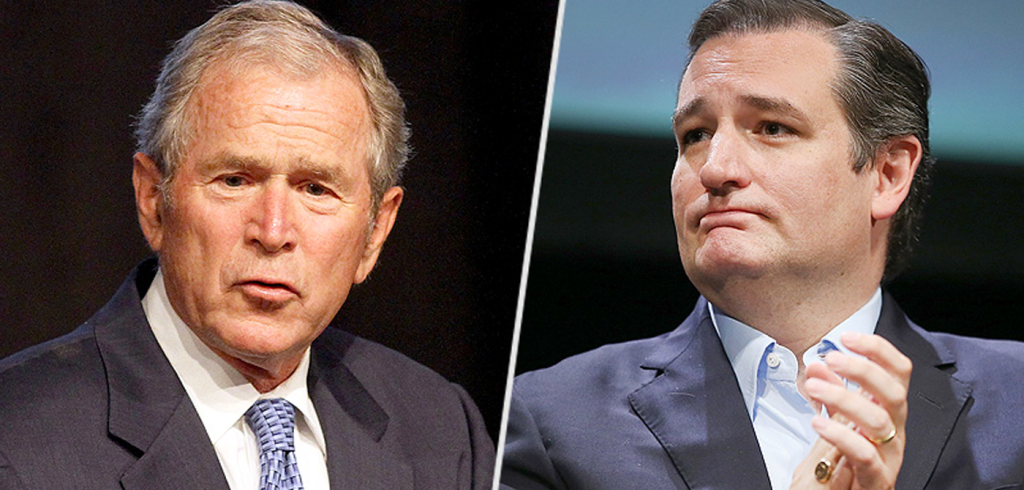
Ted Cruz once proudly wore a belt buckle borrowed from George H.W. Bush that said: “President of the United States.” He campaigned and worked for that former president’s son, Dubya, former President George W. Bush. And Cruz helped write a book lavishing praise on him. Also, the endorsement of George P. Bush, the family’s latest rising political star and son of Jeb Bush, lent credibility to Cruz’s then little-known 2012 Senate campaign. Now, though, things aren’t so simpatico between the Bushes and Cruz – and not only because one of the Texas senator’s GOP presidential primary competitors is Jeb Bush, the former governor of Florida. Rising tensions reflect Cruz potentially helping to dent the Bushes’ position as one of the nation’s pre-eminent political families, personifying a deeper internal Republican Party struggle between insurgent conservative outsiders and the old guard establishment. “There is this question of, ‘When are the adults going to come in and change the race?’ I think the adults are at the table. I certainly consider myself one,” said Mica Mosbacher, a prominent Cruz fundraiser whose late husband, Robert, was secretary of commerce under George H.W. Bush. “Some people are still in denial.” Cruz supporters point to October, when George W. Bush said of Cruz to a roomful of donors: “I just don’t like that guy.” “I think it hurt him,” Mosbacher said of the former president. “He failed to have his finger on the pulse.” Ray Sullivan, who was national spokesman for George W. Bush’s 2000 campaign, said the comment “underscores a highly competitive, multicandidate race and different segments of the Republican Party.” But he also conceded that it was somewhat unusual for George W. Bush to openly criticize a fellow Republican. “The Bushes are a competitive lot,” said Sullivan, who ran a PAC backing Rick Perry’s short-lived 2016 presidential bid before jumping to Jeb Bush‘s campaign in September. “I viewed that as almost a game-day, rally-the-troops commentary.” Cruz hasn’t retaliated, but being criticized by George W. Bush delighted his tea party base. Since then, Cruz’s candidacy has risen in the polls, while Jeb Bush’s bid has struggled. Clay Johnson III, a friend of George W. Bush since high school and former top budget official in his administration, said he recently spent time with the former president and they discussed how many of the crowded field of GOP White House hopefuls “have no idea at all about what’s involved in being president.” Still, that public display of bad blood in Bush’s comment to donors was a far cry from Bush’s 2000 presidential campaign, when Cruz was a domestic policy adviser. Cruz later held jobs in the Bush administration in the Justice Department and Federal Trade Commission and, on the verge of the 2004 Republican National Convention, wrote a chapter in “Thank You, President Bush,” a book meant to answer “Bush-haters.” In it, Cruz likened George W. Bush to Abraham Lincoln and Ronald Reagan and wrote that some fiscal conservatives decried Bush for increased government spending, but “those concerns are often overstated.” In his own autobiography published last year, however, Cruz made it clear his views had changed, criticizing Bush for excessive federal spending. Also in his book, Cruz recalled borrowing jeans, a shirt and that belt buckle from George H.W. Bush for a 2009 sailing outing, writing that “it was surreal to be wearing his clothes.” Before his 2012 Senate bid, Cruz explored running for Texas attorney general. In the autobiography, he detailed how, after the sailing trip, George H.W. Bush agreed to endorse that campaign. But Cruz wrote that Karl Rove, a top strategist for George W. Bush, pressured him not to publicize that. Rove disputed the book’s assertion last summer, prompting the Cruz campaign to release 2009 emails from Rove that it said backed up Cruz’s account. Cruz wrote that George H.W. Bush had wanted to call him “the future of the Republican Party.” Three years later, Bush’s grandson, George P., used those same words to praise Cruz during his Senate run. In a 2012 statement backing Cruz, who was then an underdog in Texas’ Republican primary, George P. Bush saluted him and another now presidential hopeful, Marco Rubio, saying both “will inspire a new generation of leaders to stand up and defend American Exceptionalism.” George P. Bush, Jeb’s eldest son, was elected Texas land commissioner in 2014. Through his office, George P. Bush declined to comment for this story, but he has said he still considers Cruz a friend – even if he’s now campaigning for his dad. Brendan Steinhauser, a GOP strategist who is uncommitted in the presidential race, called the falling out between Cruz and the Bushes “a good example of the battle for the heart and soul” of the Republican Party. “There may be frustration on the Bush side that this isn’t the party from 2000 to 2008, and certainly not before that under Bush senior,” Steinhauser said. “The tea party, the rise of the grassroots … that started during the younger Bush’s presidency.” Republished with permission of the Associated Press
Jeb Bush super PAC considering staff for early voting states
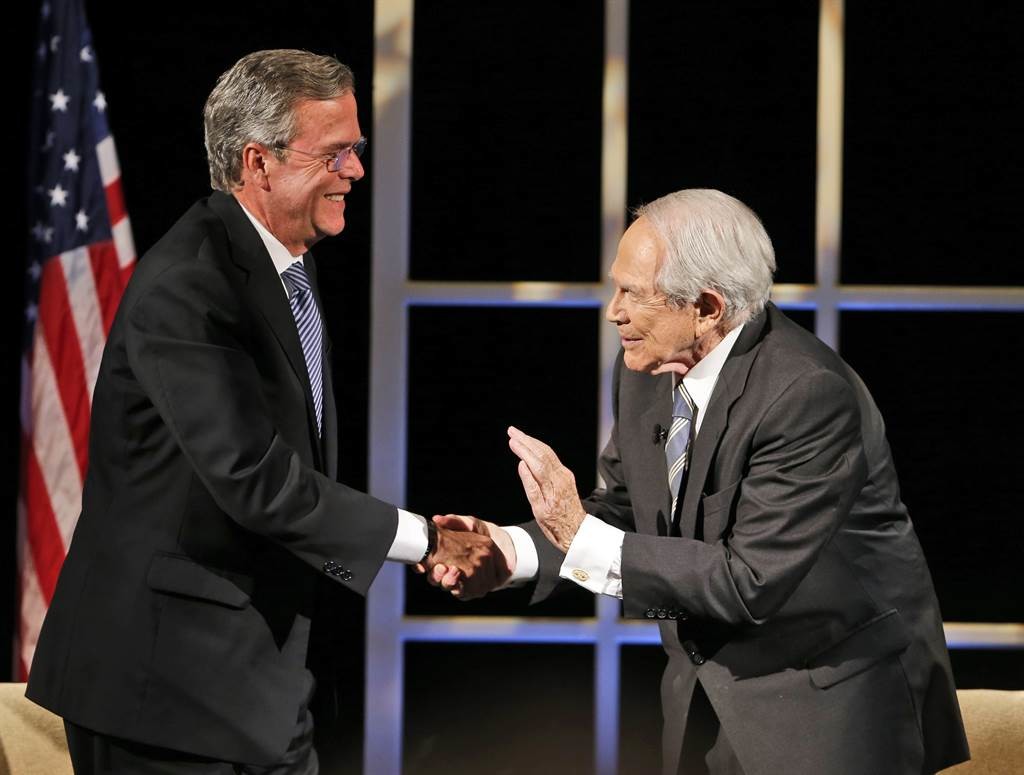
The outside political group supporting Jeb Bush‘s bid for president with tens of millions of dollars in television advertising is considering placing organizing staff in Iowa and New Hampshire, a move that would follow the decision of his formal campaign to refocus its efforts on the two early-voting states. Senior advisers to the group tried to paint an upbeat picture of Bush’s White House prospects at the outset of two days of concurrent meetings held for major donors to Bush’s campaign and the group, a super PAC known as Right to Rise USA. Scheduled months ago as a reward for top money-raisers for the candidate once viewed as having the clearest shot at the GOP nomination, the retreat ending Monday comes just days after Bush’s formal campaign cut employee salaries by 40 percent and said it would move jobs from its Miami headquarters to the leadoff-voting states. A faithful core of roughly 175 Bush supporters made the trip to Houston for the meetings, fewer than expected due in part to the rains that pounded south Texas in the wake of Hurricane Patricia. Among the invited were people who had raised at least $50,000 for the campaign, and major super PAC donors also had access to some events. Among them was a session with Mike Murphy, a longtime Bush aide who is leading Right to Rise. He played five ads for the donors as they fired off questions about when the super PAC, which is not subject to the contribution limits placed on campaigns and pulled in a record haul of $103 million in the first six months of the year, would start spending big. Already, Right to Rise has spent $14.7 million on ads through the end of this week, mainly in Iowa, New Hampshire and South Carolina, the first three states on the 2016 nominating calendar. The group has reserved another $30 million in advertising through the week of Feb. 18. But Right to Rise officials said options for what else the cash-rich super PAC can do are top of mind among some donors, including whether the group should hire staff to marshal a get-out-the-vote effort on Bush’s behalf in Iowa and New Hampshire. “We’re looking at some of that. The campaign is front and center on that. But there are a lot of supporters around the country who might want to be organized to do some stuff like that,” said a senior Right to Rise official, speaking on condition of anonymity because the plans are still being developed. “There are limits to what a super PAC can do there,” the official added. “But there’s some energy we might channel.” Bush’s super PAC has from its outset been primed to do more than just run television advertising, the activity of choice for super PACs in the 2012 presidential campaign. While federal law does not allow formal campaigns and super PACs to coordinate their activities, Bush has long planned for Right to Rise to perform some functions of a traditional campaign. “Our primary mission is to tell Jeb’s story through paid advertising, but we’re always exploring other ways we can help amplify his positive message,” said Right to Rise spokesman Paul Lindsey. Bush and Right to Rise are not alone in taking this approach. The outside group backing former technology executive Carly Fiorina handles the vast majority of communications with supporters. This past weekend, a super PAC supporting Ohio Gov. John Kasich marshalled 40 volunteers to go door-to-door in New Hampshire to promote his White House bid. Bush was loudly cheered as he took the stage before a group of Right to Rise donors Sunday afternoon at a downtown hotel ballroom. Bush’s father, former President George H.W. Bush, and mother, Barbara, had arrived at the hotel for events scheduled to include a Sunday dinner with the candidate, and with their eldest son, former President George W. Bush. Jay Zeidman, a Houston fundraiser for Bush who attended the Right to Rise briefing on Sunday, said he felt “reassured” after listening to the super PAC leadership, which underlined in its presentation to several dozen attendees that in past election cycles the front-runner had yet to emerge by mid-October. “They’re going to be the asset that we thought all along,” he said of Right to Rise, which sketched out a massive advertising plan. He said the “capital” and “leadership” that Right to Rise has makes it — and therefore Bush — a formidable competitor in the primary. Although neither Bush nor his campaign can direct the super PAC’s spending, the close relationship between the two entities was on display Sunday, as donors hopscotched between Right to Rise and official campaign events. Many attendees sported lanyards bearing logos of both the campaign and the super PAC. In a light moment aimed at underscoring their concern for following the law, Bush stepped off a hotel elevator and spotted Murphy, his longtime political confidant. The two men hugged, before parting in silence. Republished with permission of the Associated Press.