
Hoover’s Pat Lynch remembered, “Integrity beyond reproach”
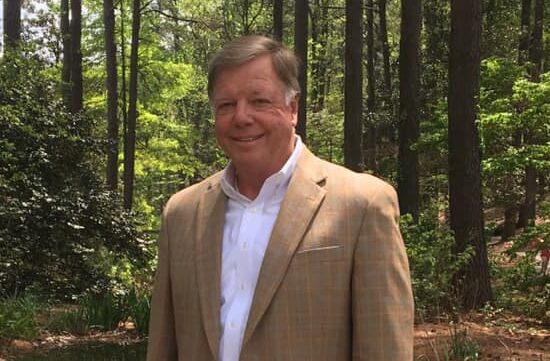
Friends and family of Pat Lynch will gather on Tuesday, August 13, for a memorial to honor his life and the many contributions he made to his community. Lynch and his wife Tynette, Hoover residents, have been active throughout the Birmingham area and have contributed personally and professionally to the City of Hoover for decades. Lynch passed away on Tuesday, August 6, due to complications from an ongoing respiratory infection after defeating cancer. “Pat took great delight in his family. He always said ‘this crazy amazing family’ was his greatest achievement in life,” his obituary read in part. He and his wife’s Facebook pages show images of a close-knit, loving family with posts of their children and grandchildren throughout the years. In January of 2023, Lynch was diagnosed with cancer which required his right kidney to be removed. Nearly a year after his diagnosis, he was honored by ROAR, the Radiation Oncology Accelerated Research, at their annual gala. According to an interview Lynch gave to the Over the Mountain Journal, “Due to his family history and long-held belief that cancer research is critical, Lynch has been a supporter of ROAR for several years.” His family noted that his wishes were that, in lieu of flowers, upon his passing donations be made to RoarTheCure.org in his name. In an interview with Senator Jabo Waggoner he highlighted their friendship saying that he’s known Lynch, “40 maybe 50 years”. Both Lynch and Waggoner’s wife were honored by ROAR for their work in cancer research which Waggoner described as making them closer over the last several years. Waggoner described the “mutual respect and friendship” among their families saying, “he was a great citizen and good friend to so many people. “He was a guy of character and we go way back and he’s always had a great personal reputation. You don’t hear anybody in this community criticizing Pat Lynch. He’s a class guy. He has a great wonderful and loving family. He will be missed in this community.” In 2009, Lynch retired from a long career as vice president and managing partner of Birmingham Budweiser, but he wasn’t ready for full retirement yet. In an interview with 280 Magazine in 2018, Lynch spoke about his “unretirement,” saying, “I didn’t know exactly what direction I was going to go after that. I had built, through my years at Budweiser, strong relationships. We were heavily involved in legislation in Montgomery that had to do with alcohol, and I knew a lot of people, a lot of local politicians. “So the natural progression for me would be to use those relationships to build a business. “I was really too young to stop and play golf, which is a really big hobby of mine, and I enjoyed making deals and getting involved in business,” Lynch said. “I’m having fun doing what I’m doing, even though it does take a lot of my time, but that’s OK.” The Hoover Sun reported that following Lynch’s departure from Budwiser, “Lynch started a business development and lobbying firm called Pat Lynch & Associates and another company called AlphaGov Consulting. His clients included beverage distributors, educational and health providers, nonprofit associations and large and small businesss. In Hoover, he has represented developers such as Will Kadish of Broad Metro, which is developing Stadium Trace Village.” Civic and community leaders have joined hundreds of friends and family in honoring the memory of Lynch with messages of support for his family. Alabama Today spoke with Jefferson County Commissioner Jimmie Stephens who said, “Pat Lynch, an honored friend and staple of the Hoover community, will be missed by all. He always exhibited class and character in all of his actions; his integrity was always beyond reproach. I will miss Pat dearly, as will the entire Hoover community.” Hoover City Councilman Steve McClinton echoed those sentiments saying, “Pat Lynch was a true pillar of Hoover, exemplifying the qualities of a Southern gentleman while serving the city and its community with distinction. Pat was a devoted family man who adored his wife Tynette and cherished every moment with his chilren and grandchildren, always doting on them. He never missed an opportunity to lend a helping hand to others. Pat was a rare soul, and the world feels a little less joyful without him.” Read his full obituary and service details below: James “Pat” Lynch of Hoover Alabama beloved Husband, Dad and Papa and caring friend to many passed away Tuesday, August 6, 2024 surrounded by his wife and best friend Tynette Lynch and his family. Pat took great delight in his family. He always said “this crazy amazing family” was his greatest achievement in life. Retired in 2009 from a long career as vice president and managing partner of Birmingham Budweiser where his title the Budman followed him for his entire life. After retirement he started a very successful business development firm, Pat Lynch & Associates, using his passion of helping people succeed. A respected leader in the Birmingham business world Pat was also very involved in the Birmingham community through his kind giving and support of many charities that were close to his heart. Pat loved golf and drinking fine wine. Pat and Tynette enjoyed a Blessed life traveling and enjoying the beach with family and friends. He said often that he had lived his bucket list. Pat was born on January 10, 1948, in Tazewell Virginia. He was preceded in death by his mother Sadie Johnson Lynch and his father William P Lynch. He is survived by wife Tynette Gustin Lynch, brother William Paul Lynch of Clermont Florida, daughters Tracy Lynch Hays (Jason), Amy Lynch Goss, Stepsons Christopher Cerniglia, Jason Cerniglia (Angie) Grandchildren Alex Hays, Abby Hays, Gage Hays, Kalib McCoy, Kyleigh McCoy, Palmer Cerniglia, Peyton Cerniglia, Parson Cerniglia and Presley Cerniglia, and his nieces and nephews. Visitation is at 11 am and Funeral Mass following at 12 noon at Prince of Peace Catholic Church in Hoover on Tuesday, August 13 with lunch served after Mass. In lieu of flowers
Steve Livingston elected new Senate Majority Leader, replacing Clay Scofield
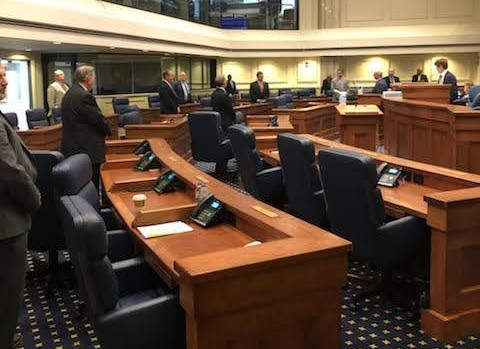
On Monday, Senate President Pro Tempore Greg Reed (R-Jasper) announced that State Senator Steve Livingston (R-Scottsboro) had been elected the new Senate Majority Leader, replacing Sen. Clay Scofield (R-Guntersville), in a meeting of the Republican state senators. “The process of electing Senator Livingston was efficient and effective,” Reed said. “The Republican Caucus emerged with a united decision, and we look forward to continuing to lead Alabama toward guaranteeing the state is a better place to live, work, and raise a family. I am excited about the transformative work we are doing and the goals we will achieve throughout our third quadrennium of leadership.” Speaker of the House Nathaniel Ledbetter (R-Rainsville) congratulated Livingston on his election. “In addition to being one of my closest friends for many years, Steve Livingston has been a mentor of mine since the first moment I joined the House and a strong leader whose example I respect deeply,” said Ledbetter. “Sen. Livingston is a man of strong convictions and conservative beliefs, and he will lead his colleagues with the fairness, strength, and common sense that are his trademarks.” As was reported by Alabama Today, Sen. Scofield resigned from the Senate on Monday. “I have resigned from the Senate to become the Executive Vice President of the Business Council of Alabama,” Scofield wrote in a letter. This decision was one of the hardest that I have ever had to make, and with any decision of this magnitude, I involved a lot of prayer and talked it over with family and friends. If I didn’t love serving you, the decision would have been easy. It’s a dream job with an organization whose mission I strongly believe in. I have always supported policies that make Alabama more business-friendly because if we have healthy businesses, they can create more high-paying jobs. As President Ronald Reagan said: “I believe the best social program is a job.” This new job will allow me to continue my mission to make Alabama the most business/job-friendly state in the nation. “I also want to thank Senator Scofield for his unwavering dedication to the state of Alabama during his term as Majority Leader and tenure in the Alabama Senate,” Reed said. “After entering the Senate together nearly 14 years ago, Senator Scofield has proven himself to be an enduring friend, an exceptional leader, and a true champion for the people of Alabama. We wish Senator Scofield well in his future endeavors.” The Majority Leader is the second most powerful member of the Senate, behind the President Pro Tem. Next would be the Senate Rules Committee Chairman – Sen. Jabo Waggoner (R-Vestavia). Livingston represents Jackson, Dekalb, and Madison counties in the Alabama Senate, To connect with the author of this story or to comment, email brandonmreporter@gmail.com.
Judge dismisses Birmingham Southern College lawsuit
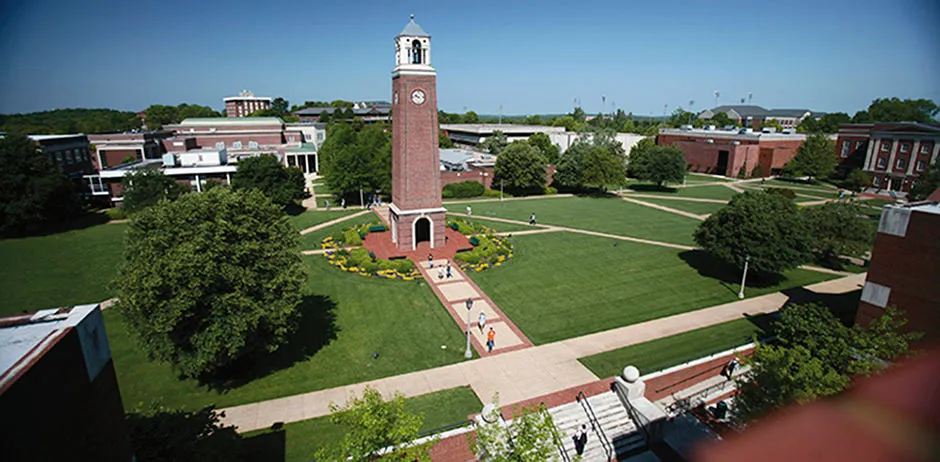
On Tuesday, Montgomery Circuit Judge James Anderson dismissed the lawsuit brought by Birmingham Southern College (BSC) to force State Treasurer Young Boozer (R) to give the troubled college a bridge loan to allow the private college to stay open. In this past legislative regular session, the Legislature approved controversial legislation to help BSC. The Distressed Institutions of Higher Learning Revolving Loan Fund Act, passed by the Legislature and signed by Alabama Governor Kay Ivey (R), empowered the State Treasurer to loan money to failing private colleges. Boozer had the power to give BSC the money, but after evaluating BSC’s financial viability, Boozer concluded that there was little chance that BSC would ever be able to pay the state back. BSC responded by suing Boozer, arguing that the legislative intent of the legislation was to give the school the money. Alabama Attorney General Steve Marshall (R) asked that the court dismiss the lawsuit. Judge Anderson agreed with the state’s arguments. Daniel Coleman is the President of BSC. “We are disappointed with this ruling and are exploring our options, which may include an appeal to the Alabama Supreme Court with a request for an expedited briefing,” said BSC President Coleman in a statement. “While the Alabama Constitution provides for immunity to state officials, such immunity should not apply to those who act arbitrarily or capriciously, or in bad faith, or who have misinterpreted the law in question.” “Our good faith was betrayed over the several months of working with Treasurer Boozer to deliver this bridge loan to the College,” Coleman added. “The timeline of our interactions clearly demonstrates that his behavior was arbitrary and capricious. We also believe he is misinterpreting the language of the Act pertaining to collateral.” The legislation allowed Boozer to give BSC a $30 million lifeline, providing the College with operating funds for three years. BSC claimed that during those three years, it could raise an endowment of up to $200 million to ensure its long-term financial stability. BSC likely would have closed in the spring of 2023 if not for the passage of the controversial bridge loan legislation. In a letter dated October 13, Boozer notified BSC that their loan application had been denied; the letter arrived on October 18. BSC claimed that during months of discussions, Boozer gave them no indication that any aspect of BSC’s application was incorrect or that he would not act as the Legislature intended, Coleman said. Coleman claims that Boozer has provided inconsistent reasons for his denial. Judge Anderson ruled that the legislation gives Boozer discretion over who he grants a loan to and was within his rights to deny the loan. Anderson said he sympathizes with the college. However, given the Legislature’s language, past precedent, and sovereign immunity, BSC has no case. Thus, he granted Marshall’s motion to dismiss. BSC, which has been declining for decades, has been hemorrhaging students in recent years and is reportedly down to just 731 students, while the college still has 284 employees. The college decided to stay open for the fall semester pending receiving the money from the state’s loan. At this point, however, it appears that the college will have to close soon, perhaps as soon as the end of the current semester. BSC had initially asked the Legislature and local government for a cash bailout. That request was rejected, but BSC alum State Senator Jabo Waggoner (R-Vestavia Hills) sponsored the Distressed Institutions of Financial Learning Revolving Loan Fund Act to save the failing liberal arts college. The closing of a private college is not without precedent in Alabama. Judson College, the state’s only women’s college, closed four years ago when its income could not meet its liabilities. To connect with the author of this story or to comment, email brandonmreporter@gmail.com.
Attention Alabama drivers: new law tightens cell phone use in vehicles

For years, safety experts have instructed drivers to put down the cell phone. Now, a new law in Alabama tightens the rules, and penalties, for holding a cell phone while behind the wheel. The new distracted driving law was guided through the legislative process by state Sen. Jabo Waggoner of Vestavia Hills, whose 18-year-old son was killed in a distracted driving accident in 1979. Waggoner has been a long-time advocate for strong driving laws and hopes the new law will help cut down on similar distracted-driving tragedies in the state. More than 3,500 people were killed nationwide in 2021 in crashes involving distracted drivers, according to the National Highway Traffic Safety Administration. More than 362,000 were injured. The updated Alabama law builds on a prior prohibition that made texting while driving illegal. Under the new law, just holding a phone while driving is a secondary violation, with some exceptions, such as making an emergency call to the police or the fire department. That means law enforcement can’t pull you over for talking on the phone, but they can fine you for it after stopping you for another violation. The cost is $50 for a first offense, $100 if you’re caught again within 24 months, and $150 if caught a third time in the same period. In addition to these fines, points would be added to the driver’s record. The new law doesn’t prohibit putting a phone on speaker and using it hands-free while driving. Using Bluetooth continues to be permitted. Read the full bill here. Republished with the permission of The Alabama NewsCenter.
Legislature passes bill to make improper annexations valid

On Thursday, the Alabama Senate passed legislation that would bar a property owner from challenging a past annexation if there was something flawed with the process. House Bill 48 is sponsored by State Representative Jim Hill. The bill was carried in the Senate by State Senator Jabo Waggoner. Hill said that periodically the legislature brings this bill so that cities can’t be sued over past annexation efforts. The last time the Legislature did this was in 2011. Sen. Waggoner said in committee that he is bringing this bill for the Alabama League of Municipalities. Hill said that the homeowner has had time to bring a claim and has not exercised that challenge already, and so has accepted the annexation as valid. State Sen. Chris Elliott strongly objected to the bill in committee over grounds that this bill would be making an illegal annexation legal after the fact. According to the synopsis, “Under existing law, municipal annexations prior to May 4, 2011, have been validated and ratified notwithstanding any procedural defect in the annexation. This bill would validate and ratify any annexations prior to the effective date of the act proposing this bill.” SB261 passed the Alabama Senate 18 to 11. The legislation has already passed the House so it now goes to the Governor for her consideration. Thursday was day 23 of the 2023 Alabama Regular Legislative Session. 851 bills have been introduced to this point in the session. To connect with the author of this story or to comment, email brandonmreporter@gmail.com.
Senate rejects due process for student discipline bill
On Tuesday, the Alabama Senate voted to reject controversial legislation that would have set up a formal due process standard for disciplining a child in an Alabama public school. Senate Bill 181 (SB181) is sponsored by State Senator Rodger Smitherman. The synopsis states, “This bill would provide a uniform statewide system of procedural due process protections relating to the suspension and expulsion of public school students for violating the student code of conduct or state law. This bill would also provide for the adoption of any necessary rules to implement this act by the State Board of Education.” The bill, after being amended, was voted down rapidly with no floor debate. Smitherman then took an hour of time during the next bill to voice his unhappiness with the Senate’s rejection of his legislation. “Last year, we passed the same bill out of the Senate almost unanimous,” Smitherman said. Last year the legislation failed in the House of Representatives. The legislation was staunchly opposed by Alabama School Superintendents and other education supporters. “It is obvious they did a good lobbying effort among our colleagues to kill the bill,” Smitherman said. “The school superintendents, they have elevated their power now to the point that they can convince all but eleven people that these children do not need due process.” “Those little children ain’t going to have anybody standing out there (in the Statehouse halls) talking for them,” Smitherman said. “Who is getting suspended? Who is getting so many days? and for what reason?” Smitherman said heavily, implying that school systems target Black students, particularly males, for discipline. “The teacher is the judge, jury, and executioner,” Smitherman said. “They (the accused children) don’t get the first benefit of the doubt,” Smitherman said. “They are guilty until they are proved innocent.” The most controversial element of Smitherman’s legislation was giving a student the right to face their accuser. The Greene County Superintendent testified before committee that students fear retaliation by other students, so a student who might tell a teacher that another child has a gun in school; would not come forward if her identity was revealed. Smitherman also opposes the mandatory kindergarten bill that would force a child who did not attend kindergarten as a five-year-old to be denied admission into first grade. He also opposes the Alabama Literacy Act provision that a child that can’t read at grade level by the end of the third grade will have to repeat third grade. “First, they want to hold them back in the first grade,” Smitherman said. “If they don’t get them there, then they want to hold them back in third grade. If they don’t get them there, then they use these discipline policies to suspend or expel them.” “They ain’t going to stay in school when they are 21,” Smitherman said. “If they don’t get an education, they ain’t gonna get a job. If they have no job, they can’t eat.” Smitherman called the schools a “pipeline to prison.” The Legislature is also concerned with criminal gangs operating within many Alabama schools. The Senate voted down SB181 11 to 20. Jabo Waggoner, Tom Butler, Arthur Orr, and Greg Reed were the only Republicans to vote for the bill. Billy Beasley was the only Democrat who voted against the legislation. The controversial legislation appears to be dead for this session. To connect with the author of this story or to comment, email brandonmreporter@gmail.com.
Greg Reed says bill to reduce grocery tax gaining momentum among GOP state Senators
On Thursday, the Alabama Senate passed the largest education budget in Alabama’s history. Between the $8.9 billion FY2024 education trust fund (ETF) and the $2.8 billion FY2023 supplemental appropriation, the total appropriation shattered every revenue record in state history. The great economy and the newfound wealth are forcing legislators to set priorities and ask hard questions about what they really want to accomplish in the next four years. The problem with money, especially new money, is that everybody has their own ideas about what to do with it. Every school in the state and every university wants more money than they received last year. Ditto with almost every state agency funded in the education budget. The Alabama Department of Education is presenting legislators with a myriad of plans to create or expand programs it claims will improve the dreadful educational performance in the state. The Alabama Department of Commerce has requests for renewed and expanded economic incentives. The Alabama Department of Corrections, which is normally largely funded in the state general fund budget (SGF) rather than the education trust fund (ETF), wants $100 million in education dollars to build education facilities on the sites of their new megaprisons in Elmore and Escambia Counties. There were even calls from Montgomery legislators for $30 million to build a dubious water rafting theme park. Every University or nonprofit group has presented the legislature with their plans to build a new building, center, or program. In her State of the State address, Governor Kay Ivey promised every Alabamian a $400 check in their mailbox. School choice advocates are asking for education dollars to follow the child out of Alabama’s troubled public school system with the PRICE Act. Four legislators have presented plans to reduce or eliminate the state’s four percent sales tax on groceries. Legislators are talking about lowering the state’s corporate income tax rate. The Alabama House of Representatives actually passed legislation eliminating the income tax on hourly workers working overtime. There are also calls to save money in this record revenue year in anticipation of the next economic downturn. With 140 different legislators, there are 140 different ideas about how to spend the state’s revenues. “We cannot do it all,” said Sen. Arthur Orr, who chairs the Senate Finance and Taxation Education Committee, told reporters following passage of the budget package Thursday. Senate Pro Tem. Greg Reed agrees. “We can’t do all of it,” Reed said. “There is a slew of tax cuts ideas coming,” Orr said. “How are we going to afford it?” “We need to be careful that we don’t cut too many taxes,” Reed said. Reed indicated that the plan most likely to move forward is the plan to reduce grocery taxes. “When you talk to the members, you will hear more about the grocery tax than any other,” Reed said. Alabama Today asked Orr if the $45 million tax cut for hourly workers that passed the House on Tuesday was in the budget that passed the Senate on Thursday. “No, it was not,” Orr said. The Senate does plan to save some of the money in a new reserve account. “Half a billion dollars is going into a savings account which is where we’re going to put the rebate money to take care of future needs, particularly because we’re concerned about the future of the economy,” Orr said. The Senate also downsized Governor Ivey’s rebate plan from $400 per tax filer to $105, saving approximately $700 million. The Senate eliminated plans to spend $30 million on a new healthcare-focused boarding school in Demopolis. That was replaced with a $500,000 study to study the feasibility of the plan and what would be the best site for the plan. The Senate rejected an amendment by Sen. Bobby Singleton that would have restored $2 million of funding for the school. “I would like to thank this body for telling little babies in West Alabama that they don’t mean anything,” Singleton said after losing the vote, “Thank you, this is why we will always be number 50.” The Senate budget also cut out the plan to provide $30,000 million to Montgomery, including the plans for the controversial water park. “I am very concerned that the capital city will be completely left out of the supplemental,” said Sen. Kirk Hatcher. “I am pleading with you to help with this.” The legislature did advance a controversial bill to provide a bridge loan to cash-strapped private college Birmingham Southern College. That bill is sponsored by Sen. Jabo Waggoner – a Birmingham Southern Alum. The budget package now goes to the Alabama House of Representatives for its consideration. The House has already passed the state general fund budget (SGF). The SGF could come out of committee in the Senate as early as Wednesday, but sources think it likely will be another week. “This is an unprecedented budget and an unprecedented time,” Orr said. Wednesday was Day 18 of the 2023 Alabama Regular Legislative Session. To connect with the author of this story or to comment, email brandonmreporter@gmail.com.
Senate Committee advances education budget package

On Wednesday, the Finance and Taxation Education Committee approved over $11 billion in funding for education. State Senator Arthur Orr is the Chairman of the Senate Finance and Taxation Education Committee “This has been the most trying budget in my 14 years as a budget chairman,” Orr said. “To add something, you have to cut something. There are so many decisions in writing a budget. We did receive a budget from across the street. Some things I understood. There were some things there I didn’t understand.” $8,798,591,041 is in the 2024 fiscal year Education Trust Fund (ETF) budget itself – SB88. That is an increase from $8,261,590,649 in 2023 to $537,000,392—a 6.5% increase over the 2023 education budget. K-12 will increase from $5,626,390,769 in 2023 to $5,988,821,987 in 2024. Higher Ed will be increased from $2,116,780,588 to $2,258,619,038. The many other agencies in the ETF will be increased from $518,419,292 to $551,153,016. That is a decrease of $18,350,000 from Gov. Kay Ivey’s budget request. The actual ETF budget could have been much greater. An $11 billion ETF with different priorities and accounting was a real possibility. A large part of the budget package was not in the FY2024 ETF but was instead in a massive $ $2,787,667,309 supplemental appropriation to the already record 2023 education budget –SB87. This is in addition to the $8,261,590,649 already appropriated for education in the current 2023 budget year. 2022 and 2021 also saw massive supplemental appropriations bills swelling the dollars spent on education in those fiscal years beyond the ETF budgets. SB101 created the Educational Opportunities Reserve Fund, which functions as a second state savings account for when revenue collections fall below projects. Orr explained that the goal is to create a “waterfall” effect, where funds flow to funds so that in a 2009-style economic crash, there would still be funds to avoid proration. Orr warned that as of the end of April 2023, tax collections for the ETF are $30 million below what they were at this time in 2022. The most significant change between the Governor’s plan versus the Senate Committee plan is that the Governor’s generous tax rebate – SB86 – has been cut from $400 per tax filer to just $100 per filer. Orr explained that the cost of the governor’s rebate would have been $1,030,000,000. The cost of the much smaller committee rebate is $275 million. That is paid for in the supplemental appropriation for 2023. The Committee passed a pay increase for educators – SB85. All education employees will get a two percent across-the-board pay increase. Sen. Orr explained that the Legislature passed a salary matrix for teachers last year. “Teachers get at least a one percent step increase every year no matter what the Legislature does.” With the two percent across-the-board increase plus the one percent annual step increase, the teachers will get a three percent increase effective on October 1. Orr said the Legislature is considering creating a similar matrix for education support staff. Orr said that the Legislature is considering creating a “floor” for education support staff. The problem that the Legislature is running into is that teacher’s aides, janitors, lunchroom workers, secretaries, and school bus drivers pay scales vary widely from local system to system. SB269 established the K-12 Capital Grant Program within the Office of the Lieutenant Governor to provide grants to local schools to assist with capital projects, deferred maintenance, or technology needs. All the bills in the education budget package received favorable reports from the Committee. Traveling within the budget package is a controversial proposal to give private college, Birmingham Southern, a $30 million dollar loan to keep the struggling liberal arts institution afloat. Without a bailout of some sort, the college would be forced to close, the president said. SB278 is sponsored by Sen. Jabo Waggoner. The full Senate could consider the whole education budget package as early as Thursday. The House has already passed the state general fund budget (SGF) – the other half of the twin budgets that the state passes every year. Thursday will be day 18 of the 2023 Alabama Regular Legislative Session. To connect with the author of this story or to comment, email brandonmreporter@gmail.com.
Steve Flowers: Jabo Waggoner – An Alabama political icon
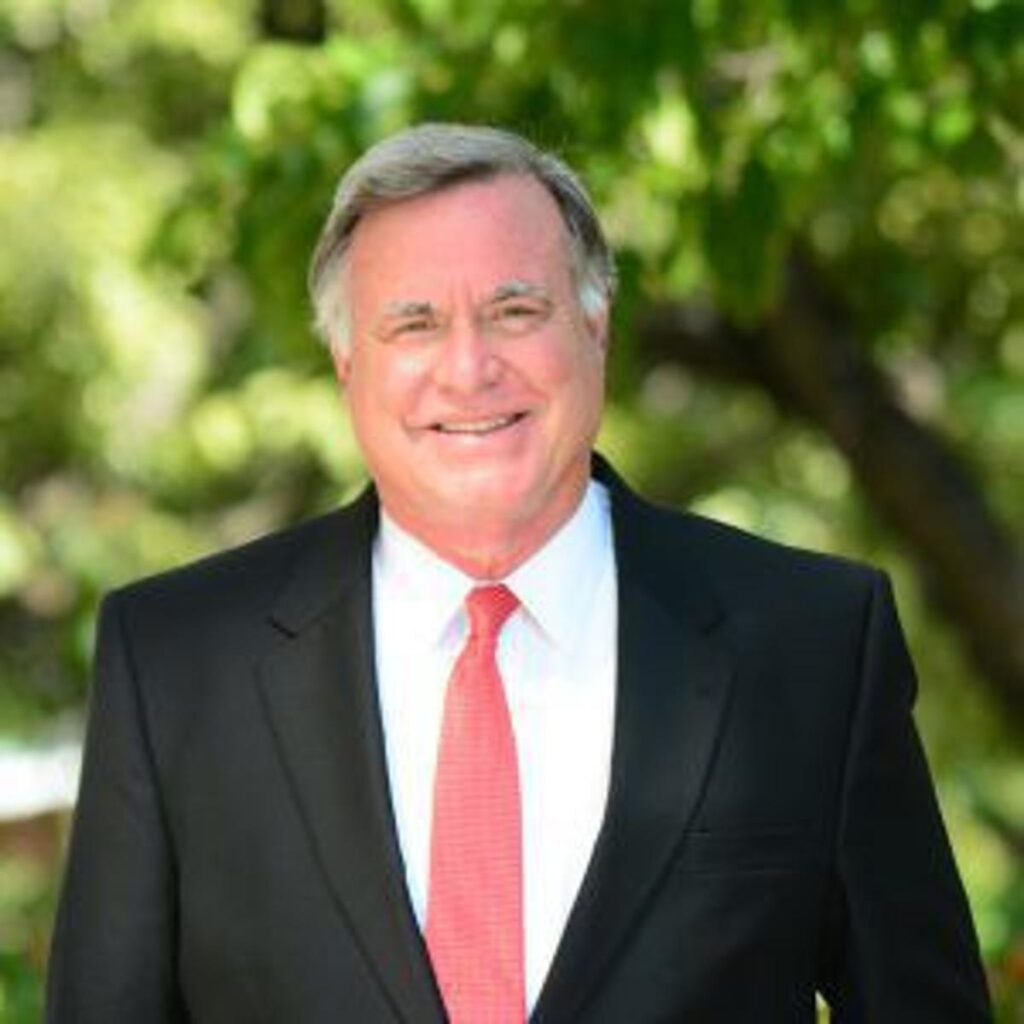
As I stroll down the halls of the Alabama Senate during this current Regular Session of the Alabama Legislature, I will stop and visit in the offices of my favorite legislative buddies. My favorite and first stop is with my longtime friend Jabo Waggoner. Jabo, being the Dean of the legislature, has the first prime corner office. He also chairs the agenda-setting Rules Committee. Therefore, there is a throng of high-priced lobbyists camped outside the door trying to get Jabo to put their bills on the Special Order Calendar. Jabo and I will swap stories of bygone years and reminisce about past experiences. Jabo is a big sports fan and was a great college basketball player. In fact, Jabo was one of the founders and remains on the Board of the Alabama Sports Hall of Fame, which is located in downtown Birmingham. Jabo, Gene Hallman, and Edgar Welden were the pillars and founders of this prestigious Institution. One of Jabo’s and my favorite remembrances is going together to the Olympic Soccer Games held at Legion Field in Birmingham. Recently while visiting Jabo, I thought, “I am with an Alabama political icon.” Jabo Waggoner has been in the Alabama Legislature for 50 years this year. Folks, that is an Alabama record. Jabo Waggoner is the longest-serving legislator in Alabama history. He served 17 years in the Alabama House of Representatives and is in his 33rd year in the Alabama Senate. Jabo was first elected to the Alabama Senate in 1990. The heart of his district has always been the entire city of Vestavia. He also represents parts of Homewood and Hoover. This is a very Republican area, and therefore, Jabo is an arch Republican. Jabo is revered in Jefferson County, but his popularity extends beyond Jefferson and Shelby counties. When Kay Ivey was running for Governor for the first time in 2018, she asked Jabo to be her titular campaign manager. He introduced her as she announced her candidacy. Jabo is adored by his Senate colleagues, especially the younger state senators. They throng to him for tutoring and mentoring. The Senate leaders, Greg Reed of Jasper and Clay Scofield of Arab, seek his guidance on tricky senate maneuverings. Jabo was the Republican Minority Leader of the State Senate from 1999 until the Republicans gained a legislative majority in 2010. He was the first Republican Majority Leader, then relinquished that role to be the Rules Chairman, where he currently serves. Jabo is married to his high school sweetheart Marilyn. They have been married for over 60 years. I have never met a more beautiful or sweeter lady than Marilyn Waggoner. They had four children, three sons, and a daughter. One of their sons, Scott, died at an early age in an automobile accident. Jabo and Marilyn are ardent members of the Homewood Church of Christ. They attend almost every Sunday and sit with Jabo’s best friend, Dr. Swaid and his wife, Christy. Jabo’s and Marilyn’s children attend the same church. Jabo Waggoner has done a lot for Jefferson County for over 50 years. It would take a book to chronicle his legislative accomplishments and good deeds. In the 1970s, Waggoner sponsored legislation that spearheaded the purchase of 45 blocks in downtown Birmingham for UAB’s expansion. UAB purchased this property, which was valued at $8.5 million at that time. There is no telling what that land is worth today – probably well over $200 million to $300 million. Jabo was first elected to the legislature in 1966. It is no coincidence that UAB has grown into one of the premier medical and research institutions in America and the Crown Jewel of Alabama during that same period. Although Jabo is an arch conservative Republican, he has forged a close working relationship with his fellow Democratic Senate leader Roger Smitherman to work across the aisle for the good of Jefferson County. In closing, in all my years of following Alabama politics, I have never seen a more modest or amicable leader than Jabo Waggoner, Jr. I have never seen or heard of anyone who has ever met Jabo that did not like him. Jabo Waggoner is an icon of Alabama political history. See you next week. Steve Flowers is Alabama’s leading political columnist. His weekly column appears in over 60 Alabama newspapers. He served 16 years in the state legislature. Steve may be reached at www.steveflowers.us.
Legislature to convene Tuesday for fourth week of the session
Both Houses of the Alabama Legislature will meet on Tuesday for the eleventh day of the 2023 Alabama Regular Legislative Session. The Alabama Senate will convene at 2:30 p.m. The Alabama House of Representatives has not posted the start time on the Legislature’s website, but it is probably around 1:00 p.m. The House Tuscaloosa County Legislation Committee will meet Tuesday at 12:45 p.m. in Room 418 of the Statehouse. The committee will consider just one bill. House Bill 275 (HB275) is sponsored by State Representative Ron Bolton. According to the bill, “it would allow the City of Northport in Tuscaloosa County to provide for a warrant recall fee to allow a municipal judge or municipal magistrate for the City of Northport to recall, under certain conditions, a failure to appear warrant.” The Senate County and Municipal Government Committee will meet at 1:00 p.m. in the Senate Finance and Taxation room on the eighth floor of the Alabama Statehouse. Two bills are on the agenda. There is a public hearing scheduled for House Bill 114. HB114 is sponsored by State Representative Debbie Wood. HB114 will allow county governments to claim unclaimed property in their custody faster. Senator Gerald Allen sponsors Senate Bill 169. SB169 would specify that for municipal business taxes purposes, the definition of gross receipts does not include any excise tax imposed by the federal, state, and local governments. Senate Bill 203 (SB203) had been on an earlier version of the Committee agenda but was removed as of press time. SB203 is sponsored by Sen. Jabo Waggoner. SB203 would “authorize any county, municipality, or governmental entity subject to a countywide civil service system to elect by a majority vote of the county or municipal governing body to opt out of the countywide civil service system; to require the county, municipality, or governmental entity to adopt a human resources policy and procedures manual; and to require the county, municipality, or governmental entity to notify the director of the countywide civil service system of its decision to withdraw from the system.” There are over a dozen committee meetings scheduled for Wednesday. Neither the House of Representatives nor the Senate have released a special order calendar as of press time. State Rep. Susan Dubose reported that her legislation (House Bill 261) will be on the House floor on Tuesday. HB261 protects female college athletes from having to compete with biological males in athletics events. The transgender community will likely oppose the bill. It has 39 Republican cosponsors. The regular session is limited by the Alabama Constitution of 1901 to no more than thirty legislative days in a regular session. Tuesday will be the 11th Legislative day. To connect with the author of this story or to comment, email brandonmreporter@gmail.com.
State Senate votes to advance property tax increase for Vestavia

Vestavia Hills residents could soon be voting on whether or not to raise their property taxes after the Alabama Senate voted on Thursday to advance legislation authorizing the school system to hold a referendum on raising ad valorem taxes. Senate Bill 63 (SB63) is sponsored by State Sen. James T. “Jabo” Waggoner Jr., who chairs the powerful Senate Rules Committee. “This is on behalf of the Vestavia Hills Board of Education,” Waggoner said on the floor of the Senate. “As you know, we have one of the better school systems in the state. They are asking for 9.4 mills.” Sen. Rodger Smitherman said, “It is a tax bill, and I am going to vote for the bill.” “We did the same for Center Point,” Smitherman said. “With Center Point, we did that with street light cameras. What concerns me is that Birmingham does not get the same consideration. I had the same bill for the city of Birmingham, but I did not get the same consideration.” Senate Minority Leader Bobby Singleton said, “Thank you for bringing this bill. Education is important. I applaud you for bringing this and doing what is best for the school children in your district.” SB63 would authorize Vestavia to increase the rate at which ad valorem taxes are levied and collected by the city on all taxable property situated within the city. If passed, the bill would raise the maximum rate to $3.54 on each one hundred dollars ($100) (35.4 mills on each dollar) of assessed value. The city presently levies and collects the Special Tax at a rate of $2.56 on each one hundred dollars (25.6 mills on each dollar) of assessed value. The increase is subject to the approval of a majority of the qualified voters residing in the City who vote on the proposed increase at a special election called and held for that purpose. Singleton said that the Alabama Farmer’s Federation (without naming them) had opposed a rural tax referendum with “Vote No” signs because they don’t want to pay higher taxes on their farmland and forest land. Whether or not they will oppose this tax increase remains to be seen. SB63 was passed by the Senate in a 16 to 0 vote. SB63 is a local bill. It is customary practice in the Alabama Legislature for members who do not represent the county affected by the legislation, in this case Jefferson County, not to oppose other members’ local bills. Waggoner is the dean of the Legislature, having served in the House of Representatives for five terms from 1966 to 1984 and nine terms in the Alabama Senate from 1990 to the present. The legislation now goes to the Alabama House of Representatives for their consideration. Thursday was Day 4 of the 2023 Alabama Regular Legislative Session. To connect with the author of this story or to comment, email brandonmreporter@gmail.com
The State of Alabama honors Richard Shelby
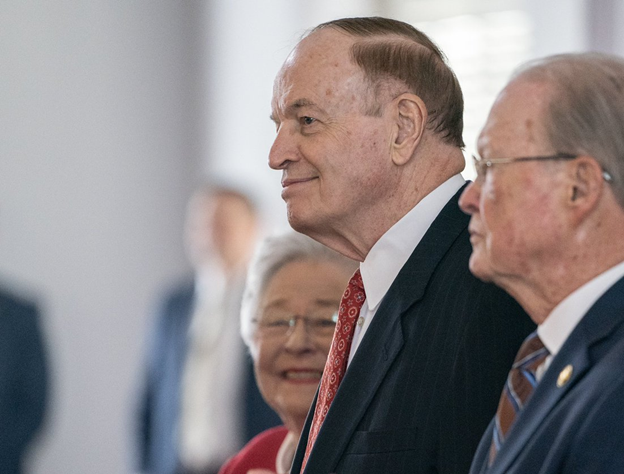
On Thursday, both Houses of the Alabama Legislature joined Alabama Governor Kay Ivey for a joint legislative session to honor former U.S. Sen. Richard Shelby and his 52 years of service to the State of Alabama. Shelby represented State Senate District 16 from 1971 to 1979. In 1978, he was elected to Congress, representing Alabama’s Seventh Congressional District. He served four terms in the U.S. House of Representatives. In 1986 he was elected to the U.S. Senate. He spent the next 36 years serving the people of Alabama in the United States Senate. Shelby is a native of Birmingham and a graduate of the Birmingham School of Law, but it is Tuscaloosa where he launched his career. He was hired as city prosecutor for Tuscaloosa and became a special assistant attorney general before launching his political career as State Senator representing Tuscaloosa in the 1970 election. Every year Shelby was in the Senate, he introduced a flat tax and a balanced budget amendment—neither ever passed the Senate. The Legislature commended Shelby for his “Service to the state of Alabama and its citizens and wished him continued health and happiness in all future endeavors.” Ivey said, “We are here today, honoring a friend to all of Alabama. To Richard Shelby, I say welcome home. We are honored to have you back.” “He is the state’s longest-serving Senator at 36 years,” Ivey said. Ivey said that out of all the great senators the state of Alabama has had, they have been “eclipsed by Senator Shelby.” Ivey praised Shelby for having steered hundreds of millions of dollars in engineering and sciences funding to Alabama colleges and universities, as well as Redstone Arsenal, the Port of Mobile, and other projects across the state. “We wish you the best, and we proudly welcome you back to our sweet home Alabama,” Ivey concluded. Lieutenant Governor Will Ainsworth said Shelby “should be forever known as Alabama’s greatest builder.” “Perhaps the most important and lasting thing that Richard Shelby has built is his legacy,” Ainsworth said. “His legacy will be felt long after Richard Shelby and all who gather in this room have passed by generations of Alabamians not yet born.” Senate Pro Tem. Greg Reed said, “I echo everything that has been said eloquently by the Governor and Lieutenant Governor.” Speaker of the House Nathaniel Ledbetter said, “It is an honor and a privilege to honor a man in Senator Shelby who has dedicated his life to service of the people of Alabama.” Ledbetter thanked Shelby for the contribution that he has made to the development of the state. “Alabama’s economy is stronger than it has ever been,” Ledbetter said. “We have more jobs that we can ever fill. We look forward to building on the foundation that you have built in your 51 years of service.” State Sen. Jabo Waggoner praised Shelby, saying, “It appears that I am the only one in the Alabama Legislature still standing when he came to the Senate in 1971. I was elected in 1966, so I had a four year head start on Richard.” “He grew up on the west side of Birmingham like I did, but I did not know him until then,” Waggoner recalled. Every legislator today has an office in the Alabama Statehouse. In 1971 the Legislature still met in the historic 1859 State Capitol. “There were about five offices behind this (House) chamber,” Waggoner said. “For the rest of us, our office was this seat in this chamber, so we spent a lot of time together under the rotunda.” “When the history is written, what he has done in the House of Representatives and the Senate will put him right at the top,” Waggoner continued. “Everybody in Alabama knows the name Richard Shelby – everybody – and what he has accomplished for this state. When the history book is written, my friend, you will be right at the top.” Shelby said, “Today, I come back around to where I started 52 years ago. It is a great honor.” “I thought I was going to come down here and run things,” Shelby said. “After ten days, I realized I was going to have to work with people.” “We have come a long way,” Shelby said. Shelby said that he learned legislators can accomplish the most “if we work together to advance everybody.” To connect with the author of this story or to comment, email brandonmreporter@gmail.com.
