
Senate bid to save Roe v. Wade falls to GOP-led filibuster
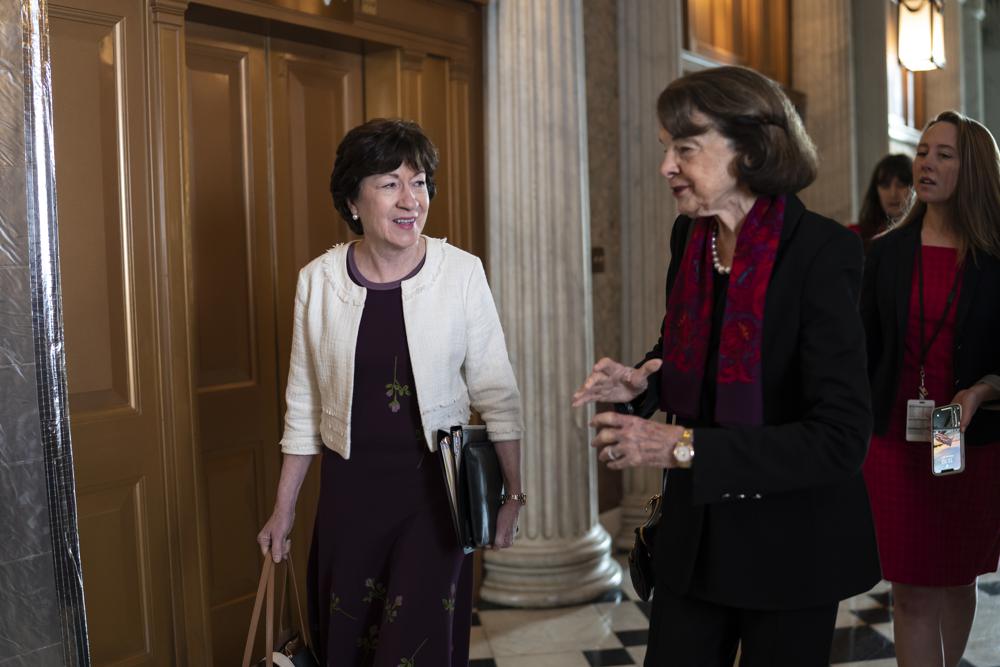
The Senate fell far short Wednesday in a rushed effort toward enshrining Roe v. Wade abortion access as federal law, blocked by a Republican filibuster in a blunt display of the nation’s partisan divide over the landmark court decision and the limits of legislative action. The almost party-line tally promises to be just the first of several efforts in Congress to preserve the nearly 50-year-old court ruling, which declares a constitutional right to abortion services but is at serious risk of being overturned this summer by a conservative Supreme Court. President Joe Biden said that Republicans “have chosen to stand in the way of Americans’ rights to make the most personal decisions about their own bodies, families, and lives.” Biden urged voters to elect more abortion-rights lawmakers in November and pledged in the meantime to explore other ways to secure the rights established in Roe. For now, his party’s slim majority proved unable to overcome the filibuster led by Republicans, who have been working for decades to install conservative Supreme Court justices and end Roe v. Wade. The vote was 51-49 against proceeding, with 60 votes needed to move ahead. Congress has battled for years over abortion policy, but the Wednesday vote to take up a House-passed bill was given new urgency after the disclosure of a draft Supreme Court opinion to overturn the Roe decision that many had believed to be settled law. The outcome of the conservative-majority court’s actual ruling, expected this summer, is sure to reverberate around the country and on the campaign trail ahead of the fall midterm elections that will determine which party controls Congress. Security was tight at the Capitol where Vice President Kamala Harris presided, and it has been bolstered across the street at the Supreme Court after protesters turned out in force last week following the leaked draft. Scores of House Democratic lawmakers marched protest-style to the Senate and briefly watched from the visitor galleries. Harris can provide a tie-breaking vote in the 50-50 split Senate, but that was beside the point on Wednesday. One conservative Democrat, Joe Manchin of West Virginia, voted with the Republicans, saying he supported keeping Roe v. Wade but believed the current bill was too broad. “The Senate is not where the majority of Americans are on this issue,” Harris said afterward. Over several days, Democratic senators delivered speeches contending that undoing abortion access would mean great harm, not only for women but for all Americans planning families and futures. Sen. Catherine Cortez Masto, D-Nev., said that most American women have only known a world where abortion access was guaranteed but could face a future with fewer rights than their mothers or grandmothers. “That means women will not have the same control over their lives and bodies as men do, and that’s wrong,” she said in the run-up to Wednesday’s vote. Few Republican senators spoke in favor of ending abortion access, but they embraced the filibuster to block the bill from advancing. Senate Republican leader Mitch McConnell, an architect of the effort to install conservative justices on the Supreme Court — including three during the Trump era — has sought to downplay the outcome of any potential changes in federal abortion policy. “This issue will be dealt with at the state level,” McConnell said. Some other Republicans, including Sen. John Thune of South Dakota, argue that the House-passed bill is more extreme than Roe and would expand abortion access beyond what is already the law. About half the states already have approved laws that would further restrict or ban abortions, including some trigger laws that would take effect once the court rules. Polls show that most Americans want to preserve access to abortion in the earlier stages of pregnancy, but views are more nuanced and mixed when it comes to late-term abortions. The draft court ruling on a case from Mississippi suggested the majority of conservative justices are prepared to end the federal right to abortion, leaving it to the states to decide. Whatever the Supreme Court says this summer, it will almost guarantee a new phase of political fighting in Congress over abortion policy, filibuster rules, and the most basic rights to health care, privacy, and protecting the unborn. In recent years, abortion debates have come to a political draw in Congress. Bills would come up for votes — to expand or limit services — only to fail along party lines or be stripped out of broader legislative packages. In the House, where Democrats have the majority, lawmakers approved the abortion-rights Women’s Health Protection Act last year on a largely party-line vote after the Supreme Court first signaled it was considering the issue by allowing a Texas law’s ban to take effect. But the bill has languished in the Senate, evenly split with bare Democratic control because of Harris’ ability to cast a tie-breaking vote. Wednesday’s failure renewed calls to change Senate rules to do away with the high-bar filibuster threshold, at least on this issue. The two Republican senators who support abortion access — Lisa Murkowski of Alaska, who faces her own reelection in November, and Susan Collins of Maine — were also no votes, having proposed their own more tailored approach to counter the Supreme Court’s potential action. Both of the Republican senators, who voted to confirm most of former President Donald Trump’s justices, are in talks over alternatives. But Democrats have largely panned the Collins-Murkowski effort as insufficient. “I plan to continue working with my colleagues on legislation to maintain – not expand or restrict – the current legal framework for abortion rights in this country,” Collins said in a statement. Pressure is building on those two senators to join most Democrats in changing the filibuster rules, but that appears unlikely. Five years ago, it was McConnell who changed Senate rules to selectively do away with the filibuster to confirm Trump’s justices after blocking Barack Obama’s choice of Merrick Garland to fill a Supreme Court vacancy at the start of the 2016 presidential campaign, leaving the seat open for Trump to fill after he won
Donald Trump’s clout factors into U.S. House races in West Virginia, Nebraska
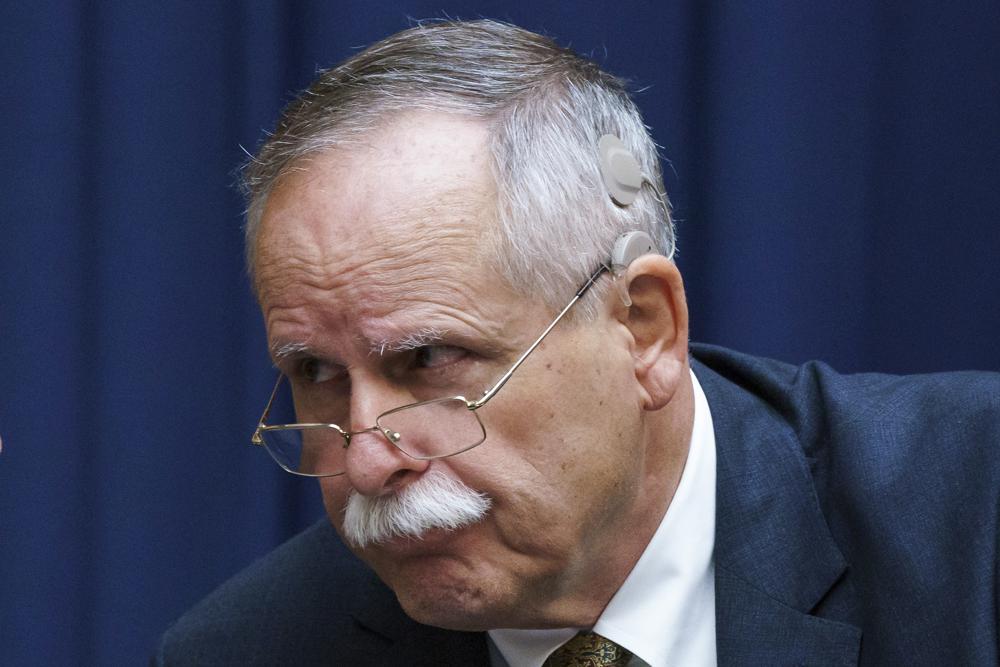
Roads, bridges, and former President Donald Trump are on West Virginia and Nebraska voters’ minds as they choose congressional candidates in Tuesday’s Republican primary elections. Two incumbent GOP congressmen who have taken dramatically different approaches to their time in office are facing off in West Virginia’s 2nd Congressional District, one of the most-watched U.S. House primaries on the day’s ballot. Reps. David McKinley and Trump-backed Alex Mooney were pitted against each other after West Virginia lost a congressional seat based on the results of the 2020 U.S. census. Throughout West Virginia on Tuesday, voters were heading to polling places at schools, churches, and public libraries. Susan Smith, a small business owner in Valley Grove, West Virginia, voted for Mooney at a local elementary school Tuesday morning. She lives in McKinley’s former district and said she always voted for him in the past. But not in this election. “When Mr. McKinley started voting with the Democrats and the current administration, that’s when things changed,” said Smith, who cited McKinley’s vote for President Joe Biden’s infrastructure bill and the January 6 commission. “I’m sorry to be losing a congressman, but we cannot have a Republican congressman voting with the Democrats. West Virginia did not need the money from this un-infrastructure bill.” Lowell Moore, a retired highways worker and county commissioner in rural Tucker County, said the choice was clear to support McKinley. He said he’s already seeing the benefit of federal infrastructure money in work being done to complete Corridor H, the last remaining section of the Appalachian Development Highway System in West Virginia. Moore said completing Corridor H will cut the response time for emergency services in half in Tucker County, which does not have a hospital and where first responders now have to travel on winding mountain roads. “The people he represents needed this so bad,” Moore said. “I’m a Republican, and I commend him for reaching across the aisle. It shouldn’t be about making the political decision — it should be about making the right decision.” West Virginia’s election is the first of five primaries in which two incumbent U.S. House members will face off. It will be followed by similar contests in Georgia and Michigan and in two Illinois districts. The primary comes on the heels of a victory by Trump-endorsed conservative JD Vance, author of the bestselling memoir “Hillbilly Elegy,” who defeated six other candidates to win the Ohio Republican primary for U.S. Senate last week. The West Virginia contest will once again test the former president’s clout when his own name isn’t on the ballot. Nebraska voters will nominate candidates on Tuesday to fill the seat abandoned by U.S. Rep. Jeff Fortenberry, a Republican who resigned from office and ended his reelection bid after he was convicted of lying to federal authorities about an illegal campaign contribution. Fortenberry’s name will still appear on the ballot for the 1st Congressional District because he withdrew after a deadline to certify the ballot, but Sen. Mike Flood, a former speaker of the Nebraska Legislature, appears to have the advantage over five other Republican candidates. Voters will also pick nominees for Nebraska’s 2nd Congressional District in the Omaha area. Three-term Republican Rep. Don Bacon faces a long-shot challenge from Steve Kuehl, an Omaha consultant who got a shoutout from Trump when the former president visited earlier this month. Trump blasted Bacon as a “bad guy” during a recent rally in the state and had criticized him previously for his support of a federal infrastructure bill that most GOP lawmakers opposed. Bacon also has been mildly critical of Trump in the past, saying the former president bore some responsibility for the January 6 riot at the U.S. Capitol. Trump stopped far short of officially endorsing Kuehl, however, saying: “I think Steve will do well. Good luck, Steve, whoever the hell you are.” Democrats in Nebraska will nominate either state Sen. Tony Vargas of Omaha or Alisha Shelton, an Omaha mental health therapist, to challenge Bacon in the 2nd, the state’s only competitive district. In the rural, geographically vast 3rd Congressional District, Republican U.S. Rep. Adrian Smith faces a challenger but is expected to win his party’s nomination. Two Democrats are vying for their party’s nomination within the district, which is overwhelmingly Republican. In West Virginia, incumbent Rep. Carol Miller is expected to hold her seat in the 1st Congressional District against four Republican challengers. In the state’s 2nd Congressional District, where McKinley and Mooney are battling each other for the GOP nomination, openly gay former Morgantown city councilor Barry Wendell is competing against security operations manager Angela Dwyer in the Democratic primary. Mooney has attacked McKinley for voting with 12 other House Republicans in favor of Biden’s $1.2 trillion infrastructure bill. Trump, who won every single county in West Virginia in two presidential elections and said Republicans who voted for the infrastructure bill should be “ashamed of themselves,” endorsed Mooney on the same day Biden signed the infrastructure law. Rep. David McKinley, a civil engineer by trade, received endorsements and praise from Democratic U.S. Sen. Joe Manchin and GOP Gov. Jim Justice over his infrastructure vote. He said it was time to put party politics aside to meet the needs of his constituents. “This wasn’t for Joe Biden — this was to help West Virginia,” he told The Associated Press. Republished with the permission of The Associated Press.
Volodymyr Zelenskyy’s ‘desperate’ plea to Congress: Send more planes

Fighting for his country’s survival, Ukraine’s leader made a “desperate” plea Saturday to American lawmakers for the United States to help get more warplanes to his military and cut off Russian oil imports as Kyiv tries to stave off the Russian invasion. President Volodymyr Zelenskyy opened the private video call with U.S. lawmakers by telling them this may be the last time they see him alive. He has remained in Kyiv, the capital, which has a vast Russian armored column threatening from the north. Appearing in what is now his trademark army-green shirt in front of a white wall with the Ukrainian flag, he told them Ukraine needs to secure its skies, either through a no-fly zone enforced by NATO or through the provision of more warplanes so Ukraine could better defend itself. Zelenskyy has been pleading for a no-fly zone for days, but NATO has refused, saying it could provoke a widespread war with Russia. The hourlong exchange with some 300 members of Congress and their staffs came as Russian troops continued to shell encircled cities, and the number of Ukrainians who have fled the country grew to 1.4 million. “President Zelenskyy made a desperate plea,” said Senate Majority Leader Chuck Schumer. He said Zelenskyy wants the U.S. to facilitate the transfer of planes from Eastern European allies. “I will do all I can to help the administration to facilitate their transfer,” Schumer said. The U.S. is considering sending American-made F-16s as backfill to former Soviet bloc countries in Eastern Europe that are now members of NATO. They, in turn, would send Ukraine their own Soviet-era MiGs, which Ukrainian pilots are trained to fly. There appears to be a logistical problem, however, in sending the F-16s to Poland or other East European allies because of a production backlog. These countries would essentially have to give their MiGs to the Ukrainians and accept an IOU from the U.S. for the F-16s. The situation is further complicated because the next shipment of F-16s is set for Taiwan, and Congress would be reluctant to delay those deliveries as it eyes China. Secretary of State Antony Blinken indicated the fighter jets are under consideration after meeting with Ukrainian Foreign Minister Dymtro Kuleba at the Poland-Ukraine border outside the town of Korczowa. “We are talking about and working on everything,” Blinken told reporters. Blinken reiterated that the U.S. support for Ukraine “not only has been unprecedented, not only is it going to continue, it’s going to increase.” The U.S. Congress is working on a $10 billion package of military and humanitarian aid to Ukraine. Schumer told Zelenskyy lawmakers hope to send it quickly to Ukraine, according to a person on the call, and granted anonymity to discuss it. When Senate Republican leader Mitch McConnell asked about the types of military support his country needs, Zelenskyy said drones as well as planes would be the most helpful. During the call, Democratic Sen. Joe Manchin of West Virginia asked Zelenskyy about the idea of banning the import of Russian oil to the U.S., according to two other people granted anonymity to discuss the private call. They said Zelenskyy indicated such a ban would be effective in putting pressure on Russia. Republicans and a growing number of Democrats, including Speaker Nancy Pelosi, back the idea of a Russian oil import ban. The Biden administration has so far resisted that step, worried about rising prices at the pump. Zelenskyy urged U.S. lawmakers to sanction Russia’s oil and gas sector, which has so far escaped the mounting sanctions imposed by the Biden administration and other countries. The Ukrainian leader also urged lawmakers to suspend Visa and Mastercard credit card access in Russia — and the two announced later Saturday that they were doing just that. Mastercard said cards issued by Russian banks will no longer be supported by its network, and any card issued outside the country will not work at Russian stores or ATMs. Visa said it’s working with clients and partners in Russia to cease all Visa transactions over the coming days. In a video posted to Twitter after the call, Sen. Lindsey Graham, R-S.C., said: “Anything that could hurt the Russian economy will help the Ukrainian people and may make this war more difficult for Putin.” Zelenskyy’s office said he also suggested the U.S. consider imposing an embargo on all Russian goods and stripping Russia of its most-favored-nation trade status. Lawmakers are concerned that Zelenskyy will be killed in the Russian invasion. They are also worried that a Ukrainian government under assault will be unable to function and to receive aid. When one lawmaker asked diplomatically what would happen if he was killed, Zelenskyy acknowledged the concerns but implored Congress to do whatever it can to help Ukraine fight off Russia’s assault on his country. Sen. Ben Sasse, R-Neb., said in a statement that Zelenskyy’s “message is simple: ‘close the skies or give us planes.’”
Joe Biden banning Russia from U.S. airspace because of Ukraine
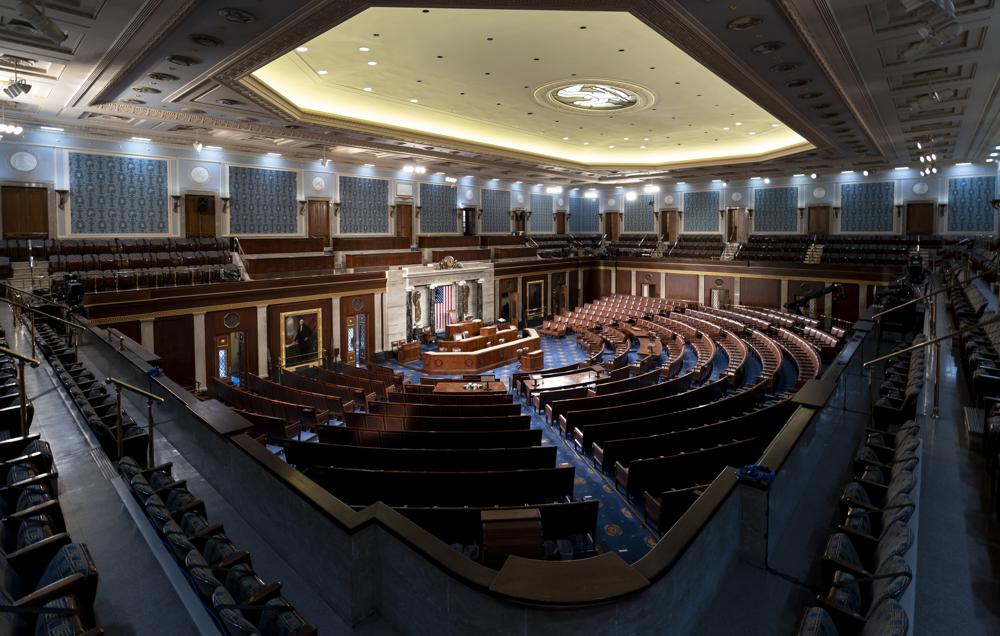
President Joe Biden will vow to make Vladimir Putin “pay a price” for Russia’s invasion of Ukraine in his first State of the Union address, rallying allies abroad while also outlining his plans at home to fight inflation and the fading but still dangerous coronavirus. In addition to recounting U.S. and allied economic sanctions against Russia, Biden planned to announce that the U.S. is following Canada and the European Union in banning Russian planes from its airspace in retaliation for the invasion of Ukraine, according to two people familiar with his remarks’ They spoke only on the condition of anonymity before the speech. Biden planned in his Tuesday night remarks to highlight the bravery of Ukrainian defenders and the resolve of a newly reinvigorated Western alliance that has worked to rearm the Ukrainian military and cripple Russia’s economy through sanctions. He was set to deliver an ominous warning that without consequences, Russian President Putin’s aggression wouldn’t be contained to Ukraine. “Throughout our history, we’ve learned this lesson – when dictators do not pay a price for their aggression, they cause more chaos,” Biden was to say, according to advance excerpts released by the White House. “They keep moving. And, the costs and threats to America and the world keep rising.” Even before the Russian invasion sent energy costs skyrocketing, prices for American families had been rising, and the COVID-19 pandemic continues to hurt families and the country’s economy. Biden planned to outline plans to address inflation by reinvesting in American manufacturing capacity, speeding supply chains, and reducing the burden of childcare and eldercare on workers. “We have a choice,” Biden was to say. “One way to fight inflation is to drive down wages and make Americans poorer. I have a better plan to fight inflation. Lower your costs, not your wages.” Set against disquiet at home and danger abroad, the White House had conceived Tuesday night’s speech as an opportunity to highlight the improving coronavirus outlook, rebrand Biden’s domestic policy priorities, and show a path to lower costs for families grappling with soaring inflation. But it has taken on new significance with last week’s Russian invasion of Ukraine and nuclear saber-rattling by Putin. In an interview with CNN and Reuters, Zelenskyy said he urged Biden to deliver a strong and “useful” message about Russia’s invasion. Ahead of the speech, the White House announced that Ukrainian Ambassador to the U.S. Oksana Markarova would join first lady Jill Biden in the galleries to watch Biden’s address. Biden will address a mask-optional crowd in the House chamber, one sign of the easing coronavirus threat. But he’ll also speak from within a newly fenced Capitol due to renewed security concerns after last year’s insurrection. Rising energy prices as a result of Russia’s war in Ukraine risk exacerbating inflation in the U.S., which is already at the highest level in 40 years, eating into people’s earnings and threatening the economic recovery from the pandemic. And while the geopolitical crisis in Eastern Europe may have helped to cool partisan tensions in Washington, it can’t erase the political and cultural discord that is casting doubt on Biden’s ability to deliver on his pledge to promote national unity. Biden is speaking to an American public that is frustrated with his performance. A February AP-NORC poll found that more people disapproved than approved of how Biden is handling his job, 55% to 44%. That’s down from a 60% favorable rating last July. White House officials acknowledge the mood of the country is “sour,” citing the lingering pandemic and inflation. Biden, in his speech, will highlight progress from a year ago — with the majority of the U.S. population now vaccinated and millions more people at work — but also acknowledge that the job is not yet done, a recognition of American discontent. Biden aides say they believe the national psyche is a “trailing indicator” that will improve with time. But time is running short for the president, who needs to salvage his first-term agenda to revive the political fortunes of his party before November’s midterm elections. House Republicans say the word “crisis” describes the state of the union under Biden and Democrats — from an energy policy that lets Russia sell oil abroad to challenges at home over jobs and immigration. “We’re going to push the president to do the right thing,” said House Majority Leader Kevin McCarthy. At least a half dozen lawmakers, including Reps. Jamie Raskin and Pete Aguilar, both members of the committee investigating last year’s Capitol riot, and Sen. Alex Padilla, D-Calif., had tested positive for COVID-19 and were not expected at the Capitol for the speech. Where his speech to Congress last year saw the rollout of a massive social spending package, Biden plans this year to repackage past proposals in search of achievable measures he hopes can win bipartisan support in a bitterly divided Congress before the elections. The president was to highlight investments in everything from internet broadband access to bridge construction from November’s $1.2 trillion bipartisan infrastructure law as an example of government reaching consensus and delivering change for the nation. He also planned to appeal to lawmakers to compromise on rival competitiveness bills that have passed the House and Senate; both meant to revitalize high-tech American manufacturing and supply chains in the face of growing geopolitical threats from China. The speech comes as progress on many of Biden’s other legislative priorities remains stalled on Capitol Hill after Democratic Sen. Joe Manchin scuttled the sweeping “Build Back Better” spending bill that Biden championed last fall. As part of his pitch to voters, Biden was to resurrect components of the legislation, but with a new emphasis on how proposals like extending the child tax credit and bringing down child care costs could bring relief to families as prices rise. He was also to outline how his climate change proposals would cut costs for lower- and middle-income families and create new jobs. Jen Psaki said Biden “will absolutely use the word inflation” in the speech but emphasized that he was
Analysis: Republicans poised to do well in 2022 midterm elections
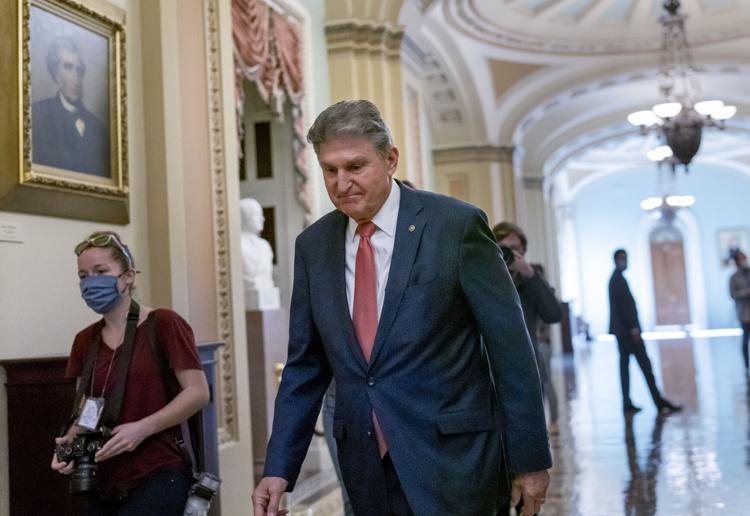
Less than a year out from the November 2022 midterm elections, Republicans are in a position to pick up more seats than previously expected after redistricting was finalized across the states and 44 members of Congress, a majority of them Democrats, are either retiring or aren’t running for reelection. Skyrocketing inflation and energy costs and President Joe Biden’s declining polling numbers could result in Democrats losing dozens of Congressional seats, political analysts indicate. As of this month, six sitting members of the U.S. Senate and 38 in the U.S. House are leaving office, according to calculations by Ballotpedia. Of the 37 leaving the U.S. House, 26 are Democrats and 12 are Republicans. The majority – 28 – are retiring. They include six senators, five of whom are Republicans, and 22 representatives, 17 of whom are Democrats. The remainder, 15, are running for another office. Eight House members are running for a U.S. Senate seat, evenly split among Republicans and Democrats, with four each. They are from Vermont, Pennsylvania, Missouri, Florida, North Carolina, Ohio, and Alabama. Three House members are running for governor – one Democrat and one Republican in New York, and one Democrat in Florida. Others are running for state and local offices in Texas, Maryland, California, and Georgia. They include one Republican running for secretary of state, one Republican and one Democrat running for attorney general, and one Democrat running for mayor. No U.S. Senator is running for another office; all six are retiring. They include Republicans Richard Burr of North Carolina, Pat Toomey of Pennsylvania, Rob Portman of Ohio, Richard Shelby of Alabama, Roy Blunt of Missouri, and Democrat Patrick Leahy of Vermont. A Washington Post/ABC News poll found that Republicans hold a 10-point margin over Democrats in a generic congressional race. Biden’s approval rating on the economy was 39%, and his overall approval rating was 41% at the time. A December Rasmussen Reports survey also found that voters favored Republicans over Democrats by 13 points, 51%-38%, at the time. An even wider margin of 22% was found among voters who identify as Independents, who said they would choose a generic Republican over a generic Democrat by a margin of 48%-26%. Currently, Democrats hold a nine-seat majority in the U.S. House. The U.S. Senate is split, with 50 Republicans, 48 Democrats and 2 Independents, with the Independents caucusing with the Democrats, and the Democratic vice president acting as a tie breaker. This could change with West Virginia Democratic Sen. Joe Manchin considering leaving the Democratic Party. “I would like to hope that there are still Democrats that feel like I do,” Manchin told a local West Virginia radio station, as reported by the Washington Post. “Now, if there’s no Democrats like that, then they’ll have to push me wherever they want me.” Manchin also told reporters last month that he’d consider leaving the Democratic Party if he were to become “an embarrassment to my Democrat colleagues,” as a “moderate centrist Democrat.” He said he’d still caucus with the Democrats, enabling them to keep the majority temporarily. Historically, since the end of World War II, the sitting president’s party has lost seats nearly every midterm election. A total of 469 seats in Congress are up for reelection in 2022, including 34 in the Senate and all 435 in the House. As a result of changing demographics reported by the 2020 Census, six states gained congressional seats, with Texas gaining two. Five states gained one seat: Colorado, Florida, Montana, North Carolina, and Oregon. Seven states lost a seat: California, Illinois, Michigan, New York, Ohio, Pennsylvania, and West Virginia. By Bethany Blankley | The Center Square contributor Republished with the permission of The Center Square.
Chris Talgo: Joy to the world, Build Back Better’s demise has come
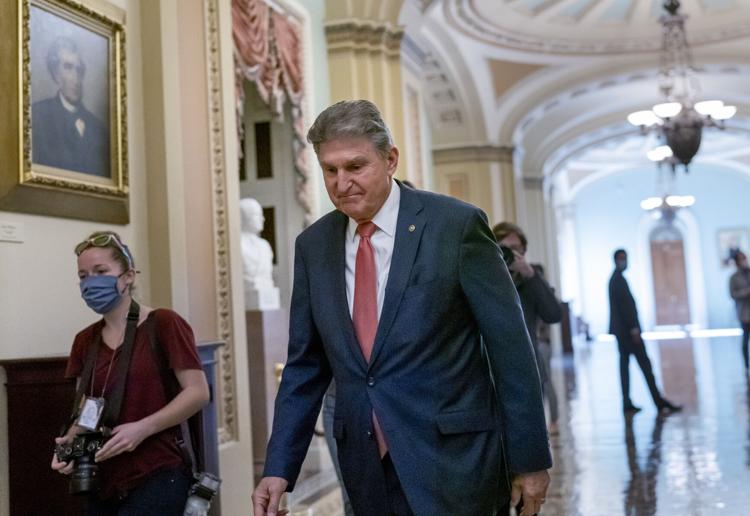
On December 19, just days before millions of Americans gather for Christmas festivities, Sen. Joe Manchin (D-WV) delivered a much-needed early present to the nation when he let it be known that he would not vote in favor of President Joe Biden’s Build Back Better bill. While on “Fox News Sunday,” Manchin succinctly stated, “I cannot vote to continue with this piece of legislation.” When pressed if there is any room for future negotiations, Manchin dug in his heels, saying, “I’ve done everything humanly possible … This is a no. I have tried everything I know to do.” Although the possibility exists that portions of Biden’s Build Back Better (BBB) bill could be resurrected in 2022, based on Manchin’s comments, it seems it is a fait accompli that the current version of BBB is dead and buried, forever. For most Americans, this is welcome news. Several recent polls show BBB is unpopular with the public. For instance, according to a December 9 poll conducted by NPR/Marist, only 41 percent of Americans support BBB. Unsurprisingly, only 42 percent of those polled said BBB “will help people like themselves,” while just 35 percent said BBB “will help lower inflation.” Apparently, and thankfully, the American people have a better understanding of basic economics than most members of the U.S. Congress, particularly those in the Democratic Party. Without a doubt, BBB would have supercharged the rampant inflation that is already wreaking havoc throughout the U.S. economy. As of this writing, the inflation rate, as measured by the consumer price index, has reached a 39-year high of 6.8 percent, with no sign of abating anytime soon. Even worse, the producer price index, which measures final demand for goods and services and functions as a gauge of future inflationary pressure, just hit an all-time high of 9.8 percent. In other words, the rapidly rising rate of inflation is unlikely to trend downward anytime soon. For all Americans, inflation has become a persistent problem. Per a report from the Penn Wharton Budget Model, “inflation in 2021 will require the average U.S. household to spend around $3,500 more in 2021 to achieve the same level of consumption of goods and services as in recent previous years (2019 or 2020). Moreover, we estimate that lower-income households spend more of their budget on goods and services that have been more impacted by inflation. Lower-income households will have to spend about 7 percent more while higher-income households will have to spend about 6 percent more.” However, despite the alarming signs that inflation is picking up steam and causing significant pain and suffering for American families, the Democratic Party could not care less. Immediately after Manchin put a stake through the heart of BBB, prominent Democrats and much of the mainstream media were in a tizzy. Rep. Ilhan Omar (D-MN) went into full-on attack mode, saying, “We all knew that Senator Manchin couldn’t be trusted, the excuses that he just made, I think, are complete bulls***.” Rep. Ayanna Pressley (D-MA) chimed in with this quip, “The Senate must return to session immediately and bring this historic and transformational bill to a vote so Senator Manchin – and every Republican who has opposed it from the very beginning—can demonstrate, on the record, the contempt they have for their constituents and for everyone who calls America home.” What Omar, Pressley, and too many other radical leftists fail to understand is that Manchin is representing his constituents, the people of West Virginia, who overwhelmingly oppose BBB. According to a recent poll, 53 percent of West Virginians strongly oppose BBB, and 59 percent of independent voters in West Virginia strongly oppose BBB. What’s more, 64 of West Virginians strongly agree that BBB will make inflation worse while 66 percent strongly agree that “Congress should slow down and reconsider the Build Back Better Act in light of inflation concerns.” Fortunately, for now, at least, Joe Manchin has dealt a devastating blow to President Biden’s Build Back Better bill. It remains to be seen whether or not Manchin caves and votes for BBB-lite. Yet, regardless of what happens in the future, we should celebrate the early Christmas miracle that is the demise of Build Back Better. Chris Talgo (ctalgo@heartland.org) is senior editor at The Heartland Institute.
$2T bill stalled, Senate Dems seem ready to move on for now
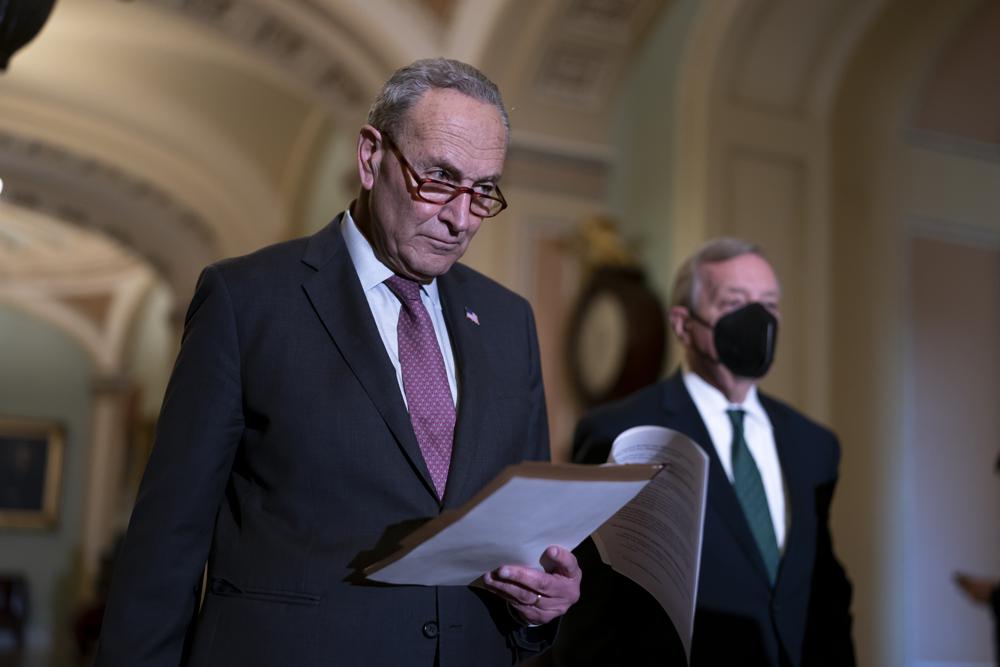
Democrats’ vast social and environment package was stuck in the Senate on Thursday as leaders’ hopes for an accord with holdout Sen. Joe Manchin and approval of their flagship domestic measure in the year’s waning days seemed all but dead. After a closed-door lunch among Senate Democrats, Sen. Ben Cardin, D-Md., told reporters that a statement by President Joe Biden was expected shortly giving an update on “his conversations with Sen. Manchin and others.” Talks on the 10-year, roughly $2 trillion bill between Biden and Manchin, who wants to cut and reshape the measure, are said to have yielded little progress. Majority Leader Chuck Schumer, D-N.Y., had set Senate passage before Christmas as his goal, but disputes with Manchin and other Democrats remain. It has become clear that the party is seeking explicit intervention from Biden in hopes he will cut a deal with Manchin, D-W.Va., or urge lawmakers to delay action until January. Biden “wants to get this done as soon as possible,” White House spokesperson Karine Jean-Pierre told reporters. She added, “But we understand it’s going to take time, and we’re going to continue to do the work.” Schumer barely mentioned the legislation as the day’s business began. Instead, he described Democrats’ efforts to break a logjam on voting rights legislation and a pile of nominations the Senate will consider “as we continue working to bring the Senate to a position where we can move forward” on the social and environment bill. Using his sway in a 50-50 Senate where Democrats need unanimity to prevail, Manchin has continued his drive to force his party to cut the bill’s cost and eliminate programs he opposes. All Republicans oppose the package, arguing the measure carrying many of Biden’s paramount domestic priorities is too expensive and would worsen inflation. “The best Christmas gift Washington could give working families would be putting this bad bill on ice,” said Senate Minority Leader Mitch McConnell, R-Ky. The rocky status of the Biden-Manchin talks was described Wednesday by a person who spoke only on condition of anonymity. The person said Manchin was pushing to eliminate the bill’s renewal of expanded benefits under the child tax credit, a keystone of Democratic efforts to reduce child poverty. Manchin told reporters Wednesday that assertions he wants to strip the child tax credit improvements were “a lot of bad rumors.” Asked if he backed eliminating one of the bill’s child tax credit improvements — monthly checks sent to millions of families — he said, “I’m not negotiating with any of you.” Adding further doubt about quick Senate action this year, Biden suggested that Democrats should instead prioritize voting rights legislation, a primary party goal that Republicans have long stymied. Democrats face an uphill fight on the voting measure, but focusing on it would let them wage a battle that energizes the party’s voters while lawmakers work behind the scenes on the social and environment bill. Asked whether Congress should quickly consider the voting legislation and delay the $2 trillion bill to next year, Biden told reporters, “If we can get the congressional voting rights done, we should do it.” He added, “There’s nothing domestically more important than voting rights.” Biden spoke Wednesday as he toured tornado damage in Dawson Springs, Kentucky. Letting the social and environment legislation slip into next year, when congressional elections will be held, would be ominous for the bill’s ultimate prospects. With Democrats having blown past previous self-imposed deadlines on the push, another delay would fuel Republican accusations that they are incompetently running a government they control. Democrats are bracing for November elections when the GOP has a real chance of winning control of the House and Senate. Word of Manchin’s stance prompted a backlash from colleagues, whom he’s frustrated for months with constant demands to cut the bill’s size and scope. The measure also has money for health care, universal prekindergarten, and climate change programs largely paid for with tax boosts on big corporations and the rich. The second-ranking Democrat, Sen. Richard Durbin of Illinois, said “the level of emotion” among Democrats over the child tax credit “is very high,” and said he was “stunned” when he heard about Manchin’s demands. Manchin has wanted the overall bill’s 10-year price tag to fall below $2 trillion. He also wants all its programs to last the full decade. The current bill would extend the enhanced child tax credit for just one year, a device to contain the bill’s cost. Renewing the improved benefits for ten years would increase its current one-year cost of around $100 billion to over $1 trillion, and doing that while cutting the overall bill’s size would wreak havoc on Democrats’ other priorities in the bill. The Treasury Department says the expanded tax credit has helped the families of 61 million children. Another impediment to Democrats is a time-consuming review by the Senate parliamentarian, Elizabeth MacDonough, about whether many of the bill’s provisions violate the chamber’s rules and should be dropped. Her written opinions on that, including on provisions letting many migrants remain temporarily in the U.S., may not be ready until the weekend or later. Manchin’s other demands have included removing a new requirement for paid family leave. Disputes among other lawmakers include how to increase federal tax deductions for state and local taxes. The House approved its version of the legislation in November. Republished with the permission of the Associated Press.
Senate rejects Joe Biden’s vaccine mandate for businesses
The Senate narrowly approved a resolution Wednesday to nullify the Biden administration’s requirement that businesses with 100 or more workers have their employees be vaccinated against the coronavirus or submit to weekly testing. The vote was 52-48. The Democratic-led House is unlikely to take the measure up, which means the mandate would stand, though courts have put it on hold for now. Still, the vote gave senators a chance to voice opposition to a policy that they say has sparked fears back home from businesses and from unvaccinated constituents who worry about losing their jobs should the rule go into effect. “Every so often Washington D.C. does something that lights up the phone lines. This is one of these moments,” said Sen. Steve Daines, R-Mont. At home, he said, “this issue is what I hear about. This issue is a top-of-mind issue.” Lawmakers can invalidate certain federal agency regulations if a joint resolution is approved by both houses of Congress and signed by the president, or if Congress overrides a presidential veto. That’s unlikely to happen in this case. Under the rule, private-sector companies with 100 or more workers must require their employees to be fully vaccinated against COVID-19 or be tested for the virus weekly and wear masks on the job. The Occupational Safety and Health Administration said it would work with companies on compliance but would fine them up to more than $13,000 for each violation, though implementation and enforcement is suspended as the litigation unfolds. Senate Majority Leader Chuck Schumer, D-N.Y., said Americans who have refused to get vaccinated are the biggest impediment to ending the pandemic. He implied that some of the resistance to mandated vaccines is based on politics. “Some of the anti-vaxxers here in this chamber remind me of what happened 400 years ago when people were clinging to the fact that the sun revolved around the Earth. They just didn’t believe science. Or 500 years ago when they were sure the Earth was flat,” Schumer said. Schumer said social media has played a role in spreading falsehoods about the vaccine, and “so has the far right.” He urged senators to vote against the resolution, sponsored by Sen. Mike Braun, R-Ind. Republicans said they are supportive of the vaccine, but that the mandate amounts to government overreach. “His mandates are under fire in the courts. Main Street job creators are complaining against it, and tonight, the U.S. Senate must send a clear message: back off this bad idea,” Braun said. Some argued that the mandate may even contribute to people not getting vaccinated. “I think, actually, the mandate has made it worse in terms of hardening people who don’t want to be told what to do by the government,” said Sen. John Barrasso, R-Wyo. Sen. Shelley Moore Capito, R-W.Va., said a telephone town hall she recently held with constituents made clear they are concerned about keeping their a job if the mandate goes into effect. “If you look at my state, 40% of my state’s workforce stands to lose their job under this mandate,” Capito said. “It will be a killer to our economy.” In the end, two Democratic lawmakers voted with 50 Republicans to void the mandate, Sens. Joe Manchin of West Virginia and Jon Tester of Montana. Manchin had said in a tweet that he does not support any federal vaccine mandate for private businesses. Tester’s office said his opposition is based on conversations with Montana businesses who “expressed deep concerns about the negative effect on their bottom lines and our state’s economy during this fragile recovery period.” Sen. Patty Murray, D-Wash., sided with the Biden administration, noting that the pandemic is still raging and that deaths are overwhelmingly among the unvaccinated. “How on earth does it make sense right now to undercut one of the strongest tools that we have to get people vaccinated and stop this virus?” Murray said. “In what world is that a good idea?” The White House released a statement earlier this week stating that Biden’s advisers would recommend he veto the resolution in the unlikely event it makes it to his desk. “The president wants to see Americans back on the job, and Americans back at work should not face risk from those who are not vaccinated and who refuse to be tested,” the White House said. Deaths in the United States stemming from COVID-19 are running close to 1,600 a day on average. The overall U.S. death toll less than two years into the pandemic could soon reach 800,000. Republished with the permission of the Associated Press.
Poll: Americans more concerned about economy, government than COVID
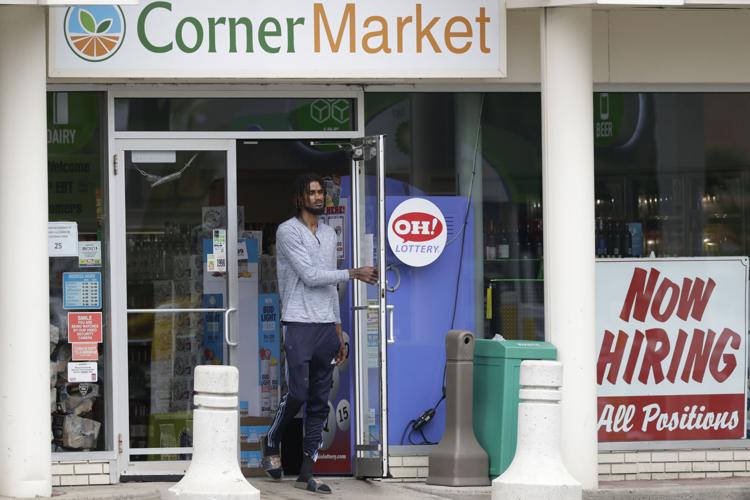
Americans are more concerned about government than they are about COVID-19, a new poll indicates. The Gallup poll released Monday found that 26% of Americans cite an economic issue as the country’s most important problem. The poll reports that 21% of Americans name “the government/poor leadership” as the nation’s top problem, while 13% say it is COVID-19. Meanwhile, concern about the economy is at the highest level since the pandemic began. Inflation and unemployment are leading causes for concern among Americans, the poll found. Inflation is at the top of 7% of Americans’ list, while 5% of Americans feel the same about unemployment. “It has been more than 20 years (April 2001) since inflation was named as the most important problem by at least 7% of Americans,” Gallup said. “The last time mentions of inflation were significantly higher than now was in May 1985 when it registered 11%.” Gallup found that 70% of Americans believe the economy is getting worse, not better. “Gallup’s Economic Confidence Index, which measures Americans’ assessments of current U.S. economic conditions and whether the economy is getting better or worse, is -29 in November,” the group said. “The current reading is similar to October’s -25 score, as well as the -33 registered in April 2020, the worst so far during the pandemic. Economic confidence has improved at various points in the pandemic but has not been able to sustain the improvement for long.” Those economic fears play into the larger political divide as Congress considers nearly $2 trillion in additional social spending. The plan passed the U.S. House along party lines last week and is now before the Senate, where Democrats cannot afford to lose a vote. One major hindrance to the Democratic plan has been inflation, cited by swing voter U.S. Sen. Joe Manchin, D-W.V., as a key reason for his hesitancy to support the plan. It seems many Americans share that concern. A recently released Politico/Morning Consult poll found that 43% of Americans believe Joe Biden’s bill will make inflation worse, despite the administration’s claims that it will actually improve inflation. Federal debt spending increases inflation because more money is printed to help offset the cost and pay debt obligations. Republicans have also pointed to inflation in their opposition to the Democrats’ plan. “Only Democrats would cheer the passage of a bill that saddles Americans with more debt, taxes, and inflation,” said U.S. Rep. Andy Biggs, R-Ariz. “They’re in for a rude awakening come 2022.” By Casey Harper | The Center Square Republished with the permission of The Center Square.
Joe Biden signs $1T infrastructure deal with bipartisan crowd
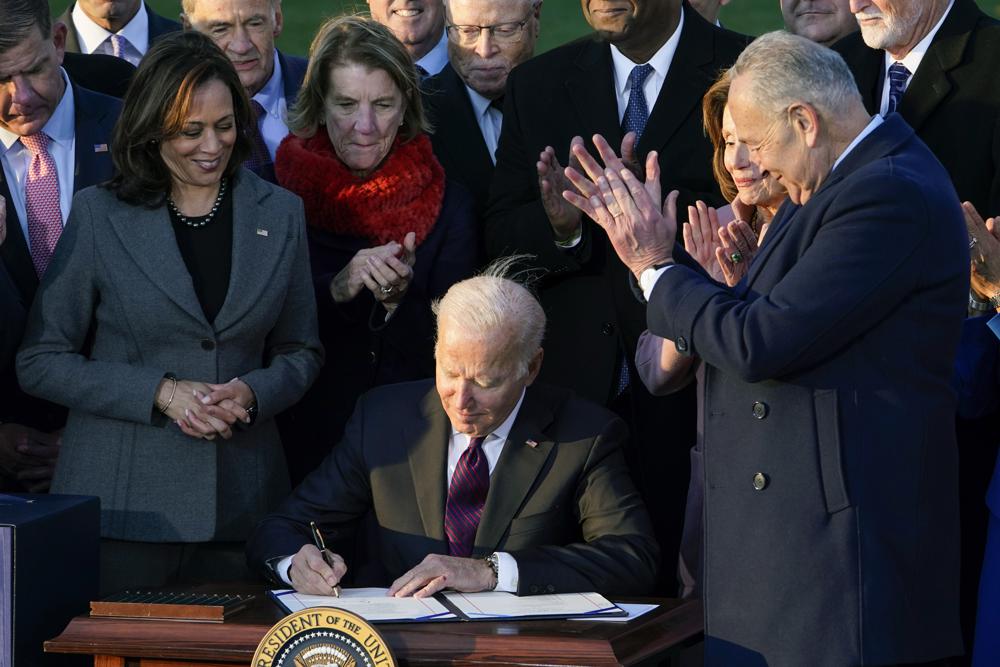
President Joe Biden signed his hard-fought $1 trillion infrastructure deal into law Monday before a bipartisan, celebratory crowd on the White House lawn, declaring that the new infusion of cash for roads, bridges, ports, and more is going to make life “change for the better” for the American people. But prospects are tougher for further bipartisanship ahead of the 2022 midterm elections as Biden pivots back to more difficult negotiations over his broader $1.85 trillion social spending package. The president hopes to use the infrastructure law to build back his popularity, which has taken a hit amid rising inflation and the inability to fully shake the public health and economic risks from COVID-19. “My message to the American people is this: America is moving again and your life is going to change for the better,” he said. With the bipartisan deal, the president had to choose between his promise of fostering national unity and a commitment to transformative change. The final measure whittled down much of his initial vision for infrastructure. Yet the administration hopes to sell the new law as a success that bridged partisan divides and will elevate the country with clean drinking water, high-speed internet, and a shift away from fossil fuels. “Folks, too often in Washington, the reason we didn’t get things done is because we insisted on getting everything we want. Everything,” Biden said. “With this law, we focused on getting things done. I ran for president because the only way to move our country forward in my view was through compromise and consensus.” Biden will get outside Washington to sell the plan more broadly in the coming days. He intends to go to New Hampshire on Tuesday to visit a bridge on the state’s “red list” for repair, and he will go to Detroit on Wednesday for a stop at General Motors’ electric vehicle assembly plant, while other officials also fan out across the country. The president went to the Port of Baltimore last week to highlight how the supply chain investments from the law could limit inflation and strengthen supply chains, a key concern of voters who are dealing with higher prices. “We see this as is an opportunity because we know that the president’s agenda is quite popular,” White House press secretary Jen Psaki said Monday before the signing. The outreach to voters can move “beyond the legislative process to talk about how this is going to help them. And we’re hoping that’s going to have an impact.” Biden held off on signing the hard-fought infrastructure deal after it passed on Nov. 5 until legislators would be back from a congressional recess and could join in a splashy bipartisan event. On Sunday night before the signing, the White House announced Mitch Landrieu, the former New Orleans mayor, would help manage and coordinate the implementation of the infrastructure spending. The gathering Monday on the White House lawn was uniquely upbeat with a brass band and peppy speeches, a contrast to the drama and tensions when the fate of the package was in doubt for several months. The speakers lauded the measure for creating jobs, combating inflation, and responding to the needs of voters. Ohio Sen. Rob Portman, a Republican who helped negotiate the package, celebrated Biden’s willingness to jettison much of his initial proposal to help bring GOP lawmakers on board. Portman even credited former President Donald Trump for raising awareness about infrastructure, even though the loser of the 2020 election voiced intense opposition to the ultimate agreement. “This bipartisan support for this bill comes because it makes sense for our constituents, but the approach from the center out should be the norm, not the exception,” Portman said. The signing included governors and mayors of both parties and labor and business leaders. In addition to House Speaker Nancy Pelosi and Senate Majority Leader Chuck Schumer, the guest list included Republicans such as Louisiana Sen. Bill Cassidy, Maine Sen. Susan Collins, New York Rep. Tom Reed, Alaska Rep. Don Young, and Maryland Gov. Larry Hogan. In order to achieve a bipartisan deal, the president had to cut back his initial ambition to spend $2.3 trillion on infrastructure by more than half. The bill that becomes law on Monday in reality includes about $550 billion in new spending over 10 years, since some of the expenditures in the package were already planned. The agreement ultimately got support from 19 Senate Republicans, including Senate GOP leader Mitch McConnell. Thirteen House Republicans also voted for the infrastructure bill. An angry Trump issued a statement attacking “Old Crow” McConnell and other Republicans for cooperating on “a terrible Democrat Socialist Infrastructure Plan.” McConnell said the country “desperately needs” the new infrastructure money, but he skipped Monday’s signing ceremony, telling WHAS radio in Louisville, Kentucky, that he had “other things” to do. Historians, economists, and engineers interviewed by The Associated Press welcomed Biden’s efforts. But they stressed that $1 trillion was not nearly enough to overcome the government’s failure for decades to maintain and upgrade the country’s infrastructure. The politics essentially forced a trade-off in terms of potential impact not just on the climate but on the ability to outpace the rest of the world this century and remain the dominant economic power. “We’ve got to be sober here about what our infrastructure gap is in terms of a level of investment and go into this eyes wide open, that this is not going to solve our infrastructure problems across the nation,” said David Van Slyke, dean of the Maxwell School of Citizenship and Public Affairs at Syracuse University. Biden also tried unsuccessfully to tie the infrastructure package to the passage of a broader package of $1.85 trillion in proposed spending on families, health care, and a shift to renewable energy that could help address climate change. That measure has yet to gain sufficient support from the narrow Democratic majorities in the Senate and House. Biden continues to work to appease Democratic skeptics of the broader package such as
Joe Biden hails infrastructure win as ‘monumental step forward’
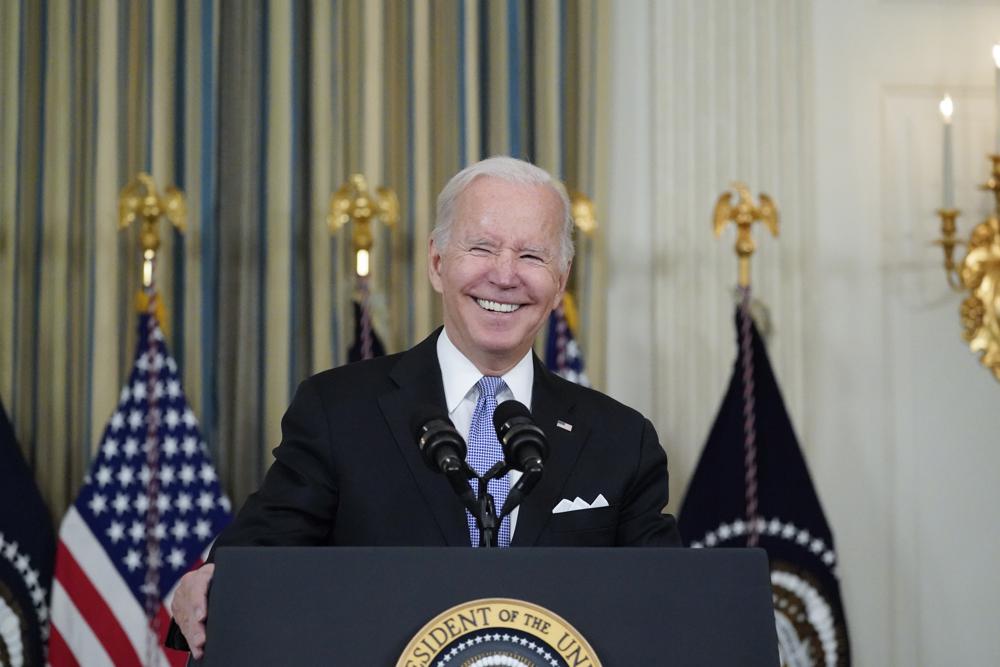
President Joe Biden on Saturday hailed Congress’ passage of his $1 trillion infrastructure package as a “monumental step forward for the nation” after fractious fellow Democrats resolved a months-long standoff in their ranks to seal the deal. “Finally, infrastructure week,” a beaming Biden told reporters. “I’m so happy to say that: infrastructure week.” The House passed the measure 228-206 late Friday, prompting prolonged cheers from the relieved Democratic side of the chamber. Thirteen Republicans, mostly moderates, supported the legislation, while six of Democrats’ farthest left members opposed it. Approval of the bill, which promises to create legions of jobs and improve broadband, water supplies, and other public works, sends it to the desk of a president whose approval ratings have dropped and whose nervous party got a cold shoulder from voters in this past week’s off-year elections. Democratic candidates for governor were defeated in Virginia and squeaked through in New Jersey, two blue-leaning states. Those setbacks made party leaders — and moderates and liberals alike — impatient to produce impactful legislation and demonstrate they know how to govern. Democrats can ill afford to seem in disarray a year before midterm elections that could give Republicans congressional control. Voters “want us to deliver,” Biden said, and Friday’s vote “proved we can.” “On one big item, we delivered,” he added. The infrastructure package is a historic investment by any measure, one that Biden compares in its breadth to the building of the interstate highway system in the last century or the transcontinental railroad the century before. He called it a “blue-collar blueprint to rebuilding America.” His reference to infrastructure week was a jab at his predecessor, Donald Trump, whose White House declared several times that “infrastructure week” had arrived, only for nothing to happen. Simply freeing up the infrastructure measure for final congressional approval was like a burst of adrenaline for Democrats. Yet despite the win, Democrats endured a setback when they postponed a vote on a second, even larger bill until later this month. That 10-year, $1.85 trillion measure bolstering health, family, and climate change programs was sidetracked after moderates demanded a cost estimate on the measure from the nonpartisan Congressional Budget Office. The postponement dashed hopes that the day would produce a double-barreled win for Biden with passage of both bills. But in an evening breakthrough brokered by Biden and House leaders, five moderates agreed to back that bill if the budget office’s estimates are consistent with preliminary numbers that White House and congressional tax analysts have provided. The agreement, in which lawmakers promised to vote on the social and environment bill by the week of Nov. 15, was a significant step toward a House vote that could ultimately ship it to the Senate. Elated by the bill’s passage, Biden held forth with reporters for over a half-hour Saturday morning, joking that his chances of getting the bill done had been written off multiple times, only for him to be able to salvage it. He said he would wait to hold a signing ceremony until lawmakers — Democrats and Republicans who voted for it — return to Washington after a week’s recess. The president acknowledged uncertainty surrounding his larger social and environmental spending package, saying “time will tell” whether he can keep popular provisions like universal paid family leave in the final version. He wouldn’t say whether he has private assurances from moderate Democrats in the House and Senate to pass the nearly $2 trillion bill, but said he was “confident” he would get the votes. Biden predicted Americans would begin to feel the impact of the infrastructure bill “probably starting within the next two to three months as we get shovels in the ground.” But the full impact will probably take decades to be fully realized. He added that he would visit some ports that would benefit from the legislation in the next week, as his administration tries frantically to ease supply chain disruptions that are raising prices on consumer goods before the holidays. Transportation Secretary Pete Buttigieg said there’s a pent-up demand to get going on public works. He told CNN he’s already got $10 billion worth of applications for a certain program that’s only got $1 billion in it. “This is not just a short-term stimulus bill.” Biden said the investment would be viewed in 50 years as “When America decided to win the competition of the 21st century” with a rising China. The president and first lady Jill Biden delayed plans to travel Friday evening to their house in Rehoboth Beach, Delaware. Instead, Biden spoke to House leaders, moderates, and progressives. Rep. Pramila Jayapal, D-Wash., leader of the Congressional Progressive Caucus, said Biden even called her mother in India, though it was unclear why. “This was not to bribe me — this is when it was all done,” Jayapal told reporters. The lawmaker said her mother told her she “just kept screaming like a little girl.” In a statement, five moderates said that if the fiscal estimates on the social and environment bill raise problems, “we remain committed to working to resolve any discrepancies” to pass it. In exchange, liberals agreed to back the infrastructure measure, which they’d spent months holding hostage in an effort to press moderates to back the larger bill. The day marked a rare detente between Democrats’ moderate and liberal wings that party leaders hope will continue. The rival factions had spent weeks accusing each other of jeopardizing Biden’s and the party’s success by overplaying their hands. But Friday night, Jayapal suggested they would work together moving forward. Democrats have struggled for months to take advantage of their control of the White House and Congress by advancing their priorities. That’s been hard, in part because of Democrats’ slender majorities and bitter internal divisions. “Welcome to my world,” House Speaker Nancy Pelosi told reporters. “We are not a lockstep party.” Democrats’ day turned tumultuous early after a half-dozen moderates demanded the budget office’s cost estimate of the sprawling package of health, education, family, and climate change
Senate Dems push new voting bill, and again hit GOP wall
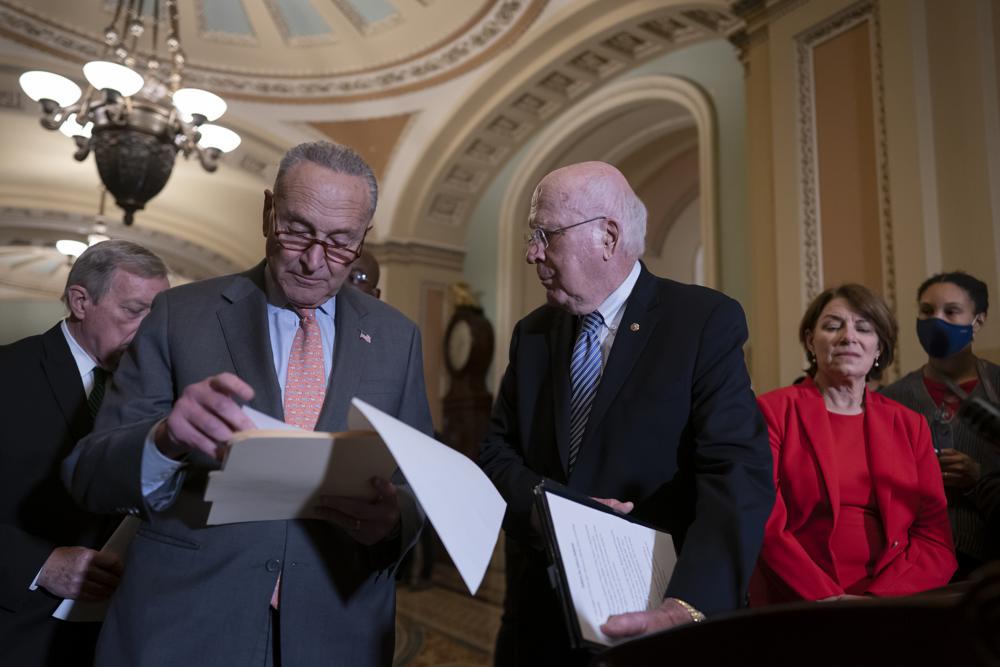
If at first you don’t succeed, make Republicans vote again. That’s the strategy Senate Majority Leader Chuck Schumer appears to be pursuing as the New York Democrat forced another test vote Wednesday on legislation to overhaul the nation’s election laws. For the fourth time since June, Republicans blocked it. Democrats entered the year with unified, albeit narrow, control of Washington, and a desire to counteract a wave of restrictive new voting laws in Republican-led states, many of which were inspired by Donald Trump’s false claims of a stolen 2020 election. But their initial optimism has given way to a grinding series of doomed votes that are meant to highlight Republican opposition but have done little to advance a cause that is a top priority for the party ahead of the 2022 midterm elections. The Senate voted against debating voting legislation Wednesday, with Republicans this time filibustering an update to the landmark Voting Rights Act, a pillar of civil rights legislation from the 1960s. GOP senators oppose the Democratic voting bills as a “power grab.” “This is a low, low point in the history of this body,” Schumer said after the failed vote, later adding, “The Senate is better than this.” The stalemate is forcing a reckoning among Senate Democrats about whether to make changes to the filibuster rule, which requires 60 votes for legislation to advance. That could allow them to muscle legislation through but would almost certainly come back to bite them if and when Republicans take back control of the chamber. Earlier Wednesday, Schumer met with a group of centrist Democrats, including Sens. Jon Tester of Montana, Angus King of Maine, and Tim Kaine of Virginia, for a “family discussion” about steps that could be taken to maneuver around Republicans. That’s according to a senior aide who requested anonymity to discuss private deliberations. But it’s also a move opposed by moderate Sens. Kyrsten Sinema of Arizona and Joe Manchin of West Virginia. Without their support, Democrats won’t have the votes needed to make a change. Time is ticking down. Redistricting of congressional districts (a once-in-a-decade process Democrats want to overhaul to make less partisan) is already underway. And the Senate poised to split town next week for a home-state work period. “Senate Democrats should stay in town and focus on the last act in this battle,” said Fred Wertheimer, who leads the good government group Democracy 21. The latest measure blocked by Republicans Wednesday is different from an earlier voting bill from Democrats that would have touched on every aspect of the electoral process. It has a narrower focus and would restore the Justice Department’s ability to police voting laws in states with a history of discrimination. The measure drew the support of one Republican, Alaska Sen. Lisa Murkowski after Democrats agreed to make changes that she sought. But all other Republicans opposed opening debate on the bill. “Every time that Washington Democrats make a few changes around the margins and come back for more bites at the same apple, we know exactly what they are trying to do,” said Senate Minority Leader Mitch McConnell, who slammed the vote as “political theatre” on a trumped-up a “go-nowhere bill.” Murkowski, too, said she still had underlying issues with the bill as written while criticizing Schumer’s decision to force repeated “show votes.” “Let’s give ourselves the space to work across the aisle,” she said Wednesday. “Our goal should be to avoid a partisan bill, not to take failing votes over and over.” The Democrats’ John Lewis Voting Rights Advancement Act, named for the late Georgia congressman who made the issue a defining one of his career, would restore voting rights protections that have been dismantled by the Supreme Court. Under the proposal, the Justice Department would again police new changes to voting laws in states that have racked up a series of “violations,” drawing them into a mandatory review process known as “preclearance.” The practice was first put in place under the Voting Rights Act of 1965. But it was struck down by a conservative majority on the Supreme Court in 2013, which ruled the formula for determining which states needed their laws reviewed was outdated and unfairly punitive. The court did, however, say that Congress could come up with a new formula. The bill does just that. A second ruling from the high court in July made it more difficult to challenge voting restrictions in court under another section of the law. The law’s “preclearance” provisions had been reauthorized by Congress with overwhelming bipartisan support five times since it was first passed decades ago. But after the Supreme Court’s 2013 ruling, Republican support for the measure cratered. Though the GOP has shown no indication that its opposition will waver, there are signs that some of the voting changes Democrats seek aren’t as electorally advantageous for the party as some hope. Republican Glenn Youngkin’s victory in Virginia’s Tuesday gubernatorial election offers the latest test case. Democrats took control of all parts of Virginia’s government in 2019 and steadily started liberalizing the state’s voting laws. They made mail voting accessible to all and required a 45-day window for early voting, among the longest in the country. This year they passed a voting rights act that made it easier to sue for blocking ballot access. But those changes didn’t hurt Youngkin, who comfortably beat Democrat Terry McAuliffe, a popular former governor seeking a valedictory term. That’s still unlikely to change Republicans’ calculus. “Are we all reading the tea leaves from Virginia? Yes, absolutely,” Murkowski said. “Will it be something colleagues look to? It’s just one example.” Democratic frustration is growing, meanwhile leading to increasingly vocal calls to change the filibuster. “We can’t even debate basic bills,” said Minnesota Sen. Amy Klobuchar, a Democrat. “The next step is to work on ideas to restore the Senate.” Republished with the permission of the Associated Press.
