
Republican 2016 hopefuls get emotional on eve of SC primary

The Republican battle for South Carolina turned deeply personal on the eve of Saturday’s high-stakes presidential primary, as New York businessman Donald Trump eyed a delegate sweep and his Republican rivals fought for a southern surprise. Texas Sen. Ted Cruz, the son of a pastor, evoked “the body of Christ” in his closing message while fending off allegations of campaign misconduct in a state where most Republicans identify as evangelical Christians. At the same time, Trump allies took subtle shots at Pope Francis for questioning the Republican front-runner’s devotion to Christian principles. Ohio Gov. John Kasich opened up about the death of his parents. And Jeb Bush turned to his mother to help revive his underdog campaign. Friday marked an emotionally charged day in the campaign, with 50 delegates up for grabs in Saturday’s primary contest. Candidates were also trying to stoke some badly needed momentum heading into the next phase of the campaign: March 1’s Super Tuesday. Trump appeared to hold a commanding lead less than 24 hours before voting began in South Carolina. With a big win, the billionaire businessman could take home most, if not all, of the state’s 50 delegates. Such a victory would mark a particularly painful blow to Cruz, whose consistent focus on Christian values and southern roots should have given him a distinct advantage here. As the undisputed Republican front-runner, Trump was a popular target in the final-hours’ scramble for votes. “Trump values are not South Carolina values,” the state’s senior senator, Lindsey Graham, charged during a Charleston rally for Bush. Former first lady Barbara Bush offered a positive contrast with her son’s values: “He’s steady. He’s honest. He is modest. He is kind, and he is good.” Trump’s campaign continued trying to brush off an extraordinary criticism from Pope Francis the day before. When asked about Trump’s call to build a massive wall on the U.S.-Mexican border, the leader of the Roman Catholic Church said those who seek to build walls instead of bridges are not Christian. “I say only that this man is not Christian if he has said things like that,” Francis said aboard the Papal plane. Trump called the Pope’s words “disgraceful” on Thursday, but offered a distinctly softer jab as he courted South Carolina voters on Friday. “Yesterday, the Pope was great,” Trump told an audience in Myrtle Beach. “They had him convinced that illegal immigration was like a wonderful thing. Not wonderful for us. It’s wonderful for Mexico.” Added Trump supporter, pastor Mark Burns: “We respect and honor the Pope. But I don’t know … The walls that are around the Vatican are pretty big walls.” Campaigning in the same city, Cruz tried to take advantage of the spiritual spat by highlighting his own religious devotion. “Every minute that you’re not on the phone calling friends and loved ones, spend beseeching God, praying for this country, that this spirit of revival that is sweeping this country continue and grow, and that we awaken the body of Christ,” the Texas senator said. Cruz also took a veiled shot at Trump’s campaign motto, featured on hats, T-shirts and bumper stickers. “It’s easy to say, ‘Let’s Make America Great Again,’” he said. But, he asked, “Do you understand what made America great in the first place?” While Cruz wanted to be on offense, his campaign faced new questions about a website it created this week attacking Rubio’s record. The site features a photo of Rubio shaking hands with President Barack Obama. After Rubio’s team complained, Cruz’s campaign acknowledged that the photo was manufactured using a computer program. “Every picture in a political campaign is photoshopped,” Cruz spokesman Rick Tyler told FOX News when pressed to explain the tactic. Meanwhile, the lesser-known Kasich continued to highlight his compassionate side. In a television ad broadcast across the state, he spoke of his parents’ deaths at the hands of a drunk driver. “I was transformed. I discovered my purpose by discovering the Lord,” Kasich says in the ad. The day before, the Ohio governor hugged for several moments a teary supporter who opened up about his own personal struggles. Speaking to reporters Friday, Kasich recalled a New Hampshire woman who told him about her child’s fight for sobriety and another in South Carolina who talked about her medical problems. “For some reason people feel safe in telling me stuff,” Kasich said. “There’s a bigger message than about me. Forget me, it’s about all of us having to pay more attention to some other people.” The personal and religious appeals come in a state where religious conservatives typically play an outsized role. In South Carolina’s 2012 Republican primary election, two-thirds of the voters identified themselves as born-again or evangelical Christian. Republished with permission of the Associated Press.
Allies of Jeb Bush, John Kasich spar over military spending
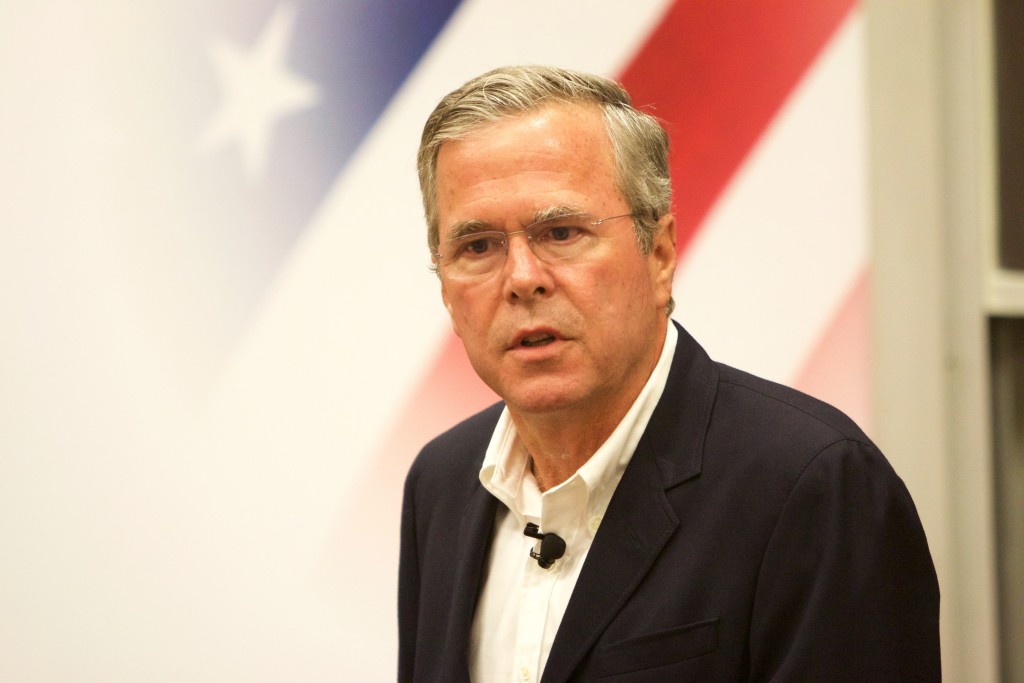
John Kasich proudly cites his efforts while in Congress to cut what he believed was wasteful defense spending. But allies for Jeb Bush, a Republican presidential rival, see a potential vulnerability for Kasich in military-minded South Carolina and are trying to slow the Ohio governor’s momentum after a strong showing in New Hampshire. An outside group backing Bush has begun airing a television ad ahead of the Feb. 20 primary, using Kasich’s own words. It’s an effort to undermine Kasich in a state that’s home to Fort Jackson and Parris Island, massive training installations for the Army and Marine Corps, as well as a number of air bases and a naval training school for nuclear submarine officers. Kasich and former House Speaker Newt Gingrich, winner of the state’s primary in 2012, are denouncing the broadside, but it’s clear that the rivalry between Kasich, the Ohio governor, and Bush, a former Florida governor, is intensifying. Bush’s team sees defense spending as a key area to draw distinctions. Right to Rise, the outside group backing Bush, launched the ad on Friday. It begins with a narrator saying “threats to America are growing,” over photographs of foreign leaders and the Islamic State group. It plays a clip of Kasich from his time in Congress saying he wants to turn the Pentagon into a “triangle,” adding “I spent a whole career trying to rein in defense spending.” Right to Rise also aired ads in New Hampshire hitting Kasich for backing a budget that led to the closure of an Air Force base in the state. Kasich finished second in the New Hampshire primary; Bush finished fourth. Kasich doesn’t shy away from his record, often bragging during campaign stops about his work to cut wasteful military spending during his 18 years on the House Armed Services and Budget Committees. “I was what they call a member of the ‘cheap hawk caucus,’” he said Thursday at a Pancake House in Pawleys Island. “In other words, we’re going to be as strong as we need to be, but we’re not going to waste money.” Kasich says his budget plan would increase military spending by $100 billion, focusing the money on the front lines while cutting bureaucratic jobs at the Pentagon. Gingrich, who served with Kasich in Congress but is not making an endorsement in the GOP primary, told The Associated Press that he was speaking out because he feels he has an “obligation to bear witness to the facts” and believes the ad distorts Kasich’s record. Bush hasn’t attacked Kasich directly on military spending while campaigning in South Carolina. At a stop in Fountain Inn on Saturday morning, Bush only mentioned Kasich to criticize Medicaid expansion in Ohio. Right to Rise, meanwhile, is standing by the ad. “John Kasich’s long history of cutting critical national defense projects is well-documented, from both his record and his own mouth,” spokesman Paul Lindsay said. Republished with permission of the Associated Press.
George W. Bush: From South Carolina cameo to starring role

George W. Bush won a bruising South Carolina presidential primary on his way to the Oval Office, as his father did before him. Now it’s his brother’s turn, and for Jeb Bush, the most consequential foreign policy decisions of his brother’s time in office are suddenly front-and-center of his bid to keep alive his campaign for the Republican presidential nomination — thanks to Donald Trump. The former president had already announced plans to campaign for his younger brother on Monday in South Carolina, marking his most direct entry into the 2016 race to date, when the GOP front-runner used the final debate before the state’s Feb. 20 primary as an opportunity to excoriate George W. Bush’s performance as commander-in-chief. The former president, Trump said, ignored “the advice of his CIA” and “destabilized the Middle East” by invading Iraq on dubious claims that Saddam Hussein had weapons of mass destruction. “I want to tell you: they lied,” Trump said. “They said there were weapons of mass destruction, there were none. And they knew there were none.” Trump didn’t let up as Bush tried to defend his brother, dismissing his suggestion that George W. Bush built a “security apparatus to keep us safe” after the 9/11 attacks. “The World Trade Center came down during your brother’s reign, remember that,” Trump said, adding: “That’s not keeping us safe.” The onslaught — which Jeb Bush called Trump enjoying “blood sport” — was the latest example of the billionaire businessman’s penchant for mocking his rival as a weak, privileged tool of the Republican Party establishment, special interests and well-heeled donors. But the exchange also highlighted the former Florida governor’s embrace of his family name and history as he jockeys with Florida Sen. Marco Rubio and Ohio Gov. John Kasich to emerge from South Carolina as the clear challenger to Trump, who won the New Hampshire primary, and Texas Sen. Ted Cruz, the victor in Iowa’s caucuses. The approach tacks away from Bush’s months-long insistence that he’s running as “my own man,” but could be a perfect fit for South Carolina. Noted South Carolina Sen. Lindsey Graham, who ended his GOP presidential campaign in December and endorsed Jeb Bush in January, said: “The Bush name is golden in my state.” George W. Bush retains wide appeal among Republicans, from evangelicals to chamber of commerce business leaders and retired members of the military. All are prominent in South Carolina, with Bush campaign aide Brett Foster going so far as to say that George W. Bush is “the most popular Republican alive.” After the debate, some Republicans again suggested Trump had gone too far. Bush wasn’t alone on stage leaping to his brother’s defense, with Rubio coming back to the moment to say, “I thank God all the time it was George W. Bush in the White House on 9/11 and not Al Gore.” The attack on George W. Bush carries risk for Trump, given the Bush family’s long social and political ties in South Carolina and the state’s hawkish national security bent, bolstered by more than a half-dozen military installations and a sizable population of veterans who choose to retire in the state. Trump has repeatedly defied predictions that his comments might threaten his perch atop the field. And as he jousted Saturday with Trump, Jeb Bush said, “this is not about my family or his family.” But the Bush family does have a history in the state that’s hard to overlook. In 2000, George W. Bush beat John McCain in a nasty contest, marred by rumors that McCain had an illegitimate black child. McCain adopted a child from Bangladesh. Exit polls showed George W. Bush won nearly every demographic group. George H.W. Bush, the 41st president, won twice here, beating Bob Dole in 1988 and demolishing Pat Buchanan in 1992. One of the elder Bush’s top strategists, Lee Atwater, hailed from South Carolina and remains a legend in GOP campaign annals. Last week, Jeb Bush touted the endorsement of Iris Campbell, the widow of former South Carolina Gov. Carroll Campbell, a national co-chairman of previous Bush presidential campaigns. Yet even as he defended his brother’s presidency at Saturday’s debate, Jeb Bush found a way to distance himself from George W. Bush’s business affairs and to criticize Trump at the same time. The issue: eminent domain. Before entering politics, George W. Bush was part-owner of the Texas Rangers, and their home city of Arlington, Texas, used eminent domain to take private land and build a stadium for the team. Trump has defended such uses of eminent domain as a way to foster economic development. Retorted Bush, who argued eminent domain should be reserved for public infrastructure projects, “There is all sorts of intrigue about where I disagree with my brother. There would be one right there.” Republished with permission of the Associated Press.
Presidential Primary Brief: 266 days until Election Day
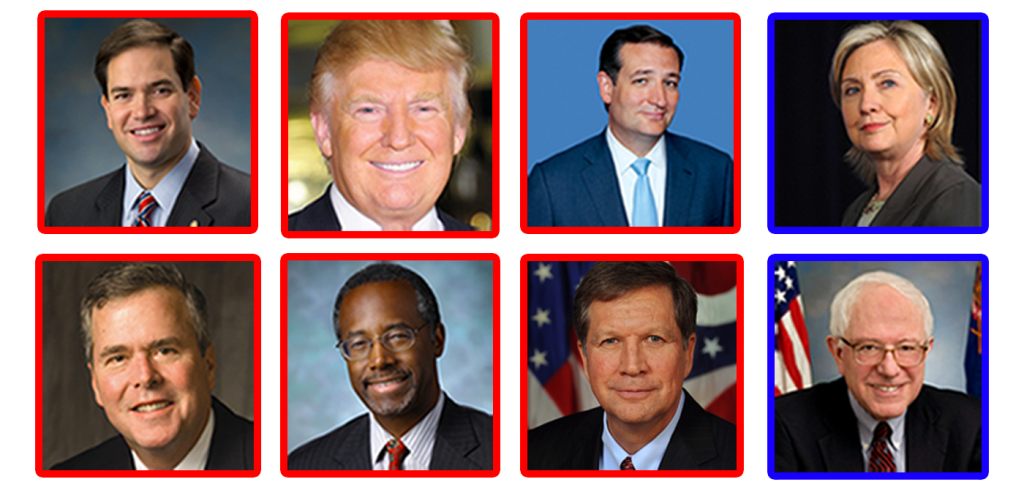
14 days until AL Presidential Primary 266 days until Election Day Convention Dates: Republican July 18-21, 2016, Democratic July 25-28, 2016 Weekly Headlines: Bernie Sanders defeats Hillary Clinton in NH primary Carly Fiorina suspends her presidential bid Chris Christie suspends campaign Press Clips: Michael Bloomberg confirms interest in a 2016 Presidential campaign (US News 2/9/16) As voters head to the polls for the New Hampshire primary today, there’s another twist in the presidential campaign: Former New York Mayor Michael Bloomberg has confirmed for the first time that he is considering a White House run as an independent. “I’m listening to what candidates are saying and what the primary voters appear to be doing,” Bloomberg told the Financial Times. He added: “I find the level of discourse and discussion distressingly banal and an outrage and an insult to the voters.” He said the public deserves “a lot better” and noted that he is “looking at all the options.” Bloomberg, a billionaire who owns a media empire named after him, said he would need to start placing his name on state ballots by early March in order to have a serious chance to win. But victory would be very difficult. Only Gilmore left out of CBS’ Republican debate on Saturday (Politico 2/12/16) Six Republican candidates for president will take the debate stage on Saturday night, leaving only former Gov. Jim Gilmore frozen out of CBS’ prime-time event. Donald Trump, Ted Cruz, Marco Rubio, Jeb Bush, Ben Carson and John Kasich all made the cut, according to CBS’ criteria. It will be one of the smallest showdowns for the Republicans thus far this cycle, which at one point saw 11 people crowded on stage. To qualify for the debate, candidates had to either place in the top five of the New Hampshire primary, place in the top three of the Iowa caucuses, or place among the top five candidates in averages of national and South Carolina polls. New Hampshire runner-up John Kasich is the anti-Donald Trump (US News 2/10/16) Who can stop Trump? As expected, Donald Trump cruised to a crushing victory in New Hampshire on Tuesday night. (Who would have believed last June when Trump entered the race that we’d be yawning at his winning New Hampshire?) Trump blew away his competitors, securing well above 30 percent of the vote – more than double that of the first runner-up. And that’s where the real story of New Hampshire lies: Ohio Gov. John Kasich came from the bottom of the pack to secure a second-place finish. Will he be the savior to deliver us from Trump? Carson: I reassess the future of my campaign every day (Politico 2/12/16) Ben Carson is constantly reassessing his campaign. “I reassess the future of the campaign every day, so of course I will continue to do that,” Carson said on MSNBC’s “Morning Joe” after he was asked what would happen if he didn’t do well in South Carolina. But Carson, who is currently in fifth place in the state, according to the RealClearPolitics polling average, has faith that South Carolina will change his luck. “I think South Carolina is gonna be the turning point,” the retired neurosurgeon said. He added that South Carolina is the type of place he loves to go to. Polls give Donald Trump huge advantage going into South Carolina (AOL News 2/12/16) Coming off of his first political win in New Hampshire, Donald Trump now has his sights set on South Carolina, and a new national poll shows he may be gaining even more momentum across the country. According to a poll from Morning Consult, he has more than double the support of any rival among self-identified Republicans and Republican-leaning independents. Trump holds a commanding 44 percent lead with this key voting bloc. His closest rival, Ted Cruz, only comes in with 17 percent of support. Cruz, Glenn Beck rip Trump on abortion, gay marriage (Politico 2/11/16) Ted Cruz and Glenn Beck unleashed a barrage of criticisms of Donald Trump on religion and social issues here, angling for support from voters in one of the most conservative parts of the state. At the massive Morningstar Fellowship Church, Cruz laced into Trump as weak on abortion, gay marriage and gun rights while Beck suggested Trump has never cracked open a Bible. “Too many people right now are looking at a guy like Donald Trump and believing that that man has ever opened a Bible. That’s the biggest crock of bullcrap I’ve ever heard. We all know it,” Beck said. Millennials paving the way: 2016 Presidential election (Huffington Post 2/12/16) How can it be a surprise that Millennials are excited about Senator Bernie Sanders? The Iowa caucus and New Hampshire primary were clear signs that Millennials could carry the 2016 presidential election. And the proof is in the numbers; over 80 percent of Democratic participants under the age of 30 voted for Senator Sanders according to a recent CNN poll. Obama reportedly received only 57 percent in 2008. So why are so many Millennials “feeling the Bern?” As GOP nomination fight gets more feisty, so does Marco Rubio (ABC News 2/12/16) Following a disappointing fifth place finish in New Hampshire, Marco Rubio is going on the offensive. Hoping for a better performance in Saturday’s South Carolina primary, Rubio has spent the last few days repeatedly blasting Donald Trump, Jeb Bush and Ted Cruz at various campaign stops in the Palmetto State. “Donald Trump has zero foreign policy experience,” Rubio said in Okatie, South Carolina. “Negotiating a hotel deal in another country is not foreign policy experience.” He also slammed Trump for recently using a vulgar word to refer to Cruz. Meet the super-rich driving the 2016 election (USA Today 2/8/16) Nearly half the money pouring into all federal super PACs came from just 107 people or groups that each gave $1 million or more to influence the outcome of this year’s presidential and congressional races, a USA TODAY analysis of new campaign finance reports shows.
Progressive group sends “love” with GOP Valentine’s Day cards

Valentine’s Day is a day of romance, and Americans United for Change is sending a love letter to their friends in the GOP. Tongue-in-cheek that is. In a new email, the progressive advocacy group, fronted by Democratic operative Brad Woodhouse, issued its Republican Party Valentine’s Day cards. “Having trouble expressing yourself to that special someone in your life this Valentine’s season,” the email asks. “Why not let the Republican candidates do it for you with these personalized cards from their favorite Republican Party front-runners?” Of course, each card includes a (not so flattering) quote taken from each of the leading Republican presidential candidates. The first card features a lovely sentiment from presidential front-runner Donald Trump, talking about fellow (now former) candidate Carly Fiorina: “Look at that face. Would anybody vote for that? Can you imagine that the face of our next president?! I mean, she’s a woman, and I’m not s’posedta say bad things, but really, folks, come on? Are we serious?” Next is a charming bon mot coming by way of Number-2-with-a-bullet candidate Ohio Gov. John Kasich, who asked a female audience member at an Iowa town hall, “Have you ever been on a diet?” Another is a golden oldie from former Florida Gov. Jeb Bush, who, during the heat of a 1994 campaign, said that marriage is one of three options for women on welfare: “How you get on welfare is by not having a husband in the house — let’s be honest here. Men are not on welfare, that’s the point.” The final card comes courtesy of Florida Sen. Marco Rubio, with his now-famous oft-repeated debate mantra: “Let’s dispel with this fiction that Barack Obama doesn’t know what he’s doing. He knows exactly what he’s doing.”
Ted Cruz app data collection helps campaign read minds of voters
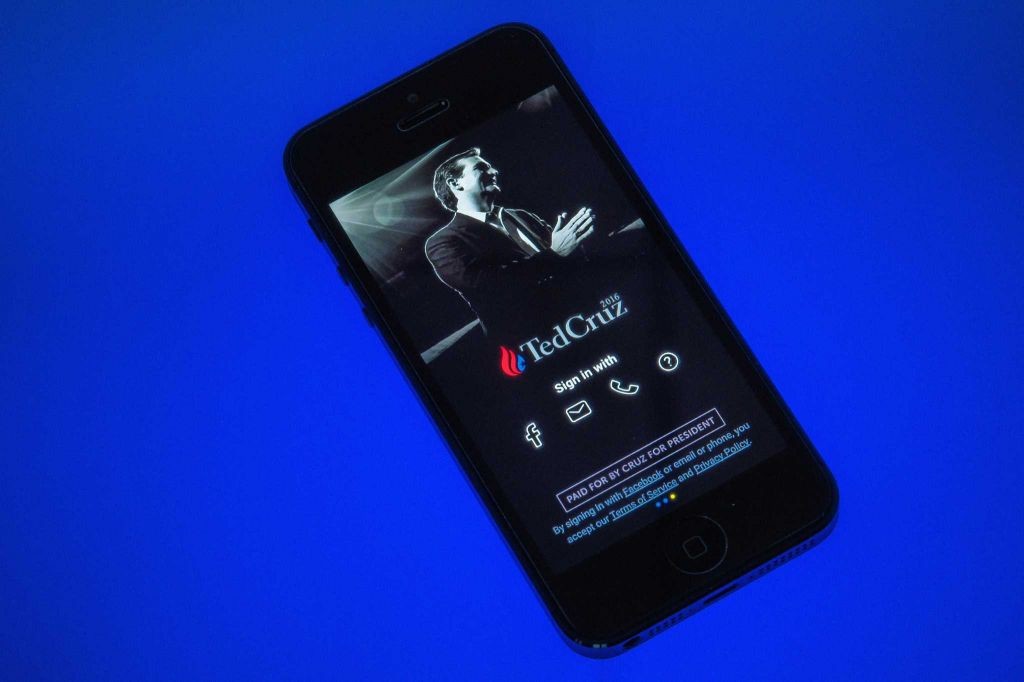
Protecting the privacy of law-abiding citizens from the government is a pillar of Ted Cruz‘s Republican presidential candidacy, but his campaign is testing the limits of siphoning personal data from supporters. That information and more is then fed into a vast database containing details about nearly every adult in the United States to build psychological profiles that target individual voters with uncanny accuracy. Cruz’s sophisticated analytics operation was heralded as key to his victory in Iowa earlier this month — the first proof, his campaign said, that the system has the potential to power him to the nomination. After finishing a distant third in New Hampshire, Cruz is looking to boost the turnout of likely supporters in South Carolina and in Southern states with primaries on March 1, where voters are more evangelical and conservative. The son of mathematicians and data processing programmers, Cruz is keenly and personally interested in the work. “Analytics gives the campaign a roadmap for everything we do,” said Chris Wilson, data and digital director. “He has an acute understanding of our work and continually pushes me on it.” Data-mining to help candidates win elections has been increasing among both Republicans and Democrats. Mobile apps by other presidential campaigns also collect some information about users. But The Associated Press found the Cruz campaign’s app — downloaded to more than 61,000 devices so far — goes furthest to glean personal data. The Cruz app prompts supporters to register using their Facebook logins, giving the campaign access to personal information such as name, age range, gender, location and photograph, plus lists of friends and relatives. Those without a Facebook account must either provide an email address or phone number to use the app. By contrast, the app offered by GOP candidate Ben Carson‘s campaign asks supporters to surrender the same information as Cruz from their Facebook accounts, but also gives an option to use it without providing any personal information. Carson’s app separately asks users to let the campaign track their movements and asks them to voluntarily supply their birthdate and gender — including options for “male,” ”female” and “other.” Ohio Gov. John Kasich‘s campaign app doesn’t request personal information from supporters, but it repeatedly nags users to let the campaign track their movements until they answer yes. Democratic Sen. Bernie Sanders‘ app, “Field the Bern,” requires supporters to sign in using their Facebook account or an email address, and it also repeatedly asks to let the campaign track their movements until they answer yes. The Cruz app separately urges users to let it download their phone contacts, giving the campaign a trove of phone numbers and personal email addresses. The campaign says that by using its app, “You hereby give your express consent to access your contact list,” but Wilson said the campaign will not do this to anyone who declines to allow it when the app requests permission. Cruz’s app also transmits to the campaign each user’s physical location whenever the app is active, unless a user declines to allow it. The campaign said it does this “so that we can connect you to other Cruz Crew users based on your particular geographic location.” The campaign tells users it can share all the personal information it collects with its consultants or other organizations, groups, causes, campaigns or political organizations with similar viewpoints or goals. It also shares the material with analytics companies. Cruz’s campaign combines the information with data from a group called Cambridge Analytica, which has been involved in his efforts since fall 2014. A Cambridge investor, Robert Mercer, has given more money than anyone else to outside groups supporting Cruz. Sanders’ campaign said it shares personal information from supporters with its consultants and vendors but not analytics companies. Cambridge has a massive 10 terabyte database — enough to fill more than 2,100 DVDs — that contains as many as 5,000 biographical details about the 240 million Americans of voting age. Cambridge considers its methodology highly secretive, but it may include such details as household income, employment status, credit history, party affiliation, church membership and spending habits. Cambridge uses powerful computers and proprietary algorithms to predict Americans’ personality traits. The Cruz campaign paid Cambridge $3.8 million in 2015, accounting for more than 8 percent of all its spending. Two outside groups supporting Cruz, including one directly funded by $11 million from Mercer, paid the firm $682,000 since December. Cambridge has five employees at Cruz headquarters in Houston and 70 others split between New York City and the Washington suburbs. The power of Cruz’s data-driven systems was on display in Iowa. The GOP candidates held similar positions on issues such as abortion and gun control. Cambridge helped differentiate Cruz by identifying automated red light cameras as an issue of importance to Iowa residents upset with government intrusion. Potential voters living near the red light cameras were sent direct messages saying Cruz was against their use. “Everything in this campaign is data-driven. I’ve never seen anything like it,” said Jerry Sickles, a paid field representative in Hooksett, New Hampshire, who uses the Cruz Crew app. “We just know exactly who our voters are, and we will make sure they get out to vote.” Cruz, the junior senator from Texas, has been outspoken about protecting Americans’ personal information from the government, including the National Security Agency. “Instead of a government that seizes your emails and your cell phones, imagine a federal government that protected the privacy rights of every American,” he said when announcing his campaign. Cruz campaign officials say it’s different for the government versus a campaign to collect data. Sickle said Cruz is building on the use of big data pioneered by the successful Democratic campaigns of Barack Obama in 2008 and 2012. “It’s not like we’re giving it to the NSA,” Sickle said. A campaign spokeswoman, Alice Stewart, added: “Why wouldn’t we want to use every tool available to us to win?” The scope of Cruz’s system is formidable. Cambridge’s database combines government and
Jumbled GOP field hopes for survival in South Carolina
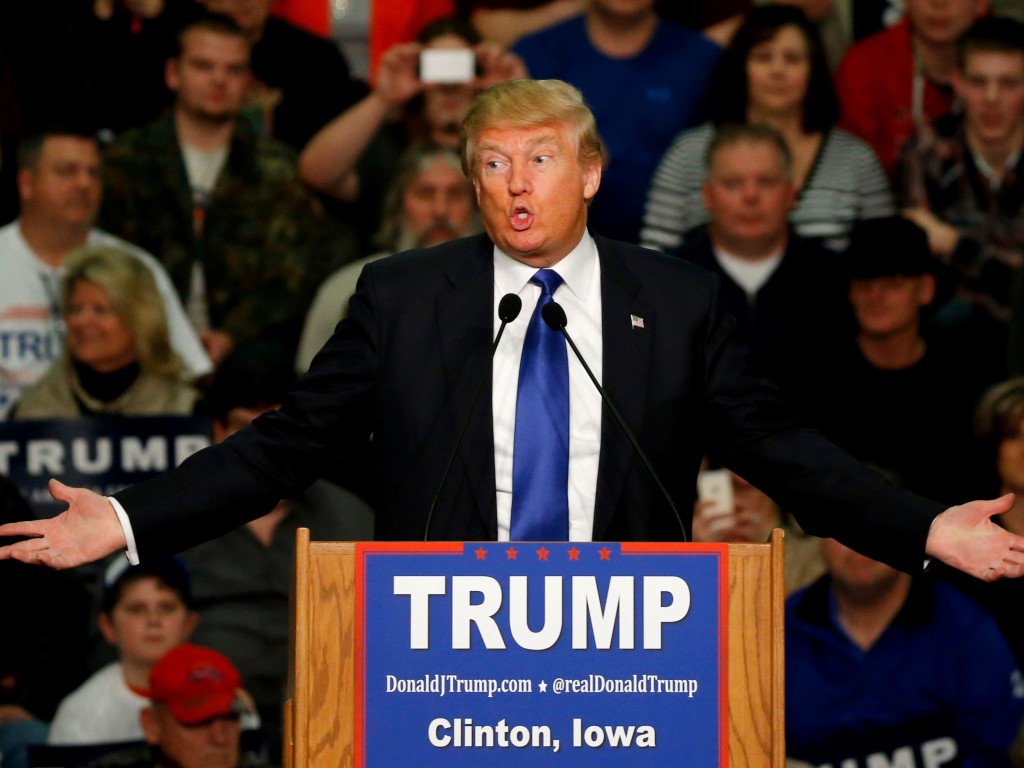
Hoping for survival in the South, a muddled field of Republican presidential contenders descended Wednesday on South Carolina, no closer to clarity about who can stand between Donald Trump and their party’s nomination. Not me, Carly Fiorina announced, dropping out of the campaign. A Chris Christie spokeswoman said his race was over, too. But a sizeable field remained. To the dismay of party leaders, all signs point to a drawn-out battle for delegates following Trump’s resounding victory in New Hampshire. Florida Sen. Marco Rubio, under immense pressure to prove himself after a devastating fifth-place finish, was looking for a fight that could last for months or even spill into the first contested GOP national convention since 1976. “We very easily could be looking at May — or the convention,” Rubio campaign manager Terry Sullivan told The Associated Press. If Trump had Republicans on edge, Democrats were feeling no less queasy. Rejected in New Hampshire, Hillary Clinton sought redemption in Nevada, where a more diverse group of voters awaited her and Bernie Sanders. Sanders, a Vermont senator and self-proclaimed democratic socialist, raised $5 million-plus in less than a day after his New Hampshire triumph. The contributions came mostly in small-dollar amounts, his campaign said, illustrating the resources he’ll have to fight Clinton to a bitter end. Both Clinton and Sanders — the first Jew to win a presidential primary — worked to undercut each other among African-Americans and Hispanics with less than two weeks until the Democratic contests in Nevada and South Carolina. Sanders met for breakfast in Harlem with the Rev. Al Sharpton, a civil rights activist. Clinton, meanwhile, announced plans to campaign with the mother of Sandra Bland, whose death while in police custody became a symbol of racial tensions. And Clinton’s campaign deployed South Carolina state Rep. Todd Rutherford to vouch for her support for minorities. “Secretary Clinton has been involved in South Carolina for the last 40 years,” Rutherford said. “Bernie Sanders has talked about these issues for the last 40 days.” Texas Sen. Ted Cruz, the conservative firebrand and victor in the leadoff Iowa caucuses, returned to the center of the fracas after largely sitting out New Hampshire. He drew contrasts with Trump as he told a crowd of 500 in Myrtle Beach that Texans and South Carolinians are more alike than not. “We love God, we’re gun owners, military veterans and we’re fed up with what’s happening in Washington,” Cruz said. Almost all the Republicans have spent months building complex campaigns and blanketing airwaves in South Carolina, which heralds the start of the GOP campaign’s foray into the South. After that primary on Feb. 20, seven Southern states including Georgia and Virginia will anchor the Super Tuesday primaries on March 1, with oodles of delegates at stake. The state, with its array of conservative GOP voters, will test Trump and the others in new ways. Having courted social conservatives in Iowa and moderates in New Hampshire, the candidates face an electorate infused with evangelical, pro-business and military-minded flavors. Rubio’s campaign has looked forward to the state. Yet his path grew far trickier after a fifth-place New Hampshire letdown, which terminated talk of Republican leaders quickly uniting behind him as the strongest alternative to “outsiders” Trump and Cruz. His campaign’s suggestion that the race could veer a contested convention seemed to signal to mainstream Republicans that the party would be ill-served by allowing the Trump phenomenon to last much longer. GOP officials have already had early discussions about such a July scenario, which could be triggered if no candidate secures a majority of delegates by convention time. For Gov. John Kasich, whose second-place showing was New Hampshire’s primary stunner, the task was to convert newfound interest into support in a state ideologically distant from his native Ohio. With a minimal South Carolina operation compared to his rivals, Kasich must work quickly. Seeking votes at a local business in Charleston, Kasich worked to burnish his reputation as a results-oriented leader. “If you don’t go to the gym, you get flabby,” Kasich said. “And if the country doesn’t solve its problems, it gets flabby.” Heading into the final two-week sprint, Trump was leading in South Carolina among all demographic groups, an NBC/Marist/Wall Street Journal poll showed, with Cruz and Rubio a distant second and third. Already, more than $32 million has been spent on TV ads here, according to CMAG/Kantar Media data — much of it by Right to Rise, the PAC backing former Florida Gov. Jeb Bush. Though he placed fourth on Tuesday, Bush was hoping that Rubio’s slump would forestall his own ouster from the race. After a rally in Bluffton, he said voters in New Hampshire “pushed the pause button” on anointing any candidate — and turned to his brother, George W. Bush, for help. His campaign debuted a new ad featuring the former president, who plans to campaign in the Palmetto State. Republished with permission of the Associated Press.
Jeb Bush attacks John Kasich on Medicaid expansion as the campaign moves to South Carolina
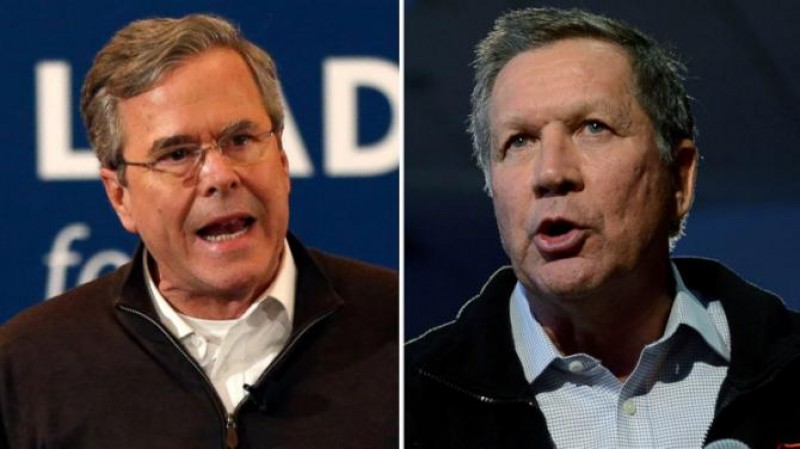
New Hampshire was said to be the crucible for the three governors running for the centrist/establishment lane of the GOP presidential contest. The winner of that competition was John Kasich, the Ohio Governor who came in second place behind Donald Trump. Jeb Bush came in fourth, ahead of Marco Rubio and Chris Christie, whose future in the race now looks dubious. On MSNBC’s Morning Joe on Wednesday, Bush began laying out the case why he should be the conservative choice over Kasich. “A conservative needs to win the conservative party’s nomination, and I’m the most conservative governor and most conservative candidate with a proven record in the field right now, and that’s my case,” he said. On Monday, Right to Rise, Bush’s Super PAC, began airing an ad in New Hampshire critical of Kasich’s record and past statements. However, the enmity goes both ways. ABC News reported on Tuesday that Kasich supporters making phone calls on behalf of their candidate were instructed in their scripts to criticize Bush. On Morning Joe, Bush explicitly criticized Kasich on what is undoubtedly an issue that could hurt him with Republicans – his decision to expand Medicaid, allowing more Ohio citizens to sign on to the Affordable Care Act. “John’s a good man, he’s served as governor in the state of Ohio, he’s done a good job,” Bush said. “But his record is not nearly as good as mine. And the one telling thing that he did, apart from not really focusing on rebuilding the military, is that when he had a chance, he expanded Obamacare through Medicaid.” “He’ll have to explain that down here,” Bush added. “People want (the ACA) repealed. They don’t want it expanded.” Bush mentioned how Rick Scott was one of some Republican governors who resisted Medicaid expansion; an issue considered anathema by the GOP establishment since it is part of the Affordable Care Act. The issue has divided Republicans, and Arizona’s Jan Brewer and Pennsylvania’s Tom Corbett were two other governors who opted for expansion. Bush refused to say how he’ll do in the South Carolina Primary, which takes place on February 20. He did say that Kasich doesn’t seem to have much of an effort on the ground in the Palmetto State, saying that it appears the Ohio Governor “had a one-state strategy.” “My intention is to do well here, ” Bush said. “To build on the success we had and to continue to make the case that we need a proven leader in Washington D.C. to fix the mess, not just to talk about how bad things are but to actually allow people to rise up again, because people are struggling in this country.”
Marco Rubio promises supporters he’ll do better as the campaign moves to South Carolina
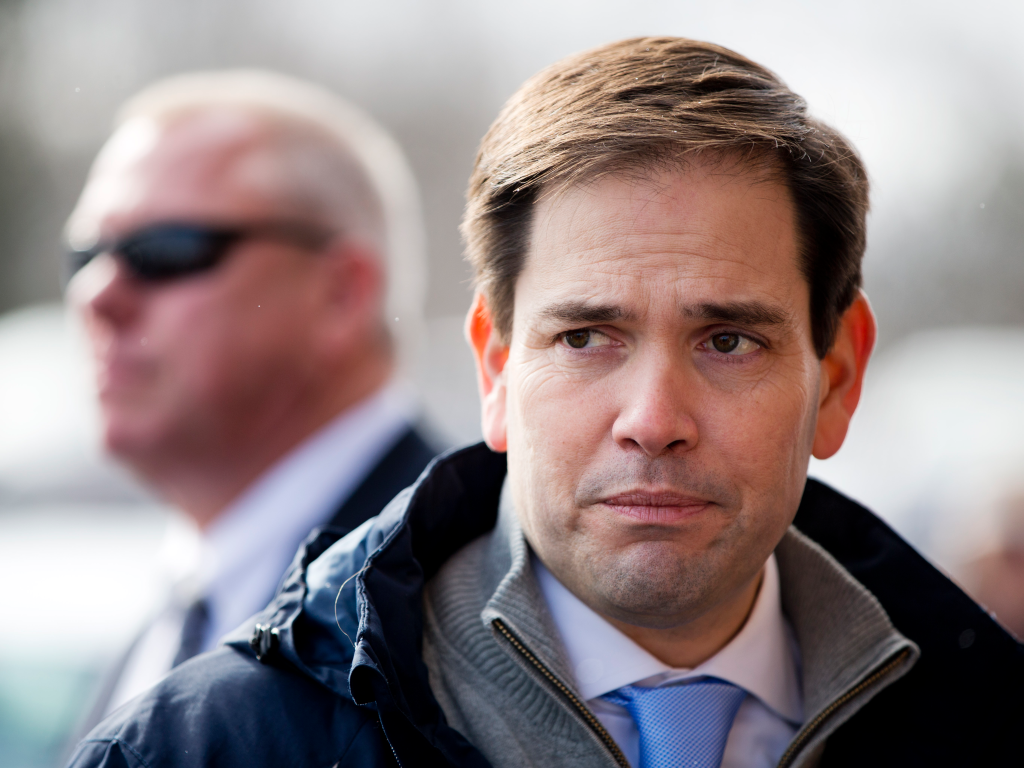
Marco Rubio vows that he will never allow what happened to him in last Saturday night’s GOP debate to happen to him again. “I want you to understand something,” he told the crowd of disappointed supporters at the Radisson Hotel in Manchester, New Hampshire on Tuesday night. “Our disappointment tonight is not on you; it’s on me. It is on me. I did not do well on Saturday night — listen to this: that will never happen again. That will never happen again.” What Rubio’s vowing will never happen again is that he will falter in this campaign as he did under a verbal assault he received at the hands of New Jersey Governor Chris Christie during last Saturday night’s debate in Manchester. “Let me tell you why it will never happen again,” he said. “It’s not about me, it’s not about this campaign, it is about this election. It’s about what’s at stake in this election.” Christie blasted Rubio for his lack of experience during the debate, and Rubio failed to respond, instead repeatedly reciting his criticisms about Barack Obama. In the days after the debate, he tripled down on those comments, saying he didn’t understand why the media was making such a big issue about it and continued the anti-Obama mantra. He dropped the facade on Tuesday night, however, after he finished a disappointing fifth in the race, behind not only Donald Trump and Ted Cruz, but John Kasich and Jeb Bush as well. He did, however, best Christie, who appears now to be considering dropping out of the race. Rubio’s nationally televised gaffe may have impacted the race, as 65 percent of GOP voters said they were influenced by Saturday night’s debate. Also, ABC News found nearly half of Republican primary voters saying they’d made their final decision in just the last few days. Only 20 percent of Democratic voters reported being late deciders. The question is now – is Rubio’s campaign fatally wounded? That remains to be seen. You can watch Rubio’s concession speech here.
Bernie Sanders, John Kasich win 1st votes in tiny NH community
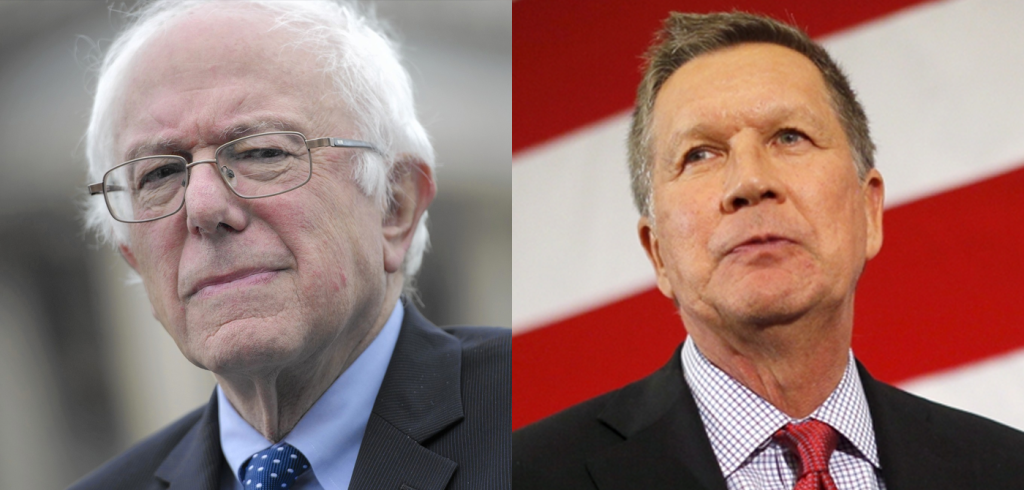
Bernie Sanders and John Kasich picked up the most votes as the first ballots of the first-in-the-nation primary were cast early Tuesday. Sanders won over all four Democratic voters in the tiny town of Dixville, while Kasich sneaked past Donald Trump, 3-2, among Republicans. Under New Hampshire state law, communities with fewer than 100 voters can get permission to open their polls at midnight and close them as soon as all registered voters have cast their ballots. While that happened in three locations, Dixville traditionally gets most of the spotlight due to its media-friendly setup at the Balsams Grand Resort Hotel. Located about 20 miles from the Canadian border, Dixville exists as a town only for voting purposes. Almost all of its nine voters are employees of the hotel, which closed in 2011 but is currently undergoing a major overhaul under new owners. Former owner Neil Tillotson started the midnight voting tradition in 1960, likely at the suggestion of a news photographer looking for an advantage in getting his pictures out to newspapers ahead of his rivals. For many years, voters cast their ballots in individual booths in the hotel’s posh ballot room. Because of the renovations, the nine current residents voted in another building on the property, the Hale House. In 2012, there was a tie for first place on the Republican side, with Mitt Romney and Jon Huntsman getting two votes apiece. All three Democrats voted for Obama. Hart’s Location, about 80 miles south of Dixville, first hosted midnight voting in 1948 but gave it up after the 1964 election when residents grew weary of the late hours and media frenzy every four years. Energized with new blood, town residents revived the tradition in 1996, and this year, the town has 41 registered voters. Millsfield is also making a comeback this year, though it’s unclear just when the town last voted at midnight or when its tradition started. According to a 1952 article in Time magazine, eight residents voted at midnight during the general election that year. This year, there are 22 registered voters. Republished with permission of the Associated Press.
Jeb Bush rises to 2nd place in New Hampshire, poll says
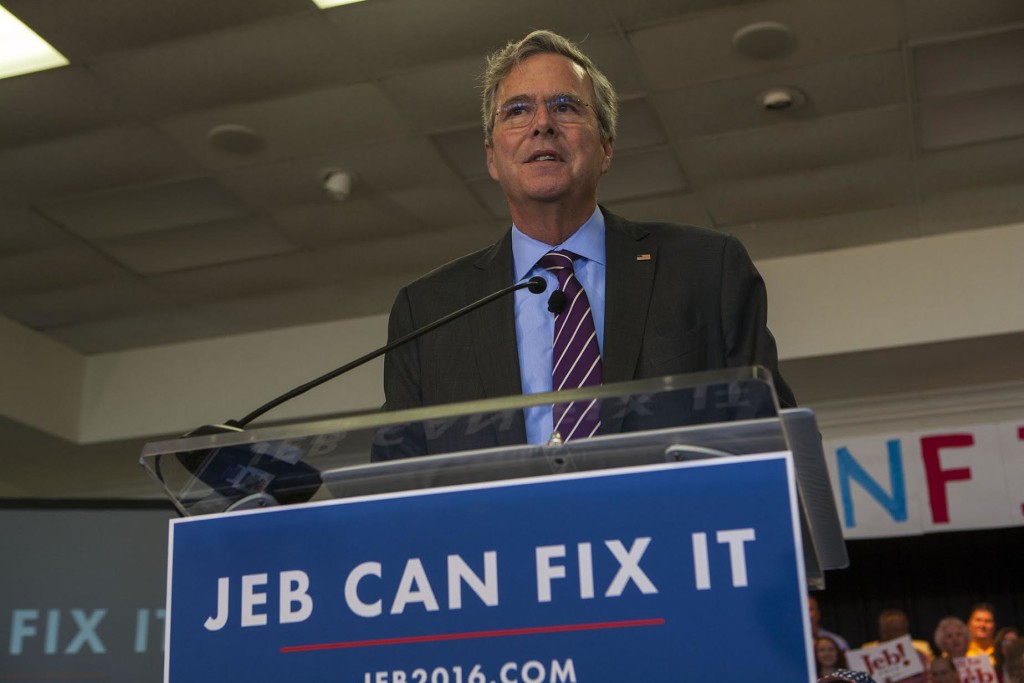
Donald Trump continues to lead the Republican field in New Hampshire, but a new poll of likely Republican primary voters shows Jeb Bush in second place. Trump maintains a strong lead over his Republican opponents with 31 percent, according to a Harper Polling survey of likely Republican primary voters in New Hampshire. Bush comes in second with 14 percent, followed by John Kasich at 12 percent. Marco Rubio is at 10 percent, while Ted Cruz is at 9 percent. The polling position comes as welcome news to the Bush campaign, which has struggled in the polls in recent weeks. The Harper Polling survey was conducted on Monday and Tuesday. It polled 425 likely Republican primary voters and has a margin of error of 4.75 percent. Brock McCleary, president of Harper Polling, wrote in a memo that the results from Tuesday, the second night of the poll, were “were largely unchanged from pre-Iowa Caucus results on Monday night.” Cruz came out on top in Monday’s Iowa caucus, with 28 percent. Trump came in second with 24 percent, while Rubio rounded out the Top 3 with 23 percent. Bush had a poor showing in Iowa, receiving 5,238 votes, or 2.8 percent. The New Hampshire primary is Tuesday.
Jeb Bush invokes dad’s Iowa victory as hopeful sign of things to come
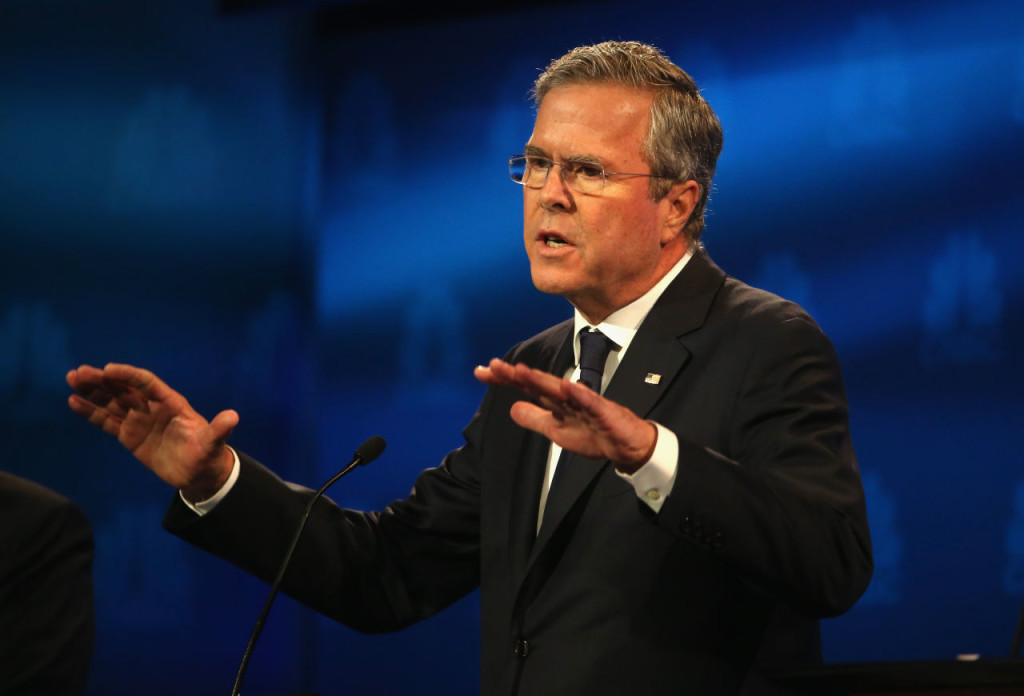
Jeb Bush was never expected to be a serious contender in Iowa, but his paltry total of just 2.8 percent of Iowa caucus voters still has to hurt. That’s after his Super PAC spent nearly $15 million there. The former Florida governor knew the results wouldn’t be pretty. He wasn’t even in Iowa Monday night, instead campaigning at a town hall meeting in New Hampshire. Appearing on “Fox and Friends” early Tuesday, Bush referenced a breaking story from Paris (where French police say five people were arrested with plans to stage attacks on nightspots and leave for Syria), and pivoted to his foreign policy gravitas. “We have a national security threat that is not going to go away, we need someone with a steady hand, someone who can has the backbone to be able to be a commander in chief to lead this country,” he said. Bush refused to play along with Fox anchor Steve Doocy‘s question about what he would do over if he could in Iowa. “I don’t look back,” he said, adding that he looks forward to campaigning in New Hampshire, South Carolina and Nevada. Doocy reminded Bush that the Iowa winner often doesn’t become the GOP nominee, referring to George H.W. Bush‘s surprise victory in 1980. “Yeah, I remember in 1980 we were all excited, with my dad upsettingRonald Reagan in the Iowa caucus. He had big mo, he came here to New Hampshire and it didn’t work out. And many other candidates have the same story.” In fact, it’s been 16 years since Republican caucus-goers here have accurately picked the eventual GOP nominee for president. Some polls have shown Bush with growth in the polls in New Hampshire. The Real Clear Politics average of polls in New Hampshire shows Bush locked in a tight four-man battle for second place, less than a point below Ted Cruz and John Kasich in fourth place with 10.3 percent. All are way behind Donald Trump, however, who dominates currently with a poll average rating of 33 percent.
