
Senate confirms Alex Acosta as Donald Trump’s secretary of labor
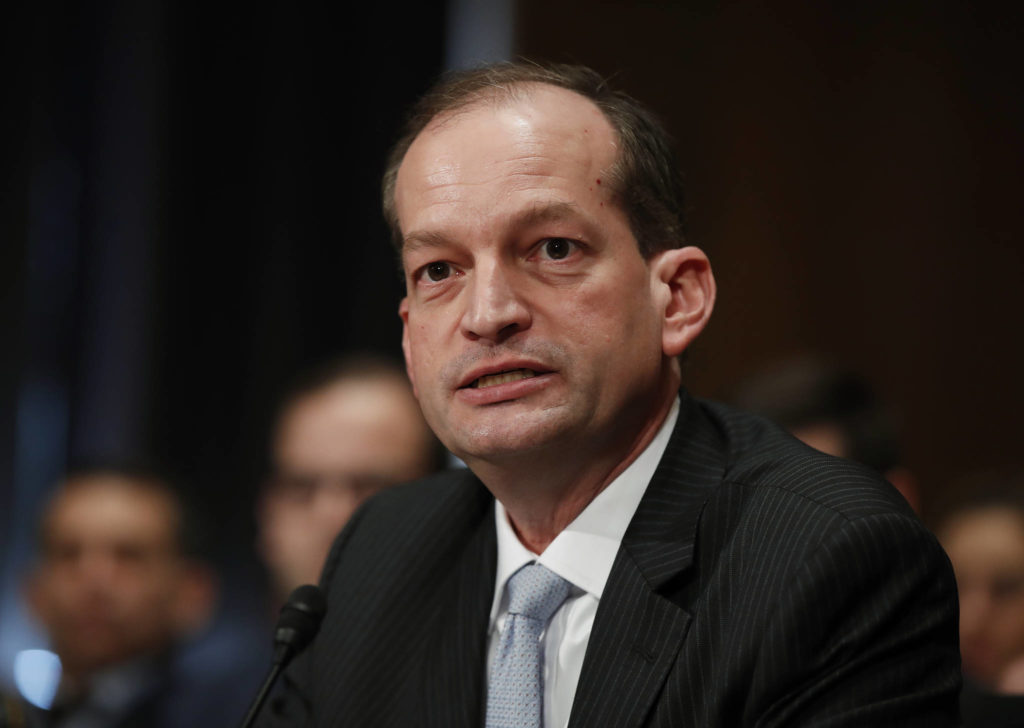
The Senate on Thursday confirmed Alex Acosta as Labor secretary, filling out President Donald Trump‘s Cabinet as he approaches his 100th day in office. The 60-38 vote confirms Acosta to the post. Once sworn as the nation’s 27th Labor secretary, the son of Cuban immigrants will lead a sprawling agency that enforces more than 180 federal laws covering about 10 million employers and 125 million workers. Sen. Tim Scott, R-S.C., spoke for many Republicans with a statement issued just after the vote saying he hopes Acosta’s focus will be “promoting labor policies that are free of unnecessarily burdensome federal regulations.” Scott said he wants Acosta to permanently revoke rules governing financial advisers and adding Americans eligible for overtime pay. Democrats said any Labor secretary should advocate for the American workers to whom Trump promised so much during his upstart presidential campaign. They said Acosta has given no such commitment. “Acosta failed this basic test,” tweeted Sen. Elizabeth Warren, D-Mass. Acosta has been a federal prosecutor, a civil rights chief at the Justice Department and a member of the National Labor Relations Board. He will arrive at the top post with relatively little clear record on some of the top issues facing the administration over key pocketbook issues, such as whether to expand the pool of American workers eligible for overtime pay. Acosta wasn’t Trump’s first choice for the job. Former fast food CEO Andrew Puzder withdrew his name from consideration last month, on the eve of his confirmation vote, after becoming a political headache for the new administration. Puzder acknowledged having hired a housekeeper not authorized to work in the U.S. and paying the related taxes years later — after Trump nominated him — and came under fire from Democrats for other issues related to his company and his private life. Acosta’s ascension would come at a key moment for Trump, just two days before he reaches the symbolic, 100-day marker. The White House has sought to cross the threshold with its own list of Trump’s accomplishments. Trump can say the Acosta vote was bipartisan, because eight Democrats and one independent voted yes. Joining the Republicans in his favor were Democratic Sens. Catherine Cortez Masto of Nevada, Heidi Heitkamp of North Dakota, Joe Manchin of West Virginia, Claire McCaskill of Missouri, Bob Menendez of New Jersey, Bill Nelson of Florida, Jon Tester of Montana and Mark Warner of Virginia. Independent Sen. Angus King of Maine also voted for Acosta. Labor secretary is the last Cabinet post for Trump to fill. Trump’s choice for U.S. trade representative, a job considered Cabinet-level, is awaiting a Senate vote. From the beginning, Acosta’s was a quiet march to confirmation that stood out because it didn’t attract the deep partisan battles faced by some of Trump’s other nominees, including Education Secretary Betsy DeVos and Secretary of State Rex Tillerson. Justice Neil Gorsuch‘s nomination provoked such a fight that majority Senate Republicans used the “nuclear option” to remove the 60-vote filibuster barrier for Supreme Court picks. Thursday’s vote marks the fourth time Acosta has been confirmed for the Senate. Democrats and most labor groups were mostly muted in their response to Acosta’s nomination. At his confirmation hearing, Democratic Sens. Patty Murray of Washington and Warren hammered Acosta for answers on a selection of issues important to labor and whether Acosta would cave to political pressure from Trump. Acosta refused to answer the policy questions until he’s confirmed, and he vowed to be an independent and fair voice for workers. Both senators said they had great concerns, and both voted no. Our standard can’t be ‘not Puzder,’” Murray said Wednesday on the Senate floor. But tellingly, even as Acosta’s nomination wound through the Senate, Democrats and their allies also tried to move on to other, labor-related issues — namely, a minimum wage hike to $15 an hour, which Trump opposes. Meanwhile, the Labor Department’s online landing page bears a glimpse of Acosta’s policy priorities: “Buy American, Hire American.” That’s the title of Trump’s executive order this week directing the secretaries of labor and other agencies to issue guidance within 60 days on policies that would “ensure that, to the extent permitted by law” federal aid “maximize the use of materials produced in the United States, including manufactured products; components of manufactured products; and materials such as steel, iron, aluminum, and cement.” Republished with permission of The Associated Press.
Marco Rubio says next step in Syria is negotiating regime change

Sen. Marco Rubio says the next step in Syria should be to work with Sunni governments to discuss “an alternative” government in Syria. Rubio is a Florida Republican and onetime rival of President Donald Trump. The conservative tells NBC’s “Today” show that Trump should reach out to Saudi Arabia and the United Arab Emirates, as well as Turkey, to discuss ways to get Syrian President Bashar Assad to step down and create a new regime. Assad has not responded to diplomatic pressure in the past, but Rubio says the military strikes could change that. He says, “We need to now move forward through a combination of diplomacy and, quite frankly, the support of groups on ground, particularly non-jihadist Sunni groups, to create alternatives to the Assad regime.” Republished with permission of The Associated Press.
Ethics panel to probe complaints against Devin Nunes

The Latest on the congressional inquiry into Russian meddling in the 2016 election (all times local): 10:20 a.m. The House Ethics Committee is investigating allegations that intelligence committee Chairman Devin Nunes may have made unauthorized disclosures of classified information. The full 10-member committee is investigating the allegations, a departure from the usual procedure of having a smaller subcommittee handle a probe, and an indication of the seriousness of the claims. The California Republican congressman says several left-wing activist groups have filed accusations against him with the office of congressional ethics. Nunes says the charges are false and politically motivated. But he says it’s in the best interest of the committee to have Republican Mike Conaway of Texas temporarily take charge of the committee’s investigation. ___ 10:15 a.m. Two ethics watchdog groups filed complaints about the chairman of the House intelligence committee, Republican Devin Nunes of California. Nunes says he’s temporarily stepping aside from the panel’s investigation of Russian meddling in the election because of the complaints. Democracy 21 and Citizens for Responsibility and Ethics in Washington say Nunes disclosed classified information, which violates House ethics rules. The groups say Nunes publicly disclosed information he learned by viewing classified material. Two of the four people who signed the March 28 letter alleging ethics violations served as White House counsels in Republican and Democratic administrations. ___ 10:05 a.m. Speaker Paul Ryan says Texas Republican Mike Conaway will take over the House investigation into Russian meddling in last year’s election. Ryan says an ethics complaint filed against Intelligence Committee Chairman Devin Nunes of California by government watchdog groups would be a “distraction” and that Nunes should no longer lead the probe. Nunes has come under intense criticism for meeting secretly with White House officials to view intelligence regarding Trump associates. Ryan says he is confident that Conaway “will oversee a professional investigation into Russia’s actions and follow the facts wherever they lead.” ___ 9:49 a.m. The chairman of the House intelligence committee says he will temporarily step aside from the panel’s probe into Russian meddling in the election. In a statement on Thursday, Republican congressman Devin Nunes of California says that several left-wing activist groups have filed accusations against him with the office of congressional ethics. Nunes says the charges are false and politically motivated. But he says it’s in the best interest of the committee to have GOP congressman Mike Conaway of Texas temporarily take charge of the committee’s investigation. He says he will continue fulfilling other duties with the committee and wants to talk to the ethics committee as soon as possible to defend himself. Republished with permission of The Associated Press.
Donald Trump steps up effort to dispute and distract on Russia

After weeks on the defensive, President Donald Trump has stepped up his efforts to dispute, downplay and distract from revelations stemming from the investigations into the Kremlin’s interference in last year’s election and possible Russian ties to his campaign associates. The White House says the real story is not about Russia — it’s about how Obama administration officials allegedly leaked and mishandled classified material about Americans. Trump and his aides have accused former officials of inappropriately disclosing — or “unmasking” — the names of Trump associates whose conversations were picked up by U.S. intelligences agencies. “Such amazing reporting on unmasking and the crooked scheme against us by @foxandfriends,” Trump tweeted Monday. ‘Spied on before nomination.’ The real story.” The White House has not pointed to any hard evidence to support such allegations, and instead has relied on media reports from some of the same publications Trump derides as “fake news.” The truth is buried somewhere in classified material that is illegal to disclose. Here’s a look at what the White House believes is the real story. __ THE FLYNN AFFAIR Trump fired national security adviser Michael Flynn following news reports that Flynn misled the White House about his contacts with Russia’s ambassador to the U.S. But the White House says the problem is that Flynn’s conversations were in the news at all. “The real story here is why are there so many illegal leaks coming out of Washington?” Trump tweeted after firing Flynn in February. The White House has called for investigations into the disclosure of multiple intercepted conversations that Flynn had with Ambassador Sergey Kislyak before the inauguration. The government routinely monitors the communications of foreign officials in the U.S. It’s illegal to publicly disclose such classified information. Officially, the White House said Flynn was forced to resign because he had given inaccurate descriptions of the discussions to Vice President Mike Pence and others in the White House. But Trump has continued to defend Flynn, suggesting he was only fired because information about his contacts came out in the media. “Michael Flynn, Gen. Flynn is a wonderful man,” Trump said. “I think he’s been treated very, very unfairly by the media.” ___ THE OBAMA ADMINISTRATION White House officials say some Obama holdovers are part of a so-called deep state out to tear Trump down. Last week, the White House latched onto a month-old television interview from an Obama administration official who said she encouraged congressional aides to gather as much information on Russia as possible before the inauguration. Evelyn Farkas, the former deputy assistant secretary of defense, said she feared that information “would disappear” after President Barack Obama left office. She was no longer in government at the time, having left the Pentagon about a year before the election. White House spokesman Sean Spicer called Farkas’ comments “devastating” and said they “raised serious concerns on whether or not there was an organized and widespread effort by the Obama administration to use and leak highly sensitive intelligence information for political purposes.” On Monday, Spicer suggested there should be more interest in a Bloomberg report in which anonymous U.S. officials said that Susan Rice, Obama’s national security adviser, asked for the identities of people related to Trump’s campaign and transition dozens of times. Spicer remarked that he was “somewhat intrigued by the lack of interest” in the Rice revelations. But he added: “I do think that it’s interesting, the level, or lack thereof, of interest in this subject.” As national security adviser, Rice would have regularly received intelligence reports and been able to request the identities of Americans whose communications were intercepted. ___ THE HILL WEIGHS IN The White House has embraced a top Republican’s assertion that information about Trump associates were improperly spread around the government in the final days of the Obama administration. It appears the White House played a role in helping House intelligence committee Chairman Devin Nunes, R-Calif., acquire some of that information. Nunes announced last week that he had seen intelligence reports showing that Trump aides’ communications were picked up through routine surveillance. But he said their identities may have been improperly revealed. The California congressman later said he viewed the reports at the White House. The White House contends that Nunes’ information — which has not been made public — validates Trump’s explosive claim that his predecessor wiretapped his New York skyscraper. Nunes has disputed that but still says he found the reports “troubling.” The White House’s apparent involvement in helping Nunes access the information has overshadowed what Trump officials contend are real concerns about how much information about Americans is disseminated in intelligence reports. Trump has asked the House and Senate intelligence committees to include the matter in their Russia investigations. ___ CAMPAIGN MODE Trump won the election, but thinks it’s his vanquished opponent whose ties to Russia should be investigated. Some of the White House’s allegations against Clinton stem from her four years as secretary of state, a role that gave her ample reasons to have frequent contacts with Russia. To deflect questions about Trump’s friendly rhetoric toward Russia, the White House points to the fact that Clinton was a central figure in the Obama administration’s attempt to “reset” relations with Moscow — an effort that crumbled after Vladimir Putin took back the presidency. “When you compare the two sides in terms of who’s actually engaging with Russia, trying to strengthen them, trying to act with them, trying to interact with them, it is night and day between our actions and her actions,” Spicer said. Rex Tillerson, Trump’s secretary of state, has deep ties to Russia from his time running ExxonMobil and cutting oil deals with Moscow. The White House has also tried to link Clinton to Russia’s purchase of a controlling stake in a mining company with operations in the U.S., arguing that she was responsible for “selling off one-fifth of our country’s uranium.” The Clinton-led State Department was among nine U.S. government agencies that had to approve the purchase of
Congress seen as not likely to pass tax overhaul quickly

After their humiliating loss on health care, Republicans in Congress could use a quick victory on a big issue. It won’t be an overhaul of the tax code. Overhauling the tax code could prove harder to accomplish than repealing and replacing Barack Obama‘s health law. Congressional Republicans are divided on significant issues, especially a new tax on imports embraced by House Speaker Paul Ryan. And the White House is sending contradicting signals on the new tax, adding to the uncertainty. House Republicans also can’t decide whether to move on from health care. Ryan canceled a scheduled vote on a House GOP plan after it became obvious that Republicans didn’t have the votes. He said he will continue to work on the issue but one of his top lieutenants on health care, Rep. Kevin Brady, R-Texas, says he is now “100 percent” focused on a tax overhaul. Ryan says Congress can work on both at the same time. It won’t be easy. Here’s why: ___ REPUBLICAN DIVIDE House and Senate Republicans largely agree on the broad outlines of a tax overhaul. They want to lower tax rates for individuals and corporations, and make up the lost revenue by scaling back tax breaks. But they are sharply divided on a key tenet of the House Republican plan. The new “border adjustment tax” would be applied to profits from goods and services consumed in the U.S., whether they are domestically produced or imported. Exports would be exempt. House GOP leaders say the tax is key to lowering the top corporate income tax rate from 35 percent to 20 percent. But good luck finding a single Republican senator who will publicly support the tax. Sen. Rob Portman, R-Ohio, is the latest in a long line of Republican senators to come out against the tax. ___ ABSENT DEMOCRATS Senate Finance Committee Chairman Orrin Hatch, R-Utah, says he wants to work with Democrats to overhaul the tax code. “A bipartisan bill would allow us to put in place more lasting reforms and give the overall effort additional credibility,” Hatch said. Majority Leader Mitch McConnell, R-Ky., has said it is bad policy to pass major legislation without bipartisan support. “Without some meaningful buy-in, you guarantee a food fight,” McConnell wrote in his memoir last year. “You guarantee instability and strife.” But in the House, Republicans haven’t reached out to Democrats in any meaningful way. ___ WHERE’S THE WHITE HOUSE? “Obviously we’re driving the train on this,” White House press secretary Sean Spicer said. But President Donald Trump‘s administration has been all over the map on tax reform. Trump at one point said the House border tax is too complicated, then said it’s in the mix. Treasury Secretary Steven Mnuchin told a Senate panel that “there would be no absolute tax cut for the upper class” in Trump’s tax plan. However, the plan Trump unveiled during his presidential campaign would provide big tax breaks to high-income households. Since taking office, Trump has promised “massive” tax cuts for the middle class. A former Treasury official under President Barack Obama says the White House needs to stake out clear goals on tax overhaul to guide the debate in Congress. “I think it’s important for the administration to signal early the general shape” of what they would like to accomplish so that there are fewer proposals vying for attention, said Michael Mundaca, a former assistant Treasury secretary now at Ernst & Young. ___ TAX CHANGE IS DIFFICULT There is a reason it’s been 31 years since the last time Congress rewrote the tax code. Since then, the number of exemptions, deductions and credits has mushroomed. Taxpayers enjoyed $1.6 trillion in tax breaks in 2016 — more than the federal government collected in individual income taxes. That huge number could provide plenty of tax breaks that lawmakers can scale back so they can lower tax rates significantly. There is just one problem — all of the biggest tax breaks are very popular and have powerful constituencies. Nearly 34 million families claimed the mortgage interest deduction in 2016. That same year more than 43 million families took advantage of a deduction of state and local taxes. The House Republicans’ tax plan would retain the mortgage deduction and eliminate the deduction for state and local taxes. ___ HEALTH CARE Both Trump and Republicans in Congress made big campaign promises to repeal and replace Obama’s health law, so the issue won’t go away. However, several players say negotiations on a way forward are non-existent. In the meantime, Trump is stoking animosity among a key voting bloc by criticizing them on Twitter. Two factions in the House GOP had members oppose the health plan: the hard-right Freedom Caucus and the moderate Tuesday Group. Ryan has suggested that they get together to sort out their differences, but it’s not happening, according to one key lawmaker. “We are not currently negotiating with the Freedom Caucus. There was never a meeting scheduled with the Freedom Caucus. We will never meet with the Freedom Caucus,” said Rep. Chris Collins, R-N.Y., a member of the Tuesday Group. Trump tweeted: “The Freedom Caucus will hurt the entire Republican agenda if they don’t get on the team, & fast. We must fight them, & Dems, in 2018!” To quote a favorite saying of the president, Not nice. Republished with permission of The Associated Press.
House Freedom Caucus chairman says there’s ‘no deal’ on the GOP health care legislation after White House meeting

The Latest on the upcoming health care vote in the House (all times local): 1:35 p.m. The chairman of the conservative House Freedom Caucus says there’s “no deal” on the GOP health care legislation after a meeting at the White House with President Donald Trump. The assertion from Congressman Mark Meadows of North Carolina throws plans for a vote on the bill later Thursday into doubt. Two dozen or so Freedom Caucus members have opposed the legislation pushed by GOP leaders, saying it doesn’t go far enough to repeal “Obamacare.” But the group had been negotiating directly with the White House in hopes of reaching agreement to eliminate additional requirements on insurers. Without a deal with the Freedom Caucus, and with moderate-leaning members defecting, it seems unlikely GOP leaders will have the votes they need to go forward with a vote later Thursday as they had planned. ___ 10:06 a.m. Former President Barack Obama is celebrating the seventh anniversary of his landmark health care law, saying in a statement on Thursday that “America is stronger because of the Affordable Care Act.” Obama does not directly address GOP efforts to repeal his law, which are coming to a head Thursday as House leaders push toward a vote on their repeal legislation. Republicans remain short of votes. The former president does say that if Republicans are serious about lowering costs and expanding coverage, and are prepared to work with Democrats, “That’s something we all should welcome.” But, Obama says, “we should start from the baseline that any changes will make our health care system better, not worse for hardworking Americans.” He notes 20 million Americans gained coverage under his law. ___ 9:40 a.m. President Donald Trump is urging people to call their lawmakers to express support for the Republican legislation to repeal and replace “Obamacare.” Trump posted a video on Twitter Thursday asking people to get behind the plan. He says that people were “given many lies” about the Affordable Care Act. Trump added that the legislation was “terrific” and “you’re going to be very, very happy.” The GOP legislation was on the brink hours before Republican leaders planned to put it on the House floor for a showdown vote. Trump was spending the final hours trying to close the deal with conservatives who have opposed the plan. ___ 9:00 a.m. The GOP’s long-promised legislation to repeal and replace “Obamacare” stands on the brink, just hours before Republican leaders planned to put it on the House floor for a showdown vote. The stakes are high, and Republicans are staring at the possibility of a failure that would throw prospects for their other legislative goals into uncertainty. Speaking to members of the conservative Freedom Caucus mid-day Thursday, Trump is pitching concessions to representatives who want to limit the requirement for health plans to include benefits including substance abuse and maternity care. But those changes appear to be scaring off at least some moderate Republicans. In a count by The Associated Press, at least 26 Republicans say they opposed the bill, enough to narrowly defeat the measure. Republished with permission of The Associated Press.
Paul Manafort had plan to benefit Vladamir Putin government

President Donald Trump‘s former campaign chairman, Paul Manafort, secretly worked for a Russian billionaire to advance the interests of Russian President Vladimir Putin a decade ago and proposed an ambitious political strategy to undermine anti-Russian opposition across former Soviet republics, The Associated Press has learned. The work appears to contradict assertions by the Trump administration and Manafort himself that he never worked for Russian interests. Manafort proposed in a confidential strategy plan as early as June 2005 that he would influence politics, business dealings and news coverage inside the United States, Europe and the former Soviet republics to benefit the Putin government, even as U.S.-Russia relations under Republican President George W. Bush grew worse. Manafort pitched the plans to Russian aluminum magnate Oleg Deripaska, a close Putin ally with whom Manafort eventually signed a $10 million annual contract beginning in 2006, according to interviews with several people familiar with payments to Manafort and business records obtained by the AP. Manafort and Deripaska maintained a business relationship until at least 2009, according to one person familiar with the work. “We are now of the belief that this model can greatly benefit the Putin Government if employed at the correct levels with the appropriate commitment to success,” Manafort wrote in the 2005 memo to Deripaska. The effort, Manafort wrote, “will be offering a great service that can re-focus, both internally and externally, the policies of the Putin government.” Manafort’s plans were laid out in documents obtained by the AP that included strategy memoranda and records showing international wire transfers for millions of dollars. How much work Manafort performed under the contract was unclear. The disclosure comes as Trump campaign advisers are the subject of an FBI probe and two congressional investigations. Investigators are reviewing whether the Trump campaign and its associates coordinated with Moscow to meddle in the 2016 campaign. Manafort has dismissed the investigations as politically motivated and misguided, and said he never worked for Russian interests. The documents obtained by AP show Manafort’s ties to Russia were closer than previously revealed. In a statement to the AP, Manafort confirmed that he worked for Deripaska in various countries but said the work was being unfairly cast as “inappropriate or nefarious” as part of a “smear campaign.” “I worked with Oleg Deripaska almost a decade ago representing him on business and personal matters in countries where he had investments,” Manafort said. “My work for Mr. Deripaska did not involve representing Russia’s political interests.” Deripaska became one of Russia’s wealthiest men under Putin, buying assets abroad in ways widely perceived to benefit the Kremlin’s interests. U.S. diplomatic cables from 2006 described Deripaska as “among the 2-3 oligarchs Putin turns to on a regular basis” and “a more-or-less permanent fixture on Putin’s trips abroad.” In response to questions about Manafort’s consulting firm, a spokesman for Deripaska in 2008 — at least three years after they began working together — said Deripaska had never hired the firm. Another Deripaska spokesman in Moscow last week declined to answer AP’s questions. Manafort worked as Trump’s unpaid campaign chairman last year from March until August. Trump asked Manafort to resign after AP revealed that Manafort had orchestrated a covert Washington lobbying operation until 2014 on behalf of Ukraine’s ruling pro-Russian political party. The newly obtained business records link Manafort more directly to Putin’s interests in the region. According to those records and people with direct knowledge of Manafort’s work for Deripaska, Manafort made plans to open an office in Moscow, and at least some of Manafort’s work in Ukraine was directed by Deripaska, not local political interests there. The Moscow office never opened. Manafort has been a leading focus of the U.S. intelligence investigation of Trump’s associates and Russia, according to a U.S. official. The person spoke on condition of anonymity because details of the investigation were confidential. Meanwhile, federal criminal prosecutors became interested in Manafort’s activities years ago as part of a broad investigation to recover stolen Ukraine assets after the ouster of pro-Russian President Viktor Yanukovych there in early 2014. No U.S. criminal charges have ever been filed in the case. FBI Director James Comey, in confirming to Congress the federal intelligence investigation this week, declined to say whether Manafort was a target. Manafort’s name was mentioned 28 times during the hearing of the House Intelligence Committee, mostly about his work in Ukraine. No one mentioned Deripaska. White House spokesman Sean Spicer said Monday that Manafort “played a very limited role for a very limited amount of time” in the campaign, even though as Trump’s presidential campaign chairman he led it during the crucial run-up to the Republican National Convention. Manafort and his associates remain in Trump’s orbit. Manafort told a colleague this year that he continues to speak with Trump by telephone. Manafort’s former business partner in eastern Europe, Rick Gates, has been seen inside the White House on a number of occasions. Gates has since helped plan Trump’s inauguration and now runs a nonprofit organization, America First Policies, to back the White House agenda. Gates, whose name does not appear in the documents, told the AP that he joined Manafort’s firm in 2006 and was aware Manafort had a relationship with Deripaska, but he was not aware of the work described in the memos. Gates said his work was focused on domestic U.S. lobbying and political consulting in Ukraine at the time. He said he stopped working for Manafort’s firm in March 2016 when he joined Trump’s presidential campaign. Manafort told Deripaska in 2005 that he was pushing policies as part of his work in Ukraine “at the highest levels of the U.S. government — the White House, Capitol Hill and the State Department,” according to the documents. He also said he had hired a “leading international law firm with close ties to President Bush to support our client’s interests,” but he did not identify the firm. Manafort also said he was employing unidentified legal experts for the effort at leading universities and
Winners and losers in Donald Trump’s first budget plan

Military spending would get the biggest boost in President Donald Trump‘s proposed budget. Environmental programs, medical research, Amtrak and an array of international and cultural programs — from Africa to Appalachia — would take big hits, among the many parts of the government he’d put on a crash diet. The budget proposal out Thursday is a White House wish list; it’ll be up to Congress to decide where money goes. If Trump gets his way, there will be more losers than winners among government departments and programs. Some programs would tread water: WIC grants — money to states for health care and nutrition for low-income women, infants and children — are one example. Monday for states grants for water infrastructure projects would be held level as well. Some others would lose everything: Trump proposes to eliminate money for the Corporation for Public Broadcasting, the national endowments for the arts and the humanities and more than a dozen other independent agencies financed by the government. A sampling: WINNERS —The Pentagon. Trump proposes a 10 percent increase in the massive defense budget, adding $52 billion in military spending in one year top expand personnel, equipment and capability. Another $2 billion would go to nuclear weapons. —Veterans Affairs. Up 5.9 percent. That’s an additional $4.4 billion, driven by ever-growing health care costs. —Homeland Security. Up 6.8 percent. That’s $2.8 billion more. Most of the increase, $2.6 billion, would be to help kick-start Trump’s promised border wall. The president has repeatedly said Mexico would pay for the wall; Mexican officials are adamant that they won’t. Trump also wants an extra $1.5 billion for more immigration jails and deportations, and $314 million to hire 1,500 immigration enforcement and border patrol agents. —The National Nuclear Security Administration, which oversees the maintenance and safety of the nuclear arsenal and its research labs. The agency would grow by 11.3 percent, or $1.4 billion, so that it takes up more than half the Energy Department’s budget, which would shrink overall. —Opioid prevention and treatment: a proposed $500 million increase in the Health and Human Services Department to counter the epidemic and more money for the Justice Department to combat the problem. —School choice: $1.4 billion more to expand school choice programs, bringing spending in that area to $20 billion, even as the Education Department’s overall budget would be cut by $9 billion, or 13 percent. LOSERS: —EPA, facing a 31.4 percent cut, or $2.6 billion. The plan would cut 3,200 jobs at the agency, eliminate a new plan for tighter regulations on power plants, and “zero out” programs to clean up the Great Lakes and the Chesapeake Bay. —Health and Human Services, facing the largest cut in dollar terms: $12.6 billion, or 16.2 percent. The plan would cut $5.8 billion from the nearly $32 billion National Institutes of Health, the nation’s premier medical research agency, bringing its total to $25.9 billion. It’s not clear what research on diseases or disorders would lose the most money, although the budget plan specifically calls for elimination of a division that focuses on global health. Already, the NIH’s budget hasn’t kept pace with inflation over the last decade, making it dramatically harder for scientists around the country to win money for research projects into potential new treatments or better understanding of disease. —State Department and U.S. Agency for International Development. Down 28 percent, or $10 billion. Foreign aid would be reduced, as would money to the U.N. and to multilateral development banks including the World Bank. Some foreign military grants would be shifted to loans. —Labor Department. A more than 20 percent cut, or $2.5 billion. To be eliminated: a $434 million program that has helped more than 1 million people 55 and older find jobs, according to the department. The blueprint says the Senior Community Service Employment Program is inefficient and unproven. —Agriculture Department. A nearly 21 percent cut, or $4.7 billion, achieved in part by cutting land acquisition in the National Forest System, rural water infrastructure and statistical capabilities at the department. Trump also proposes reduced staff in county USDA offices, an idea that fell flat in Congress when President Barack Obama proposed a similar reduction. —Transportation Department. Trump proposes a cut of nearly 13 percent, or $2.4 billion. Amtrak, local transit agencies, and rural communities that depend on federal subsidies to obtain scheduled airline service would take the brunt. Trump would eliminate subsidies for Amtrak long-distance train routes, which would most likely mean the end of those routes since they are generally not profitable. Money for the Federal Transit Administration grant program for new light rail and subway construction would be eliminated except for multi-year projects the government has already committed to help fund. —Internal Revenue Service: After years of cuts, the IRS budget would be cut again — by $239 million from this year’s spending levels. The IRS budget is down about $1 billion from its height in 2010. Since then, the agency has lost more than 17,000 employees. As a result, the chances of getting audited have rarely been so low. —Commerce Department. A 16 percent or $1.5 billion cut. The plan would eliminate more than $250 million in National Oceanic and Atmospheric Administration grants, including a program that helps coastal communities adapt to climate change, deal with invasive species and maintain healthy water and fisheries. Also on the chopping block: the Economic Development Administration, which provides federal dollars to foster job creation and attract private investment; and the Minority Business Development Agency, which is dedicated to helping minority-owned business get off the ground and grow. The Trump administration says the two agencies duplicate work done elsewhere. —School programs: The plan would eliminate a $1.2 billion initiative that supports before- and after-school programs as well as summer programs. —Independent agencies supported by tax dollars. If Trump prevails, a hefty contingent of entities would lose all federal money and be shut. Among them, the public broadcasting corporation, the Appalachian Regional Commission, the Chemical Safety Board, the United States
House GOP health bill facing fresh House committee test

The White House and Republican leaders are talking to rank-and-file lawmakers about revising the GOP health care overhaul, hoping to keep a rebellion by conservatives and moderates from snowballing and imperiling the party’s showpiece legislation. Four days after a congressional report projected the bill would pry coverage from millions of voters, signs of fraying GOP support for the legislation were showing. The measure would strike down much of former President Barack Obama‘s 2010 overhaul and reduce the federal role, including financing, for health care consumers and is opposed uniformly by Democrats. In a fresh test of Republicans’ willingness to embrace the legislation, the House Budget Committee was considering the measure Thursday. Republicans expressed confidence the bill would be approved, but the vote could be tight. The panel can’t make significant changes but was expected to endorse non-binding, suggested changes to nail down votes. The bill would eliminate the tax penalty that pressures people to buy coverage and the federal subsidies that let millions afford it, replacing them with tax credits that are bigger for older people. It would cut Medicaid, repeal the law’s tax increases on higher earning Americans and require 30 percent higher premiums for consumers who let coverage lapse. Overt GOP opposition grew after the nonpartisan Congressional Budget Office projected Monday that the legislation would push 24 million Americans off coverage in a decade and shift out-of-pocket costs toward lower income, older people. Obama’s law has provided coverage to around 20 million additional people House Speaker Paul Ryan, R-Wis., told reporters Wednesday that leaders could now make “some necessary improvements and refinements” to the legislation. But he declined to commit to bringing the measure to the House floor next week, a schedule Republican leaders have repeatedly said they intended to keep. At a late rally in Nashville Wednesday, President Donald Trump said: “We’re going to arbitrate, we’re all going to get together, we’re going to get something done.” Vice President Mike Pence met with House GOP lawmakers and pressed them to unite behind the legislation. “‘It’s our job to get it out of here and get it to the Senate,’” Pence told Republicans, according to Rep. Dennis Ross, R-Fla. That would let Trump pressure “Democrats in these red states to come on board,’” Ross said, referring to Republican-leaning states where Democratic senators face re-election next year. But insurgents still abound. Conservatives want to end Obama’s expansion of Medicaid to 11 million additional low-income people next year, not 2020 as the bill proposes. They say a GOP proposed tax credit to help people pay medical costs is too generous, and they want to terminate all of Obama’s insurance requirements, including mandatory coverage of specified services like drug counseling. Rep. Mark Meadows, R-N.C., head of the hard-line conservative House Freedom Caucus, continued pushing for changes. He claimed at least 21 members of his group would oppose the measure as written; the bill would fail if 22 Republicans join all Democrats in opposing it. But underscoring the push-pull problem GOP leaders face in winning votes, moderates feel the tax credits are too stingy, especially for low earners and older people. They oppose accelerating the phase-out of the Medicaid expansion and are unhappy with long-term cuts the measure would inflict on the entire program. Terminating the Medicaid expansion in 2020 and not 2018 “is sacrosanct to me,” said moderate Rep. Tom MacArthur, R-N.J. In a new complication, Sen. Charles Grassley, R-Iowa, said the measure lacked the votes to pass in the Senate, where Republicans hold a precarious 52-48 majority. That left House members angry over being asked to take a politically risky vote for legislation likely to be altered. Moderates “don’t like the idea of taking a vote in the House that may go nowhere in the Senate,” said Rep. Charlie Dent, R-Pa. Amid the maneuvering, a federal report said more than 12 million people have signed up for coverage this year under the very statute that Republicans want to repeal. That figure underscored the potential political impact of the GOP’s next move. Republished with permission of The Associated Press.
After 2 months, Jim Mattis is only Donald Trump pick at Pentagon

Jim Mattis is not lonely in the Pentagon, but two months into his tenure as secretary of defense not a single political appointee has joined him. The retired Marine general, who took office just hours after President Donald Trump was sworn in, has sparred with the White House over choices for high-priority civilian positions that, while rarely visible to the public, are key to developing and implementing defense policy at home and abroad. When the Obama administration closed shop in January, only one of its top-tier Pentagon political appointees stayed in place — Robert Work, the deputy defense secretary. He agreed to remain until his successor is sworn in. So far, no nominee for deputy has been announced, let alone confirmed by the Senate. The administration has announced four nominees for senior Pentagon civilian jobs, and two of those later withdrew. Trump’s nominee to lead the Army, Vincent Viola, withdrew in early February because of financial entanglements, and about three weeks later Philip B. Bilden, the Navy secretary nominee, withdrew for similar reasons. On Tuesday, the White House announced it intends to nominate John J. Sullivan to be the Pentagon’s chief lawyer. In January, Trump announced former congresswoman Heather Wilson of New Mexico as his nominee to be Air Force secretary, but he has not submitted the nomination to the Senate. “The process has definitely slowed,” said Dov Zakheim, who served as the Pentagon budget chief during the George W. Bush administration. He said he would be surprised if Mattis gets any senior appointees confirmed before mid-April. “The delays are already causing much consternation among allies, especially in Europe and Southeast Asia, as their most senior working level day-to-day contacts – the deputy assistant secretaries — may not come onboard until the summer,” Zakheim said in an email exchange. “Lots of mayhem could take place before then.” This is not an issue at the Pentagon alone. While most of Trump’s choices for Cabinet and Cabinet-level posts have won Senate confirmation, 500-plus government-wide sub-Cabinet level positions requiring Senate confirmation remain unfilled. There are few visible signs that the absence of Trump appointments in the Pentagon has affected its management of the counter-Islamic State campaign or military operations in Afghanistan. But the president has ordered a number of major policy reviews that require senior-level Pentagon attention, including counter-IS strategy, nuclear and missile defense plans and a blueprint for building up and improving the combat-readiness of the military. Even Republicans are taking note. Rep. Mac Thornberry, chairman of the House Armed Services Committee, said at a hearing Wednesday that when lawmakers have nuclear policy questions, “we do not have people in place in the new administration to answer some of those questions.” Pentagon insiders say the appointment process, while contentious at times, has not produced significantly more friction than previous transitions in which the White House changed political parties. Democrat Barack Obama had fewer issues at the Pentagon when he took office in January 2009 because he kept in place Bush’s defense chief, Robert Gates, and Obama’s transition team quickly settled on nominees for key senior defense policy jobs. When Bush made Donald H. Rumsfeld his defense chief in January 2001, Rumsfeld did not get his policy chief, Douglas Feith, in place until July. Rumsfeld, however, had an advantage that Mattis does not: some of his predecessor’s senior staff agreed to remain for months. By Rumsfeld’s count, it took the Bush White House 70 days on average to approve a recommended nominee, plus 52 more days for Senate confirmation. A Pentagon spokesman, Navy Capt. Jeff Davis, said Mattis is committed to getting the right people in key jobs. “He and his staff are actively conducting interviews and working collaboratively with the White House to nominate people to the Senate for confirmation,” Davis said. “We are in the final stages of vetting on several of these, and expect they will be announced soon.” Walter Slocombe, who served as policy chief at the Pentagon during Bill Clinton‘s presidency, said the appointments process is unavoidably sluggish because of extensive political and security vetting. “Having said that, it’s a very bad idea that it takes so long,” he said. Career civil servants can fill the void for a time, but their power is limited. “They’ll do enough to keep the engine turning over and be a big help in a crisis, but they’re not able to take the lead on policy formation,” he added. Mattis has said little publicly about the pace of getting a new team installed, but officials familiar with the process say he and the White House have been at loggerheads on some picks. The officials spoke on condition of anonymity to discuss internal deliberations. Mattis may be about to prevail in one important appointment — Anne W. Patterson, a career diplomat and former ambassador to Egypt and Pakistan who recently retired after serving as the State Department’s assistant secretary for near eastern affairs. Officials expect her to be announced soon as Trump’s nominee to serve as undersecretary of defense for policy, a position of broad responsibility for steering policy. Critics, including some Republicans, opposed her selection on grounds that as ambassador in Cairo she was too accommodating to former Egyptian President Mohamed Morsi and the Muslim Brotherhood. Among other key Pentagon offices still without a presidentially appointed leader: intelligence, budget chief, weapons buyer, technology chief and personnel policy. These and other top positions were vacated by Obama appointees at the end of his term or earlier last year; they are now run by holdover officials in what the Pentagon calls a “performing the duties” status, meaning they can do the work unless it involves a duty that by law can be performed only by a Senate-confirmed appointee. Republished with permission of The Associated Press.
Dems force delays in votes on Jeff Sessions, Steve Mnuchin, Tom Price
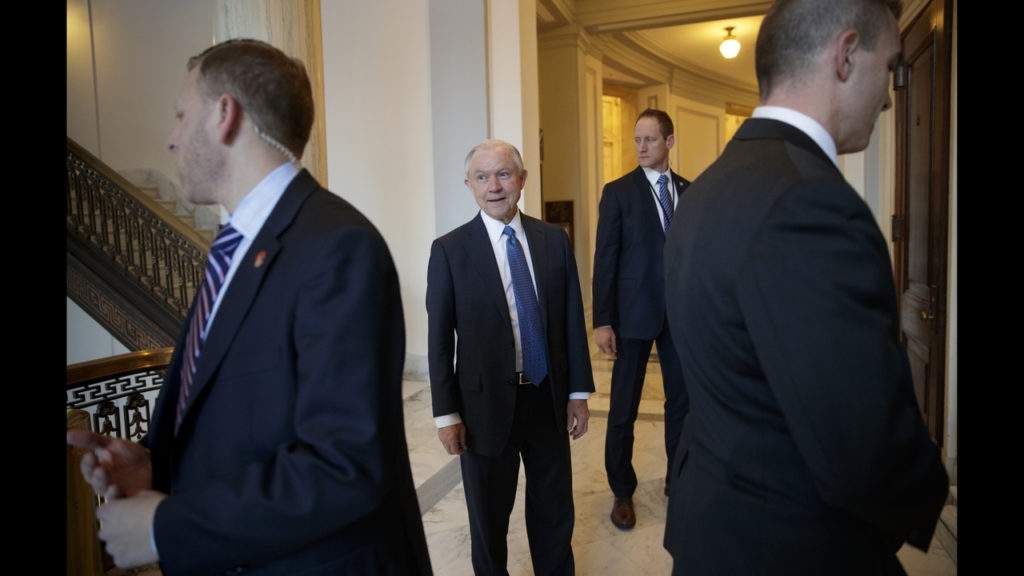
Democrats forced delays Tuesday in planned Senate committee votes on President Donald Trump‘s picks for Health and Treasury secretaries and attorney general, amid growing Democratic surliness over the administration’s aggressive early moves against refugees and an expected bitter battle over filling the Supreme Court vacancy. Democrats abruptly boycotted a Senate Finance Committee meeting called to vote on Rep. Tom Price, R-Ga., the Health nominee and Steve Mnuchin, Trump’s Treasury selection, saying both had misled Congress about their financial backgrounds. The Democrats’ action prevented the Finance panel from acting because under committee rules, 13 of its members — including at least one Democrat — must be present for votes. It was unclear when the panel would reschedule to votes. At the Senate Judiciary Committee, a meeting considering Sen. Jeff Sessions, R-Ala., to be attorney general lasted so long — chiefly because of lengthy Democratic speeches — that Chairman Charles Grassley, R-Iowa, said the panel would meet again Wednesday. The meeting on Sessions’ nomination was coming with Democrats and demonstrators around the country in an uproar over Trump’s executive order temporarily blocking refugees. Even some Republicans were warning it could hinder anti-terrorism efforts. Not everything ground to a halt. The Senate education committee voted 12-11 to send Trump’s pick to head the Education Department, Betsy DeVos, to the full Senate for a confirmation vote. The Senate Energy and Natural Resources Committee quickly approved former Texas Gov. Rick Perry as Energy secretary by 16-7, and Rep. Ryan Zinke, R-Mont., to head Interior by 16-6. And the full Senate easily confirmed Elaine Chao to become transportation secretary by a 93-6 vote. Chao was labor secretary under President George W. Bush, and is wife of Senate Majority Leader Mitch McConnell, R-Ky. Just before the Finance committee was scheduled to vote on Price and Mnuchin, Democrats called a briefing for reporters and announced their plan to force a delay. Sen. Debbie Stabenow, D-Mich., said Price and Mnuchin would hold positions “that directly affect peoples’ lives every day. The truth matters.” Finance Committee Chairman Orrin Hatch, R-Utah, accused Democrats of “a lack of desire to fulfill their constitutional responsibilities.” “They ought to stop posturing and acting like idiots,” he said. In 2013 when Democrats controlled the Senate, Republicans boycotted a committee vote on Gina McCarthy to head the Environmental Protection Agency, temporarily stalling it. Democrats cited one report in The Wall Street Journal that Price received a special, discounted offer to buy stock in a biomedical company, which contradicted his testimony to Congress. They said another report in The Columbus Dispatch showed documents revealing that Mnuchin had not been truthful with the Senate in the confirmation process in comments about how his bank OneWest had handled home foreclosures. Republicans have supported both men, and both have strongly defended their actions. Democrats have opposed Price, a seven-term congressional veteran, for his staunch backing of his party’s drive to scuttle Obama’s health care law and to reshape Medicare and Medicaid, which help older and low-income people afford medical care. They’ve also assailed Price for buying stocks of health care firms, accusing him of using insider information and conflicts of interest for backing legislation that could help his investments. Price says his trades were largely managed by brokers and that he’s followed congressional ethics rules. Democrats have criticized Mnuchin for not initially revealing nearly $100 million in assets, and were expected to vote against both nominees. They’ve also accused him of failing to protect homeowners from foreclosures and criticized him for not initially disclosing all his assets. DeVos, a wealthy GOP donor and conservative activist, has long supported charter schools and allowing school choice. That’s prompted opposition from Democrats and teachers’ unions who view her stance as a threat to federal dollars that support public education. Critics have also mocked her for suggesting that guns could be justified in schools to protect students from grizzly bears. Two prominent Republicans on the education committee, Sens. Susan Collins of Maine and Lisa Murkowski of Alaska, said they remained uncertain if they will vote for her on the Senate floor. Murkowski said DeVos has yet to prove that she deeply cares about America’s struggling schools and its children. Republished with permission of the Associated Press.
Tim Kaine says he’s not going to run for president in 2020

Virginia Sen. Tim Kaine says he’ll seek re-election in 2018 but is ruling out a presidential bid in 2020. The former Democratic vice presidential nominee said in an interview with The Associated Press on Thursday that his place is in the Senate and his decision not to run in 2020 is final. “Period. Full stop,” Kaine said. With a heightened national profile after campaigning across the country for more than three months as Hillary Clinton‘s running mate, Kaine could have chosen to pursue his own White House ambitions or tried and play a leading role charting a reeling Democratic Party’s direction in the Donald Trump era. But the first-term senator and former governor said he belongs in the upper chamber, where he will be part of a Democratic minority whose ability to filibuster will be “the only emergency brake there is” on Trump and the GOP-controlled Congress. Kaine has already been a vocal critic of Trump’s appointment of Steve Bannon as a senior advisor. Kaine said Bannon’s ties to white nationalism and anti-Semitism disqualify him from a senior role in the White House. Kaine said he would continue to guard against the “normalization” by Trump of what Kaine said were un-American values, but he added that he’s keeping an open mind about the billionaire businessman’s presidency. “I have a lot of concerns, but I don’t think it’s fair to the administration to just assume everything that was said during the campaign will be done,” Kaine said, noting that Trump had already shown some post-Election Day flexibility on issues like gay marriage and the Affordable Care Act. Kaine said there were some issues Democrats could work with Trump on, including increased infrastructure spending and raising the tax rate on carried interest, which is often used by managers for private equity firms and hedge funds to reduce tax payments. Kaine said he plans to use his higher national profile to continue to advocate for issues he’s long cared about, notably on increasing Congress’ role in war-making powers. “I’ve been willing to stand up and do that with a president of my own party and I tell you, I’m sure going to be willing to stand up to President Trump,” Kaine said. Kaine has twice come close to being vice president. He was on President Barack Obama‘s shortlist in 2008 and many expected Clinton to win this year. On the campaign trail this year, the deeply spiritual Kaine often told supporters that the election would work out the way things are supposed to. Kaine said Clinton’s loss was “hard” to take, but didn’t shake his faith that the outcome was for the best. “Maybe the whole reason I’m in the Senate was less being in the Senate when there was President Obama, who was a friend of mine. Maybe the reason I’m in the Senate is for the next four years,” Kaine said. Republished with permission of the Associated Press.
