
Hillary Clinton lining up policy priorities for 2017, if she wins

Hillary Clinton‘s advisers are crafting a domestic policy agenda for the opening months of a potential presidency that is centered on three issues with some level of Republican support: an infrastructure package that emphasizes job creation, criminal justice reform, and immigration legislation — with the promise of quick executive action if a bill fails in Congress. Clinton’s campaign aides and transition team have been emphasizing the trio of priorities in conversations with lawmakers and advocacy groups, according to several people involved in those discussions. While Clinton has spoken frequently about each subject in campaign appearances, her advisers’ discussions provide new insight into how the Democrat might approach her first months in the White House, should she defeat Donald Trump on Nov. 8. People with knowledge of Clinton’s planning insisted on anonymity because they were not authorized to discuss the private conversations publicly. Clinton campaign officials would not comment on the emerging agenda, saying Clinton is focused squarely on defeating Trump and helping Democrats take control of the Senate, which would improve her chances of securing passage of her policy priorities. “Anyone who thinks that our candidate or the campaign is focused on the transition is mistaken,” said Jennifer Palmieri, Clinton’s communications director. “Hillary Clinton is superstitious.” Clinton has led national and battleground state polls in recent weeks, though Trump sees a new FBI email inquiry as an opening to overtake the Democrat in the election’s closing days. If Clinton wins, immigration is expected be among the most complex domestic policy issues she hopes to tackle in 2017. Some Republican leaders, desperate to boost their party’s appeal with Hispanics, have backed legislation, but the party’s right wing keeps resisting, and may be more emboldened by the popularity of Trump’s hardline immigration policies with some GOP voters. Clinton’s team has actively looked for ways to avoid the traps that have sunk President Barack Obama‘s bid for an immigration overhaul in 2013. Sweeping legislation that included a path to citizenship for millions of people illegally in the U.S. passed the Senate that year, but Republican leaders in the House refused to put the measure up for a vote. Advocacy groups have discussed with Clinton aides the prospect of pushing the House to act on immigration first this time around, testing the will of a chamber that is expected to stay in Republican hands. However, that approach is largely contingent on Paul Ryan remaining speaker of the House. The Wisconsin lawmaker has spoken favorably of the need to address the nation’s fractured immigration laws. But he may face an internal revolt that forces him out of his leadership post, given the anger among some House Republicans over his lukewarm support for Trump during the general election. Asked whether Ryan would be willing to work with Clinton on immigration legislation, spokeswoman AshLee Strong said: “Speaker Ryan is focused on beating Democrats in November, including Hillary Clinton.” In another break from Obama’s immigration strategy, Clinton aides have signaled plans to wield the threat of executive action more aggressively during the legislative process. Obama spent years insisting only Congress could change immigration laws, though he later took executive actions to keep millions of people in the U.S. illegally from deportation. “We’re long past time when a president can simply say, I really supported (immigration reform), but Congress didn’t do it,” said Clarissa Martinez De Castro of the National Council of La Raza, a group that advocates immigration reform. Some of Obama’s executive actions on immigration have been challenged in the courts. The Supreme Court, which is down one justice, deadlocked 4-4 on a decision about the legality of the executive actions. If Clinton is elected, she would presumably nominate a ninth justice inclined to uphold the measures. Beyond the pitched battle potentially ahead on immigration, it’s clear Clinton’s team is looking for ways she could court bipartisan support for other policies. Clinton aides have been telling Democrats that she plans to push swiftly for a package of criminal justice reforms, seizing on an issue with broad Republican backing. She could ask lawmakers to pick up a package of reforms that stalled in the Senate earlier this fall, legislation aimed at reducing mandatory minimum sentences for some non-violent offenders and reducing the money the U.S. spends on incarcerations. “There’s going to be a very important effort for bipartisan cooperation together on this,” Clinton said of criminal justice reform in a radio interview Thursday. Advisers say Clinton does not view gun control, a more politically risky issue even among some Democratic members of Congress, as part of a criminal justice package. Clinton’s other main priority should she win appears to be moving swiftly on a multibillion-dollar infrastructure package aimed at boosting economic growth and creating jobs. She’s proposed spending $275 billion on new road, sewer and other infrastructure projects. Republicans are broadly supportive of infrastructure investments. But as with the numerous fiscal fights between Obama and congressional Republicans, paying for the spending bill could become a point of contention. Clinton’s plan states that “business tax reform” would finance her agenda, which would include $250 billion in direct funding over five years and $25 billion to seed an infrastructure bank. While the details of the tax reforms are unclear, New York Sen. Chuck Schumer has said the money could come from letting companies pay a lower tax rate on their overseas earnings. Republished with permission of the Associated Press.
Luther Strange weighs in on Alabama lottery legislation

Various lottery bills are being considered by Alabama state lawmakers Tuesday, but Alabama Attorney General Luther Strange doesn’t support any of them. Strange released a statement Tuesday morning, calling the proposed state lottery a “Band-Aid” for the state’s ongoing budget shortfall. “I am personally opposed to any lottery to fund state government,” said Strange. “I believe the lottery is, at best, a Band-Aid on the state’s budgetary problems and will not provide the kind of longterm solution we need.” He also said he believes one of the lottery proposals could open loopholes that would lead to casino gambling. Strange continued, “As attorney general, I have been approached by the Legislature to offer a legal interpretation of the impact of the various lottery proposals upon the state. My office has reviewed the governor’s proposed constitutional amendment (SB3). If the amendment passes as proposed and is followed by responsible enabling legislation, my legal team believes it will create a limited lottery without the kinds of loopholes that will lead to casino gambling or protracted litigation. However, if Sen. McClendon’s proposed constitutional amendment (SB11) passes, my legal team believes it will not only allow for a lottery, but will lead to casino gambling and protracted litigation.” A special session of the state Legislature began Monday to consider a state lottery. There, Gov. Robert Bentley is asking state lawmakers to approve a referendum that would allow state voters to decide whether or not Alabama should have a lottery. Bentley said a lottery could raise an estimated $225 million per year.
Lady Gaga hits stage for invite-only show for DNC delegates

Lady Gaga hit the stage at an invitation-only concert Thursday for delegates to the Democratic National Convention, covering classic songs from Woody Guthrie, Neil Young, the Beatles and others. Gaga opened with a jazzy version of Guthrie’s “This Land is Your Land” and then Young’s “Old Man.” She was introduced by Democratic U.S. Sen. Cory Booker, who called her a star who’s not afraid to speak out about sexual violence and mental health. She closed out her set with the Beatles’ “Come Together” and then sang Edith Piaf‘s “La Vie en Rose” as an encore. Lenny Kravitz, who also performed inside the convention on Wednesday night, ended his set Thursday by shouting, “We, the people! We, the people! We, the people!” DJ Jazzy Jeff spun tunes in between their sets. The show gives Camden, one of the country’s most impoverished cities, time in the Democratic convention spotlight. George Norcross and Susan McCue, president of General Majority PAC and a former chief of staff to U.S. Senate Majority Leader Harry Reid, hosted the “Camden Rising” event, held hours before Hillary Clinton formally accepts the Democratic Party’s nomination for president. Norcross is credited with working with Republican Gov. Chris Christie to help in redevelopment efforts in Camden, many partially funded through state grants and tax credits. The insurance executive is a Democratic superdelegate along with his brother, U.S. Rep. Donald Norcross. Both are supporting Clinton. Clinton delegate Suzanne Perkins, 47, of Ann Arbor, Michigan, said she thinks celebrities can help influence delegates and voters. After Kravitz’s set, she said Bernie Sanders supporters in her delegation who like his music and politics heard his support for Clinton and might think, “Maybe I ought to open my mind. Here’s a guy whose politics I agree with and he endorsed her.” Republished with permission of the Associated Press.
GOP team addresses America Saturday
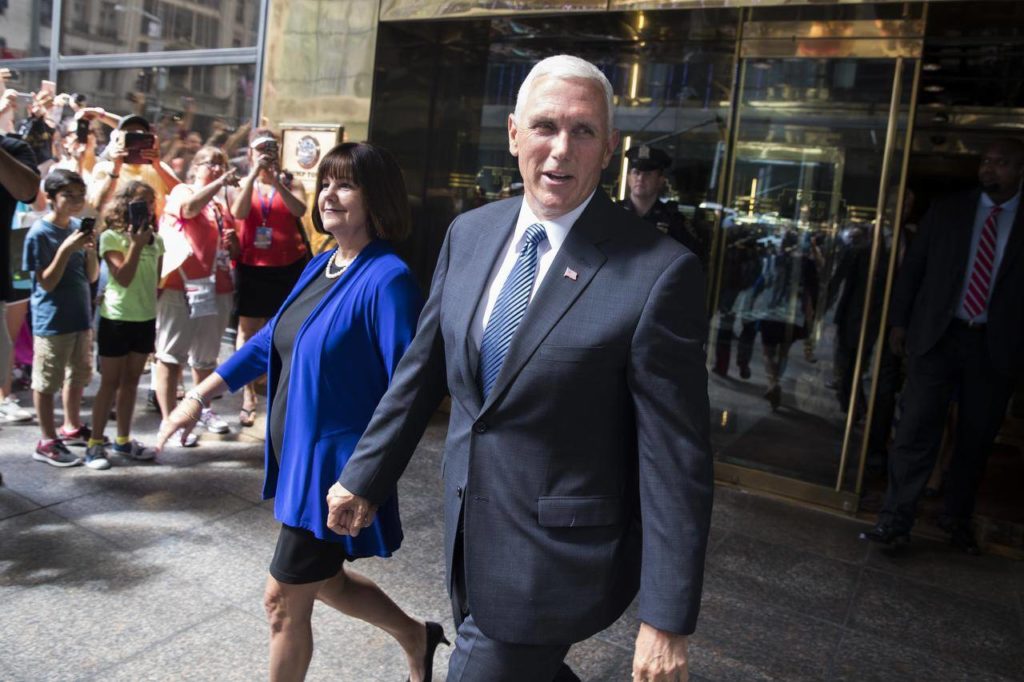
After frenzied, final decision-making, Donald Trump announced Indiana Gov. Mike Pence as his running mate Friday, adding an experienced politician with deep Washington connections to the Republican presidential ticket. Trump’s pick was aimed in part at easing some Republicans’ concerns about his temperament and lack of political experience. Pence spent 12 years in Congress before being elected governor and his demeanor is as calm as Trump’s is fiery. While some conservatives are skeptical of Trump’s political leanings, Pence has been a stalwart ally on social issues. Yet Pence is largely unknown to many Americans. And his solidly conventional political background runs counter to Trump’s anti-establishment mantra. The two men scheduled a news conference for Saturday in New York to present themselves to America as the Republican team that will take on Hillary Clinton and her Democratic running mate in November. The duo will head to Cleveland next week for the Republican National Convention. As Pence arrived for a private meeting with Trump Friday, he told reporters he “couldn’t be more happy for the opportunity to run with and serve with the next president of the United States.” In choosing Pence, Trump appears to be looking past their numerous policy differences. The governor has been a longtime advocate of trade deals such as NAFTA and the Trans-Pacific Partnership, both of which Trump aggressively opposes. Pence also has been critical of Trump’s proposed temporary ban on foreign Muslims entering the United States, calling the idea “offensive and unconstitutional.” The reaction to the Pence choice from Republican officials was overwhelmingly positive — no small feat for Trump, given how polarizing he’s been within his own party. “It was a pick that clearly shows he is pivoting to the general election,” said GOP chairman Reince Priebus, who was in the midst of an interview with The Associated Press when Trump announced his decision. “He is choosing a person who has the experience inside and outside Washington, Christian conservative, very different style that I think shows a lot of maturity.” Pence, a staunchly conservative 57-year-old, served six terms in Congress before being elected governor and could help Trump navigate Capitol Hill. He is well-regarded by evangelical Christians, particularly after signing a law that critics said would allow businesses to deny service to gay people for religious reasons. Clinton’s campaign moved quickly to paint him as the “most extreme pick in a generation.” “By picking Mike Pence as his running mate, Donald Trump has doubled down on some of his most disturbing beliefs by choosing an incredibly divisive and unpopular running mate,” said John Podesta, Clinton’s campaign chairman. Clinton spent Friday holding meetings in Washington about her own vice presidential choice. Massachusetts Sen. Elizabeth Warren, a favorite of liberals and one of the Democrats’ most effective Trump critics, and Colorado Gov. John Hickenlooper, were seen in separate cars that left Clinton’s home. Housing Secretary Julian Castro also met with Clinton, according to a person familiar with the meeting who spoke on condition of anonymity to describe the private gathering. Trump spent weeks weighing vice presidential contenders, including former House Speaker Newt Gingrich and New Jersey Gov. Chris Christie, and only zeroed in on Pence in recent days. In fact, the selection process appeared on the verge of sliding out of control in the final hours before the announcement, sparking speculation that Trump might be changing his mind. Word that Pence would be joining the Republican ticket began trickling out in news reports Thursday before Trump had made a final decision or called Pence to offer him the job, according to a Republican familiar with the situation. Trump was in California for fundraisers, separated from his closest aides, and was fuming about leaks that he viewed as an attempt to pressure him into the decision. Still, Trump called Pence Thursday afternoon to offer him the job and ask him to fly to New York for a Friday morning news conference. Pence accepted and boarded a private plane, along with his wife. A few hours later, a huge truck barreled through a crowded holiday celebration in Nice, France, killing more than 80 people. With Pence sitting in a New York hotel, Trump decided to postpone the announcement. The billionaire businessman then went on Fox News to say he had not yet settled on his “final, final” choice. He also held a midnight conference call with his top aides to discuss the situation, according to two people with knowledge of the call. By Friday, plans were back on track. Trump sent out a Twitter message saying he was pleased to announce Pence as his running mate. Moments later, one of Pence’s aides filed paperwork with the Indiana Secretary of State’s office withdrawing him from the governor’s race. Pence was up for re-election, and state law prohibits candidates from being on ballots in two contests. Trump’s formal announcement came about an hour before Pence’s noon Friday deadline for withdrawing. Paul Manafort, Trump’s campaign chairman, strongly rejected suggestions that the candidate considered changing his mind about Pence. “Never waffled once he made his decision,” Manafort wrote in an email. Gingrich, one of the finalists for the vice presidential spot, said he was “very comfortable” with Trump’s decision and praised Pence as someone who could help unite the party. But as of Friday afternoon, Gingrich had yet to share his support with Trump himself. He told The Associated Press he had not received a call from Trump telling him he wasn’t getting the job. Meanwhile, Trump did speak with Christie, according to a person familiar with their conversation. Ironically, Christie traveled with Trump to Indiana in April to help introduce the candidate to Pence when Trump was trying to win his endorsement ahead of India’s primary. Pence endorsed Trump’s rival Ted Cruz instead. Republished with permission of the Associated Press.
Mike Pence with Donald Trump on blocking some immigration

The Latest on the 2016 presidential campaign (all times local): 10:40 p.m. Indiana Gov. Mike Pence says he supports Donald Trump‘s call to “temporarily suspend immigration from countries where terrorists’ influence and impact represents a threat to the United States.” Pence spoke Friday on Fox News Channel’s “Hannity,” giving his first TV interview since Trump invited him to join the Republican ticket for the White House. Last year, Pence came out against Trump’s proposed temporary ban on foreign Muslims entering the United States, calling such a ban “offensive and unconstitutional.” Trump’s spokeswoman recently said he no longer supports his proposed religious test. Pence says he “stepped up without hesitation” when Trump asked him to be his running mate. He says Trump “understands the anxiety and the aspiration of the American people” like no leader since President Ronald Reagan. __ 9:10 p.m. Hillary Clinton is expressing support for the government of Turkish President Recep Tayyip Erdogan after an attempted military coup rocked Turkey’s capital. The Democratic presidential candidate is urging “calm and respect for laws, institutions, and basic human rights and freedoms — and support for the democratically elected civilian government.” She says, “All parties should work to avoid further violence and bloodshed, and the safety of American citizens and diplomatic missions must be ensured.” Turkish officials say the government appears to have repelled the attempted coup following a night of explosions, air battles and gunfire across Ankara. __ 8:10 p.m. A leader of conservatives making a last-ditch attempt to block Donald Trump’s nomination says she’s dropping her effort to force the Republican National Convention to vote on her plan to let delegates back any presidential candidate they want. The convention rules committee has already rejected Colorado delegate Kendal Unruh‘s proposal to “unbind” delegates from the candidates they were committed to by state primaries and caucuses. Unruh had been saying that despite that defeat, she’d get enough support to force a full convention vote next week on her plan to let delegates vote their conscience. But she said Friday that the Trump campaign and party officials have peeled away that support. She says she and her supporters believe delegates already have the right to vote their conscience and will oppose Trump’s nomination. ___ 5:35 p.m. Donald Trump says the taxes he pays are a private matter. But for candidates auditioning to be his running mate, similar reluctance wasn’t an option. Vice presidential search finalist Newt Gingrich said Thursday that Trump’s campaign required him to submit more than a decade worth of tax returns as part of the vetting process. Vetting potential vice presidents’ tax returns is a standard practice for candidates in both parties — but Trump has so far refused to make his own returns public on the grounds that he is being audited by the Internal Revenue Service. But tax scholars and former IRS officials have noted there is no rule against releasing tax filings during audits and say Richard Nixon released his returns while under audit in 1973. __ 5:15 p.m. Housing and Urban Development Secretary Julian Castro has met with Hillary Clinton at her Washington home as the presumptive Democratic presidential nominee considers her choice for vice president. That’s according to a person familiar with the Friday gathering, who spoke on condition of anonymity to discuss the private meeting. Two other senior Democrats also appeared to meet with Clinton on Friday. Massachusetts Sen. Elizabeth Warren and Colorado Gov. John Hickenlooper were seen in separate cars that departed Clinton’s home Friday afternoon. Clinton is also vetting Virginia Sen. Tim Kaine for the vice presidency and campaigned with him in his home state Thursday. Castro is considered a rising star in the party and is a former mayor of San Antonio. ___ 4:40 p.m. Colorado Gov. John Hickenlooper has visited Hillary Clinton’s Washington home as the presumptive Democratic presidential nominee ponders her choice for vice president. Hickenlooper was in a car that departed Clinton’s Washington home Friday afternoon. The Democratic governor declined to comment on his visit. The apparent meeting came after Massachusetts Sen. Elizabeth Warren visited Clinton’s house earlier Friday. Other candidates Clinton is known to be vetting are Virginia Sen. Tim Kaine and Housing and Urban Development Secretary Julian Castro. A person who spoke on condition of anonymity to discuss internal matters said earlier that Clinton was holding meetings Friday about her running mate selection. ___ 4 p.m. Delegates to the Republican National Convention are embracing Donald Trump‘s choice for vice president — even those who have yet to warm up to Trump. Some delegates hope the choice of Indiana Gov. Mike Pence will help unite Republicans and fire up the party base to support Trump. Not everyone is on board. But at the very least, Trump has all but assured that next week’s convention vote for vice president will go smoothly. Pence has a strong reputation among fellow Republicans as a social conservative. The former congressman has plenty of Washington experience and a calm, thoughtful demeanor that stands in stark contrast to the bombastic Trump. New Hampshire delegate Tom Rath called Pence a solid pick who should reassure a lot of people in the party. __ 3:40 p.m. An application by Bernie Sanders‘ campaign for a permit to rally during the Democratic National Convention has been denied. A spokeswoman for Philadelphia Mayor Jim Kenney says it was rejected because of the requested location in a park across from the convention site. She says the campaign sought to use a certain field that can only be used for recreational purposes. The application said the July 24 rally would be in support of Sanders’ campaign and estimated the crowd size at 15,000 to 40,000 people. Kenney’s spokeswoman, Lauren Hitt, says it’s not too late for the campaign to apply for a different location, if it is still interested. Sanders said Friday he won’t be holding any large rallies during the July 25-28 convention, but will focus on attending smaller events and talking to delegates. __ 3:30 p.m.
Dan Coats says Donald Trump hasn’t made up his mind on VP
The Latest on the 2016 presidential campaign ahead of the Republican and Democratic national conventions (all times EDT): 1:30 p.m. Indiana Sen. Dan Coats says Donald Trump hasn’t made up his mind about who to select as his running mate. Coats told The Associated Press Wednesday that he spoke with Gov. Mike Pence late Tuesday — one of the names on Trump’s shortlist of potential running mates — and Pence told him there’s still no decision. “I think he’s the front-runner,” Coats said, adding, “I think he ought to be the front-runner.” Coats said Pence is “pretty calm about the whole thing.” He added that Trump is cognizant that he needs to make a decision by Friday given gubernatorial succession rules in Indiana. But he concluded that “reading Donald Trump’s mind is not the easiest thing to do.” ___ 1:20 p.m. Hillary Clinton says the Republican Party of Abraham Lincoln has been transformed into “the party of Trump.” Rattling off a series of attacks against her GOP rival, Clinton says Trump is “dangerous,” ”divisive,” ”fear-mongering” and is “pitting American against American.” Even stalwart Republicans, she says, should be alarmed by Trump’s policies and racist rhetoric. Clinton is casting Trump as ignorant of the Constitution, dismissive of U.S. law and lacking the character to be trusted with American security. “Imagine if he had not just Twitter and cable news to go after his critics and opponents, but also the IRS – or for that matter, our entire military,” she says. “Do any of us think he’d be restrained?” ___ 1:07 p.m. Hillary Clinton is calling on the country — including herself — to “do a better job of listening” rather than fueling political and other divisions after a series of high-profile shootings. Clinton says the country must address both gun violence, criminal justice reform and find ways to better support police departments. “I know that just saying these things together may upset some people,” she says. “But all these things can be true at once.” Clinton is speaking in the Illinois Old State House chamber in Springfield, the site of Abraham Lincoln’s his famous address about the perils of slavery. She is trying to use the symbolic site to contrast her call for civility with what she sees as rival Donald Trump’s polarizing campaign. Clinton said she has work to do, as well. She says that as someone “in the middle of a hotly fought political campaign, I cannot claim that my words and actions haven’t sometimes fueled the partisanship that often stands in the way of our progress.” Clinton adds, “I recognize that I have to do better too.” ___ 12:29 p.m. Donald Trump is meeting with finalists for the job of his vice presidential running mate. Trump met Tuesday with New Jersey Gov. Chris Christie and his family. Early Wednesday, Trump and his children met with Indiana Gov. Mike Pence and his family. Former House Speaker Newt Gingrich also was said to be a finalist. All three have auditioned for the job by opening for Trump at campaign rallies over the past week. Trump was expected to make an announcement on Friday. ___ 10:20 a.m. Republican Donald Trump huddled with Indiana Gov. Mike Pence at the governor’s mansion in Indiana on Wednesday morning amid swirling speculation about Trump’s vice presidential deliberations. Pence and Trump walked out of the residence together just before 10:30 a.m. The pair was joined inside by Pence’s wife, Karen, as well as Trump’s daughter, Ivanka, and his son-in-law Jared Kushner. Trump is said to have narrowed his short list down to a trio of top contenders, including Pence. Pence joined Trump at a fundraiser and a rally on Tuesday where he received a warm reception from the crowd. ___ 10:15 a.m. The lead super PAC backing Democratic presidential candidate Hillary Clinton has begun targeting Spanish-speaking voters in Colorado, Nevada and Florida as part of a $35 million online effort it announced earlier this year. An online ad from Priorities USA features video clips of Trump calling Hispanics “drug dealers” and “criminals” and leading his supporters in the chant: “Build that wall! Build that wall! Build that wall!” In Spanish, an on-screen message declares that “hatred is growing in our country.” The ad campaign also includes a website: unidoscontratrump.org, which means “united against Trump.” The same message will appear in banner ads on social media. The three targeted states all have significant Latino populations. Trump insists he can do better among Hispanics than the less-than-30 percent Republican Mitt Romney drew in 2012 after calling for “self-deportation” for immigrants in the country illegally. ___ 7:35 a.m. Bernie Sanders says he agrees with the harsh remarks that Justice Ruth Bader Ginsburg has made about Republican presidential candidate Donald Trump. The Vermont senator declined to say whether it is appropriate for a sitting Supreme Court justice to openly criticize a White House contender. But he tells ABC’s “Good Morning America” that he agrees Trump is a “total opportunist” and said “the record clear is quite clear that he lies just a whole lot of the time.” Ginsburg in a series of interviews with The Associated Press, The New York Times and CNN has called Trump unqualified to be president and joked that she would move to New Zealand if he won. Trump said in a tweet that Ginsburg should resign. Sanders’s comments came a day after he formally endorsed Hillary Clinton as the Democratic nominee for president. Asked if he is open to being her running mate, Sanders said, “I doubt that will happen.” He said his focus is on helping Clinton win. He says, “We cannot have a man with Trump’s temperament with the nuclear code and running this country.” 5:25 a.m. Hillary Clinton is turning to the symbolism of Abraham Lincoln’s “House Divided” speech to argue that the nation needs to repair its divisions after high-profile shootings in Texas, Louisiana and Minnesota. Clinton’s campaign says the Democratic presidential candidate will talk about the importance of uniting
Alabama not alone: 1 of 22 states facing budget shortfalls

With the nation’s economy at its healthiest since the Great Recession, a surprising trend is emerging among the states — large budget gaps. An Associated Press analysis of statehouse finances around the country shows that at least 22 states project shortfalls for the coming fiscal year. The deficits recall recession-era anxiety about plunging tax revenue and deep cuts to education, social services and other government-funded programs. The sheer number of states facing budget gaps prompted Standard & Poor’s Ratings Service to call the trend a sort of “early warning.” “After all, if a state is grappling with a budget deficit now, with the economic expansion approaching its sixth anniversary, what will be its condition when the next slowdown strikes?” credit analyst Gabriel Petek wrote in a recent report. The forces at work today are somewhat different than when the recession took hold in 2008. In some states, revenue growth has been stagnant, missing projections and making it difficult to keep pace with expanding populations and rising costs for health care and education. Other states have been hurt by a steep decline in oil prices or seen their efforts to promote growth through tax cuts fail to work as anticipated. The result is a nation divided between states such as California and Colorado that are riding the wave of the economic recovery and others such as Illinois and Pennsylvania that appear closer to bust than boom. A majority of states have failed to climb back to their pre-recession status, in terms of tax revenue, financial reserves and employment rates, said Barb Rosewicz, who tracks the fiscal health of states for The Pew Charitable Trusts. Alabama, for example, faces a $290 million shortfall after a voter-approved bailout expires at the end of the current fiscal year. Projected cuts would create a $27 million hole in the state’s court system, forcing more than 600 layoffs and leaving just one juvenile probation officer and two clerical staffers in each county, said Rich Hobson, administrative director for the Alabama Unified Judicial System. If nothing is done, the courts will not have the staff to send jury notices, monitor juvenile delinquents, process protection orders and collect and distribute child support payments, he said. “This is an insane proposition,” Hobson said. “The public would suffer.” To avoid the cuts, Republican Gov. Robert Bentley has proposed raising $541 million through increases in the tobacco tax and sales taxes on automobiles. A top Republican in the Alabama Senate has introduced a gambling bill that would ultimately ask voters to decide whether to create a state lottery and allow four casinos. Lawmakers in some other states, including Nevada, Connecticut and Pennsylvania, have also debated whether to raise taxes. Nationally, total tax revenue coming to the states has been rising, but the pace has been slow as employment continues to lag pre-recession levels in more than half the states, according to the Pew Charitable Trusts. Pew also found that 30 states are collecting less revenue than at their peak. “What we are seeing across states right now is an economic and financial recovery that is a little bit different than the recoveries we’ve seen in the past,” said Emily Raimes, a vice president with Moody’s Investors Service who tracks state government finances. Previous recoveries were broader, she said, benefiting more states and allowing them to replenish their financial reserves. The Census Bureau recently reported that total state government tax collections in fiscal year 2014, which in most states ended last June, increased 2.2 percent over the previous fiscal year. That represented the fourth consecutive overall increase, but 17 states reported declines in tax revenue from the previous fiscal year, according to the report. Alaska saw the biggest drop, of $1.7 billion. Alaska relies heavily on oil revenue and projects a $3.2 billion budget shortfall for the coming fiscal year. A special legislative session has been called after lawmakers failed to agree on a way to fund the budget, even though the state has plenty of money in reserves to cover the gap. That’s not the case in Illinois, where lawmakers are trying to figure out how to close a $6 billion projected shortfall for the next fiscal year, due largely to the expiration of a temporary tax increase. Republican Gov. Bruce Rauner, who campaigned against the tax plan, has suggested cuts to health care, local governments and other areas. But lawmakers in the Democratic-led General Assembly say spending cuts alone will not close the gap. In Kansas, the Republican governor and GOP-dominated Legislature now confront budget deficits after aggressive tax cutting that prompted them to reduce school funding this spring. Districts across the state have cut staff and programs such as summer school, and at least eight are ending the current school year early to save money. That includes the Shawnee Heights district outside Topeka, where students will begin their summer break two days early. Lawmakers passed a new school funding law that promises the money will be restored and state aid will rise each of the next two fiscal years, but educators are skeptical. “There’s no rational person in education who would think we’ll be getting that money, when the state budget is tanking,” said Charles Walther, a middle school history, government and geography teacher who heads the district union. Republished with permission of the Associated Press.
