
Exclusive: Roy Moore rebounds in polls as accusations are discredited
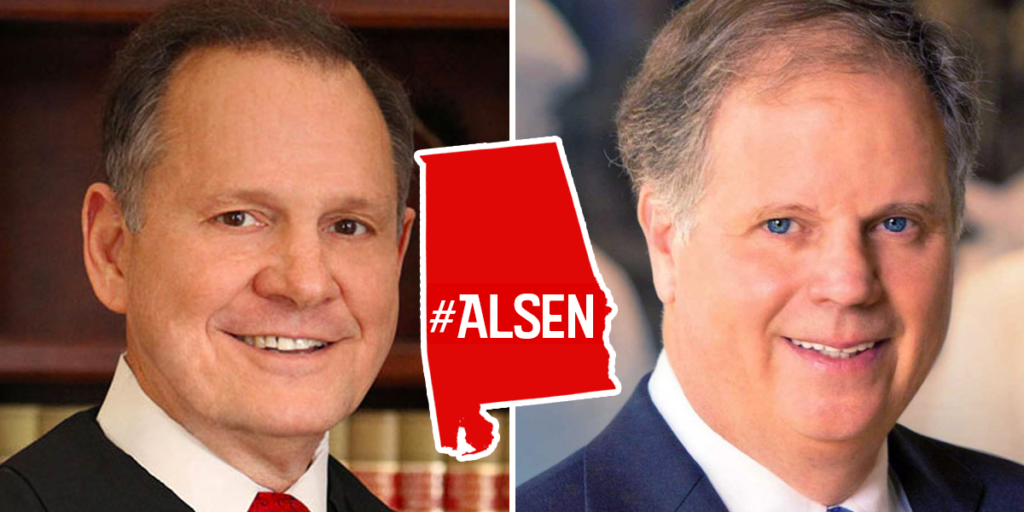
Alabama’s special U.S. Senate election is less than one month away and a new poll shows Republican nominee Roy Moore holding a solid lead over his Democratic opponent Doug Jones. In a poll conducted by Sky Research on Tuesday Nov. 21 among registered Alabama voters, the results show Moore with 46.7 percent support to Jones’ 39.6 percent. 13.7 percent of voters polled remain undecided. With a margin of error of 3.1 percent, Moore maintains significant lead over Jones, but the undecided voters could swing the election either way. When asked “Do you consider your political views to be more in line with the Republican or Democrat party?,” 62.3 percent of 1,059 respondents identified as Republican, while 37.7 percent Democrat. The results come as President Donald Trump on Tuesday avowed his support for the former Alabama Chief Justice for first time since Moore was accused of sexually pursuing at least nine women when he was in his 30s and they were in their teens. Trump had previously said, through the White House Press Secretary Sarah Huckabee Sanders, “Like most Americans, the president believes we cannot allow a mere allegation, in this case, one from many years ago, to destroy a person’s life. However, the president also believes that if these allegations are true, Judge Moore will do the right thing and step aside.” On Tuesday, Trump himself said Moore “totally denies” the allegations against him. Reiterating that the country doesn’t “need” liberal Jones in the seat. “Let me just tell you, Roy Moore denies it. That’s all I can say. He denies it. By the way, he totally denies it,” Trump told reporters as he was departing Washington for his Mar-a-Lago resort for the Thanksgiving holiday. “I can tell you one thing for sure, we don’t need a liberal person in there, a Democrat. I’ve looked at his record — it’s terrible on crime, it’s terrible on the border, it’s terrible on the military.” Tuesday’s poll comes in sharp contrast to Louisiana-based JMC Analytics poll AL.com reported on just a week ago Sunday, just three days after the allegations first came out. “The poll had Jones received 46 percent support in the poll to Moore’s 42 percent. With a margin of error of 4 percent, however, the race is essentially a statistical tie,” reported AL.com. Since that time, women from across the state have stepped forward defending Moore’s character. On Friday, on the steps of the Alabama State Capitol, more than 30 women stood united in their support of the embattled nominee. There, Ann Eubank, the statewide co-chair of Rainy Day Patriots, and the legislative chair of the Alabama Legislative Watchdogs, spoke on behalf of Moore’s character going so far as to say if the ” state Republican Party decide to remove Moore from the ballot, or if they worked to disallow or decertify an election won by Moore, there would be a revolt, which she said would be ‘bad’ for Republicans in next year’s statewide election.” Among the accusations that have been debunked is that Moore was banned from the Gadsen Mall. A former manager appeared on WBRC news to say though they did have written reports of those who were banned he did not recall Moore ever being on that list. That report is in addition to statements released on Monday, where several witnesses came forward to discredit the accusations made by Beverly Nelson and her lawyer Gloria Allred against Moore. On Monday, Rhonda Ledbetter, a retired public school teacher who is currently the senior choir director at a Baptist church and teaches children at a local, church-sponsored day care center, went on record debunking Beverly Nelson’s claim against Moore. “When I heard Beverly Nelson’s story, there were several details that were different from what I remember. I was nervous at coming forward because of all the attention this story has gotten, but as a moral and ethical person I had to speak up about what I know to be true,” Ledbetter recounted. “I was a waitress at Olde Hickory for almost three years from 1977-1979, and I never saw Roy Moore come in to the restaurant. Not one time.” Moore faces the Democratic nominee Doug Jones in the special election on Dec. 12.
POLL: Alabama Senate race tied following bombshell allegations against Roy Moore
A new Friday poll shows the U.S. Senate race in Alabama is now too close to call, following a bombshell report on Thursday that accuses Republican nominee Roy Moore pursued a sexual encounter with a 14-year-old girl in 1979. Moore has denied the allegations. The Decision Desk HQ–Opinion Savvy poll found 46.4 percent of likely Alabama voters surveyed said they support Moore, while 46 percent said they support the Democratic nominee Doug Jones. In the previous survey, Moore lead Jones by 5.7 percent. Jones now holds a sixteen point lead over Moore among women, down 10 percent from the September poll. While Moore enjoys a twenty point lead among men, which has gone up 1 percent. When asked whether or not they have heard about the allegations against Moore, most respondents had. 82 percent said they had heard the news. And when asked whether Moore should withdraw from the race, 34.9 percent of respondents said yes, while 54 percent replied no. The poll was conducted on November 9th of 515 likely voters via landline and mobile. The poll has a margin of error of 4.3 percentage points. Moore and Jones face-off in the Alabama Senate special election on Dec. 12. The entire poll is viewable here.
In poll, people say Donald Trump tax plan benefits rich, companies
Most Americans say President Donald Trump‘s tax plan would benefit the wealthy and corporations, and less than half believe his message that “massive tax cuts” would help middle-class workers, according to an Associated Press-NORC poll. The survey could serve as a warning sign for Trump as he pushes Republicans to support his proposal. The president and GOP lawmakers are seeking a major legislative victory before the 2018 elections. For all the differences of opinion over the details of tax changes, the poll shows a large and bipartisan appetite for tax cuts for middle-class families. Majorities of both Republicans and Democrats think the middle class and small businesses pay too much and that the wealthy and large corporations pay too little. But doubts and partisan differences emerge when Americans size up whether the middle class will truly benefit from Trump’s plan, says the survey conducted by the AP-NORC Center for Public Affairs Research. Just 43 percent of those of adults who have heard at least a little bit about the plan think it would help the middle class. And on that, there’s a large partisan divide: 79 percent of Republicans and 19 percent of Democrats share that sentiment. “The more we give tax breaks to the wealthy, we’ve gone down that road before in the Bush regime,” said Democrat Benjamin Orris, a 36-year-old educator from Evanston, Illinois. “That brought us into the Great Recession – almost back to the Great Depression.” Darron Smith, a 49-year-old Trump voter from West Des Moines, Iowa, said the tax plan would help him as a single parent. He predicted lower taxes would lead to more consumer spending. As for the warnings from Democrats, Smith said he remembered hearing the same arguments during President Ronald Reagan’s tenure. “Any time Republicans want to do a tax cut, the first thing Democrats say is it’s going to help the rich. I don’t see it that way,” Smith said. Trump has held weekly events since late August on his tax overhaul, arguing the United States must slash the corporate rate to remain competitive and shrink the number of tax brackets. The Trump administration has suggested cutting corporate rates and overhauling the tax system could provide a $4,000 annual pay raise to the average family. Democrats and other critics question whether lower corporate rates and other changes would result in that kind of increase for families. Trump and congressional Republicans also want to repeal inheritance taxes on multimillion-dollar estates. “Our plan can be summarized in three simple words: jobs, jobs, jobs,” Trump said in the Oval Office on Tuesday. But the AP-NORC poll shows a negative undercurrent surrounding the plan, and majorities in both parties view the proposal as a boon for the rich and corporate interests. The poll found 69 percent of adults who have heard at least a little bit about the plan think it would help large corporations. The sentiment was bipartisan, including 70 percent of Democrats and 69 percent of Republicans. Also, 60 percent said the tax push would bolster the wealthy, with 67 percent of Democrats and 54 percent of Republicans viewing it that way. “I have no confidence in his tax plan,” said Democrat Nancy Bauhs, a 70-year-old retired sweater designer from New Holstein, Wisconsin. Fifty-four percent of those questioned, including 58 percent of Republicans and 52 percent of Democrats, think they personally pay too much in taxes. The survey found that 56 percent said they think middle-class households pay too much, while 56 percent say the same about small businesses. By contrast, 72 percent say the wealthy and large corporations pay too little in taxes. The administration has been actively trying to sell the plan. House Republicans are expected to consider a budget measure this week that would serve as a precursor to the tax overhaul, and administration officials have promoted the plan at events around the country. Vice President Mike Pence, in a Tuesday speech to the GOP-leaning American Enterprise Institute, noted that Trump “doesn’t like talking about tax reform, he likes talking about tax cuts because he wants the American people to know we are cutting taxes for every American.” “And when we cut taxes on businesses, it’s going to benefit working Americans. So I encourage you to go make that case,” Pence said. Large majorities of Americans think tax cuts for small businesses, middle-income people and lower income people would help the economy. But the poll shows people taking the opposite view for the wealthy and corporations. The poll found 51 percent think tax cuts for the wealthy would hurt the economy compared with 23 percent who thought it would help. Also, 48 percent said tax cuts for large corporations would hurt the economy compared with 31 percent who think they would help. Two-thirds of Democrats think tax cuts for the wealthy would hurt the economy. Among Republicans, about one-third said tax cuts benefiting the wealthy would help the economy, one-third said they would hurt and the final third think they would make no difference. There’s greater disagreement on the impact of cuts for large corporations: Democrats are more likely to think they would hurt rather than help the economy (59 percent to 20 percent) while Republicans are more likely to think they would help than hurt (49 percent to 30 percent). The AP-NORC poll of 1,054 adults was conducted Oct. 12-16 using a sample drawn from NORC’s probability-based AmeriSpeak panel, which is designed to be representative of the U.S. population. The margin of sampling error for all respondents is plus or minus 4.0 percentage points. Respondents were first selected randomly using address-based sampling methods, and later interviewed online or by phone. Republished with permission from the Associated Press.
Poll: Most don’t want young immigrants deported
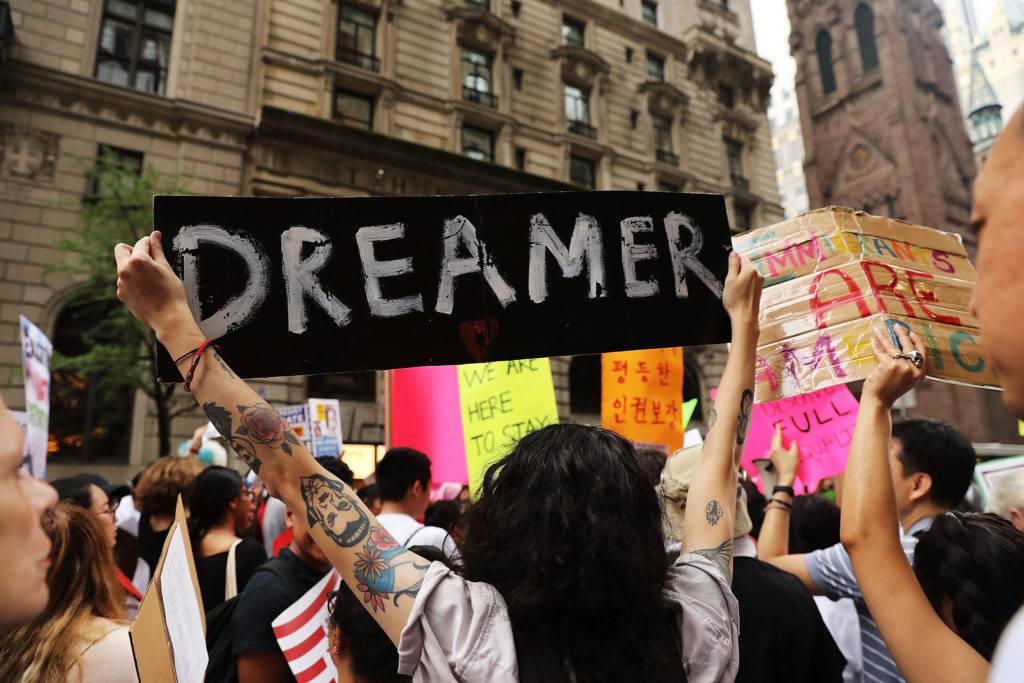
Just 1 in 5 Americans want to deport young immigrants brought to the United States as children and now here illegally, the focus of a politically fraught debate between the White House and Congress. Americans also have largely negative opinions about President Trump’s signature immigration pledge to build a wall along the entire U.S.-Mexico border, according to a new poll by The Associated Press-NORC Center for Public Affairs Research. Just under half – 49 percent – oppose construction while 32 percent support it. On Sunday, Trump told lawmakers his hardline immigration priorities, including the wall, must be approved if he is to go along with protecting the young immigrants from deportation. About 800,000 young immigrants had been given a deportation reprieve under President Barack Obama‘s Deferred Action for Childhood Arrivals, also known as DACA, until Trump ended the program last month. He’s given Congress six months to act. About 60 percent of Americans favor allowing those young immigrants, commonly referred as “Dreamers,” to stay in the U.S. legally, compared to 22 percent who are opposed. Just 19 percent of respondents say all these childhood arrivals should be deported. Sixty-eight percent of Hispanics, 61 percent of blacks and 57 percent of whites favor extending protections. Eight in 10 Democrats favor allowing the young immigrants to stay legally. So do more than 4 in 10 Republicans. “For the ones who are already here, there should be a way for them to stay because it wasn’t their fault,” said Nik Catello, a 57-year-old independent film producer from Orange County, California. “But you have to give them a path to citizenship.” Showing sympathy for the young immigrants does not always translate into softer views on immigration. Catello, for example, favors the construction of a wall along the Mexican border. Among those who favor a border wall, 38 percent also favor allowing “Dreamers” to stay. “What you see is growing support within the voters overall in giving Dreamers a path to citizenship,” said Todd Schulte, president of FWD.us, an immigration advocacy group founded by Facebook CEO Mark Zuckerberg. “Giving Dreamers the ability to earn citizenship is the most popular bipartisan, not just immigration, issue, the single most united issue in the country.” When Trump ordered the phase-out of the DACA program last month, he gave 150,000 young immigrants the chance to quickly renew permits that are to expire before March 5. Officials say that more than 35,000 didn’t make his Oct. 5 deadline. And many others will see their status begin expiring after March 5, unless Congress acts before then. Trump suggested at the time that he was eager for a deal to settle the matter, telling reporters, “I have a love for these people and hopefully now Congress will be able to help them and do it properly.” He also tweeted that if Congress was unwilling to find a fix, he would “revisit this issue!” in six months. Trump had previously said he wanted a DACA deal to include significant money for border security and eventual funding for the wall. But the priorities released by the White House this week went far beyond that. The White House’s demands include limiting green cards to spouses and minor children of U.S. citizens and lawful permanent residents, hiring 10,000 more immigration enforcement officers and making it easier to deport unaccompanied children. The White House says the measures are to soften the impact on the U.S. caused by granting benefits to DACA recipients. Carolyn Kurtz, a 62-year-old retired engineer from Monument City, Colorado, who wants protections for young immigrants, said Trump hasn’t done “the research necessary” on immigration. “Do I believe that immigration should be more carefully monitored and maybe limited? Yes. But the way he wants to go about it is not the way to do it,” Kurtz said. She called the president’s stance “very close-minded.” Two-thirds of Americans – 64 percent – say they disapprove of Trump’s handling of immigration, and a similar percentage – 65 percent – say the same of his handling of foreign policy. Both of those are similar to Trump’s overall approval rating. The poll also revealed more Americans favor than oppose another aspect of Trump’s immigration policy – his latest travel ban. Forty-four percent favor it compared to 37 percent who say they are against the new rules. In September, the administration announced the most recent restrictions which affect citizens of Chad, Iran, Libya, North Korea, Somalia, Syria, and Yemen – and some Venezuelan government officials and their families. They are to go into effect Oct. 18. It was the administration’s third try at limiting travel after a broader ban sparked chaos in January and was challenged in courts across the country. The AP-NORC poll of 1,150 adults was conducted Sept. 28-Oct. 2 using a sample drawn from NORC’s probability-based AmeriSpeak panel, which is designed to be representative of the U.S. population. The margin of sampling error for all respondents is plus or minus 4.1 percentage points. Respondents were first selected randomly using address-based sampling methods, and later interviewed online or by phone. Republished with permission from the Associated Press.
Poll says Democrat Doug Jones nearly tied with GOP candidates in Ala. Senate race
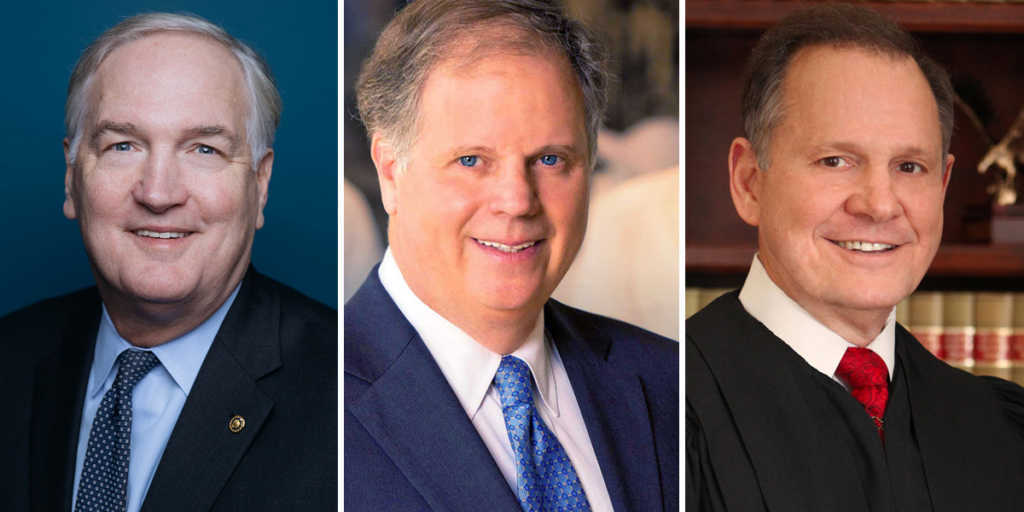
According to a new poll, Democrat Doug Jones has the potential to pull an upset in Alabama’s U.S. Senate race in December. On Dec. 12, Jones will face-off against a Republican challenger — either current, interim Sen. Luther Strange or former Ala. Chief Justice Roy Moore, which will be determined in a run-off Sept. 26 — where, according to the new poll from Emerson College, he’s with striking distance. The poll finds Jones trailing both Republicans by only a handful of points — Moore leads Jones by four percentage points, meanwhile Strange leads him by only three points. While the results make the race a statistical dead heat, the Yellowhammer State has traditionally been one of the reddest of red states. The last time the state voted for a Democrat for president was back 1976, and the last time it voted a Democrat to the Senate was twenty years ago, in 1997. Nevertheless, according to the poll, the constant-GOP infighting between Strange and Luther has put a bad taste in many voter’s mouths. “The GOP will need to find a way to unite during the 11 weeks until the General Election, or face the prospect of Jones pulling off an upset,” reads the poll. Which begs the question — can the GOP unify behind the run-off victor? Or will there be a Jones upset? Only time will tell.
New polling shows tight race for Roy Moore, Luther Strange in GOP Senate primary
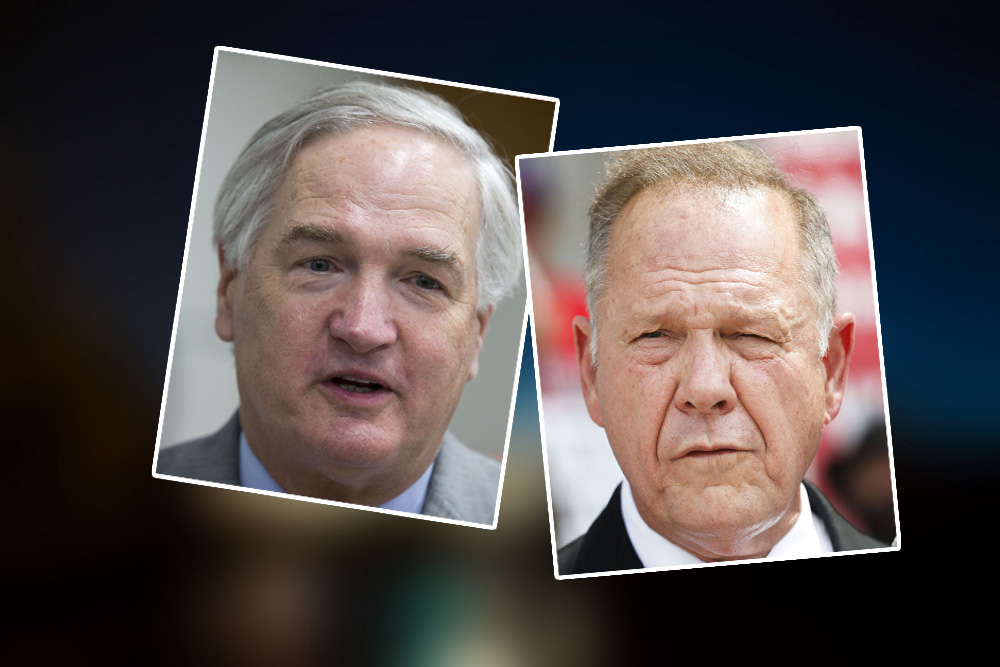
As the contentious Alabama U.S. Senate race heats up, new polling shows a tight contest between former Alabama Supreme Court Chief Justice Roy Moore and sitting U.S. Sen. Luther Strange. The Montgomery Advertiser reports on a new poll of 426 likely Republican voters showing Moore holding a narrow lead over Strange, 31 percent to 29 percent. The numbers were within the poll’s 5 percent margin of error. Huntsville Republican Congressman Mo Brooks comes in third at 18 percent, with state Sen. Trip Pittman of Baldwin County gets 8 percent and Alabama Christian Coalition president Randy Brinson with 2 percent. Eleven percent are undecided. Other Republican candidates on the ballot include Dr. James Beretta, Joseph Breault, Mary Maxwell and Bryan Peeples Meanwhile, SuperPAC’s are preparing ahead of the Aug. 15 Republican special primary. Senate Leadership Fund, the committee linked to Majority Leader Mitch McConnell, has banked over $1.5 million in 26 days in July. SLF has been spending heavily to back Strange, appointed to the Senate seat in February after Jeff Sessions stepped down to become Donald Trump’s Attorney General. According to Federal Election Commission reports, mostly through a $1 million check from hedge fund manager Steven A. Cohen and $250,000 from Phil Ruffin, owner of the Treasure Island Hotel and Casino in Las Vegas. Most of SuperPAC’s attention in the race has been focused on Brooks, attacking him for lack of fidelity to then-candidate Donald Trump, who later carried Alabama easily in the 2016 presidential race. Recently, the group opened up a second front with some new attack ads targeting Moore, a popular far-right social conservative. The National Rifle Association of America Political Victory Fund also reported spending $43,117 on radio ads to boost Strange, according to a newly filed independent expenditure report dated Aug. 2. The race will most likely result in a Sept. 26 runoff between the two top vote getters, since it appears that no single candidate will receive a majority. The last day to apply for an absentee ballot for the primary is Thursday, Aug. 10.
Americans and guns: It’s really complicated, survey shows

Americans have long had a complex relationship with guns. Now, a new study shows that the country’s deep political divide is reflected in attitudes toward gun control. The Pew survey released Thursday found a sharp drop in overall support for gun control despite common ground on some key issues. For example, when people were asked whether it was more important to protect gun rights or control gun ownership, 51 percent favored gun control and 47 percent favored gun rights. Compare that with responses in 2000, when two-thirds of those surveyed said they supported gun control measures. People in the new survey were in broad agreement when asked about specific gun control measures. Some 89 percent supported preventing the mentally ill from buying guns and 84 percent of all adults supported background checks for private sales and at gun shows. Barring gun purchases for people on no-fly lists won support from 83 percent, while 71 percent of adults, including a small majority of gun owners, supported a federal database tracking gun sales. The survey showed wide disparities in how people view firearms along political, gender, racial and geographic lines. The gaps come at the start of President Donald Trump’s term. He is seen as one of the most gun-friendly presidents and could be supported by a Republican-controlled Congress, although there has been little action on gun issues since January. About half of the public said making it more difficult to purchase a firearm would mean fewer mass shootings, while a little over one-third said it would have no impact. Most people attribute gun violence to the ease in illegally getting access to a firearm, and the public can’t decide whether making it easier to legally purchase a firearm would lower or raise the crime rate. Republicans have made the most significant shifts on guns while Democrats have remained consistent in their views, said Kim Parker, Pew’s director of social trends research. “This reflects that the issue has really become more polarized, more driven by partisan attitudes,” Parker said. The study also showed that people in the United States, whether they own a firearm or not, have broad exposure to guns. At least two-thirds have lived in a household with guns and about 70 percent have fired a gun. The main reason most cited for wanting to own a gun? Protection. Two-thirds of gun owners say they own a gun to protect themselves or loved ones. Nearly one-third of gun owners have five or more. Still, just one-quarter of them said they usually carry a firearm outside the home. That willingness to purchase a firearm is despite the fact that 44 percent of adults said they personally know someone who was shot and about one-quarter say they or a family member have been threatened or intimidated by someone with a gun. The Pew Research Center sought to better understand Americans’ “complex relationship” with firearms. Researchers wanted to see people’s views on various policy issues – from safe storage of firearms around children to limits on who and where someone can carry a gun. Republished with permission of The Associated Press.
Poll: Few favor Donald Trump’s move to ditch Paris accord
Less than one-third of Americans support President Donald Trump‘s decision to withdraw from the Paris climate accord, a new poll shows, and just 18 percent of respondents agree with his claim that pulling out of the international agreement to reduce carbon emissions will help the U.S. economy. The survey conducted by the Associated Press-NORC Center for Public Affairs Research earlier this month found that a slim majority – 52 percent – worry that withdrawing will actually hurt the economy. Twenty-seven percent think it won’t have an impact either way. But digging deeper into the numbers shows a sharp partisan divide on global warming, with Republicans more likely to align themselves with the president’s views. Seventy-eight percent of Democrats think withdrawing from the Paris agreement will hurt the national economy. Among Republicans, just 24 percent think it will hurt, 40 percent think it will have no impact and 34 percent think it will help. Donald Nolan is a New Jersey businessman who has spent years living and traveling overseas. He worries that Trump is undermining U.S. credibility abroad. An independent voter, Nolan said he strongly opposes pulling out of the Paris accord. “Where I live, we’re 36 feet above sea level. It the polar ice caps melt, there won’t be any dry land here,” said Nolan, 60. “If you are pulling out of something that pretty much every other country in the world is a part of, then that is not seen as being a leader. When I lived overseas, America was always looked at as being first. But I see our position to be deteriorating.” Overall, 44 percent of Americans are very concerned and 26 percent are moderately concerned that withdrawing from the agreement will hurt the country’s standing in the world, with that concern also dividing along party lines. By a 46 percent to 29 percent margin, more oppose than favor the U.S. withdrawing from the agreement. Democrats are far more likely to oppose than support withdrawing from the agreement, 69 percent to 16 percent. Republicans are more likely to support Trump’s withdrawal, 51 percent to 20 percent. Independents are mixed in their views. Twenty-five percent support the withdrawal, 36 percent are opposed and 37 percent don’t feel strongly one way or the other. Similarly, 43 percent say they’re very or extremely concerned that the U.S. withdrawing from the agreement will hurt global efforts to fight climate change, while 25 percent are moderately concerned. Seventy-two percent of Democrats, but just 13 percent of Republicans, are very concerned about the withdrawal hurting global efforts to fight climate change. Sixty-four percent of Americans disapprove and just 34 percent approve of how Trump is handling the issue of climate change, the poll shows. That’s similar to his overall approval rating, but there are other areas where Trump performs a bit better. For example, 43 percent approve of how he’s handling the economy and 47 percent approve of how he’s handling the threat of terrorism. The poll shows about two-thirds of Americans think that climate change is happening, while only about 1 in 10 think it’s not. The remaining quarter aren’t sure one way or another. Seven in 10 Americans – including some of those who aren’t sure whether climate change is actually happening – think it’s a problem that the U.S. government should be working to address. Among those who do think it’s a problem the government should address, more oppose than support withdrawing from the Paris agreement by a 60 percent to 21 percent margin. More than half of Americans -53 percent – say climate change is a very or extremely important issue to them. Women are more likely than men to call climate change an important issue, 59 percent to 47 percent. Bonnie Sumner, an independent voter who has lived in Colorado the last nine years, is among those who said doing something to combat climate change is important. She said her community in the Rocky Mountains is still dealing with the after effects of a devastating wildfire. “It’s definitely gotten hotter than it used to be,” said Sumner, 72. “I try to keep up with science, not people who have money to be made by not wanting things to change.” The poll shows that 35 percent of Americans have a great deal of confidence in the scientific community, 51 percent have some confidence, and 11 percent have hardly any confidence. But, again, there’s a big political divide: 53 percent of Democrats, but just 22 percent of Republicans and 19 percent of independents, say they have a great deal of confidence in scientists. Sumner said Trump is too quick to dismiss the evidence of global warming compiled by climate scientists. “His position, as it is with too many other things, is, ‘I know what’s best, I know better than everybody else, and this is a hoax, and this is fake news,’” she said. “I’m frightened for us, my children and my grandchildren. We only have one earth, we have to work together.” — The AP-NORC poll of 1,068 adults was conducted June 8-11 using a sample drawn from NORC’s probability-based AmeriSpeak panel, which is designed to be representative of the U.S. population. The margin of sampling error for all respondents is plus or minus 4.1 percentage points. Respondents were first selected randomly using address-based sampling methods, and later interviewed online or by phone. Republished with permission of The Associated Press.
Poll: Most young people say gov’t should pay for health care

Most young Americans want any health care overhaul under President Donald Trump to look a lot like the Affordable Care Act signed into law by his predecessor, President Barack Obama. But there’s one big exception: A majority of young Americans dislike “Obamacare’s” requirement that all Americans buy insurance or pay a fine. A GenForward poll says a majority of people ages 18 to 30 think the federal government should be responsible for making sure Americans have health insurance. It suggests most young Americans won’t be content with a law offering “access” to coverage, as Trump and Republicans in Congress proposed in doomed legislation they dropped March 24. The Trump administration is talking this week of somehow reviving the legislation. Conducted Feb. 16 through March 6, before the collapse of the GOP bill, the poll shows that 63 percent of young Americans approve of the Obama-era health care law. It did not measure reactions to the Republican proposal. The most popular element of the law is allowing young adults to stay on their parents’ insurance until age 26, which is favored by 75 percent of 18-30 year olds. It’s not just that they personally benefit — an Associated Press-NORC Center for Public Affairs Research poll conducted in January found that provision was equally popular among all adults. That proposal was included in the failed GOP overhaul. But the Republican plan also contained provisions that most young Americans — the racially diverse electorate of the future — do not support, according to the poll. Two-thirds of young people agree with a smaller majority of Americans overall that the government should make sure people have health care coverage. And they understand that will cost more: Sixty-three percent want the government to increase spending to help people afford insurance. Those feelings cut across racial lines and include most whites, who formed the base of Trump’s political support in the presidential election. “I do believe the government should offer it because we pay taxes,” said Rachel Haney, 27, of Tempe, Arizona. “I do feel like it’s a right.” GenForward is a survey of adults age 18 to 30 by the Black Youth Project at the University of Chicago with the AP-NORC Center. The poll pays special attention to the voices of young adults of color, highlighting how race and ethnicity shape the opinions of a new generation. Only about a quarter of young people want “Obamacare” repealed. That includes 16 percent of young adults who want it repealed and replaced as Trump has vowed and another 10 percent who want it repealed without a replacement. Just over a third of young whites want to see the law repealed, making them more likely than those of other racial and ethnic groups to say so. “He just wants to protect us from al-Qaida, and terrorism,” said Kervin Dorsainvil, 18, a computer technician from Port Charlotte, Florida. “I feel like health care should be much higher on the list. I feel like we have the resources, the medical technology and everything in place to provide the health care to the people. So why wouldn’t we do that?” Young people are more likely than Americans overall to say the government should make sure people have health care. A recent AP-NORC poll of U.S. adults, conducted during and after the collapse of the GOP proposal, found just 52 percent called it a federal government responsibility to make sure all Americans have coverage. Despite their overall approval of “Obamacare,” young Americans’ views on the law aren’t all rosy. Just a third say the law is working relatively well, while another third think the health care policy has serious problems. About 2 in 10 consider the law to be fatally flawed. The law’s requirement that all Americans buy insurance or pay a fine is opposed by 54 percent of young people and favored by just 28 percent. On the other hand, 71 percent favor the law’s Medicaid expansion, 66 percent of young adults favor the prohibition on denying people coverage because of a person’s medical history, 65 percent favor requiring insurance plans to cover the full cost of birth control, 63 percent favor requiring most employers to pay a fine if they don’t offer insurance and 53 percent favor paying for benefit increases with higher payroll taxes for higher earners. About a quarter of young adults say they personally have insurance through their parents, while another 1 in 10 have purchased insurance through an exchange. ___ The poll of 1,833 adults age 18-30 was conducted using a sample drawn from the probability-based GenForward panel, which is designed to be representative of the U.S. young adult population. The margin of sampling error for all respondents is plus or minus 4 percentage points. The survey was paid for by the Black Youth Project at the University of Chicago, using grants from the John D. and Catherine T. MacArthur Foundation and the Ford Foundation. Respondents were first selected randomly using address-based sampling methods, and later interviewed online or by phone. Republished with permission of The Associated Press.
Poll: Americans divided on admitting refugees
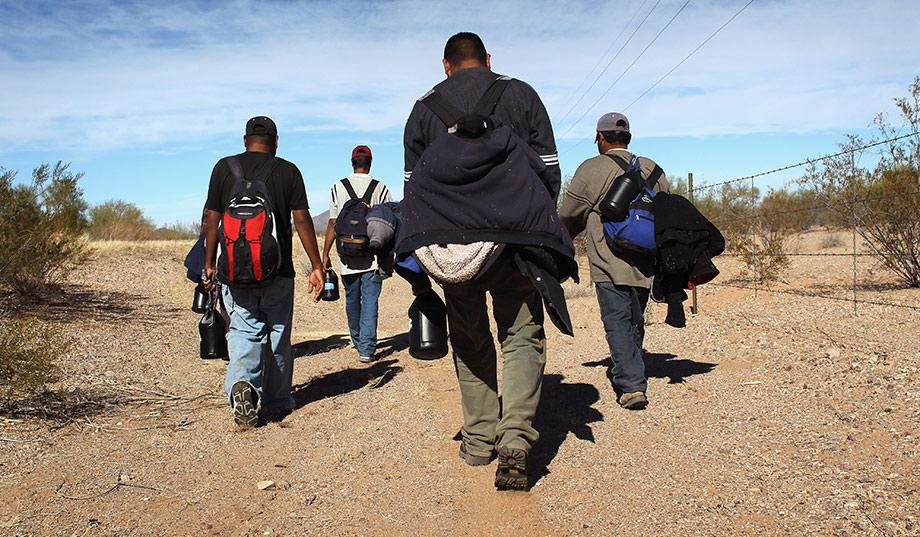
Where immigrants are concerned, James Wright is OK with people who are here legally, as well as illegally – if they haven’t committed crimes. But turn the talk specifically to the risks and benefits of admitting refugees to the U.S., and the New Jersey resident gives a fraught sigh. “It’s hard not to be conflicted,” said Wright, 26, an independent who supports President Donald Trump’s proposed travel ban on certain foreigners. “By no means do I want to be cruel and keep people out who need a safe place. But we have to have a better system of thoroughly finding out who they are.” Wright is part of a group of Americans a new survey suggests are making distinctions between legal immigrants who choose to be here and refugees – who are legal immigrants, too – fleeing persecution in their home countries. A new poll by The Associated Press-NORC Center for Public Affairs Research reflects that divide, with two-thirds of the respondents saying the benefits of legal immigration generally outweigh the risks. But just over half – 52 percent – say refugees pose a great enough risk to further limit their entry into the United States. Interviews with some of the poll’s participants suggest the distinction may be one of perception in an age of religious and politically inspired violence and 4.8 million refugees fleeing war-scarred Syria. “Sometimes the vetting might not be quality,” said Randall Bagwell, 33, a Republican from of San Antonio, Texas, the state second to California in settling refugees between Oct. 1 and Jan. 31, according to the State Department. “Nobody can do quality control when they’re just reacting immediately.” President Donald Trump has long linked tougher immigration limits to a safer country, and on Monday signed a new travel ban that, in part, will suspend refugee travel to the U.S. for four months except for those already on their way to the United States. The new order, which takes effect on March 16, will impose a 90-day ban on entry to the United States for people from Sudan, Syria, Iran, Libya, Somalia and Yemen – all Muslim-majority nations – who are seeking new visas. It was Trump’s second effort at a travel ban. The first was blocked by the courts. Also reflecting his hard line, Trump last week announced to Congress a new office to aid Americans and their families who are victims of immigrant violence. That’s despite years of studies that have shown that immigrants are less likely to commit crimes than U.S.-born people. Much of Trump’s candidacy and young presidency have been powered by the idea that he will protect Americans from “bad dudes” who want to come here, issuing a mix of tough, if vague, policy – from “extreme vetting” to the travel ban, a border wall with Mexico and more. Americans report conflicting feelings about immigrants just over six weeks into his presidency, the poll suggests. On the one hand, Americans see refugees as a risk apart from other legal immigrants, with a third of Democrats and 8 in 10 Republicans saying the risks are great enough to place more limits on refugees admitted to the U.S. Despite those fears, Americans still see legal immigration generally as a boon, the poll shows. More than 6 in 10 say a major benefit of legal immigration is that it enhances the reputation of the United States as a land of opportunity. The good and bad of immigration has long been a painful and intensifying national debate. Trump has shown some flexibility – or inconsistency, depending on one’s viewpoint – on his approach. For example, Iraq is no longer on the list of countries whose people are banned. Officials from the Pentagon and State Department had urged the White House to reconsider given Iraq’s key role in fighting the Islamic State group. Also, the new order does not subject Syrians to an indefinite travel ban, as did the original. Trump also has minimized talk of deporting all of the estimated 11 million people in the U.S. illegally and suggested that he could be open to comprehensive immigration reform. That sparked both interest and skepticism on Capitol Hill, where a solution has stymied Congress for years. But Trump’s warnings about refugees in particular apparently have stuck in the American consciousness, according to the poll. Refugees entering the U.S. undergo rigorous background checks, including a search of government databases that list people suspected of having ties to terrorist groups. Processing of refugees can take up to two years – and usually longer for those coming from Syria. After a year in the U.S., refugees are required to check in and obtain green cards. But U.S. officials have acknowledged that information on people coming from Syria, in particular, may be limited. Mandy Gibson, 37, sees the benefits of admitting legal immigrants – but isn’t so sure about refugees. “Maybe it’s the media. They are making refugees sound like they aren’t legal immigrants and I don’t necessarily understand, but they are different to me,” said Gibson, who works in a Greensboro, North Carolina, grocery store. Either way, she said, “anybody who is coming from countries that have ISIS really should have a very thorough background check.” — The AP-NORC poll of 1,004 adults was conducted Feb. 16-20, using a sample drawn from NORC’s probability-based AmeriSpeak panel, which is designed to be representative of the U.S. population. The margin of sampling error for all respondents is plus or minus 3.9 percentage points. Republished with permission of The Associated Press.
Poll: Most young whites think Hillary Clinton knowingly broke law

Young Americans are divided over Hillary Clinton‘s handling of her email account while she was secretary of state, with most young whites saying she intentionally broke the law and young people of color more likely to give Clinton the benefit of the doubt. The new GenForward poll of young Americans ages 18-30 also finds both Clinton and Donald Trump viewed negatively by a majority of those polled. GenForward is a survey by the Black Youth Project at the University of Chicago with the Associated Press-NORC Center for Public Affairs Research. The poll is designed to pay special attention to the voices of young adults of color, highlighting how race and ethnicity shape the opinions of a new generation. Things to know about how young people view the presidential contest: — CLINTON’S EMAILS Among all young adults in the GenForward poll, 43 percent say Clinton intentionally broke the law in her use of a private email address on a personal server while she was secretary of state, and another 20 percent think she did so unintentionally. As for the rest, 27 percent think she showed poor judgment but did not break the law, and 8 percent say she did nothing wrong at all. More than half of young whites – 54 percent – think Clinton intentionally committed a crime, and another 17 percent think she did so unintentionally. Young African-Americans, Asian-Americans and Hispanics view Clinton’s actions in a more sympathetic light, though few clear her of all wrongdoing. Just 32 percent of Hispanics, 29 percent of Asian-Americans and 21 percent of African-Americans think Clinton intentionally broke the law, with most of the remainder saying she either did so unintentionally or showed poor judgment that did not amount to lawbreaking. — NOT LIKING THEIR OPTIONS Neither Trump nor Clinton is well-liked by young adults overall, with just 38 percent saying they have a favorable view of Clinton and even fewer – 21 percent – saying they have a favorable view of Trump. While majorities of young African-Americans, Asian-Americans and Hispanics do have a positive view of Clinton, 7 in 10 young whites have a negative opinion. Trump is viewed negatively by more than 8 in 10 young blacks, Hispanics and Asian-Americans and by about two-thirds of young whites. Large majorities of young adults across racial and ethnic groups consider Trump to be unqualified to be president. On the other hand, most young African-Americans, Hispanics and Asian-Americans think Clinton is qualified to be president, but most young whites say she’s not. More than 7 in 10 young Americans don’t see Trump or Clinton alike as honest and trustworthy. For Clinton, that perception is greater among young whites, while young people of color are more likely to doubt Trump’s honesty than Clinton’s. — SANDERS SUPPORTERS The GenForward poll, which was conducted before the political conventions, showed an uphill battle for Clinton in consolidating support among young people. Young people across racial and ethnic groups were more likely to support Sanders than Clinton in their primary contest, the poll shows. And among those who supported Sanders during the primary season, less than half were prepared to say they’ll support Clinton over Trump in the fall. Still, few said they’d support Trump. The rest said they were undecided, will vote for a third-party candidate, or will not vote. — WHAT’S THE ALTERNATIVE? Young people are largely in agreement that the two major American political parties are lacking when it comes to representing the public. Just 28 percent of young adults, including 31 percent of African-Americans and Hispanics and 26 percent of whites and Asian-Americans, say the two parties do a good job of representing the American people. Although they’re not happy with their options, young people across racial and ethnic groups are mostly unfamiliar with their alternatives. Seven in 10 say they don’t know enough about LibertarianGary Johnson to have an opinion about him, and nearly 8 in 10 say the same about Jill Stein of the Green Party. An AP-GfK poll also conducted in July found similar levels of unfamiliarity among adults of all ages. — The poll of 1,940 adults age 18-30 was conducted July 9-20 using a sample drawn from the probability-based GenForward panel, which is designed to be representative of the U.S. young adult population. The margin of sampling error for all respondents is plus or minus 3.8 percentage points. The survey was paid for by the Black Youth Project at the University of Chicago using grants from the John D. and Catherine T. MacArthur Foundation and the Ford Foundation. Respondents were first selected randomly using address-based sampling methods, and later interviewed online or by phone. Republished with permission of the Associated Press.
Pew Research: Republicans, Democrats have starkly different foreign affairs priorities

A new comprehensive study on American views on foreign affairs finds to no surprise that Republicans are from Mars and Democrats from Venus, but also finds Republican presidential candidate Donald Trump‘s supporters more isolationist than anyone. The survey, released Thursday by the Pew Research Center, finds that Democrats consider the nation’s biggest global fears to be climate change, ISIS, cyberattacks and disease pandemics, and few lose much sleep over threats to the United States from Syrian refugees, China or Russia. Republicans, on the other hand, worry about just about every global menace except climate change, and their biggest concerns are ISIS, cyberattacks, Syrian refugees, and global economic instability. The same survey breaks out foreign affairs issues by candidate supporter, and finds Trump’s supporters far less likely than other candidates’ to want to see the United States intervene militarily or economically in other countries. Trump supporters are most likely to want to see the United States spend more on the war on terror and more on the U.S. military, while also saying America is already too involved overseas. Trump supporters mainly want to see America provide foreign aide. Overall, the survey found a relatively broad isolationist viewpoint. “The public views America’s role in the world with considerable apprehension and concern. In fact, most Americans say it would be better if the U.S. just dealt with its own problems and let other countries deal with their own problems as best they can,” Pew reports in its survey, “Public Uncertain, Divided Over America’s Place in the World,” posted Thursday. Among the lengthy report’s findings: Overall, 45 percent of Americans think military spending should stay about as it is, while 35 percent believe that it should be increased and 24 percent think it should be decreased. There is a dramatic split by party, however; 61 percent of Republicans think military spending needs to be increased, compared with 31 percent of independents and 20 percent of Democrats. Overall, 57 percent of Americans think the U.S. should deal with its own problems for now, and 37 percent believe that it should help other countries with their problems. Similarly, 41 percent of Americans think the country is doing too much to support other countries, 28 percent think the current programs are just about right, and 27 percent think they’re not enough. 65 percent of Trump supporters believe U.S. foreign aid is a bad thing, while 55 percent of Democrat Hillary Clinton supporters think it’s a good thing. Supporters of Democrat Bernie Sanders and now ex-candidates Republicans U.S. Sen. Ted Cruz and Ohio Gov. John Kasich are all pretty evenly split on the question. Overall, 54 percent of Americans think the United States is the world’s leading economic power; followed by 34 percent who believe it is China; 6 percent, Japan; and 2 percent the European Union. Overall, 72 percent of Americans think the United States is the world’s leading military power; followed by 12 percent who believe it is China, 10 percent, Russia; and 2 percent the European Union. 91 percent of Republicans think that ISIS and similar groups are a major threat to U.S. security, while 76 percent of both Democrats and independents think that. 77 percent of Democrats believe climate change is a major threat to U.S. security, compared with 52 percent of independents and 26 percent of Republicans. 77 percent of Trump supporters sympathize with Israel and 10 percent with Palestinians. For Clinton supporters the split is 47 to 27 percent; For Sanders supporters it’s 33 to 39 percent. Trump and Clinton supporters generally agree on the balance between homeland protection measures and civil liberties, while Sanders supporters disagree: 66 percent of Trump’s supporters think the country’s anti-terrorism policies have not gone far enough, and 20 percent think too far, threatening civil liberties. For Clinton’s supporters the split is 51 to 35 percent, while for Sanders’ its 33 to 51 percent. 54 percent of Trump’s supporters think the U.S. does too much to try to solve the world’s problems. For Clinton’s supporters, it’s 34 percent and for Sanders’, 42 percent. Overall, 41 percent of Americans think so. Overall, 49 percent of Americans think that U.S. involvement in the global economy is a bad thing, and 44 percent a good thing. The opposition was more pronounced among Republicans, older people and people with limited educations. People ages 18 to 29, college graduates and liberals were the only groups that mostly thought involvement in the global economy is a good thing. Landslide majorities of Trump’s supporters oppose the U.S. importing more goods, increasing investment in developing countries and increasing foreign aid. Strong majorities, sometimes over 60 percent, of both Clinton’s and Sanders supporters support those policies. 85 percent of Trump’s supporters think the Syrian/Iraqi refugee crisis is a significant threat to America, while only 40 percent of Clinton’s supporters think so, and only 34 percent of Sanders’. Strong majorities of every party and candidate constituency support the current U.S. military campaign against ISIS, ranging from 56 percent of Sanders’ supporters to 66 percent of Trump’s supporters. But almost no group majority believes that the anti-ISIS campaign is actually going well, except for Clinton’s supporters (57 percent.) The biggest difference by party is on the question of whether overwhelming use of military force against global terrorism is a good thing or bad thing. Republicans think it is the best way to defeat terrorism, by 70 percent to 24 percent. Democrats think it would only inspire more worldwide hatred of the U.S., leading to more terrorism, by 65 percent to 31 percent. Independents were pretty split, leaning slightly toward worrying about fostering worldwide hatred (49 percent to 45 percent.) Most of the analysis in the Pew report is based on telephone interviews conducted April 12-19 among a national sample of 2,008 adults, 18 years of age or older, living in all 50 U.S. states and the District of Columbia (505 respondents were interviewed on a landline telephone, and 1,503 were interviewed on a cellphone, including 914 who had no landline telephone). Some
