
Sandra Day O’Connor, who made history as the first woman on the Supreme Court, dies at 93
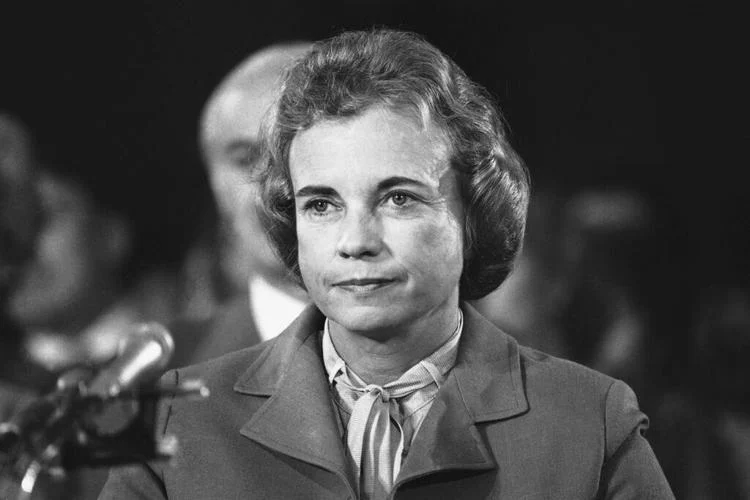
Ashley Murray, Alabama Reflector WASHINGTON — The first woman to serve on the nation’s highest court is dead at 93. Sandra Day O’Connor, a groundbreaking justice on the U.S. Supreme Court, died Friday in Phoenix, Arizona of complications related to advanced dementia, probably Alzheimer’s, and a respiratory illness, according to an announcement from the court. President Ronald Reagan nominated O’Connor in 1981, and she was confirmed by the full Senate, 99-0, in September of that year. The moderate O’Connor, who served on the bench until her retirement in 2006, was often the decisive vote in major cases that reached the Supreme Court in her nearly quarter-century as associate justice. The justices issued rulings in high-profile cases during O’Connor’s tenure, including Bush v. Gore, which settled the 2000 presidential contest in George W. Bush’s favor, and Planned Parenthood of Southeastern Pennsylvania v. Casey, a 5-4 decision that affirmed the constitutional right to an abortion but with leeway for states to impose some restrictions. O’Connor sided with the majority in both cases. “She was consequential,” journalist and historian Evan Thomas told the National Archives in 2019 while promoting his biography “First: Sandra Day O’Connor.” She cast the so-called “swing vote” 330 times in 24 years, Thomas said. “And where it really mattered was in abortion rights and affirmative action,” he said, referring to several cases, including Grutter v. Bullinger, which upheld the consideration of race in the University of Michigan’s law school admissions. In 2022, O’Connor’s successor, Justice Samuel Alito, wrote the majority opinion overturning Planned Parenthood v. Casey and Roe v. Wade, striking down abortion rights at the federal level. A ‘true public servant’ and ‘trailblazer’ Chief Justice John Roberts said in a statement Friday that O’Connor “blazed a historic trail as our Nation’s first female Justice.” “She met that challenge with undaunted determination, indisputable ability, and engaging candor. We at the Supreme Court mourn the loss of a beloved colleague, a fiercely independent defender of the rule of law, and an eloquent advocate for civics education. And we celebrate her enduring legacy as a true public servant and patriot,” he said. Senate Minority Leader Mitch McConnell of Kentucky said in a statement that the “nation mourns the passing of a towering figure in the history of American law.” “… From her election as the first female Majority Leader in the history of American legislatures to her confirmation as the first female Justice of the U.S. Supreme Court, Sandra Day O’Connor led with a brilliance and conviction that disarmed resistance. Her vote on the court frequently determined the majority in landmark cases, and the legacy of her role in landmark decisions reviving federalism during her first several terms on the Court continues to resound in Constitutional jurisprudence,” McConnell said. In the mid-1990s and 2000, O’Connor provided decisive votes in two 5-4 decisions that found federal laws unconstitutional under the Commerce Clause, including sections of the Violence Against Women Act and a federal law that criminalized carrying a firearm within 1,000 feet of schools. Senate Majority Leader Chuck Schumer of New York said O’Connor was the “conscience of the Court.” Schumer said in a statement issued Friday that O’Connor “was one of the true historic figures of the 20th century. In decision after decision, Sandra Day O’Connor was often the key vote in defending the rights of Americans—in protecting clean air, in protecting women’s rights, in protecting against discrimination, in protecting voting rights. I join Americans all across the country in mourning her passing today.” Speaker of the House Mike Johnson of Louisiana described O’Connor as a “trailblazer” and “legal giant” in a Friday morning post on X. “As the first woman to ever serve on the Supreme Court, Justice O’Connor inspired a generation of women — including the five female Justices that succeeded her — to chart a path that previously seemed unattainable,” he said. “Despite never serving as Chief Justice, she was widely regarded as the most powerful Justice on the bench during her tenure.” The women who followed O’Connor’s appointment to the court included Ruth Bader Ginsburg, nominated by former President Bill Clinton in 1993; Sonia Sotomayor and Elena Kagan in 2009 and 2010, both nominated by former President Barack Obama; Amy Coney Barrett, nominated by former President Donald Trump in 2020; and Ketanji Brown Jackson, nominated by President Joe Biden in 2022. Obama released a statement Friday recounting the well-known story of O’Connor’s challenges finding a job in the legal field as a woman in the 1950s, when she was asked about her typing skills and offered work as a legal secretary. “Fortunately for us, she set her sights a little higher – becoming the first woman to serve as a U.S. Supreme Court justice,” Obama said. “As a judge and Arizona legislator, a cancer survivor and child of the Texas plains, Sandra Day O’Connor was like the pilgrim in the poem she sometimes quoted – forging a new path and building a bridge behind her for all young women to follow. Michelle and I send our thoughts to Sandra’s family and everyone who learned from and admired her.” From the Southwest to the nation’s capital O’Connor was born on March 26, 1930, in El Paso, Texas, and grew up on a ranch in Arizona. She graduated near the top of her law school class at Stanford University in 1952. O’Connor began her law career as deputy county attorney of San Mateo County, California, followed by a position as a civilian attorney for Quartermaster Market Center, Frankfurt, Germany, from 1954 to 1957. O’Connor practiced law in Maryvale, Arizona, until 1960 and went on to serve as assistant attorney general of Arizona from 1965 to 1969. She followed her time in the attorney general’s office with multiple terms in the Arizona State Senate beginning in 1969 and eventually serving as the body’s majority leader. In 1975, she was elected as a Maricopa County Superior Court judge and served until 1979, when she was appointed to the Arizona Court
Justice Brett Kavanaugh seeks to dispel the notion that the Supreme Court is partisan
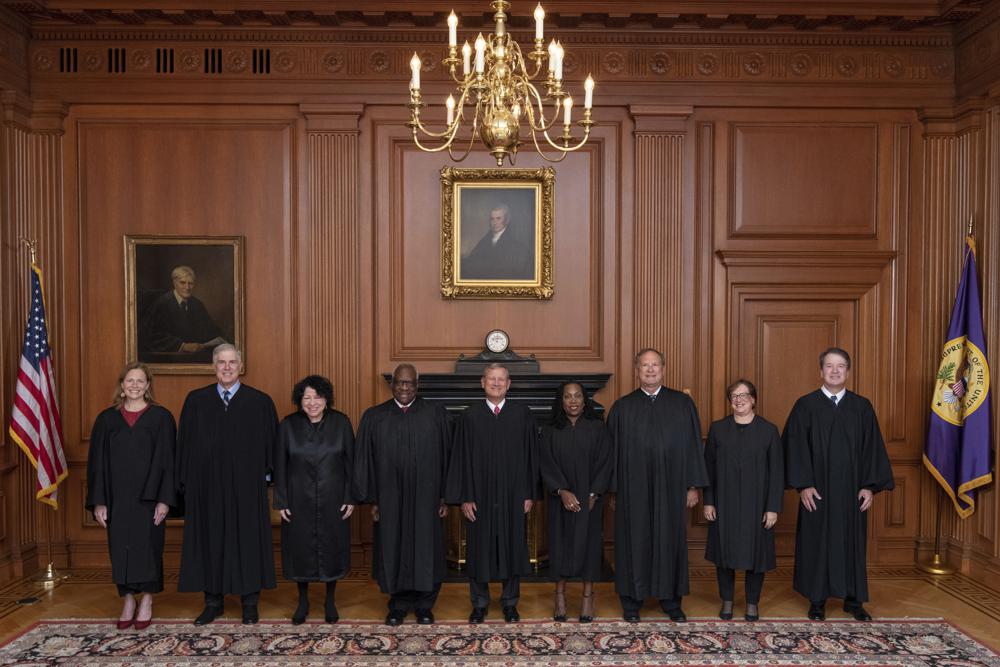
Justice Brett Kavanaugh pointed to the mixed U.S. Supreme Court decisions this term as he sought Thursday to dispel notions that it is partisan, even after conservatives brought about the end of affirmative action in college admissions and struck down President Joe Biden’s student loan debt relief program. “The court is an institution of law. It’s an institution of law, not of politics, not of partisanship,” Kavanaugh said at a judicial conference in Minnesota, in the first public remarks by a justice since the court recessed for the summer late last month. The Supreme Court has been reshaped by the three justices nominated by President Donald Trump, including Kavanaugh. Although Kavanaugh sided with the conservative majorities in the affirmative action and student loan rulings, as well as last summer’s ruling overturning the nationwide right to abortion, he was also part of the mixed conservative and liberal majorities this term that backed Black voters in Alabama and preserved a federal law aimed at keeping Native American children with Native families. And the term was marked by other notable surprises, rejecting conservative positions in a North Carolina redistricting case that could have reshaped elections across the country, while backing the Biden administration in a fight over deportation priorities. “We have lived up, in my estimation, to deciding cases based on law and not based on partisan affiliation and partisanship,” Kavanaugh said. “We don’t caucus in separate rooms. We don’t meet separately. We’re not sitting on different sides of the aisle at an oral argument. … We work as a group of nine.” Speaking to an audience of judges, attorneys, and court personnel from the 8th Circuit, which stretches from Minnesota and the Dakotas south to Arkansas, Kavanaugh said he didn’t fully appreciate until he joined the court how much time the nine justices spend alone with each other. He estimated that they eat lunch together around 65 times a year. “And the rule at lunch is you can’t talk about work,” he said. “It’s a good rule. … It builds relationships and friendships, and then when we have tough cases — and we only really have tough cases — you have a reservoir of goodwill toward each of the other people.” Kavanaugh said he was warmly welcomed in his first term in 2018 by then-Justices Ruth Bader Ginsburg and Stephen Breyer, who were part of the court’s liberal wing. He also praised his working relationships with the two newest justices, conservative Amy Coney Barrett and liberal Ketanji Brown Jackson. Kavanaugh, who was the justice most often in the majority this term in divided cases, said the Supreme Court hears 60 to 70 cases a term and that only a relative few might get most of the attention. But he said there are lots of 9-0 decisions, and there can also be a lot of 7-2 and 6-3 decisions. “All sorts of different lineups,” he said. “And so I might be working with Sonia Sotomayor on the Andy Warhol case, while we disagree on a case on the competition clause. We’re not going to let our relationship where we’re working together on one suffer just because we disagree on the other. And that’s going on with all nine of us on a daily basis.” Kavanaugh only briefly mentioned the ethics issues that have dogged some justices — including conservatives Clarence Thomas and Samuel Alito and the liberal Sotomayor — and potentially undermined public confidence in the court. He noted that Chief Justice John Roberts said in May that the justices were continuing to work on that as a group. “That’s accurate,” he said. “I’m not going to add anything to what the chief justice has said on that topic.” Roberts offered no specifics at the time, and the justices have not adopted an ethics code. Kavanaugh said people getting upset when the high court makes difficult decisions comes with the territory. He said the best the justices can do is try to be consistent, clearly explain their reasoning, and try to show that they actually are working as a team of nine on difficult cases instead of caucusing on a partisan basis. “You shouldn’t be in this line of work if you don’t like criticism,” he said. “Because you’re going to get it. And you’re going to get a lot of it.” Republished with the permission of The Associated Press.
Steve Marshall announces victory over the Equal Rights Amendment

Alabama Attorney General Steve Marshall announced on Tuesday that the U.S. Court of Appeals for the D.C. Circuit affirmed Alabama’s win in defending against a lawsuit that sought to compel the U.S. Archivist to certify the long-expired Equal Rights Amendment as part of the U.S. Constitution. “Today, the U.S. Court of Appeals for the D.C. Circuit agreed with our argument that Nevada and Illinois cannot purport to ratify a proposed amendment that expired decades ago and then force the Archivist to sneak the Equal Rights Amendment into the Constitution,” said AG Marshall. “This is a significant victory for the rule of law.” In 1972, Congress passed the Equal Rights Amendment; but it still had to be ratified by the states. The seven-year ratification deadline came and went, with the amendment failing to get ratified by the 38 states needed for it to become part of the Constitution. In 2018, Nevada purported to become the 36th state to ratify the amendment, followed shortly by Illinois and Virginia. Those states then filed suit to compel the Archivist to certify their untimely ratifications and add the Equal Rights Amendment to the Constitution. Virginia later dropped its suit. Alabama, Louisiana, Nebraska, South Dakota, and Tennessee intervened in the litigation, arguing that the expiration of the seven-year ratification deadline meant that the amendment process would have to begin anew if the Equal Rights Amendment were to be enacted. The district court agreed, holding that “the ERA’s deadline barred Plaintiffs’ late-coming ratifications.” On Tuesday, the D.C. appellate court affirmed Alabama’s position, holding that the challenging states had not shown a clear legal right to have a federal court order the Archivist to certify the proposed amendment. The court noted that the ratification deadline had long ago expired, and it rejected the challenging states’ argument that the deadline was invalid or could otherwise be ignored. “We are glad the court rejected plaintiffs’ calls to unconstitutionally amend our Constitution,” continued Marshall. “If activists want a new ERA, they should persuade their fellow Americans that it makes sense, then pass it through Congress and a new state ratification process. As the late Justice Ruth Bader Ginsburg — a noted proponent of the ERA — stated, the ERA cannot become law unless it is ‘put back in the political hopper and we start over again collecting the necessary states to ratify it.’ Any other route would undermine the rule of law upon which we all depend.” The House voted in 2020 to remove the deadline when Virginia became the 38th state. On Tuesday, the U.S. Senate met to consider a resolution withdrawing the seven-year deadline. To connect with the author of this story or to comment, email brandonmreporter@gmail.com.
Supreme Court overturns Roe v. Wade; states can ban abortion

The Supreme Court has ended constitutional protections for abortion that had been in place nearly 50 years in a decision by its conservative majority to overturn Roe v. Wade. Friday’s outcome is expected to lead to abortion bans in roughly half the states. The decision, unthinkable just a few years ago, was the culmination of decades of efforts by abortion opponents, made possible by an emboldened right side of the court that has been fortified by three appointees of former President Donald Trump. The ruling came more than a month after the stunning leak of a draft opinion by Justice Samuel Alito, indicating the court was prepared to take this momentous step. It puts the court at odds with a majority of Americans who favored preserving Roe, according to opinion polls. Alito, in the final opinion issued Friday, wrote that Roe and Planned Parenthood v. Casey, the 1992 decision that reaffirmed the right to abortion, were wrong the day they were decided and must be overturned. “We hold that Roe and Casey must be overruled. The Constitution makes no reference to abortion, and no such right is implicitly protected by any constitutional provision,” Alito wrote. Authority to regulate abortion rests with the political branches, not the courts, Alito wrote. Joining Alito were Justices Clarence Thomas, Neil Gorsuch, Brett Kavanaugh, and Amy Coney Barrett. The latter three justices are Donald Trump appointees. Thomas first voted to overrule Roe 30 years ago. Chief Justice John Roberts would have stopped short of ending the abortion right, noting that he would have upheld the Mississippi law at the heart of the case, a ban on abortion after 15 weeks, and said no more. Justices Stephen Breyer, Sonia Sotomayor, and Elena Kagan — the diminished liberal wing of the court — were in dissent. “With sorrow—for this Court, but more, for the many millions of American women who have today lost a fundamental constitutional protection—we dissent,” they wrote. The ruling is expected to disproportionately affect minority women who already face limited access to health care, according to statistics analyzed by The Associated Press. Thirteen states, mainly in the South and Midwest, already have laws on the books that ban abortion in the event Roe is overturned. Another half-dozen states have near-total bans or prohibitions after 6 weeks of pregnancy, before many women know they are pregnant. In roughly a half-dozen other states, the fight will be over dormant abortion bans that were enacted before Roe was decided in 1973 or new proposals to sharply limit when abortions can be performed, according to the Guttmacher Institute, a research group that supports abortion rights. More than 90% of abortions take place in the first 13 weeks of pregnancy, and more than half are now done with pills, not surgery, according to data compiled by Guttmacher. The decision came against a backdrop of public opinion surveys that find a majority of Americans oppose overturning Roe and handing the question of whether to permit abortion entirely to the states. Polls conducted by The Associated Press-NORC Center for Public Affairs Research and others also have consistently shown about 1 in 10 Americans want abortion to be illegal in all cases. A majority are in favor of abortion being legal in all or most circumstances, but polls indicate many also support restrictions, especially later in pregnancy. The Biden administration and other defenders of abortion rights have warned that a decision overturning Roe also would threaten other high court decisions in favor of gay rights and, even potentially, contraception. But Alito wrote in his draft opinion that his analysis addresses abortion only, not other rights that also stem from a right to privacy that the high court has found implicit, though not directly stated, in the Constitution. Abortion is different, Alito wrote, because of the unique moral question it poses. Whatever the intentions of the person who leaked Alito’s draft opinion, the conservatives held firm in overturning Roe and Casey. In his draft, Alito dismissed the arguments in favor of retaining the two decisions, including that multiple generations of American women have partly relied on the right to abortion to gain economic and political power. Changing the composition of the court has been central to the anti-abortion side’s strategy. Mississippi and its allies made increasingly aggressive arguments as the case developed, and two high-court defenders of abortion rights retired or died. The state initially argued that its law could be upheld without overruling the court’s abortion precedents. Then-Gov. Phil Bryant signed the 15-week measure into law in March 2018, when Justices Anthony Kennedy and Ruth Bader Ginsburg were still members of a five-justice majority that was mainly protective of abortion rights. By early summer, Kennedy had retired and was replaced by Justice Brett Kavanaugh a few months later. The Mississippi law was blocked in lower federal courts. But the state always was headed to the nation’s highest court. It did not even ask for a hearing before a three-judge panel of the 5th U.S. Circuit Court of Appeals, which ultimately held the law invalid in December 2019. By early September 2020, the Supreme Court was ready to consider the state’s appeal. The court scheduled the case for consideration at the justices’ private conference on Sept. 29. But in the intervening weeks, Ginsburg died, and Barrett was quickly nominated and confirmed without a single Democratic vote. The stage now was set, although it took the court another half year to agree to hear the case. By the time Mississippi filed its main written argument with the court in the summer, the thrust of its argument had changed, and it was now calling for the wholesale overruling of Roe and Casey. The first sign that the court might be receptive to wiping away the constitutional right to abortion came in late summer when the justices divided 5-4 in allowing Texas to enforce a ban on the procedure at roughly six weeks, before some women even know they are pregnant. That dispute turned on the unique structure of the
U.S. Supreme Court to take up major abortion rights challenge
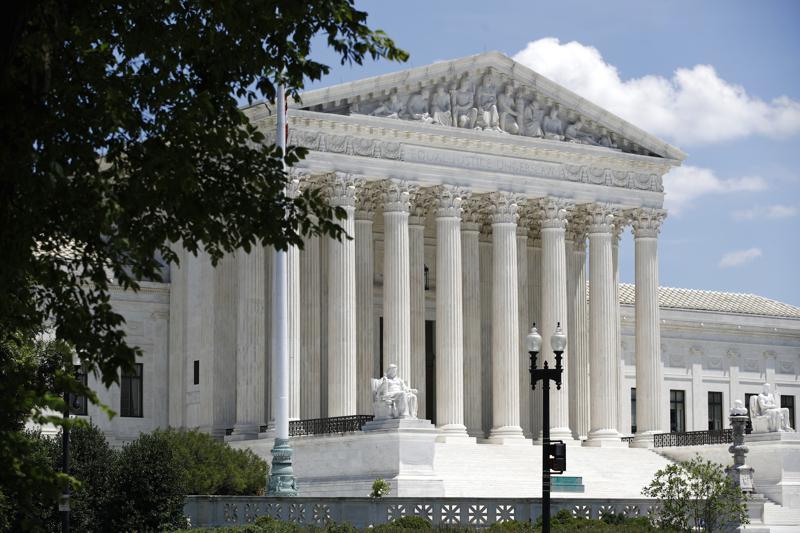
The Supreme Court agreed Monday to a showdown over abortion in a case that could dramatically alter nearly 50 years of rulings on abortion rights. With three justices appointed by President Donald Trump part of a 6-3 conservative majority, the court is taking on a case about whether states can ban abortions before a fetus can survive outside the womb. Mississippi, which is asking to be allowed to enforce an abortion ban after 15 weeks of pregnancy, is not asking the court to overrule the 1973 Roe v. Wade decision confirming a woman’s right to an abortion, or a decision 19 years later that reaffirmed it. But abortion-rights supporters said the case is a clear threat to abortion rights. “The court cannot uphold this law without overturning the principal protections of Roe v. Wade,” Nancy Northup, president and CEO of the Center for Reproductive Rights, said in a call with reporters. Even if the court does not explicitly overrule earlier cases, a decision favorable to the state could lay the groundwork for allowing even more restrictions on abortion, including state bans on abortion once a fetal heartbeat is detected, as early as six weeks. The case probably will be argued in the fall, with a decision likely in the spring of 2022 during the campaign for congressional midterm elections. Mississippi’s ban had been blocked by lower courts as inconsistent with Supreme Court precedent that protects a woman’s right to obtain an abortion before the fetus can survive outside her womb. “States may regulate abortion procedures prior to viability so long as they do not impose an undue burden on the woman’s right, but they may not ban abortions. The law at issue is a ban,” Judge Patrick Higginbotham of the 5th U.S. Circuit Court of Appeals wrote in affirming a lower-court ruling that invalidated the law. The Supreme Court had previously turned down state appeals over previability abortion bans. More than 90% of abortions take place in the first 13 weeks of a woman’s pregnancy, according to the Centers for Disease Control and Prevention. John Bursch, vice president of the anti-abortion Alliance Defending Freedom, said the high court has repeatedly held that states can regulate abortions later in pregnancy. Viability “has never been a legitimate way to determine a developing infant’s dignity or to decide anybody’s legal existence,” Bursch said. The justices had put off action on the case for several months. Justice Ruth Bader Ginsburg, an abortion-rights proponent, died just before the court’s new term began in October. Her replacement, Justice Amy Coney Barrett, is the most open opponent of abortion rights to join the court in decades. Barrett is one of three Trump appointees on the Supreme Court. The other two, Justices Neil Gorsuch and Brett Kavanaugh, voted in dissent last year to allow Louisiana to enforce restrictions on doctors that could have closed two of the state’s three abortion clinics. Chief Justice John Roberts, joined by Ginsburg and the other three liberal justices, said the restrictions were virtually identical to a Texas law the court struck down in 2016. But that majority no longer exists, even if Roberts, hardly an abortion rights supporter in his more than 15 years on the court, sides with the more liberal justices. White House press secretary Jen Psaki said the Biden administration backs legislation that would write the Roe decision into federal law, regardless of the outcome of the Supreme Court case. The legislation would put an end to state efforts to ban abortion, Northup said. The Mississippi law was enacted in 2018 but was blocked after a federal court challenge. The state’s only abortion clinic remains open. About 10% of its abortions are done after the 15th week, said Shannon Brewer, the clinic director at Jackson Women’s Health Organization. The case is separate from a fight over laws enacted by Mississippi and other states that would ban most abortions when a fetal heartbeat is detected. Mississippi also is among 11 states with a total abortion ban waiting to take effect if the Supreme Court overturns its Roe decision, according to NARAL Pro-Choice America. A central question in the case is about viability — whether a fetus can survive on its own at 15 weeks. The clinic presented evidence that viability is impossible at 15 weeks, and the appeals court said that the state “conceded that it had identified no medical evidence that a fetus would be viable at 15 weeks.” Viability occurs roughly at 24 weeks, the point at which babies are more likely to survive. But the state argues that viability is an arbitrary standard that doesn’t take sufficient account of the state’s interest in regulating abortion. The Mississippi law would allow exceptions to the 15-week ban in cases of medical emergency or severe fetal abnormality. Doctors found in violation of the ban would face mandatory suspension or revocation of their medical license. Republished with the permission of the Associated Press.
Donald Trump, Joe Biden hit battleground Pennsylvania amid pandemic
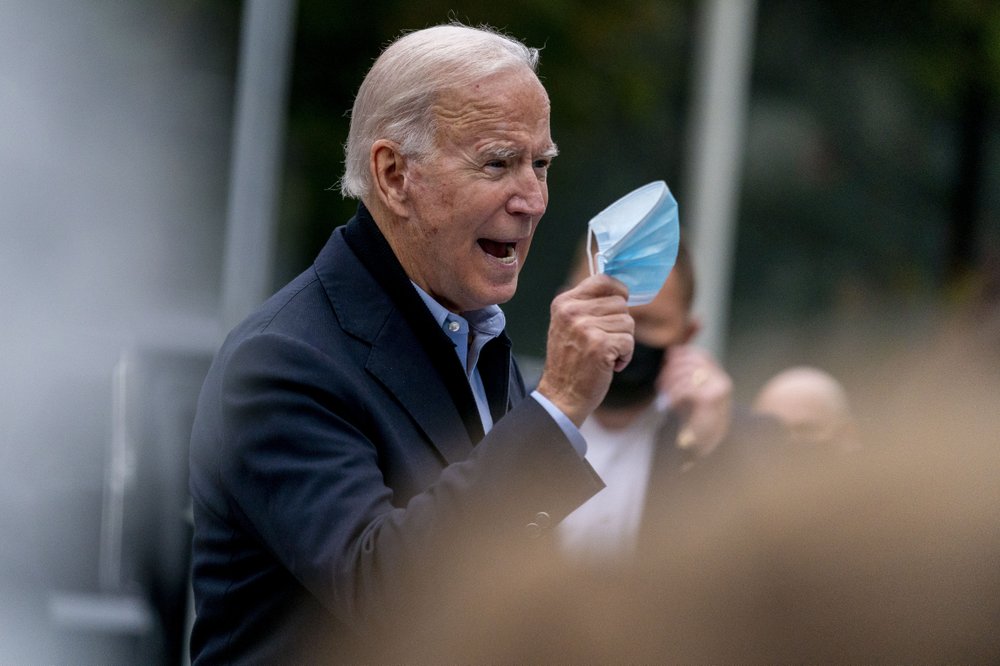
President Donald Trump and Democratic rival Joe Biden zeroed in on the critical battleground of Pennsylvania on Monday, demonstrating starkly different approaches to rallying voters just eight days before polls close during the worst public health crisis in a century. Trump drew thousands of largely mask-less supporters as he began a final-week charge through nearly a dozen states ahead of the election. Biden, taking a more cautious approach in an effort to show that he’s taking the pandemic seriously, greeted a few dozen supporters outside a Chester, Pennsylvania, campaign field office. “Bottom line is Donald Trump is the worst possible person to lead us through this pandemic,” Biden said as he sharpened his closing message into an indictment of Trump’s handling of the virus. Trump, meanwhile, stoked fears about Biden’s plans to address the outbreak. “It’s a choice between a Trump boom or a Biden lockdown,” Trump claimed at a rally in Allentown, focusing on the economy and the possibility of lost jobs. Trump returned to the White House to celebrate the confirmation of Supreme Court Justice Amy Coney Barrett Monday evening. Trump has sought to use the vacancy created by the death of Justice Ruth Bader Ginsburg last month to animate conservative evangelical and Catholic voters to his candidacy, but the high court fight has been overshadowed by virus concerns. In Pennsylvania, Trump also touted the appointment of another conservative justice as potentially giving him an edge in election-related litigation surrounding a surge in absentee and mail ballots due to the pandemic. For each candidate, the differing campaign approaches carry risks. For Trump, the full-speed-ahead strategy could spread the virus in places that are already setting new records and leave him appearing aloof to the consequences. And if Biden comes up short in the election, his lower-key travel schedule will surely come under scrutiny as a missed opportunity. Trump’s campaign schedule suggested he’s on the defensive in Pennsylvania, viewed by his aides as critical to his path to 270 electoral votes. Biden, meanwhile, is demonstrating more confidence with signals that he’s hoping to expand his campaign map. In the closing days Biden plans to visit Georgia, a state that hasn’t voted for a Democratic presidential candidate since 1992, and Iowa, which Trump carried by more than 9 percentage points in 2016. He’s dispatching his running mate, Kamala Harris, later this week to Texas, which hasn’t backed a Democrat for the White House since Jimmy Carter in 1976. With more than a third of the expected ballots in the election already cast, it could become increasingly challenging for Trump and Biden to reshape the contours of the race. But both men are fighting for any endgame advantage. Biden is leading Trump in most national polls and has an advantage, though narrower, in many key battlegrounds. While the final week of the campaign is colliding with deepening concerns about the COVID crisis in far-flung parts of the U.S., Trump is anxious for voters to focus on almost anything else. He’s worried that he will lose if the election becomes a referendum on his handling of the pandemic. Biden, meanwhile, is working to ensure the race is just that, hitting Trump on the virus and presenting himself as a safer, more stable alternative. The stakes were clear this past weekend as the White House became the locus for a second outbreak of the virus in a month. Several close aides to Vice President Mike Pence tested positive, including his chief of staff, Marc Short. Pence, though, was insistent on maintaining his aggressive political calendar, even though he was deemed a “close contact,” claiming the status of an “essential employee.” Pence arrived at a rally in Hibbing, Minnesota, wearing a mask Monday but removed it as he reached the podium to speak to a crowd of supporters who were largely not wearing face coverings or social distancing. Hibbing police confirmed more than 650 people in attendance, exceeding Minnesota health guidelines to restrict crowds to 250 people. With Election Day just over a week away, average deaths per day across the country are up 10% over the past two weeks, from 721 to nearly 794 as of Sunday, according to data from Johns Hopkins University. Confirmed infections per day are rising in 47 states, and deaths are up in 34. The latest national outbreak has provided a potent sign of the divergent approaches the Trump and Biden campaigns have taken to the virus. On Sunday, White House chief of staff Mark Meadows said that “we’re not going to control the pandemic” and the focus should be on containment and treatment. Biden, in a statement, said Meadows’ comments continued with the Trump administration waving “the white flag of defeat” in the face of the virus. Trump fired back Monday as he arrived in Pennsylvania, saying Biden, with his concerns about the virus spread, has “waved a white flag on life.” He rejected Biden’s comments that the nation is facing a “dark winter,” saying, “No it’s not going to be a dark winter. It’s going to be a great winter. It’s going to be a great spring.” Biden’s team argues the coronavirus is likely to blot out any other issues that might come up in the final days of the campaign — including his recent debate-stage comment in which he affirmed he’d transition away from oil, later walking that back as a transition away from federal subsidies. That strategy appeared to pay off as the outbreak in Pence’s staff refocused the national conversation once again on the pandemic. Trump and his team, meanwhile, have struggled to settle on a closing message, with the undisciplined candidate increasingly trusting his instincts over his advisers. He’s grasped for dirt on his Democratic rival and used apocalyptic terms to describe a Biden presidency, but Biden has thus far proven more resistant to such attacks than Trump’s 2016 rival, Hillary Clinton. Anticipating a razor-thin Electoral College margin, Trump has an aggressive schedule including a visit Omaha, Nebraska,
Amy Coney Barrett confirmed as Supreme Court justice

Amy Coney Barrett was confirmed to the Supreme Court late Monday by a deeply divided Senate, Republicans overpowering Democrats to install President Donald Trump’s nominee days before the election and secure a likely conservative court majority for years to come. Trump’s choice to fill the vacancy of the late liberal icon Ruth Bader Ginsburg potentially opens a new era of rulings on abortion, the Affordable Care Act and even his own election. Democrats were unable to stop the outcome, Trump’s third justice on the court, as Republicans race to reshape the judiciary. Barrett is 48, and her lifetime appointment as the 115th justice will solidify the court’s rightward tilt. Monday’s vote was the closest high court confirmation ever to a presidential election, and the first in modern times with no support from the minority party. The spiking COVID-19 crisis has hung over the proceedings. Vice President Mike Pence’s office said Monday he would not preside at the Senate session unless his tie-breaking vote was needed after Democrats asked him to stay away when his aides tested positive for COVID-19. The vote was 52-48, and Pence’s vote was not necessary. With Barrett’s confirmation assured, Trump was expected to celebrate with a primetime swearing-in event at the White House. Justice Clarence Thomas was set to administer the Constitutional Oath, a senior White House official said. “Voting to confirm this nominee should make every single senator proud,” said Senate Majority Leader Mitch McConnell, fending off “outlandish” criticism in a lengthy speech. During a rare weekend session he declared that Barrett’s opponents “won’t be able to do much about this for a long time to come.” Pence’s presence presiding for the vote would have been expected, showcasing the Republican priority. But Senate Democratic leader Chuck Schumer and his leadership team said it would not only violate virus guidelines of the Centers for Disease Control and Prevention, “it would also be a violation of common decency and courtesy.” Some GOP senators tested positive for the coronavirus following a Rose Garden event with Trump to announce Barrett’s nomination last month, but they have since said they have been cleared by their doctors from quarantine. Pence was not infected and his office said the vice president tested negative for the virus Monday. Underscoring the political divide during the pandemic, the Republican senators, most wearing masks, sat in their seats, as is tradition for landmark votes, and applauded the outcome. Democratic senators were not present, heeding Schumer’s advice not to linger in the chamber. Democrats argued for weeks that the vote was being improperly rushed and insisted during an all-night Sunday session it should be up to the winner of the Nov. 3 election to name the nominee. However, Barrett, a federal appeals court judge from Indiana, is expected to be seated swiftly, and begin hearing cases. Speaking near midnight Sunday, Sen. Elizabeth Warren, D-Mass., called the vote “illegitimate” and “the last gasp of a desperate party.” Several matters are awaiting decision just a week before Election Day, and Barrett could be a decisive vote in Republican appeals of orders extending the deadlines for absentee ballots in North Carolina and Pennsylvania. The justices also are weighing Trump’s emergency plea for the court to prevent the Manhattan District Attorney from acquiring his tax returns. And on Nov. 10, the court is expected to hear the Trump-backed challenge to the Obama-era Affordable Care Act. Just before the Senate vote began, the court sided with Republicans in refusing to extend the deadline for absentee ballots in Wisconsin. Trump has said he wanted to swiftly install a ninth justice to resolve election disputes and is hopeful the justices will end the health law known as “Obamacare.” During several days of public testimony before the Senate Judiciary Committee, Barrett was careful not to disclose how she would rule on any such cases. She presented herself as a neutral arbiter and suggested, “It’s not the law of Amy.” But her writings against abortion and a ruling on “Obamacare” show a deeply conservative thinker. Full Coverage: U.S. Supreme Court Sen. Lindsey Graham, R-S.C., the chairman of the Judiciary Committee, praised the mother of seven as a role model for conservative women. “This is historic,” Graham said. Republicans focused on her Catholic faith, criticizing earlier Democratic questions about her beliefs. Graham called Barrett “unabashedly pro-life.” At the start of Trump’s presidency, McConnell engineered a Senate rules change to allow confirmation by a majority of the 100 senators, rather than the 60-vote threshold traditionally needed to advance high court nominees over objections. That was an escalation of a rules change Democrats put in place to advance other court and administrative nominees under President Barack Obama. Republicans are taking a political plunge by pushing for confirmation days from the Nov. 3 election with the presidency and their Senate majority at stake. Only one Republican — Sen. Susan Collins, who is in a tight reelection fight in Maine — voted against the nominee, not over any direct assessment of Barrett. Rather, Collins said, “I do not think it is fair nor consistent to have a Senate confirmation vote prior to the election.” Trump and his Republican allies had hoped for a campaign boost, in much the way Trump generated excitement among conservatives and evangelical Christians in 2016 over a court vacancy. That year, McConnell refused to allow the Senate to consider then-President Barack Obama’s choice to replace the late Justice Antonin Scalia, arguing the new president should decide. Most other Republicans facing tough races embraced the nominee who clerked for the late Scalia to bolster their standing with conservatives. Sen. Thom Tillis, R-N.C., said in a speech Monday that Barrett will “go down in history as one of the great justices.” But it’s not clear the extraordinary effort to install the new justice over such opposition in a heated election year will pay political rewards to the GOP. Demonstrations for and against the nominee have been more muted at the Capitol under coronavirus restrictions. Democrats were unified against Barrett. While two Democratic senators voted to confirm
GOP-led Senate panel advances Barrett as Democrats boycott
Senate Judiciary Committee Republicans powered past a Democratic boycott Thursday to advance Amy Coney Barrett’s Supreme Court nomination to the full Senate, keeping President Donald Trump’s pick on track for confirmation before the Nov. 3 election. Democratic senators refused to show up in protest of the GOP’s rush to install Trump’s nominee to replace the late Justice Ruth Bader Ginsburg. Never has the Senate confirmed a Supreme Court nominee so close to a presidential election. All 12 Republicans on the committee voted in favor of Barrett, a conservative judge. No-show Democrats left behind posters at their desks of Americans they say have benefited from the Affordable Care Act, now being challenged at the high court. Senators plan to convene a rare weekend session before a final confirmation vote expected Monday. “Big day for America,” Trump tweeted after the committee vote. Barrett, 48, would lock a 6-3 conservative court majority for the foreseeable future. That could open a new era of rulings on abortion access, gay marriage and even the results of this year’s presidential election. Republicans have bristled at Democrats’ claim that the Obama-era health law, known as “Obamacare,” is in jeopardy if Barrett joins the court. But Trump told CBS’ “60 Minutes” that “it will be so good” if the court puts an end to the law. The court is set to hear a Trump-backed case against the health overhaul on Nov. 10. “I think it’ll end. I hope that they’ll end it,” Trump said in comments released Thursday by the White House before the interview airs Sunday. As the Senate committee met, protesters, some shouting “Stop the confirmation!” demonstrated outside the Capitol across the street from the Supreme Court. Some dressed as handmaids, a reference to Barrett’s role in a conservative religious group that once called high-ranking women members “handmaids.” Other demonstrators had “#SupportAmy” signs. The protesters drowned out Democratic senators who had called a news conference to decry what they called a “sham” confirmation process. Senate Democratic leader Chuck Schumer of New York said the Senate’s Republican majority “is conducting the most rushed, most partisan and the least legitimate nomination to the Supreme Court in our nation’s history.” “Democrats will not lend a single ounce of legitimacy to this sham vote,” he said. Unable to stop the confirmation, Democrats have been trying unsuccessfully to stall the process so the winner of the White House race could name the new nominee. With Republicans holding a 53-47 majority in the Senate, Trump’s pick for the court is almost certain to be confirmed. All Democrats are expected to oppose Barrett’s confirmation. “This is a groundbreaking, historic moment,” said Sen. Lindsey Graham, R-S.C., the committee chairman. “We did it.” Barrett, an appellate court judge from Indiana, appeared for three days before the committee last week, batting back Democrats’ questions. She was asked about her approach to legal questions surrounding abortion access, gay marriage and the nation’s tradition of a peaceful transfer of presidential power. Trump has said he wants a judge seated in time to hear any potential disputes arising from the upcoming election. Barrett declined to say whether she would withdraw from participating in such cases. Sen. Ted Cruz, R-Texas, said the court fight will be perhaps the “single most important accomplishment” of Trump’s presidency. Republican senators ridiculed the Democratic boycott as election-year antics. “Rather than show up and do their job, they continue the theater,” said Sen. John Cornyn, R-Texas, pointing out the posters at the Democrats’ desks. Sen. Mike Lee, R-Utah, called the boycott “a walkout on the American people.” But Democrats on the committee insisted the Republicans were rushing the nomination to tip the court even further to the right. Sen. Mazie Hirono, D-Hawaii, called Barrett a “clear and present danger” to the values Ginsburg fought for on the court. “I stand here for Justice Ginsburg,” said Sen. Amy Klobuchar, D-Minn., urging Americans to vote their protests at the ballot box. Many judicial nominees decline to discuss their views on various issues, saying they will consider the cases as they come. Barrett took a similar approach, drawing deep skepticism from Democrats because she had previously spoken out against abortion and past rulings on the health law. Barrett released dozens of answers this week to additional questions senators had posed, but her responses were similar as she declined to weigh in on whether the landmark Roe v. Wade abortion ruling is a “super precedent” of the court or whether the president could unilaterally change the date set in law for the election. Senate Majority Leader Mitch McConnell, R-Ky., has defended Barrett as “exceptionally qualified” as well as his own decision to push her nomination forward. He had refused to consider President Barack Obama’s nominee in February 2016, saying it was too close to a presidential election that year; Obama was in his second and final term. Republicans have focused on Barrett’s Catholic faith, calling her a role model for conservative and religious women. Republicans also warn that Democrats will “pack the court” by adding more justices if they win the White House and the Senate, although key Democrats have not said that would be a priority. Joe Biden said last week he’s “not a fan” of adding justices to balance the court ideologically. But during his own interview with “60 Minutes,” an excerpt of which CBS released Friday, Biden said he won’t rule out studying the addition of members as part of a commission he plans to name to look at court changes if he’s elected. Republished with the permission of the Associated Press.
Supreme Court puts curbside voting on hold in Alabama
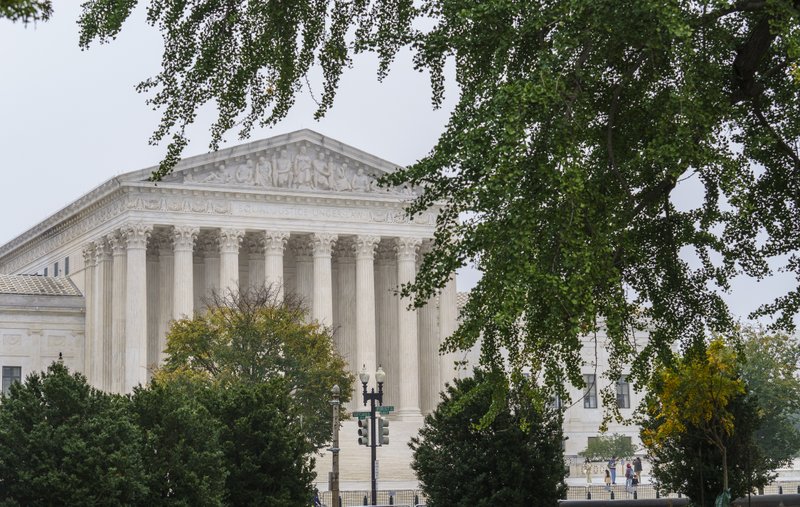
The Supreme Court on Wednesday put on hold a lower court order that would have permitted curbside voting in Alabama in November. The justices’ vote was 5-3, with the court’s three liberals dissenting. As is typical when the Supreme Court acts on an emergency basis, the justices in the majority did not explain their decision. It was not clear how many counties might have offered curbside voting, allowing people to vote from their car by handing their ballot to a poll worker. Justice Sonia Sotomayor, in a dissent joined by Justice Stephen Breyer and Justice Elena Kagan, described the lower court’s order allowing curbside voting in November as “modest,” and she said she would not have put it on hold. “It does not require all counties to adopt curbside voting; it simply gives prepared counties the option to do so. This remedy respects both the right of voters with disabilities to vote safely and the State’s interest in orderly elections,” she said, noting that 28 states permit curbside voting. The decision stemmed from a lawsuit the NAACP Legal Defense and Educational Fund, the Southern Poverty Law Center and the Alabama Disabilities Advocacy Program filed on behalf of voters with health issues who were concerned about the risk of COVID-19 at the polls. The state’s Republican attorney general and secretary of state sought to block a lower court’s ruling in the case that would have let counties offer curbside voting. Lawyers for the state argued that since Alabama does not have a law expressly permitting curbside voting, that it should not be allowed. “I am very enthusiastic that the Supreme Court of the United States has seen fit to secure Alabama’s election integrity by ruling as to the letter and the spirit of the law,” Alabama Secretary of State John Merrill said in a telephone interview. Alabama Attorney General Steve Marshall argued Alabama has “taken extraordinary measures to ensure that all voters can vote safely,” and that it would be potentially chaotic to rapidly implement curbside voting days ahead of the election. Deuel Ross, senior counsel for the NAACP Legal Defense and Educational Fund, which brought the lawsuit, said he was disappointed and said there is nothing in state or federal law that prohibits this “very common means of people being able to vote.” “Over a third of Alabama voters are high-risk individuals who are more susceptible to death or serious illness from COVID-19, and the (Centers for Disease Control and Prevention) has recommended curbside voting as a means for people not to interact with other individuals. There is testimony that was cited by Justice Sotomayor from our clients that they don’t want to risk their life to vote and they shouldn’t have to,” Ross said in a telephone interview. It was unclear how many counties would offer curbside voting if it was allowed, but Ross said several counties had expressed interest. Jefferson and Montgomery counties were open to offering curbside voting, according to court filings. The lawsuit had also challenged Alabama absentee ballot rules that require voters to get their identification photocopied and witnessed, The 11th U.S. Circuit Court of Appeals upheld the state’s absentee ballot requirements. The Supreme Court has weighed in on curbside voting in Alabama before, at an earlier stage of the case. In July, before the death of Justice Ruth Bader Ginsburg left a vacancy on the court, the justices split 5-4 along ideological lines to put on hold a court orde Republished with the permission of the Associated Press.
Senate to work through weekend to push Amy Coney Barrett onto court
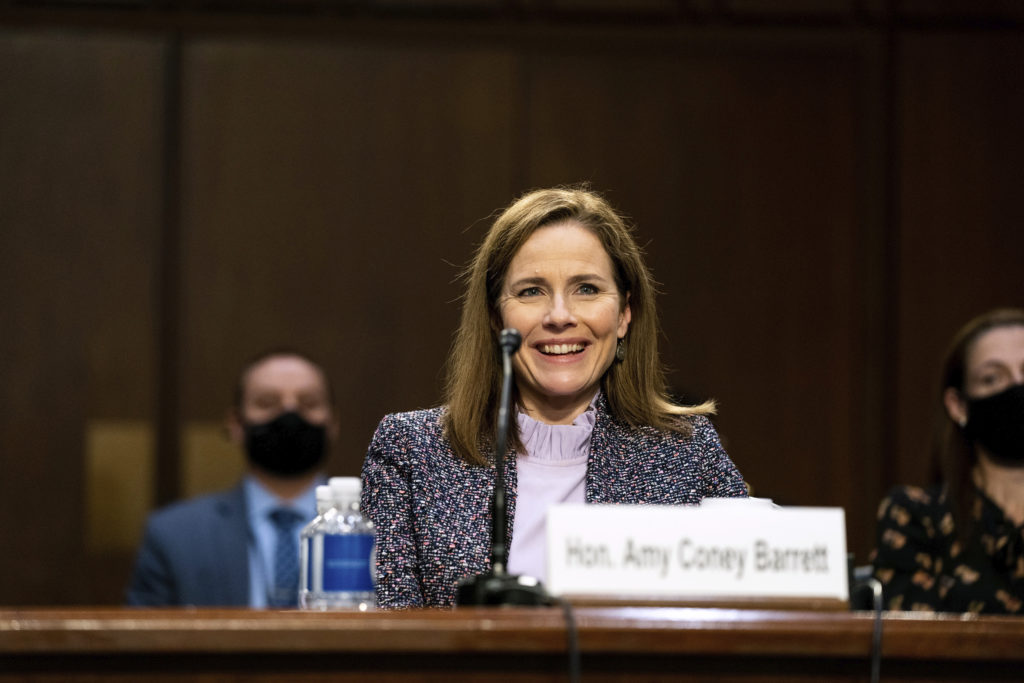
Wasting no time, the Senate is on track to confirm Judge Amy Coney Barrett to the Supreme Court by next Monday, charging toward a rare weekend session as Republicans push past procedural steps to install President Donald Trump’s pick before Election Day. Senate Majority Leader Mitch McConnell said he will begin the process as soon as the Senate Judiciary Committee wraps up its work Thursday. With a 53-47 Republican majority, and just two GOP senators opposed, Trump’s nominee is on a glide path to confirmation that will seal a conservative hold on the court for years to come. McConnell said Monday that Barrett demonstrated over several days of public hearings the “sheer intellectual horsepower that the American people deserve to have on the Supreme Court.” Without the votes to stop Barrett’s ascent, Democrats have few options left. They are searching for two more GOP senators to break ranks and halt confirmation, but that seems unlikely. Never before as a court nominee been voted on so close to a presidential election. Senate Democratic leader Chuck Schumer decried what he called the “farcical” process to “jam” through Trump’s choice, even as the coronavirus outbreak sidelined GOP senators. “The Republican majority is running the most hypocritical, most partisan and least legitimate process in the history of Supreme Court confirmations,” he said during speech as the Senate opened. The Senate Judiciary Committee is set to meet Thursday to vote on recommending Barrett’s nomination to the full Senate. By Friday, procedural votes are expected, continuing over the weekend as Republicans push through the steps for a final vote to confirm Barrett as soon as Monday. The 48-year-old appellate court judge from Indiana delivered few specific answers during several days of public testimony as senators probed her previously outspoken views against abortion, the Affordable Care Act, and other issues before the court. She declined to say whether she would recuse herself from cases involving the election between Trump and Democrat Joe Biden. Trump has said he wants the judge seated in time to hear any potential disputes from the Nov. 3 election. He also has said he’s looking for a judge who would rule against the Obama-era health care law, which is headed to the court in a case justices are expected to hear Nov. 10. If confirmed, Barrett would be Trump’s third justice on the court. She would fill the vacancy from the late Ruth Bader Ginsberg, the liberal icon, locking in a 6-3 conservative majority on the high court. Republished with the permission of the Associated Press.
Kay Ivey: An inspirational pick
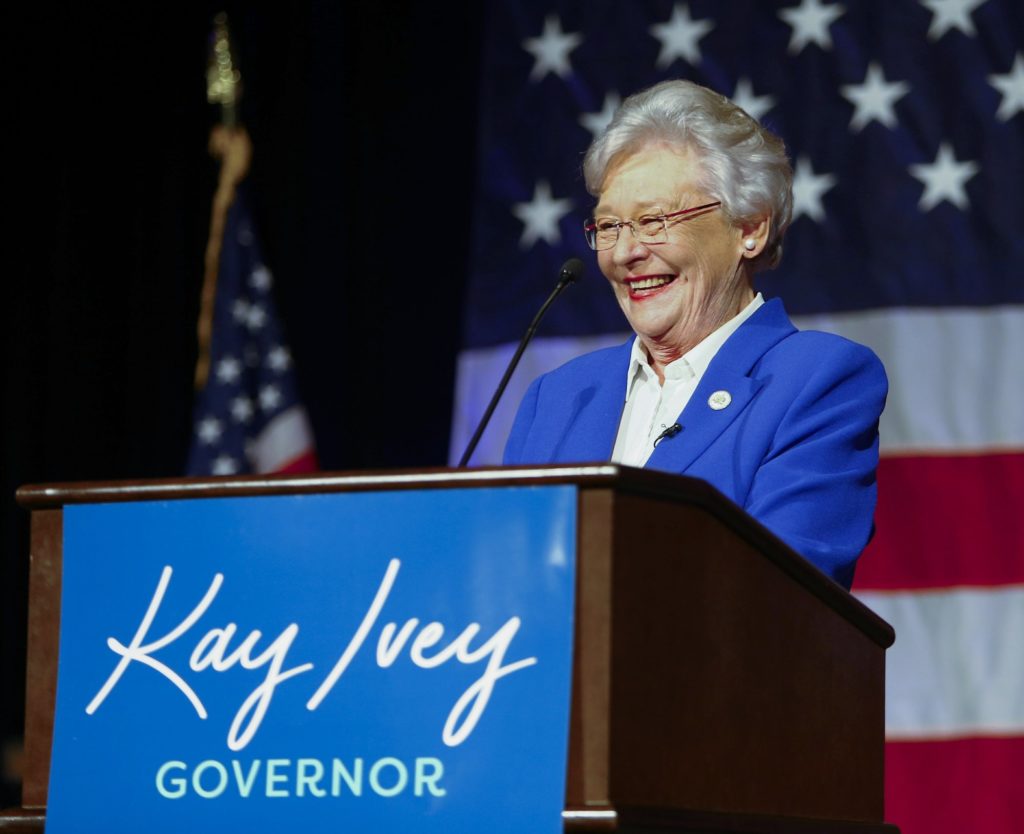
A century ago, the Suffragettes finally succeeded in winning the right to vote for women. They would be thrilled to see the nomination of a woman so uniquely qualified to serve on the U.S. Supreme Court as Judge Amy Coney Barrett, were they alive today. It’s easy to imagine them storming the streets of America and urging that Judge Barrett be confirmed, and by a wide margin. After all, the four female justices nominated before her were confirmed with lopsided votes by the U.S. Senate: 99-0 for Justice Sandra Day O’Connor, 68-31 for Justice Sonia Sotomayor, 63-37 for Justice Elena Kagan and 96-3 for the late Justice Ruth Bader Ginsburg. Sadly, it speaks to the times in which we are living that Judge Barrett’s vote by the Senate will most likely come down to a tight vote, with nearly every Democrat opposing her nomination. As governors who are either the first or second females to be elected in our respective states, we are rightfully proud to see diversity expand among the highest levels of government. Notably, however, our support for Judge Barrett hinges not on her being a female, but rather her superior intellect, unflappable composure and impeccable integrity, all which combine to make her eminently qualified in every way. Regretfully, we know – as do many others – that the climb for women into the upper echelon of American leadership has always been a bit steeper. After all, when was the last time a man’s haircut, the color of his tie or suit, or the number of children in his family were scrutinized as part of the public discourse? It is bittersweet that Judge Barrett followed her father’s advice that she could do anything her male counterparts could do, only better, and yet, sadly, millions of women appear to oppose her nomination simply because she interprets the law as-written, rather than siding with them on every issue. Is this the new standard for qualification? Many progressives, it seems, claim to believe in the power of women, but only for women who think and talk like they do. We applaud President Donald Trump for choosing Judge Amy Coney Barrett for service on our nation’s highest court; she may well be one of the most qualified, extraordinary picks during the past century, and we urge the United States Senate to confirm her nomination in short order. We especially like the direct answers Judge Barrett provided to two of the Senate Judiciary Committee members who questioned her last week. When Sen. Chris Coons, D-Delaware, suggested that Judge Barrett would vote in the same manner as the late Justice Antonin Scalia, a conservative for whom she had clerked earlier in her career, she calmly responded, “I assure you I have my own mind.” And when the Committee’s ranking Democrat, Sen. Dianne Feinstein, D-California, asked her whether she believed that Medicare was unconstitutional, she cited the “Ginsburg Rule,” so named for the late justice she will be following, of providing “no hints, no previews, no forecasts.” Perhaps one of the most powerful witnesses to speak in support of Judge Barrett was her former law student at Notre Dame, Laura Wolk. Ms. Wolk is totally blind, but before pursuing the “impossible dream” of becoming the first blind law clerk at the Supreme Court last year, she was struggling with her classwork as a first-year law student, fearful of failing. Laura recalled, “Judge Barrett leaned forward and looked at me intently. ‘Laura,’ she said, with the same measured conviction that we have seen displayed throughout her entire nomination process, ‘this is no longer your problem. It’s my problem.’” Ms. Wolk went on to say that Judge Barrett helped her see a pathway to success. She said the Judge will “serve this country with distinction not only because of her intellectual prowess, but also because of her compassionate heart and her years of treating others as equals deserving of complete respect.” When Judge Barrett raises her right hand to take the oath to “administer justice without respect to persons” and to “support and defend the Constitution of the United States,” it will be a win-win for every female – young and old alike during the past 100 years – who has dreamed of seeing women advance to the top positions of our government. Moreover, it will be a signal to every little girl – and boy – that the most qualified individual will get the job. Governors Kay Ivey of Alabama, Kristi Noem of South Dakota and Kim Reynolds of Iowa authored this column.
Casey Mattox: Senator Doug Jones is wrong to oppose Amy Coney Barrett
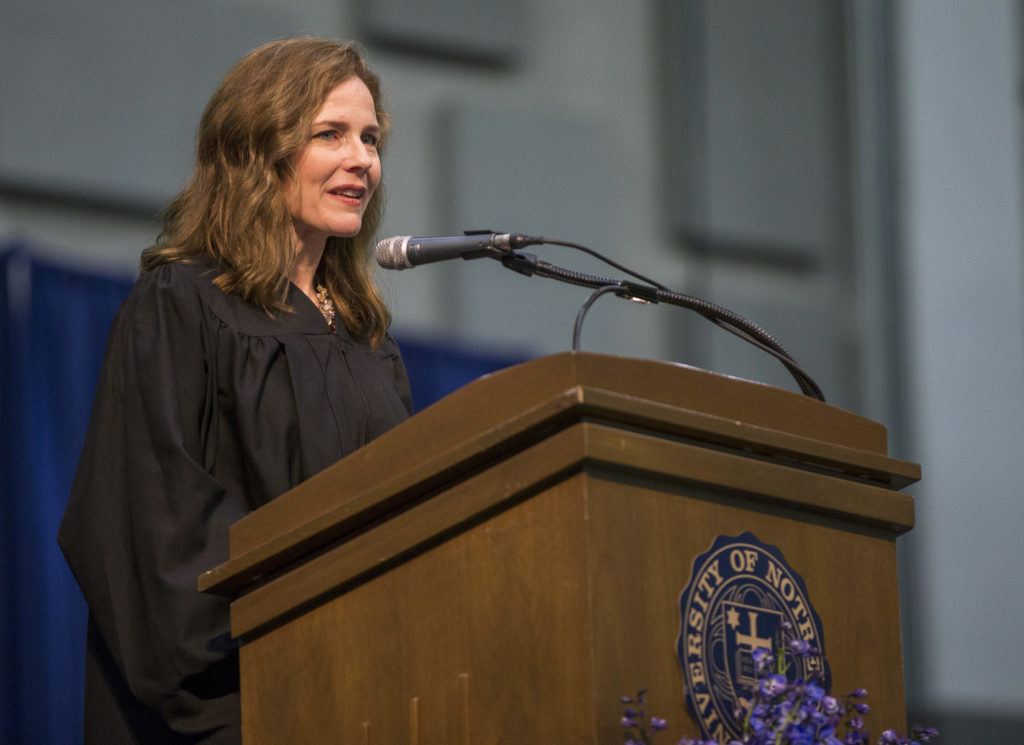
The nation recently mourned the passing of Supreme Court Justice Ruth Bader Ginsburg. And as is his responsibility under the Constitution, the president has nominated a successor: Amy Coney Barrett. Judge Barrett has impressive credentials and has been widely praised by legal scholars, her students, and her colleagues. She clearly warrants confirmation. While Senator Richard Shelby has declared his support, Senator Doug Jones has already said that he will oppose her nomination. That’s a mistake, and Jones should reconsider. The Supreme Court is charged with defending the rights and liberties of the American people. All too often, government is prone to encroach on those rights, and we look to the Court to step in and draw a bright line to protect our freedoms. We know that not every nominee to the federal bench understands that role and is willing and able to fulfill it. So when a Senator refuses to even consider a candidate who is highly qualified to do just that, it’s a serious error. Our Constitution empowers Congress to write the laws that govern our nation. The executive branch is responsible for administering and enforcing those laws. And the judiciary both resolves disputes between private litigants and adjudicates constitutional disputes. While all three have an equal duty to act as a check and balance against the other, the judiciary typically has the final say. To accomplish that, we count on judges to set aside their personal policy goals and instead issue rulings based on the plain text of the law and the Constitution. This preserves the rights of all Americans to settle important policy questions for ourselves through our elected representatives at all levels of government. To paraphrase Associate Justice Neil Gorsuch in his confirmation hearings, a judge who likes every outcome he or she reaches is very likely a bad judge. We’ve already elected lawmakers – including Senator Jones. We don’t need the Supreme Court to do that job. We need the Justices to apply the plain text of the laws to the cases before them. Senator Jones should be among the last people to want the Justices to take over his job. Judge Barrett has shown throughout her career that she understands the role that judges should play in our constitutional system. In her work as a clerk for the late Supreme Court Justice Antonin Scalia, during her time as a law professor at the University of Notre Dame, and in her current role as a judge on the U.S. Court of Appeals for the Seventh Circuit, she has given every indication that she is prepared to fulfill that role on the Supreme Court. Beyond that, she has earned bipartisan praise for her intellect, work, and temperament. In all these respects, she is highly qualified for the position to which she is nominated. The Senate faces an important question. It would be a mistake to fail to confirm an extremely talented and capable judge to serve as associate justice of the highest court in the land. Amy Coney Barrett is such a candidate. Sadly however, Senator Jones has said that he refuses even to consider Ms. Barrett’s qualifications. Instead, he will vote against her if that vote occurs earlier than he would prefer. That’s a mistake, and we can only hope he will reconsider. A “yes” vote is the right one in terms of protecting our liberties and upholding the rule of law. So in the weeks ahead, when the Senate votes on Judge Barrett’s nomination, Senator Jones should join his colleagues in support of her nomination. Casey Mattox is vice president of legal and judicial strategy at Americans for Prosperity. He is a native of Collinsville, and a former clerk of the Alabama Supreme Court.
